Overview
Definition clues are contextual hints embedded within sentences or passages that directly explain the meaning of an unfamiliar or challenging vocabulary word. On the SAT Reading and Writing (RW) section, these clues serve as the foundation for "Words in Context" questions, where students must determine the precise meaning of a word as it's used in a specific passage. Rather than testing rote memorization of vocabulary lists, the SAT assesses whether students can leverage surrounding text to decode word meanings—a skill that mirrors authentic reading comprehension.
Understanding how to identify and utilize sat definition clues is essential because approximately 15-20% of the Reading and Writing section consists of vocabulary-in-context questions. These questions appear consistently across both literary and informational passages, making definition clue recognition a high-yield skill that directly impacts overall scores. Students who master this technique can confidently approach unfamiliar words without panic, knowing that the passage itself contains the information needed to select the correct answer.
Definition clues connect to broader rw skills including inference-making, close reading, and understanding author's purpose. When students learn to spot explicit definitions, restatements, examples, and contrast clues, they simultaneously strengthen their ability to analyze sentence structure, recognize transitional phrases, and understand how authors deliberately scaffold meaning for readers. This topic serves as a gateway skill that enhances performance across all Reading and Writing question types, from main idea questions to rhetorical analysis.
Learning Objectives
By the end of this study guide, students will be able to:
- [ ] Identify key features of Definition clues
- [ ] Explain how Definition clues appears on the SAT
- [ ] Apply Definition clues to answer SAT-style questions
- [ ] Distinguish between four major types of definition clues (direct definition, restatement, example, contrast)
- [ ] Recognize signal words and punctuation marks that introduce definition clues
- [ ] Evaluate answer choices by matching them against textual evidence from definition clues
Prerequisites
Students should have foundational knowledge in the following areas:
- Basic sentence structure: Understanding subjects, predicates, and clauses helps identify where definition clues are positioned relative to target words
- Common punctuation usage: Recognizing how commas, dashes, parentheses, and colons function enables students to spot definition clues set off by punctuation
- Fundamental reading comprehension: The ability to extract main ideas from sentences provides the baseline skill for identifying contextual meaning
- Synonym and antonym relationships: Understanding word relationships helps students recognize restatement and contrast clues
Why This Topic Matters
Real-World Significance
Definition clue recognition extends far beyond standardized testing. In academic settings, students encounter specialized terminology in textbooks across disciplines—from scientific nomenclature to historical concepts—where authors embed definitions to support reader comprehension. Professional reading, whether legal documents, technical manuals, or research articles, frequently employs this same technique. Mastering definition clues develops the metacognitive skill of strategic reading: knowing when to slow down, identify helpful context, and construct meaning from available information rather than immediately consulting external resources.
Exam Statistics and Frequency
The SAT Reading and Writing section contains approximately 54 questions total, with 13-15 questions dedicated to "Words in Context." Of these vocabulary questions, roughly 60-70% can be answered using definition clues found directly in the passage. This translates to 8-10 questions per test where definition clue mastery directly determines correct answers. These questions appear across all four passage types (literature, history/social studies, science, and humanities) and at varying difficulty levels, making this skill universally applicable throughout the exam.
Common Exam Appearances
Definition clues appear in SAT passages through several predictable patterns:
- Appositive phrases that rename or define a preceding term
- Relative clauses beginning with "which," "that," or "who" that elaborate on word meanings
- Explanatory sentences that follow the introduction of technical or specialized vocabulary
- Comparative structures that clarify meaning through similarity or contrast
- Parenthetical insertions that provide quick definitions or clarifications
Core Concepts
What Are Definition Clues?
Definition clues are textual signals that reveal the meaning of a word through context rather than requiring prior vocabulary knowledge. These clues function as embedded mini-definitions that authors intentionally include to ensure reader comprehension. On the SAT, recognizing these clues transforms vocabulary questions from memory tests into reading comprehension exercises where the answer exists within the passage itself.
The SAT specifically designs passages to include sufficient context for determining word meanings. This design philosophy reflects the exam's focus on college-readiness skills: successful college students must navigate complex texts containing unfamiliar terminology by using contextual analysis rather than constantly consulting dictionaries.
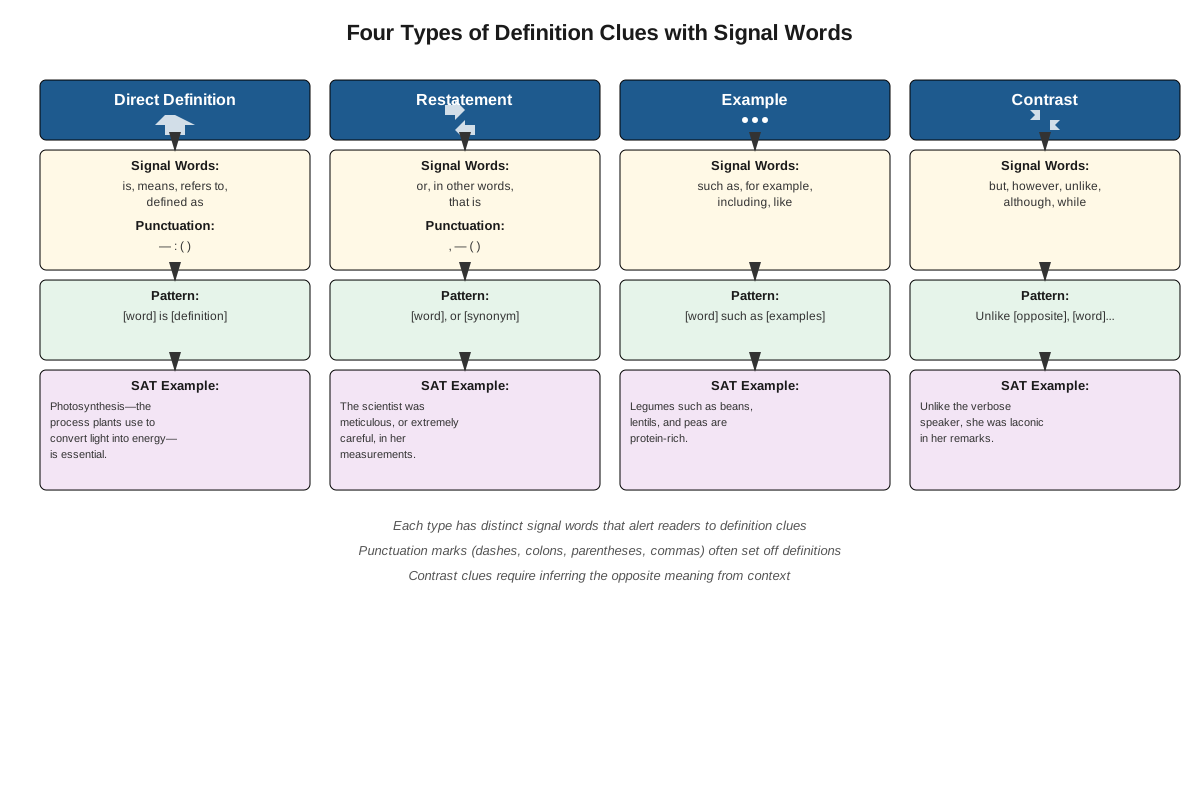
Four Major Types of Definition Clues
1. Direct Definition Clues
Direct definition clues provide explicit meanings through formal definitions or explanations. These are the most straightforward type and often use specific signal words.
Signal words and phrases include:
- "means," "is defined as," "refers to," "is known as"
- "in other words," "that is," "specifically"
- "the term," "called," "or"
Example: "The scientist studied bioluminescence, which is the production and emission of light by living organisms."
Here, "which is" signals a direct definition of bioluminescence.
2. Restatement Clues
Restatement clues present the same idea using different, often simpler words. The author essentially says the same thing twice using synonymous language.
Signal words and phrases include:
- "also known as," "in simpler terms," "put another way"
- Commas, dashes, or parentheses setting off equivalent phrases
Example: "The politician's mendacious statements—his dishonest and false claims—damaged his credibility."
The phrase after the dash restates "mendacious" using more familiar synonyms.
3. Example Clues
Example clues illustrate word meaning through specific instances or scenarios that demonstrate the concept in action.
Signal words and phrases include:
- "such as," "for example," "for instance," "including"
- "like," "especially," "particularly"
Example: "The garden contained many indigenous plants, such as native wildflowers, grasses, and shrubs that had grown in the region for centuries."
The examples clarify that "indigenous" means native or original to a place.
4. Contrast Clues
Contrast clues reveal meaning by presenting an opposite or contrasting idea, allowing readers to infer meaning through antonyms or opposing concepts.
Signal words and phrases include:
- "but," "however," "although," "while," "whereas"
- "unlike," "in contrast to," "on the other hand," "rather than"
- "instead," "yet," "nevertheless"
Example: "Unlike her gregarious sister who loved parties and crowds, Maria was quite introverted."
The contrast with "gregarious" (described as loving parties and crowds) helps define "introverted" as the opposite.
Punctuation as Definition Clue Markers
Punctuation marks frequently signal definition clues on the SAT:
| Punctuation | Function | Example |
|---|---|---|
| Commas | Set off appositives or restatements | "The aurora, a natural light display, appeared overhead." |
| Dashes | Emphasize definitions or explanations | "She exhibited remarkable tenacity—persistent determination—throughout the challenge." |
| Parentheses | Insert supplementary definitions | "The patient showed signs of hypoxia (oxygen deficiency) during the examination." |
| Colons | Introduce explanations or lists of examples | "The ecosystem demonstrated resilience: the ability to recover from disturbance." |
Syntactic Structures That Signal Definition Clues
Certain sentence structures reliably introduce definition clues:
- Appositive constructions: A noun phrase that renames another noun
- "My neighbor, an ornithologist, studies bird behavior."
- Relative clauses: Clauses beginning with relative pronouns that provide additional information
- "She practiced calligraphy, which is the art of decorative handwriting."
- "To be" verb constructions: Linking verbs that connect subjects to definitions
- "Photosynthesis is the process by which plants convert light into energy."
- Prepositional phrases of definition: Phrases that clarify meaning
- "The concept of entropy, or disorder in a system, is central to thermodynamics."
Concept Relationships
Definition clues exist within a hierarchical relationship structure:
Broad Reading Comprehension → Context Clue Recognition → Definition Clues → Four Specific Types (Direct, Restatement, Example, Contrast)
Each type of definition clue connects to specific linguistic features:
- Direct Definition Clues rely on explicit signal words and formal explanatory language
- Restatement Clues depend on synonym recognition and parallel structure understanding
- Example Clues require the ability to generalize from specific instances to broader concepts
- Contrast Clues necessitate antonym recognition and understanding of oppositional relationships
Definition clues also connect to prerequisite knowledge:
- Sentence structure understanding enables identification of where clues appear relative to target words
- Punctuation knowledge helps recognize when definitions are set off from main clauses
- Vocabulary relationships (synonyms/antonyms) support interpretation of restatement and contrast clues
Furthermore, definition clue mastery supports progression to more advanced rw skills:
- Inference questions: Understanding explicit definitions builds capacity for inferring implicit meanings
- Tone and style analysis: Recognizing how authors scaffold meaning reveals rhetorical choices
- Synthesis across texts: Definition clue skills transfer to comparing how different authors define similar concepts
High-Yield Facts
⭐ Definition clues appear in 60-70% of SAT Words in Context questions, making them the most reliable strategy for vocabulary questions.
⭐ Punctuation marks (commas, dashes, parentheses, colons) frequently signal definition clues by setting off explanatory information from the main sentence.
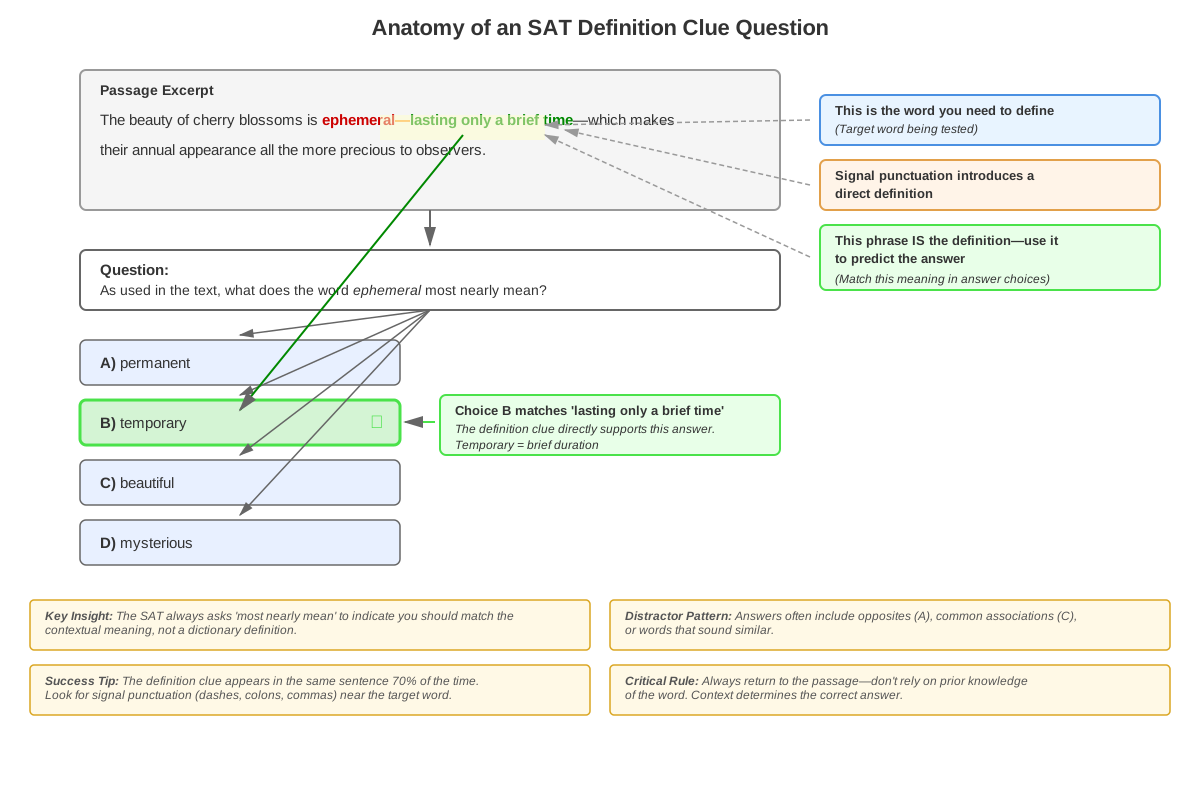
⭐ The correct answer to a definition clue question will match the specific context of the passage, not just any dictionary definition of the word.
⭐ Signal words like "which is," "or," "such as," and "unlike" are high-probability indicators that a definition clue follows.
⭐ Contrast clues require identifying the opposite meaning and then selecting the antonym of that opposite.
- Definition clues can appear before, after, or surrounding the target vocabulary word in a sentence.
- Multiple definition clues may work together in a single sentence to clarify a word's meaning.
- The SAT intentionally uses words with multiple meanings, requiring students to match the contextual definition rather than the most common definition.
- Example clues often appear in series (multiple examples connected by commas) to illustrate a concept comprehensively.
- Restatement clues frequently use simpler, more familiar vocabulary to explain more sophisticated terms.
- Authors use definition clues to make specialized or technical content accessible to general audiences.
- The distance between a target word and its definition clue rarely exceeds one sentence on the SAT.
Quick check — test yourself on Definition clues so far.
Try Flashcards →Common Misconceptions
Misconception: Definition clues always appear immediately after the target word.
Correction: Definition clues can appear before, after, or even in a separate nearby sentence. Students must scan the surrounding context, not just the words immediately following the target vocabulary.
Misconception: The correct answer is always the most common dictionary definition of the word.
Correction: The SAT tests words in specific contexts where less common meanings may apply. The correct answer must match how the word functions in the particular passage, which is revealed by definition clues in that context.
Misconception: If a word seems familiar, definition clues aren't necessary.
Correction: Many SAT vocabulary words have multiple meanings, and familiar words are often used in unfamiliar ways. Always verify meaning against contextual clues rather than assuming the most common definition applies.
Misconception: Contrast clues directly state the meaning of the target word.
Correction: Contrast clues provide the opposite meaning, requiring an additional inference step. Students must identify what's being contrasted, determine its meaning, and then select the antonym.
Misconception: Only one type of definition clue appears per question.
Correction: SAT passages often layer multiple types of definition clues (e.g., both examples and restatement) to support word meaning. Effective readers synthesize information from all available clues.
Misconception: Definition clues are only useful for difficult, unfamiliar words.
Correction: Even when students know a word's general meaning, definition clues help identify the precise shade of meaning the author intends, which is essential for selecting the best answer among similar choices.
Worked Examples
Example 1: Direct Definition and Restatement Clues
Passage excerpt:
"The archaeologist's discovery of the ancient artifact was fortuitous—a lucky accident that occurred while she was actually searching for something entirely different. This serendipitous find, or fortunate discovery made by chance, would reshape understanding of the civilization."
Question:
As used in the passage, "fortuitous" most nearly means:
A) planned
B) accidental
C) unfortunate
D) deliberate
Solution Process:
Step 1: Identify the target word and locate surrounding context.
- Target word: "fortuitous"
- Context: The sentence containing the word and the following sentence
Step 2: Look for definition clue signals.
- The dash (—) after "fortuitous" signals an explanation
- The phrase "or" in the next sentence signals a restatement
Step 3: Extract the definition clues.
- Direct definition clue: "a lucky accident"
- Restatement clue: "serendipitous find, or fortunate discovery made by chance"
Step 4: Synthesize the clues.
- Both clues emphasize: lucky, accident, chance, fortunate
- The word relates to something unplanned but positive
Step 5: Evaluate answer choices against the clues.
- A) planned—contradicts "accident" and "by chance"
- B) accidental—matches "accident" and "by chance" ✓
- C) unfortunate—contradicts "lucky" and "fortunate"
- D) deliberate—contradicts "accident" and "by chance"
Answer: B
Connection to learning objectives: This example demonstrates identifying direct definition clues (the dash and explanation) and restatement clues (the "or" phrase), then applying these clues to eliminate incorrect answers and select the contextually appropriate meaning.
Example 2: Example and Contrast Clues
Passage excerpt:
"While most species in the ecosystem were specialists, adapted to exploit narrow ecological niches such as specific food sources or particular microhabitats, the raccoon proved to be a generalist. Unlike its more fastidious neighbors, it could thrive in diverse environments and consume varied diets."
Question:
As used in the passage, "generalist" most nearly means:
A) expert
B) specialist
C) adaptable organism
D) selective creature
Solution Process:
Step 1: Identify the target word and context.
- Target word: "generalist"
- Context: Sentence containing the word and the following sentence
Step 2: Identify definition clue types.
- Contrast clue: "While most species...were specialists" contrasts with "the raccoon proved to be a generalist"
- Example clue: "thrive in diverse environments and consume varied diets" provides examples of generalist behavior
- Contrast clue: "Unlike its more fastidious neighbors" provides additional contrast
Step 3: Analyze the contrast structure.
- Specialists are described as: "adapted to exploit narrow ecological niches," "specific food sources," "particular microhabitats"
- Generalists (by contrast) must be: opposite of narrow/specific/particular = broad/diverse/varied
Step 4: Incorporate the example clues.
- "Diverse environments" and "varied diets" confirm the generalist can handle multiple conditions
- This supports the interpretation of flexibility and adaptability
Step 5: Evaluate answer choices.
- A) expert—doesn't relate to the diversity/variety theme
- B) specialist—this is explicitly contrasted with generalist
- C) adaptable organism—matches "diverse environments," "varied diets," and the contrast with narrow specialists ✓
- D) selective creature—contradicts the "varied" and "diverse" descriptors
Answer: C
Connection to learning objectives: This example shows how contrast clues (identifying what something is NOT) combine with example clues (specific instances of behavior) to reveal meaning. It demonstrates the application of multiple definition clue types simultaneously, a common SAT pattern.
Exam Strategy
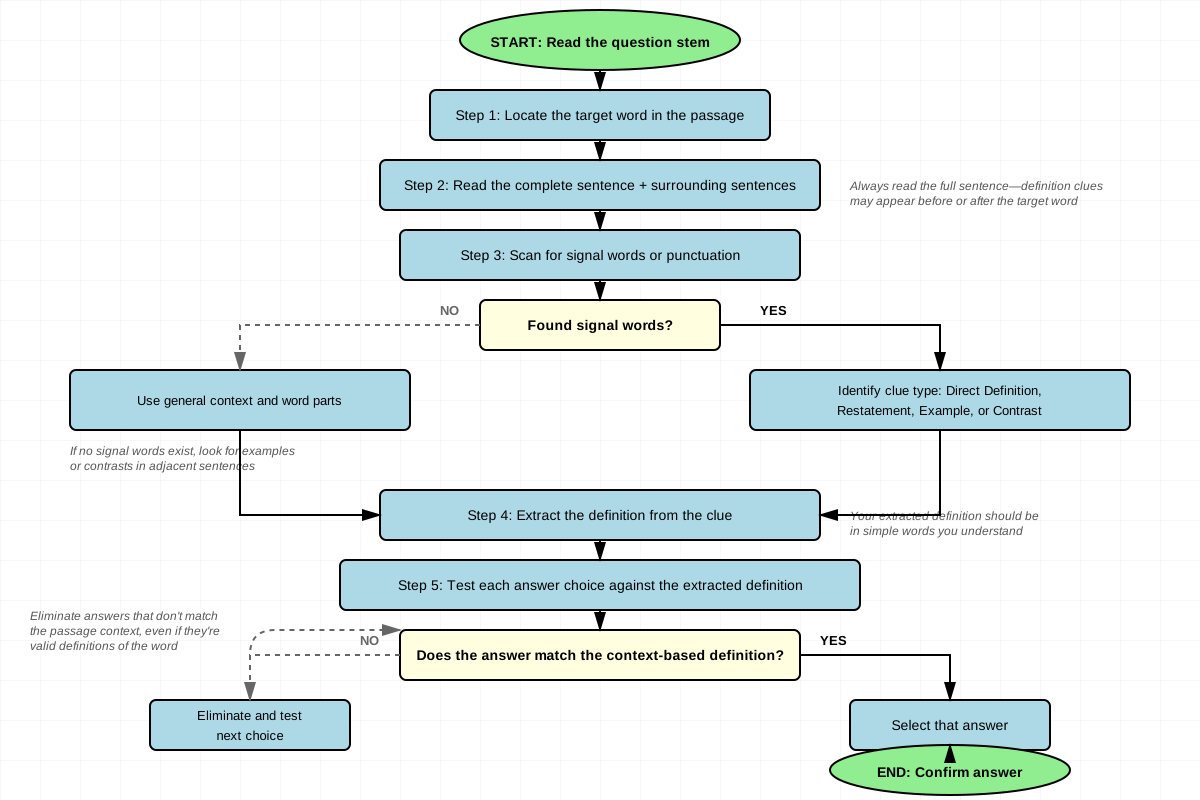
Systematic Approach to Definition Clue Questions
Step 1: Read the question first to identify the target word before reading the passage excerpt. This focuses attention on relevant context.
Step 2: Read the full sentence containing the target word, plus one sentence before and after. Definition clues typically appear within this range.
Step 3: Mark definition clue signals as you read:
- Circle punctuation marks (commas, dashes, parentheses, colons)
- Underline signal words ("which is," "such as," "unlike," "or")
- Bracket explanatory phrases
Step 4: Classify the clue type (direct definition, restatement, example, or contrast) to guide your interpretation strategy.
Step 5: Paraphrase the clue in your own words before looking at answer choices. This prevents answer choices from influencing your interpretation.
Step 6: Eliminate answers that contradict the definition clues, then select the choice that best matches your paraphrase.
Trigger Words and Phrases to Watch For
High-yield signal words for immediate attention: - Definition introducers: "means," "refers to," "is defined as," "is known as" - Restatement markers: "or," "in other words," "that is to say" - Example indicators: "such as," "for example," "including," "like" - Contrast signals: "unlike," "however," "while," "whereas," "but"
Process of Elimination Tips
Eliminate answers that:
- Contradict explicit clues: If the passage says "unlike aggressive," eliminate any answer suggesting aggression
- Use the wrong connotation: If clues suggest something positive, eliminate negative-connotation answers
- Are too broad or narrow: Match the specificity level of the definition clues
- Represent common meanings that don't fit context: The SAT often tests secondary meanings; eliminate the "obvious" answer if it contradicts contextual clues
Keep answers that:
- Align with multiple clues: The best answer typically matches several pieces of contextual evidence
- Match the tone and register: Academic passages use academic-level synonyms; informal passages use conversational language
- Fit grammatically: The answer must work as the same part of speech as the target word
Time Allocation Advice
- Spend 45-60 seconds per Words in Context question
- Allocate 20 seconds to reading and identifying clues, 25 seconds to evaluating answers, 15 seconds to verify
- If definition clues aren't immediately apparent within 30 seconds, mark the question and return after completing easier questions
- Don't waste time trying to recall dictionary definitions; the passage contains everything needed
Memory Techniques
DECO Mnemonic for Definition Clue Types
Direct definition (explicit explanations)
Example clues (specific instances)
Contrast clues (opposite meanings)
Or-statements (restatements and synonyms)
Remember: "DECO-rate your understanding with context clues"
CUPS Acronym for Punctuation Signals
Commas
Underscores (dashes)
Parentheses
Semi-colons and colons
These punctuation marks "hold the CUPS" that contain definition clues.
Visualization Strategy: The Definition Clue Spotlight
Imagine a spotlight shining on the target word, with definition clues as surrounding lights that illuminate its meaning from different angles:
- Above: Direct definitions that shine down clearly
- Sides: Examples that illuminate from multiple perspectives
- Below: Restatements that reflect the same light back
- Behind: Contrasts that create shadows showing what the word is NOT
Signal Word Categories Mnemonic
"REDS" for Restatement: "Restating Equals Different Synonyms"
- or, in other words, that is, also known as
"EXCEL" for Examples: "Examples Clarify Exact Literal meanings"
- such as, for example, including, like
"CUBS" for Contrast: "Contrasts Uncover By Showing opposites"
- unlike, but, however, whereas
Summary
Definition clues are contextual signals embedded in SAT Reading and Writing passages that reveal vocabulary word meanings without requiring prior memorization. These clues appear in four primary forms: direct definitions (explicit explanations using signal words like "means" or "refers to"), restatements (synonymous rephrasing often set off by punctuation), examples (specific instances that illustrate concepts), and contrast clues (opposite meanings that reveal definition through antonyms). Mastering definition clue recognition transforms vocabulary questions from memory tests into reading comprehension exercises, as the passage itself contains sufficient information to determine correct answers. Students must systematically scan surrounding sentences for punctuation marks (commas, dashes, parentheses, colons) and signal words that introduce these clues, then match answer choices against textual evidence rather than relying on dictionary definitions. This skill accounts for 60-70% of Words in Context questions, making it the highest-yield strategy for the vocabulary component of the SAT. Success requires reading beyond the immediate sentence, synthesizing multiple clue types, and selecting answers that match the specific contextual usage rather than the most common meaning of a word.
Key Takeaways
- Definition clues appear in 8-10 questions per SAT, making them essential for achieving high Reading and Writing scores
- Four clue types (direct, restatement, example, contrast) can be systematically identified using signal words and punctuation markers
- Punctuation marks (commas, dashes, parentheses, colons) are high-probability indicators that definition clues follow
- The correct answer matches the passage's specific context, not necessarily the word's most common dictionary definition
- Contrast clues require an extra inference step: identify the opposite, then select its antonym
- Multiple definition clues often work together in a single passage to clarify meaning from different angles
- Systematic scanning of surrounding sentences (one before and one after the target word) captures most definition clues on the SAT
Related Topics
Context Clues Beyond Definitions: While this guide focuses on definition clues, the SAT also tests inference-based context clues where meaning must be constructed from broader passage themes rather than explicit signals. Mastering definition clues provides the foundation for these more complex contextual analysis questions.
Tone and Connotation in Vocabulary: Understanding how word choice creates tone requires recognizing not just denotative meanings (revealed by definition clues) but also connotative associations. This advanced skill builds directly on definition clue mastery.
Rhetorical Analysis of Word Choice: Authors strategically choose when to provide definition clues and when to expect reader knowledge. Analyzing these choices connects vocabulary skills to understanding author's purpose and audience awareness.
Transition Words and Logical Relationships: Many definition clue signal words (like "however," "such as," "unlike") also function as transition words that reveal logical relationships between ideas, making this a natural progression topic.
Practice CTA
Now that you understand the systematic approach to identifying and applying definition clues, it's time to reinforce these skills through active practice. Complete the practice questions to test your ability to recognize different clue types, identify signal words, and select contextually appropriate answers. Use the flashcards to memorize high-yield signal words and punctuation patterns that appear repeatedly on the SAT. Remember: definition clue mastery isn't about memorizing vocabulary lists—it's about developing the strategic reading skills that unlock meaning from any passage. Each practice question you complete strengthens the neural pathways that make definition clue recognition automatic on test day. You've got this!
Sign up free to keep reading
Create a free AnvayaPrep account to finish this SAT guide on Definition clues — plus flashcards and practice questions.