Overview
Negative connotation is a critical concept in the SAT Reading and Writing section that tests a student's ability to understand the emotional and evaluative undertones of words beyond their literal dictionary definitions. While two words may share similar denotative meanings—their explicit, dictionary definitions—they often carry vastly different connotative meanings that reveal an author's attitude, bias, or perspective. Understanding negative connotation means recognizing when a word choice suggests disapproval, criticism, or unfavorable judgment.
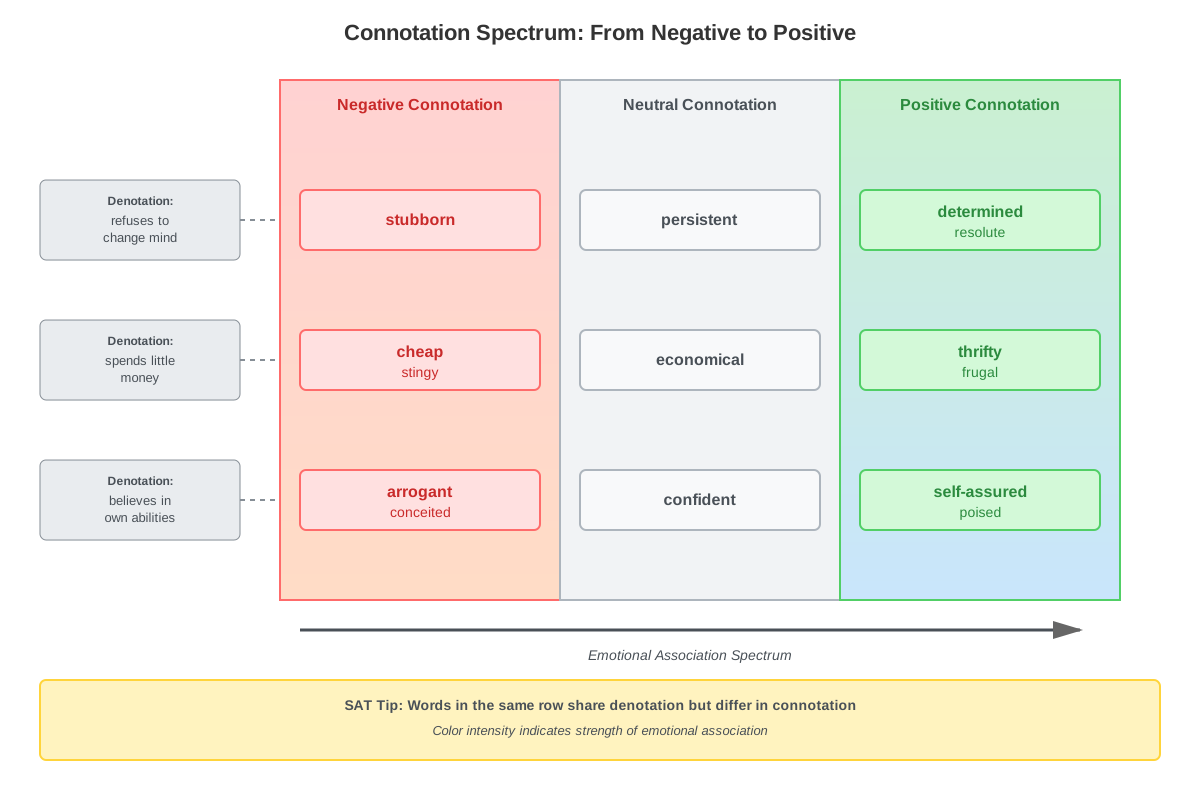
On the SAT, questions involving sat negative connotation typically appear in the Words in Context domain, where students must select the word that best fits the tone and meaning of a passage. These questions assess whether students can distinguish between synonyms based on their emotional weight and implied judgment. For instance, the words "stubborn," "resolute," and "determined" all describe someone who refuses to change their mind, but "stubborn" carries a negative connotation suggesting unreasonable inflexibility, while "resolute" and "determined" convey positive qualities of strength and commitment. The ability to detect these subtle differences is essential for achieving a high score in the rw (Reading and Writing) section.
Mastering negative connotation connects directly to broader reading comprehension skills, including author's tone, rhetorical purpose, and argument analysis. When students understand how word choice shapes meaning and reveals perspective, they become more sophisticated readers capable of analyzing complex texts critically. This skill extends beyond vocabulary questions to inform answers about main ideas, author's purpose, and textual evidence, making it one of the most high-yield topics for SAT preparation.
Learning Objectives
- [ ] Identify key features of negative connotation
- [ ] Explain how negative connotation appears on the SAT
- [ ] Apply negative connotation to answer SAT-style questions
- [ ] Distinguish between words with similar denotations but different connotations
- [ ] Analyze how negative connotation reveals author's attitude and purpose
- [ ] Evaluate the appropriateness of word choices based on context and tone
Prerequisites
- Basic vocabulary knowledge: Understanding common SAT-level words provides the foundation for recognizing subtle differences in connotation
- Denotation vs. connotation distinction: Knowing that words have both literal meanings (denotation) and emotional associations (connotation) is essential for this topic
- Context clues: The ability to use surrounding text to determine meaning helps identify whether a connotation is positive, negative, or neutral
- Reading comprehension fundamentals: Understanding main ideas and author's purpose provides the framework for analyzing word choice
Why This Topic Matters
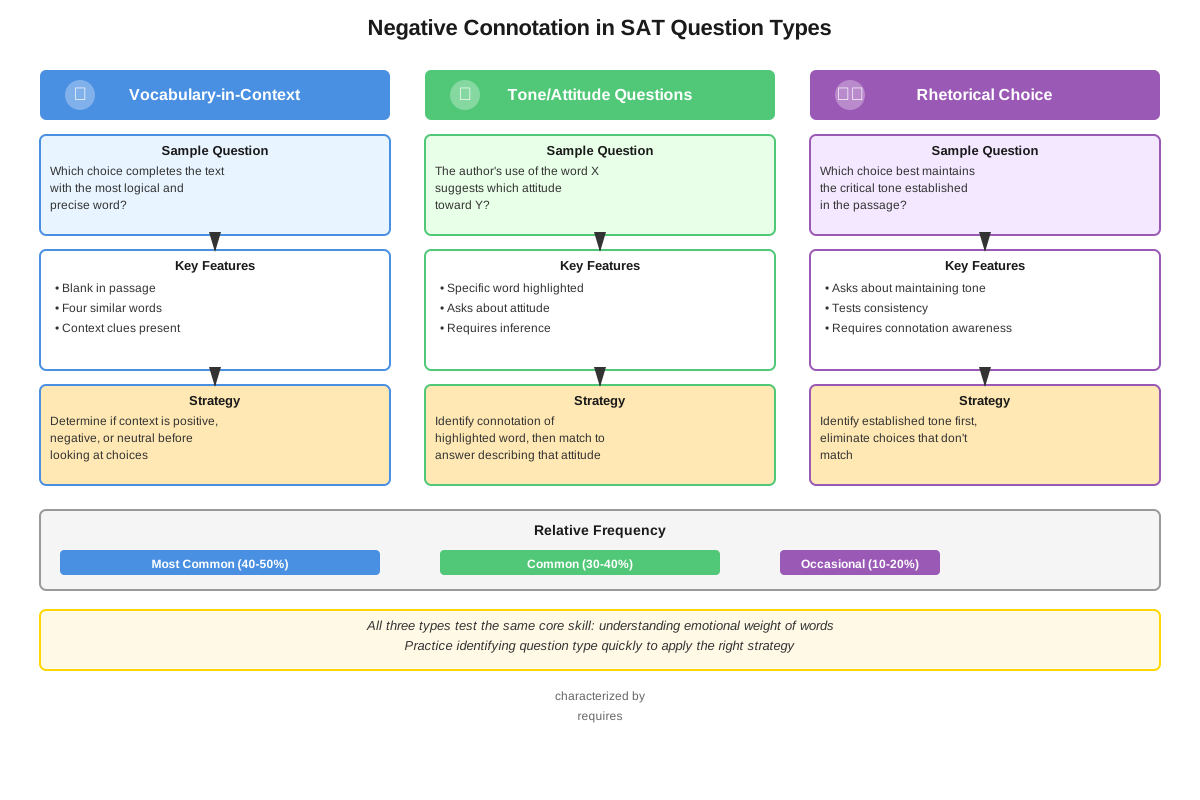
Negative connotation questions appear with high frequency on the SAT, typically comprising 2-4 questions per test in the Reading and Writing section. These questions are considered "high-yield" because they test multiple skills simultaneously: vocabulary knowledge, contextual understanding, and analytical reasoning. Students who master this concept gain a significant advantage because connotation questions often separate mid-range scorers from top performers.
In real-world applications, understanding negative connotation is essential for critical reading of news articles, political speeches, advertisements, and academic texts. Writers carefully select words to influence readers' perceptions, and recognizing these choices enables readers to identify bias, evaluate arguments, and resist manipulation. For example, describing a politician as "calculating" versus "strategic" conveys the same basic idea but creates vastly different impressions.
On the SAT, negative connotation most commonly appears in three question formats: vocabulary-in-context questions where students select the best word to complete a sentence; tone and style questions where students identify the author's attitude; and revision questions where students must choose language that maintains consistency with the passage's overall tone. Passages may come from literature, social sciences, natural sciences, or humanities, but the underlying principle remains constant: word choice matters, and connotation shapes meaning.
Core Concepts
Understanding Connotation vs. Denotation
Denotation refers to the literal, dictionary definition of a word—its explicit, objective meaning. Connotation, by contrast, encompasses the emotional associations, cultural implications, and subjective feelings that a word evokes. While denotation answers "What does this word mean?", connotation addresses "How does this word make us feel?" and "What does this word suggest beyond its basic definition?"
Consider the words "cheap," "inexpensive," and "economical." All three denote low cost, but their connotations differ dramatically. "Cheap" carries negative connotation, suggesting poor quality or stinginess. "Inexpensive" is relatively neutral, simply indicating low price. "Economical" has positive connotation, implying wise spending and good value. The SAT frequently tests this exact type of distinction.
The Spectrum of Connotation
Connotation exists on a spectrum from strongly negative to strongly positive, with neutral in the middle. Understanding this spectrum helps students make precise word choices:
| Negative Connotation | Neutral | Positive Connotation |
|---|---|---|
| Stubborn | Firm | Resolute |
| Childish | Youthful | Youthful |
| Pushy | Assertive | Confident |
| Scrawny | Thin | Slender |
| Stench | Smell | Aroma |
| Mob | Crowd | Gathering |
| Scheme | Plan | Strategy |
Each row demonstrates how synonyms or near-synonyms can carry different emotional weight. On the SAT, students must identify which word from this spectrum best fits the passage's tone and context.
Identifying Negative Connotation
Several linguistic features signal negative connotation:
- Harsh or unpleasant sounds: Words with hard consonants or abrupt syllables often carry negative associations (e.g., "gawk" vs. "observe")
- Association with undesirable qualities: Words linked to negative traits, behaviors, or outcomes (e.g., "manipulative" vs. "influential")
- Diminutive or belittling implications: Words that minimize or trivialize (e.g., "dabble" vs. "practice")
- Suggestion of excess or deficiency: Words indicating too much or too little of a quality (e.g., "obsessive" vs. "dedicated")
Context as the Determining Factor
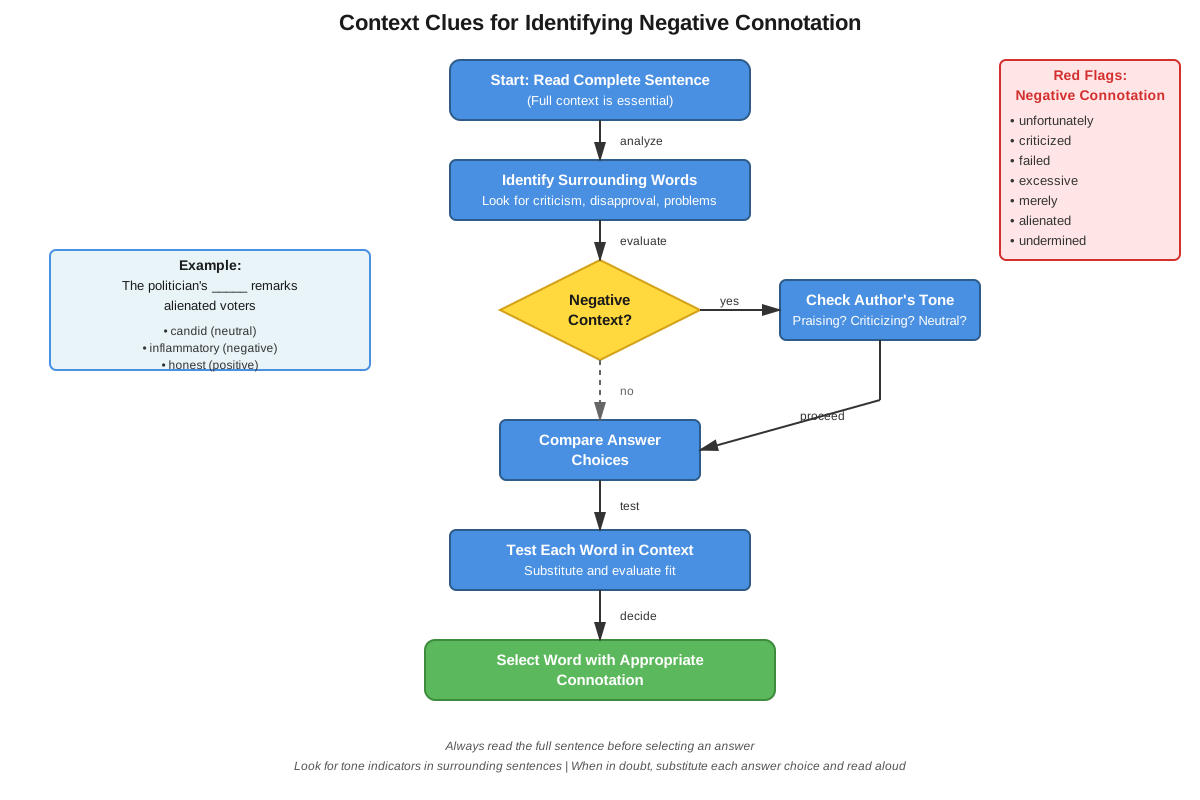
The surrounding text provides crucial clues about whether a word's connotation fits appropriately. Students should examine:
- Tone indicators: Adjectives, adverbs, and other descriptive language that establish the passage's overall attitude
- Author's purpose: Whether the author is praising, criticizing, informing, or persuading
- Subject matter: The topic being discussed and the typical language associated with it
- Parallel structures: How similar ideas are expressed elsewhere in the passage
For example, in a passage criticizing a politician's behavior, words like "calculated," "manipulative," and "opportunistic" would fit the negative tone, while "strategic," "influential," and "ambitious" would create tonal inconsistency.
Common Categories of Negative Connotation
Understanding typical categories helps students recognize patterns:
Describing People's Behavior:
- Negative: arrogant, conceited, smug, pompous (vs. Positive: confident, self-assured)
- Negative: lazy, idle, lethargic (vs. Positive: relaxed, leisurely)
- Negative: nosy, prying, intrusive (vs. Positive: curious, inquisitive)
Describing Appearance:
- Negative: gaudy, garish, flashy (vs. Positive: vibrant, colorful, striking)
- Negative: decrepit, dilapidated, ramshackle (vs. Neutral: old, aged)
Describing Actions:
- Negative: meddle, interfere, tamper (vs. Positive: assist, help, contribute)
- Negative: squander, waste, fritter away (vs. Neutral: spend, use)
Describing Communication:
- Negative: babble, prattle, ramble (vs. Neutral: talk, speak)
- Negative: propaganda, rhetoric (vs. Neutral: information, persuasion)
Concept Relationships
Negative connotation connects to multiple aspects of SAT Reading and Writing:
Within Words in Context: Negative connotation → determines word choice → affects precision and style → influences overall meaning. Understanding connotation is the foundation for selecting contextually appropriate vocabulary.
Connection to Tone and Style: Author's attitude → expressed through word choice → revealed by connotation → creates overall tone. Recognizing negative connotation helps students identify whether an author is critical, skeptical, disapproving, or hostile.
Relationship to Rhetorical Purpose: Author's goal → shapes language selection → includes connotative choices → achieves intended effect. Writers use negative connotation deliberately to persuade, criticize, or reveal bias.
Link to Evidence and Support: Claims and arguments → supported by language → strengthened or weakened by connotation → affects persuasiveness. Analyzing connotation helps students evaluate the strength and bias of textual evidence.
The progression of mastery follows this path: Basic vocabulary knowledge → Understanding denotation vs. connotation → Recognizing positive/negative/neutral distinctions → Applying connotation analysis to context → Evaluating appropriateness of word choices → Mastering SAT question types.
High-Yield Facts
⭐ Negative connotation refers to the unfavorable emotional associations and implied criticism that words carry beyond their literal definitions.
⭐ Words with similar denotations can have vastly different connotations, making context essential for determining the appropriate word choice.
⭐ On the SAT, connotation questions test whether students can select words that match the passage's tone and the author's attitude.
⭐ Negative connotation often reveals author bias, criticism, or disapproval toward the subject being discussed.
⭐ The same word can have different connotations in different contexts, though some words carry consistently negative associations.
- Words describing excess (obsessive, fanatical) or deficiency (meager, paltry) typically carry negative connotation.
- Diminutive forms and belittling language (dabble, tinker, fiddle) often suggest negative judgment about the seriousness or importance of an activity.
- Synonyms for "said" vary widely in connotation: "claimed" and "alleged" suggest doubt, while "stated" and "explained" are more neutral.
- Physical appearance words like "scrawny," "lanky," and "gaunt" carry more negative connotation than "thin" or "slender."
- Words associated with animals when applied to humans usually carry negative connotation (wolfish, mousy, sheepish).
Quick check — test yourself on Negative connotation so far.
Try Flashcards →Common Misconceptions
Misconception: All synonyms are interchangeable in any context. → Correction: Synonyms share similar denotations but differ in connotation, formality, and appropriateness. The SAT specifically tests the ability to distinguish between synonyms based on these subtle differences.
Misconception: Negative connotation means the word is always inappropriate or wrong to use. → Correction: Negative connotation is appropriate when the context calls for criticism, disapproval, or negative judgment. The key is matching connotation to context and author's purpose.
Misconception: Connotation is subjective and varies completely from person to person. → Correction: While some variation exists, connotation is largely shared within a language community and culture. The SAT tests conventional, widely-recognized connotations, not idiosyncratic personal associations.
Misconception: Longer or more complex words automatically have more negative connotation. → Correction: Word length and complexity don't determine connotation. Simple words like "cheap" or "fake" can be more negative than complex words like "economical" or "synthetic."
Misconception: If a word appears in a negative context, the word itself has negative connotation. → Correction: Context and connotation are related but distinct. A word with positive connotation can appear in a negative context (e.g., "Despite his courage, he failed"), and recognizing this mismatch is sometimes the key to answering SAT questions correctly.
Misconception: Neutral words don't exist; all words carry either positive or negative connotation. → Correction: Many words are genuinely neutral in connotation, particularly technical terms, basic nouns, and common verbs. Words like "walk," "house," and "write" typically lack strong emotional associations.
Worked Examples
Example 1: Vocabulary in Context
Passage: "The senator's opponents accused him of being _______ in his pursuit of campaign donations, suggesting he would compromise his principles for financial support."
Options:
A) diligent
B) opportunistic
C) persistent
D) dedicated
Step 1: Analyze the context
The passage discusses opponents accusing the senator of something negative related to campaign donations. The phrase "compromise his principles" signals criticism and disapproval.
Step 2: Evaluate each option's connotation
- "Diligent" (A) has positive connotation, suggesting careful, hardworking effort
- "Opportunistic" (B) has negative connotation, suggesting someone who exploits situations for personal gain without regard for principles
- "Persistent" (C) is relatively neutral to positive, indicating continued effort
- "Dedicated" (D) has positive connotation, suggesting commitment and devotion
Step 3: Match connotation to context
Since opponents are making an accusation and the context mentions compromising principles, we need a word with negative connotation. Only "opportunistic" fits.
Answer: B) opportunistic
Connection to Learning Objectives: This example demonstrates how to identify negative connotation (opportunistic suggests unprincipled behavior), how it appears on the SAT (vocabulary-in-context format), and how to apply the concept to select the correct answer by matching connotation to context.
Example 2: Maintaining Consistent Tone
Passage: "The art critic dismissed the exhibition as derivative and uninspired. She described the paintings as _______ attempts to recreate the style of more talented artists."
Options:
A) earnest
B) ambitious
C) feeble
D) modest
Step 1: Identify the established tone
The critic "dismissed" the exhibition and used negative words like "derivative" and "uninspired." The tone is clearly critical and disapproving.
Step 2: Analyze connotations
- "Earnest" (A) has positive connotation, suggesting sincere, genuine effort
- "Ambitious" (B) has positive connotation, suggesting bold, aspiring goals
- "Feeble" (C) has negative connotation, suggesting weak, inadequate, or pathetic attempts
- "Modest" (D) is relatively neutral to positive, suggesting humble or moderate
Step 3: Select the word that maintains consistency
To maintain the critical tone established by "dismissed," "derivative," and "uninspired," we need another negative word. "Feeble" is the only option that continues the pattern of criticism.
Step 4: Verify with context
"Feeble attempts to recreate" fits perfectly with the idea that the paintings are weak imitations, supporting the critic's overall negative assessment.
Answer: C) feeble
Connection to Learning Objectives: This example shows how negative connotation creates and maintains tone throughout a passage, how the SAT tests consistency of word choice, and how to eliminate options based on connotation mismatch.
Exam Strategy
Approaching Connotation Questions
Step 1: Read for tone first
Before looking at answer choices, determine whether the passage's tone is positive, negative, or neutral. Look for tone indicators like:
- Adjectives describing the subject
- The author's explicit statements of approval or disapproval
- The overall context (criticism, praise, objective analysis)
Step 2: Eliminate based on connotation mismatch
If the passage is clearly negative, immediately eliminate all positive options. If it's positive, eliminate negative options. This often reduces four choices to two.
Step 3: Consider intensity
Among words with similar connotation, choose the one whose intensity matches the passage. A mildly critical passage needs a mildly negative word, not an extremely harsh one.
Step 4: Test your answer in context
Read the sentence with your selected word to ensure it creates a coherent, consistent meaning.
Trigger Words and Phrases
Watch for these signals of negative context:
- Criticism indicators: "dismissed," "criticized," "condemned," "denounced," "attacked"
- Negative evaluations: "failed," "inadequate," "insufficient," "disappointing," "problematic"
- Contrast markers: "however," "but," "although," "despite" (may signal a shift to negative)
- Accusatory language: "accused of," "alleged," "supposedly," "claimed"
Process of Elimination Tips
- Eliminate extreme mismatches first: If the passage is clearly negative, eliminate obviously positive words immediately
- Watch for neutral traps: The SAT often includes neutral words as distractors when you need a clearly positive or negative choice
- Consider formality: Sometimes the wrong answer has the right connotation but wrong formality level (too casual or too formal)
- Beware of partial synonyms: Words that share some meaning but differ in connotation are common wrong answers
Time Allocation
Connotation questions should take 30-45 seconds each:
- 10 seconds: Read and understand context
- 10 seconds: Identify required connotation
- 15 seconds: Evaluate options
- 5-10 seconds: Verify answer
If you're spending more than a minute, you're likely overthinking. Trust your instinct about whether a word "feels" positive or negative—your intuition about connotation is usually reliable.
Memory Techniques
The "Feeling Test" Mnemonic
When evaluating connotation, ask: "Would I want this word used to describe ME or someone I admire?"
- If YES → Positive connotation
- If NO → Negative connotation
- If NEUTRAL → Neutral connotation
The "Synonym Spectrum" Visualization
Visualize words arranged on a line from negative to positive:
NEGATIVE ←―――――――― NEUTRAL ――――――→ POSITIVE
stubborn ←―― firm ――→ resolute
cheap ←―― inexpensive ――→ economical
Practice placing synonyms on this spectrum to internalize connotation differences.
The "TONE" Acronym
Tone indicators first
Options evaluated for connotation
Negative, positive, or neutral?
Eliminate mismatches
Category Clustering
Group words by category and connotation:
CONFIDENCE (Positive → Negative)
Assured → Confident → Self-assured → Proud → Arrogant → Conceited
THRIFT (Positive → Negative)
Economical → Frugal → Thrifty → Cheap → Stingy → Miserly
Memorizing these progressions helps you quickly identify where a word falls on the connotation spectrum.
Summary
Negative connotation represents the unfavorable emotional associations and implied criticism that words carry beyond their literal dictionary definitions. On the SAT Reading and Writing section, understanding negative connotation is essential for selecting contextually appropriate vocabulary, identifying author's tone, and analyzing rhetorical purpose. While words may share similar denotations, their connotations can differ dramatically, and the SAT specifically tests whether students can distinguish between synonyms based on these subtle emotional differences. Success on connotation questions requires three key skills: recognizing the passage's established tone through context clues, evaluating each word option's connotative meaning, and selecting the choice that maintains consistency with the author's attitude and purpose. Students must understand that negative connotation is not inherently wrong or inappropriate—it's the correct choice when the context calls for criticism, disapproval, or negative judgment. Mastering this concept provides advantages across multiple question types and is considered high-yield for score improvement.
Key Takeaways
- Negative connotation refers to unfavorable emotional associations beyond literal meaning, revealing criticism or disapproval
- Context determines appropriateness: negative connotation is correct when the passage's tone is critical or disapproving
- Words with similar denotations often have vastly different connotations, making precise word choice essential
- SAT questions test whether students can match word connotation to passage tone and author's attitude
- Eliminate answer choices by identifying connotation mismatches with the established tone
- Common negative connotation patterns include words suggesting excess, deficiency, or belittling judgment
- Recognizing negative connotation connects to broader skills: tone analysis, rhetorical purpose, and critical reading
Related Topics
Positive Connotation: Understanding favorable emotional associations complements negative connotation knowledge, as SAT questions often require distinguishing between positive, negative, and neutral word choices. Mastering both enables complete analysis of connotative meaning.
Tone and Style: Author's tone is largely created through connotative word choices. Understanding negative connotation provides the foundation for analyzing whether a passage is critical, skeptical, enthusiastic, or objective.
Rhetorical Analysis: Writers use connotation deliberately to achieve rhetorical purposes. Recognizing negative connotation helps students analyze persuasive techniques and identify bias in arguments.
Vocabulary in Context: Connotation is one aspect of selecting contextually appropriate vocabulary. Related skills include understanding denotation, recognizing register and formality, and analyzing semantic precision.
Author's Purpose and Point of View: Word choice, including connotation, reveals author's perspective and intentions. Mastering negative connotation enables deeper analysis of how authors position themselves relative to their subjects.
Practice CTA
Now that you've mastered the core concepts of negative connotation, it's time to reinforce your learning through active practice. Complete the practice questions to test your ability to identify negative connotation in various contexts and apply this knowledge to SAT-style questions. Use the flashcards to memorize common word pairs with different connotations and build your vocabulary. Remember: understanding connotation is not just about memorizing definitions—it's about developing sensitivity to the emotional weight of language. With consistent practice, you'll quickly recognize connotation patterns and confidently select the right answer every time. Your investment in mastering this high-yield topic will pay dividends across the entire Reading and Writing section!
Sign up free to keep reading
Create a free AnvayaPrep account to finish this SAT guide on Negative connotation — plus flashcards and practice questions.