Overview
Positive connotation refers to the emotional or cultural associations that a word carries beyond its literal dictionary definition. When a word has a positive connotation, it evokes favorable, pleasant, or desirable feelings and associations in the reader's mind. Understanding connotation is fundamental to the SAT Reading and Writing section because the exam frequently tests whether students can distinguish between words with similar denotations (literal meanings) but different connotative values.
On the SAT, sat positive connotation questions appear primarily in the "Words in Context" question type, where students must select the word that best completes a sentence based on both meaning and tone. These questions assess whether students can recognize subtle differences in word choice that affect the overall message and emotional impact of a passage. The ability to identify positive connotation is essential because choosing a word with the wrong connotation—even if it has a similar literal meaning—can completely alter the intended message of a sentence.
This topic connects directly to broader rw (Reading and Writing) skills including tone analysis, author's purpose, and rhetorical effectiveness. Mastering positive connotation enables students to better understand how authors craft their messages, manipulate reader emotions, and achieve specific rhetorical goals. This skill extends beyond vocabulary recognition to encompass critical reading comprehension and nuanced language analysis—core competencies that the SAT measures across multiple question types.
Learning Objectives
- [ ] Identify key features of positive connotation in words and phrases
- [ ] Explain how positive connotation appears on the SAT and in test questions
- [ ] Apply positive connotation to answer SAT-style questions accurately
- [ ] Distinguish between words with similar denotations but different connotative values
- [ ] Analyze how positive connotation affects tone and meaning in context
- [ ] Evaluate word choices to determine which best fits the intended positive tone of a passage
Prerequisites
- Basic vocabulary knowledge: Understanding literal word meanings (denotation) is essential before analyzing emotional associations
- Reading comprehension skills: Students must be able to understand passage context to determine appropriate word choice
- Familiarity with tone: Recognizing whether a passage is positive, negative, or neutral helps identify connotative requirements
- Sentence structure understanding: Grammatical context often provides clues about the type of connotation needed
Why This Topic Matters
Positive connotation questions appear with high frequency on the SAT, typically comprising 3-5 questions per test administration in the Reading and Writing section. These questions are considered "high-yield" because they're predictable in format and, with proper preparation, highly answerable. The College Board consistently includes connotation-based questions because they measure sophisticated language skills that correlate with college readiness and academic success.
In real-world applications, understanding positive connotation is crucial for effective communication in academic writing, professional correspondence, and persuasive discourse. The ability to choose words with appropriate emotional weight allows writers to influence reader perception, establish credibility, and achieve rhetorical goals. This skill is particularly valuable in college essays, research papers, and any context where precise language matters.
On the SAT, positive connotation most commonly appears in:
- Words in Context questions where four vocabulary options have similar meanings but different connotations
- Transition and word choice questions in the Writing section where tone consistency is tested
- Rhetorical synthesis questions where students must match word choice to the passage's overall tone
- Paired passages where contrasting connotations reveal different authorial perspectives
Core Concepts
Understanding Connotation vs. Denotation
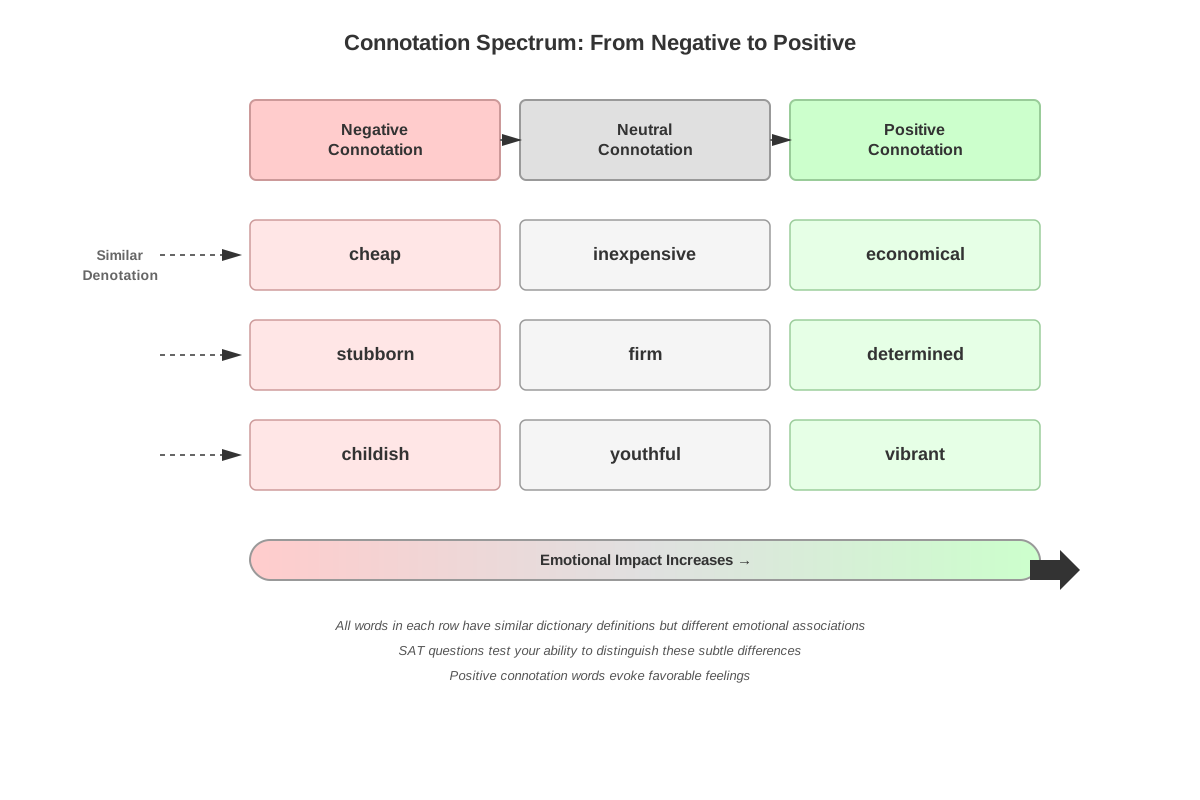
Denotation is the literal, dictionary definition of a word—its objective, universal meaning. Connotation, by contrast, encompasses the emotional, cultural, and subjective associations that a word carries. While denotation answers "What does this word mean?", connotation answers "How does this word make us feel?"
For example, the words "home," "house," "residence," and "dwelling" all share similar denotations—they refer to a place where someone lives. However, their connotations differ significantly:
- "Home" carries warm, positive connotations of comfort, family, and belonging
- "House" is relatively neutral, referring to the physical structure
- "Residence" sounds formal and somewhat detached
- "Dwelling" can sound old-fashioned or impersonal
On the SAT, recognizing these subtle differences is essential because test questions often present four words with nearly identical denotations but varying connotative values.
Characteristics of Positive Connotation
Words with positive connotation share several identifiable features:
- Favorable emotional associations: They evoke pleasant feelings, optimism, or approval
- Desirable qualities: They suggest attributes that society or culture values positively
- Uplifting tone: They contribute to an encouraging, hopeful, or celebratory mood
- Affirmative implications: They imply success, goodness, or beneficial outcomes
| Neutral/Negative Word | Positive Connotation Alternative | Why It's More Positive |
|---|---|---|
| thin | slender, svelte | Suggests attractiveness rather than deficiency |
| old | vintage, classic, timeless | Emphasizes value and quality over age |
| cheap | affordable, economical, budget-friendly | Focuses on value rather than low quality |
| talkative | articulate, eloquent, expressive | Highlights communication skill rather than excess |
| stubborn | determined, resolute, steadfast | Frames persistence as strength rather than inflexibility |
Context Determines Connotation
The same word can carry different connotations depending on context. Consider the word "ambitious":
- In a positive context: "Her ambitious goals inspired the entire team" (suggests admirable drive)
- In a negative context: "His ambitious scheming alienated his colleagues" (suggests ruthless self-interest)
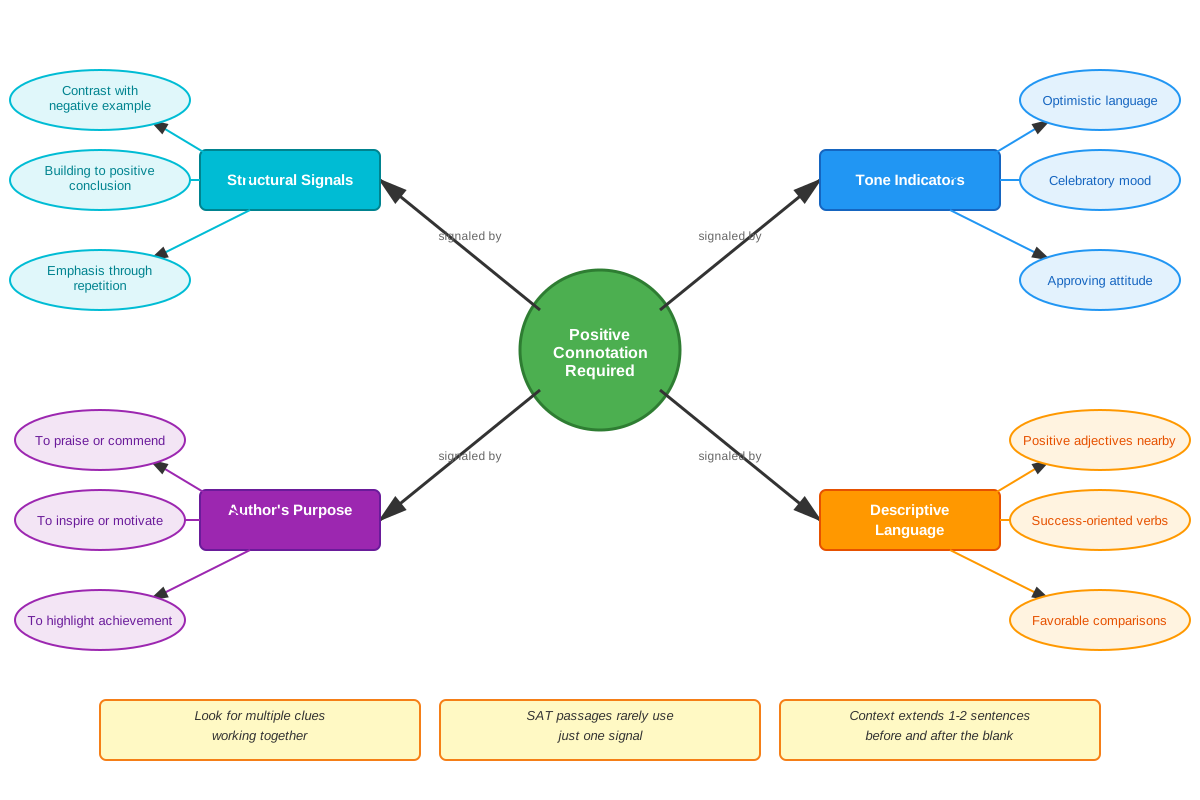
On the SAT, students must carefully read the surrounding sentences to determine whether the passage requires a word with positive, negative, or neutral connotation. Context clues include:
- Tone indicators: Words like "fortunately," "successfully," or "celebrated" signal positive contexts
- Subject matter: Passages about achievements, innovations, or beneficial outcomes typically require positive connotation
- Parallel structure: If other sentences use positive language, maintain consistency
- Contrasts: Words like "however" or "unlike" may signal a shift in connotation
Intensity and Degree
Positive connotation exists on a spectrum of intensity. Some words are mildly positive, while others are extremely positive. The SAT tests whether students can match the intensity of connotation to the context.
Mild positive: good, nice, pleasant, adequate, satisfactory
Moderate positive: excellent, wonderful, impressive, noteworthy, commendable
Strong positive: extraordinary, magnificent, exceptional, phenomenal, unparalleled
Choosing a word with excessive positive connotation for a modest context sounds hyperbolic and inappropriate. Conversely, using a mildly positive word when the context demands strong praise sounds underwhelming. The SAT rewards students who can calibrate connotative intensity to match the passage's tone and content.
Cultural and Temporal Variations
Connotations can shift across cultures, time periods, and social contexts. Words that once carried positive connotations may become neutral or negative, and vice versa. While the SAT generally uses words with stable, widely-recognized connotations, understanding this variability helps students approach unfamiliar words strategically.
For SAT purposes, focus on contemporary American English connotations and consider:
- Formal vs. informal registers: "Collaborate" (positive, professional) vs. "hang out" (casual, less appropriate for formal contexts)
- Academic vs. colloquial usage: "Demonstrate" (positive in academic writing) vs. "show off" (potentially negative)
- Euphemistic language: Words chosen specifically to create positive associations where neutral or negative terms might otherwise apply
Concept Relationships
The concept of positive connotation connects to multiple aspects of SAT Reading and Writing:
Positive Connotation → Tone Analysis: Understanding connotation enables students to identify whether a passage's tone is optimistic, critical, neutral, or celebratory. Tone questions often hinge on recognizing the cumulative effect of connotative word choices.
Denotation → Positive Connotation → Word Choice: Students must first understand literal meanings (denotation), then layer on emotional associations (connotation) to make appropriate word choices. This hierarchical relationship means that vocabulary knowledge is necessary but insufficient—connotative awareness is the next level of sophistication.
Context Clues → Positive Connotation → Correct Answer: The surrounding text provides signals about the required connotation. Students who identify these context clues can eliminate answer choices with inappropriate connotations, even if those words have similar denotations.
Positive Connotation ↔ Negative Connotation: These concepts exist in opposition but are learned together. Understanding what makes a word positively connotated helps students recognize negatively connotated alternatives, and vice versa. Many SAT questions include both types as answer choices to test discrimination skills.
Author's Purpose → Word Choice → Positive Connotation: Authors select words with specific connotations to achieve rhetorical goals. When an author wants to persuade, inspire, or celebrate, they choose words with positive connotations. Recognizing this relationship helps students understand both word choice questions and broader rhetorical analysis questions.
High-Yield Facts
⭐ Positive connotation refers to the favorable emotional associations a word carries beyond its literal meaning, and it appears in 3-5 questions per SAT test.
⭐ Words with similar denotations can have vastly different connotations; the SAT frequently tests this distinction in Words in Context questions.
⭐ Context clues in surrounding sentences indicate whether a positive, negative, or neutral connotation is required for the blank.
⭐ The intensity of positive connotation must match the context—excessive positivity sounds hyperbolic while insufficient positivity sounds underwhelming.
⭐ Tone consistency is crucial; if a passage uses positive language throughout, the correct answer will maintain that positive connotation.
- Words with positive connotation contribute to an optimistic, favorable, or celebratory tone in a passage.
- Formal academic writing often requires words with positive connotation that sound professional rather than colloquial.
- Euphemistic language typically employs positive connotation to soften or improve the perception of neutral or negative concepts.
- Cultural and temporal contexts can affect connotation, but the SAT uses words with stable, widely-recognized associations.
- Eliminating answer choices with inappropriate connotations is often easier than directly identifying the correct answer, making process of elimination highly effective.
- Parallel structure in passages often signals that similar connotations should be maintained across sentences.
- Words describing people's qualities (ambitious, determined, stubborn) are particularly susceptible to connotative variation based on context.
Quick check — test yourself on Positive connotation so far.
Try Flashcards →Common Misconceptions
Misconception: If a word has the right denotation (literal meaning), it's automatically the correct answer.
Correction: The SAT specifically tests whether students can distinguish between words with similar denotations but different connotations. A word might be technically accurate but still wrong if its emotional associations don't match the passage's tone.
Misconception: More sophisticated or longer words always have more positive connotations.
Correction: Word length and complexity don't determine connotation. Simple words like "home" can be more positive than complex words like "domicile." The SAT rewards appropriate word choice, not vocabulary showing-off.
Misconception: Positive connotation means the word describes something objectively good or beneficial.
Correction: Positive connotation refers to favorable emotional associations, not objective goodness. A word can describe something neutral or even negative while still carrying positive connotation (e.g., "passed away" has more positive connotation than "died," though both describe the same event).
Misconception: If you don't know a word's connotation, you should guess based on how it sounds.
Correction: While phonetic associations can sometimes provide hints, they're unreliable. Instead, use context clues, eliminate obviously wrong answers, and consider the word's usage in familiar phrases or contexts.
Misconception: Connotation is subjective and varies from person to person, so there's no definitively correct answer.
Correction: While connotations can vary somewhat, the SAT uses words with widely-recognized, stable connotative values in American English. There is always one best answer based on conventional usage and context.
Misconception: Neutral words are always wrong on positive connotation questions.
Correction: Sometimes the context calls for a neutral word rather than an overtly positive one. The key is matching the connotation to the specific context, not automatically choosing the most positive option.
Worked Examples
Example 1: Basic Positive Connotation Identification
Question: The scientist's research was _______ by her colleagues, who recognized its potential to transform the field.
A) tolerated
B) acknowledged
C) celebrated
D) mentioned
Step 1: Analyze the context
The sentence describes colleagues recognizing research with transformative potential. The phrase "transform the field" suggests something highly significant and positive. The context requires a word with strong positive connotation.
Step 2: Evaluate each option's connotation
- "Tolerated" (A) has negative connotation—it suggests reluctant acceptance of something undesirable
- "Acknowledged" (B) is relatively neutral—it means recognized but doesn't convey enthusiasm
- "Celebrated" (C) has strong positive connotation—it suggests enthusiastic recognition and approval
- "Mentioned" (D) is neutral to slightly negative—it suggests minimal attention
Step 3: Match intensity to context
The research has "potential to transform the field," which is highly significant. This context demands a word with strong positive connotation, not mild or neutral language.
Step 4: Select the answer
Answer: C) celebrated
This word matches both the positive tone and the high intensity required by the context. The colleagues aren't just recognizing the research; they're enthusiastically approving it.
Example 2: Distinguishing Similar Words with Different Connotations
Question: Despite facing numerous obstacles, the entrepreneur remained _______, refusing to abandon her vision even when others doubted its feasibility.
A) obstinate
B) stubborn
C) determined
D) inflexible
Step 1: Identify the denotation
All four words share a similar core meaning: unwilling to change one's mind or course of action. However, their connotations differ significantly.
Step 2: Analyze the context for tone indicators
- "Despite facing numerous obstacles" suggests perseverance
- "Refusing to abandon her vision" frames persistence positively
- The overall context presents the entrepreneur's persistence as admirable, not problematic
Step 3: Evaluate connotations
- "Obstinate" (A) has negative connotation—suggests unreasonable stubbornness
- "Stubborn" (B) has negative connotation—implies inflexibility and unwillingness to listen
- "Determined" (C) has positive connotation—suggests admirable persistence and resolve
- "Inflexible" (D) has negative connotation—suggests inability to adapt
Step 4: Apply the positive connotation requirement
The context clearly frames the entrepreneur's persistence as a positive quality. Only "determined" carries the positive connotation that matches this framing.
Answer: C) determined
This example illustrates how the SAT tests subtle connotative differences between near-synonyms. All four words could technically describe someone who won't change their mind, but only "determined" presents this quality positively.
Exam Strategy
Systematic Approach to Positive Connotation Questions
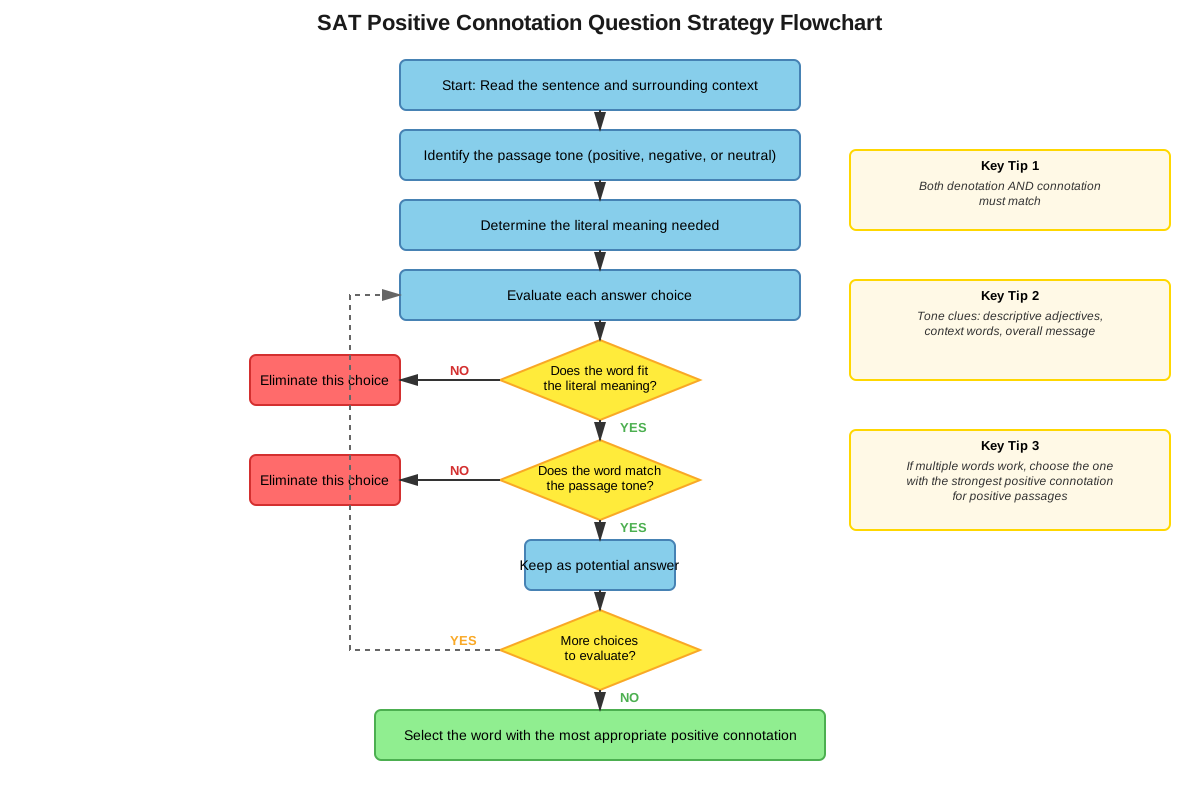
- Read the entire sentence carefully, paying attention to tone indicators and context clues
- Identify whether the context is positive, negative, or neutral before looking at answer choices
- Eliminate answers with inappropriate connotations first (if context is positive, eliminate negative and sometimes neutral options)
- Compare remaining options for intensity, ensuring the connotative strength matches the context
- Verify your choice by substituting it into the sentence and confirming it sounds natural and appropriate
Trigger Words and Phrases
Watch for these context clues that signal positive connotation is required:
- Success indicators: "achieved," "accomplished," "succeeded," "triumphed"
- Praise language: "admired," "respected," "celebrated," "honored"
- Beneficial outcomes: "improved," "enhanced," "benefited," "advanced"
- Positive emotions: "delighted," "pleased," "satisfied," "grateful"
- Affirmative transitions: "fortunately," "happily," "successfully," "remarkably"
Conversely, these phrases signal that positive connotation may NOT be appropriate:
- "However," "unfortunately," "despite," "although" (may introduce contrast)
- "Critics argue," "opponents claim," "skeptics suggest" (introduces negative perspective)
- "Failed," "struggled," "declined," "deteriorated" (negative outcomes)
Process of Elimination Tips
Exam Tip: On positive connotation questions, eliminating wrong answers is often faster and more reliable than directly identifying the right answer.
Elimination Strategy:
- Cross out any words with clearly negative connotations (usually 1-2 options)
- Eliminate neutral words if the context demands strong emotion (usually 0-1 options)
- Choose between remaining positive options based on intensity and precision
Common Wrong Answer Patterns:
- The "too strong" trap: A word with excessive positive connotation for a modest context
- The "technically correct" trap: A word with the right denotation but wrong connotation
- The "sounds fancy" trap: A sophisticated word that doesn't fit the tone or context
- The "close but not quite" trap: A word that's positive but not the specific type of positive required
Time Allocation
Positive connotation questions should take approximately 30-45 seconds each:
- 10-15 seconds: Read and understand context
- 10-15 seconds: Evaluate answer choices
- 5-10 seconds: Verify your selection
- 5 seconds: Mark your answer
If you're spending more than 60 seconds on a connotation question, you're overthinking it. Trust your instincts about how words make you feel—connotation is partly intuitive for native and proficient English speakers.
Memory Techniques
The "Feeling Test" Mnemonic
When evaluating connotation, ask yourself: "How does this word make me FEEL?"
- Favorable or unfavorable?
- Emotional weight (strong, moderate, mild)?
- Expected in this context?
- Logical fit with surrounding words?
Visualization Strategy
Create mental images associated with connotative differences:
Positive Connotation Visualization: Imagine words with positive connotation in bright, warm colors (gold, sunny yellow, warm orange). Picture them in pleasant contexts—celebrations, achievements, beautiful settings.
Negative Connotation Visualization: Imagine words with negative connotation in dark, cool colors (gray, dark blue, black). Picture them in unpleasant contexts—conflicts, failures, harsh environments.
This visual association helps your brain quickly categorize words during the exam.
The "Synonym Spectrum" Technique
For commonly tested word groups, memorize the connotative spectrum from negative to positive:
Persistence Spectrum:
Obstinate (negative) → Stubborn (negative) → Persistent (neutral) → Determined (positive) → Resolute (positive)
Intelligence Spectrum:
Cunning (negative) → Clever (neutral/positive) → Intelligent (positive) → Brilliant (very positive) → Genius (extremely positive)
Confidence Spectrum:
Arrogant (negative) → Proud (neutral/slightly negative) → Confident (positive) → Self-assured (positive) → Poised (very positive)
Acronym: TONE
When selecting words based on connotation, remember TONE:
- Tone of the passage (positive, negative, neutral?)
- Other words nearby (maintain consistency)
- Nuance matters (subtle differences are intentional)
- Eliminate inappropriate connotations first
Summary
Positive connotation represents the favorable emotional associations that words carry beyond their literal definitions, and mastering this concept is essential for SAT success. The exam consistently tests whether students can distinguish between words with similar denotations but different connotative values, particularly in Words in Context questions. Success requires understanding that context determines the appropriate connotation—students must read carefully to identify tone indicators and match word choice to the passage's emotional tenor. The key strategy involves eliminating answer choices with inappropriate connotations before selecting from remaining options based on intensity and precision. Positive connotation connects to broader reading and writing skills including tone analysis, author's purpose, and rhetorical effectiveness, making it a high-yield topic that appears in multiple question types across the SAT.
Key Takeaways
- Positive connotation refers to favorable emotional associations beyond literal meaning, appearing in 3-5 questions per SAT test
- Context clues in surrounding sentences indicate whether positive, negative, or neutral connotation is required
- Words with similar denotations can have vastly different connotations—the SAT specifically tests this distinction
- Elimination strategy is highly effective: remove words with inappropriate connotations before comparing remaining options
- Intensity matters: match the strength of positive connotation to the context (mild, moderate, or strong)
- Tone consistency is crucial—maintain the emotional tenor established by surrounding sentences
- Process of elimination is often faster and more reliable than direct identification on connotation questions
Related Topics
Negative Connotation: Understanding words with unfavorable emotional associations is the natural complement to positive connotation. Many SAT questions include both positive and negative options to test discrimination skills.
Neutral Connotation and Register: Some contexts require words without strong emotional associations. Learning when to use neutral language connects to understanding formal vs. informal register.
Tone and Mood: Connotation directly affects a passage's tone and mood. Mastering connotation enables more sophisticated tone analysis questions.
Author's Purpose and Rhetorical Strategies: Understanding why authors choose words with specific connotations connects to broader questions about persuasive techniques and rhetorical effectiveness.
Transitions and Logical Flow: Maintaining connotative consistency across sentences relates to transition questions where tone shifts must be managed appropriately.
Practice CTA
Now that you've mastered the core concepts of positive connotation, it's time to apply this knowledge! Work through the practice questions to test your ability to identify connotative differences and select appropriate words based on context. Use the flashcards to reinforce your understanding of commonly tested word pairs with different connotations. Remember: positive connotation questions are highly predictable and, with practice, become some of the most reliably answerable questions on the SAT. Each practice question you complete builds the pattern recognition and intuition that leads to test day success. You've got this!
Sign up free to keep reading
Create a free AnvayaPrep account to finish this SAT guide on Positive connotation — plus flashcards and practice questions.