Overview
The distinction between amount versus number represents one of the most frequently tested grammar concepts on the ACT English section. This seemingly simple rule trips up countless students because both words refer to quantity, yet they apply to fundamentally different types of nouns. Mastering this distinction is essential not only for achieving a top score on the ACT but also for developing precise, professional writing skills that will serve students throughout their academic and professional careers.
On the ACT, amount versus number questions typically appear 1-3 times per test, making this a high-yield topic that deserves focused attention. These questions test a student's ability to recognize whether a noun can be counted as individual units or measured as a mass. The ACT deliberately uses these words in contexts where both might sound acceptable to the untrained ear, requiring students to apply grammatical rules rather than rely on what "sounds right." Understanding this distinction demonstrates command of precise diction, a skill that connects to broader concepts of word choice and grammatical agreement.
This topic sits within the larger framework of grammar and usage on the ACT, specifically relating to subject-verb agreement, pronoun-antecedent agreement, and other concepts that require distinguishing between singular and plural forms. The ACT amount versus number rule also connects to the broader category of quantifier usage, which includes related distinctions like "fewer versus less" and "many versus much." Students who master this concept develop a sharper eye for grammatical precision that benefits their performance across multiple question types on the English section.
Learning Objectives
- [ ] Identify when Amount versus number is being tested in ACT passages
- [ ] Explain the core rule or strategy behind Amount versus number
- [ ] Apply Amount versus number to ACT-style questions accurately
- [ ] Distinguish between countable and uncountable nouns in complex contexts
- [ ] Recognize related quantifier errors that follow similar patterns
- [ ] Evaluate answer choices by testing noun countability systematically
- [ ] Demonstrate mastery by correctly answering 90%+ of practice questions on this topic
Prerequisites
- Basic noun classification: Understanding the difference between concrete and abstract nouns helps students categorize which nouns are countable versus uncountable, forming the foundation for applying the amount/number rule.
- Singular and plural forms: Recognizing how nouns change from singular to plural is essential because countable nouns have distinct plural forms while uncountable nouns typically do not.
- Subject-verb agreement fundamentals: This background knowledge connects to amount/number because both involve matching grammatical forms based on whether something is treated as singular or plural.
- Basic quantifier vocabulary: Familiarity with words like "many," "much," "few," and "less" provides context for understanding the broader category of quantity expressions that includes amount and number.
Why This Topic Matters
In real-world communication, the precise use of "amount" and "number" signals educated, professional writing. Business reports, academic papers, and formal correspondence all require this distinction. When a writer confuses these terms, it creates the same jarring effect as a subject-verb agreement error—readers may not consciously identify the mistake, but they perceive the writing as less polished and credible. This precision becomes particularly important in technical, scientific, and financial writing where exact quantification matters.
On the ACT English section, amount versus number questions appear with remarkable consistency. Statistical analysis of released ACT tests shows this concept tested in approximately 60-70% of all English sections, typically appearing 1-3 times per 75-question test. These questions usually appear in the "Conventions of Standard English" category, which comprises roughly 40% of the English section. Given that each question carries equal weight, mastering this high-frequency concept provides an excellent return on study time investment.
The ACT presents this topic in several characteristic ways. Most commonly, students encounter an underlined word ("amount" or "number") and must determine whether it correctly matches the noun it modifies. The test may also present this concept through related quantifiers like "less" versus "fewer" or "much" versus "many," which follow identical countability rules. Questions typically appear in passages discussing statistics, research findings, historical data, or any context involving quantities. The ACT favors contexts where both options might sound plausible to test genuine understanding rather than mere familiarity with the rule.
Core Concepts
The Fundamental Rule
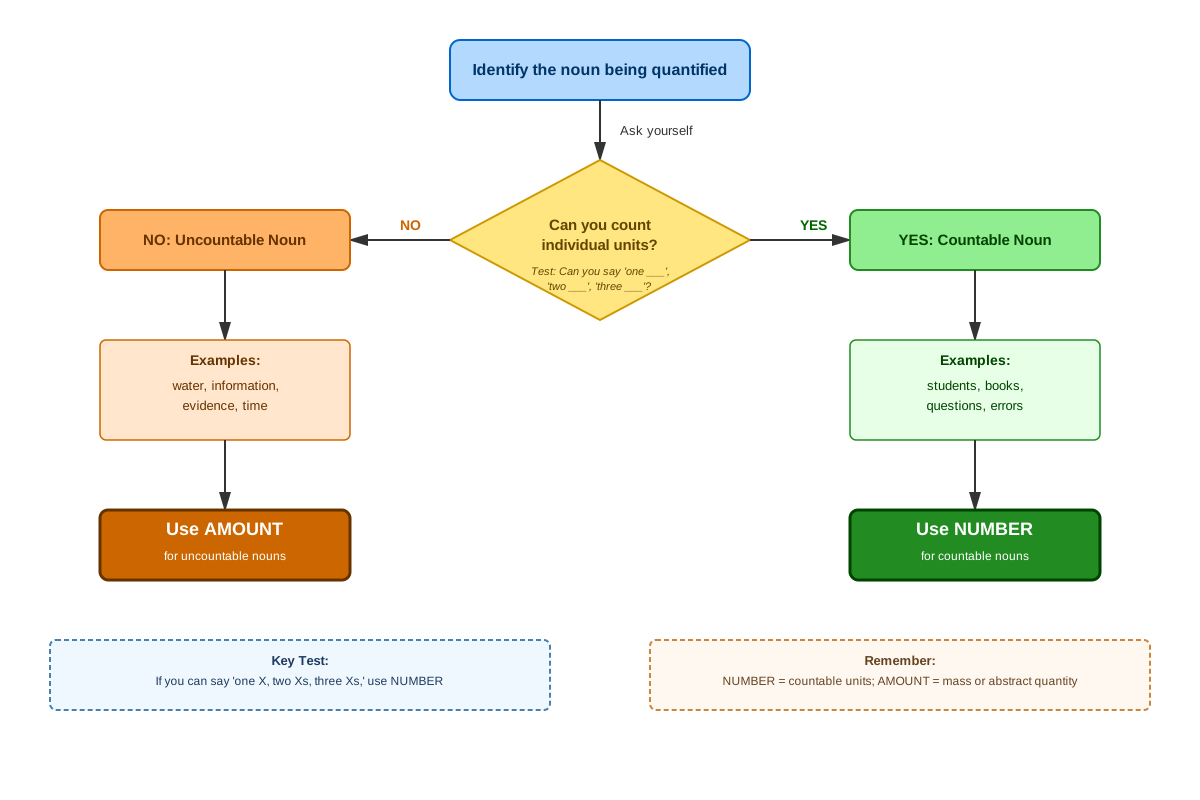
The amount versus number distinction hinges entirely on one question: Can the noun be counted as individual, separate units? This single criterion determines the correct choice in every situation. Amount refers to quantities that cannot be counted as individual units—these are measured, estimated, or described in bulk. Number refers to quantities that can be counted as distinct, separate items—these have individual units that can be enumerated.
The technical grammatical terms for these categories are "uncountable nouns" (also called "mass nouns" or "non-count nouns") and "countable nouns." Uncountable nouns represent substances, concepts, or collections that we perceive as wholes rather than as aggregations of individual units. Countable nouns represent discrete objects or entities that exist as separate, distinguishable items.
Identifying Countable Nouns
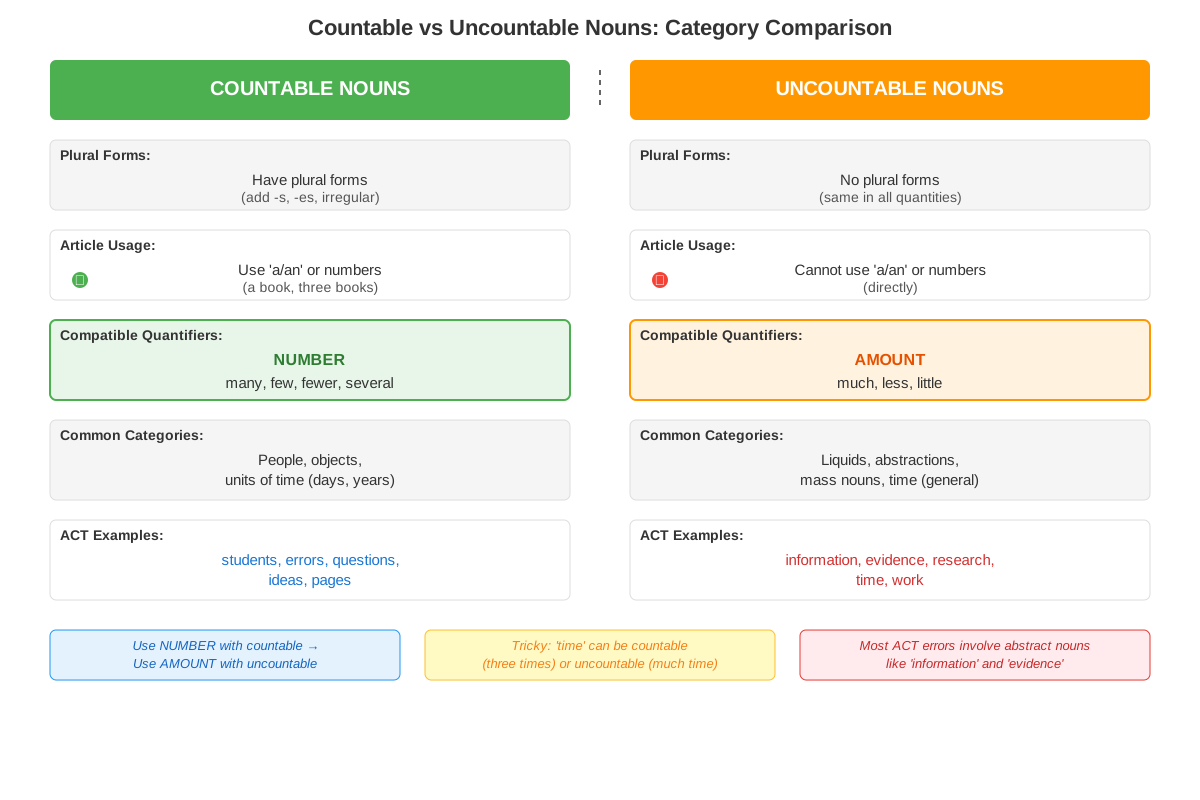
Countable nouns share several identifying characteristics that make them compatible with "number":
- They have distinct plural forms (book/books, student/students, idea/ideas)
- They can be preceded by numbers (three books, seventeen students, two ideas)
- They can be used with "a" or "an" in singular form (a book, an idea)
- They answer the question "How many?" rather than "How much?"
Common countable nouns on the ACT include: students, questions, people, books, cars, trees, buildings, errors, attempts, years, days, hours, dollars (when referring to individual bills or coins), and any other noun representing discrete entities.
Identifying Uncountable Nouns
Uncountable nouns possess characteristics that make them compatible with "amount":
- They typically have no plural form or the plural form means something different (water, information, evidence, furniture)
- They cannot be preceded by numbers without adding a unit word (three glasses of water, not three waters)
- They cannot be used with "a" or "an" without modification (some water, not a water)
- They answer the question "How much?" rather than "How many?"
Common uncountable nouns on the ACT include: water, information, evidence, research, data (traditionally uncountable, though usage is evolving), money (as a general concept), time (as a general concept), work, homework, advice, knowledge, and abstract concepts like happiness, freedom, or justice.
The Complete Usage Pattern
| Countable Nouns | Uncountable Nouns |
|---|---|
| number | amount |
| many | much |
| fewer | less |
| several | - |
| a few | a little |
| numerous | - |
This table reveals that the amount/number distinction is part of a larger system of quantifiers. Understanding this pattern helps students recognize related errors and apply consistent logic across multiple question types.
Special Cases and Complications
Certain nouns create confusion because they can function as either countable or uncountable depending on context:
Time: "The number of times I visited" (countable instances) versus "The amount of time I spent" (uncountable duration)
Money: "The number of dollars in my wallet" (countable bills) versus "The amount of money I have" (uncountable general wealth)
Experience: "The number of experiences she had" (countable events) versus "The amount of experience she gained" (uncountable expertise)
The ACT occasionally tests these context-dependent nouns to assess deeper understanding. The key is always to examine the specific noun being modified and determine whether it's being used in a countable or uncountable sense in that particular sentence.
Application Strategy
When encountering an amount/number question on the ACT, follow this systematic approach:
- Identify the noun being modified by "amount" or "number"
- Ask: "Can I count individual units of this noun?"
- Try adding a number before the noun: Does "five [nouns]" make sense?
- Check for plural form: Does this noun have a standard plural?
- Apply the rule: Countable = number; Uncountable = amount
This methodical process eliminates guessing and ensures consistent accuracy across all question variations.
Concept Relationships
The amount versus number distinction connects to several other grammatical concepts in a hierarchical relationship. At the foundation lies noun classification—the ability to categorize nouns as countable or uncountable. This classification skill then branches into multiple applications: amount/number selection, fewer/less selection, many/much selection, and subject-verb agreement patterns.
The relationship flows as follows: Noun identification → Countability determination → Quantifier selection → Grammatical agreement. Each step depends on the previous one, making countability determination the critical skill that unlocks multiple question types.
This topic also connects laterally to pronoun-antecedent agreement because countable and uncountable nouns require different pronoun forms. For example, countable nouns might be replaced with "they" or "them," while uncountable nouns use "it." Similarly, subject-verb agreement connects because uncountable nouns always take singular verbs, while countable nouns can take either singular or plural verbs depending on number.
Understanding amount versus number also prepares students for idiom and word choice questions more broadly. The ACT frequently tests whether students can select the precise word for a specific context, and the amount/number distinction exemplifies this type of precision. Students who master this concept develop the analytical approach needed for all diction questions: identify the context, understand the subtle distinctions between similar words, and apply the appropriate rule.
High-Yield Facts
⭐ Amount is used with uncountable nouns; number is used with countable nouns—this is the single most important rule for this topic.
⭐ Countable nouns can be made plural and can follow numbers (three books, five students); uncountable nouns cannot.
⭐ The ACT tests amount versus number approximately 1-3 times per English section, making it a high-frequency concept.
⭐ "Fewer" and "less" follow the exact same countability rule as "number" and "amount" (fewer = countable, less = uncountable).
⭐ When in doubt, try adding a number before the noun—if it sounds natural, the noun is countable and requires "number."
- "Much" and "many" also follow this pattern: "much" modifies uncountable nouns, "many" modifies countable nouns.
- Common uncountable nouns on the ACT include: information, evidence, research, water, money (general), time (duration), and work.
- Common countable nouns on the ACT include: students, people, questions, books, years, days, hours, and attempts.
- Some nouns can be either countable or uncountable depending on context (time, experience, paper), requiring careful analysis of how the noun is used in the specific sentence.
- The phrase "the number of" is always singular and takes a singular verb, while "a number of" is plural and takes a plural verb—this is a related but distinct concept.
- Abstract nouns (happiness, freedom, justice) are typically uncountable and pair with "amount."
- Collective nouns (team, group, committee) are typically treated as singular uncountable units in American English, though British English may treat them as plural.
Quick check — test yourself on Amount versus number so far.
Try Flashcards →Common Misconceptions
Misconception: "Amount" and "number" are interchangeable synonyms that both mean "quantity." → Correction: While both words relate to quantity, they apply to fundamentally different types of nouns. "Amount" applies only to uncountable nouns (substances or concepts measured in bulk), while "number" applies only to countable nouns (discrete items that can be enumerated). Using them interchangeably creates a grammatical error.
Misconception: If a noun represents a large quantity, use "amount" because it sounds more impressive or formal. → Correction: The size of the quantity is irrelevant to the amount/number choice. Even if discussing millions of items, if those items are countable (millions of people, millions of dollars), "number" is correct. The countability of the noun, not the magnitude of the quantity, determines the correct word.
Misconception: "Data" is plural, so it must be countable and require "number." → Correction: While "data" is technically the plural of "datum," modern usage increasingly treats "data" as an uncountable mass noun, particularly in American English. The ACT typically treats "data" as uncountable, pairing it with "amount," though this usage is evolving. Context matters, and students should be prepared for either usage.
Misconception: Money is always countable because you can count dollars. → Correction: "Money" as a general concept is uncountable and pairs with "amount" (the amount of money). However, specific denominations are countable (the number of dollars, the number of coins). The ACT tests this distinction by using "money" in its general, uncountable sense versus specific countable units.
Misconception: If you can see individual items, the noun must be countable. → Correction: Visual separateness doesn't determine countability; linguistic convention does. For example, "furniture" refers to individual pieces you can see and count, but English treats it as uncountable. You must say "pieces of furniture" to count it. Similarly, "homework" consists of individual assignments but is treated as uncountable. The grammatical category, not physical reality, determines the correct quantifier.
Misconception: Time is always uncountable because it's abstract. → Correction: "Time" can be either countable or uncountable depending on whether it refers to duration (uncountable: "the amount of time") or instances/occasions (countable: "the number of times"). The ACT specifically tests this distinction, requiring students to analyze the context carefully rather than applying a blanket rule.
Worked Examples
Example 1: Research Context
Passage: "The study collected a significant amount/number of responses from participants across the country."
Analysis Process:
Step 1: Identify the noun being modified. The quantifier modifies "responses."
Step 2: Determine if "responses" is countable. Can we count individual responses? Yes—we could say "one response, two responses, three responses." The noun has a clear plural form.
Step 3: Test with a number. "The study collected 500 responses" sounds natural and grammatically correct.
Step 4: Apply the rule. Since "responses" is countable, we need "number."
Correct Answer: "The study collected a significant number of responses from participants across the country."
Connection to Learning Objectives: This example demonstrates identifying when the concept is being tested (objective 1), applying the core rule about countability (objective 2), and accurately selecting the correct answer in an ACT-style context (objective 3). The research context is typical of ACT passages, making this a representative example.
Example 2: Time Context with Complexity
Passage: "Despite the amount/number of hours she dedicated to practice, her performance improved only marginally."
Analysis Process:
Step 1: Identify the noun being modified. The quantifier modifies "hours."
Step 2: Determine if "hours" is countable. This requires careful thought because "time" can be tricky. However, "hours" specifically refers to distinct units of time. We can say "one hour, two hours, three hours."
Step 3: Test with a number. "She dedicated 20 hours to practice" is perfectly natural.
Step 4: Check for plural form. "Hours" is already plural, and "hour" is the singular form—clear evidence of countability.
Step 5: Apply the rule. Since "hours" is countable, we need "number."
Correct Answer: "Despite the number of hours she dedicated to practice, her performance improved only marginally."
Why This Is Tricky: Students might be tempted to choose "amount" because they're thinking of "time" as an abstract, uncountable concept. However, the passage uses "hours," which are specific, countable units. This example illustrates why careful attention to the exact noun being modified is essential.
Connection to Learning Objectives: This example shows how to distinguish between countable and uncountable nouns in complex contexts (objective 4) and demonstrates the systematic evaluation process (objective 6) needed for consistent accuracy.
Exam Strategy
When approaching ACT amount versus number questions, implement this strategic framework to maximize accuracy and efficiency:
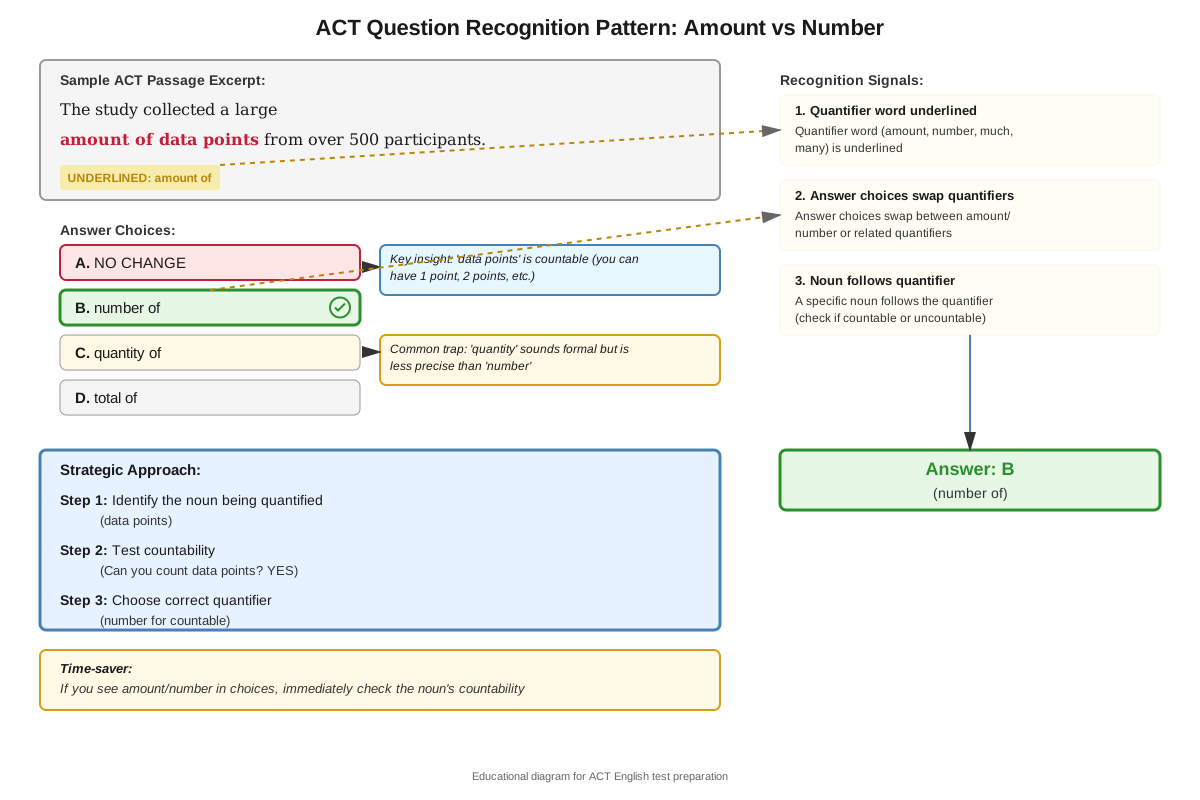
Recognition Triggers: Watch for these signals that indicate an amount/number question is being tested:
- The words "amount" or "number" appear in the underlined portion
- Answer choices alternate between "amount" and "number"
- The sentence discusses quantities, statistics, or measurements
- Related quantifiers like "fewer/less" or "many/much" appear in answer choices
The Three-Second Test: Develop the habit of immediately asking, "Can I put a number in front of this noun?" This quick mental test—imagining "five [nouns]" or "twenty [nouns]"—provides instant clarity in most cases. If the phrase sounds natural, choose "number." If it sounds awkward or impossible, choose "amount."
Process of Elimination Strategy: When answer choices include both amount/number and other variations, eliminate based on countability first. This rule is absolute—there are no exceptions or context-dependent variations to the basic countability principle. Once you've determined whether the noun is countable, you can confidently eliminate half the answer choices immediately.
Time Allocation: These questions should take no more than 15-20 seconds once you've mastered the concept. The analysis is straightforward: identify the noun, determine countability, select the answer. If you find yourself spending more time, you're likely overthinking. Trust the systematic process and move forward.
Confidence Markers: You can be highly confident in your answer when:
- The noun has an obvious plural form (students, books, questions)
- You can naturally insert a number before the noun
- The noun appears in a list or enumeration context
- The passage discusses statistics or data points
Red Flags for Careful Analysis: Slow down and analyze more carefully when:
- The noun is "time," "money," "experience," or another context-dependent word
- The noun is abstract (happiness, freedom, knowledge)
- The noun is a collective (team, group, committee)
- You're unfamiliar with whether the noun is typically countable
The Parallel Structure Clue: Sometimes the passage provides hints through parallel structure. If the sentence uses other quantifiers, check whether they're countable or uncountable forms. For example, if you see "many" elsewhere in the sentence, the passage is discussing countable items, suggesting "number" is correct.
Memory Techniques
The COUNT Mnemonic: To remember when to use "number," think COUNT:
- Can you count individual items?
- Obvious plural form exists?
- Units are separate and distinct?
- Number goes before the noun naturally?
- Try adding "five" or "ten" before it?
If you answer "yes" to these questions, use "number."
The MASS Mnemonic: To remember when to use "amount," think MASS:
- Measured rather than counted?
- Abstract or substance-like?
- Singular form only (or plural means something different)?
- Sounds wrong with numbers directly before it?
If you answer "yes" to these questions, use "amount."
Visual Memory Technique: Picture a number line with distinct, separate points—each point represents a countable item. This visual connects "number" with discrete, countable units. Contrast this with a glass of water (an amount) where you can't separate individual units—the water is a continuous mass.
The Plural Test Shortcut: Create a mental habit: whenever you see "amount" or "number," immediately try making the noun plural. If it sounds natural (book → books), use "number." If it sounds wrong or impossible (water → waters doesn't work in the same way), use "amount."
Rhyme Memory Aid: "If you can count each one, 'number' gets it done. If it's measured as a whole, 'amount' fills that role."
Association Technique: Link "number" with "numerous" (both start with 'n' and both relate to countable items). Link "amount" with "mountain" (both contain 'mount' and both suggest mass or bulk rather than individual units).
Summary
The amount versus number distinction is a high-frequency, high-yield concept on the ACT English section that tests students' ability to match quantifiers with appropriate noun types. The fundamental rule is straightforward: use "number" with countable nouns (discrete items that can be enumerated and have plural forms) and "amount" with uncountable nouns (substances or concepts measured in bulk without distinct plural forms). Success on these questions requires systematic analysis: identify the specific noun being modified, determine whether it can be counted as individual units, and apply the appropriate quantifier. This concept connects to broader patterns of quantifier usage, including fewer/less and many/much, all of which follow the same countability principle. Students who master this distinction through the three-second test (imagining a number before the noun) and the plural form check can answer these questions with near-perfect accuracy in minimal time, providing a reliable source of points on the ACT English section.
Key Takeaways
- Amount modifies uncountable nouns (measured in bulk); number modifies countable nouns (discrete, enumerable items)—this is the absolute rule with no exceptions
- The quickest test for countability is imagining a number before the noun: if "five [nouns]" sounds natural, use "number"
- Countable nouns have distinct plural forms and can follow numbers directly; uncountable nouns typically lack standard plural forms
- This concept appears 1-3 times per ACT English section and follows identical logic to fewer/less and many/much distinctions
- Context-dependent nouns like "time," "money," and "experience" require careful analysis of whether they're used in a countable or uncountable sense in the specific sentence
- The systematic approach (identify noun → test countability → apply rule) ensures consistent accuracy and takes only 15-20 seconds per question
- Mastering this high-frequency concept provides an excellent return on study time investment and demonstrates the grammatical precision the ACT rewards
Related Topics
Fewer versus Less: This distinction follows the identical countability rule as amount versus number. "Fewer" modifies countable nouns while "less" modifies uncountable nouns. Mastering amount/number provides immediate transferable knowledge to fewer/less questions, effectively doubling the value of this study time.
Many versus Much: Another quantifier pair governed by the same countability principle. "Many" pairs with countable nouns and "much" with uncountable nouns. Understanding the pattern across all these quantifier pairs reinforces the fundamental concept and helps students recognize the broader category being tested.
Subject-Verb Agreement: Countable and uncountable nouns behave differently in subject-verb agreement. Uncountable nouns always take singular verbs, while countable nouns can take either singular or plural verbs depending on number. This connection helps students see how noun classification affects multiple aspects of grammar.
Pronoun-Antecedent Agreement: The countable/uncountable distinction affects pronoun selection. Countable plural nouns are replaced with "they/them," while uncountable nouns use "it." This relationship demonstrates how mastering noun classification benefits performance across multiple question types.
Collective Nouns and Agreement: Understanding how English treats groups (team, committee, audience) as singular units connects to the broader concept of how language categorizes quantities. This advanced topic builds on the foundational countability skills developed through amount/number mastery.
Practice CTA
Now that you've mastered the core concepts, rules, and strategies for amount versus number, it's time to cement your understanding through active practice. The practice questions and flashcards are specifically designed to mirror actual ACT question formats and difficulty levels, giving you the opportunity to apply your knowledge in realistic test conditions. Challenge yourself to achieve 90%+ accuracy on practice questions—this level of mastery ensures you'll confidently handle these questions on test day. Remember, every amount/number question you answer correctly is a guaranteed point toward your target score. Your investment in mastering this high-frequency concept will pay dividends throughout the English section. Start practicing now to transform this knowledge into automatic, test-day performance!
Sign up free to keep reading
Create a free AnvayaPrep account to finish this ACT guide on Amount versus number — plus flashcards and practice questions.