Overview
Comparative forms are a critical component of ACT English grammar and usage questions, appearing consistently across multiple test administrations. These forms allow writers to compare two or more items, qualities, or actions, and the ACT frequently tests whether students can identify and correct errors in comparative and superlative constructions. Mastery of comparative forms requires understanding not only the basic rules of forming comparatives and superlatives but also recognizing common errors such as double comparatives, illogical comparisons, and incorrect modifier usage.
The ACT English section tests comparative forms in several ways: through direct comparison errors, faulty parallelism in comparative structures, and ambiguous or incomplete comparisons. Students must be able to distinguish between comparative forms (used for comparing two items) and superlative forms (used for comparing three or more items), apply the correct suffixes or helping words, and ensure that comparisons are logical and complete. These questions often appear in the context of longer passages where students must evaluate whether a sentence correctly expresses a comparison or whether revision is necessary.
Understanding ACT comparative forms connects directly to broader concepts in grammar and usage, including modifier placement, parallel structure, and logical expression. Comparative forms interact with adjectives and adverbs, requiring students to recognize parts of speech and apply the appropriate comparative construction. Additionally, comparative errors often overlap with clarity and style issues, making this topic essential not only for grammar questions but also for rhetorical skills questions that assess effective expression.
Learning Objectives
- [ ] Identify when Comparative forms is being tested
- [ ] Explain the core rule or strategy behind Comparative forms
- [ ] Apply Comparative forms to ACT-style questions accurately
- [ ] Distinguish between comparative and superlative forms in context
- [ ] Recognize and correct double comparative and double superlative errors
- [ ] Evaluate whether comparisons are logical, complete, and grammatically parallel
- [ ] Determine the appropriate form based on the number of items being compared
Prerequisites
- Basic parts of speech (adjectives and adverbs): Comparative forms modify nouns and verbs, so recognizing whether a word functions as an adjective or adverb is essential for applying the correct comparative construction.
- Sentence structure fundamentals: Understanding subjects, verbs, and objects helps identify what elements are being compared and whether the comparison is grammatically sound.
- Modifier usage: Comparative forms are types of modifiers, and understanding how modifiers function in sentences provides the foundation for recognizing comparative errors.
Why This Topic Matters
Comparative forms appear in real-world writing whenever comparisons are made—from academic essays and business reports to everyday communication. The ability to construct clear, logical comparisons is fundamental to effective writing and critical thinking. In professional and academic contexts, faulty comparisons can create ambiguity, undermine credibility, and confuse readers about the relationships between ideas or data.
On the ACT English section, comparative forms questions appear with high frequency, typically showing up 2-4 times per test. These questions fall primarily under the "Conventions of Standard English" category, specifically within grammar and usage. The ACT tests comparative forms through several question types: identifying errors in underlined portions, selecting the best revision from multiple options, and determining whether a sentence should be revised or left as written. Questions may test comparative forms directly (asking students to choose between "better" and "best") or indirectly (embedding comparative errors within longer sentences where students must recognize the error among other potential issues).
Common ways comparative forms appear in ACT passages include: comparisons between two characters or ideas in narrative passages, statistical comparisons in informational texts, descriptions of relative qualities in scientific or historical contexts, and evaluative statements in argumentative passages. The test often embeds comparative errors in complex sentences to assess whether students can maintain grammatical accuracy while processing multiple pieces of information.
Core Concepts
Basic Comparative and Superlative Formation
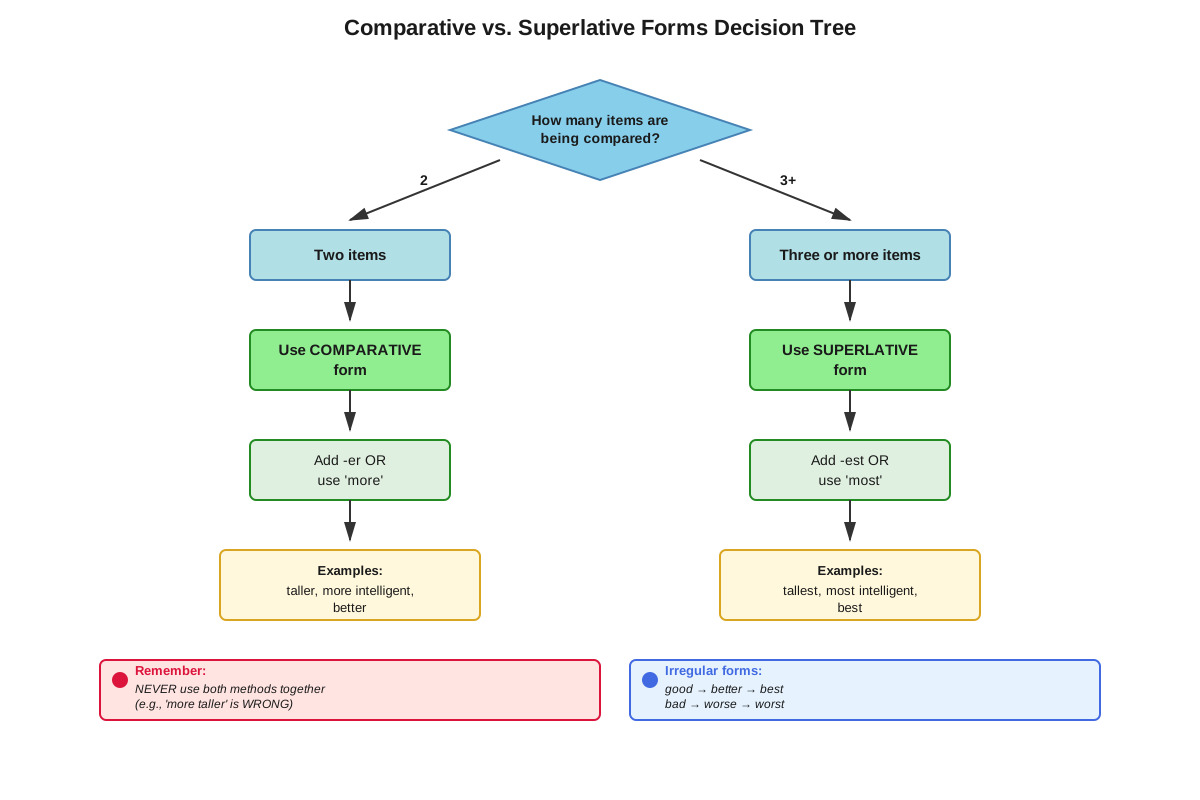
Comparative forms are used to compare two items, while superlative forms compare three or more items. The formation of these forms depends on the length and structure of the base adjective or adverb.
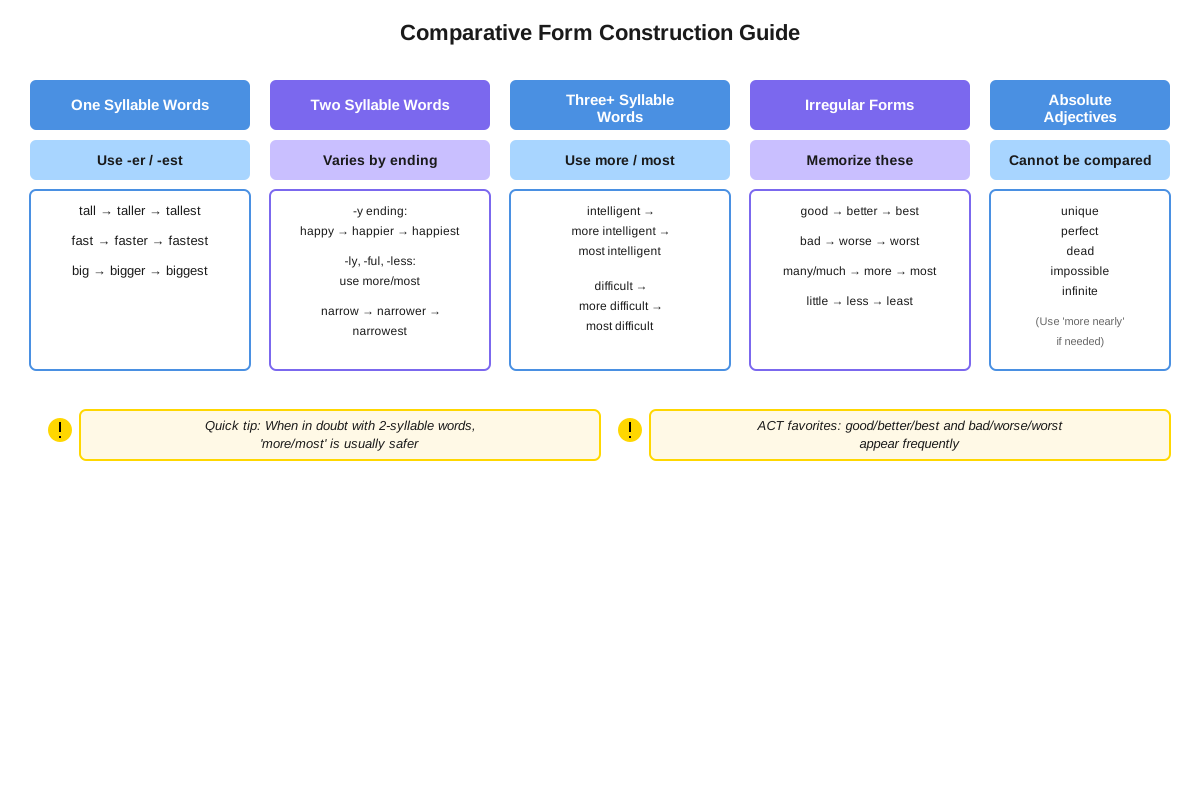
For most one-syllable adjectives and adverbs, add -er for the comparative and -est for the superlative:
- tall → taller → tallest
- fast → faster → fastest
- hard → harder → hardest
For most adjectives and adverbs of two or more syllables, use more (comparative) or most (superlative) before the word:
- beautiful → more beautiful → most beautiful
- carefully → more carefully → most carefully
- intelligent → more intelligent → most intelligent
Some two-syllable adjectives can take either form, particularly those ending in -y, -le, -ow, or -er:
- happy → happier/more happy → happiest/most happy
- simple → simpler/more simple → simplest/most simple
- narrow → narrower/more narrow → narrowest/most narrow
Irregular Comparative and Superlative Forms
Certain common adjectives and adverbs have irregular comparative and superlative forms that must be memorized:
| Base Form | Comparative | Superlative |
|---|---|---|
| good/well | better | best |
| bad/badly | worse | worst |
| much/many | more | most |
| little | less | least |
| far | farther/further | farthest/furthest |
These irregular forms are frequently tested on the ACT because students often incorrectly apply regular formation rules to these words (e.g., "more good" instead of "better").
Double Comparatives and Double Superlatives
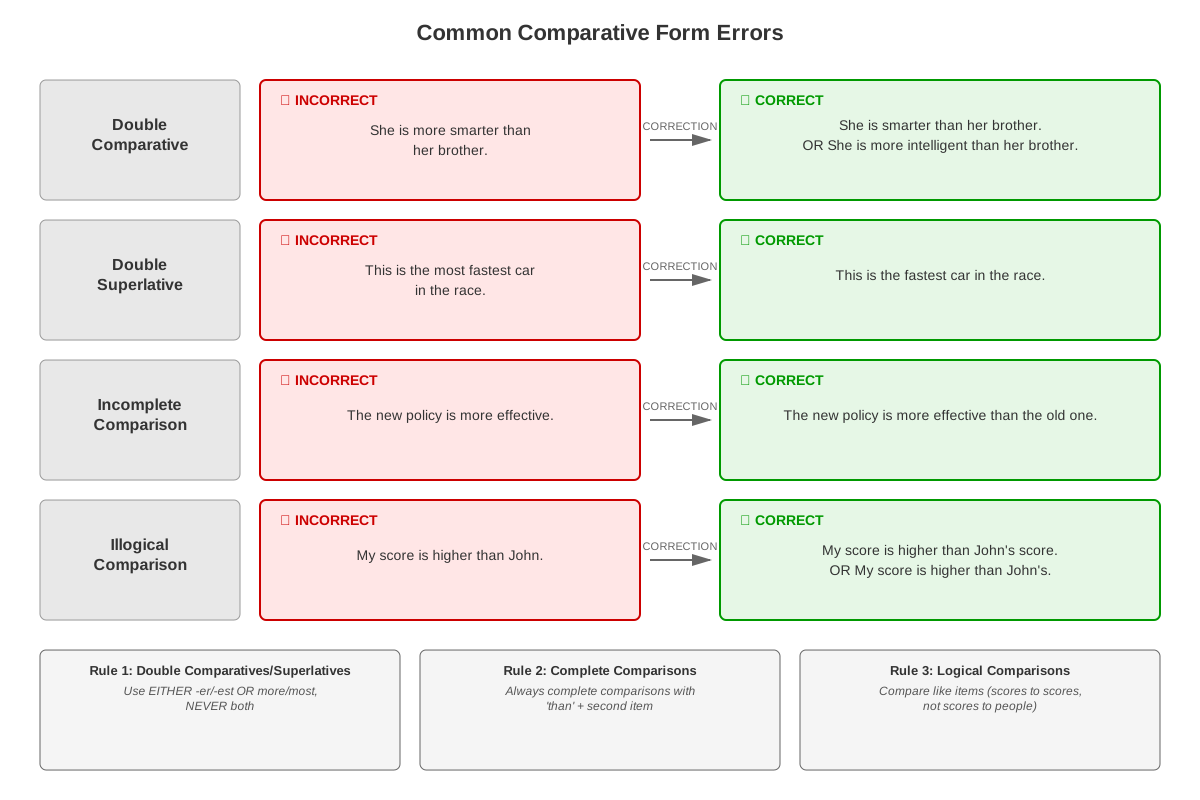
A double comparative occurs when both the -er suffix and "more" are used together, or when both the -est suffix and "most" are used together. This construction is always incorrect in standard English:
Incorrect: This solution is more better than the previous one.
Correct: This solution is better than the previous one.
Incorrect: She is the most smartest student in the class.
Correct: She is the smartest student in the class.
The ACT frequently tests this error because it sounds emphatic in casual speech but violates standard grammar rules.
Logical Comparisons
Comparisons must be logical and complete, meaning they must compare similar or compatible items. A common error involves comparing an item to a category that doesn't include that item, or comparing incompatible elements:
Illogical: The population of New York is larger than Los Angeles.
(This compares a population to a city, not to another population)
Logical: The population of New York is larger than that of Los Angeles.
OR: The population of New York is larger than Los Angeles's population.
Illogical: Like most students, Maria's grades improved.
(This compares students to grades)
Logical: Like those of most students, Maria's grades improved.
OR: Like most students, Maria improved her grades.
Comparative Forms with "Than" and "As"
The word "than" is used with comparative forms to introduce the second element of comparison:
- This book is longer than that one.
- She runs more quickly than her brother.
The construction "as...as" is used for comparisons of equality:
- This book is as long as that one.
- She runs as quickly as her brother.
A common error involves using "than" with "as...as" constructions or omitting "than" after a comparative:
Incorrect: This book is as long or longer than that one.
Correct: This book is as long as or longer than that one.
Number Agreement in Comparisons
When comparing two items, use the comparative form. When comparing three or more items, use the superlative form. This distinction is crucial for ACT questions:
Incorrect: Between the two candidates, she is the best qualified.
Correct: Between the two candidates, she is the better qualified.
Incorrect: Of all three options, this is the better choice.
Correct: Of all three options, this is the best choice.
Context clues such as "between," "of the two," "either," and "neither" signal two-item comparisons requiring comparative forms. Words like "among," "of all," "in the group," and references to three or more items signal superlative forms.
Incomplete Comparisons
Comparisons must be complete enough for readers to understand what is being compared. Incomplete comparisons create ambiguity:
Incomplete: The new policy is more effective.
(More effective than what?)
Complete: The new policy is more effective than the old policy.
Incomplete: This restaurant serves better food.
Complete: This restaurant serves better food than any other restaurant in town.
The ACT tests incomplete comparisons by offering answer choices that either include or omit the necessary comparison element.
Concept Relationships
The concepts within comparative forms build upon each other in a logical progression. Basic formation rules (adding -er/-est or using more/most) serve as the foundation for all comparative constructions. Understanding these rules enables recognition of double comparative errors, which occur when students incorrectly apply both formation methods simultaneously.
Irregular forms represent exceptions to the basic formation rules and must be memorized separately. These irregular forms frequently appear in logical comparison questions because common words like "good" and "bad" are often used in comparative contexts.
Number agreement (comparative vs. superlative) connects directly to logical comparisons because both require careful attention to what is being compared. A comparison can be grammatically correct in form but logically flawed if the wrong number of items is implied or if incompatible elements are compared.
Incomplete comparisons relate to all other concepts because any comparative construction—whether regular, irregular, or involving specific numbers of items—can be rendered unclear by omitting essential comparison elements.
The relationship map flows as follows:
Basic Formation Rules → Double Comparative Errors (what to avoid)
Basic Formation Rules → Irregular Forms (exceptions to learn)
Number Agreement → Logical Comparisons (both require analyzing what's being compared)
All Formation Types → Incomplete Comparisons (any comparison can be incomplete)
These concepts also connect to prerequisite knowledge: parts of speech determine which formation rule applies (adjective vs. adverb), sentence structure helps identify what elements are being compared, and modifier usage provides the grammatical framework for understanding how comparatives function in sentences.
High-Yield Facts
⭐ Comparative forms compare two items; superlative forms compare three or more items.
⭐ Never use double comparatives (more better) or double superlatives (most fastest)—choose either the suffix or the helping word, not both.
⭐ Irregular comparatives and superlatives (good/better/best, bad/worse/worst) do not follow standard formation rules and must be memorized.
⭐ Comparisons must be logical—compare similar items (populations to populations, not populations to cities).
⭐ The word "than" follows comparative forms; "as...as" constructions show equality.
- One-syllable adjectives and adverbs typically add -er/-est; longer words typically use more/most.
- Context clues like "between two" or "of the three" indicate whether to use comparative or superlative forms.
- Incomplete comparisons lack necessary information about what is being compared to what.
⭐ Words like "between," "either," and "of the two" signal comparative forms; "among," "of all," and references to three or more signal superlatives.
- Some two-syllable adjectives (especially those ending in -y, -le, -ow, -er) can take either formation method.
- Comparisons using "as...as" require both instances of "as" to be grammatically complete.
- Faulty parallelism in comparisons occurs when the compared elements have different grammatical structures.
Quick check — test yourself on Comparative forms so far.
Try Flashcards →Common Misconceptions
Misconception: Using "more" or "most" with any word makes it sound more emphatic and sophisticated.
Correction: Double comparatives and superlatives (more better, most fastest) are always incorrect in standard English. Choose either the suffix (-er/-est) or the helping word (more/most), never both.
Misconception: "Good" can be made comparative by adding -er to form "gooder."
Correction: "Good" is an irregular adjective with the comparative form "better" and superlative form "best." Similarly, "bad" becomes "worse" and "worst," not "badder" and "baddest."
Misconception: Any comparison is complete as long as it includes a comparative or superlative form.
Correction: Comparisons must explicitly state or clearly imply what is being compared. "This car is faster" is incomplete without specifying what it's faster than.
Misconception: Superlative forms can be used when comparing two items if you want to emphasize that one is significantly superior.
Correction: Grammatical rules require comparative forms for two items and superlative forms for three or more, regardless of the degree of difference. "Between the two options, this is the best" is incorrect; it should be "better."
Misconception: As long as a comparison uses correct comparative forms, it's grammatically acceptable.
Correction: Comparisons must also be logical, comparing compatible elements. "The speed of this car is faster than that truck" is illogical because it compares speed to a truck rather than to another speed.
Misconception: "More" and "most" can be used with any adjective or adverb for flexibility.
Correction: While many multi-syllable words require "more" and "most," one-syllable words typically require -er and -est. "More fast" is incorrect; "faster" is correct. However, some two-syllable words accept both forms.
Worked Examples
Example 1: Identifying and Correcting Comparative Errors
Original Sentence: Between classical music and jazz, I find classical to be the most relaxing genre for studying.
Step 1: Identify what is being compared
The sentence compares two music genres: classical music and jazz.
Step 2: Determine the correct form
Since only two items are being compared, the comparative form "more relaxing" should be used, not the superlative "most relaxing."
Step 3: Check for other errors
The comparison is logical (comparing one genre to another genre) and complete (both items are clearly stated).
Step 4: Apply the correction
The word "most" should be changed to "more."
Corrected Sentence: Between classical music and jazz, I find classical to be the more relaxing genre for studying.
Connection to Learning Objectives: This example demonstrates how to identify when comparative forms are being tested (the presence of "between" and two items signals a comparative context), explains the core rule (use comparative for two items, superlative for three or more), and shows how to apply this knowledge to correct the error.
Example 2: Complex Comparison with Multiple Issues
Original Sentence: The new smartphone's camera is more better than the previous model, making it the best choice of the two options available.
Step 1: Identify all comparative elements
The sentence contains two comparative constructions: "more better" and "the best choice of the two options."
Step 2: Analyze the first comparison
"More better" is a double comparative error. The word "better" is already the comparative form of "good," so adding "more" is redundant and incorrect.
Step 3: Analyze the second comparison
"The best choice of the two options" uses a superlative form ("best") when comparing only two items. The phrase "of the two options" explicitly states that only two items are being compared.
Step 4: Check for logical consistency
The comparison is logical (comparing one camera to another camera) and the items being compared are compatible.
Step 5: Apply all corrections
Change "more better" to "better" and change "the best" to "the better."
Corrected Sentence: The new smartphone's camera is better than the previous model, making it the better choice of the two options available.
Alternative Correction: The new smartphone's camera is better than the previous model's, making it the better choice of the two options available.
(This version adds "model's" to make the comparison more explicitly parallel.)
Connection to Learning Objectives: This example shows how to identify multiple comparative errors in a single sentence, explains both the double comparative rule and the two-item vs. three-or-more-item rule, and demonstrates how to apply corrections systematically. It also illustrates how comparative errors can appear multiple times in complex sentences, requiring careful analysis of each comparative construction.
Exam Strategy
When approaching ACT questions involving comparative forms, follow this systematic process:
Step 1: Identify comparison triggers
Look for words that signal comparisons: "than," "as...as," "more," "most," "-er," "-est," "between," "among," "better," "best," "worse," "worst." These words indicate that the question is testing comparative forms.
Step 2: Count the items being compared
Determine whether the sentence compares two items (requiring comparative forms) or three or more items (requiring superlative forms). Pay special attention to context clues:
- Two-item signals: "between," "either," "neither," "of the two," "both"
- Three-or-more signals: "among," "of all," "in the group," specific numbers three or higher
Step 3: Check for double comparatives/superlatives
Scan for any instance where both a suffix (-er/-est) and a helping word (more/most) appear together. This is always incorrect. Also watch for double negatives in comparative constructions.
Step 4: Verify logical consistency
Ensure that the comparison is between compatible items. Ask: "Is this comparing apples to apples?" If the sentence compares a quality to an object, or an object to a category, it's likely illogical.
Step 5: Assess completeness
Determine whether the comparison includes enough information for clarity. If a sentence says something is "better" or "more effective" without specifying what it's being compared to, the comparison may be incomplete.
Exam Tip: When answer choices differ only in comparative forms (better vs. best, more vs. most), immediately count how many items are being compared. This single step eliminates at least two answer choices in most cases.
Process of Elimination Tips:
- Eliminate any answer choice with a double comparative or double superlative immediately
- If the sentence clearly indicates two items, eliminate all superlative options
- If the sentence indicates three or more items, eliminate all comparative options
- Eliminate choices that create illogical comparisons, even if the comparative form is technically correct
- When stuck between two choices, choose the one that makes the comparison more explicit and complete
Time Allocation:
Comparative forms questions should take 20-30 seconds each. If you can quickly identify the number of items being compared, you can often answer these questions in under 20 seconds. Don't overthink—the ACT tests straightforward application of rules, not subtle interpretive distinctions.
Common Trigger Phrases:
- "Between X and Y" → use comparative
- "Of all the" → use superlative
- "More [adjective] than" → check for double comparative
- "The most [adjective]" → verify three or more items
- "As [adjective] as" → check for complete construction
Memory Techniques
Mnemonic for Two vs. Three or More:
"Two gets -ER, Three gets -EST"
The number of letters in "two" (3) is less than in "three" (5), just as comparative (-er) comes before superlative (-est) in degree.
Irregular Forms Mnemonic:
"Good Better Best, Never Let It Rest; Bad Worse Worst, Never Let It Burst"
This rhyme helps remember the two most commonly tested irregular comparative forms.
Double Comparative Check:
"One Word, One Way"
Remember that each comparative or superlative should be formed in only one way—either with a suffix or with a helping word, never both. Visualize a fork in the road where you must choose one path.
Logical Comparison Visualization:
Picture a balance scale. For a comparison to be logical, both sides of the scale must hold the same type of item (both populations, both speeds, both qualities). If one side has a population and the other has a city, the scale tips over—the comparison is illogical.
Counting Items Technique:
Use your fingers to physically count the items being compared when reading the sentence. This kinesthetic action reinforces the two-vs.-three-or-more distinction and prevents careless errors.
"Than" vs. "As...As" Memory Aid:
"Than" = Different (comparative, showing difference)
"As...As" = Same (showing equality)
The word "than" has an "a" like "apart," while "as...as" repeats the same word, emphasizing sameness.
Summary
Comparative forms are essential grammatical structures that allow writers to express relationships between two or more items, and they appear frequently on the ACT English section. The fundamental rule is straightforward: use comparative forms (formed with -er or "more") when comparing two items, and use superlative forms (formed with -est or "most") when comparing three or more items. However, the ACT tests this concept through various error types, including double comparatives, illogical comparisons, incomplete comparisons, and incorrect number agreement. Students must recognize irregular forms like "good/better/best" and "bad/worse/worst," avoid the temptation to use both suffixes and helping words simultaneously, ensure that comparisons are between compatible elements, and verify that comparisons include enough information to be clear. Success on comparative forms questions requires systematic analysis: identify comparison triggers, count the items being compared, check for formation errors, verify logical consistency, and assess completeness. By mastering these core concepts and applying a strategic approach, students can confidently tackle comparative forms questions and improve their ACT English scores.
Key Takeaways
- Comparative forms (-er, more) compare two items; superlative forms (-est, most) compare three or more items—this distinction is the foundation of most ACT questions on this topic
- Double comparatives and double superlatives are always incorrect; choose either the suffix or the helping word, never both
- Irregular forms (good/better/best, bad/worse/worst) must be memorized because they don't follow standard formation patterns
- Comparisons must be logical (comparing compatible items) and complete (including enough information to be clear)
- Context clues like "between," "of the two," "among," and "of all" signal whether to use comparative or superlative forms
- One-syllable words typically take -er/-est; multi-syllable words typically take more/most; some two-syllable words accept both
- Systematic analysis—identifying triggers, counting items, checking formation, verifying logic, and assessing completeness—leads to accurate answers on ACT comparative forms questions
Related Topics
Parallel Structure: Comparative forms often appear in parallel constructions where multiple elements must maintain consistent grammatical form. Mastering comparatives enables better recognition of parallelism errors.
Modifier Placement: Since comparative forms function as modifiers, understanding their placement and relationship to the words they modify connects directly to broader modifier concepts.
Logical Expression and Clarity: Comparative forms questions often overlap with rhetorical skills questions about clear and effective expression, as illogical or incomplete comparisons create ambiguity.
Pronoun-Antecedent Agreement: Comparisons sometimes involve pronouns (e.g., "that of," "those of"), requiring understanding of pronoun reference to construct logical comparisons.
Idioms and Standard Expressions: Certain comparative constructions follow idiomatic patterns (e.g., "as...as," "more...than"), connecting to the broader topic of standard English idioms.
Practice CTA
Now that you've mastered the core concepts of comparative forms, it's time to put your knowledge into action! Attempt the practice questions to reinforce your understanding and build confidence in identifying and correcting comparative errors. The flashcards will help you memorize irregular forms and key rules for quick recall during the exam. Remember, comparative forms questions are highly predictable on the ACT—with focused practice, you can turn this topic into a consistent source of correct answers and score improvement. Every practice question you complete strengthens your pattern recognition and speeds up your response time, bringing you closer to your target score!
Sign up free to keep reading
Create a free AnvayaPrep account to finish this ACT guide on Comparative forms — plus flashcards and practice questions.