Overview
Parallel lists represent one of the most frequently tested grammatical concepts on the ACT English section. This topic examines how items in a series—whether words, phrases, or clauses—must maintain consistent grammatical structure throughout the list. When a sentence presents multiple items performing the same function, each element must match in form: all nouns, all verbs in the same tense, all prepositional phrases, or all clauses with identical structure. The ACT tests this concept extensively because it assesses both grammatical knowledge and attention to structural detail, skills essential for clear, professional writing.
Understanding ACT parallel lists is crucial because these questions appear in approximately 10-15% of all ACT English passages, making them among the highest-yield grammar topics to master. The concept extends beyond simple lists of three items; it encompasses comparisons using "and," "or," correlative conjunctions like "either...or" and "not only...but also," and complex series involving multiple phrases or clauses. Students who master parallelism can quickly identify errors that might otherwise sound acceptable in casual speech but violate formal written English standards.
Parallel structure connects deeply to broader writing principles including clarity, consistency, and rhetorical effectiveness. It relates to verb tense consistency, subject-verb agreement, and proper use of conjunctions—all fundamental grammar concepts tested throughout the ACT English section. Mastering parallelism improves not only test performance but also overall writing quality, as parallel construction creates rhythm, emphasis, and logical flow in sentences. This topic serves as a gateway to understanding more sophisticated rhetorical strategies and sentence-level revision skills that the ACT values highly.
Learning Objectives
- [ ] Identify when Parallel lists is being tested in ACT English passages
- [ ] Explain the core rule or strategy behind Parallel lists construction
- [ ] Apply Parallel lists principles to ACT-style questions accurately
- [ ] Distinguish between correct and incorrect parallel structures in complex sentences
- [ ] Recognize parallelism errors involving different parts of speech and grammatical forms
- [ ] Construct parallel lists using correlative conjunctions correctly
- [ ] Evaluate whether items in a series maintain consistent verb tense, voice, and mood
Prerequisites
- Parts of speech identification: Recognizing nouns, verbs, adjectives, adverbs, and phrases is essential because parallel structure requires matching grammatical forms
- Verb tenses and forms: Understanding infinitives, gerunds, participles, and various tenses enables identification of verb form consistency in lists
- Phrase and clause structure: Distinguishing between prepositional phrases, noun phrases, and dependent clauses helps recognize when list items match structurally
- Basic sentence structure: Knowledge of subjects, predicates, and objects provides the foundation for understanding how list items function within sentences
- Conjunctions: Familiarity with coordinating and correlative conjunctions is necessary because these words signal parallel structures
Why This Topic Matters
Parallel structure appears throughout professional, academic, and technical writing, making it a practical skill beyond test preparation. Job descriptions, legal documents, scientific papers, and business communications all rely on parallel construction to present information clearly and professionally. Writers use parallelism to create memorable phrases, emphasize key points, and guide readers through complex information efficiently. The ability to construct and recognize parallel structures distinguishes competent writers from exceptional ones.
On the ACT English section, parallelism questions appear in approximately 3-5 questions per test, representing roughly 4-7% of the total English score. These questions typically appear as "Sentence Structure and Formation" items, one of the four major reporting categories. The ACT presents parallelism in various contexts: simple three-item lists, complex series with multiple phrases, comparisons using "than" or "as," and constructions with correlative conjunctions. Questions may test parallelism within a single sentence or across multiple sentences in a paragraph.
Common ACT passage contexts for parallel lists include biographical narratives describing someone's accomplishments or activities, process descriptions explaining steps or procedures, and argumentative passages presenting multiple reasons or examples. The test frequently embeds parallelism errors in longer, more complex sentences where the structural inconsistency is less immediately obvious. Students must recognize that parallelism extends beyond obvious lists with commas and "and"—it includes any construction where multiple elements serve equivalent grammatical functions.
Core Concepts
The Fundamental Rule of Parallelism
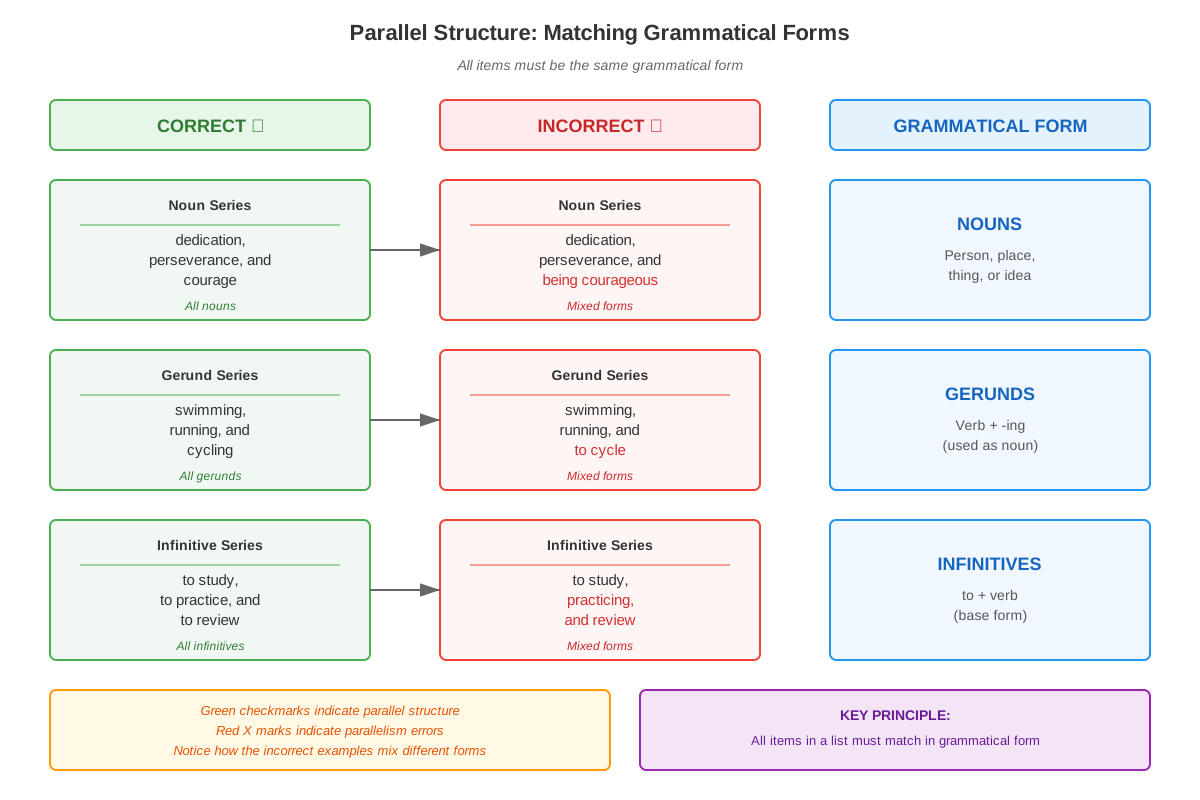
The core principle governing parallel lists is structural consistency: when a sentence presents two or more items in a series, each item must use the same grammatical form. This rule applies regardless of whether the list contains two items, three items, or more. The grammatical form encompasses part of speech (noun, verb, adjective), verb form (infinitive, gerund, participle), phrase type (prepositional, noun, adjective), and clause structure (dependent, independent).
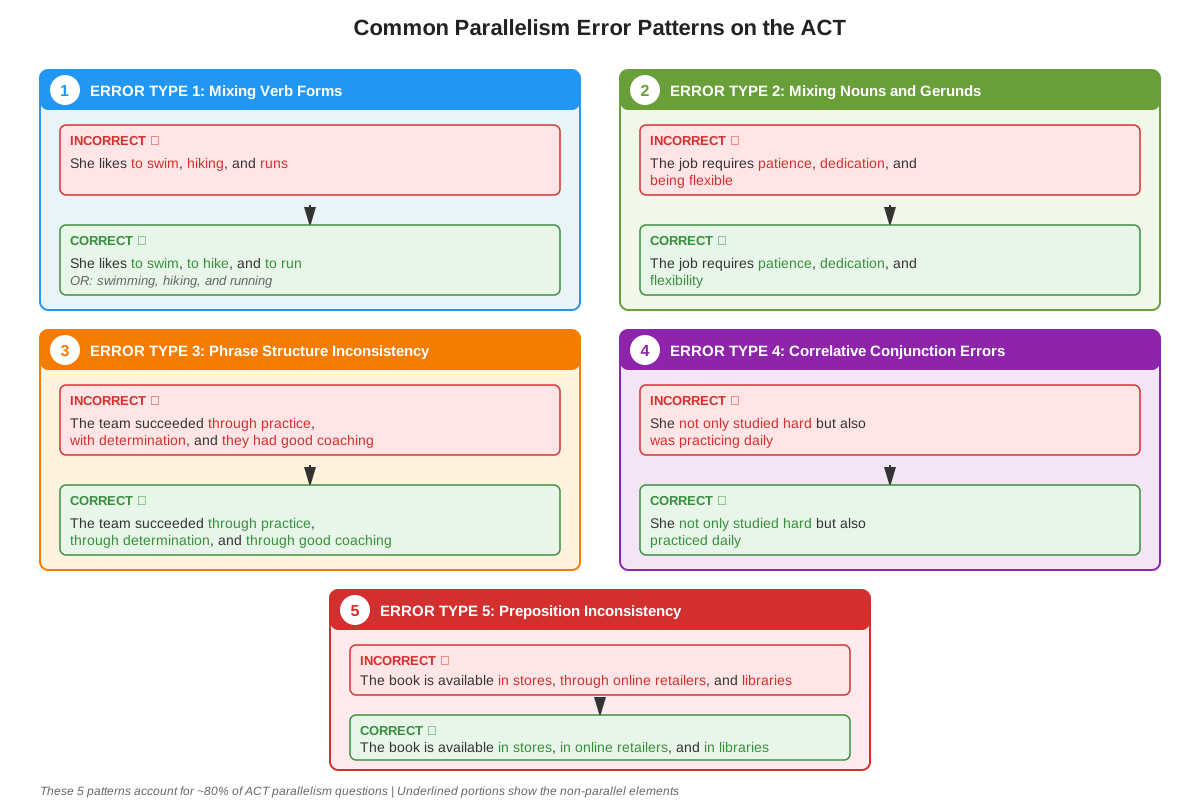
Consider this basic example: "She enjoys swimming, hiking, and to bike" violates parallelism because the first two items are gerunds (swimming, hiking) while the third is an infinitive (to bike). The corrected version maintains consistency: "She enjoys swimming, hiking, and biking" (all gerunds) or "She enjoys to swim, to hike, and to bike" (all infinitives, though less common in modern usage).
Types of Parallel Structures
Noun Parallelism
When listing nouns, all items must be nouns or noun phrases of equivalent structure:
Correct: The recipe requires flour, sugar, and butter. (all single nouns)
Correct: The recipe requires three cups of flour, two cups of sugar, and one stick of butter. (all noun phrases with measurements)
Incorrect: The recipe requires flour, sugar, and adding butter. (mixing nouns with a gerund phrase)
Verb Parallelism
Verbs in a list must match in form—all infinitives, all gerunds, all participles, or all conjugated verbs in the same tense:
Correct: To succeed, you must study, practice, and review. (all base verbs)
Correct: Success requires studying, practicing, and reviewing. (all gerunds)
Incorrect: Success requires studying, to practice, and review. (mixing gerunds, infinitives, and base verbs)
Phrase Parallelism
When listing phrases, each must follow the same structural pattern:
Correct: The dog ran through the park, over the bridge, and into the woods. (all prepositional phrases)
Incorrect: The dog ran through the park, over the bridge, and then he went into the woods. (mixing prepositional phrases with a clause)
Clause Parallelism
Lists of clauses must maintain parallel structure in their internal construction:
Correct: The teacher explained what we should study, how we should prepare, and when we should arrive. (all noun clauses beginning with question words)
Incorrect: The teacher explained what we should study, how we should prepare, and the arrival time. (mixing clauses with a noun phrase)
Parallelism with Correlative Conjunctions
Correlative conjunctions—paired connectors like "either...or," "neither...nor," "not only...but also," "both...and"—require strict parallelism. The grammatical structure following the first conjunction must match the structure following the second:
Correct: She is both intelligent and hardworking. (both followed by adjectives)
Correct: She both studies diligently and works efficiently. (both followed by verb phrases)
Incorrect: She both is intelligent and hardworking. (inconsistent placement creates structural mismatch)
The key is ensuring that whatever follows the first conjunction matches what follows the second. If "not only" is followed by a verb, "but also" must be followed by a verb. If "either" precedes a noun phrase, "or" must precede a noun phrase.
Parallelism in Comparisons
Comparisons using "than," "as," or "like" require parallel structure between the compared elements:
Correct: Writing an essay is more difficult than solving a math problem. (both gerund phrases)
Correct: To write an essay is more difficult than to solve a math problem. (both infinitive phrases)
Incorrect: Writing an essay is more difficult than to solve a math problem. (mixing gerund and infinitive)
Articles and Prepositions in Parallel Lists
A subtle aspect of parallelism involves articles (a, an, the) and prepositions (in, on, at, etc.). When these words appear before the first item in a list, they can either be repeated before each item or used only once to apply to all items:
Correct: The museum features paintings, sculptures, and photographs. (article used once)
Correct: The museum features the paintings, the sculptures, and the photographs. (article repeated)
Incorrect: The museum features the paintings, sculptures, and photographs. (inconsistent article use)
The same principle applies to prepositions:
Correct: She searched in the closet, under the bed, and behind the dresser. (preposition with each item)
Correct: She searched in the closet, the bathroom, and the garage. (preposition applies to all)
Incorrect: She searched in the closet, bathroom, and behind the dresser. (inconsistent preposition use)
Concept Relationships
Parallel structure serves as a unifying principle connecting multiple grammatical concepts. Understanding parts of speech enables recognition of whether list items match (all nouns, all verbs, etc.), which forms the foundation of parallelism. Verb forms and tenses directly impact parallel structure because lists containing verbs must maintain consistency in both form (infinitive vs. gerund) and tense (past, present, future).
The relationship flows as follows: Parts of Speech Identification → Phrase and Clause Recognition → Parallel Structure Analysis → Sentence Clarity and Effectiveness. Each step builds on the previous one, with parallelism representing the synthesis of these foundational skills.
Parallelism also connects forward to more advanced concepts. Mastering parallel lists enhances understanding of rhetorical strategies because parallel construction creates emphasis and rhythm. It relates to sentence combining and revision since recognizing parallel structure helps writers merge ideas efficiently. Additionally, parallelism intersects with subject-verb agreement and pronoun-antecedent agreement because maintaining parallel structure often requires ensuring these agreements remain consistent across list items.
The concept extends to punctuation as well, particularly comma usage in series and semicolons in complex lists. Understanding when to use commas between parallel items and when semicolons are necessary for clarity demonstrates the interconnected nature of grammar concepts on the ACT.
High-Yield Facts
⭐ All items in a list must use the same grammatical form: nouns with nouns, verbs with verbs, phrases with phrases, clauses with clauses.
⭐ Correlative conjunctions require strict parallelism: whatever structure follows the first conjunction must match the structure following the second.
⭐ Verb forms in lists must match exactly: all infinitives, all gerunds, all participles, or all conjugated verbs in the same tense.
⭐ Prepositional phrases in a list must maintain parallel structure: each phrase should follow the same pattern (preposition + noun/pronoun).
⭐ Comparisons using "than" or "as" require parallel structure between the compared elements.
- Articles and prepositions can apply to all list items or be repeated with each item, but usage must be consistent throughout the list.
- Parallel structure applies to lists of two items connected by "and" or "or," not just lists of three or more items.
- Adjectives and adverbs in a list must maintain consistent form and cannot mix with other parts of speech.
- Dependent clauses in a list should begin with the same type of subordinating word (all "that" clauses, all "which" clauses, etc.).
- Parallelism errors often occur in longer sentences where the distance between list items makes inconsistency less obvious.
- The ACT frequently tests parallelism by placing the error in the third or fourth item of a list, after establishing a pattern with earlier items.
- Parallel structure improves sentence rhythm and readability, making it both a grammatical and rhetorical device.
Quick check — test yourself on Parallel lists so far.
Try Flashcards →Common Misconceptions
Misconception: Parallel structure only matters in lists of three or more items. → Correction: Parallelism applies to any series of two or more items connected by conjunctions. "She likes swimming and to hike" is incorrect even with just two items; it should be "She likes swimming and hiking" or "She likes to swim and to hike."
Misconception: As long as list items are all the same part of speech, the structure is parallel. → Correction: Matching parts of speech is necessary but not sufficient. Verbs must also match in form (all infinitives or all gerunds), and phrases must follow the same structural pattern. "To study, practicing, and review" contains all verbs but violates parallelism because the forms differ.
Misconception: Parallelism only applies to items separated by commas. → Correction: Parallel structure is required whenever multiple elements serve equivalent grammatical functions, including items connected by "and," "or," "but," or correlative conjunctions, regardless of comma usage. "She is talented and works hard" is correct, but "She is talented and a hard worker" lacks parallelism despite having no commas.
Misconception: Starting each item with the same word creates parallelism. → Correction: While repetition can enhance parallel structure, true parallelism requires matching grammatical forms, not just repeated words. "He enjoys to swim, to run, and to bike" is parallel, but "He enjoys to swim, running, and to bike" is not, despite "to" appearing twice.
Misconception: Parallelism is just a stylistic preference, not a grammatical rule. → Correction: Parallel structure is a fundamental grammatical principle in formal written English. Violations create ambiguity, confusion, and are considered errors on standardized tests like the ACT. While some parallelism choices involve style, maintaining basic parallel structure is a grammatical requirement.
Worked Examples
Example 1: Identifying and Correcting Verb Form Parallelism
Original Sentence: The committee's responsibilities include reviewing applications, to interview candidates, and the selection of finalists.
Analysis: This sentence contains a list of three items describing the committee's responsibilities. Let's examine each item's grammatical form:
- Item 1: "reviewing applications" (gerund phrase)
- Item 2: "to interview candidates" (infinitive phrase)
- Item 3: "the selection of finalists" (noun phrase)
The three items use different grammatical structures, violating parallel structure. To correct this, all three items must use the same form.
Correction Option 1 (all gerund phrases): The committee's responsibilities include reviewing applications, interviewing candidates, and selecting finalists.
Correction Option 2 (all noun phrases): The committee's responsibilities include the review of applications, the interview of candidates, and the selection of finalists.
Why This Matters: The ACT frequently tests this type of error where each item in a list uses a different verb form. The correct answer will make all items match. On the test, you would see the underlined portions and need to select the choice that creates parallelism. This example addresses Learning Objective 3 (applying parallel lists to ACT-style questions) and Learning Objective 5 (recognizing parallelism errors involving different parts of speech).
Example 2: Correlative Conjunctions and Parallelism
Original Sentence: The new policy will not only reduce costs but also improving efficiency and increase customer satisfaction.
Analysis: This sentence uses the correlative conjunction pair "not only...but also," which requires strict parallelism. Let's examine what follows each conjunction:
- After "not only": "reduce costs" (base verb + object)
- After "but also": "improving efficiency and increase customer satisfaction" (gerund + object AND base verb + object)
The structure is inconsistent. Additionally, within the second part, "improving" (gerund) and "increase" (base verb) are not parallel with each other.
Step-by-step correction:
- Identify what follows "not only": the base verb "reduce"
- Ensure "but also" is followed by the same structure: base verb(s)
- Make the list after "but also" parallel: "improve" and "increase" (both base verbs)
Corrected Sentence: The new policy will not only reduce costs but also improve efficiency and increase customer satisfaction.
Alternative Analysis: If we wanted to use gerunds, we would need to restructure: "The new policy will involve not only reducing costs but also improving efficiency and increasing customer satisfaction."
Why This Matters: Correlative conjunctions appear frequently on the ACT, and students often miss these errors because the sentence sounds acceptable in casual speech. This example demonstrates Learning Objective 6 (constructing parallel lists using correlative conjunctions correctly) and shows how multiple parallelism issues can appear in a single sentence.
Exam Strategy
When approaching ACT English questions testing parallel lists, follow this systematic process:
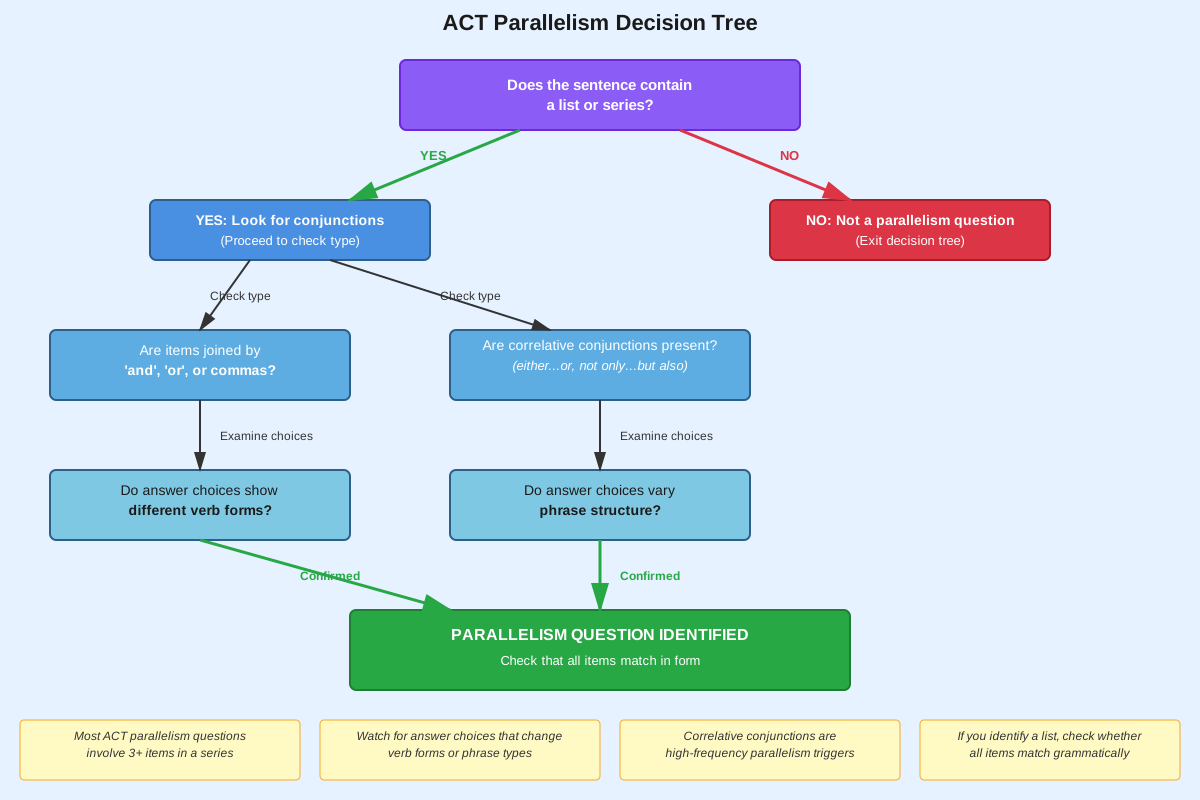
Step 1: Identify List Markers - Look for conjunctions (and, or, but), commas separating items, or correlative conjunctions (either...or, not only...but also, both...and). These signal that parallelism may be tested.
Step 2: Isolate Each Item - Mentally or physically separate each item in the list. Write down or identify the grammatical form of each item: noun, verb form, phrase type, or clause structure.
Step 3: Compare Structures - Check whether all items match in grammatical form. If they don't match, the sentence contains a parallelism error.
Step 4: Evaluate Answer Choices - On the ACT, incorrect answer choices often maintain the parallelism error or introduce new errors. The correct answer will make all list items parallel while maintaining the sentence's original meaning.
Exam Tip: The ACT often places the parallelism error in the last item of a list. If the first two items are gerunds, check whether the third item is also a gerund. This pattern appears in approximately 60% of parallelism questions.
Trigger Words and Phrases to Watch For:
- "and," "or," "but" connecting items in a series
- Correlative conjunctions: either...or, neither...nor, not only...but also, both...and, whether...or
- Comparison words: than, as, like
- Lists with commas separating three or more items
- Series of actions or characteristics describing a subject
Process of Elimination Tips:
- Eliminate choices that mix verb forms (infinitives with gerunds)
- Eliminate choices that mix parts of speech (nouns with adjectives)
- Eliminate choices where correlative conjunctions are followed by different structures
- Keep choices where all list items follow identical grammatical patterns
Time Allocation: Parallelism questions should take 20-30 seconds once you recognize the pattern. If you can quickly identify the list and check whether items match, you'll answer correctly without extensive deliberation. Don't overthink these questions—the error is usually obvious once you isolate each list item.
Memory Techniques
The "Match Game" Mnemonic: Think of parallel structure as a matching game where every item must wear the same "outfit" (grammatical form). If the first item wears a "gerund outfit" (-ing form), all items must wear gerund outfits. This visualization helps remember that consistency is key.
The "PAIR" Acronym for Correlative Conjunctions:
- Placement matters: what follows the first conjunction
- Alignment required: second conjunction must match
- Identical structures: both sides must be the same
- Review both parts: check each side independently
The "Three-Part Test" for Any List:
- Part of speech: Are all items nouns, verbs, adjectives, etc.?
- Form: Do verbs match in form (all -ing, all infinitives)?
- Structure: Do phrases/clauses follow the same pattern?
Visualization Strategy: Picture a balanced scale. Parallel structure keeps the scale balanced—each item has equal grammatical "weight" and form. When items don't match, the scale tips, signaling an error. This mental image helps quickly identify imbalanced (non-parallel) structures.
The "Echo Technique": When checking parallelism, mentally "echo" each item with the same introductory words. For example, in "She likes swimming, hiking, and to bike," echo as "She likes swimming, she likes hiking, she likes to bike." The awkwardness of "she likes to bike" compared to the others reveals the error.
Summary
Parallel lists represent a fundamental principle of grammatical consistency: when a sentence presents multiple items serving the same function, each item must maintain identical grammatical structure. This rule applies to lists of nouns, verbs, phrases, and clauses, regardless of list length. The ACT tests parallelism extensively through simple series, correlative conjunctions (either...or, not only...but also), and comparisons using "than" or "as." Mastering this concept requires identifying list markers, isolating each item's grammatical form, and ensuring perfect structural consistency. Common errors include mixing verb forms (infinitives with gerunds), combining different parts of speech, and misaligning structures with correlative conjunctions. Success on ACT parallelism questions depends on systematic analysis: identify the list, determine each item's form, verify consistency, and select the answer choice that makes all items parallel. This skill appears in 3-5 questions per test and represents high-yield content that, once mastered, provides quick, confident points on test day.
Key Takeaways
- Parallel structure requires all list items to use identical grammatical forms: matching parts of speech, verb forms, phrase types, and clause structures
- Correlative conjunctions demand strict parallelism: whatever structure follows the first conjunction must match the structure following the second
- Verb form consistency is crucial: lists must use all infinitives, all gerunds, all participles, or all conjugated verbs in the same tense
- The ACT frequently places parallelism errors in the last item of a list, making systematic checking of each item essential
- Parallelism applies to any series of two or more items, not just lists of three or more, and includes items connected by "and," "or," or other conjunctions
- Identifying list markers (conjunctions, commas, correlative pairs) immediately signals potential parallelism questions on the ACT
- Mastering parallel structure improves both test performance and overall writing quality, as it creates clarity, rhythm, and professional polish
Related Topics
Subject-Verb Agreement: Understanding how subjects and verbs must agree in number connects to parallelism because lists of subjects or predicates must maintain consistent agreement patterns throughout. Mastering parallelism provides a foundation for recognizing agreement issues in complex sentences.
Verb Tense Consistency: Parallel structure often requires maintaining consistent verb tenses across list items. Students who master parallelism are better equipped to identify and correct inappropriate tense shifts within sentences and paragraphs.
Comma Usage and Punctuation in Series: Proper punctuation of parallel lists, including the Oxford comma debate and semicolon usage in complex series, builds directly on understanding parallel structure. This topic extends parallelism knowledge to punctuation conventions.
Rhetorical Skills and Sentence Effectiveness: Parallel structure serves as both a grammatical rule and a rhetorical device. Advanced study examines how parallelism creates emphasis, rhythm, and memorable phrasing in persuasive and literary writing.
Sentence Combining and Revision: Recognizing parallel structure enables more sophisticated sentence combining, allowing writers to merge multiple ideas efficiently while maintaining grammatical correctness and stylistic polish.
Practice CTA
Now that you've mastered the principles of parallel lists, it's time to cement your understanding through active practice. The concepts you've learned—identifying list markers, analyzing grammatical forms, and ensuring structural consistency—become automatic only through repeated application. Challenge yourself with the practice questions designed specifically to mirror ACT question types and difficulty levels. Use the flashcards to reinforce high-yield facts and common error patterns. Remember, parallelism questions represent some of the most predictable points on the ACT English section—master this topic, and you'll confidently earn these points on test day. Your investment in understanding parallel structure will pay dividends not only on the ACT but in all your future writing endeavors!
Sign up free to keep reading
Create a free AnvayaPrep account to finish this ACT guide on Parallel lists — plus flashcards and practice questions.