Overview
Sentence combining is one of the most frequently tested skills on the ACT English section, appearing in approximately 10-15% of all questions. This topic assesses a student's ability to recognize when two or more sentences, clauses, or phrases should be joined together to create more sophisticated, concise, and grammatically correct writing. The ACT tests sentence combining through questions that ask students to choose the most effective way to merge ideas, eliminate redundancy, and improve the flow of a passage.
Mastering sentence combining is essential because it directly impacts both the Sentence Structure and Rhetorical Skills portions of the ACT English test. Questions may present choppy, repetitive sentences and ask students to identify the best method for combining them—whether through coordination (using conjunctions like "and," "but," "or"), subordination (using dependent clauses), or punctuation marks like semicolons and colons. Understanding when and how to combine sentences demonstrates advanced writing proficiency and helps students recognize effective prose construction.
This topic connects intimately with other ACT English concepts including comma usage, semicolon rules, coordination and subordination, parallel structure, and conciseness. Students who excel at ACT sentence combining can identify relationships between ideas, choose appropriate conjunctions and punctuation, and eliminate wordiness—all skills that appear across multiple question types on the exam. The ability to combine sentences effectively is not just a test-taking skill; it represents a fundamental understanding of how ideas relate to one another and how to communicate those relationships clearly and efficiently.
Learning Objectives
- [ ] Identify when sentence combining is being tested in ACT English questions
- [ ] Explain the core rule or strategy behind sentence combining
- [ ] Apply sentence combining to ACT-style questions accurately
- [ ] Distinguish between coordination and subordination as combining methods
- [ ] Evaluate multiple sentence combining options to select the most effective choice
- [ ] Recognize when sentences should remain separate rather than be combined
- [ ] Identify and eliminate redundancy created by improper sentence combining
Prerequisites
- Independent and dependent clauses: Understanding clause types is essential because sentence combining requires knowing which clauses can stand alone and which need to be attached to independent clauses.
- Coordinating and subordinating conjunctions: Familiarity with these conjunctions is necessary because they serve as the primary tools for joining sentences and establishing relationships between ideas.
- Comma rules: Proper comma usage is critical when combining sentences, particularly with coordinating conjunctions and introductory dependent clauses.
- Semicolon usage: Semicolons provide an alternative method for combining closely related independent clauses without conjunctions.
- Sentence fragments and run-ons: Recognizing these errors helps students avoid creating them when attempting to combine sentences.
Why This Topic Matters
In real-world writing, the ability to combine sentences effectively separates basic writers from sophisticated ones. Professional writing—whether in business communications, academic papers, or journalism—requires varying sentence structure and length to maintain reader engagement and clearly express complex relationships between ideas. Writers who can only produce simple, choppy sentences struggle to convey nuanced arguments or maintain reader interest.
On the ACT English section, sentence combining questions appear with remarkable frequency, typically showing up 5-8 times per test. These questions usually present underlined portions that include periods, conjunctions, or transition words, with answer choices offering different ways to connect the ideas. The test may also present questions with "DELETE the underlined portion" as an option, testing whether students recognize that combining isn't always the best choice. According to ACT data, approximately 12% of all English questions involve some aspect of sentence structure, and sentence combining represents a significant portion of these questions.
Common manifestations in exam passages include: choppy sequences of short sentences that could be combined for better flow; redundant sentences that repeat information unnecessarily; sentences with weak transitions that could be strengthened through proper combining; and overly complex sentences that should actually be separated. The ACT particularly favors questions where students must choose between coordination (equal ideas) and subordination (one idea dependent on another), as this distinction reveals sophisticated understanding of logical relationships.
Core Concepts
What Is Sentence Combining?
Sentence combining refers to the process of joining two or more sentences, clauses, or phrases into a single, more sophisticated sentence while maintaining grammatical correctness and clarity. The goal is to create writing that flows smoothly, eliminates unnecessary repetition, and clearly expresses the relationships between ideas. On the ACT, sentence combining questions test whether students can recognize opportunities to merge ideas and select the most effective method for doing so.
The fundamental principle underlying sentence combining is that effective writing varies sentence structure and length. A passage filled with short, simple sentences sounds choppy and immature, while a passage with appropriately combined sentences demonstrates control over language and helps readers understand how ideas connect. However, combining sentences isn't always the right choice—sometimes ideas are distinct enough that they deserve separate sentences.
Methods of Sentence Combining
Coordination
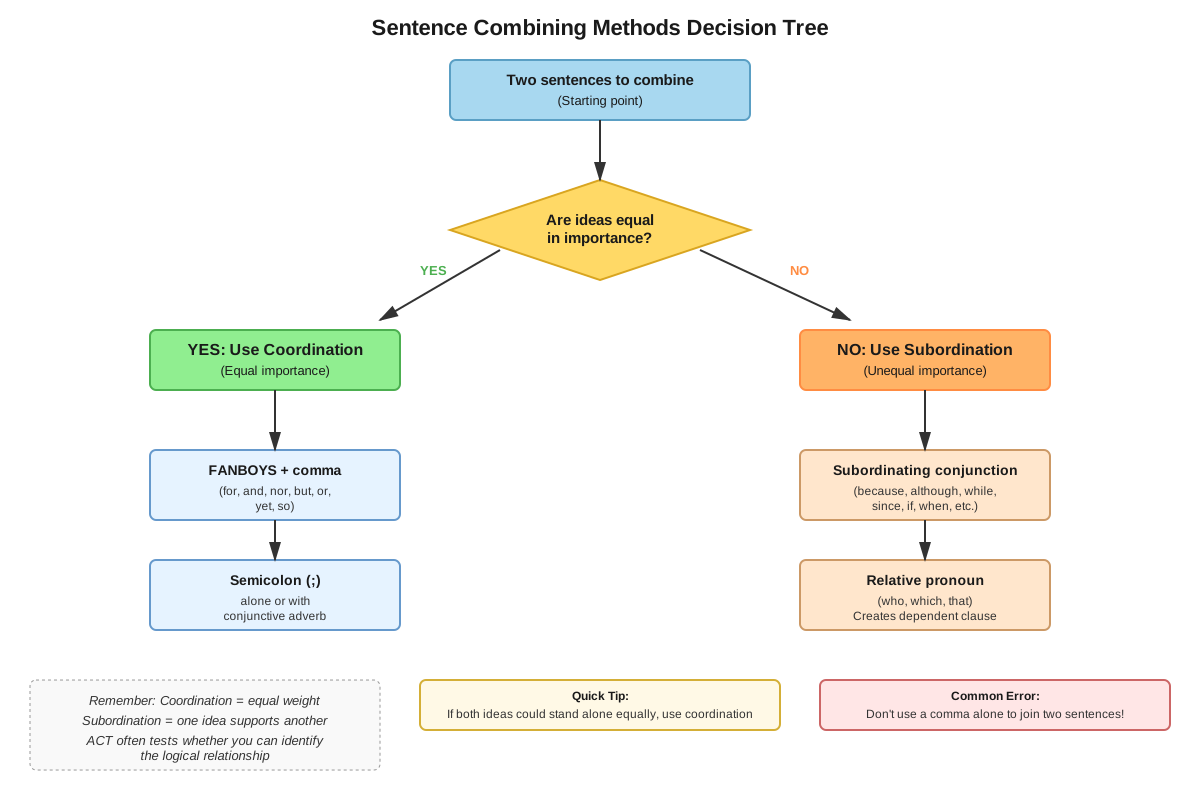
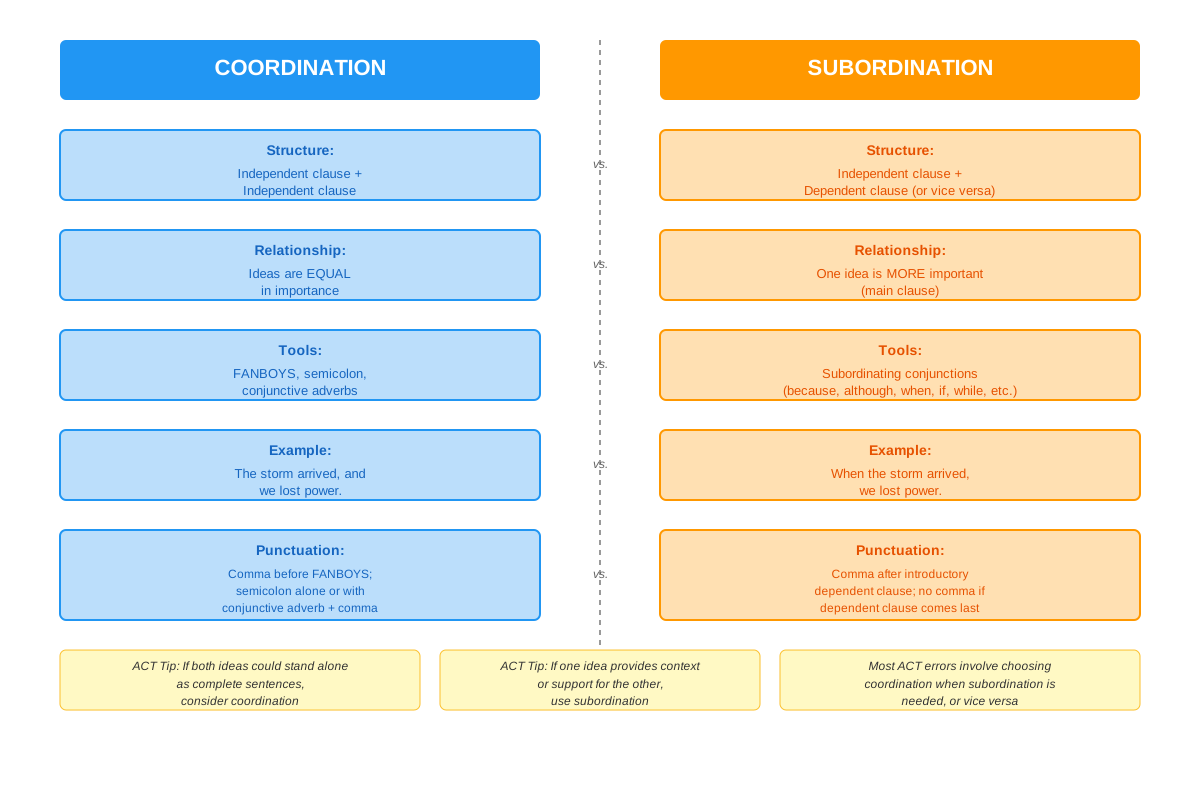
Coordination joins two independent clauses of equal importance using coordinating conjunctions. The seven coordinating conjunctions can be remembered with the acronym FANBOYS: For, And, Nor, But, Or, Yet, So. When using coordination, a comma must precede the coordinating conjunction.
Structure: Independent clause + comma + coordinating conjunction + independent clause
Example:
- Before: "The experiment failed. The scientists learned valuable information."
- After: "The experiment failed, but the scientists learned valuable information."
Coordination works best when both ideas carry equal weight and neither idea depends on the other for meaning. The choice of conjunction matters significantly because each establishes a different relationship:
| Conjunction | Relationship | Example |
|---|---|---|
| And | Addition | "She studied hard, and she passed the test." |
| But/Yet | Contrast | "He was tired, but he continued working." |
| Or | Alternative | "We can leave now, or we can wait until morning." |
| So | Result | "It rained heavily, so the game was cancelled." |
| For | Reason | "She brought an umbrella, for rain was predicted." |
| Nor | Negative addition | "He didn't call, nor did he send a message." |
Subordination
Subordination joins an independent clause with a dependent clause, creating a relationship where one idea depends on the other for complete meaning. This method uses subordinating conjunctions such as "although," "because," "since," "when," "while," "if," "unless," "after," "before," and "though."
Structure: Dependent clause + comma + independent clause OR Independent clause + dependent clause (no comma)
Example:
- Before: "The temperature dropped below freezing. The pipes burst."
- After: "When the temperature dropped below freezing, the pipes burst."
- Alternative: "The pipes burst when the temperature dropped below freezing."
Subordination is appropriate when one idea provides context, cause, condition, or contrast for another idea. The subordinating conjunction signals the specific relationship between the clauses. Choosing subordination over coordination indicates that one idea is more important than the other or that one idea depends on the other for meaning.
Semicolon Connection
Independent clauses that are closely related can be joined with a semicolon without any conjunction. This method works when the relationship between ideas is clear without an explicit connector.
Structure: Independent clause + semicolon + independent clause
Example:
- Before: "The library closes at midnight. Students often study there until closing."
- After: "The library closes at midnight; students often study there until closing."
Semicolons can also be used with conjunctive adverbs (however, therefore, moreover, nevertheless, consequently, furthermore) to show specific relationships:
Structure: Independent clause + semicolon + conjunctive adverb + comma + independent clause
Example: "The experiment succeeded; however, the results were unexpected."
Relative Clauses
Relative clauses use relative pronouns (who, whom, whose, which, that) to combine sentences by turning one sentence into a clause that modifies a noun in the other sentence.
Example:
- Before: "The scientist won the Nobel Prize. She discovered the new element."
- After: "The scientist who discovered the new element won the Nobel Prize."
This method is particularly useful when one sentence provides additional information about a noun in another sentence.
Phrase Reduction
Sometimes sentences can be combined by reducing one sentence to a phrase—eliminating the subject and verb while preserving the essential information.
Example:
- Before: "Maria graduated from college. She immediately started her job search."
- After: "After graduating from college, Maria immediately started her job search."
When NOT to Combine Sentences
Understanding when to keep sentences separate is equally important. Sentences should remain separate when:
- Ideas are distinct and unrelated: Forcing unrelated ideas together creates confusion
- Emphasis is needed: Short sentences create emphasis and impact
- Combining creates awkwardness: If the combined sentence is difficult to read or understand, separation is better
- The passage needs variety: All long sentences become monotonous; mixing lengths improves readability
Avoiding Redundancy in Combining
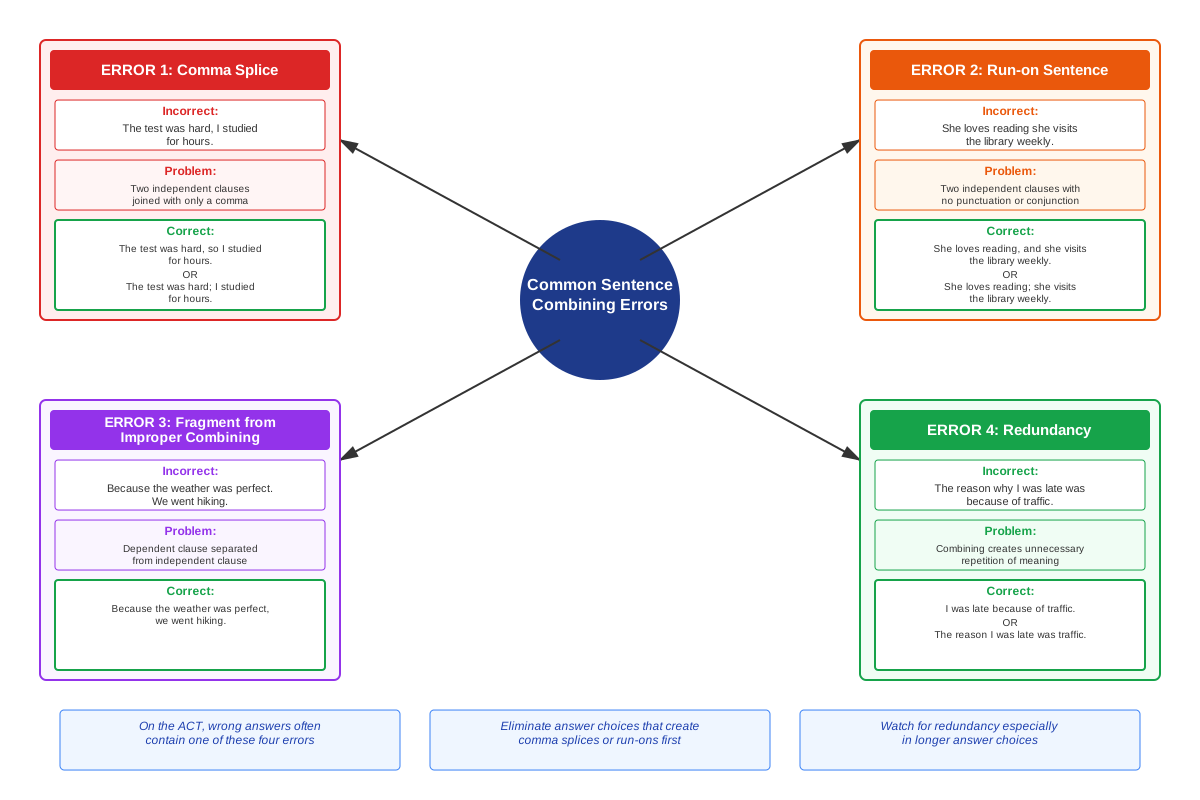
A common error in sentence combining involves creating redundancy—saying the same thing twice in different words. The ACT frequently tests this by offering answer choices that combine sentences but repeat information unnecessarily.
Example of redundant combining:
- Wrong: "The ancient artifact was old and dated back to ancient times."
- Right: "The artifact dated back to ancient times."
Concept Relationships
Sentence combining serves as a central hub connecting multiple ACT English concepts. At its foundation, sentence combining relies on understanding independent and dependent clauses—students must identify which clauses can stand alone before determining how to join them. This clause recognition leads directly to choosing between coordination (for equal ideas) and subordination (for dependent relationships).
The choice of combining method then triggers specific punctuation rules: coordination requires commas before coordinating conjunctions, subordination requires commas after introductory dependent clauses, and semicolons follow their own distinct rules. These punctuation decisions connect sentence combining to the broader category of comma usage, semicolon usage, and colon usage.
Sentence combining also intersects with conciseness and redundancy—one primary reason to combine sentences is to eliminate repetitive information and create more efficient prose. This connection means that sentence combining questions often test multiple skills simultaneously: students must recognize the opportunity to combine, choose the correct method, apply proper punctuation, and eliminate redundancy.
Relationship map: Clause identification → Relationship recognition (equal vs. dependent) → Method selection (coordination, subordination, semicolon, or phrase) → Punctuation application → Redundancy elimination → Effective combined sentence
Additionally, sentence combining connects forward to rhetorical skills questions about organization and style. The ability to combine sentences effectively improves paragraph flow, creates transitions between ideas, and contributes to the overall coherence of a passage—all elements tested in rhetorical skills questions.
Quick check — test yourself on Sentence combining so far.
Try Flashcards →High-Yield Facts
⭐ Coordination requires a comma before the coordinating conjunction when joining two independent clauses
⭐ Subordination requires a comma after an introductory dependent clause but not when the dependent clause follows the independent clause
⭐ Semicolons can only join two independent clauses; they cannot join an independent clause to a dependent clause
⭐ The ACT frequently tests whether students can distinguish between coordination (equal ideas) and subordination (dependent ideas)
⭐ Sentence combining should eliminate redundancy, not create it
- Conjunctive adverbs (however, therefore, moreover) require a semicolon before and a comma after when joining independent clauses
- The relative pronoun "that" is used for essential information, while "which" is used for non-essential information
- Short sentences can be effective for emphasis; not all short sentences should be combined
- Combining sentences with "and" creates addition, while "but" creates contrast—choosing the wrong conjunction changes meaning
- When a sentence combining question offers "DELETE the underlined portion" as an option, consider whether the sentences are better kept separate
Common Misconceptions
Misconception: Any two short sentences should be combined to improve writing quality.
Correction: Sentences should only be combined when they share a clear logical relationship and when combining improves clarity and flow. Short sentences can be effective for emphasis, and forcing unrelated ideas together creates confusion rather than sophistication.
Misconception: A comma alone can join two independent clauses.
Correction: A comma alone creates a comma splice, which is a serious grammatical error. To join two independent clauses, use a comma with a coordinating conjunction, a semicolon, or make one clause dependent through subordination.
Misconception: Semicolons and commas are interchangeable when combining sentences.
Correction: Semicolons can only join two independent clauses that are closely related. Commas must be paired with coordinating conjunctions to join independent clauses. Using a semicolon where a comma is needed (or vice versa) creates a grammatical error.
Misconception: Longer, more complex sentences are always better than shorter ones.
Correction: Effective writing varies sentence length and structure. While combining choppy sentences improves flow, creating overly long, complex sentences can confuse readers. The goal is clarity and variety, not maximum length.
Misconception: The words "however," "therefore," and "moreover" are coordinating conjunctions that can follow a comma.
Correction: These words are conjunctive adverbs, not coordinating conjunctions. They require a semicolon before them (or a period, making a new sentence) and a comma after them when joining independent clauses. Using only a comma before them creates a comma splice.
Misconception: When combining sentences, all information from both original sentences must be preserved.
Correction: Effective sentence combining often involves eliminating redundant information. If both sentences say essentially the same thing in different words, the combined sentence should include the information only once.
Worked Examples
Example 1: Choosing Between Coordination and Subordination
Original passage: "The museum opened a new exhibit. Attendance increased by 40%."
Question: Which of the following best combines these sentences?
A. The museum opened a new exhibit, and attendance increased by 40%.
B. When the museum opened a new exhibit, attendance increased by 40%.
C. The museum opened a new exhibit; attendance increased by 40%.
D. The museum opened a new exhibit, attendance increased by 40%.
Step 1: Identify the relationship between ideas. The first sentence describes an action (opening an exhibit), and the second describes a result (increased attendance). This suggests a cause-and-effect relationship.
Step 2: Evaluate each option:
- Option A uses coordination with "and," which simply adds the ideas without showing causation. This is grammatically correct but doesn't express the relationship as clearly as possible.
- Option B uses subordination with "when," which establishes a time relationship and implies causation. This effectively shows that the attendance increase resulted from the new exhibit.
- Option C uses a semicolon, which is grammatically correct but doesn't explicitly show the cause-and-effect relationship.
- Option D creates a comma splice, which is grammatically incorrect.
Step 3: Select the best answer. Option B is correct because it uses subordination to clearly express the cause-and-effect relationship between the new exhibit and increased attendance. While options A and C are grammatically correct, option B most effectively communicates the logical connection between ideas.
Learning objective addressed: This example demonstrates how to apply sentence combining by evaluating the relationship between ideas and choosing the method that best expresses that relationship.
Example 2: Eliminating Redundancy While Combining
Original passage: "The ancient manuscript was very old. It dated back to medieval times in the Middle Ages."
Question: Which of the following best combines these sentences while eliminating redundancy?
A. The ancient manuscript was very old and dated back to medieval times in the Middle Ages.
B. The ancient manuscript, which was very old, dated back to medieval times.
C. The ancient manuscript dated back to medieval times.
D. Dating back to medieval times in the Middle Ages, the ancient manuscript was very old.
Step 1: Identify redundant information. "Ancient," "very old," "medieval times," and "Middle Ages" all convey essentially the same information—that the manuscript is from a distant historical period.
Step 2: Evaluate each option:
- Option A combines the sentences but preserves all the redundancy, making it wordy and repetitive.
- Option B eliminates some redundancy but still includes both "ancient" and "very old," which are redundant.
- Option C eliminates all redundancy by keeping only the most specific information ("dated back to medieval times") and the necessary subject ("manuscript"). The word "ancient" in "ancient manuscript" is acceptable because it's part of the subject, but the phrase "medieval times" provides more specific information.
- Option D preserves the redundancy and creates an awkward construction.
Step 3: Select the best answer. Option C is correct because it combines the sentences while eliminating all unnecessary repetition. The phrase "dated back to medieval times" conveys all the essential information without redundancy.
Learning objective addressed: This example shows how to identify when sentence combining is being tested alongside conciseness, and how to apply the core strategy of eliminating redundancy while combining sentences.
Exam Strategy
When approaching sentence combining questions on the ACT, follow this systematic process:
Step 1: Identify the question type. Look for underlined portions that include periods, conjunctions, or transition words. Questions asking "Which choice most effectively combines the sentences?" explicitly test sentence combining. Questions with answer choices that vary in punctuation and conjunctions also typically test this skill.
Step 2: Read the surrounding context. Don't just read the underlined portion—read the sentences before and after to understand the flow of ideas and the logical relationships between them.
Step 3: Determine the relationship between ideas. Ask yourself: Are these ideas equal in importance (coordination)? Does one idea depend on the other (subordination)? Is there a cause-and-effect relationship? A contrast? A time sequence? The relationship determines the best combining method.
Step 4: Eliminate grammatically incorrect options first. Look for comma splices, run-ons, and incorrect punctuation. This often eliminates 1-2 answer choices immediately.
Step 5: Check for redundancy. If an option combines the sentences but repeats information unnecessarily, eliminate it. The ACT values conciseness.
Step 6: Consider whether the sentences should remain separate. If "DELETE the underlined portion" or "NO CHANGE" (keeping sentences separate) is an option, evaluate whether combining actually improves the passage. Sometimes short sentences are more effective.
Trigger words and phrases to watch for:
- Questions containing "most effectively combines"
- Questions containing "best joins these sentences"
- Underlined periods between short sentences
- Underlined coordinating conjunctions
- Underlined semicolons or other punctuation between clauses
Process of elimination tips:
- Immediately eliminate comma splices (comma alone between independent clauses)
- Eliminate options that create sentence fragments
- Eliminate options that change the meaning of the original sentences
- Eliminate options that create redundancy
- Eliminate options that use incorrect punctuation with conjunctions
Time allocation: Sentence combining questions should take 20-30 seconds each. If you understand the relationship between ideas and know the punctuation rules, these questions are straightforward. Don't overthink them—trust your knowledge of coordination, subordination, and punctuation rules.
Memory Techniques
FANBOYS acronym: Remember the seven coordinating conjunctions with FANBOYS:
- For
- And
- Nor
- But
- Or
- Yet
- So
Comma + FANBOYS rule: Visualize a comma and a FANBOY holding hands to join two independent clauses. They must work together—neither can do the job alone.
Semicolon = Period: Think of a semicolon as a "weak period." It can only go where a period could go (between two independent clauses), but it shows the ideas are closely related.
AAAWWUBBIS for subordinating conjunctions: Remember common subordinating conjunctions with AAAWWUBBIS:
- After
- Although
- As
- When
- While
- Until
- Because
- Before
- If
- Since
The "Intro Comma" rule: When a dependent clause introduces a sentence (comes first), it needs a comma after it. Visualize the dependent clause as a guest arriving at a party—it needs to be announced (comma) before entering the main event (independent clause).
Relationship visualization: Create a mental image for each relationship type:
- Coordination (equal ideas): Two people standing side by side, equal height
- Subordination (dependent relationship): One person standing on another's shoulders—one supports the other
- Cause and effect: Dominoes falling—one action triggers another
Summary
Sentence combining is a high-frequency ACT English topic that tests students' ability to join sentences, clauses, and phrases effectively while maintaining grammatical correctness and eliminating redundancy. The core strategy involves identifying the logical relationship between ideas and selecting the appropriate combining method: coordination for equal ideas using FANBOYS conjunctions with commas, subordination for dependent relationships using subordinating conjunctions, semicolons for closely related independent clauses, or phrase reduction for conciseness. Success requires understanding that not all sentences should be combined—sometimes separation provides emphasis or clarity. Students must recognize comma splices, apply correct punctuation rules, and eliminate redundancy when combining. The ACT frequently tests the distinction between coordination and subordination, the proper use of commas with coordinating conjunctions, and the ability to identify when combining improves versus harms a passage. Mastering sentence combining requires knowing clause types, understanding logical relationships, applying punctuation rules correctly, and recognizing that effective writing varies sentence length and structure for clarity and engagement.
Key Takeaways
- Sentence combining appears in 10-15% of ACT English questions and tests both grammatical knowledge and rhetorical effectiveness
- Coordination (comma + FANBOYS) joins equal ideas, while subordination creates dependent relationships between clauses
- Semicolons can only join two independent clauses and should be used when ideas are closely related
- Always eliminate redundancy when combining sentences—don't repeat information unnecessarily
- Not all short sentences should be combined; sometimes separation provides emphasis or clarity
- Comma splices (comma alone between independent clauses) are always incorrect
- The relationship between ideas determines the best combining method—identify whether ideas are equal, causal, contrasting, or sequential
Related Topics
Comma Usage: Mastering sentence combining requires deep knowledge of comma rules, particularly with coordinating conjunctions, introductory dependent clauses, and non-essential information. Understanding when commas are required versus optional is essential for combining sentences correctly.
Semicolon and Colon Usage: These punctuation marks provide alternative methods for combining sentences. Semicolons join closely related independent clauses, while colons introduce explanations or lists. Mastering these tools expands combining options.
Coordination and Subordination: These concepts form the theoretical foundation of sentence combining. Deeper study of how coordination and subordination affect meaning and emphasis will strengthen combining skills.
Conciseness and Redundancy: Sentence combining often serves the goal of creating more concise writing. Understanding how to eliminate wordiness and repetition is essential for effective combining.
Parallel Structure: When combining sentences that contain lists or multiple elements, maintaining parallel structure becomes critical. This topic builds on sentence combining skills.
Practice CTA
Now that you understand the principles and strategies of sentence combining, it's time to apply this knowledge! Work through the practice questions to test your ability to identify combining opportunities, choose the correct method, and apply proper punctuation. The flashcards will help you memorize key rules and relationships. Remember, sentence combining is one of the most frequently tested topics on the ACT English section—mastering it will significantly boost your score. Each practice question you complete strengthens your pattern recognition and builds the confidence you need to tackle these questions quickly and accurately on test day. You've got this!
Sign up free to keep reading
Create a free AnvayaPrep account to finish this ACT guide on Sentence combining — plus flashcards and practice questions.