Overview
Coordination and subordination represent two fundamental methods for combining ideas within sentences, and mastering these concepts is critical for success on the ACT English test. These grammatical structures determine how independent and dependent clauses relate to one another, affecting both the logical flow and grammatical correctness of sentences. On the ACT, approximately 15-20% of all English questions test your ability to recognize proper coordination and subordination, making this one of the highest-yield topics in the Sentence Structure unit.
The ACT frequently tests whether students can identify when two ideas should be joined as equals (coordination) or when one idea should be subordinated to support another (subordination). Questions may ask you to choose the correct conjunction, determine whether a comma or semicolon is appropriate, or recognize when a sentence structure creates a fragment or run-on. Understanding ACT coordination and subordination requires not just memorizing rules, but developing an intuitive sense of logical relationships between ideas.
This topic connects directly to other essential English concepts including punctuation, sentence fragments, run-on sentences, and parallel structure. Strong coordination and subordination skills enable you to construct sophisticated, varied sentences while avoiding common grammatical errors. The ability to recognize and correct coordination and subordination errors will improve your performance across multiple question types on the ACT English section.
Learning Objectives
- [ ] Identify when coordination and subordination is being tested in ACT questions
- [ ] Explain the core rule or strategy behind coordination and subordination
- [ ] Apply coordination and subordination to ACT-style questions accurately
- [ ] Distinguish between coordinating and subordinating conjunctions and their appropriate uses
- [ ] Recognize when a sentence requires coordination versus subordination based on logical relationships
- [ ] Correct common errors involving improper coordination and subordination
- [ ] Evaluate whether conjunctions and punctuation properly reflect the relationship between clauses
Prerequisites
- Independent and dependent clauses: Understanding the difference between clauses that can stand alone and those that cannot is fundamental to applying coordination and subordination rules correctly
- Basic punctuation rules: Knowledge of comma, semicolon, and period usage is essential since coordination and subordination directly affect punctuation choices
- Subject-verb agreement: Recognizing complete thoughts requires identifying subjects and verbs within clauses
- Sentence fragments and run-ons: These errors often result from improper coordination or subordination, so familiarity with them helps identify when these concepts are being tested
Why This Topic Matters
In academic and professional writing, the ability to combine ideas effectively distinguishes sophisticated writers from novice ones. Coordination and subordination allow writers to show relationships between ideas, emphasize important information, and create sentence variety that engages readers. These skills transfer directly to college-level writing, where complex argumentation requires precise expression of logical relationships.
On the ACT English test, coordination and subordination questions appear in approximately 8-12 questions per test, representing roughly 10-15% of the 75 total English questions. These questions typically appear in three formats: choosing the correct conjunction, selecting appropriate punctuation to join clauses, and identifying whether a sentence structure properly expresses the logical relationship between ideas. The ACT particularly favors testing students' ability to recognize when a coordinating conjunction creates a run-on sentence or when a subordinating conjunction creates an inappropriate fragment.
Common question stems include "Which choice best connects the two ideas?" or "Which conjunction most effectively shows the relationship between these clauses?" The test also embeds coordination and subordination within revision questions that ask about sentence effectiveness or logical flow. Because these questions test both grammatical correctness and rhetorical effectiveness, they require deeper understanding than simple rule memorization.
Core Concepts
Understanding Coordination
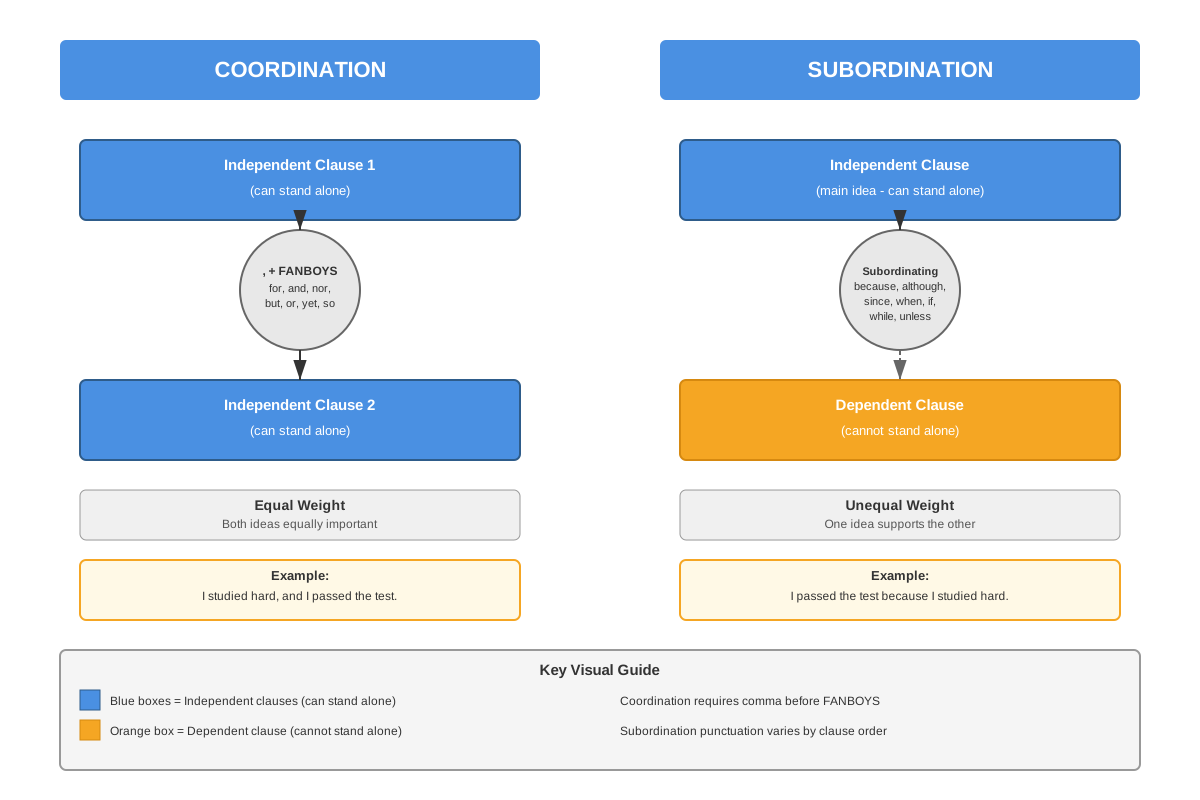
Coordination joins two or more grammatically equal elements—typically independent clauses—to show that ideas have equal importance or weight. When coordinating independent clauses, writers use coordinating conjunctions (for, and, nor, but, or, yet, so—remembered by the acronym FANBOYS) preceded by a comma, or they use a semicolon alone.
The key principle of coordination is equality: both clauses must be able to stand alone as complete sentences. Consider this example:
- Correct: "The student studied diligently, and she earned a perfect score."
- Correct: "The student studied diligently; she earned a perfect score."
Both clauses ("The student studied diligently" and "she earned a perfect score") are independent and can function as separate sentences. The coordinating conjunction "and" or the semicolon shows they are related but equally important ideas.
Each coordinating conjunction conveys a specific logical relationship:
| Conjunction | Relationship | Example |
|---|---|---|
| for | Reason/cause | "She succeeded, for she prepared thoroughly." |
| and | Addition | "He studied grammar, and he practiced writing." |
| nor | Negative addition | "He didn't study, nor did he attend class." |
| but | Contrast | "She was nervous, but she performed well." |
| or | Alternative | "Study now, or struggle later." |
| yet | Contrast/concession | "The test was difficult, yet most students passed." |
| so | Result/effect | "He missed class, so he failed the quiz." |
Understanding Subordination
Subordination creates a hierarchy between clauses by making one clause dependent on another. The dependent clause (also called a subordinate clause) cannot stand alone and must be attached to an independent clause to form a complete sentence. Writers create subordination using subordinating conjunctions such as although, because, since, when, while, if, unless, after, before, until, and whereas.
The fundamental principle of subordination is that it shows one idea is less important than, or provides context for, another idea. The subordinate clause typically provides background information, conditions, reasons, or contrasts that support the main clause.
Consider these examples:
- "Although the test was challenging, most students performed well."
- "The students celebrated because they had finished their exams."
- "When the bell rang, everyone left quickly."
In each example, the clause beginning with the subordinating conjunction depends on the independent clause for complete meaning. Notice that subordinate clauses can appear at the beginning or end of sentences, with comma usage depending on position.
Punctuation Rules for Coordination and Subordination
Proper punctuation is inseparable from coordination and subordination. The ACT frequently tests whether students can match punctuation to sentence structure.
Coordination punctuation rules:
- Independent clause + comma + coordinating conjunction + independent clause
- Independent clause + semicolon + independent clause
- Independent clause + semicolon + conjunctive adverb + comma + independent clause (e.g., "however," "therefore," "moreover")
Subordination punctuation rules:
- Subordinate clause + comma + independent clause (introductory dependent clause requires comma)
- Independent clause + subordinate clause (no comma when dependent clause follows)
- Exception: Use comma with "although," "though," "even though," and "whereas" regardless of position when they show strong contrast
Common Coordination and Subordination Errors
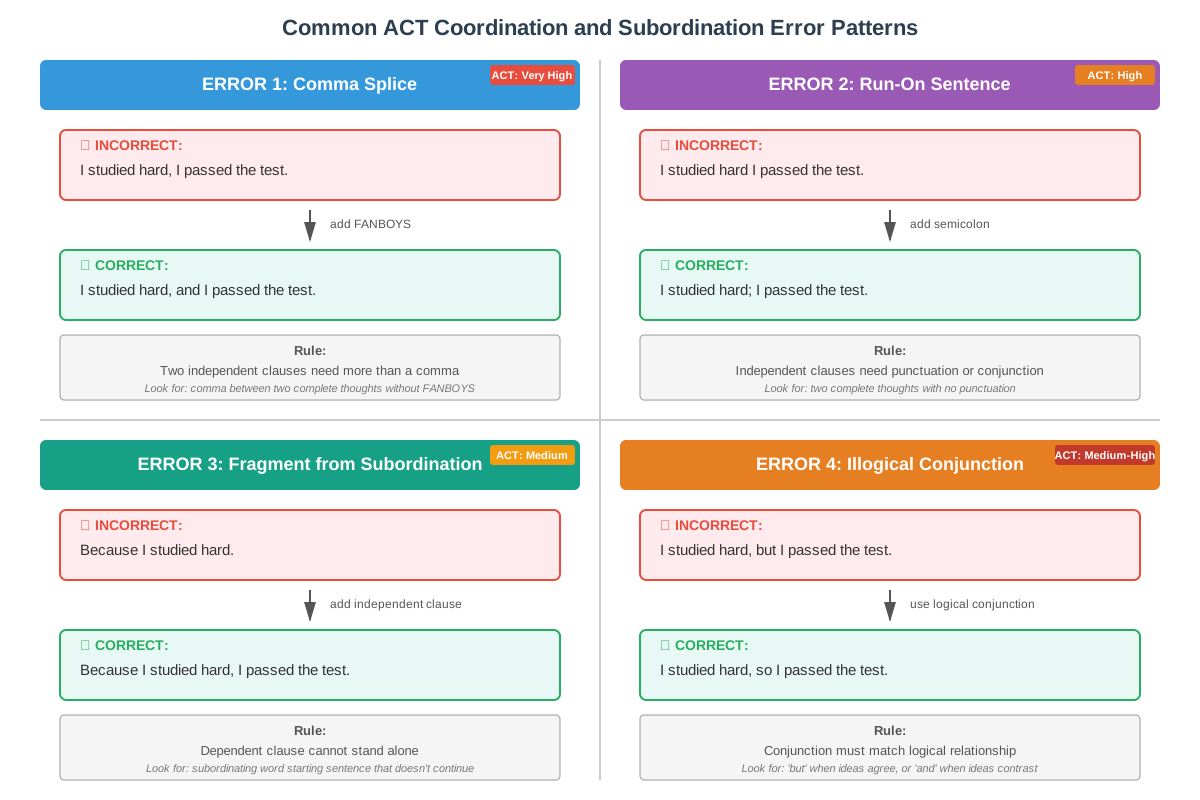
The ACT tests several recurring error patterns:
Comma splices: Joining two independent clauses with only a comma (no conjunction)
- Incorrect: "The student studied hard, she passed the test."
- Correct: "The student studied hard, and she passed the test."
Run-on sentences: Joining two independent clauses with no punctuation
- Incorrect: "The test was difficult most students passed."
- Correct: "The test was difficult, but most students passed."
Fragments from subordination: Starting a sentence with a subordinating conjunction but failing to include an independent clause
- Incorrect: "Because the student studied hard."
- Correct: "Because the student studied hard, she passed the test."
Illogical conjunctions: Using a conjunction that doesn't match the logical relationship
- Incorrect: "She studied for hours, so she failed the test." (illogical cause-effect)
- Correct: "She studied for hours, yet she failed the test." (shows unexpected contrast)
Choosing Between Coordination and Subordination
The ACT often tests whether students can determine which structure better expresses the relationship between ideas. This requires understanding the logical connection:
Use coordination when:
- Ideas are equally important
- Ideas are parallel or similar in nature
- You want to show addition, contrast, or result between equal ideas
Use subordination when:
- One idea provides context, reason, or condition for another
- One idea is clearly less important than the other
- You want to emphasize one idea over another
- You need to show time relationships, cause-effect, or conditions
Example comparison:
- Coordination: "The weather was terrible, but we continued hiking." (equal emphasis on both facts)
- Subordination: "Although the weather was terrible, we continued hiking." (emphasizes the decision to continue)
Concept Relationships
Coordination and subordination form the foundation of sentence structure complexity. Coordination connects to parallel structure because coordinated elements must be grammatically parallel. When you coordinate clauses, you must ensure they have similar grammatical forms and logical weight.
Subordination directly relates to sentence fragments because improper subordination—using a subordinating conjunction without completing the sentence with an independent clause—creates fragments. Understanding subordination also connects to comma usage since the position of dependent clauses determines comma placement.
Both coordination and subordination relate to run-on sentences and comma splices. Improper coordination (missing conjunctions or incorrect punctuation) creates these errors. The relationship flows as follows:
Independent clauses → require proper joining → through coordination (equal ideas) OR subordination (unequal ideas) → determines punctuation → affects sentence correctness → impacts clarity and effectiveness
Additionally, these concepts connect to rhetorical skills questions about sentence effectiveness. The ACT may ask which version best expresses an idea, requiring you to evaluate whether coordination or subordination better serves the writer's purpose. This connects coordination and subordination to broader concepts of emphasis, conciseness, and logical flow.
Quick check — test yourself on Coordination and subordination so far.
Try Flashcards →High-Yield Facts
⭐ Coordinating conjunctions (FANBOYS) must be preceded by a comma when joining two independent clauses
⭐ A semicolon can join two independent clauses without any conjunction
⭐ Subordinating conjunctions create dependent clauses that cannot stand alone as sentences
⭐ When a dependent clause begins a sentence, it must be followed by a comma before the independent clause
⭐ When a dependent clause ends a sentence, no comma is needed (with exceptions for strong contrast words)
- A comma alone cannot join two independent clauses (this creates a comma splice)
- Conjunctive adverbs (however, therefore, moreover) require a semicolon before them and a comma after when joining independent clauses
- The conjunction "so" shows result or consequence, not addition
- "Yet" and "but" both show contrast, but "yet" emphasizes unexpectedness
- Common subordinating conjunctions include: although, because, since, when, while, if, unless, after, before, until, whereas, though
- Two independent clauses joined without proper punctuation or conjunction create a run-on sentence
- The logical relationship between ideas should determine whether to use coordination or subordination
- "For" as a coordinating conjunction means "because" and is relatively formal
- Subordination allows writers to de-emphasize less important information
- The ACT prefers concise, clear coordination and subordination over wordy constructions
Common Misconceptions
Misconception: Any two sentences can be joined with a comma and "and."
Correction: While "and" is versatile, it should only join ideas that have a logical additive or sequential relationship. Using "and" to join unrelated ideas creates confusion even if grammatically correct.
Misconception: Semicolons and commas are interchangeable.
Correction: Semicolons join independent clauses of equal weight; commas cannot join independent clauses without a coordinating conjunction. Using a comma alone creates a comma splice error.
Misconception: All dependent clauses require commas.
Correction: Only dependent clauses that begin sentences require commas. When a dependent clause follows an independent clause, no comma is typically needed (exceptions exist for contrast words like "although").
Misconception: "However" is a coordinating conjunction.
Correction: "However" is a conjunctive adverb, not a coordinating conjunction. It requires a semicolon before it (or a period, making it start a new sentence) and a comma after it when joining independent clauses.
Misconception: Longer sentences always need subordination.
Correction: Sentence length doesn't determine structure. Short sentences can use subordination, and longer sentences might use coordination. The logical relationship between ideas determines the appropriate structure.
Misconception: Starting a sentence with "because" always creates a fragment.
Correction: Starting with "because" creates a dependent clause, but if you complete the sentence with an independent clause, it's grammatically correct: "Because it rained, we stayed inside."
Misconception: "So" and "therefore" are interchangeable.
Correction: "So" is a coordinating conjunction requiring only a comma before it. "Therefore" is a conjunctive adverb requiring a semicolon before it and comma after it.
Worked Examples
Example 1: Identifying and Correcting Coordination Errors
Question: The students completed their research papers, they submitted them before the deadline.
Which of the following is the best revision?
A. NO CHANGE
B. papers; and they submitted
C. papers, and they submitted
D. papers and they submitted
Solution:
Step 1: Identify the clause structure.
- "The students completed their research papers" = independent clause (has subject "students" and verb "completed")
- "they submitted them before the deadline" = independent clause (has subject "they" and verb "submitted")
Step 2: Analyze the current punctuation.
The sentence uses only a comma to join two independent clauses, creating a comma splice error. Choice A is incorrect.
Step 3: Evaluate each option.
- Choice B: "papers; and they submitted" - Incorrect. A semicolon should not be used with a coordinating conjunction. Use either semicolon alone OR comma + conjunction, not both.
- Choice C: "papers, and they submitted" - Correct. This uses the proper pattern: independent clause + comma + coordinating conjunction + independent clause. The conjunction "and" logically shows the sequential relationship.
- Choice D: "papers and they submitted" - Incorrect. When joining two independent clauses with a coordinating conjunction, a comma is required before the conjunction.
Step 4: Verify the logical relationship.
The ideas show a sequence of events (completing, then submitting), making "and" the appropriate coordinating conjunction.
Answer: C
This question tests the core coordination rule: independent clauses joined by coordinating conjunctions require a comma before the conjunction.
Example 2: Choosing Between Coordination and Subordination
Question: The experiment yielded unexpected results. The researchers decided to repeat the entire procedure.
Which of the following best combines these sentences to show the logical relationship?
A. The experiment yielded unexpected results, and the researchers decided to repeat the entire procedure.
B. Because the experiment yielded unexpected results, the researchers decided to repeat the entire procedure.
C. The experiment yielded unexpected results; the researchers decided to repeat the entire procedure.
D. The experiment yielded unexpected results, the researchers decided to repeat the entire procedure.
Solution:
Step 1: Determine the logical relationship between ideas.
The unexpected results caused or motivated the decision to repeat the procedure. This is a cause-effect relationship.
Step 2: Evaluate each option.
- Choice A: Uses coordination with "and," which shows addition or sequence but doesn't emphasize the causal relationship. This is grammatically correct but rhetorically weak.
- Choice B: Uses subordination with "because," which explicitly shows the cause-effect relationship. The subordinate clause ("Because the experiment yielded unexpected results") provides the reason for the main action (repeating the procedure). This is both grammatically correct and rhetorically effective.
- Choice C: Uses a semicolon to coordinate the clauses, treating them as equally important. This doesn't emphasize the causal relationship.
- Choice D: Creates a comma splice error (two independent clauses joined by only a comma).
Step 3: Select the most effective option.
While A and C are grammatically correct, B best expresses the logical relationship by subordinating the cause to emphasize the effect.
Answer: B
This question demonstrates that choosing between coordination and subordination depends on the logical relationship you want to emphasize, not just grammatical correctness.
Exam Strategy
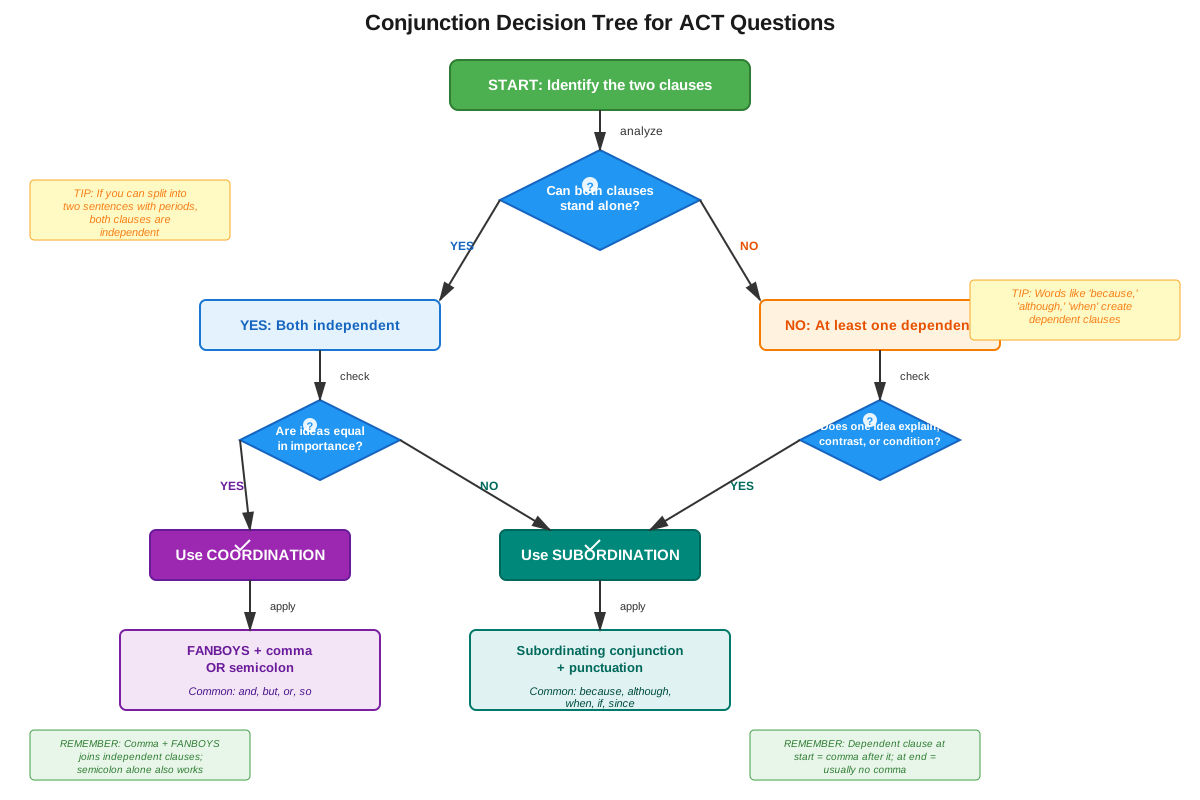
When approaching ACT questions testing coordination and subordination, follow this systematic process:
Step 1: Identify clause structure
Quickly determine whether you're dealing with independent clauses, dependent clauses, or a combination. Look for subjects and verbs to identify complete thoughts.
Step 2: Check for trigger words
Watch for coordinating conjunctions (FANBOYS), subordinating conjunctions (because, although, when, etc.), and conjunctive adverbs (however, therefore, moreover). These signal that coordination or subordination is being tested.
Step 3: Verify punctuation matches structure
- Independent + independent = comma + FANBOYS OR semicolon alone
- Dependent + independent = comma after dependent clause
- Independent + dependent = usually no comma
Step 4: Evaluate logical relationships
Ask yourself: Are these ideas equal in importance (coordination) or is one supporting the other (subordination)? Does the conjunction match the logical relationship (contrast, cause, addition, etc.)?
Step 5: Eliminate obvious errors
Immediately eliminate choices that create comma splices, run-ons, or fragments. On the ACT, these are always incorrect.
Exam Tip: When you see two independent clauses in a question, immediately check the punctuation and conjunction. About 70% of coordination/subordination questions involve this pattern.
Time-saving strategies:
- If you see a comma between two complete sentences with no FANBOYS conjunction, it's wrong (comma splice)
- If you see a semicolon + coordinating conjunction, it's wrong (use one or the other, not both)
- If a sentence starts with a subordinating conjunction but has no independent clause, it's wrong (fragment)
- When choosing between grammatically correct options, select the one that best shows the logical relationship
Common trigger phrases in questions:
- "Which choice best connects these ideas?"
- "Which conjunction most effectively shows the relationship?"
- "Which revision corrects the error in the underlined portion?"
- "Which choice provides the most logical transition?"
Memory Techniques
FANBOYS Acronym: Remember the seven coordinating conjunctions with this classic mnemonic:
- For
- And
- Nor
- But
- Or
- Yet
- So
Comma + FANBOYS = Friends: Think of coordinating conjunctions as "friends" that bring two equal ideas together, but they need a comma to hold hands.
Subordination = Sub-ordinate (Below): The word "subordinate" means "below in rank." Subordinate clauses are "below" or less important than independent clauses—they can't stand alone.
The Semicolon Bridge: Visualize a semicolon as a bridge connecting two equal islands (independent clauses). The bridge is strong enough on its own—it doesn't need help from FANBOYS.
AAAWWUBBIS for Subordinating Conjunctions: Remember common subordinating conjunctions:
- After
- Although
- As
- When
- While
- Until
- Because
- Before
- If
- Since
The Dependent Clause Rule: "If it starts dependent, comma it." When a dependent clause begins a sentence, it needs a comma before the independent clause that follows.
Visualization for Comma Splices: Picture a comma as a weak link that breaks under the weight of two independent clauses. It needs a FANBOYS conjunction to strengthen it, or you need to upgrade to a semicolon.
Summary
Coordination and subordination are essential sentence-combining techniques that the ACT tests extensively throughout the English section. Coordination joins grammatically equal elements—typically independent clauses—using coordinating conjunctions (FANBOYS) with commas or semicolons alone. Subordination creates a hierarchy by making one clause dependent on another using subordinating conjunctions like because, although, when, and while. The ACT tests whether students can identify proper punctuation for these structures, recognize errors like comma splices and run-ons, and choose the structure that best expresses logical relationships between ideas. Success requires memorizing the coordinating conjunctions, understanding that independent clauses need proper joining (comma + FANBOYS or semicolon), knowing that dependent clauses beginning sentences require commas, and recognizing that the logical relationship between ideas should determine whether to coordinate or subordinate. These concepts connect directly to sentence fragments, run-ons, punctuation, and rhetorical effectiveness questions.
Key Takeaways
- Coordinating conjunctions (FANBOYS) require a comma before them when joining two independent clauses
- Semicolons can join independent clauses without any conjunction, but never use semicolon + FANBOYS together
- Subordinating conjunctions create dependent clauses that must attach to independent clauses to form complete sentences
- Dependent clauses at the beginning of sentences require commas; those at the end typically don't
- Comma splices (comma alone joining independent clauses) and run-ons (no punctuation joining independent clauses) are always incorrect
- Choose coordination when ideas are equal in importance; choose subordination when one idea supports or provides context for another
- The logical relationship between ideas (cause-effect, contrast, addition, time) should determine which conjunction to use
Related Topics
Parallel Structure: Coordination requires that joined elements be grammatically parallel. Mastering coordination and subordination prepares you to recognize when coordinated items must have matching grammatical forms.
Sentence Fragments and Run-ons: These errors often result from improper coordination or subordination. Understanding how to properly join clauses prevents these common mistakes.
Comma Usage: Many comma rules directly relate to coordination and subordination, including comma placement with introductory dependent clauses and coordinating conjunctions.
Rhetorical Skills - Sentence Effectiveness: Advanced questions ask which sentence structure best achieves a rhetorical purpose, requiring you to evaluate whether coordination or subordination better serves the writer's goals.
Transitions and Logical Flow: Coordinating and subordinating conjunctions function as transitions between ideas, connecting this topic to broader questions about paragraph organization and coherence.
Practice CTA
Now that you've mastered the concepts of coordination and subordination, it's time to reinforce your learning through active practice. Complete the practice questions to test your ability to identify coordination and subordination errors, apply the rules you've learned, and develop the quick recognition skills essential for ACT success. Use the flashcards to memorize coordinating and subordinating conjunctions until you can recall them instantly. Remember: understanding these concepts intellectually is just the first step—consistent practice transforms knowledge into the automatic recognition skills that lead to perfect scores. You've got this!
Sign up free to keep reading
Create a free AnvayaPrep account to finish this ACT guide on Coordination and subordination — plus flashcards and practice questions.