Overview
Sentence fragments represent one of the most frequently tested concepts in the ACT English section, appearing in approximately 10-15% of all sentence structure questions. A sentence fragment is an incomplete sentence that lacks either a subject, a predicate, or fails to express a complete thought despite having both elements. Understanding how to identify and correct fragments is crucial for achieving a high score on the ACT, as these errors often appear disguised within complex passages where they can easily be overlooked.
The ACT tests sentence fragments in subtle and sophisticated ways that go beyond simple identification. Test-makers deliberately craft passages where fragments may sound correct when read quickly, particularly when they follow complete sentences or contain multiple words that create the illusion of completeness. Students must develop a systematic approach to analyzing sentence structure, recognizing that length does not equal completeness—a fragment can be quite long, while a complete sentence might be remarkably short.
Mastering ACT sentence fragments connects directly to broader concepts in sentence structure, including run-on sentences, comma splices, and proper punctuation usage. This topic serves as a foundational element for understanding how independent and dependent clauses function, how subordinating conjunctions affect sentence completeness, and how punctuation marks signal relationships between ideas. Success with fragments enhances overall writing clarity and prepares students for more advanced concepts in sentence construction and rhetorical skills.
Learning Objectives
- [ ] Identify when sentence fragments is being tested in ACT English passages
- [ ] Explain the core rule or strategy behind recognizing and correcting sentence fragments
- [ ] Apply sentence fragments knowledge to ACT-style questions accurately
- [ ] Distinguish between dependent clauses, phrases, and complete sentences in context
- [ ] Recognize common fragment patterns involving subordinating conjunctions and relative pronouns
- [ ] Evaluate multiple correction options to select the most effective solution for fragment errors
- [ ] Analyze complex sentences to determine whether all clauses can stand independently
Prerequisites
- Independent and dependent clauses: Understanding the difference between clauses that can stand alone and those that cannot is essential for identifying fragments, as most fragments are dependent clauses incorrectly punctuated as complete sentences.
- Subject-verb agreement: Recognizing subjects and verbs within clauses helps determine whether a sentence contains the minimum requirements for completeness.
- Basic punctuation rules: Knowledge of how periods, commas, and semicolons function is necessary because fragments often result from incorrect punctuation choices that separate dependent clauses from independent ones.
- Parts of speech: Familiarity with conjunctions, particularly subordinating conjunctions, enables students to identify words that create dependent clauses and potential fragments.
Why This Topic Matters
Sentence fragments appear in real-world writing more frequently than many realize, particularly in informal communication, advertising copy, and creative writing where fragments may be used intentionally for stylistic effect. However, in formal academic and professional writing—the standard the ACT upholds—fragments represent serious errors that undermine credibility and clarity. Understanding fragments helps students become more effective communicators in college essays, research papers, business correspondence, and any context requiring formal written communication.
On the ACT English section, sentence fragment questions typically appear 3-5 times per test, making them a high-yield topic that directly impacts scores. These questions most commonly appear in the "Conventions of Standard English" category, specifically under sentence structure and formation. The ACT presents fragments in several distinct formats: as underlined portions requiring correction, as punctuation choices that create or eliminate fragments, and as questions asking whether a sentence should be divided or combined with adjacent sentences.
Fragment questions on the ACT often appear in passages discussing complex topics where multiple clauses and sophisticated sentence structures create opportunities for errors. Test-makers frequently place fragments after semicolons, following transitional phrases, or as dependent clauses beginning with subordinating conjunctions like "although," "because," "since," or "while." The exam also tests fragments created by relative pronouns ("which," "that," "who") that introduce dependent clauses incorrectly separated from main clauses. Recognizing these patterns enables students to quickly identify potential fragment issues and apply systematic correction strategies.
Core Concepts
Definition of Complete Sentences
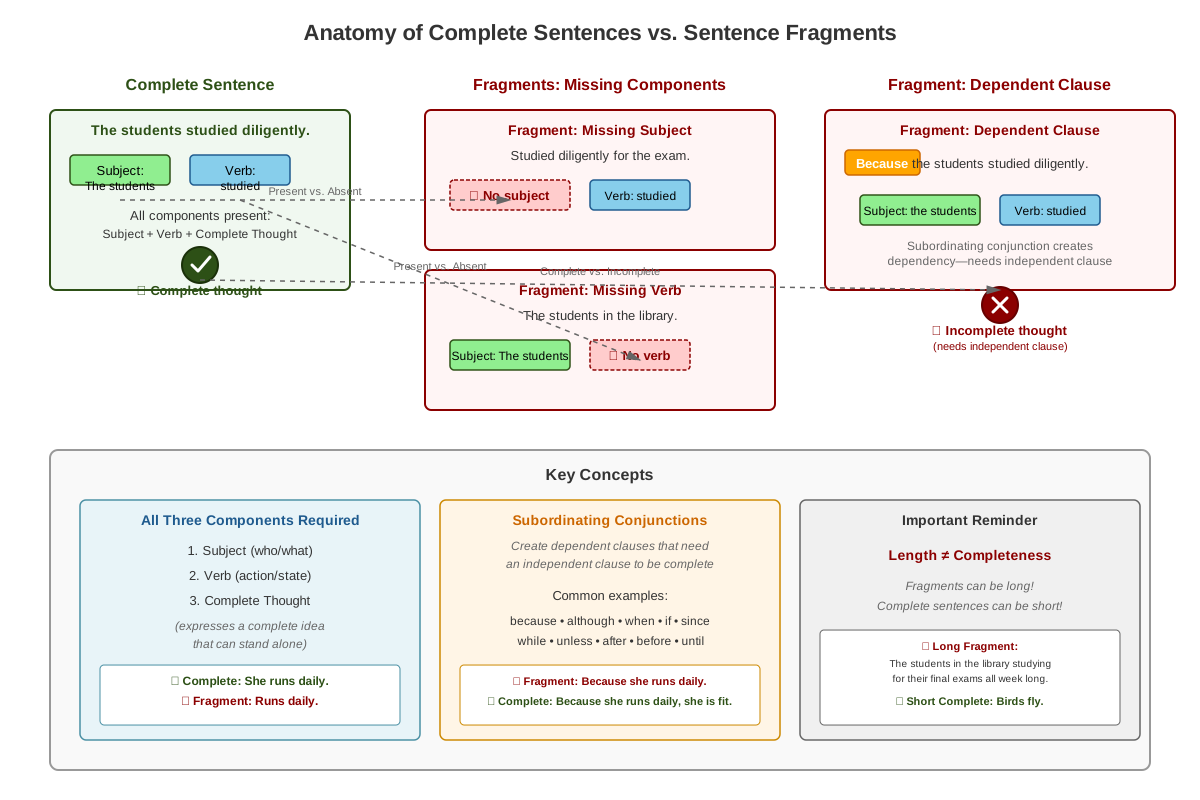
A complete sentence must contain three essential elements: a subject (who or what the sentence is about), a predicate (a verb and any associated information about what the subject does or is), and a complete thought (the sentence must make sense standing alone). All three elements must be present simultaneously for a sentence to be grammatically complete. The sentence "The dog barked" is complete because it has a subject (dog), a predicate (barked), and expresses a complete thought. However, "Because the dog barked" contains a subject and predicate but fails to express a complete thought due to the subordinating conjunction "because," making it a fragment.
The completeness test requires reading a potential sentence in isolation, without context from surrounding sentences. If the sentence leaves the reader waiting for additional information or wondering "what happened?" or "so what?", it likely lacks completeness. This test proves particularly valuable on the ACT, where fragments often sound acceptable when read within a paragraph but fail when examined independently.
Types of Sentence Fragments
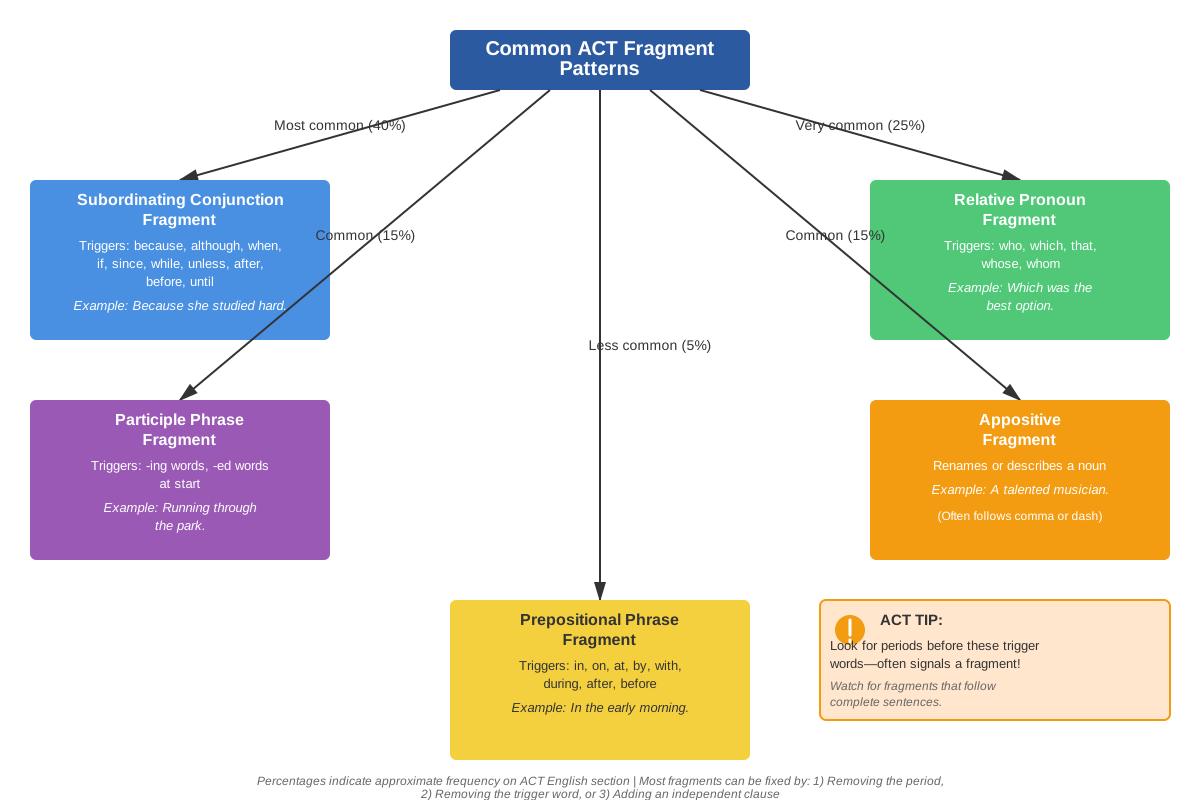
Dependent clause fragments represent the most common type tested on the ACT. These fragments occur when a dependent clause—a clause beginning with a subordinating conjunction or relative pronoun—is punctuated as a complete sentence. Subordinating conjunctions include words like although, because, since, when, while, if, unless, until, after, before, and though. When these words begin a clause, they create dependency, meaning the clause cannot stand alone. For example: "Although she studied for three hours." This fragment contains a subject (she) and verb (studied) but remains incomplete because "although" creates an expectation of additional information.
Relative clause fragments occur when clauses beginning with relative pronouns (who, whom, whose, which, that) are separated from the nouns they modify. These fragments often appear after periods or semicolons when they should remain connected to the preceding independent clause. Example: "The scientist made a groundbreaking discovery. Which changed the field forever." The second portion is a fragment because "which" introduces a dependent clause that must attach to the noun it modifies (discovery).
Phrase fragments lack either a subject or a verb, or both. These include prepositional phrase fragments ("In the morning before sunrise"), participial phrase fragments ("Running quickly through the park"), infinitive phrase fragments ("To complete the assignment on time"), and appositive fragments ("A dedicated student with excellent grades"). While these phrases can function as sentence components, they cannot stand alone as complete sentences.
Missing subject fragments occur when a sentence lacks a clear subject, often appearing as a verb phrase or predicate without identification of who or what performs the action. Example: "Walked to the store and bought groceries." This fragment has verbs (walked, bought) but no subject performing these actions.
Missing verb fragments contain a subject but lack a complete verb or predicate. Example: "The students in the classroom after lunch." This fragment has a subject (students) but no verb indicating what the students did or were.
Fragment Identification Strategies
| Strategy | Application | Example |
|---|---|---|
| Isolation test | Read the sentence alone, ignoring context | "Because it was raining." → Incomplete thought |
| Subject-verb check | Identify both subject and verb | "The book on the table." → Has subject, lacks verb |
| Subordination scan | Look for subordinating conjunctions at the start | "While studying for exams." → Creates dependency |
| Relative pronoun check | Identify clauses beginning with who, which, that | "Which was unexpected." → Dependent clause |
| Complete thought test | Ask if the sentence answers a question fully | "After the game ended." → Leaves reader waiting |
Common Fragment Patterns on the ACT
The ACT consistently presents fragments in predictable patterns. Pattern 1: Subordinating conjunction fragments appear when a dependent clause beginning with a subordinating conjunction is incorrectly separated from an independent clause. The test often places a period or semicolon where a comma should appear, or places a comma where no punctuation is needed.
Pattern 2: Transitional phrase fragments occur when transitional expressions like "for example," "such as," "including," or "especially" introduce phrases that cannot stand alone. Example: "The team needed several supplies. Such as uniforms, equipment, and transportation."
Pattern 3: Appositive fragments happen when a noun phrase that renames or describes another noun is separated from the sentence containing that noun. Example: "Dr. Martinez received the award. A recognition of her decades of research."
Pattern 4: -ing and -ed phrase fragments involve participial phrases incorrectly punctuated as complete sentences. Example: "The students completed their projects. Working late into the night." The second portion is a fragment because "working" is a participle, not a complete verb.
Correction Methods
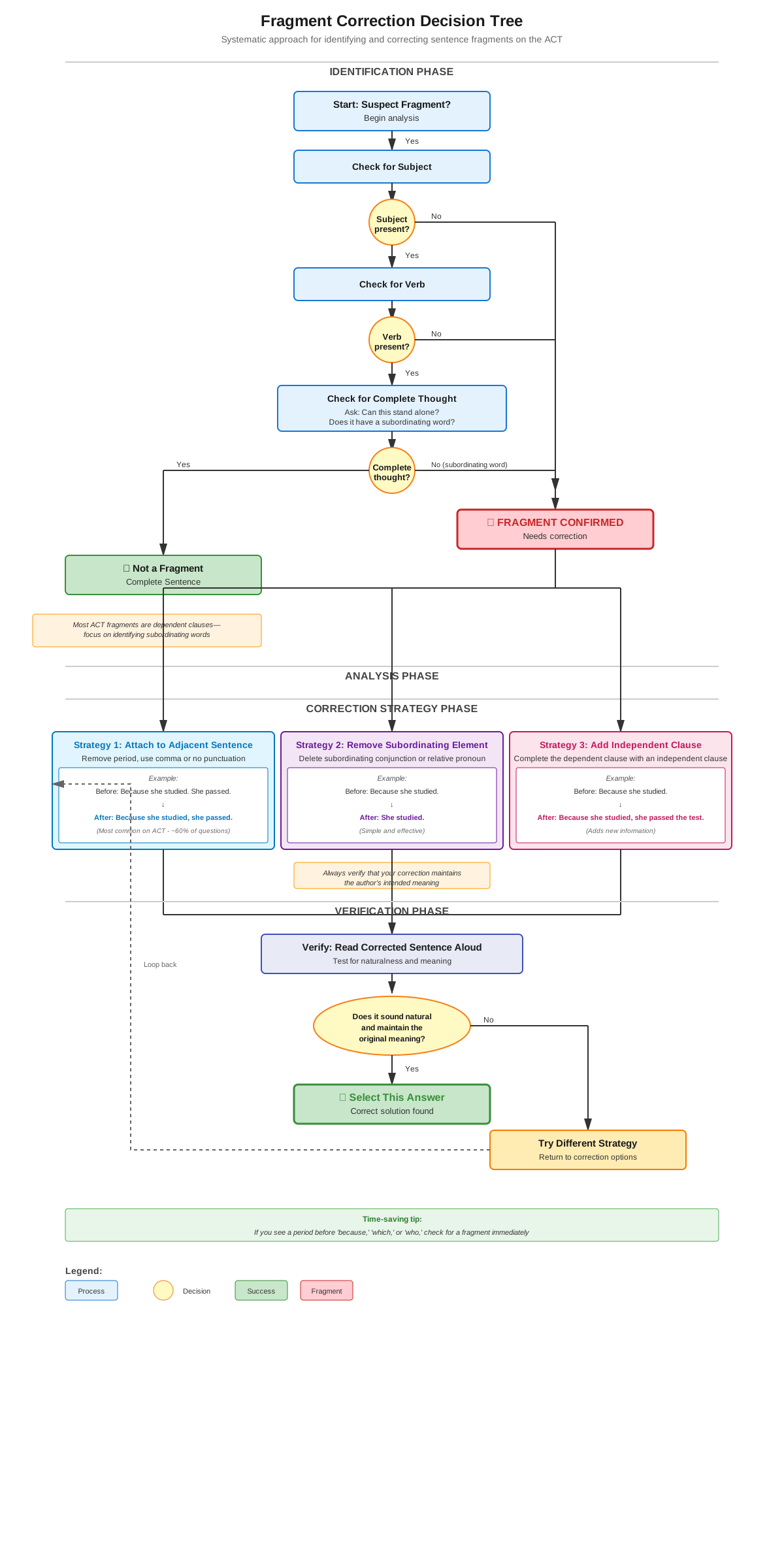
Fragments can be corrected through several methods, and the ACT tests students' ability to select the most effective correction for each context. Method 1: Attachment involves connecting the fragment to an adjacent independent clause using appropriate punctuation (usually a comma). Example: Fragment: "Because the weather was cold. We stayed inside." Correction: "Because the weather was cold, we stayed inside."
Method 2: Completion adds missing elements (subject, verb, or both) to transform the fragment into a complete sentence. Example: Fragment: "Running through the park." Correction: "She was running through the park."
Method 3: Removal eliminates the word or words creating dependency, allowing the remaining clause to stand independently. Example: Fragment: "Although the experiment succeeded." Correction: "The experiment succeeded."
Method 4: Recombination restructures the sentence entirely, incorporating the fragment's information into a nearby sentence in a different grammatical form. Example: Fragment: "The presentation was excellent. Especially the visual aids." Correction: "The presentation, especially the visual aids, was excellent."
The ACT typically provides four answer choices for fragment questions, with options representing different correction methods or maintaining the error. Students must evaluate which correction preserves the intended meaning while creating grammatically correct, clear sentences.
Concept Relationships
Sentence fragments connect directly to the broader concept of sentence structure, serving as one of three major sentence-level errors alongside run-on sentences and comma splices. Understanding fragments requires mastery of clause types (independent vs. dependent), which in turn depends on knowledge of subordinating conjunctions and relative pronouns. The relationship flows: Parts of Speech → Clause Formation → Sentence Completeness → Fragment Identification.
Fragments relate inversely to run-on sentences—while fragments contain too little to be complete, run-ons contain too much without proper separation. Both errors involve improper relationships between clauses, making them conceptually linked. The correction methods for fragments (attachment, completion) mirror the correction methods for run-ons (separation, subordination), creating a symmetrical relationship: Fragment Correction ↔ Run-on Correction.
Punctuation rules directly impact fragment creation and correction. Understanding when to use periods, commas, semicolons, and colons determines whether clauses are properly connected or incorrectly separated. The relationship follows: Punctuation Choice → Clause Relationship → Sentence Completeness. Incorrect punctuation (particularly periods and semicolons used where commas belong) creates most ACT fragment errors.
The concept map flows: Subordinating Conjunctions → create → Dependent Clauses → when improperly punctuated → become → Fragments → corrected through → Attachment or Completion → requires understanding → Punctuation Rules → which connect to → Sentence Structure → tested through → ACT English Questions.
High-Yield Facts
⭐ A sentence fragment lacks a subject, a verb, or a complete thought, or any combination of these elements.
⭐ Dependent clauses beginning with subordinating conjunctions (although, because, since, when, while, if) cannot stand alone as complete sentences.
⭐ The ACT most frequently tests fragments created by subordinating conjunctions and relative pronouns (which, that, who).
⭐ Fragments can be corrected by attaching them to independent clauses, adding missing elements, or removing words that create dependency.
⭐ A semicolon can only separate two independent clauses; using a semicolon before a dependent clause creates a fragment.
- Participial phrases (-ing and -ed phrases) cannot function as complete sentences without helping verbs and subjects.
- Transitional phrases like "for example," "such as," and "including" typically introduce fragments when punctuated as separate sentences.
- Length does not determine completeness—a fragment can contain many words while a complete sentence might be very short.
- Appositive phrases that rename or describe nouns must remain attached to the sentences containing those nouns.
- The isolation test (reading a sentence alone without context) reliably identifies fragments that sound correct in context.
- Infinitive phrases (to + verb) cannot serve as complete sentences without additional independent clauses.
- Fragments often appear intentionally in creative writing and advertising but are always incorrect in formal academic writing tested by the ACT.
Quick check — test yourself on Sentence fragments so far.
Try Flashcards →Common Misconceptions
Misconception: A sentence is complete if it contains many words or seems long enough. → Correction: Sentence completeness depends on grammatical structure (subject, verb, complete thought), not length. "Because the extremely dedicated and hardworking students studied diligently for many hours" is a fragment despite its length, while "She ran" is complete despite being only two words.
Misconception: Any group of words with a subject and verb is a complete sentence. → Correction: A sentence must also express a complete thought. Dependent clauses contain subjects and verbs but remain incomplete due to subordinating conjunctions or relative pronouns that create dependency. "When the bell rang" has both subject (bell) and verb (rang) but is incomplete.
Misconception: Fragments are always short and easy to spot. → Correction: Fragments can be quite long and complex, containing multiple phrases and clauses. The presence of subordinating conjunctions or relative pronouns, not length, determines whether a structure is a fragment.
Misconception: Starting a sentence with "because," "although," or other subordinating conjunctions always creates a fragment. → Correction: Sentences can begin with subordinating conjunctions if they contain both a dependent clause and an independent clause. "Because it rained, the game was cancelled" is complete, while "Because it rained" alone is a fragment.
Misconception: Commas can fix any fragment by connecting it to a nearby sentence. → Correction: While commas often correct fragments, the specific punctuation needed depends on the relationship between clauses. Some fragments require removal of subordinating words, addition of missing elements, or restructuring rather than simple comma addition.
Misconception: If a sentence sounds right when read aloud in context, it must be complete. → Correction: Context can make fragments seem complete because the reader's mind fills in missing information from surrounding sentences. The isolation test reveals true fragments by removing contextual support.
Misconception: Semicolons and periods function interchangeably for separating ideas. → Correction: Semicolons can only separate two independent clauses, while periods can end any complete sentence. Using a semicolon before a dependent clause creates a fragment, while a period would simply separate two complete thoughts.
Worked Examples
Example 1: Subordinating Conjunction Fragment
Passage: "The research team collected extensive data over three years. Although the results were inconclusive and required further analysis."
Analysis: The second sentence is a fragment. Let's apply our identification strategy:
- Isolation test: Reading "Although the results were inconclusive and required further analysis" alone leaves the reader waiting for additional information—what happened although the results were inconclusive?
- Subject-verb check: The fragment has a subject (results) and verbs (were, required), so it's not missing these elements.
- Subordination scan: The word "although" is a subordinating conjunction that creates a dependent clause, making this structure unable to stand alone.
- Complete thought test: The subordinating conjunction creates an incomplete thought—the reader expects to learn what occurred despite the inconclusive results.
Correction options:
- Option A (Attachment): "The research team collected extensive data over three years, although the results were inconclusive and required further analysis." (Replace period with comma)
- Option B (Removal): "The research team collected extensive data over three years. The results were inconclusive and required further analysis." (Remove "although")
- Option C (Recombination): "Although the results were inconclusive and required further analysis, the research team collected extensive data over three years." (Reverse clause order with proper punctuation)
Best answer: Option A or C, depending on emphasis desired. The ACT would present these as answer choices, and students must recognize that Option B changes the meaning by removing the contrast relationship "although" establishes.
Learning objective connection: This example demonstrates identifying when fragments are being tested (subordinating conjunction pattern), explaining the core rule (dependent clauses cannot stand alone), and applying correction strategies accurately.
Example 2: Relative Pronoun Fragment
Passage: "Dr. Chen developed a new teaching methodology. Which significantly improved student engagement and comprehension in mathematics courses."
Analysis: The second sentence is a fragment created by the relative pronoun "which."
- Isolation test: "Which significantly improved student engagement and comprehension in mathematics courses" cannot stand alone—the reader immediately asks "which what?"
- Relative pronoun check: "Which" is a relative pronoun that introduces a dependent clause modifying a noun in the previous sentence (methodology).
- Subject-verb check: The fragment has a subject (which, referring to methodology) and verb (improved), but the relative pronoun creates dependency.
- Complete thought test: The clause provides additional information about something but cannot function independently because "which" signals that it modifies a preceding noun.
Correction options:
- Option A (Attachment with comma): "Dr. Chen developed a new teaching methodology, which significantly improved student engagement and comprehension in mathematics courses."
- Option B (Attachment without comma): "Dr. Chen developed a new teaching methodology which significantly improved student engagement and comprehension in mathematics courses." (This would be incorrect because nonrestrictive clauses require commas)
- Option C (Replacement): "Dr. Chen developed a new teaching methodology. This significantly improved student engagement and comprehension in mathematics courses." (Replace "which" with "this" and make it an independent clause)
- Option D (Restructuring): "Dr. Chen developed a new teaching methodology that significantly improved student engagement and comprehension in mathematics courses." (Use "that" for restrictive clause without comma)
Best answer: Option A for nonrestrictive (additional information) or Option D for restrictive (essential information). The ACT tests whether students understand the difference and can punctuate accordingly.
Learning objective connection: This example shows how to identify relative pronoun fragments, distinguish between restrictive and nonrestrictive clauses, and evaluate multiple correction options to select the most effective solution.
Exam Strategy
When approaching ACT sentence fragment questions, implement a systematic three-step process: Identify, Analyze, Correct. First, identify potential fragments by scanning for subordinating conjunctions at the beginning of sentences, relative pronouns following periods or semicolons, and sentences that seem to provide additional information about previous sentences. The ACT often underlines portions containing or adjacent to fragments, signaling that sentence structure requires examination.
Trigger words and phrases that signal potential fragments include:
- Subordinating conjunctions: although, because, since, when, while, if, unless, until, after, before, though, whereas, even though
- Relative pronouns: which, that, who, whom, whose, where
- Transitional phrases: for example, such as, including, especially, particularly, like
- Participial forms: -ing words (running, thinking, working) and -ed words (completed, finished, broken) without helping verbs
Exam Tip: When you see a period or semicolon followed by one of these trigger words, immediately test whether the following structure can stand alone as a complete sentence.
Process-of-elimination strategy: On fragment questions, the ACT typically provides four answer choices: (A) NO CHANGE (maintains the fragment), (B) one correction method, (C) another correction method, and (D) a third option that might create a different error. Eliminate choice A if you've identified a fragment. Then evaluate remaining options by checking whether they create complete sentences, maintain the original meaning, and follow standard punctuation rules. Often, two choices will correct the fragment but one will be more concise or clearer—select the most effective option.
Time allocation: Fragment questions should take 15-20 seconds each once you've developed recognition skills. Spend 5 seconds identifying whether a fragment exists, 5 seconds determining the fragment type, and 5-10 seconds evaluating correction options. If a question requires more than 30 seconds, mark it for review and move forward—you may gain clarity when returning with fresh perspective.
Context consideration: Always read one sentence before and one sentence after the potential fragment. The ACT deliberately creates passages where fragments seem to flow naturally from previous sentences. Reading in context helps you understand the intended meaning and select corrections that preserve logical relationships between ideas.
Punctuation focus: Pay special attention to periods, semicolons, and commas in answer choices. The ACT frequently tests fragments through punctuation changes rather than word changes. A question might offer identical wording with different punctuation marks, requiring you to determine which punctuation creates proper clause relationships.
Memory Techniques
SWIFT acronym for identifying fragments:
- Subordinating conjunction at the start
- Which, that, who (relative pronouns) after periods
- Incomplete thought when read alone
- Fails subject-verb-completeness test
- Transitional phrases standing alone
The "So What?" Test: When examining a potential sentence, ask "So what?" If the sentence leaves you asking this question, it's likely a fragment. Complete sentences answer questions; fragments raise them.
Visualization strategy: Picture a sentence as a bridge. A complete sentence bridges from one side (the subject) to the other (the predicate expressing a complete thought). A fragment is a broken bridge—it starts but doesn't reach the other side, leaving the reader stranded. Subordinating conjunctions and relative pronouns are like warning signs saying "bridge under construction"—they signal incompleteness.
The "Because Test": Add "because" to the beginning of any sentence you're examining. If adding "because" makes it sound incomplete (which it should for any sentence), then removing "because" should make it sound complete. If it still sounds incomplete after removing "because," it was already a fragment. Example: "Because the students studied" sounds incomplete. Remove "because": "The students studied" sounds complete. But "Because when the bell rang" sounds incomplete, and "When the bell rang" still sounds incomplete—revealing the original fragment.
FANBOYS vs. SUBORDINATORS: Remember that FANBOYS (for, and, nor, but, or, yet, so) are coordinating conjunctions that connect independent clauses, while subordinators (although, because, since, when, while, if) create dependent clauses. If a sentence begins with a FANBOYS word, check for two independent clauses. If it begins with a subordinator, check for both a dependent and independent clause.
Summary
Sentence fragments represent incomplete sentences lacking a subject, verb, or complete thought, appearing frequently on the ACT English section as high-yield questions testing sentence structure mastery. The most common fragments involve dependent clauses beginning with subordinating conjunctions (although, because, since, when, while) or relative pronouns (which, that, who) incorrectly separated from independent clauses by periods or semicolons. Successful fragment identification requires applying the isolation test—reading potential sentences alone without context—and checking for subjects, verbs, and complete thoughts. Fragments can be corrected through attachment (connecting to independent clauses with appropriate punctuation), completion (adding missing elements), removal (eliminating words creating dependency), or recombination (restructuring sentences entirely). The ACT tests fragments through subtle patterns where length and context disguise incompleteness, requiring students to systematically analyze sentence structure rather than relying on how sentences sound. Mastering fragments enhances overall writing clarity and directly improves ACT English scores by enabling quick, accurate identification and correction of these common errors.
Key Takeaways
- Sentence fragments lack a subject, verb, or complete thought and cannot stand alone as grammatically correct sentences in formal writing
- Subordinating conjunctions (although, because, since, when, while) and relative pronouns (which, that, who) most frequently create ACT fragment questions
- The isolation test—reading a sentence alone without surrounding context—reliably identifies fragments that sound acceptable in passages
- Fragments can be corrected by attaching them to independent clauses, adding missing elements, removing dependency-creating words, or restructuring sentences
- Length does not indicate completeness; fragments can be long while complete sentences can be remarkably short
- Semicolons can only separate two independent clauses; using semicolons before dependent clauses creates fragments
- Systematic analysis using trigger words, subject-verb checks, and complete thought tests enables quick, accurate fragment identification on the ACT
Related Topics
Run-on Sentences and Comma Splices: After mastering fragments, students should study run-on sentences, which represent the opposite error—too much content without proper separation. Understanding both fragments and run-ons provides comprehensive knowledge of sentence boundary errors.
Subordination and Coordination: This topic explores how to combine clauses effectively using subordinating and coordinating conjunctions, building on fragment knowledge to create sophisticated, varied sentence structures.
Punctuation Rules: Deep study of comma, semicolon, colon, and dash usage connects directly to fragment correction, as proper punctuation determines whether clauses are appropriately connected or separated.
Sentence Variety and Style: Once students can identify and correct fragments, they can study how to intentionally vary sentence structures for rhetorical effect, including understanding when fragments might be acceptable in creative contexts.
Parallel Structure: This advanced topic builds on sentence completeness concepts, requiring students to ensure that sentence elements maintain consistent grammatical forms throughout complex constructions.
Practice CTA
Now that you've mastered the core concepts of sentence fragments, it's time to apply your knowledge through targeted practice. Complete the practice questions to test your ability to identify fragments in ACT-style passages and select the most effective corrections. Use the flashcards to reinforce trigger words, fragment types, and correction strategies until recognition becomes automatic. Remember, fragment questions appear 3-5 times per ACT English section—mastering this topic directly improves your score. Consistent practice transforms these concepts from theoretical knowledge into practical skills you'll apply confidently on test day. You've built a strong foundation; now strengthen it through application!
Sign up free to keep reading
Create a free AnvayaPrep account to finish this ACT guide on Sentence fragments — plus flashcards and practice questions.