Overview
The distinction between who versus whom represents one of the most frequently tested pronoun usage concepts on the ACT English section. This grammatical principle tests a student's understanding of pronoun case—specifically, whether a pronoun functions as a subject or an object within a sentence. While many native English speakers struggle with this distinction in everyday conversation, the ACT consistently includes questions that require precise identification of the correct form. Mastering this concept is essential not only for earning points on pronoun questions but also for demonstrating command of formal written English, which the ACT values highly.
Understanding ACT who versus whom questions requires recognizing that these pronouns follow the same case rules as other pronouns in English: "who" functions as a subject (like "he," "she," or "they"), while "whom" functions as an object (like "him," "her," or "them"). The ACT typically embeds these pronouns in complex sentence structures, dependent clauses, or prepositional phrases to obscure the correct answer. Students who can quickly identify the pronoun's grammatical function within its clause will consistently select the correct answer, often in under 30 seconds per question.
This topic connects directly to broader concepts in English grammar, including subject-verb agreement, pronoun-antecedent agreement, and clause structure. A solid grasp of who versus whom demonstrates mastery of sentence analysis—the ability to break down complex sentences into their component parts and identify how each element functions. This analytical skill transfers to other ACT English questions involving sentence structure, making this topic a high-leverage investment of study time.
Learning Objectives
- [ ] Identify when who versus whom is being tested in ACT questions
- [ ] Explain the core rule or strategy behind who versus whom usage
- [ ] Apply who versus whom to ACT-style questions accurately
- [ ] Distinguish between subject and object functions within dependent clauses
- [ ] Use the he/him substitution method to verify correct pronoun case
- [ ] Recognize common ACT trap answers that exploit who versus whom confusion
- [ ] Analyze complex sentence structures to determine pronoun function regardless of word order
Prerequisites
- Basic pronoun knowledge: Understanding personal pronouns (I/me, he/him, she/her, they/them) is essential because who/whom follow identical case patterns
- Subject and predicate identification: Recognizing what performs the action (subject) versus what receives the action (object) forms the foundation for choosing between who and whom
- Clause structure: Distinguishing independent from dependent clauses helps identify the grammatical boundaries within which who or whom operates
- Preposition recognition: Knowing common prepositions (to, for, with, by, from) is relevant because whom frequently follows prepositions as their object
Why This Topic Matters
In formal written English—the standard the ACT uses—the who versus whom distinction signals grammatical precision and sophistication. While this distinction has eroded in casual speech, standardized tests continue to assess it because it demonstrates understanding of pronoun case, a fundamental grammatical concept. Professional writing, academic papers, and formal communication still observe this rule, making it practically relevant beyond test day.
On the ACT English section, who versus whom questions appear with high frequency, typically 1-3 times per test. These questions usually appear in the "Conventions of Standard English" category, which comprises approximately 40% of the English section. The questions often take the form of underlined pronoun choices where students must select the grammatically correct option from four alternatives. The ACT favors testing this concept in dependent clauses, particularly relative clauses that modify nouns, and in questions following prepositions.
Common ACT passage contexts include biographical descriptions ("the scientist whom the committee honored"), historical narratives ("leaders who shaped policy"), and explanatory texts ("researchers to whom the grant was awarded"). The test writers deliberately construct sentences with inverted word order, intervening phrases, or complex structures to make the pronoun's function less obvious. Recognizing these patterns allows students to approach these questions systematically rather than relying on what "sounds right," which often leads to errors.
Core Concepts
The Fundamental Case Distinction
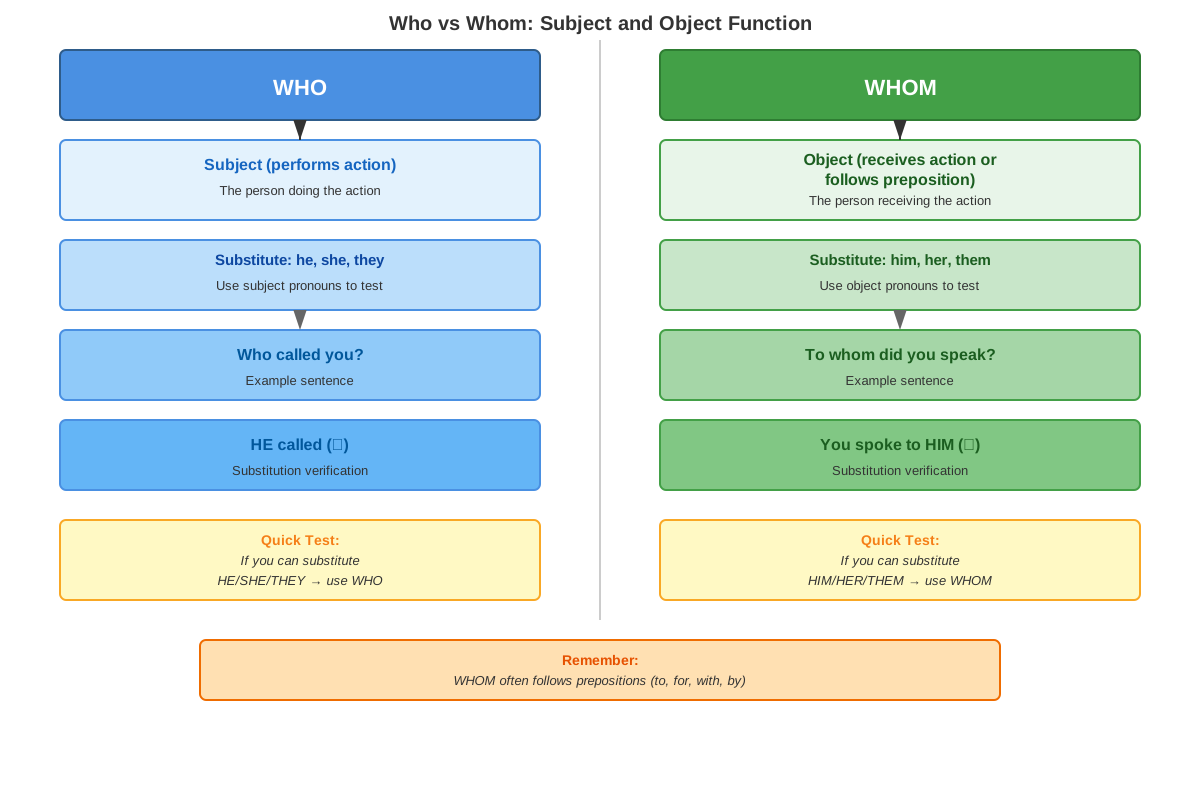
The who versus whom rule centers on grammatical case: who serves as a subject pronoun, while whom serves as an object pronoun. This distinction parallels other pronoun pairs in English. Just as "he" functions as a subject and "him" as an object, "who" and "whom" follow the same pattern. When a pronoun performs the action of a verb or links to the subject through a linking verb, use "who." When a pronoun receives the action of a verb or serves as the object of a preposition, use "whom."
Consider these parallel examples:
| Subject Form | Object Form | Example |
|---|---|---|
| He | Him | He called / I called him |
| Who | Whom | Who called? / I called whom? |
| She | Her | She responded / I asked her |
| Who | Whom | Who responded? / I asked whom? |
The key insight is that "who" and "whom" function identically to other pronouns—they simply refer to people rather than being gender-specific. This parallel structure provides the foundation for the most reliable verification strategy: substitution.
The He/Him Substitution Method
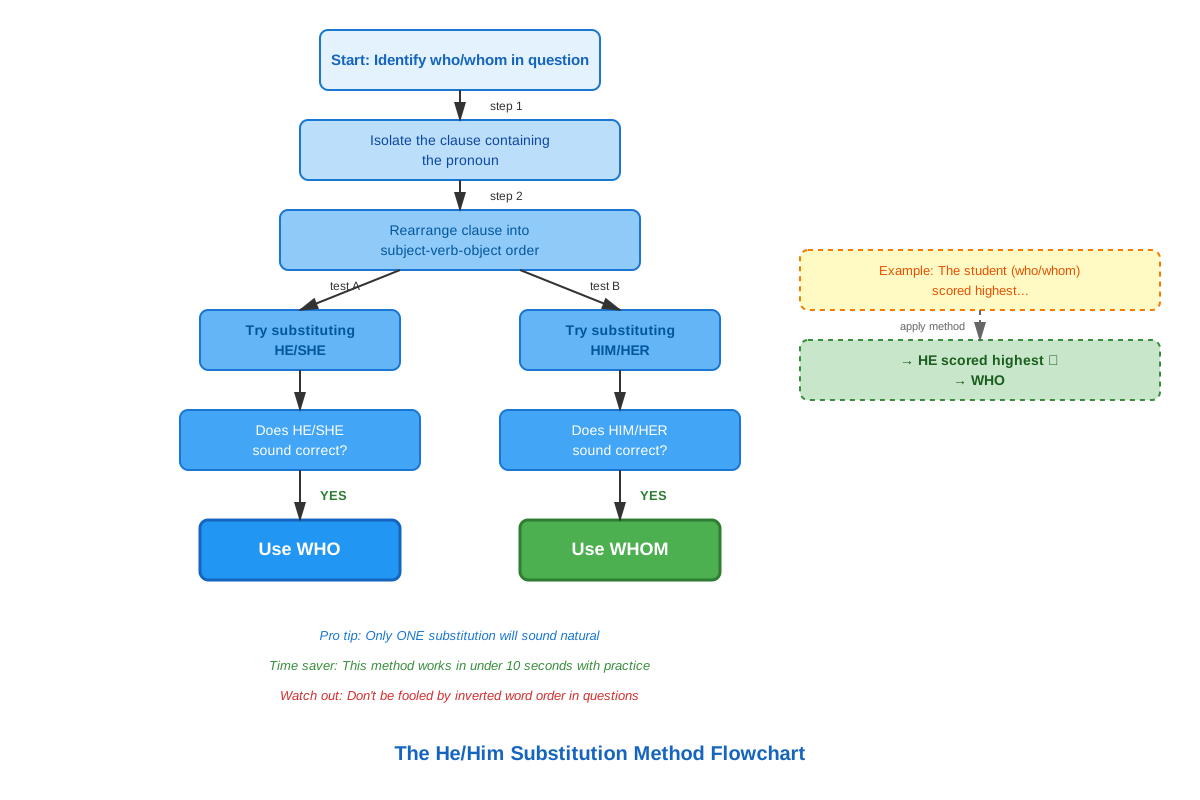
The most powerful strategy for determining correct usage involves substituting "he/him" (or "she/her" or "they/them") for "who/whom" and observing which form sounds correct. This method works because these pronouns follow identical case rules. To apply this technique:
- Isolate the clause containing who/whom
- Rearrange the clause into standard subject-verb-object order if necessary
- Substitute he/him for who/whom
- If "he" sounds correct, use "who"; if "him" sounds correct, use "whom"
For example: "The candidate (who/whom) the committee selected..."
- Isolate: "the committee selected (who/whom)"
- Rearrange: "the committee selected [pronoun]"
- Substitute: "the committee selected him" (not "he")
- Conclusion: Use "whom" because "him" is correct
This method proves especially valuable when word order obscures the pronoun's function or when the pronoun appears far from its verb.
Who as Subject
Who functions as the subject of a verb—the entity performing the action or existing in a state of being. In relative clauses, "who" introduces information about a person and simultaneously serves as the subject of the clause's verb.
Examples of who as subject:
- "The researcher who discovered the treatment received acclaim." (Who discovered? She discovered.)
- "Students who study consistently perform better." (Who study? They study.)
- "The author who was nominated attended the ceremony." (Who was nominated? He was nominated.)
In each case, "who" directly performs the verb's action or links to a state through a linking verb. The pronoun cannot be removed without making the clause incomplete. Notice that "who" typically appears immediately before the verb it governs, though modifiers may occasionally intervene.
Whom as Object
Whom functions as the object of a verb or preposition—the entity receiving the action or related to another element through a preposition. This usage often appears in three contexts: as a direct object, as an indirect object, or as the object of a preposition.
Examples of whom as object:
Direct object: "The mentor whom she consulted provided guidance." (She consulted him.)
Object of preposition: "The colleague to whom I sent the report responded quickly." (I sent it to him.)
Object in questions: "Whom did you contact?" (You contacted him.)
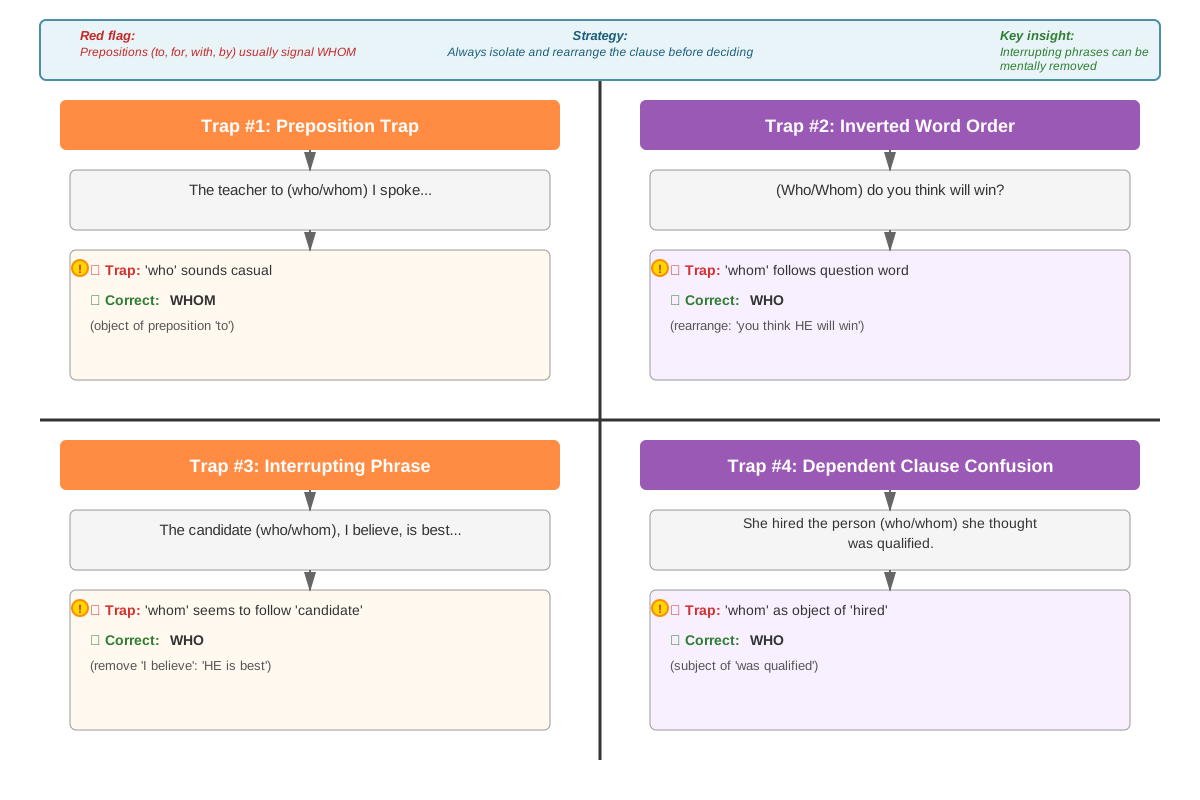
The preposition context provides the clearest signal for "whom." When a preposition (to, for, with, by, from, about, etc.) precedes the pronoun, "whom" is almost always correct. The ACT frequently tests this pattern because students often incorrectly use "who" after prepositions in casual speech.
Dependent Clause Complications
The ACT often embeds who/whom in dependent clauses, particularly relative clauses that modify nouns. The challenge arises because students must analyze the pronoun's function within its own clause, not within the entire sentence. A pronoun might appear to be an object in the main sentence structure while actually functioning as a subject within its dependent clause.
Consider: "The scientist who the university hired later won a Nobel Prize."
At first glance, "the university hired" suggests an object relationship. However, analyzing the relative clause "who the university hired" reveals that "who" is indeed the object of "hired" within that clause. The correct form is actually "whom": "The scientist whom the university hired later won a Nobel Prize." (The university hired him.)
Conversely: "The scientist who won the Nobel Prize was hired by the university."
Here, "who" is the subject of "won" within the relative clause, making "who" correct. (He won the Nobel Prize.)
The critical skill involves identifying clause boundaries and analyzing the pronoun's function within its specific clause, regardless of the surrounding sentence structure.
Inverted Word Order
The ACT frequently uses inverted word order to obscure the pronoun's function. In standard English word order (subject-verb-object), identifying subjects and objects is straightforward. However, questions, relative clauses, and stylistic inversions can place the object before the verb, making "whom" sound incorrect even when it's right.
Standard order: "You called whom?" (You called him—object)
Inverted order: "Whom did you call?" (Same meaning, same case)
Standard order: "The committee honored whom?" (The committee honored him—object)
Inverted order: "The scientist whom the committee honored..." (Same function)
When encountering inverted structures, mentally rearrange the clause into standard subject-verb-object order before applying the he/him substitution test. This technique eliminates the confusion created by unusual word order.
Concept Relationships
The who versus whom distinction connects directly to the broader concept of pronoun case, which governs all pronoun usage in English. Understanding subject versus object case for personal pronouns (I/me, he/him, she/her, they/them, we/us) provides the foundation for mastering who/whom. These concepts share identical underlying principles—only the specific pronouns differ.
Clause structure knowledge enables accurate who/whom usage because the pronoun's function must be analyzed within its specific clause. A student who can identify dependent clauses and their boundaries can isolate the relevant grammatical environment for determining pronoun case. This skill connects to broader sentence structure analysis, including identifying subjects, verbs, and objects.
The relationship map flows as follows:
Basic pronoun case (I/me, he/him) → establishes the subject/object distinction → who/whom applies the same principle → clause identification isolates the relevant grammatical unit → substitution method verifies the correct choice → accurate ACT answers
Additionally, preposition recognition connects to whom usage because prepositions always take object-case pronouns. Understanding prepositional phrases helps students quickly identify contexts where "whom" is required. This connects to broader concepts of sentence structure and modification.
Finally, who/whom questions often appear alongside other pronoun issues on the ACT, including pronoun-antecedent agreement and pronoun clarity. Mastering one pronoun concept strengthens understanding of others because they all involve analyzing how pronouns function within sentences and relate to their antecedents.
Quick check — test yourself on Who versus whom so far.
Try Flashcards →High-Yield Facts
⭐ Who functions as a subject pronoun (like he, she, they); whom functions as an object pronoun (like him, her, them)
⭐ The he/him substitution method provides the most reliable verification: if "him" fits, use "whom"; if "he" fits, use "who"
⭐ After prepositions (to, for, with, by, from), use whom: "to whom," "for whom," "with whom"
⭐ Analyze the pronoun's function within its own clause, not the entire sentence, especially in complex sentences with multiple clauses
⭐ In relative clauses, determine whether the pronoun is the subject or object of the clause's verb
- "Whom" appears less frequently in modern English but remains standard in formal writing and on the ACT
- Word order inversion (questions, stylistic choices) doesn't change the pronoun's grammatical function
- The pronoun's position in the sentence doesn't determine its case—only its grammatical function matters
- "Whoever" (subject) and "whomever" (object) follow the same rules as who/whom
- When in doubt between who and whom on the ACT, analyze the verb: if the pronoun performs the verb's action, use "who"
- The ACT never accepts "who" after a preposition in formal writing contexts
- Intervening phrases between the pronoun and its verb don't affect case selection
- "Who" can serve as a subject complement after linking verbs: "The winner was who?" (He was the winner)
Common Misconceptions
Misconception: "Whom" always sounds more formal or correct, so it should be used in sophisticated writing.
Correction: Formality doesn't determine correctness—grammatical function does. Using "whom" as a subject is incorrect regardless of the writing context. "The person whom called" is always wrong, even in formal writing, because "whom" cannot function as a subject.
Misconception: If "whom" appears after a verb, it must be correct because objects follow verbs.
Correction: The pronoun's relationship to its own clause's verb matters, not its position relative to other verbs in the sentence. In "I know who called," "who" is correct because it's the subject of "called," even though it appears after "know."
Misconception: "Whom" is becoming obsolete, so the ACT accepts "who" in all contexts.
Correction: While "whom" is less common in casual speech, the ACT tests formal written English, where the who/whom distinction remains standard. The test consistently marks "who" after prepositions as incorrect.
Misconception: The pronoun closest to the beginning of a sentence should be "who" because subjects come first.
Correction: Sentence position doesn't determine case. In "Whom did you see?" "whom" is correct despite appearing first because it's the object of "see," not the subject of the sentence.
Misconception: If a sentence sounds correct with "who," it must be right.
Correction: Casual speech patterns often use "who" incorrectly. The ACT tests formal grammar rules, not conversational usage. Many native speakers say "Who did you call?" in conversation, but "Whom did you call?" is correct in formal writing.
Misconception: "Whom" only appears in questions.
Correction: "Whom" appears in any context where an object pronoun is needed, including relative clauses ("the person whom I met"), prepositional phrases ("to whom it may concern"), and statements ("I know whom you mean").
Worked Examples
Example 1: Relative Clause with Inverted Structure
Question: The architect (who/whom) the museum commissioned designed an innovative structure.
Step 1 - Identify the clause: The relative clause is "who/whom the museum commissioned." This clause modifies "architect."
Step 2 - Identify the verb and its subject: Within the clause, the verb is "commissioned." The subject of "commissioned" is "the museum" (the museum did the commissioning).
Step 3 - Determine the pronoun's function: Since "the museum" is the subject of "commissioned," the pronoun must be the object (the museum commissioned [someone]). The architect received the action.
Step 4 - Apply substitution: Rearrange to standard order: "the museum commissioned [pronoun]." Substitute: "the museum commissioned him" (not "he"). Since "him" is correct, use "whom."
Answer: The architect whom the museum commissioned designed an innovative structure.
Connection to learning objectives: This example demonstrates identifying when who/whom is tested (relative clause modifying a person), applying the core rule (object function requires whom), and using the substitution strategy for verification.
Example 2: Prepositional Phrase Context
Question: The committee must decide to (who/whom) the scholarship should be awarded.
Step 1 - Identify the preposition: The preposition "to" precedes the pronoun, immediately suggesting "whom" because prepositions take object-case pronouns.
Step 2 - Analyze the complete structure: The phrase "to whom the scholarship should be awarded" contains a dependent clause. Within this structure, "whom" serves as the object of the preposition "to."
Step 3 - Verify with substitution: Rearrange: "the scholarship should be awarded to [pronoun]." Substitute: "the scholarship should be awarded to him" (not "he"). Since "him" is correct, use "whom."
Step 4 - Apply the preposition rule: As a general principle, prepositions always take object-case pronouns. "To whom," "for whom," "with whom," "by whom" are always correct; "to who," "for who," etc., are always incorrect in formal writing.
Answer: The committee must decide to whom the scholarship should be awarded.
Connection to learning objectives: This example illustrates recognizing ACT trap patterns (preposition + pronoun), applying the core rule (prepositions require object case), and using multiple verification strategies (both substitution and the preposition rule).
Exam Strategy
When approaching ACT who versus whom questions, follow this systematic process to maximize accuracy and efficiency:
Step 1 - Recognize the question type: Look for underlined instances of "who" or "whom," or answer choices that offer both options. These questions typically appear 1-3 times per test and are usually straightforward once you apply the correct method.
Step 2 - Check for prepositions first: If the pronoun immediately follows a preposition (to, for, with, by, from, about), select "whom" with confidence. This pattern accounts for approximately 40% of who/whom questions on the ACT and provides the fastest path to the correct answer.
Step 3 - Isolate the relevant clause: Draw mental brackets around the clause containing the pronoun. Ignore the rest of the sentence temporarily—only the pronoun's function within its own clause matters.
Step 4 - Apply the he/him substitution: Rearrange the clause into subject-verb-object order if necessary, then substitute "he" or "him." Match your answer to the substitution result: he = who, him = whom.
Step 5 - Verify by identifying the verb: Confirm your answer by locating the clause's main verb and determining whether the pronoun performs that verb's action (subject = who) or receives it (object = whom).
Exam Tip: The ACT often places "who" in the original passage when "whom" is correct, exploiting the fact that "who" sounds more natural to many test-takers. Don't trust your ear—trust the grammatical analysis.
Trigger words and phrases to watch for:
- Prepositions before the pronoun: "to ___," "for ___," "with ___," "by ___"
- Inverted questions: "Whom did," "To whom," "For whom"
- Relative clauses: "the person who/whom," "scientists who/whom"
- Verbs with clear objects: "selected," "hired," "honored," "consulted"
Process of elimination tips:
- Eliminate "who" immediately after any preposition
- Eliminate "whom" if the pronoun directly precedes and performs a verb's action
- When two answers differ only in who/whom, the question is testing this specific rule—apply the substitution method rather than considering other factors
Time allocation: These questions should take 20-30 seconds maximum. If you're spending more time, you're likely overthinking. Apply the substitution method systematically and move forward.
Memory Techniques
The "Him/Whom" Rhyme: Remember that "him" and "whom" both end in "m." If "him" fits in the sentence, use "whom." This simple rhyme provides instant recall of the substitution method.
The Preposition Rule Acronym - "PROW": Prepositions Require Object Whom. Whenever you see a preposition before the pronoun, select "whom" without further analysis.
Visual Association: Picture "who" with arms raised (like the letter W) performing an action—subjects do things. Picture "whom" with arms down (the m has descending strokes) receiving an action—objects receive things.
The Subject/Object Parallel:
- Who = He = She = They (all subjects, no "m")
- Whom = Him = Her = Them (all objects, all end in "m")
This parallel structure reinforces that who/whom follow the same pattern as other pronouns you already know.
The Question Flip: For questions, flip the structure to statement form: "Whom did you call?" becomes "You did call whom?" → "You did call him" → "whom" is correct. This technique eliminates the confusion created by question word order.
The "To Whom It May Concern" Anchor: Memorize this common formal phrase as your anchor example. Since "to" is a preposition, "whom" must follow. Whenever you see a preposition, recall this phrase to confirm that "whom" is correct.
Summary
The who versus whom distinction tests understanding of pronoun case: "who" functions as a subject pronoun (performing actions), while "whom" functions as an object pronoun (receiving actions or following prepositions). The most reliable strategy for determining correct usage involves the he/him substitution method—isolate the relevant clause, substitute "he" or "him," and match the result (he = who, him = whom). The ACT frequently tests this concept in relative clauses with inverted word order and after prepositions, where "whom" is always correct. Success requires analyzing the pronoun's grammatical function within its specific clause rather than relying on what sounds natural in casual speech. Students who systematically apply the substitution method and recognize high-frequency patterns (especially preposition + whom) can answer these questions quickly and accurately, typically earning 1-3 additional points per test.
Key Takeaways
- Who serves as a subject (like he/she/they); whom serves as an object (like him/her/them)
- The he/him substitution method provides foolproof verification: rearrange the clause, substitute, and match the result
- After prepositions (to, for, with, by, from), always use whom—this pattern appears frequently on the ACT
- Analyze the pronoun's function within its own clause, not the entire sentence, especially in complex structures
- Don't trust casual speech patterns—the ACT tests formal written English where who/whom distinctions remain standard
- Inverted word order doesn't change grammatical function; rearrange to subject-verb-object order for clarity
- These questions should take 20-30 seconds; apply the systematic method rather than deliberating about what "sounds right"
Related Topics
Pronoun Case (I/me, he/him, she/her, they/them): Mastering who/whom builds on understanding subject versus object case for all pronouns. This broader topic includes compound subjects/objects and pronouns after "than" or "as."
Pronoun-Antecedent Agreement: After mastering case, students should ensure pronouns agree with their antecedents in number and gender, another high-frequency ACT concept.
Relative Clauses and Clause Structure: Understanding dependent clauses, particularly relative clauses introduced by who/whom/which/that, enables more sophisticated sentence analysis and connects to comma usage rules.
Subject-Verb Agreement: Identifying subjects accurately (necessary for who/whom) transfers directly to ensuring verbs agree with their subjects in number.
Prepositions and Prepositional Phrases: Recognizing prepositions helps identify contexts requiring object-case pronouns, including whom, and connects to modification and sentence structure concepts.
Practice CTA
Now that you've mastered the core concepts behind who versus whom, it's time to cement your understanding through active practice. Complete the practice questions to apply the substitution method and preposition rule to ACT-style scenarios. Use the flashcards to reinforce the key distinctions and trigger patterns until your responses become automatic. Remember: this topic appears 1-3 times per test, making it a high-yield investment of your study time. Every question you answer correctly through systematic analysis rather than guesswork represents a concrete step toward your target score. You've learned the strategy—now build the confidence through repetition!
Sign up free to keep reading
Create a free AnvayaPrep account to finish this ACT guide on Who versus whom — plus flashcards and practice questions.