Overview
Relative clauses are essential grammatical structures that appear frequently on the ACT English test, making them a high-priority topic for test preparation. A relative clause is a dependent clause that modifies a noun or pronoun, providing additional information about it. These clauses typically begin with relative pronouns (who, whom, whose, which, that) or relative adverbs (where, when, why). Understanding how to correctly construct, punctuate, and identify ACT relative clauses is crucial for success on the sentence structure and punctuation portions of the exam.
The ACT tests relative clauses in multiple ways: through punctuation questions (determining whether commas are needed), pronoun selection questions (choosing the correct relative pronoun), and sentence structure questions (identifying fragments or run-ons created by improper clause construction). Students who master relative clauses gain a significant advantage because these structures appear in approximately 10-15% of all ACT English questions, either directly or as part of more complex sentence structure problems.
Relative clauses connect directly to broader concepts in English grammar, including sentence structure, punctuation rules, and pronoun usage. They represent the intersection of multiple grammatical principles, making them a cornerstone topic that supports understanding of complex sentences, subordination, and the relationship between independent and dependent clauses. Mastery of relative clauses enables students to tackle advanced sentence structure questions with confidence and precision.
Learning Objectives
- [ ] Identify when relative clauses are being tested on the ACT
- [ ] Explain the core rule or strategy behind relative clauses
- [ ] Apply relative clauses to ACT-style questions accurately
- [ ] Distinguish between restrictive and nonrestrictive relative clauses
- [ ] Select the appropriate relative pronoun based on antecedent and function
- [ ] Correctly punctuate sentences containing relative clauses
- [ ] Recognize and correct common errors involving relative clause construction
Prerequisites
- Independent and dependent clauses: Understanding the difference between clauses that can stand alone and those that cannot is fundamental to recognizing relative clauses as dependent structures.
- Basic punctuation rules (commas): Comma usage with relative clauses follows specific patterns that build on general comma principles.
- Parts of speech (nouns, pronouns, verbs): Identifying the antecedent of a relative pronoun requires recognizing nouns and pronouns in sentences.
- Subject-verb agreement: Relative clauses must maintain proper agreement between subjects and verbs within the clause.
Why This Topic Matters
Relative clauses represent one of the most frequently tested grammatical structures on the ACT English section. According to test analysis, questions involving relative clauses appear in approximately 3-5 questions per test, accounting for roughly 4-7% of the English section. These questions often combine multiple skills—punctuation, pronoun selection, and sentence structure—making them high-value targets for score improvement.
In real-world writing, relative clauses enable writers to combine ideas efficiently, create sophisticated sentence structures, and provide essential or supplementary information about nouns without creating choppy, disconnected sentences. Professional writing, academic essays, and effective communication all rely heavily on proper relative clause construction. Students who master this skill improve not only their ACT scores but also their overall writing quality.
On the ACT, relative clauses appear in several distinct question types: punctuation questions asking whether commas should surround a relative clause, pronoun questions requiring selection between "who," "whom," "which," and "that," and sentence structure questions involving fragments or run-ons created by improper relative clause construction. The test also includes questions about wordiness where students must decide whether a relative clause is necessary or redundant. Understanding the nuances of restrictive versus nonrestrictive clauses is particularly important, as this distinction determines punctuation and can affect meaning.
Core Concepts
Definition and Structure of Relative Clauses
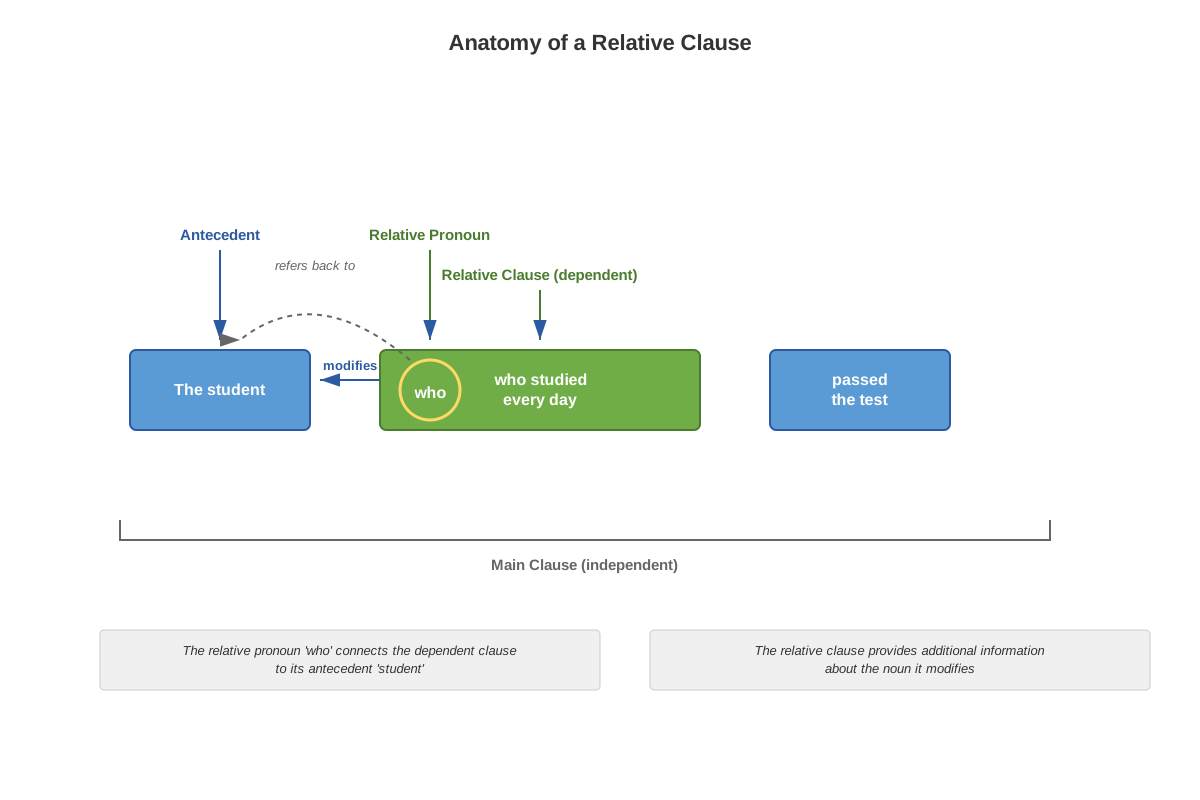
A relative clause (also called an adjective clause) is a dependent clause that modifies a noun or pronoun in the main clause. It begins with a relative pronoun (who, whom, whose, which, that) or a relative adverb (where, when, why) and contains a subject and verb. The relative pronoun serves two functions simultaneously: it connects the relative clause to the noun it modifies (the antecedent) and serves a grammatical role within the relative clause itself.
The basic structure follows this pattern: [Main clause with noun] + [relative pronoun] + [subject + verb + additional elements]. For example: "The student who studied diligently passed the exam." Here, "who studied diligently" is the relative clause modifying "student."
Restrictive vs. Nonrestrictive Relative Clauses
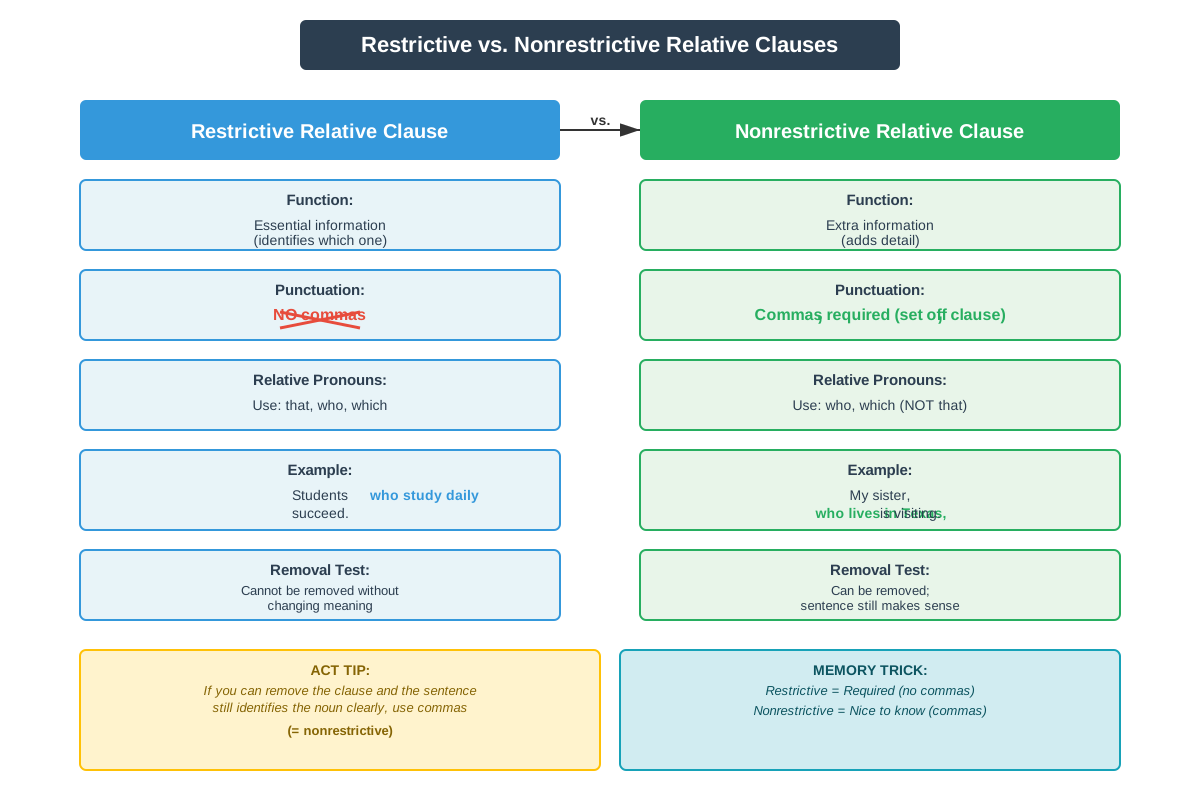
This distinction is critical for ACT success and determines punctuation choices. Restrictive relative clauses (also called essential or defining clauses) provide information that is essential to identify which specific noun is being discussed. These clauses are NOT set off by commas because removing them would change the fundamental meaning of the sentence.
Example: "Students who study regularly perform better on standardized tests."
The clause "who study regularly" restricts which students we're discussing—only those who study regularly, not all students. Without this clause, the sentence would make a different claim about all students.
Nonrestrictive relative clauses (also called nonessential or non-defining clauses) provide additional information about a noun that is already clearly identified. These clauses ARE set off by commas (or a comma and a period if at the end) because they could be removed without changing the core meaning of the sentence.
Example: "My sister, who lives in Chicago, is visiting next week."
The clause "who lives in Chicago" adds extra information, but "my sister" is already clearly identified. The sentence would still make sense without this detail.
| Feature | Restrictive | Nonrestrictive |
|---|---|---|
| Punctuation | No commas | Commas required |
| Essential to meaning | Yes | No |
| Can use "that" | Yes | No |
| Can use "which" | Sometimes (less common) | Yes |
| Can be removed | No (changes meaning) | Yes (meaning intact) |
Relative Pronouns and Their Uses
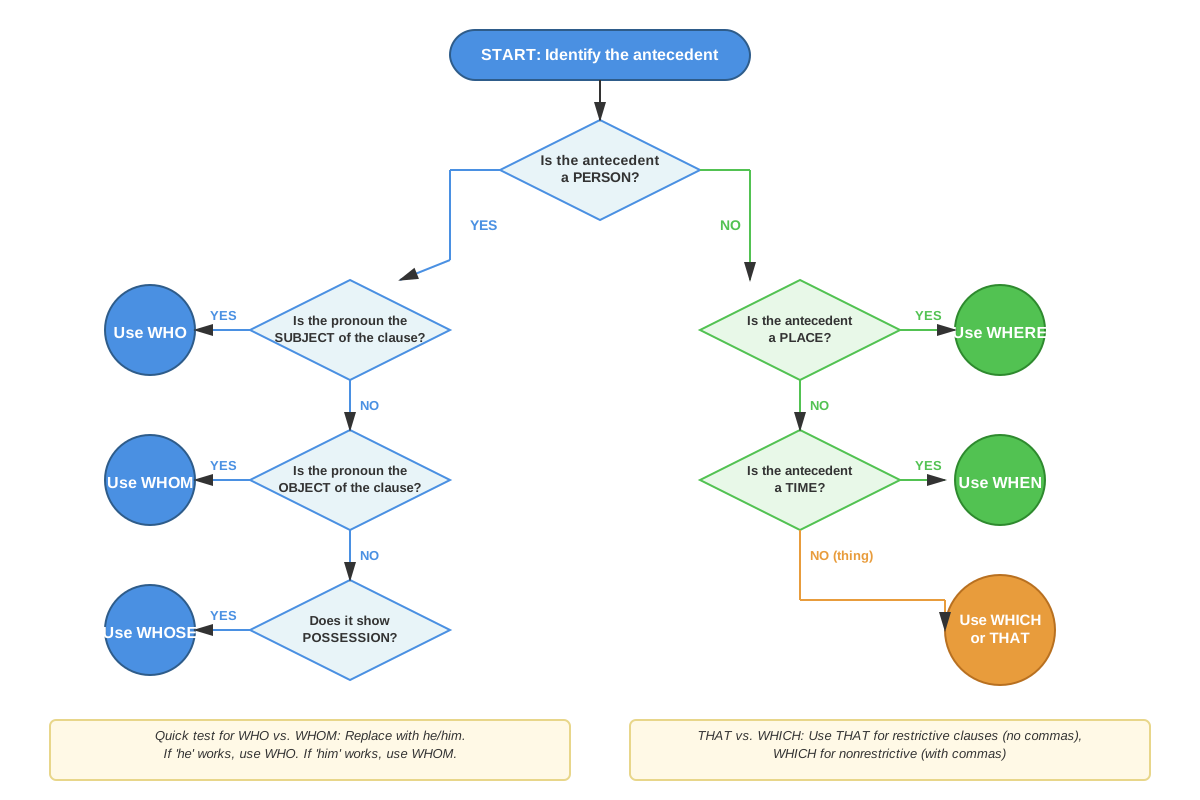
Who refers to people and serves as a subject within the relative clause.
Example: "The teacher who explained the concept was helpful."
Whom refers to people and serves as an object within the relative clause (receiving the action).
Example: "The student whom I tutored improved significantly."
Whose indicates possession and can refer to people or things.
Example: "The author whose book won the award will speak tonight."
Which refers to things or animals and is typically used in nonrestrictive clauses.
Example: "The textbook, which costs $50, includes online resources."
That refers to people, animals, or things and is used primarily in restrictive clauses.
Example: "The strategy that works best involves daily practice."
Common ACT Testing Patterns
The ACT frequently tests whether students can distinguish between "that" and "which" based on whether the clause is restrictive or nonrestrictive. Remember: "that" introduces restrictive clauses (no commas), while "which" typically introduces nonrestrictive clauses (with commas).
Another common test pattern involves "who" versus "whom." The ACT expects students to recognize that "who" functions as a subject (performing an action) while "whom" functions as an object (receiving an action). A helpful trick: if you can substitute "he/she," use "who"; if you can substitute "him/her," use "whom."
The test also examines whether students understand that relative clauses are dependent and cannot stand alone as complete sentences. A sentence fragment error often involves a relative clause incorrectly punctuated as a complete sentence.
Placement and Proximity
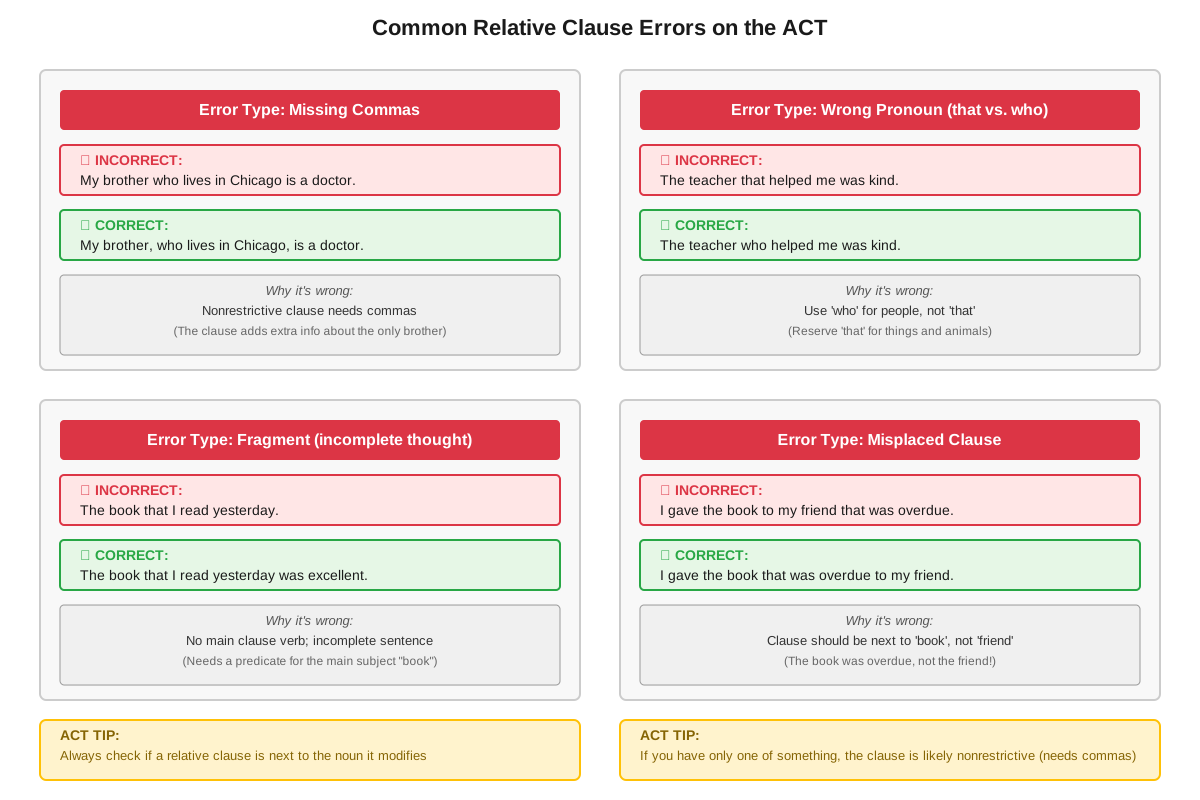
Relative clauses should be placed immediately after the noun they modify to avoid confusion. Misplaced relative clauses create ambiguity and are tested on the ACT.
Incorrect: "The book was on the table that I needed."
Correct: "The book that I needed was on the table."
The relative clause "that I needed" should directly follow "book," not "table," to clarify what was needed.
Concept Relationships
Relative clauses connect to multiple grammatical concepts tested on the ACT. Understanding independent and dependent clauses is foundational because relative clauses are always dependent—they cannot stand alone despite containing a subject and verb. This relationship helps students identify sentence fragments, which occur when a relative clause is incorrectly punctuated as a complete sentence.
The connection between relative clauses and punctuation is bidirectional: the type of relative clause (restrictive or nonrestrictive) determines punctuation, while punctuation signals the type of clause and its relationship to the main sentence. This connects to broader comma usage rules, particularly those involving essential versus nonessential information.
Pronoun usage intersects with relative clauses through the selection of appropriate relative pronouns. Students must understand pronoun-antecedent agreement (the relative pronoun must match its antecedent in number and type) and pronoun case (subject versus object forms). This connects to the broader topic of pronoun clarity and reference.
The relationship map flows as follows: Sentence Structure → determines need for → Relative Clauses → which require → Appropriate Relative Pronouns → and → Correct Punctuation → all of which support → Clear, Effective Communication. Additionally, Restrictive/Nonrestrictive Distinction → determines → Comma Usage and → Relative Pronoun Choice (that vs. which).
Quick check — test yourself on Relative clauses so far.
Try Flashcards →High-Yield Facts
⭐ Restrictive relative clauses do not use commas; nonrestrictive relative clauses require commas.
⭐ "That" is used for restrictive clauses; "which" is typically used for nonrestrictive clauses.
⭐ "Who" is the subject form; "whom" is the object form when referring to people.
⭐ Relative clauses are dependent clauses and cannot stand alone as complete sentences.
⭐ A relative clause should be placed immediately after the noun it modifies.
- "Whose" indicates possession and can refer to people or things.
- Relative pronouns serve dual functions: connecting the clause and fulfilling a grammatical role within it.
- Removing a restrictive clause changes the fundamental meaning of a sentence.
- Removing a nonrestrictive clause leaves the core meaning intact.
- "Where" and "when" can introduce relative clauses when referring to places and times.
- The verb in a relative clause must agree with the antecedent of the relative pronoun.
- Relative clauses can modify subjects, objects, or any noun in a sentence.
- Multiple relative clauses can appear in a single sentence, each modifying different nouns.
- The ACT prefers concise constructions; unnecessary relative clauses are considered wordy.
Common Misconceptions
Misconception: All relative clauses need commas. → Correction: Only nonrestrictive (nonessential) relative clauses require commas. Restrictive clauses, which are essential to the sentence's meaning, should not be set off by commas.
Misconception: "Which" and "that" are always interchangeable. → Correction: "That" is used for restrictive clauses (no commas), while "which" is typically used for nonrestrictive clauses (with commas). Using them incorrectly can change the meaning or create punctuation errors.
Misconception: "Who" and "whom" can be used interchangeably when referring to people. → Correction: "Who" functions as a subject (performing an action), while "whom" functions as an object (receiving an action). The ACT tests this distinction specifically.
Misconception: A relative clause can stand alone as a complete sentence because it has a subject and verb. → Correction: Despite containing a subject and verb, relative clauses are dependent clauses that must be attached to an independent clause. A relative clause alone is a sentence fragment.
Misconception: Relative clauses can only modify the subject of a sentence. → Correction: Relative clauses can modify any noun in a sentence—subjects, objects, or objects of prepositions—as long as they are placed immediately after the noun they modify.
Misconception: The relative pronoun always refers to the noun immediately before it. → Correction: While relative clauses should be placed near their antecedents, the relative pronoun refers to the logical antecedent based on meaning and grammatical agreement, not just proximity.
Misconception: "Whose" can only refer to people. → Correction: "Whose" can indicate possession for both people and things, though it's more commonly used with people. Example: "The company whose profits increased" is grammatically correct.
Worked Examples
Example 1: Restrictive vs. Nonrestrictive Clause
Question: Which of the following is correct?
A) The students, who completed the assignment, received full credit.
B) The students who completed the assignment received full credit.
C) The students who completed the assignment, received full credit.
D) The students, who completed the assignment received full credit.
Solution Process:
Step 1: Identify the relative clause: "who completed the assignment"
Step 2: Determine if the clause is restrictive or nonrestrictive. Ask: Does this clause identify which specific students we're discussing, or does it add extra information about already-identified students?
Step 3: Analysis—The clause identifies which students received full credit (only those who completed the assignment, not all students). This is essential information that restricts the meaning, making it a restrictive clause.
Step 4: Apply the rule—Restrictive clauses do not use commas.
Step 5: Eliminate options with commas (A, C, D).
Answer: B is correct. The restrictive relative clause "who completed the assignment" should not be set off by commas because it's essential to identifying which students received credit.
Connection to Learning Objectives: This example demonstrates how to identify when relative clauses are being tested (punctuation question), explains the core rule (restrictive clauses don't use commas), and applies the concept to an ACT-style question.
Example 2: Relative Pronoun Selection
Question: The scientist _____ research revolutionized the field won the Nobel Prize.
A) who
B) whom
C) whose
D) which
Solution Process:
Step 1: Identify what the relative pronoun needs to do. Look at the structure: "The scientist [relative pronoun] research revolutionized the field"
Step 2: Determine the relationship. The word "research" follows the relative pronoun, and "research" belongs to the scientist. This indicates possession.
Step 3: Recall relative pronoun functions:
- "Who" = subject performing action
- "Whom" = object receiving action
- "Whose" = possession
- "Which" = refers to things, not people
Step 4: The sentence needs to show that the research belongs to the scientist, requiring a possessive form.
Step 5: Eliminate options that don't show possession (A, B, D).
Answer: C is correct. "Whose" is the possessive relative pronoun that shows the research belongs to the scientist.
Connection to Learning Objectives: This example shows how to identify relative pronoun questions, explains the strategy of determining the pronoun's function within the clause, and demonstrates accurate application to an ACT-style question.
Exam Strategy
Trigger Words: When you see "who," "whom," "whose," "which," "that," "where," or "when" in the underlined portion or answer choices, immediately consider whether the question is testing relative clauses.
Step-by-Step Approach for Relative Clause Questions:
- Identify the clause: Locate the relative pronoun and the complete clause it introduces.
- Find the antecedent: Determine which noun the relative clause modifies.
- Determine restrictive vs. nonrestrictive: Ask yourself, "Is this information essential to identify which specific noun we're discussing?" If yes, it's restrictive (no commas). If no, it's nonrestrictive (needs commas).
- Check pronoun choice: Verify that the relative pronoun is appropriate for its antecedent (people vs. things) and its function within the clause (subject vs. object vs. possessive).
- Verify placement: Ensure the relative clause immediately follows the noun it modifies.
Process of Elimination Tips:
- Eliminate any option that uses commas with "that" (restrictive clauses with "that" never use commas)
- Eliminate options where "which" appears without commas in the middle of a sentence (nonrestrictive "which" requires commas)
- Eliminate "whom" if the relative pronoun is performing an action (subjects use "who")
- Eliminate "who" if the relative pronoun is receiving an action after a verb or preposition (objects use "whom")
- Eliminate options where a relative clause stands alone as a sentence (fragments)
Time Allocation: Relative clause questions should take 20-30 seconds each. If you're spending more time, use the restrictive/nonrestrictive distinction as your primary decision point—this resolves most relative clause questions quickly.
Common Question Formats:
- Punctuation questions with commas around relative clauses
- Pronoun selection among "who/whom/whose/which/that"
- Sentence structure questions involving fragments or run-ons
- Wordiness questions where relative clauses may be redundant
Memory Techniques
THAT-WHICH Mnemonic: "THAT Tightens" (restrictive, no commas) vs. "WHICH Wanders" (nonrestrictive, with commas)
WHO vs. WHOM Trick: Replace with "he/him" to test:
- "He did it" → use WHO (both end in vowels)
- "Give it to him" → use WHOM (both end in M)
Restrictive/Nonrestrictive Memory Aid: "Restrictive = Required (no commas needed)" vs. "Nonrestrictive = Nice to know (needs commas)"
Relative Pronoun Selection Chart (visualize this):
PEOPLE → Who (subject) / Whom (object) / Whose (possessive)
THINGS → Which (usually nonrestrictive) / That (restrictive)
PLACES → Where
TIMES → When
Comma Decision Flowchart (memorize this sequence):
- Can I remove the clause without changing who/what we're talking about?
- YES → Nonrestrictive → USE COMMAS
- NO → Restrictive → NO COMMAS
Summary
Relative clauses are dependent clauses that modify nouns or pronouns, beginning with relative pronouns (who, whom, whose, which, that) or relative adverbs (where, when, why). The ACT tests relative clauses through punctuation, pronoun selection, and sentence structure questions, making them a high-frequency topic worth approximately 4-7% of the English section. The critical distinction between restrictive and nonrestrictive clauses determines punctuation: restrictive clauses provide essential identifying information and require no commas, while nonrestrictive clauses add supplementary information and must be set off by commas. Relative pronoun selection depends on the antecedent (people vs. things) and the pronoun's function within the clause (subject, object, or possessive). Students must also recognize that relative clauses are dependent structures that cannot stand alone and should be placed immediately after the nouns they modify. Mastering these concepts enables students to quickly and accurately answer multiple question types on the ACT English section.
Key Takeaways
- Restrictive relative clauses (essential information) use no commas; nonrestrictive clauses (extra information) require commas
- "That" signals restrictive clauses; "which" typically signals nonrestrictive clauses
- "Who" is for subjects, "whom" is for objects, and "whose" shows possession when referring to people
- Relative clauses are dependent and must attach to independent clauses—they cannot stand alone
- Place relative clauses immediately after the nouns they modify to avoid ambiguity
- The ACT tests relative clauses through punctuation, pronoun choice, and sentence structure questions
- Understanding the restrictive/nonrestrictive distinction resolves the majority of relative clause questions efficiently
Related Topics
Complex Sentence Structure: Building on relative clauses, this topic explores how multiple dependent clauses combine with independent clauses to create sophisticated sentences. Mastering relative clauses provides the foundation for understanding more complex subordination patterns.
Comma Usage and Punctuation: Relative clauses represent one specific application of comma rules. Further study of comma usage includes introductory elements, coordinating conjunctions, and other nonessential elements.
Pronoun-Antecedent Agreement: Relative pronouns must agree with their antecedents in number and type. This topic expands to cover all pronoun references, including personal pronouns, demonstrative pronouns, and indefinite pronouns.
Sentence Fragments and Run-ons: Understanding that relative clauses are dependent helps identify fragments (dependent clauses standing alone) and run-ons (improperly joined clauses). This topic builds directly on relative clause knowledge.
Conciseness and Wordiness: Advanced application involves recognizing when relative clauses are necessary versus when they create redundancy. This connects to broader ACT principles of effective, concise writing.
Practice CTA
Now that you've mastered the core concepts of relative clauses, it's time to solidify your understanding through active practice. Complete the practice questions to test your ability to identify restrictive versus nonrestrictive clauses, select appropriate relative pronouns, and apply correct punctuation. Use the flashcards to reinforce the key distinctions between "who" and "whom," "that" and "which," and the punctuation rules for different clause types. Remember: relative clauses appear on every ACT English section, so investing time in practice now will directly translate to points on test day. You've built the foundation—now strengthen it through application!
Sign up free to keep reading
Create a free AnvayaPrep account to finish this ACT guide on Relative clauses — plus flashcards and practice questions.