Overview
Hyphenated modifiers are compound adjectives formed by joining two or more words with hyphens to create a single descriptive unit that modifies a noun. On the ACT English test, questions about hyphenated modifiers assess whether students can correctly identify when compound modifiers require hyphens and when they do not. This punctuation rule appears frequently on the exam because it tests both grammatical knowledge and attention to detail—two skills essential for achieving a high score on the English section.
Understanding ACT hyphenated modifiers is crucial because these questions appear in approximately 5-8% of all punctuation questions on the test. The ACT specifically tests whether students recognize that compound modifiers need hyphens when they appear before a noun but typically do not need them when they appear after a noun or when one of the modifying words is an adverb ending in "-ly." Mastering this topic requires recognizing the structural patterns that signal when hyphenation is necessary and developing the ability to distinguish between legitimate compound modifiers and word combinations that should remain separate.
This topic connects directly to broader punctuation concepts tested on the ACT, including the proper use of dashes, commas, and other marks that clarify meaning and relationships between words. Hyphenated modifiers also relate to the ACT's emphasis on clarity and precision in writing—core principles that underlie many English questions. Students who master hyphenated modifiers demonstrate their understanding of how punctuation serves to eliminate ambiguity and create clear, professional prose.
Learning Objectives
- [ ] Identify when hyphenated modifiers is being tested in ACT English passages
- [ ] Explain the core rule or strategy behind hyphenated modifiers
- [ ] Apply hyphenated modifiers to ACT-style questions accurately
- [ ] Distinguish between compound modifiers that require hyphens and those that do not
- [ ] Recognize the position of compound modifiers relative to the noun they modify
- [ ] Evaluate whether adverbs ending in "-ly" should be hyphenated to following adjectives
- [ ] Correct improperly hyphenated or non-hyphenated compound modifiers in context
Prerequisites
- Basic parts of speech identification: Students must recognize adjectives, adverbs, and nouns to determine which words function as modifiers and what they modify
- Understanding of word order in English sentences: Recognizing whether modifiers appear before or after nouns is essential for applying hyphenation rules correctly
- Familiarity with compound words: Knowing that multiple words can work together as a single unit helps students understand the purpose of hyphenation
- General punctuation principles: Understanding that punctuation clarifies meaning provides the foundation for why hyphenation rules exist
Why This Topic Matters
In professional and academic writing, hyphenated modifiers eliminate ambiguity and ensure readers interpret compound adjectives as unified concepts rather than separate descriptors. For example, "small business owner" could mean either a small owner of a business or an owner of a small business, but "small-business owner" clarifies the intended meaning. This precision matters in legal documents, technical writing, academic papers, and professional communications where misinterpretation could have serious consequences.
On the ACT English test, hyphenated modifiers appear in approximately 2-3 questions per exam, making them a high-yield topic relative to the time investment required to master them. These questions typically appear in the Punctuation category, which comprises about 13% of the English section. The ACT tests hyphenated modifiers through several question formats: identifying errors in underlined portions, selecting the correct version from multiple options, and determining whether "NO CHANGE" is appropriate when a compound modifier is already correctly punctuated.
Common ways this topic appears include: compound modifiers before nouns (requiring hyphens), compound modifiers after linking verbs (typically not requiring hyphens), adverb-adjective combinations with "-ly" adverbs (never requiring hyphens), and suspended hyphens in series of compound modifiers. The ACT particularly favors testing the distinction between pre-noun and post-noun positions, as this represents the most frequently misunderstood aspect of the rule.
Core Concepts
The Basic Hyphenation Rule
The fundamental principle governing hyphenated modifiers states that when two or more words work together as a single adjective to modify a noun, they should be connected with hyphens when they appear before the noun they modify. This hyphenation signals to readers that these words function as a unified concept rather than as separate, independent modifiers.
Consider these examples:
- "The well-known author signed books" (hyphenated before noun)
- "The author is well known" (not hyphenated after linking verb)
The hyphen in the first example clarifies that "well" and "known" work together as a single descriptor. Without the hyphen, readers might momentarily interpret "well" as modifying "known" or struggle to understand the relationship between the words.
Position Relative to the Noun
The position of the compound modifier determines whether hyphenation is necessary. This positional rule represents the most frequently tested aspect of hyphenated modifiers on the ACT.
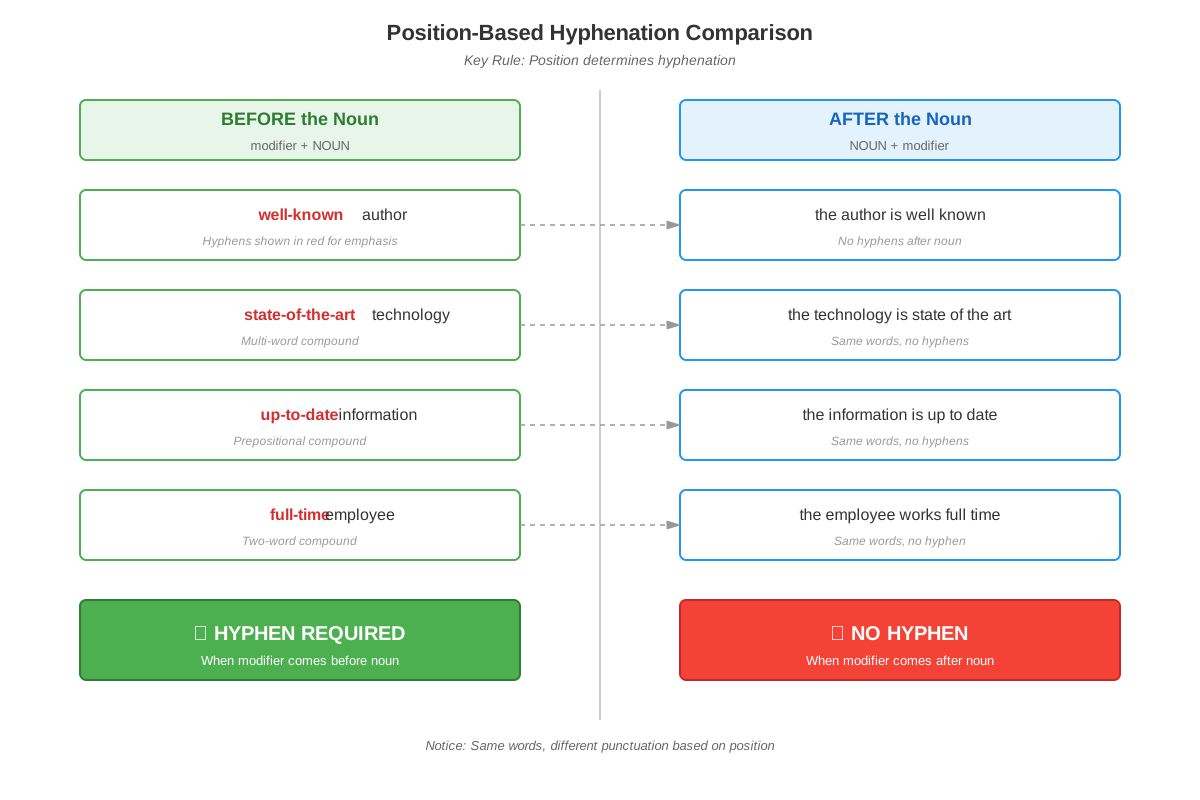
Before the noun (pre-noun position): Hyphenate compound modifiers
- "a full-time employee"
- "a state-of-the-art facility"
- "a ten-year-old child"
After the noun or linking verb (post-noun position): Generally do not hyphenate
- "The employee works full time"
- "The facility is state of the art"
- "The child is ten years old"
| Position | Example | Hyphenation Required |
|---|---|---|
| Before noun | "high-quality product" | Yes |
| After linking verb | "The product is high quality" | No |
| Before noun | "well-respected leader" | Yes |
| After linking verb | "The leader is well respected" | No |
The "-ly" Adverb Exception
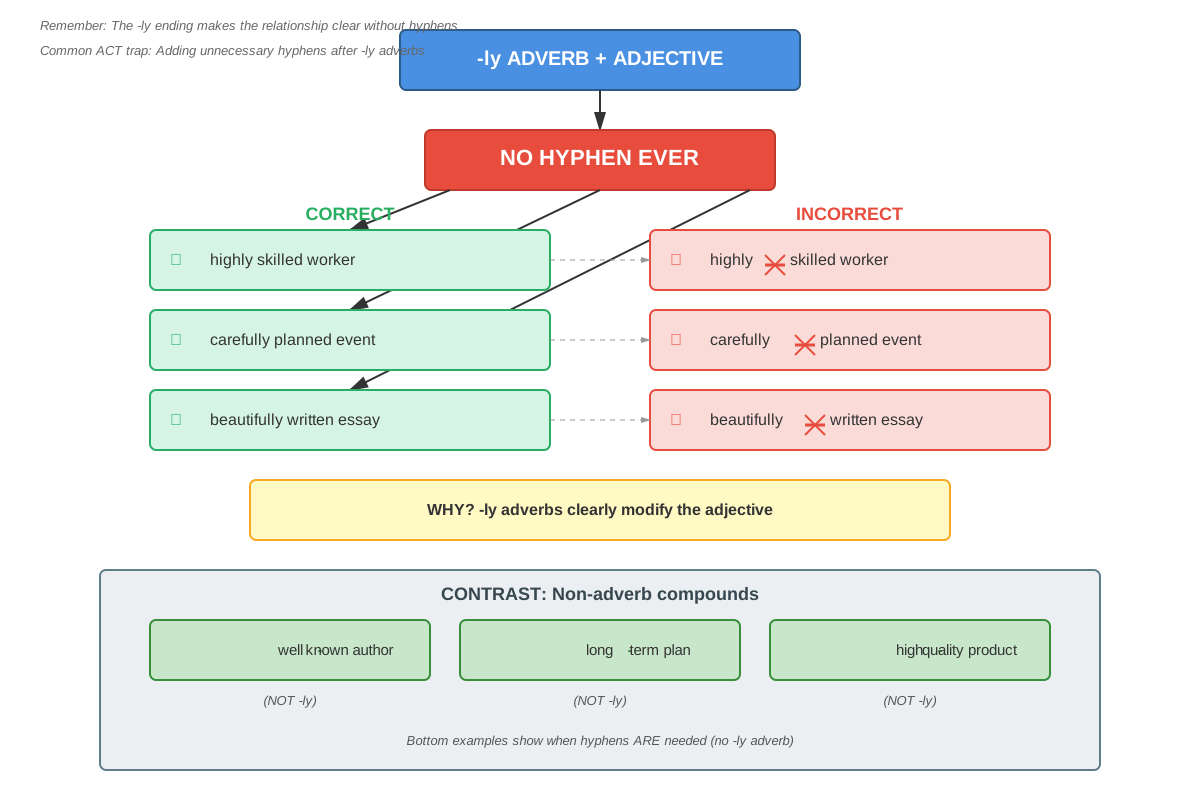
One of the most important exceptions to the hyphenation rule involves adverbs ending in "-ly." When an adverb ending in "-ly" modifies an adjective, and this combination modifies a noun, no hyphen is used, regardless of position. This exception exists because "-ly" adverbs are unambiguously adverbs—readers cannot mistake their grammatical function—so no hyphen is needed to clarify the relationship.
Correct usage (no hyphen needed):
- "a highly qualified candidate"
- "a beautifully written essay"
- "a carefully planned strategy"
Incorrect usage (hyphen inappropriately added):
- ~~"a highly-qualified candidate"~~
- ~~"a beautifully-written essay"~~
However, if the first word does not end in "-ly," the standard hyphenation rule applies:
- "a well-qualified candidate" (hyphen required)
- "a much-anticipated event" (hyphen required)
Compound Modifiers with Numbers
Numbers frequently appear in compound modifiers, and these combinations follow the standard hyphenation rules. When a number and a unit of measurement or other noun work together to modify another noun, they require hyphenation in pre-noun position.
Examples requiring hyphens:
- "a five-mile run"
- "a 20-year mortgage"
- "a three-bedroom apartment"
- "a 500-page book"
Same concepts without hyphens (post-noun position):
- "The run was five miles long"
- "The mortgage lasts 20 years"
- "The apartment has three bedrooms"
Multiple-Word Compound Modifiers
Some compound modifiers consist of three or more words working together as a single adjective. These require hyphens connecting all the words when they appear before the noun.
Examples:
- "a state-of-the-art computer"
- "a middle-of-the-road approach"
- "an end-of-year report"
- "a run-of-the-mill performance"
Suspended Hyphens
When multiple compound modifiers share a common base word, writers can use suspended hyphens (also called "hanging hyphens") to avoid repetition. The hyphen appears after each modifier, with the base word appearing only once at the end.
Example: "The company offers both full- and part-time positions"
This construction is equivalent to writing "full-time and part-time positions" but is more concise. The ACT occasionally tests whether students recognize this as correct usage.
Compound Proper Nouns and Adjectives
Proper nouns used as modifiers generally do not require hyphens, even when they consist of multiple words. Similarly, when a proper adjective (derived from a proper noun) combines with another word to modify a noun, hyphenation rules vary.
Generally no hyphen needed:
- "a New York minute"
- "a United States citizen"
- "a Supreme Court decision"
However, when a proper adjective combines with a common adjective or noun to create a compound modifier, standard hyphenation rules apply:
- "an English-speaking country"
- "a French-Canadian restaurant"
Concept Relationships
The core concepts of hyphenated modifiers build upon each other in a logical progression. The basic hyphenation rule serves as the foundation, establishing that compound modifiers require hyphens before nouns. This rule then branches into two major considerations: position relative to the noun (which determines whether the basic rule applies) and the nature of the modifying words (which determines whether exceptions apply).
The "-ly" adverb exception directly modifies the basic rule by identifying a specific word pattern that never requires hyphenation. This exception connects to prerequisite knowledge about parts of speech, as students must identify adverbs to apply this exception correctly. Similarly, compound modifiers with numbers represent a specific application of the basic rule rather than an exception, demonstrating how the fundamental principle applies across different types of word combinations.
Multiple-word compound modifiers and suspended hyphens represent advanced applications of the basic rule, showing how the principle extends to more complex constructions. These concepts connect to broader writing principles about clarity and conciseness.
The relationship map flows as follows:
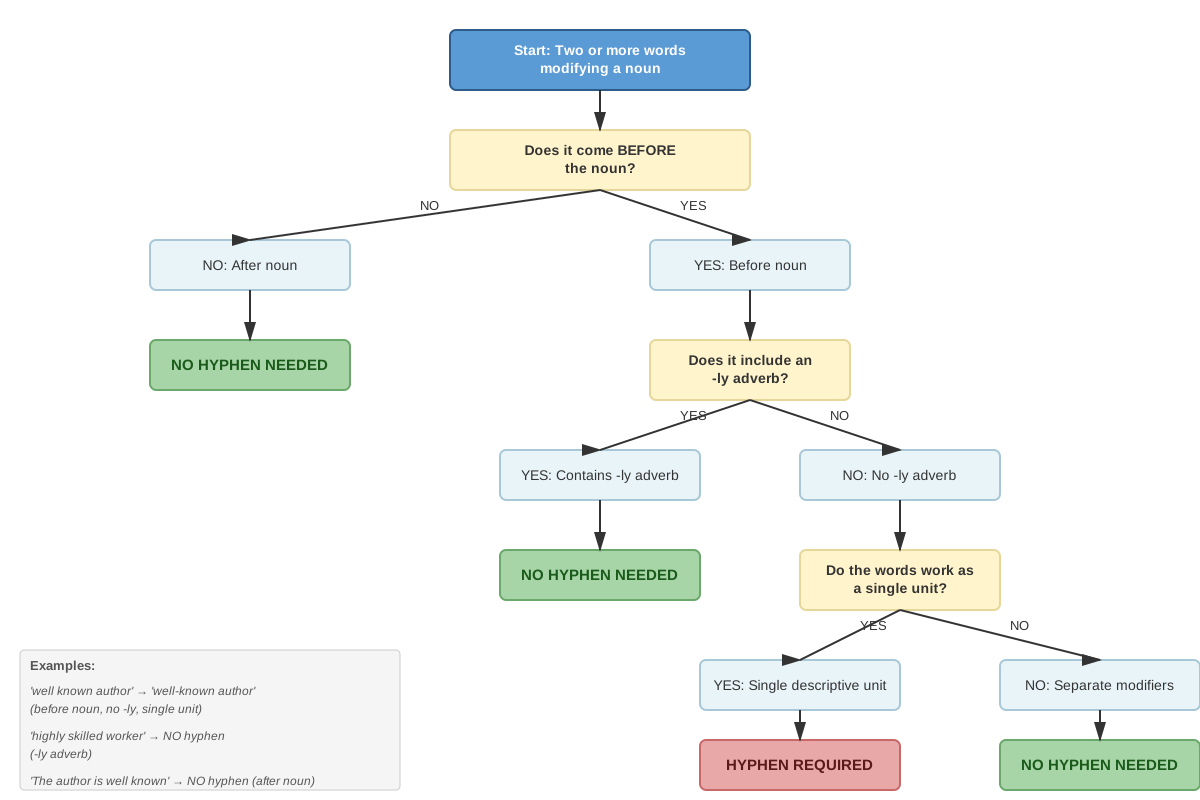
Basic Hyphenation Rule → Position Relative to Noun → Application Decision (hyphenate or not) → Check for "-ly" Exception → Check for Special Cases (numbers, proper nouns, suspended hyphens) → Final Punctuation Decision
High-Yield Facts
⭐ Compound modifiers require hyphens when they appear before the noun they modify but typically not when they appear after the noun or linking verb
⭐ Adverbs ending in "-ly" never require hyphens when combined with adjectives, regardless of position
⭐ Numbers combined with units of measurement or other nouns require hyphens in pre-noun position (e.g., "five-year plan")
⭐ The ACT frequently tests the distinction between pre-noun and post-noun positions for the same compound modifier
⭐ Multiple-word compound modifiers require hyphens connecting all words when appearing before a noun (e.g., "state-of-the-art")
- Suspended hyphens are correct when multiple compound modifiers share a common base word (e.g., "full- and part-time")
- Proper nouns used as modifiers generally do not require hyphens, even when consisting of multiple words
- Compound modifiers formed with "very" or other intensifiers typically do not require hyphens (e.g., "very important decision")
- Fractions used as adjectives require hyphens (e.g., "a two-thirds majority")
- The hyphen in compound modifiers serves to eliminate ambiguity and clarify that words function as a unified concept
- Compound modifiers that have become established as single concepts may appear in dictionaries as hyphenated words regardless of position
- When in doubt on the ACT, check whether the modifier appears before or after the noun—this is the most reliable indicator
Quick check — test yourself on Hyphenated modifiers so far.
Try Flashcards →Common Misconceptions
Misconception: All compound modifiers always require hyphens, regardless of position.
Correction: Compound modifiers typically require hyphens only when they appear before the noun they modify. When the same words appear after a linking verb or noun, hyphens are usually omitted. For example, "a well-known author" requires a hyphen, but "the author is well known" does not.
Misconception: Adverbs ending in "-ly" should be hyphenated to the adjectives they modify when appearing before a noun.
Correction: Adverbs ending in "-ly" never require hyphens when combined with adjectives, even in pre-noun position. "A highly qualified candidate" is correct; "a highly-qualified candidate" is incorrect. The "-ly" ending unambiguously identifies the word as an adverb, eliminating any potential confusion about word relationships.
Misconception: Hyphens and dashes are interchangeable punctuation marks.
Correction: Hyphens (-) and dashes (– or —) serve different purposes. Hyphens connect words within compound modifiers and compound words. Dashes set off parenthetical information or indicate interruptions. On the ACT, using a dash where a hyphen belongs (or vice versa) is incorrect.
Misconception: If words commonly appear together, they should always be hyphenated.
Correction: Frequency of use does not determine hyphenation; grammatical function and position do. "High school" is not hyphenated when used as a noun ("I attended high school"), but it is hyphenated when used as a compound modifier before a noun ("my high-school teacher").
Misconception: Numbers should always be hyphenated to the words that follow them.
Correction: Numbers require hyphens only when they combine with other words to form compound modifiers in pre-noun position. "A 10-year period" requires a hyphen, but "a period of 10 years" does not. Additionally, when numbers stand alone as adjectives without forming compound modifiers, no hyphen is needed ("I have 10 apples").
Misconception: All three-word phrases used as modifiers require hyphens connecting all three words.
Correction: Only three-word phrases functioning as unified compound modifiers require hyphens. If the first word is an "-ly" adverb, no hyphens are used. Additionally, some three-word phrases may not function as compound modifiers at all, in which case hyphens would be inappropriate.
Worked Examples
Example 1: Pre-Noun vs. Post-Noun Position
ACT-Style Question:
"The laboratory purchased state of the art equipment for the research project. The equipment was expensive but necessary."
Which of the following is the best revision of the underlined portion?
A. NO CHANGE
B. state-of-the-art equipment
C. state-of-the art equipment
D. state of-the-art equipment
Solution Process:
Step 1: Identify what is being tested. The underlined portion contains multiple words that appear to modify "equipment," suggesting this question tests hyphenated modifiers.
Step 2: Determine the position of the modifier. The phrase "state of the art" appears immediately before the noun "equipment," placing it in pre-noun position.
Step 3: Apply the basic rule. Compound modifiers in pre-noun position require hyphens connecting all the words that form the unified modifier.
Step 4: Check for exceptions. None of the words end in "-ly," and this is not a proper noun, so no exceptions apply.
Step 5: Evaluate the options. Option A (NO CHANGE) lacks hyphens entirely. Option B correctly hyphenates all three words. Option C hyphenates only two of the three words. Option D incorrectly places hyphens.
Answer: B. "state-of-the-art equipment"
Connection to Learning Objectives: This example demonstrates how to identify when hyphenated modifiers are being tested (the multiple-word phrase before a noun is a key trigger) and how to apply the core rule (pre-noun compound modifiers require hyphens).
Example 2: The "-ly" Adverb Exception
ACT-Style Question:
"The highly-motivated students completed their assignments ahead of schedule."
Which of the following is the best revision of the underlined portion?
A. NO CHANGE
B. highly motivated students
C. highly, motivated students
D. highly motivated, students
Solution Process:
Step 1: Identify the grammatical structure. "Highly" is an adverb (ending in "-ly") modifying the adjective "motivated," and together they modify "students."
Step 2: Recognize the exception. When an adverb ending in "-ly" modifies an adjective, no hyphen is used, regardless of position relative to the noun.
Step 3: Evaluate the current punctuation. The original includes a hyphen between "highly" and "motivated," which violates the "-ly" adverb exception.
Step 4: Consider the alternatives. Option B removes the hyphen, correctly applying the exception. Option C adds a comma, which is grammatically incorrect. Option D adds a comma after "motivated," which incorrectly separates the adjective from the noun.
Answer: B. "highly motivated students"
Connection to Learning Objectives: This example illustrates a common ACT trap—incorrectly hyphenating "-ly" adverbs to adjectives. Recognizing this exception is essential for applying hyphenated modifier rules accurately.
Exam Strategy
When approaching ACT questions about hyphenated modifiers, follow this systematic process:
Step 1: Identify the trigger. Look for underlined portions containing two or more words that appear to work together to describe a noun. Common patterns include adjective-adjective combinations, adjective-noun combinations, and number-noun combinations.
Step 2: Locate the noun being modified. Determine what word or phrase the potential compound modifier describes. This helps you assess position.
Step 3: Determine position. Ask: "Does the compound modifier appear immediately before the noun, or does it appear after a linking verb or the noun itself?" This is the most critical decision point.
Step 4: Check for "-ly" adverbs. If the first word ends in "-ly," no hyphen is needed regardless of position. This exception eliminates many incorrect answer choices.
Step 5: Apply the rule. Pre-noun position = hyphens needed (with "-ly" exception). Post-noun position = hyphens typically not needed.
Exam Tip: The ACT loves to test the same compound modifier in both pre-noun and post-noun positions within the same passage. If you see "well-known" hyphenated before a noun in one sentence, watch for "well known" without a hyphen after a linking verb in another sentence—both are correct in their respective positions.
Trigger words and phrases to watch for:
- Number + unit combinations ("five-year," "20-mile")
- "Well-" combinations ("well-known," "well-respected")
- Multiple-word descriptive phrases ("state-of-the-art," "up-to-date")
- Any adjective-adjective or adjective-noun combination before a noun
Process-of-elimination tips:
- Immediately eliminate options that hyphenate "-ly" adverbs to adjectives
- Eliminate options that use dashes instead of hyphens for compound modifiers
- Eliminate options that hyphenate compound modifiers appearing after linking verbs (unless the compound modifier is an established hyphenated word)
- When "NO CHANGE" is an option, verify both that hyphens are present when needed AND absent when not needed
Time allocation: Hyphenated modifier questions should take 15-20 seconds once you've mastered the rules. If you find yourself spending more time, you may be overthinking. Trust the position rule: before the noun = hyphenate (except "-ly" adverbs); after the noun = don't hyphenate.
Memory Techniques
Mnemonic for the basic rule: "Before the Noun, Hyphens Bloom"
This reminds you that hyphens appear when compound modifiers come before (bloom before) the noun they modify.
Mnemonic for the "-ly" exception: "LY words FLY free"
Adverbs ending in "-ly" fly free without hyphens—they don't need to be tied down to the adjectives they modify.
Visualization strategy: Picture compound modifiers as a train. When the train approaches a station (noun) from the front (pre-noun position), the cars need to be connected with couplings (hyphens). When the train has already passed the station (post-noun position), the cars can separate—no couplings needed.
Position check acronym: "PLAN"
- Position: Where is the modifier relative to the noun?
- Ly-ending: Does the first word end in "-ly"?
- Apply: Use the appropriate rule based on position and word type
- No second-guessing: Trust the rule and move on
Number rule reminder: Think of numbers and units as inseparable pairs when they describe something else. "A five-mile run" = the five and mile are married (hyphenated) when they describe the run together.
Summary
Hyphenated modifiers represent a high-yield punctuation topic on the ACT English test that follows clear, predictable rules. The fundamental principle states that compound modifiers—two or more words working together as a single adjective—require hyphens when they appear before the noun they modify but typically not when they appear after the noun or a linking verb. The most important exception involves adverbs ending in "-ly," which never require hyphens when combined with adjectives, regardless of position. Students must recognize the position of compound modifiers relative to nouns, identify "-ly" adverbs, and apply these rules consistently. The ACT frequently tests the distinction between pre-noun and post-noun positions using the same compound modifier in different contexts. Mastering this topic requires understanding that hyphens serve to clarify meaning by signaling that multiple words function as a unified concept, and that position determines whether this clarification is necessary. Success on hyphenated modifier questions depends on systematic analysis: identify the potential compound modifier, locate the noun, determine position, check for exceptions, and apply the appropriate rule.
Key Takeaways
- Compound modifiers require hyphens in pre-noun position but typically not in post-noun position—position is the primary determining factor
- Adverbs ending in "-ly" never require hyphens when combined with adjectives, making this the most important exception to memorize
- The ACT frequently tests the same compound modifier in both positions to assess whether students understand the positional rule
- Numbers combined with units or other nouns follow standard hyphenation rules: hyphenate before nouns, not after
- Multiple-word compound modifiers require hyphens connecting all words when appearing before a noun (e.g., "state-of-the-art")
- Systematic analysis prevents errors: identify the modifier, locate the noun, determine position, check for "-ly," then apply the rule
- Hyphenated modifier questions are high-yield and predictable—mastering the rules guarantees points on test day
Related Topics
Comma Usage with Coordinate Adjectives: Understanding when to use commas versus hyphens between adjectives helps clarify the distinction between independent adjectives (separated by commas) and compound modifiers (connected by hyphens). Mastering hyphenated modifiers provides the foundation for recognizing when adjectives work together versus when they modify independently.
Dash Usage for Emphasis and Interruption: While hyphens connect words within compound modifiers, dashes serve different purposes in sentences. Understanding the distinction between these punctuation marks prevents confusion and ensures appropriate usage on the ACT.
Modifier Placement and Clarity: Hyphenated modifiers represent one aspect of the broader topic of modifier placement. Understanding how modifiers relate to the words they describe helps students recognize ambiguity and improve sentence clarity.
Compound Words and Word Formation: Some compound modifiers have become established as permanent compound words (e.g., "self-esteem," "mother-in-law"). Studying hyphenated modifiers connects to understanding how English forms new words through combination.
Practice CTA
Now that you've mastered the rules and strategies for hyphenated modifiers, it's time to reinforce your learning through practice. Complete the practice questions to test your ability to identify when hyphens are needed, apply the positional rule, and recognize the "-ly" exception. Use the flashcards to drill the high-yield facts and exceptions until they become automatic. Remember: hyphenated modifier questions are among the most predictable on the ACT—consistent practice with these rules will translate directly into points on test day. You've invested the time to understand the concepts; now cement that knowledge through application!
Sign up free to keep reading
Create a free AnvayaPrep account to finish this ACT guide on Hyphenated modifiers — plus flashcards and practice questions.