Overview
Parentheses usage represents a critical punctuation skill tested on the ACT English section, appearing in approximately 2-4 questions per test. While parentheses might seem like a minor punctuation mark, understanding when and how to use them correctly can significantly impact a student's score. The ACT tests parentheses in specific, predictable ways, making this a high-yield topic for focused study.
Parentheses serve as a punctuation tool to set off supplementary information—details that add context or clarification but aren't essential to the sentence's core meaning. On the ACT, questions about ACT parentheses usage typically ask students to choose between parentheses, commas, dashes, or no punctuation at all. The key to mastering these questions lies in understanding the hierarchy of emphasis and the grammatical rules governing interrupters and nonessential information.
This topic connects directly to broader punctuation concepts tested on the ACT, including comma usage, dash usage, and sentence structure. Students who master parentheses usage develop a more sophisticated understanding of how punctuation controls meaning, emphasis, and readability. This knowledge transfers to questions about restrictive versus nonrestrictive clauses, appositive phrases, and sentence flow—all frequent elements in ACT English passages.
Learning Objectives
- [ ] Identify when Parentheses usage is being tested
- [ ] Explain the core rule or strategy behind Parentheses usage
- [ ] Apply Parentheses usage to ACT-style questions accurately
- [ ] Distinguish between situations requiring parentheses, commas, or dashes
- [ ] Recognize when parenthetical information can be removed without affecting sentence meaning
- [ ] Evaluate whether punctuation marks are used in matching pairs correctly
Prerequisites
- Basic comma usage: Understanding commas is essential because parentheses often compete with commas as answer choices for setting off nonessential information
- Sentence structure fundamentals: Recognizing independent and dependent clauses helps determine whether information is truly supplementary
- Dash usage basics: Dashes serve a similar function to parentheses but with different emphasis, making comparison knowledge crucial
- Subject-verb agreement: Parenthetical information often interrupts subject-verb pairs, requiring the ability to identify core sentence elements
Why This Topic Matters
In professional and academic writing, parentheses provide a sophisticated tool for adding supplementary information without disrupting the main flow of ideas. Writers use parentheses to include citations, clarifications, asides, and additional details that enhance understanding without demanding primary attention. This skill translates directly to college-level writing, research papers, and professional communication.
On the ACT English section, parentheses questions appear with consistent frequency—typically 2-4 times per test. These questions usually fall into two categories: choosing the correct punctuation mark to set off information (parentheses versus commas versus dashes) and identifying whether parentheses are used correctly in context. The ACT particularly favors testing whether students understand that parenthetical information must be truly nonessential and whether punctuation marks appear in proper pairs.
Common question formats include: selecting between different punctuation options for the same phrase, identifying errors in existing parentheses usage, and determining whether information should be set off at all. The test often embeds these questions in science or history passages where technical terms, dates, or explanatory phrases naturally require supplementary punctuation. Students who recognize the patterns can quickly eliminate wrong answers and select correct options with confidence.
Core Concepts
The Fundamental Rule of Parentheses
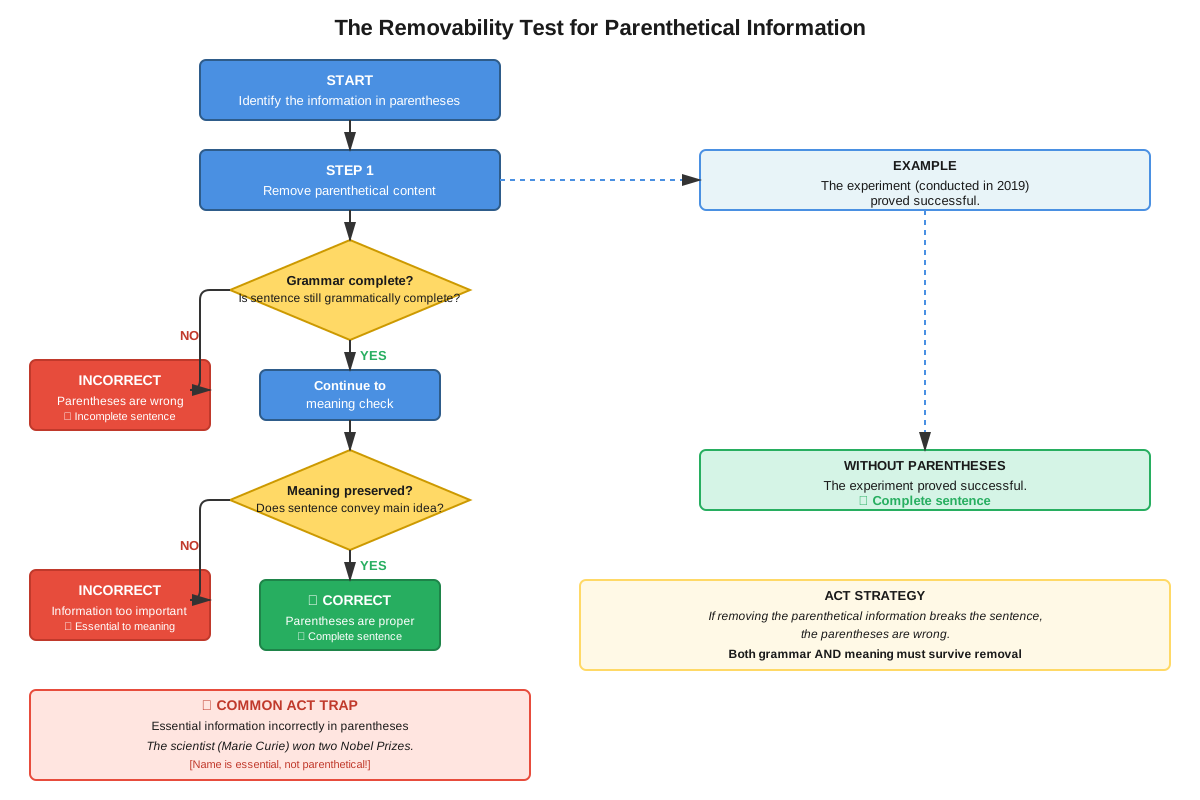
Parentheses are punctuation marks used in pairs—an opening parenthesis "(" and a closing parenthesis ")"—to enclose supplementary, nonessential information within a sentence. The cardinal rule: if you remove everything between the parentheses, the remaining sentence must still be grammatically complete and convey its primary meaning. This "removal test" serves as the most reliable strategy for evaluating parentheses usage on the ACT.
The information inside parentheses typically includes:
- Brief explanations or definitions
- Examples that clarify but don't define
- Dates, numbers, or citations
- Asides or commentary
- Acronym expansions or abbreviations
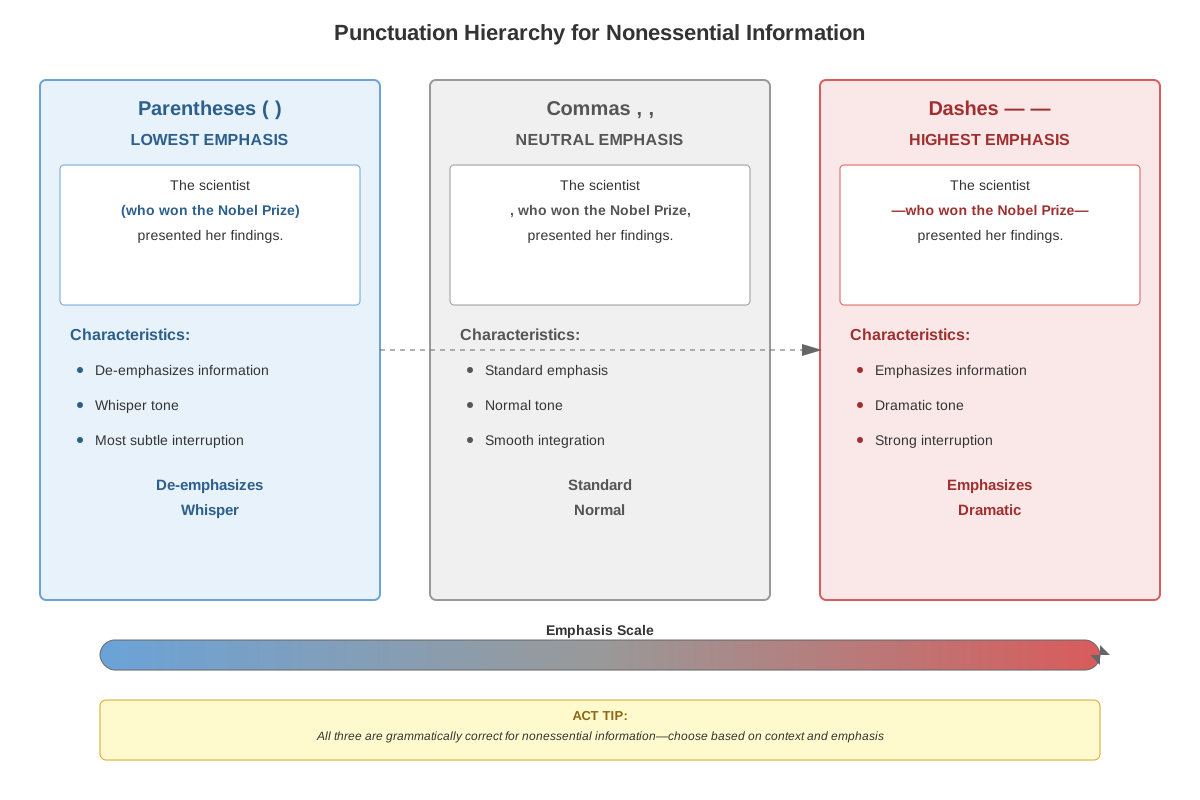
Parentheses Versus Commas Versus Dashes
The ACT frequently tests the distinction between three punctuation options for setting off nonessential information. Understanding the hierarchy of emphasis is crucial:
| Punctuation | Emphasis Level | Best Use | ACT Frequency |
|---|---|---|---|
| Parentheses | Lowest (de-emphasizes) | Minor details, technical info, asides | Medium |
| Commas | Neutral (standard) | Most nonessential clauses and phrases | High |
| Dashes | Highest (emphasizes) | Important interruptions, dramatic pauses | Medium |
Parentheses minimize the importance of enclosed information, suggesting "this is extra, feel free to skip." Commas treat information neutrally, as a natural part of the sentence flow. Dashes amplify importance, drawing attention to the enclosed material.
On the ACT, when all three options are grammatically correct, the context determines the best choice. Look for clues about whether the author wants to emphasize, de-emphasize, or neutrally present the information.
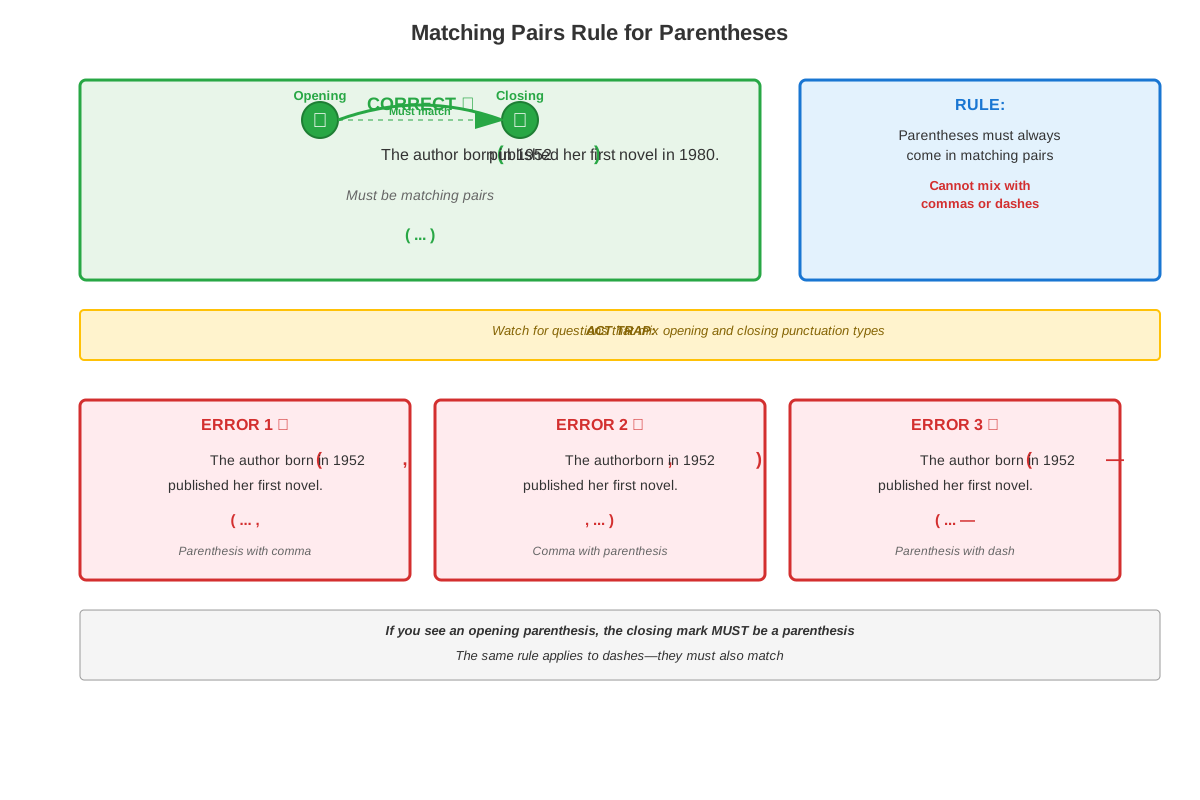
Matching Pairs Requirement
Parentheses must always appear in matching pairs. This seems obvious, but the ACT tests it by:
- Placing the opening parenthesis in one part of a passage and asking about punctuation elsewhere
- Offering answer choices that would create mismatched punctuation (e.g., opening with a parenthesis but closing with a comma)
- Testing whether students notice when a sentence opens with a parenthesis but never closes it
The matching pairs rule extends to mixing punctuation types. A sentence cannot open with a parenthesis and close with a dash, or open with a comma and close with a parenthesis. The ACT exploits this by creating answer choices that mix punctuation marks incorrectly.
Placement Rules and Sentence Structure
Parentheses can appear at three positions in a sentence:
- Mid-sentence: The most common placement, interrupting the main clause
- Example: "The scientist (Dr. Maria Chen) published her findings."
- End of sentence: Following the complete main clause
- Example: "The experiment succeeded (after three failed attempts)."
- Rarely at the beginning: Almost never tested on the ACT because it's stylistically awkward
When parentheses appear mid-sentence, they often interrupt the subject-verb connection. Students must mentally remove the parenthetical information to verify subject-verb agreement:
- "The results (which surprised everyone) was significant." ✗ INCORRECT
- "The results (which surprised everyone) were significant." ✓ CORRECT
Punctuation Outside Parentheses
A critical but frequently tested rule: punctuation marks that belong to the main sentence go outside the closing parenthesis. Punctuation that belongs only to the parenthetical material goes inside.
Examples:
- "She completed the project (finally)." ← Period belongs to main sentence
- "Did she complete the project (the difficult one)?" ← Question mark belongs to main sentence
- "She asked a question (why did this happen?)." ← Question mark belongs to parenthetical question
The ACT tests this by offering answer choices with punctuation in different positions relative to the closing parenthesis.
The Nonessential Information Test
To determine whether parentheses are appropriate, apply this three-step test:
- Remove the parenthetical information completely
- Read the remaining sentence
- Verify it's grammatically complete and meaningful
If the sentence fails this test, the information isn't truly parenthetical and shouldn't be enclosed. The ACT includes wrong answer choices that place essential information in parentheses, creating incomplete sentences when removed.
Concept Relationships
The concepts within parentheses usage form a logical hierarchy. The fundamental rule (nonessential information) serves as the foundation, determining whether parentheses are even appropriate. This connects directly to the removal test, which provides the practical method for applying the fundamental rule. Once parentheses are deemed appropriate, the matching pairs requirement becomes relevant, ensuring correct implementation. The placement rules and punctuation outside parentheses concepts then refine the technical execution.
Parentheses usage connects to prerequisite topics through shared principles. Comma usage provides the baseline understanding of nonessential information—parentheses simply offer an alternative punctuation choice with different emphasis. Dash usage extends this relationship, creating a three-way comparison that the ACT frequently tests. Sentence structure knowledge enables students to identify what's essential versus supplementary, while subject-verb agreement helps students verify that parenthetical interruptions don't mask grammatical errors.
The relationship map flows: Sentence Structure → Identify Nonessential Information → Choose Punctuation Level (Parentheses/Commas/Dashes) → Apply Matching Pairs Rule → Position Punctuation Correctly → Verify Sentence Completeness.
High-Yield Facts
⭐ Parenthetical information must be completely removable without affecting sentence grammar or core meaning
⭐ Parentheses always appear in matching pairs—opening and closing marks must both be present
⭐ Parentheses de-emphasize information; commas are neutral; dashes emphasize
⭐ Punctuation belonging to the main sentence goes outside the closing parenthesis
⭐ You cannot mix punctuation types (e.g., opening with a parenthesis and closing with a comma)
- Parentheses can enclose single words, phrases, or complete sentences
- When parentheses interrupt a sentence, subject-verb agreement must still work with the parenthetical material removed
- The ACT rarely tests parentheses at the beginning of sentences
- Parenthetical information often includes dates, acronyms, brief definitions, or examples
- If information is essential to identifying which person or thing is being discussed, it should not be in parentheses
Quick check — test yourself on Parentheses usage so far.
Try Flashcards →Common Misconceptions
Misconception: Parentheses and commas are always interchangeable for nonessential information.
Correction: While both can set off nonessential information, they convey different emphasis levels. Parentheses minimize importance, while commas treat information neutrally. The ACT expects students to choose based on context and authorial intent.
Misconception: It's acceptable to open with a parenthesis and close with a dash if they're both setting off the same information.
Correction: Punctuation marks must match in type. Opening with a parenthesis requires closing with a parenthesis. Mixing punctuation types creates a grammatical error that the ACT specifically tests.
Misconception: Periods always go inside the closing parenthesis.
Correction: Period placement depends on what the punctuation is marking. If the period ends the main sentence, it goes outside. Only if the parenthetical material is a complete sentence standing alone would the period go inside.
Misconception: Any extra information can be placed in parentheses.
Correction: Only truly nonessential information belongs in parentheses. If removing the information makes the sentence unclear about which specific person, place, or thing is being discussed, the information is essential and should not be parenthetical.
Misconception: Parentheses are informal and should be avoided in academic writing.
Correction: Parentheses are perfectly acceptable in formal academic writing when used appropriately. They serve a specific rhetorical purpose and appear frequently in scholarly articles, particularly for citations, technical specifications, and brief clarifications.
Worked Examples
Example 1: Choosing Between Punctuation Marks
Question: The research team's findings (which took three years to compile) revolutionized the field.
Which of the following alternatives to the underlined portion would NOT be acceptable?
A. findings, which took three years to compile,
B. findings—which took three years to compile—
C. findings which took three years to compile
D. findings (which took three years to compile)
Solution Process:
Step 1: Identify what's being tested. The question asks which alternative is NOT acceptable, meaning three options work and one doesn't.
Step 2: Apply the removal test. Remove "which took three years to compile" from the sentence: "The research team's findings revolutionized the field." This sentence is complete and meaningful, confirming the information is nonessential.
Step 3: Evaluate each option:
- Option A uses commas (matching pairs) to set off nonessential information ✓
- Option B uses dashes (matching pairs) to set off nonessential information ✓
- Option C uses no punctuation, making "which took three years to compile" appear restrictive/essential, changing the meaning ✗
- Option D is the original, using parentheses correctly ✓
Answer: C is NOT acceptable because removing the punctuation makes the clause restrictive, implying there are multiple sets of findings and we're specifying which ones. The original context treats this as nonessential supplementary information.
Connection to Learning Objectives: This example demonstrates identifying when parentheses usage is being tested (comparing punctuation options) and applying the core strategy (removal test and matching pairs).
Example 2: Punctuation Placement
Question: The experiment succeeded (after numerous failed attempts).
If the writer were to delete the parenthetical phrase, the sentence would primarily lose:
F. an indication of how difficult the experiment was
G. a necessary detail about when the experiment occurred
H. information about who conducted the experiment
J. the sentence's main point about success
Solution Process:
Step 1: Read the sentence without the parenthetical phrase: "The experiment succeeded." The sentence remains grammatically complete and conveys its main point.
Step 2: Analyze what the parenthetical phrase adds. "After numerous failed attempts" provides context about the difficulty and persistence required, but isn't necessary to understand that the experiment succeeded.
Step 3: Evaluate each option:
- Option F correctly identifies that the phrase indicates difficulty ✓
- Option G is incorrect because the phrase doesn't specify when, just that there were prior attempts ✗
- Option H is incorrect because no information about who conducted it appears ✗
- Option J is incorrect because the main point (success) remains without the phrase ✗
Answer: F. The parenthetical phrase adds supplementary information about difficulty without being essential to the sentence's core meaning.
Connection to Learning Objectives: This example reinforces explaining the core rule (nonessential information) and demonstrates how to evaluate whether information is truly supplementary.
Exam Strategy
When approaching ACT questions about parentheses usage, follow this systematic process:
Step 1: Identify the Question Type
- Is the question asking you to choose between punctuation marks?
- Is it asking whether existing punctuation is correct?
- Is it asking what would be lost if parenthetical information were deleted?
Step 2: Apply the Removal Test
Mentally remove everything between the parentheses (or potential parentheses). If the sentence becomes incomplete or loses essential meaning, parentheses are inappropriate.
Step 3: Check for Matching Pairs
Verify that opening and closing punctuation marks match in type. Scan the entire sentence, not just the underlined portion, as the ACT may place one mark outside the underlined section.
Step 4: Evaluate Emphasis
When choosing between parentheses, commas, and dashes, consider context clues:
- Trigger words for parentheses: "incidentally," "by the way," technical terms, dates, brief asides
- Trigger words for emphasis (dashes): "importantly," "surprisingly," "notably"
- Neutral presentation (commas): most standard nonessential clauses
Step 5: Check Punctuation Placement
Verify that periods, commas, and other marks appear in the correct position relative to closing parentheses based on what they're punctuating.
Time-Saving Tip: If you can remove the information and the sentence still works perfectly, parentheses are likely correct. This test takes 5 seconds and eliminates wrong answers quickly.
Process of Elimination Strategy:
- Eliminate any option that creates mismatched punctuation pairs
- Eliminate options that place essential information in parentheses
- Eliminate options that create sentence fragments when the parenthetical material is removed
- Among remaining options, choose based on emphasis level appropriate to context
Allocate approximately 30-45 seconds per parentheses question. These questions reward systematic thinking over speed, so resist the urge to rush.
Memory Techniques
REMOVE Mnemonic for evaluating parentheses:
- Read the sentence without the parenthetical phrase
- Evaluate whether it's still complete
- Match the punctuation pairs
- Observe the emphasis level needed
- Verify punctuation placement
- Eliminate wrong answers systematically
The Whisper Test: Think of parentheses as "whispering" information—it's there if you want it, but you could miss it and still understand everything. Commas speak at normal volume. Dashes shout.
Matching Socks Rule: Just as you wouldn't wear one sock and one shoe, you can't open with a parenthesis and close with a comma. Punctuation marks must match like pairs of socks.
The Jewelry Analogy: Parenthetical information is like jewelry on an outfit—it adds something extra, but the outfit (sentence) works fine without it. If removing the jewelry leaves you inappropriately dressed, it wasn't really optional.
Visual Pattern: When you see ( in a sentence, immediately scan for ). If you can't find it, or if you find a different punctuation mark instead, you've found an error.
Summary
Parentheses usage on the ACT centers on one fundamental principle: parentheses enclose supplementary, nonessential information that can be completely removed without affecting sentence grammar or core meaning. The ACT tests this concept by asking students to choose between parentheses, commas, and dashes (which differ in emphasis level), to identify matching pairs errors, and to evaluate whether information is truly nonessential. Success requires applying the removal test—mentally deleting parenthetical information to verify sentence completeness—and understanding that parentheses de-emphasize content while commas remain neutral and dashes emphasize. Students must also recognize that punctuation marks must appear in matching pairs of the same type and that punctuation belonging to the main sentence goes outside the closing parenthesis. Mastering these concepts enables quick, confident answers on 2-4 questions per ACT test, making parentheses usage a high-yield topic for focused study.
Key Takeaways
- Parenthetical information must pass the removal test: the sentence must remain grammatically complete and meaningful without it
- Parentheses, commas, and dashes all set off nonessential information but differ in emphasis: parentheses minimize, commas neutralize, dashes emphasize
- Punctuation marks must always appear in matching pairs of the same type—no mixing parentheses with commas or dashes
- Punctuation belonging to the main sentence goes outside the closing parenthesis; only punctuation for the parenthetical material itself goes inside
- The ACT frequently tests whether students can distinguish essential from nonessential information and choose appropriate punctuation accordingly
- Subject-verb agreement must work correctly even when parenthetical information interrupts the subject and verb
- Systematic application of the removal test and matching pairs check eliminates wrong answers efficiently
Related Topics
Comma Usage with Nonessential Clauses: Understanding how commas set off nonessential information provides the foundation for comparing punctuation options. Mastering parentheses usage makes comma questions easier because the same principles apply.
Dash Usage for Emphasis: Dashes serve a similar grammatical function to parentheses but with opposite rhetorical effect. Students who understand parentheses can quickly master dashes by focusing on the emphasis distinction.
Restrictive versus Nonrestrictive Clauses: This broader grammatical concept underlies all parentheses questions. Deep understanding of what makes information essential versus supplementary enables confident answers across multiple question types.
Appositive Phrases: Appositives frequently appear in parentheses on the ACT. Understanding how appositives rename or explain nouns helps students evaluate whether parenthetical punctuation is appropriate.
Sentence Structure and Fragments: Recognizing complete sentences enables effective application of the removal test, making this a natural next topic for students mastering parentheses.
Practice CTA
Now that you understand the core principles of parentheses usage, it's time to apply this knowledge to ACT-style practice questions. The concepts you've learned—the removal test, matching pairs, emphasis levels, and punctuation placement—will become automatic with deliberate practice. Work through the practice questions methodically, applying the systematic approach outlined in the exam strategy section. Review the flashcards to reinforce high-yield facts and common patterns. Remember: parentheses questions are highly predictable on the ACT, and students who master the patterns consistently answer these questions correctly. Your investment in practice now will pay dividends on test day!
Sign up free to keep reading
Create a free AnvayaPrep account to finish this ACT guide on Parentheses usage — plus flashcards and practice questions.