Overview
Plural possessives represent one of the most frequently tested punctuation concepts on the ACT English section. This grammatical construction indicates ownership or association when the possessor is more than one person, place, or thing. While singular possessives follow a straightforward pattern (add apostrophe + s), plural possessives require students to first determine whether the plural noun ends in -s or not, then apply the appropriate apostrophe placement rule. Mastering this distinction is critical because the ACT consistently includes questions that test whether students can differentiate between plural forms, singular possessives, and plural possessives.
The importance of ACT plural possessives extends beyond isolated punctuation questions. These constructions appear in various contexts throughout the English section, embedded within sentences that test multiple concepts simultaneously. Students must recognize possessive relationships while also evaluating sentence structure, subject-verb agreement, and logical flow. The ACT test writers deliberately create answer choices that include common errors—such as placing the apostrophe before the -s in regular plural possessives or omitting the apostrophe entirely—making this a high-yield topic for score improvement.
Understanding plural possessives connects directly to broader punctuation principles and grammatical relationships. This topic builds upon knowledge of apostrophe usage, noun forms, and the fundamental concept of possession in English. It also relates to pronoun usage, modifier placement, and clarity in writing. Students who master plural possessives demonstrate command over a key element of standard written English, which the ACT values highly across all passage types, from literary narratives to scientific explanations.
Learning Objectives
- [ ] Identify when Plural possessives is being tested in ACT questions
- [ ] Explain the core rule or strategy behind Plural possessives
- [ ] Apply Plural possessives to ACT-style questions accurately
- [ ] Distinguish between plural nouns, singular possessives, and plural possessives in context
- [ ] Recognize and correct common apostrophe placement errors in plural possessive constructions
- [ ] Evaluate answer choices that test plural possessives alongside other grammatical concepts
Prerequisites
- Basic apostrophe usage: Understanding that apostrophes indicate possession or contraction is fundamental to applying plural possessive rules correctly
- Singular possessive formation: Knowledge of adding 's to singular nouns provides the foundation for understanding how plural possessives differ
- Regular and irregular plural formation: Recognizing how nouns form plurals (adding -s, -es, or irregular changes) is essential for determining correct apostrophe placement
- Parts of speech identification: Ability to identify nouns and their functions helps students recognize when possession is being expressed
Why This Topic Matters
In real-world writing, plural possessives appear constantly in professional, academic, and personal communication. Business reports reference "the employees' benefits," academic papers discuss "the researchers' findings," and everyday correspondence mentions "the neighbors' complaints." Proper apostrophe placement in these constructions signals education level and attention to detail, making this skill valuable beyond test preparation.
On the ACT English section, plural possessive questions appear with remarkable consistency—typically 2-4 questions per test. These questions often appear in the Conventions of Standard English category, which comprises approximately 40% of the English section. The ACT specifically tests whether students can distinguish between three similar-looking forms: the plural (no apostrophe), the singular possessive (apostrophe before s), and the plural possessive (apostrophe after s for regular plurals). This makes plural possessives a high-frequency, high-impact topic for score improvement.
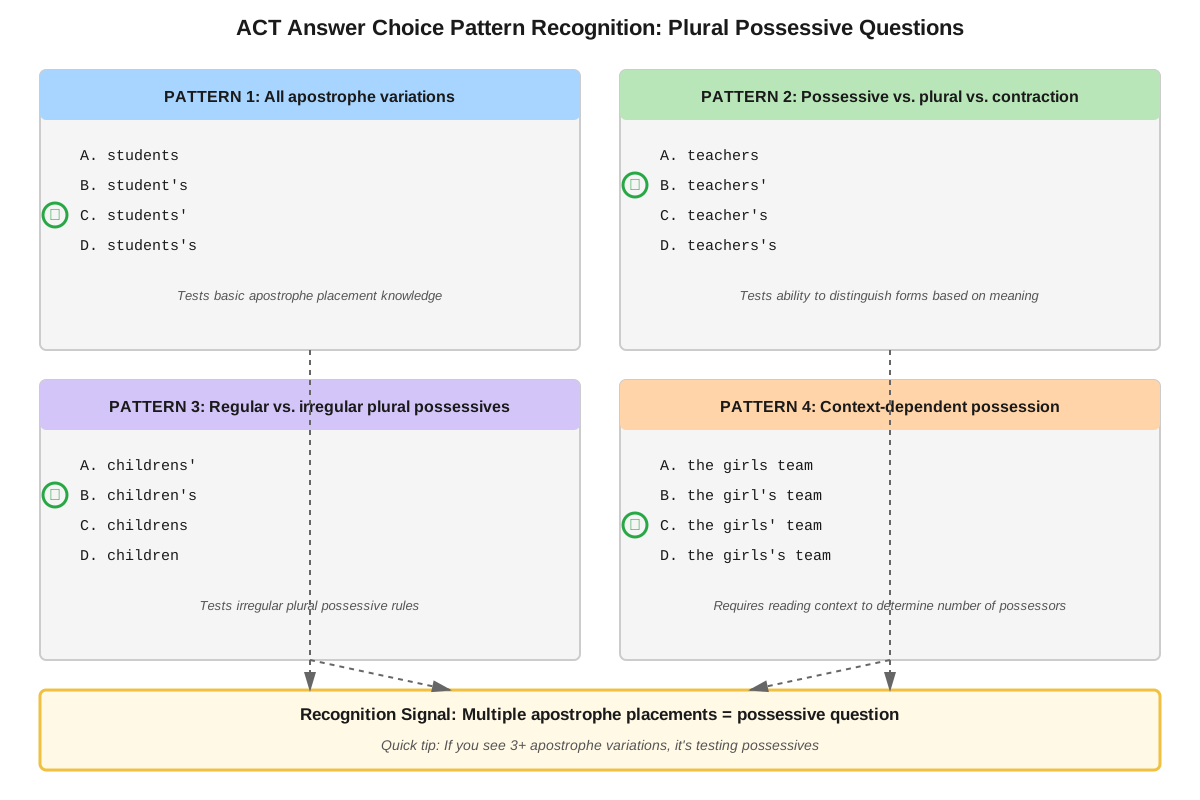
Common question formats include underlined portions where students must choose between "students," "student's," and "students'" or similar variations. The ACT also embeds plural possessive questions within longer sentences that test multiple concepts, requiring students to identify the possessive relationship while managing other grammatical considerations. Passages may include historical accounts discussing "the colonists' grievances," scientific explanations referencing "the particles' movements," or narrative descriptions mentioning "the children's toys"—each requiring precise apostrophe placement based on whether the possessor is singular or plural.
Core Concepts
The Fundamental Rule of Plural Possessives
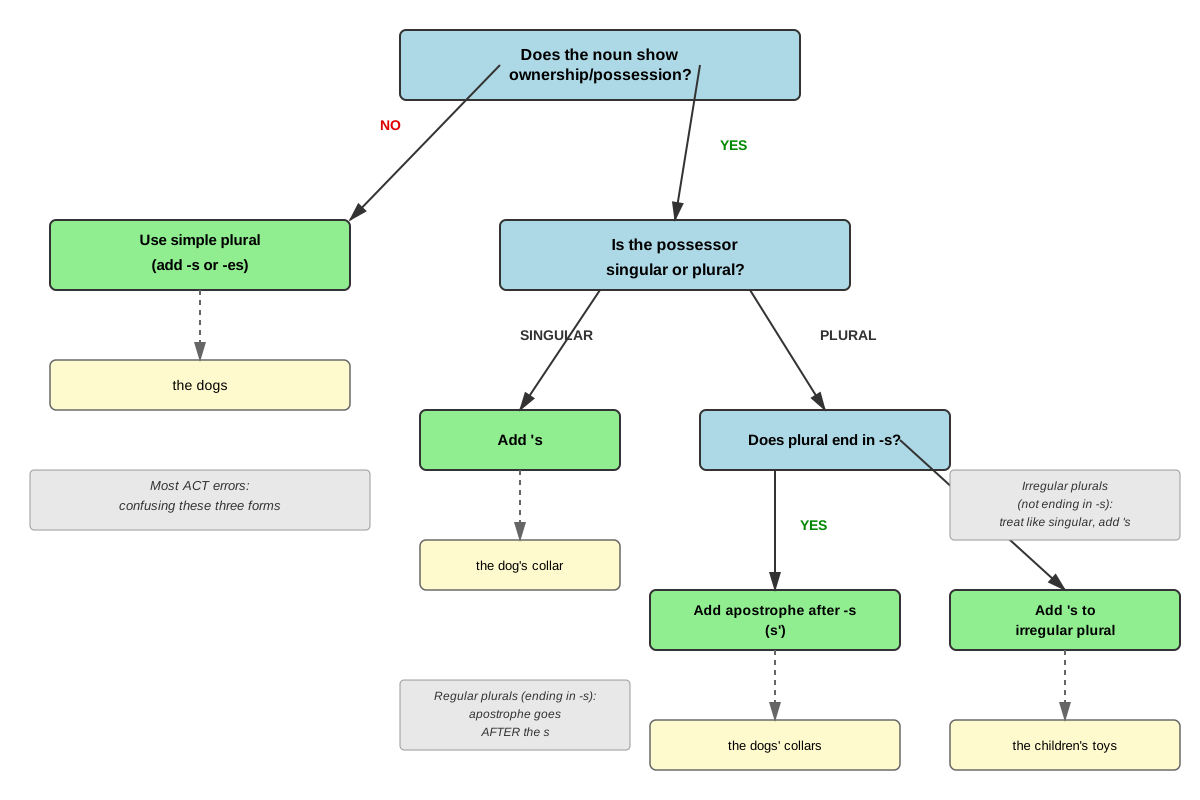
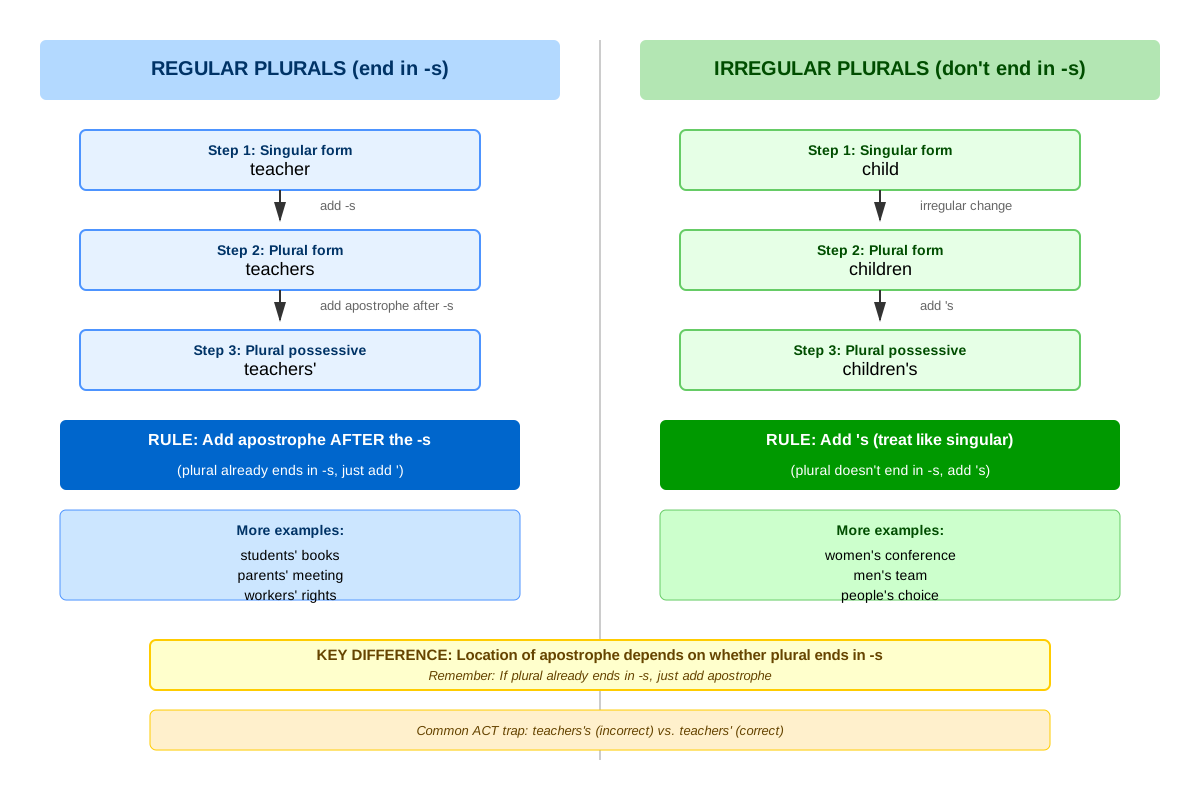
The core principle governing plural possessives depends entirely on how the plural noun is formed. For regular plural nouns that end in -s (which represents the vast majority of English plurals), the possessive is formed by adding only an apostrophe after the existing -s. For irregular plural nouns that do not end in -s, the possessive is formed by adding apostrophe + s, exactly like a singular possessive. This distinction is crucial and represents the most commonly tested aspect of this topic on the ACT.
| Noun Type | Example | Plural Form | Plural Possessive | Rule Applied |
|---|---|---|---|---|
| Regular plural | student | students | students' | Add apostrophe after the -s |
| Regular plural | teacher | teachers | teachers' | Add apostrophe after the -s |
| Regular plural | box | boxes | boxes' | Add apostrophe after the -s |
| Irregular plural | child | children | children's | Add 's (no -s in plural) |
| Irregular plural | woman | women | women's | Add 's (no -s in plural) |
| Irregular plural | person | people | people's | Add 's (no -s in plural) |
Identifying the Need for Plural Possessives
Before applying any rule, students must recognize when a plural possessive is needed. This requires identifying two elements: (1) the noun is plural (referring to more than one), and (2) the noun possesses or is associated with something else. The ACT tests this recognition by presenting sentences where the relationship between nouns must be carefully analyzed.
Consider the sentence: "The dogs barked at the mailman." Here, "dogs" is plural but not possessive—it simply indicates multiple dogs performing an action. Compare this to: "The dogs' barking woke the neighbors." Now "dogs" is both plural and possessive because the barking belongs to the dogs. The apostrophe after the -s signals this dual function.
The Three-Way Distinction
The ACT deliberately creates confusion by offering answer choices that represent three distinct grammatical forms:
- Simple plural: No apostrophe (e.g., "students") - indicates multiple items with no possession
- Singular possessive: Apostrophe before -s (e.g., "student's") - indicates one item possessing something
- Plural possessive: Apostrophe after -s (e.g., "students'") - indicates multiple items possessing something
Understanding which form is needed requires analyzing the sentence's meaning. If the sentence discusses something belonging to multiple entities, the plural possessive is correct. If it discusses something belonging to one entity, the singular possessive is correct. If no possession is involved, the simple plural is correct.
Irregular Plural Possessives
Irregular plurals present a special case that the ACT tests less frequently but still includes. Nouns like "children," "men," "women," "people," "teeth," "feet," "mice," and "geese" form plurals without adding -s. Because these plural forms don't end in -s, their possessive forms follow the singular possessive pattern: add apostrophe + s.
Examples:
- The children's playground (multiple children possess/use the playground)
- The men's department (department associated with men)
- The people's choice (choice belonging to the people)
The key insight is that the possessive formation depends on the ending of the plural form, not on whether the noun is singular or plural conceptually.
Compound Nouns and Joint Possession
When dealing with compound nouns or multiple owners, additional rules apply. For compound nouns that are plural (like "mothers-in-law"), the possessive apostrophe goes after the final -s: "mothers-in-law's advice." For joint possession (two or more people owning the same thing), only the last noun takes the possessive form: "Tom and Jerry's apartment" (they share one apartment). For separate possession (each person owns their own item), both nouns take possessive forms: "Tom's and Jerry's apartments" (each has his own apartment).
Context Clues for Possession
The ACT often provides context clues that signal possession. Words like "belonging to," "owned by," "associated with," or prepositional phrases starting with "of" can indicate possessive relationships. For example, "the opinions of the students" can be rewritten as "the students' opinions." Recognizing these equivalent constructions helps identify when plural possessives are needed.
Concept Relationships
The concept of plural possessives builds directly upon understanding of singular possessives → which establishes the basic apostrophe + s pattern → that then gets modified for regular plural possessives (apostrophe only) and irregular plural possessives (apostrophe + s). This modification depends on plural noun formation → which determines whether the plural ends in -s or not → which then dictates apostrophe placement.
The relationship between these concepts can be mapped as:
Noun identification → Determine if singular or plural → Determine if possession is expressed → Apply appropriate possessive rule → Place apostrophe correctly
This topic also connects to pronoun usage because possessive pronouns (their, its, whose) never use apostrophes, creating potential confusion. Understanding that "its" (possessive pronoun) differs from "it's" (contraction) parallels the understanding that "students'" (plural possessive) differs from "student's" (singular possessive) and "students" (simple plural).
Additionally, plural possessives relate to subject-verb agreement because correctly identifying whether a noun is singular or plural affects both possessive formation and verb selection. The sentence "The student's books are heavy" (one student) requires different verb agreement than "The students' books are heavy" (multiple students), though both use "are" because "books" is the subject.
Quick check — test yourself on Plural possessives so far.
Try Flashcards →High-Yield Facts
⭐ Regular plural possessives (plurals ending in -s) form the possessive by adding only an apostrophe after the existing -s: students' books, teachers' lounge, dogs' toys
⭐ Irregular plural possessives (plurals not ending in -s) form the possessive by adding apostrophe + s: children's games, women's rights, people's opinions
⭐ The ACT tests the three-way distinction between plural (students), singular possessive (student's), and plural possessive (students') in most questions on this topic
⭐ Never add an additional -s after the apostrophe for regular plural possessives—"students's" is always incorrect
⭐ Context determines whether possession is being expressed; look for relationships where one noun owns, is associated with, or is connected to another noun
- Possessive pronouns (its, their, whose, your) never use apostrophes, unlike possessive nouns
- Compound plural possessives place the apostrophe after the final -s of the compound: mothers-in-law's, passers-by's
- Joint possession (one item owned by multiple people) uses the possessive form only on the last owner: John and Mary's house
- Separate possession (each person owns their own item) uses possessive forms on all owners: John's and Mary's houses
- Time and money expressions often use possessive forms: two weeks' notice, five dollars' worth
- The word "of" often signals a possessive relationship that can be rewritten with an apostrophe: the books of the students = the students' books
- Plural possessives appear in all ACT passage types: prose fiction, social science, humanities, and natural science
Common Misconceptions
Misconception: All plural possessives are formed by adding 's to the plural noun → Correction: Regular plurals ending in -s form possessives by adding only an apostrophe after the existing -s (students' not students's), while irregular plurals not ending in -s add 's (children's)
Misconception: The apostrophe always goes before the -s in possessive forms → Correction: Singular possessives place the apostrophe before the -s (student's), but regular plural possessives place it after the -s (students')
Misconception: If a word ends in -s, it must be plural → Correction: Some singular nouns end in -s (James, class, boss), and their singular possessives add 's (James's, class's, boss's), while their plural possessives follow the regular rule (classes', bosses')
Misconception: Possessive pronouns like "its" and "their" need apostrophes → Correction: Possessive pronouns never use apostrophes; "it's" means "it is" and "they're" means "they are," not possessive forms
Misconception: You can determine the correct form by how it sounds → Correction: "Students," "student's," and "students'" may sound identical in speech, but meaning and context determine the correct written form, not pronunciation
Misconception: Plural possessives are rare and unimportant → Correction: Plural possessives appear 2-4 times per ACT English section and are essential for expressing ownership by multiple entities in standard written English
Misconception: The apostrophe placement doesn't significantly change meaning → Correction: "The student's books" (one student's books) means something entirely different from "The students' books" (multiple students' books); apostrophe placement fundamentally alters meaning
Worked Examples
Example 1: Regular Plural Possessive
Question: The three teachers lesson plans were reviewed by the principal before the school year began.
A. NO CHANGE
B. teachers'
C. teacher's
D. teachers's
Step 1: Identify the noun and determine if it's singular or plural
- The phrase "three teachers" clearly indicates multiple teachers, so we need a plural form
Step 2: Determine if possession is being expressed
- The lesson plans belong to the teachers, so possession is being expressed
- We can test this by rephrasing: "the lesson plans of the teachers"
Step 3: Determine the correct possessive form
- Since "teachers" is a regular plural ending in -s, the possessive is formed by adding only an apostrophe after the -s
- The correct form is "teachers'" (not "teacher's" which would be singular, not "teachers" which lacks possession, and not "teachers's" which incorrectly adds an extra -s)
Step 4: Verify by checking the sentence meaning
- "The three teachers' lesson plans" correctly indicates that multiple teachers each have lesson plans that were reviewed
Answer: B. teachers'
Connection to Learning Objectives: This example demonstrates identifying when plural possessives are tested (multiple teachers possessing lesson plans), explaining the core rule (apostrophe after -s for regular plurals), and applying it accurately to an ACT-style question.
Example 2: Irregular Plural Possessive vs. Regular Plural Possessive
Question: The childrens toys were scattered across the floor, while the parents patience was wearing thin.
Which of the following corrections should be made?
A. NO CHANGE
B. children's toys / parent's patience
C. childrens' toys / parents' patience
D. children's toys / parents' patience
Step 1: Analyze the first possessive relationship
- "Children" is an irregular plural (not "childs")
- The toys belong to the children, so possession is expressed
- Since "children" doesn't end in -s, we add 's to form the possessive: "children's"
- This eliminates options A and C
Step 2: Analyze the second possessive relationship
- The sentence context suggests multiple parents (parallel to multiple children)
- "Parents" is a regular plural ending in -s
- The patience belongs to the parents, so possession is expressed
- Since "parents" is a regular plural ending in -s, we add only an apostrophe: "parents'"
- However, we must verify: could this be singular "parent's"?
Step 3: Use context to confirm singular vs. plural
- The parallel structure with "children" (clearly plural) suggests "parents" should also be plural
- The phrase "the parents' patience" (multiple parents sharing patience) makes more logical sense than "the parent's patience" (one parent) given the context of multiple children
Step 4: Select the answer that corrects both possessives appropriately
- "children's" (irregular plural possessive) and "parents'" (regular plural possessive)
Answer: D. children's toys / parents' patience
Connection to Learning Objectives: This example requires distinguishing between irregular plural possessives (children's) and regular plural possessives (parents'), demonstrating mastery of both core rules and the ability to apply them in context with multiple possessive relationships in one sentence.
Exam Strategy
When approaching ACT questions testing plural possessives, follow this systematic process:
Step 1: Identify the trigger - Look for underlined words that end in -s or represent plural nouns, especially when followed by another noun. The ACT typically underlines the possessive form itself, with answer choices varying the apostrophe placement.
Step 2: Ask three critical questions:
- Is the noun singular or plural? (Count the entities)
- Is possession being expressed? (Does something belong to or associate with the noun?)
- How is the plural formed? (Does it end in -s or is it irregular?)
Step 3: Eliminate systematically - If possession is clearly needed, eliminate any choice without an apostrophe. If the noun is clearly plural, eliminate singular possessive forms. If the plural ends in -s, eliminate any form with 's after the -s.
Exam Tip: When you see answer choices that include variations like "students," "student's," "students'," and "students's," you're definitely being tested on possessive formation. The fourth option with double -s is almost always a distractor.
Trigger words and phrases to watch for:
- Numbers before nouns ("three teachers," "five dogs") signal plural
- Phrases with "of" ("the opinions of the students") can be rewritten as possessives
- Words indicating ownership or association ("belonging to," "associated with")
- Context suggesting multiple entities performing or possessing something
Time allocation advice: These questions should take 15-20 seconds once you've mastered the rules. Don't overthink—apply the systematic approach, and move on. If you're uncertain, mark the question and return to it, but trust your initial analysis if you've followed the steps correctly.
Process of elimination specific to plural possessives:
- Eliminate "students's" immediately (never correct)
- If context clearly shows multiple entities, eliminate singular possessive forms
- If no possession is expressed, eliminate all forms with apostrophes
- If the plural is irregular (children, women, people), eliminate forms with apostrophe after -s
Memory Techniques
The "S-S-S" Rule:
- Singular possessive: apostrophe Sits before the S (student's)
- Simple plural: no apostrophe, just S (students)
- Several owners possessive: apostrophe Sits after the S (students')
The "Count and Check" Method:
- Count the owners (one or many?)
- Check for possession (does something belong?)
- Choose apostrophe placement based on plural ending
Visualization Strategy: Picture the apostrophe as a person standing on a fence (the -s). For singular possessives, the person stands on the left side of the fence (student's). For plural possessives, the person jumps over to the right side (students'). For irregular plurals, there's no fence yet, so you build one with the person on it (children's).
The "Irregular Exception" Acronym - CWMP:
- Children
- Women
- Men
- People
These common irregular plurals all take 's for possessive forms, just like singular nouns.
The "Of Test": When uncertain about possession, try inserting "of the" - if "the books of the students" makes sense, then "the students' books" is correct. This confirms both possession and plurality.
Summary
Plural possessives represent a high-yield ACT English topic that tests students' ability to distinguish between three similar forms: simple plurals, singular possessives, and plural possessives. The core rule depends on how the plural is formed: regular plurals ending in -s add only an apostrophe after the existing -s (students'), while irregular plurals not ending in -s add apostrophe + s (children's). Success on ACT questions requires systematically identifying whether a noun is singular or plural, determining whether possession is expressed, and applying the appropriate rule based on the plural form. The ACT consistently tests this concept by offering answer choices that include all possible variations, making it essential to understand not just the correct form but why the other options are incorrect. Students must recognize possessive relationships in context, often while evaluating other grammatical concepts simultaneously. Mastering plural possessives provides a reliable opportunity to gain points on the English section, as these questions follow predictable patterns and can be answered quickly with the right approach.
Key Takeaways
- Regular plural possessives (ending in -s) add only an apostrophe after the -s: teachers', students', dogs'
- Irregular plural possessives (not ending in -s) add apostrophe + s: children's, women's, people's
- The ACT tests the three-way distinction between plural, singular possessive, and plural possessive forms
- Context determines whether possession is being expressed; look for ownership or association relationships
- Never add 's after a regular plural ending in -s—"students's" is always incorrect
- Systematic analysis (identify singular/plural, check for possession, apply appropriate rule) leads to consistent accuracy
- Plural possessive questions appear 2-4 times per ACT English section, making this a high-impact topic for score improvement
Related Topics
Singular Possessives: Understanding how singular nouns form possessives (adding 's) provides the foundation for distinguishing singular from plural possessive forms and is essential for mastering the complete possessive system.
Apostrophe Usage in Contractions: While possessive nouns use apostrophes, possessive pronouns do not; understanding the distinction between contractions (it's, they're) and possessives (its, their) prevents common errors.
Subject-Verb Agreement: Correctly identifying whether a noun is singular or plural affects both possessive formation and verb selection, making these topics complementary.
Pronoun-Antecedent Agreement: Once plural possessives are mastered, ensuring that pronouns agree with plural possessive antecedents becomes the next logical step in maintaining grammatical consistency.
Modifier Placement: Possessive forms often function as modifiers, so understanding how possessives relate to the nouns they modify connects to broader concepts of clear and effective modification.
Practice CTA
Now that you've mastered the core concepts, rules, and strategies for plural possessives, it's time to reinforce your learning through active practice. Attempt the practice questions to apply these principles to ACT-style scenarios, and use the flashcards to drill the key distinctions until they become automatic. Remember: plural possessive questions are highly predictable and represent reliable scoring opportunities—consistent practice will transform this topic into one of your strengths on test day. Every question you practice builds the pattern recognition and confidence needed to handle these questions quickly and accurately under timed conditions.
Sign up free to keep reading
Create a free AnvayaPrep account to finish this ACT guide on Plural possessives — plus flashcards and practice questions.