Overview
Singular possessives represent one of the most frequently tested punctuation concepts on the ACT English section. This grammatical structure indicates ownership or association between a single person, place, thing, or idea and another noun. Mastering singular possessives is essential because the ACT consistently includes 2-4 questions per test that directly assess a student's ability to correctly form and punctuate possessive constructions. These questions often appear deceptively simple but contain subtle traps designed to catch students who rely on "what sounds right" rather than applying concrete rules.
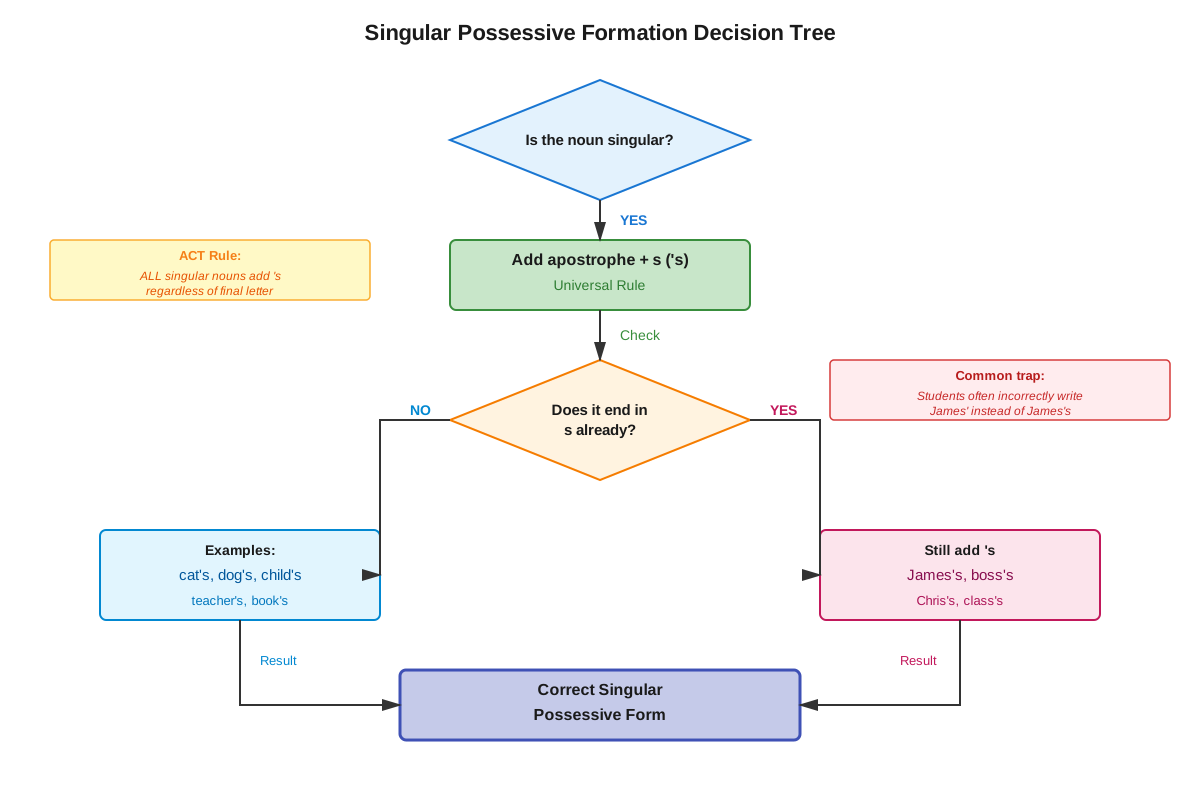
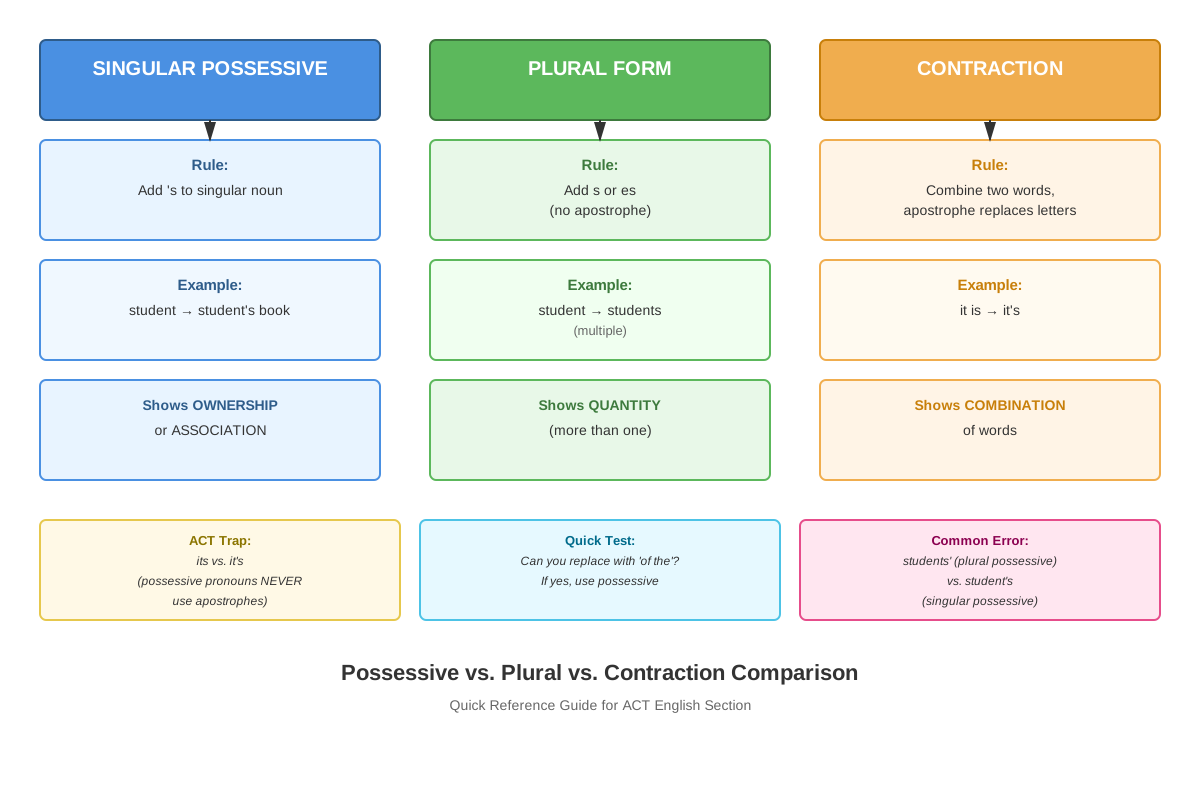
The fundamental principle behind singular possessives involves adding an apostrophe followed by the letter "s" ('s) to the end of a singular noun to show possession. This rule applies universally to singular nouns, regardless of whether the noun ends in s, x, z, or any other letter. Understanding this concept connects directly to broader punctuation mastery, particularly the distinction between possessives, contractions, and plural forms—three categories that students frequently confuse under test pressure.
ACT singular possessives questions test not only mechanical knowledge but also reading comprehension, as students must identify the relationship between nouns in context before applying the correct punctuation. This topic intersects with subject-verb agreement, pronoun usage, and sentence structure, making it a cornerstone of ACT English preparation. Students who master singular possessives gain confidence in tackling complex punctuation scenarios and improve their overall grammar scores significantly.
Learning Objectives
- [ ] Identify when Singular possessives is being tested in ACT English passages
- [ ] Explain the core rule or strategy behind Singular possessives formation
- [ ] Apply Singular possessives to ACT-style questions accurately
- [ ] Distinguish between possessive forms, contractions, and plural nouns in context
- [ ] Correctly form possessives for singular nouns ending in s, including proper nouns
- [ ] Recognize and correct common apostrophe errors in timed test conditions
- [ ] Analyze sentence context to determine whether possession is being expressed
Prerequisites
- Basic apostrophe usage: Understanding that apostrophes serve multiple functions (possession, contraction, and occasionally pluralization of letters/numbers) provides the foundation for distinguishing possessive forms from other apostrophe uses.
- Noun identification: Recognizing nouns—including proper nouns, common nouns, and compound nouns—is essential because possessive forms can only be created from nouns.
- Plural noun formation: Knowing how regular and irregular plurals are formed prevents confusion between plural forms (which typically don't use apostrophes) and possessive forms (which do).
- Reading comprehension: Understanding sentence meaning and relationships between words enables students to determine when possession or association is being expressed.
Why This Topic Matters
In real-world writing, possessive forms appear constantly in professional communication, academic writing, and everyday correspondence. Correctly using apostrophes to show possession demonstrates attention to detail and grammatical competence—qualities valued in college admissions essays, workplace emails, and formal documents. Misplaced or missing apostrophes can create confusion about meaning, change the intended message, or signal carelessness to readers.
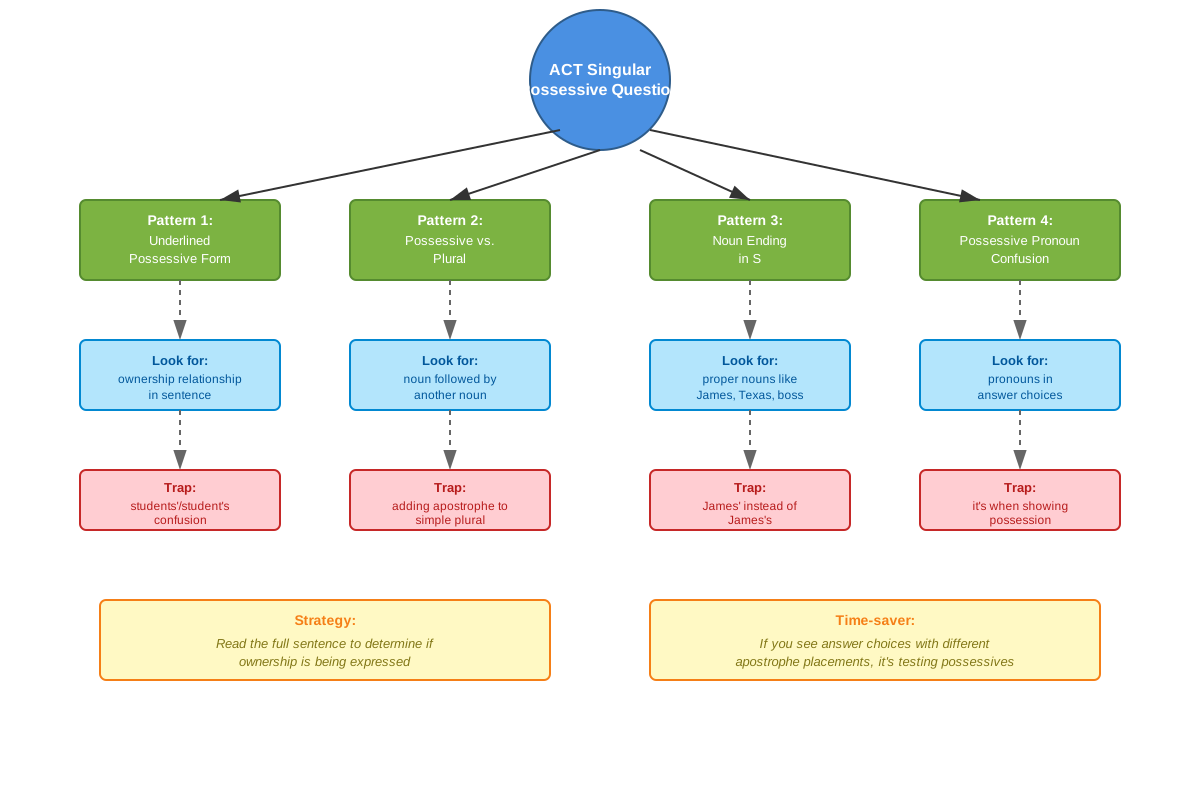
On the ACT English section, possessive questions appear with remarkable consistency. Statistical analysis of released ACT tests reveals that approximately 8-12% of all punctuation questions involve possessive forms, making this one of the highest-yield punctuation topics. These questions typically appear 2-4 times per test, distributed across different passages. The ACT tests singular possessives through several question formats: identifying errors in underlined portions, selecting the correct form from multiple choices, and determining whether an apostrophe is needed at all.
Common ACT scenarios include: possessives with singular nouns ending in s (particularly proper names like "James" or "Texas"), distinguishing between "its" (possessive) and "it's" (contraction), choosing between possessive and plural forms when both seem grammatically possible, and recognizing possessive relationships in complex noun phrases. The test writers deliberately create answer choices that include common errors—such as placing the apostrophe after the s for singular nouns or omitting the apostrophe entirely—to trap students who haven't mastered the underlying rules.
Core Concepts
The Fundamental Rule of Singular Possessives
The core principle for forming singular possessives is straightforward: add an apostrophe followed by the letter s ('s) to any singular noun to indicate possession or close association. This rule applies universally, regardless of the noun's ending letter. For example:
- The dog's collar (the collar belonging to one dog)
- Maria's laptop (the laptop belonging to Maria)
- The company's policy (the policy of the company)
- Yesterday's meeting (the meeting that occurred yesterday)
This construction indicates that the noun before the apostrophe possesses or is closely associated with the noun that follows. The relationship can express literal ownership (Sarah's car), authorship (Shakespeare's plays), origin (Italy's cuisine), duration (a day's work), or various other associations.
Singular Nouns Ending in S
A frequent source of confusion—and a favorite ACT testing point—involves singular nouns that already end in the letter s. The correct rule remains consistent: add 's to form the possessive, even when the noun ends in s. This applies to both common nouns and proper nouns:
- The boss's office (not "the boss' office")
- James's book (not "James' book")
- The class's average (not "the class' average")
- Texas's economy (not "Texas' economy")
While some older style guides permitted dropping the final s after the apostrophe for singular nouns ending in s, modern American English—and the ACT—consistently requires 's for all singular possessives. The only exception involves ancient classical names (Jesus', Moses', Achilles'), but these rarely appear on the ACT.
Distinguishing Possessives from Plurals
One of the most critical distinctions for ACT success involves recognizing the difference between possessive forms and plural forms:
| Form | Construction | Example | Meaning |
|---|---|---|---|
| Singular | noun | dog | one dog |
| Singular Possessive | noun + 's | dog's | belonging to one dog |
| Plural | noun + s (or irregular) | dogs | more than one dog |
| Plural Possessive | noun + s + ' | dogs' | belonging to multiple dogs |
The ACT frequently presents answer choices that confuse these forms. Students must read the sentence carefully to determine whether the noun is showing possession (requires apostrophe) or simply indicating quantity (no apostrophe for regular plurals).
Possessive Pronouns vs. Contractions
Another high-yield distinction involves possessive pronouns, which never use apostrophes, versus contractions, which always do:
Possessive pronouns (no apostrophe):
- its (belonging to it)
- whose (belonging to whom)
- your (belonging to you)
- their (belonging to them)
Contractions (with apostrophe):
- it's (it is or it has)
- who's (who is or who has)
- you're (you are)
- they're (they are)
The its/it's distinction appears on virtually every ACT test. Remember: if you can substitute "it is" or "it has," use "it's"; if you're showing possession, use "its" without an apostrophe.
Compound Nouns and Joint Possession
When forming possessives with compound nouns (nouns made of multiple words), add 's to the final word only:
- My mother-in-law's advice
- The attorney general's decision
- The editor in chief's column
For joint possession (when two or more people share ownership of the same thing), add 's only to the final noun:
- Ben and Jerry's ice cream (one company owned jointly)
- Mom and Dad's car (one car belonging to both parents)
If possession is separate (each person owns their own item), add 's to each noun:
- Ben's and Jerry's opinions differ (each has his own opinion)
- Mom's and Dad's cars are different colors (each has a separate car)
Time, Money, and Measurement Possessives
Singular possessives frequently appear with expressions of time, money, and measurement:
- A day's work
- A dollar's worth
- An hour's delay
- A moment's notice
- A stone's throw
These idiomatic expressions require the possessive form even though they don't express literal ownership. The ACT tests these constructions regularly because students often omit the apostrophe, thinking it's unnecessary.
Concept Relationships
The concepts within singular possessives build upon each other in a logical progression. The fundamental rule (add 's to singular nouns) serves as the foundation for all other applications. This basic principle extends to singular nouns ending in s, where the same rule applies despite the potentially awkward appearance or pronunciation. Understanding this consistency prevents students from creating false exceptions.
The distinction between possessives and plurals connects directly to the fundamental rule by clarifying when apostrophes are needed (possession) versus when they're not (simple plurality). This distinction becomes more complex when dealing with possessive pronouns versus contractions, which requires recognizing that pronouns follow different rules than regular nouns—a connection to broader pronoun usage principles.
Compound nouns and joint possession represent advanced applications of the fundamental rule, requiring students to identify the actual possessing entity before applying the 's construction. These concepts connect to sentence structure and meaning comprehension, as students must analyze relationships between multiple nouns.
Time, money, and measurement possessives demonstrate how the possessive form extends beyond literal ownership to express various relationships, connecting singular possessives to idiomatic expressions and figurative language.
The relationship map flows as follows:
Fundamental Rule (add 's) → Applies to all singular nouns → Including those ending in s → Distinguished from plurals (no apostrophe) → Contrasted with possessive pronouns (different rules) → Extended to compound constructions → Applied to idiomatic expressions
High-Yield Facts
⭐ All singular nouns form possessives by adding 's, regardless of the final letter of the noun.
⭐ Singular nouns ending in s still take 's to form the possessive (James's, not James').
⭐ Possessive pronouns (its, whose, your, their) never use apostrophes; contractions (it's, who's, you're, they're) always do.
⭐ The most frequently tested singular possessive on the ACT is the its/it's distinction.
⭐ Plural nouns do not use apostrophes unless they're showing possession (dogs = plural; dog's = singular possessive; dogs' = plural possessive).
- Time expressions (a day's work, an hour's delay) require possessive forms even though they don't express literal ownership.
- For compound nouns, add 's only to the final word (mother-in-law's, attorney general's).
- Joint possession adds 's to the final noun only (Ben and Jerry's); separate possession adds 's to each noun (Ben's and Jerry's).
- The apostrophe in a possessive always comes before the s for singular nouns, never after.
- Possessive forms can express ownership, authorship, origin, duration, measurement, or close association.
- Ancient classical names (Jesus', Moses') are the rare exception to the singular-s rule, but these seldom appear on the ACT.
- When a sentence could grammatically work with either a possessive or a plural, context determines which is correct.
Quick check — test yourself on Singular possessives so far.
Try Flashcards →Common Misconceptions
Misconception: Singular nouns ending in s should form possessives by adding only an apostrophe (James' book). → Correction: Modern American English and the ACT require 's for all singular possessives, including those ending in s. The correct form is "James's book." The only exceptions are ancient classical names, which rarely appear on the test.
Misconception: "Its" with an apostrophe (it's) is the possessive form of "it." → Correction: "It's" is always a contraction meaning "it is" or "it has," never a possessive. The possessive form of "it" is "its" without an apostrophe. This is the single most tested possessive concept on the ACT.
Misconception: Plural nouns need apostrophes (The dog's are barking). → Correction: Regular plural nouns never use apostrophes. Apostrophes with nouns indicate possession or contraction, not plurality. "The dogs are barking" is correct; "The dog's are barking" is always wrong.
Misconception: If a word ends in s, adding 's creates an awkward double-s sound, so it must be wrong. → Correction: While "James's" or "boss's" may look or sound unusual, they are grammatically correct. The ACT tests standard written English rules, not pronunciation preferences. Trust the rule: singular noun + 's.
Misconception: Possessive forms are only used for people and animals, not for objects or abstract concepts. → Correction: Possessive forms apply to all nouns, including inanimate objects (the table's surface), places (Texas's border), abstract concepts (freedom's price), and time expressions (yesterday's news). The ACT frequently tests possessives with non-living things.
Misconception: When you see an apostrophe, the word is always possessive. → Correction: Apostrophes serve three functions: showing possession (dog's), forming contractions (don't), and occasionally pluralizing letters or numbers (A's and B's). Context determines which function applies. On the ACT, distinguishing possessives from contractions is essential.
Misconception: "Whose" is a contraction of "who is." → Correction: "Whose" is the possessive form of "who" and never uses an apostrophe. "Who's" is the contraction of "who is" or "who has." This parallels the its/it's distinction and appears regularly on the ACT.
Worked Examples
Example 1: Identifying and Correcting Singular Possessive Errors
ACT-Style Question:
The companys new policy requires all employees to submit their timesheets by Friday.
Which of the following is the correct form of the underlined portion?
A. NO CHANGE
B. company's
C. companies
D. companies'
Step 1: Identify the noun and its function
The noun is "company" (singular). We need to determine whether this noun is showing possession, is simply plural, or is possessive plural.
Step 2: Analyze the sentence context
The phrase "new policy" follows "company." The policy belongs to the company—this is a possessive relationship. We're talking about one company's policy, not multiple companies.
Step 3: Apply the singular possessive rule
Since "company" is singular and shows possession, we need to add 's to form the possessive: "company's."
Step 4: Eliminate incorrect answers
- A (companys): Missing apostrophe; incorrect
- B (company's): Singular possessive; correct
- C (companies): Plural form without possession; incorrect meaning
- D (companies'): Plural possessive; incorrect because we have one company, not multiple
Answer: B
Connection to Learning Objectives: This example demonstrates identifying when singular possessives are tested (recognizing the possessive relationship), explaining the core rule (add 's to singular nouns), and applying it accurately to an ACT-style question.
Example 2: Distinguishing Possessives from Contractions
ACT-Style Question:
The museum announced that it's collection would be expanded to include contemporary art, and its' new wing would open next spring.
Which of the following corrections, if any, should be made?
A. NO CHANGE
B. Change "it's" to "its" and "its'" to "its"
C. Change "it's" to "its" and "its'" to "it's"
D. Change "it's" to "its" only
Step 1: Analyze the first underlined word ("it's")
Can we substitute "it is" or "it has"? "The museum announced that it is collection..." doesn't make sense. This should be possessive (the collection belonging to the museum), so we need "its" without an apostrophe.
Step 2: Analyze the second underlined word ("its'")
This form doesn't exist in standard English. "Its" is already possessive and never takes an apostrophe. The phrase "its new wing" shows possession (the wing belonging to the museum), so "its" without any apostrophe is correct.
Step 3: Determine necessary corrections
Both underlined portions are incorrect. The first should be "its" (possessive), and the second should be "its" (possessive, not "its'").
Step 4: Match to answer choices
- A: NO CHANGE—incorrect, both need fixing
- B: Changes both to "its"—correct
- C: Changes first to "its" and second to "it's"—incorrect, second should be possessive
- D: Changes only the first—incorrect, both need changing
Answer: B
Connection to Learning Objectives: This example addresses the critical distinction between possessive pronouns and contractions, demonstrates identifying possessive testing in context, and shows how to apply rules accurately under ACT conditions. The its/it's distinction appears on virtually every ACT test, making this a high-yield example.
Exam Strategy
When approaching ACT singular possessives questions, follow this systematic process:
Step 1: Identify the noun in question
Locate the noun that might need a possessive form. Determine whether it's singular or plural by examining context clues and the noun's form.
Step 2: Determine the relationship
Ask: "Does this noun possess, own, or have a close association with the following noun?" If yes, a possessive form is needed. If the noun is simply indicating quantity or serving another function, no apostrophe is needed.
Step 3: Apply the appropriate rule
For singular nouns showing possession, add 's regardless of the noun's ending letter. For possessive pronouns (its, whose, your, their), never add an apostrophe.
Step 4: Check for common traps
The ACT deliberately includes wrong answers that represent common errors:
- Singular possessives with apostrophe after the s (boss' instead of boss's)
- Plural forms where possessives are needed (dogs instead of dog's)
- Contractions where possessives are needed (it's instead of its)
- Possessives where plurals are needed (dog's instead of dogs)
Trigger words and phrases to watch for:
- Time expressions: "a day's," "an hour's," "yesterday's," "tomorrow's"
- Possessive pronouns: "its," "whose," "your," "their" (check that no apostrophe is present)
- Contractions: "it's," "who's," "you're," "they're" (verify that contraction meaning makes sense)
- Singular nouns ending in s: proper names like "James," "Chris," "Texas," "Kansas"
Process of elimination tips:
- If you can substitute "it is" or "it has," you need "it's" (contraction); if not, you need "its" (possessive)
- If the noun is singular and shows possession, eliminate any answer without 's
- If the noun is simply plural (not possessive), eliminate any answer with an apostrophe
- For nouns ending in s, eliminate answers with only an apostrophe (s') unless it's a plural possessive
Time allocation:
Possessive questions should take 15-30 seconds each. They test mechanical rules rather than complex reasoning, so if you know the rules, you can answer quickly and confidently. Don't overthink these questions—apply the rule and move on. If you're uncertain, mark the question and return to it after completing easier questions in the passage.
Exam Tip: When you see an apostrophe in an underlined portion, immediately ask: "Is this possessive, contraction, or neither?" This simple question helps you quickly identify what's being tested and apply the correct rule.
Memory Techniques
The "Add 's" Mnemonic:
Remember "Singular Shows 'S" — all singular possessives use 's, no exceptions (except ancient classical names you won't see on the ACT).
The "It's = It Is" Test:
Whenever you see "it's" or need to choose between "its" and "it's," substitute "it is" or "it has." If the substitution works, use "it's"; if not, use "its." This simple test works 100% of the time.
The "Who's on First?" Reminder:
Think of the classic comedy routine: "Who's on first?" means "Who is on first?" This helps you remember that "who's" is always a contraction (who is/who has), while "whose" is always possessive (belonging to whom).
The "Boss's Boss" Visualization:
Picture a boss who has a boss. "The boss's boss" requires 's twice, reinforcing that singular nouns ending in s still take 's. The repetition makes the rule memorable.
The "No Apostrophe Pronouns" List:
Create a mental list of possessive pronouns that never use apostrophes: Its, Whose, Your, Their, Our, His, Her. The acronym "I WY TO HH" isn't perfect, but grouping these together helps you remember they're exceptions to apostrophe rules.
The "Time is Money" Phrase:
Remember that time and money expressions use possessives: "a day's work," "a dollar's worth." The phrase "time is money" reminds you that both categories require possessive forms.
Summary
Singular possessives represent a high-yield, rule-based topic that appears consistently on every ACT English test. The fundamental principle is straightforward: add 's to any singular noun to show possession, regardless of the noun's ending letter. This rule applies universally to common nouns, proper nouns, and nouns ending in s. The most frequently tested aspect involves distinguishing possessive pronouns (its, whose, your, their) from contractions (it's, who's, you're, they're), with the its/it's distinction appearing on virtually every ACT. Students must also differentiate possessive forms from plural forms, recognizing that regular plurals never use apostrophes while possessives always do. Time, money, and measurement expressions require possessive forms even without literal ownership. Success on ACT singular possessive questions requires understanding these core rules, recognizing possessive relationships in context, and systematically applying the correct form. Master these concepts, and you'll confidently answer 2-4 questions correctly on every ACT English section, significantly boosting your overall score.
Key Takeaways
- All singular nouns form possessives by adding 's, including nouns that already end in s (James's, boss's, Texas's)
- The its/it's distinction is the most tested possessive concept: "its" is possessive (no apostrophe), "it's" is a contraction meaning "it is" or "it has"
- Possessive pronouns never use apostrophes (its, whose, your, their, our), while contractions always do (it's, who's, you're, they're)
- Regular plural nouns never use apostrophes unless showing possession; distinguish carefully between plurals (dogs) and singular possessives (dog's)
- Time, money, and measurement expressions require possessive forms (a day's work, an hour's delay, a dollar's worth)
- Context determines correctness: read the sentence carefully to identify possessive relationships before applying rules
- ACT questions test mechanical rules, not pronunciation: trust the standard rule (add 's to singular nouns) even if the result looks or sounds unusual
Related Topics
Plural Possessives: After mastering singular possessives, students should learn how plural nouns form possessives (add only an apostrophe after the s for regular plurals: dogs'; add 's for irregular plurals: children's). This builds directly on singular possessive knowledge.
Apostrophe Usage in Contractions: Understanding how apostrophes create contractions (don't, can't, won't, it's, who's) helps students distinguish contractions from possessives and avoid confusion between similar forms.
Pronoun-Antecedent Agreement: Possessive pronouns must agree with their antecedents in number and gender, connecting possessive knowledge to broader pronoun usage rules tested on the ACT.
Comma Usage with Possessives: Some possessive constructions require commas for clarity, particularly with appositives and non-essential clauses, linking possessive mastery to comma rules.
Subject-Verb Agreement: Possessive constructions can create complex subjects that affect verb agreement, requiring students to identify the true subject despite intervening possessive phrases.
Practice CTA
Now that you've mastered the core concepts of singular possessives, it's time to reinforce your learning through active practice. Complete the practice questions to test your ability to identify, explain, and apply singular possessive rules under timed conditions. Use the flashcards to drill the high-yield distinctions—especially its/it's and singular nouns ending in s—until they become automatic. Remember: the ACT rewards students who can quickly and confidently apply mechanical rules. Every practice question you complete builds the pattern recognition and speed you need to excel on test day. You've invested the time to learn these concepts thoroughly—now prove your mastery through deliberate practice!
Sign up free to keep reading
Create a free AnvayaPrep account to finish this ACT guide on Singular possessives — plus flashcards and practice questions.