Overview
Understanding author's purpose is one of the most critical skills tested in the ACT English section, particularly within the Rhetorical Skills subsection. Every piece of writing exists for a reason—whether to inform, persuade, entertain, describe, or explain—and the ACT frequently tests whether students can identify why an author chose specific words, sentences, or organizational strategies. Questions about author's purpose require students to step back from grammar and mechanics to consider the broader communicative goals of a passage.
On the ACT, ACT author's purpose questions typically ask students to evaluate whether a particular sentence, paragraph, or entire essay accomplishes a stated goal. These questions might ask if the passage successfully argues a point, provides adequate background information, or maintains a consistent tone. Unlike pure grammar questions that have objectively right or wrong answers based on rules, author's purpose questions require understanding the relationship between content, audience, and intent. Students must analyze not just what the text says, but why the author chose to say it in that particular way.
This topic connects deeply to other rhetorical skills including organization, style, and strategy. While grammar questions focus on sentence-level correctness, author's purpose questions evaluate passage-level effectiveness. Mastering this concept requires synthesizing multiple reading comprehension skills: identifying main ideas, recognizing tone and style, understanding audience expectations, and evaluating whether specific textual evidence supports broader claims. Success with author's purpose questions demonstrates sophisticated reading ability that extends far beyond basic comprehension.
Learning Objectives
- [ ] Identify when Author's purpose is being tested in ACT English questions
- [ ] Explain the core rule or strategy behind Author's purpose analysis
- [ ] Apply Author's purpose concepts to ACT-style questions accurately
- [ ] Distinguish between different types of authorial intent (inform, persuade, entertain, describe, explain)
- [ ] Evaluate whether specific textual elements successfully accomplish a stated purpose
- [ ] Recognize common question stems and trigger phrases that signal purpose questions
- [ ] Analyze the relationship between audience, tone, and purpose in ACT passages
Prerequisites
- Basic reading comprehension: Understanding main ideas and supporting details is essential because author's purpose questions require synthesizing information across entire passages.
- Familiarity with rhetorical modes: Recognizing narrative, expository, persuasive, and descriptive writing helps identify the author's primary intent.
- Understanding of tone and style: Author's purpose is often revealed through word choice, sentence structure, and overall tone.
- Ability to identify main ideas: Purpose questions frequently ask whether the passage accomplishes a specific goal related to its central thesis.
Why This Topic Matters
In real-world contexts, understanding author's purpose is fundamental to critical literacy. Every advertisement, news article, social media post, and academic paper has an underlying purpose that shapes its content and presentation. Recognizing these purposes helps readers evaluate credibility, detect bias, and make informed decisions about the information they consume. This skill transfers directly to college-level reading and writing, where students must analyze scholarly arguments and craft their own purpose-driven compositions.
On the ACT English section, author's purpose questions appear with high frequency, typically comprising 15-20% of the Rhetorical Skills questions. These questions often appear at the end of passages as "yes/yes/no/no" questions that ask whether the essay accomplishes a specific goal. They also appear throughout passages as questions about whether to add, delete, or revise sentences based on their contribution to the author's purpose. The ACT particularly favors questions that test whether students can identify when content is relevant or irrelevant to the stated purpose.
Common manifestations include: questions asking if an essay successfully argues for a position, questions about whether additional information would strengthen the author's purpose, questions evaluating if the passage provides adequate background for a general audience, and questions about whether the conclusion effectively reinforces the main purpose. These questions require students to maintain awareness of the passage's overall goal while reading, making them among the most challenging in the English section.
Core Concepts
Defining Author's Purpose
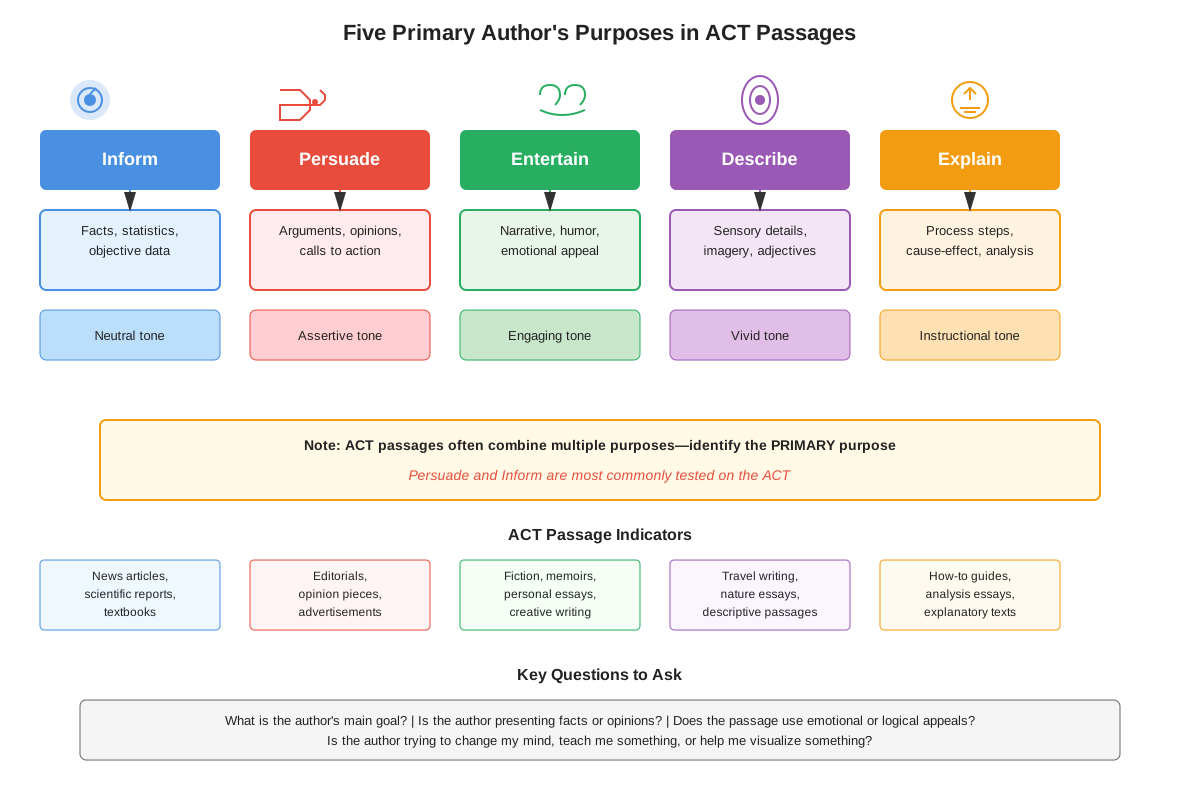
Author's purpose refers to the reason an author creates a text—the specific goal or intention behind the writing. On the ACT, identifying author's purpose means understanding what the writer aims to accomplish and evaluating whether the text successfully achieves that goal. The five primary purposes are:
- To inform: Presenting factual information objectively without trying to change the reader's opinion
- To persuade: Convincing readers to adopt a particular viewpoint or take specific action
- To entertain: Engaging readers through humor, storytelling, or emotional appeal
- To describe: Creating vivid sensory impressions of people, places, objects, or experiences
- To explain: Clarifying how something works or why something happens
Most ACT passages combine multiple purposes, but one typically dominates. A biographical essay might primarily inform while also entertaining through anecdotes. A scientific article might explain a process while also persuading readers of a theory's validity.
How Author's Purpose Appears on the ACT
The ACT tests author's purpose through several distinct question types:
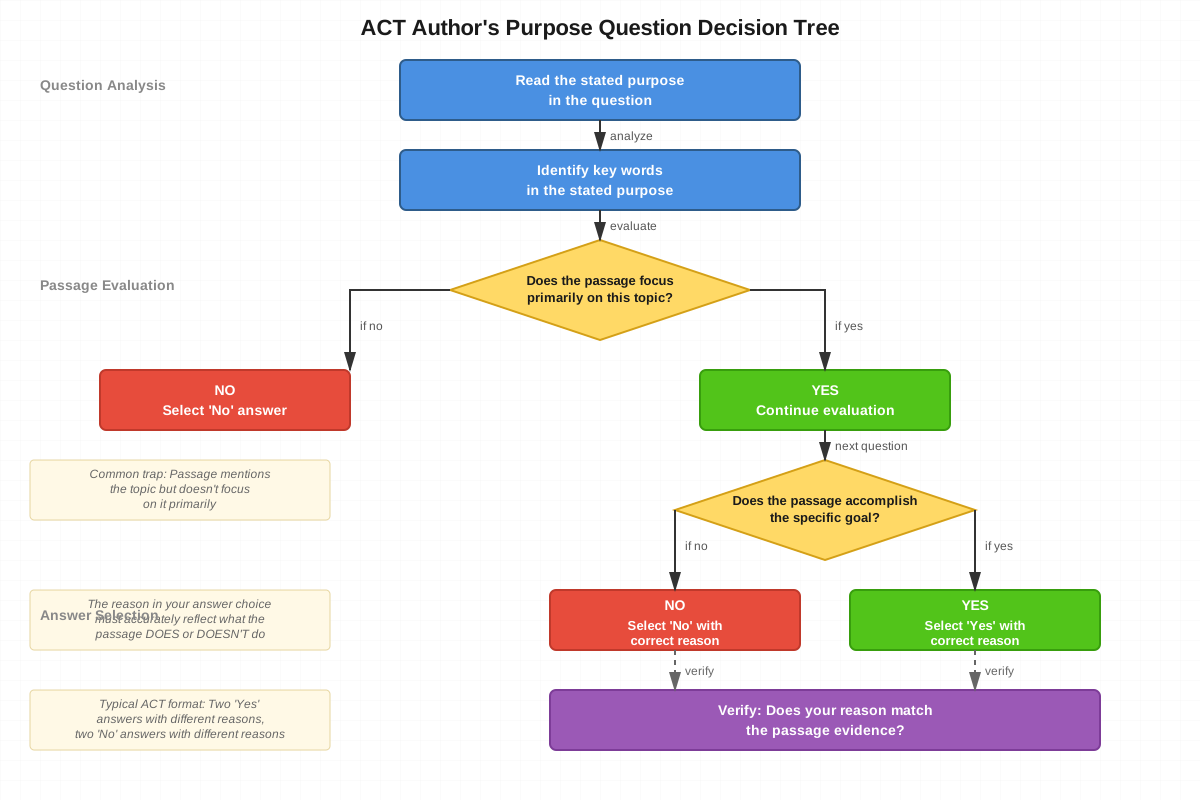
Goal-Accomplishment Questions: These typically appear at the end of passages and follow a "yes/yes/no/no" format. The question states a specific purpose (e.g., "Suppose the writer's primary purpose had been to explain the economic impact of urban gardens. Would this essay accomplish that purpose?"). Students must answer yes or no, then select the reason that best explains their answer.
Relevance Questions: These ask whether a sentence or paragraph should be added, deleted, or kept based on its contribution to the author's purpose. For example: "Should the writer add this sentence here?" The correct answer depends on whether the addition supports or distracts from the main purpose.
Revision Questions: These present multiple ways to revise a sentence and ask which best accomplishes a specific goal, such as "emphasizing the historical significance" or "maintaining the essay's formal tone."
Analyzing Purpose Through Textual Evidence
Determining author's purpose requires examining multiple textual elements:
| Textual Element | What It Reveals About Purpose |
|---|---|
| Thesis statement | Explicitly states the main argument or focus |
| Tone | Formal tone suggests informing/explaining; passionate tone suggests persuading |
| Evidence type | Statistics and facts suggest informing; anecdotes suggest entertaining/persuading |
| Organization | Chronological suggests narrating; problem-solution suggests persuading |
| Word choice | Neutral language suggests informing; loaded language suggests persuading |
| Audience cues | Technical terms suggest expert audience; definitions suggest general audience |
The Relationship Between Purpose and Relevance
A critical concept for ACT success is understanding that relevance is always determined by purpose. A detail might be interesting or factually accurate but still be irrelevant if it doesn't support the author's main purpose. For example, in an essay about the health benefits of cycling, a paragraph about bicycle manufacturing history would likely be irrelevant, even though it relates to the general topic of bicycles.
The ACT frequently tests this by offering answer choices that are:
- Relevant and accurate: Supports the purpose (often correct)
- Accurate but irrelevant: True information that doesn't advance the purpose (common trap)
- Relevant but inaccurate: Addresses the purpose but contains errors or unsupported claims
- Irrelevant and inaccurate: Neither supports the purpose nor provides accurate information
Evaluating Success in Achieving Purpose
When ACT questions ask whether a passage accomplishes a stated purpose, students must evaluate both scope and focus:
Scope refers to whether the passage covers the topic adequately. An essay that briefly mentions economic impacts in one sentence hasn't adequately addressed a purpose "to explain the economic impact of urban gardens."
Focus refers to whether the stated purpose is the primary emphasis. An essay might discuss economic impacts but focus primarily on environmental benefits, making it unsuccessful at accomplishing an economics-focused purpose.
Common Purpose Indicators
Certain phrases and structural elements signal specific purposes:
Persuasive purpose indicators: "should," "must," "it is essential that," calls to action, acknowledgment of counterarguments, emotional appeals, rhetorical questions
Informative purpose indicators: "according to," statistics, dates, definitions, neutral tone, objective presentation of facts
Explanatory purpose indicators: "because," "therefore," "as a result," cause-and-effect organization, process descriptions
Descriptive purpose indicators: Sensory details, figurative language, spatial organization, vivid adjectives
Entertaining purpose indicators: Humor, personal anecdotes, dialogue, narrative structure, emotional storytelling
Concept Relationships
Author's purpose serves as the foundation for all rhetorical skills questions on the ACT. The relationship flows as follows:
Author's Purpose → Determines → Organization: How the author structures the passage depends on the purpose. Persuasive purposes often use problem-solution organization, while informative purposes might use categorical or chronological organization.
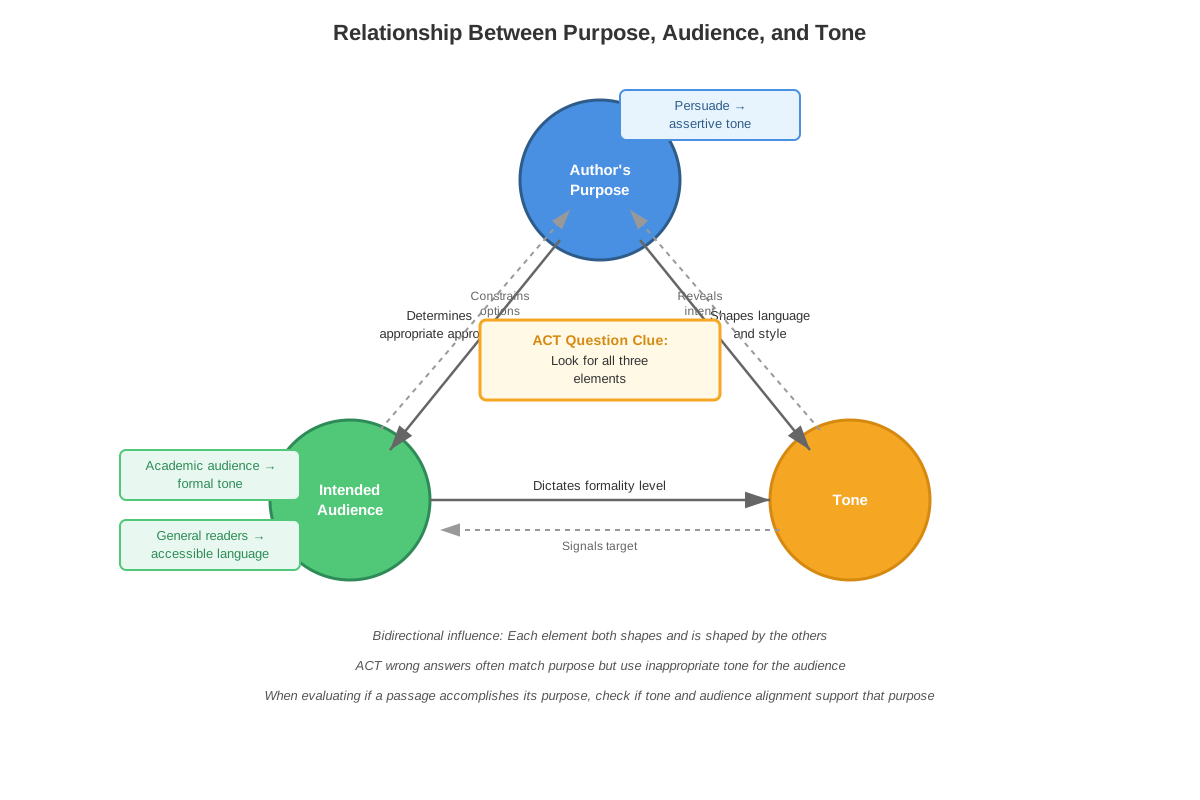
Author's Purpose → Influences → Style and Tone: The purpose dictates appropriate word choice and sentence structure. Formal, objective tone suits informative purposes; passionate, subjective tone suits persuasive purposes.
Author's Purpose → Guides → Content Selection: Every detail, example, and piece of evidence should support the purpose. Irrelevant information, regardless of accuracy, weakens the passage.
Audience Awareness → Shapes → Author's Purpose: Understanding the intended audience helps determine whether the purpose is successfully achieved. Technical writing for experts differs from explanatory writing for general audiences.
Within the topic itself, the concepts connect hierarchically: First, identify the primary purpose → Second, evaluate whether each element supports that purpose → Third, determine if the overall passage successfully accomplishes the stated goal. This three-step process applies to all ACT author's purpose questions.
The prerequisite knowledge of main ideas and tone directly enables purpose analysis. Students cannot evaluate whether a passage accomplishes a purpose without first identifying what the passage is primarily about (main idea) and how the author approaches the topic (tone). These skills work together synergistically.
High-Yield Facts
⭐ Author's purpose questions typically appear 3-5 times per ACT English section, making them high-value targets for score improvement.
⭐ The most common ACT author's purpose question format is the "yes/yes/no/no" goal-accomplishment question at the end of passages.
⭐ Relevance is always determined by the author's purpose, not by whether information is interesting or factually accurate.
⭐ When evaluating if a passage accomplishes a stated purpose, check both scope (adequate coverage) and focus (primary emphasis).
⭐ Information that is accurate but irrelevant to the purpose should be deleted—this is the most common trap answer.
- The five primary purposes are inform, persuade, entertain, describe, and explain, though most passages combine multiple purposes with one dominating.
- Persuasive writing is characterized by calls to action, acknowledgment of counterarguments, and loaded language.
- Informative writing maintains neutral tone and relies on facts, statistics, and objective presentation.
- Questions asking whether to add or delete sentences almost always hinge on whether the content supports the author's purpose.
- The correct answer to purpose questions often explicitly mentions the main topic or thesis of the passage.
- Scope problems occur when a passage mentions a topic briefly but doesn't adequately develop it to accomplish the stated purpose.
- Focus problems occur when a passage discusses the stated topic but emphasizes different aspects than the stated purpose requires.
Quick check — test yourself on Author's purpose so far.
Try Flashcards →Common Misconceptions
Misconception: If information is factually accurate and related to the general topic, it should be included in the passage.
Correction: Accuracy and topical relation are insufficient; information must specifically support the author's purpose to be relevant. An essay about health benefits of exercise doesn't need accurate information about exercise equipment manufacturing.
Misconception: Author's purpose questions are subjective and have no clear right answer.
Correction: These questions have objectively correct answers based on textual evidence. The passage either does or does not adequately address the stated purpose based on scope and focus.
Misconception: The author's purpose is always stated explicitly in the passage.
Correction: While thesis statements often reveal purpose, students must sometimes infer purpose from tone, evidence type, organization, and overall content. The ACT frequently tests this inferential skill.
Misconception: Longer passages always accomplish their purposes better than shorter ones.
Correction: Length doesn't determine success; focused, relevant content does. A concise passage that consistently addresses its purpose succeeds better than a lengthy passage that wanders off-topic.
Misconception: If a passage mentions the topic stated in the purpose question, it accomplishes that purpose.
Correction: Brief mention is insufficient. The passage must adequately develop the topic with appropriate scope and make it the primary focus to accomplish the stated purpose.
Misconception: Entertaining or interesting content always strengthens a passage.
Correction: Entertainment value is only relevant if the purpose is to entertain. Humorous anecdotes might weaken an informative scientific essay by distracting from the main purpose.
Misconception: All paragraphs in a passage must directly state the main purpose.
Correction: Supporting paragraphs provide evidence, background, or context that indirectly supports the purpose. Not every paragraph restates the thesis, but all should contribute to the overall goal.
Worked Examples
Example 1: Goal-Accomplishment Question
Passage Context: A passage describes the author's childhood experiences visiting her grandmother's farm, including detailed descriptions of the landscape, animals, and daily routines. The passage includes sensory details about the smell of hay, the sound of roosters, and the taste of fresh vegetables. It concludes with reflection on how these experiences shaped the author's appreciation for rural life.
Question: Suppose the writer's primary purpose had been to argue that small farms are economically superior to large industrial farms. Would this essay accomplish that purpose?
Answer Choices:
A. Yes, because it describes the daily operations of a small farm.
B. Yes, because it demonstrates the value of farm experiences.
C. No, because it focuses on personal memories rather than economic analysis.
D. No, because it doesn't mention industrial farms.
Step 1 - Identify the stated purpose: The purpose is to argue (persuade) that small farms are economically superior. This requires economic evidence and comparison.
Step 2 - Analyze the passage's actual content: The passage provides personal narrative and sensory descriptions. It focuses on childhood memories and personal appreciation, not economic data.
Step 3 - Check for scope: Does the passage adequately cover economic aspects? No—there are no statistics, cost analyses, or economic arguments.
Step 4 - Check for focus: Is economic superiority the primary emphasis? No—personal experience and sensory description dominate.
Step 5 - Eliminate wrong answers:
- Choice A is wrong because describing operations doesn't constitute economic argument.
- Choice B is wrong because demonstrating value of experiences doesn't address economic superiority.
- Choice D is partially correct but doesn't identify the main problem.
- Choice C correctly identifies that the passage focuses on personal memories (actual content) rather than economic analysis (required content).
Correct Answer: C. The passage fails to accomplish the stated purpose because it emphasizes personal narrative rather than providing the economic evidence and argumentation required.
Example 2: Relevance Question
Passage Context: An essay explains how photosynthesis works, describing the light-dependent and light-independent reactions, the role of chlorophyll, and the production of glucose and oxygen. The essay maintains a scientific, explanatory tone throughout.
Question: The writer is considering adding the following sentence:
"Many people find the green color of leaves aesthetically pleasing in landscape design."
Should the writer make this addition here?
Answer Choices:
F. Yes, because it provides relevant information about chlorophyll's visual properties.
G. Yes, because it connects the scientific content to everyday experience.
H. No, because it shifts focus from the biological process to aesthetic considerations.
J. No, because it contradicts information presented earlier in the essay.
Step 1 - Identify the passage's purpose: The purpose is to explain how photosynthesis works—a scientific, process-focused purpose.
Step 2 - Evaluate the proposed addition: The sentence discusses aesthetic appeal and landscape design, which relate to human preferences, not biological processes.
Step 3 - Determine relevance: Does this support explaining how photosynthesis works? No—it's tangentially related to leaves but doesn't explain the process.
Step 4 - Eliminate wrong answers:
- Choice F is wrong because visual properties aren't relevant to explaining the process.
- Choice G is wrong because connecting to everyday experience doesn't support the explanatory purpose.
- Choice J is wrong because there's no contradiction—it's simply irrelevant.
- Choice H correctly identifies that the sentence shifts focus from the biological process (the purpose) to aesthetic considerations (irrelevant to the purpose).
Correct Answer: H. The sentence should not be added because it distracts from the explanatory purpose by introducing irrelevant aesthetic considerations.
Exam Strategy
Identifying Purpose Questions
Watch for these trigger phrases that signal author's purpose questions:
- "Suppose the writer's primary purpose had been to..."
- "Would this essay accomplish that purpose?"
- "Should the writer add/delete this sentence?"
- "Which choice best accomplishes the goal of..."
- "The writer wants to emphasize..."
- "To maintain the essay's focus on..."
Exam Tip: When you see "Suppose the writer's primary purpose," immediately skim the passage to identify what the actual purpose is before evaluating the stated purpose in the question.
The Three-Step Approach
Step 1 - Identify the Actual Purpose: Before answering any purpose question, determine what the passage actually does. Look at:
- The introduction and conclusion (often state purpose explicitly)
- The type of evidence used (facts vs. anecdotes vs. arguments)
- The tone (objective vs. persuasive vs. entertaining)
- The main idea of each paragraph
Step 2 - Compare to Stated Purpose: For goal-accomplishment questions, compare what the passage actually does to what the question claims it should do. Ask:
- Does the passage adequately cover this topic? (Scope)
- Is this the primary focus? (Focus)
- Does the evidence type match the purpose? (Alignment)
Step 3 - Eliminate Based on Relevance: For add/delete questions, eliminate any answer that suggests keeping irrelevant information or removing relevant information. Remember: interesting ≠ relevant.
Time Management
Author's purpose questions, especially goal-accomplishment questions, require reading or reviewing the entire passage. Budget approximately:
- 45-60 seconds for mid-passage relevance questions
- 60-90 seconds for end-of-passage goal-accomplishment questions
Don't rush these questions—they're worth the same points as quick grammar questions but require more comprehensive analysis.
Process of Elimination Strategies
For "Yes/Yes/No/No" Questions:
- First, decide yes or no based on the passage content
- Eliminate the two answers with the opposite yes/no
- Compare the two remaining reasons carefully
- Choose the reason that most accurately describes why the passage does or doesn't accomplish the purpose
For Add/Delete Questions:
- Eliminate any answer that mischaracterizes the content (claims it says something it doesn't)
- Eliminate any answer that suggests keeping irrelevant information
- Choose the answer that correctly identifies whether the content supports the purpose
Common Wrong Answer Patterns:
- Suggests adding information that's interesting but irrelevant
- Claims the passage accomplishes a purpose it only briefly mentions
- Focuses on minor details rather than the main purpose
- Confuses related topics with the specific stated purpose
Memory Techniques
The PURPOSE Acronym
Use PURPOSE to remember what to check when evaluating author's purpose:
- Primary focus: What is the main emphasis?
- Underlying intent: Inform, persuade, entertain, describe, or explain?
- Relevance: Does each element support the purpose?
- Passage scope: Is the topic adequately covered?
- Overall tone: Does it match the purpose?
- Supporting evidence: What type of evidence is used?
- End goal: What should readers think, feel, or do after reading?
The Five Purposes Mnemonic
Remember the five primary purposes with I PEED:
- Inform
- Persuade
- Entertain
- Explain
- Describe
Visualization Strategy
Picture a target with concentric circles:
- Bullseye = Main purpose (what the passage primarily does)
- Inner ring = Supporting purposes (secondary goals)
- Outer ring = Related but irrelevant information (off-target)
When evaluating whether to add or keep information, visualize whether it hits the bullseye or falls outside the target entirely.
The Relevance Test
Create a mental checklist: "Does this sentence/paragraph..."
- Relate to the main topic? (If no, definitely irrelevant)
- Support the specific purpose? (If no, probably irrelevant)
- Provide necessary background or evidence? (If no, likely irrelevant)
All three must be "yes" for information to be truly relevant.
Summary
Author's purpose represents one of the most frequently tested and high-value concepts in ACT English Rhetorical Skills. Success requires understanding that every text exists to accomplish a specific goal—whether to inform, persuade, entertain, describe, or explain—and that all content decisions should support that purpose. The ACT tests this concept primarily through goal-accomplishment questions that ask whether a passage successfully achieves a stated purpose and through relevance questions that ask whether specific content should be added, deleted, or revised. Students must evaluate both scope (adequate coverage) and focus (primary emphasis) when determining if a passage accomplishes its purpose. The critical insight is that relevance is always determined by purpose: information can be accurate, interesting, and topically related yet still be irrelevant if it doesn't support the author's specific goal. Mastering author's purpose questions requires reading strategically to identify the passage's actual purpose, comparing it to stated purposes in questions, and ruthlessly eliminating content that distracts from the main goal, regardless of its inherent interest or accuracy.
Key Takeaways
- Author's purpose questions appear 3-5 times per ACT English section and are worth significant points for score improvement
- The five primary purposes are inform, persuade, entertain, explain, and describe, with most passages combining multiple purposes while one dominates
- Relevance is determined solely by whether content supports the author's purpose, not by accuracy or interest level
- Goal-accomplishment questions require checking both scope (adequate coverage) and focus (primary emphasis)
- The most common trap answer suggests keeping accurate but irrelevant information that distracts from the purpose
- "Yes/yes/no/no" questions should be approached by first deciding yes or no, then comparing only the two remaining answer choices
- Watch for trigger phrases like "Suppose the writer's primary purpose" and "Should the writer add this sentence" to identify purpose questions
Related Topics
Organization and Transitions: Understanding how passages are structured helps identify author's purpose, as different purposes favor different organizational patterns (chronological for narrative, problem-solution for persuasive, categorical for informative).
Style and Tone: The author's word choice and overall tone directly reflect and support the purpose, making these concepts inseparable from purpose analysis.
Main Ideas and Supporting Details: Identifying the central thesis and how details support it is foundational to evaluating whether a passage accomplishes its purpose.
Audience Awareness: Understanding the intended audience helps determine whether the author's approach and content successfully accomplish the purpose for that specific readership.
Revision Strategies: Many purpose questions ask about revising content to better accomplish a goal, connecting purpose analysis to practical editing skills.
Mastering author's purpose creates a foundation for all advanced rhetorical analysis and enables students to approach the most challenging ACT English questions with confidence.
Practice CTA
Now that you understand the core concepts of author's purpose, it's time to apply this knowledge! Work through the practice questions to test your ability to identify when purpose is being tested, evaluate whether passages accomplish stated goals, and determine relevance based on authorial intent. Use the flashcards to reinforce the key concepts, trigger phrases, and strategies you've learned. Remember: author's purpose questions reward careful, strategic thinking about the passage as a whole. Each practice question you complete strengthens your ability to see the big picture and make confident decisions about what belongs—and what doesn't—in a purpose-driven text. You've got this!
Sign up free to keep reading
Create a free AnvayaPrep account to finish this ACT guide on Author's purpose — plus flashcards and practice questions.