Overview
The best conclusion question type is one of the most frequently tested rhetorical skills on the ACT English section. These questions ask students to select the most effective concluding sentence for a paragraph or an entire passage. Unlike grammar questions that test mechanical correctness, best conclusion questions assess a student's ability to understand the main idea, tone, and purpose of a piece of writing, then choose an ending that reinforces these elements while providing appropriate closure.
Mastering ACT best conclusion questions is essential because they appear in nearly every ACT English test, typically 2-4 times per exam. These questions carry the same point value as grammar questions but require a different skill set: reading comprehension, logical reasoning, and rhetorical awareness. Students who excel at these questions demonstrate their ability to think like writers, understanding how effective conclusions tie together ideas, echo themes, and leave readers with a lasting impression.
This topic sits at the intersection of reading comprehension and writing strategy within the ACT's Rhetorical Skills domain. Best conclusion questions connect closely to other rhetorical skills such as main idea identification, tone analysis, and organizational structure. Success with these questions requires understanding not just what a passage says, but what it accomplishes—its purpose, audience, and overall message. This holistic understanding of writing makes best conclusion questions some of the most valuable for developing real-world communication skills.
Learning Objectives
- [ ] Identify when Best conclusion is being tested
- [ ] Explain the core rule or strategy behind Best conclusion
- [ ] Apply Best conclusion to ACT-style questions accurately
- [ ] Distinguish between conclusions that merely summarize versus those that provide meaningful closure
- [ ] Evaluate conclusion options based on tone consistency, relevance, and specificity
- [ ] Recognize common wrong answer patterns in best conclusion questions
- [ ] Determine whether a conclusion should focus on the paragraph or the entire passage
Prerequisites
- Reading comprehension skills: Understanding main ideas and supporting details is fundamental to selecting conclusions that align with passage content
- Tone and style recognition: Identifying whether writing is formal, informal, persuasive, or descriptive helps match conclusions to the passage's voice
- Paragraph structure awareness: Knowing how topic sentences, supporting details, and concluding sentences work together enables better conclusion selection
- Basic rhetorical awareness: Understanding purpose (to inform, persuade, entertain) helps determine what type of closure is most appropriate
Why This Topic Matters
Best conclusion questions test a critical real-world skill: the ability to end written communication effectively. Whether composing emails, reports, essays, or presentations, knowing how to craft a strong conclusion that reinforces the main message without being redundant or off-topic is invaluable. These questions assess whether students can think strategically about writing as a complete unit rather than just a collection of sentences.
On the ACT English section, best conclusion questions typically appear 2-4 times per test, accounting for approximately 3-5% of all English questions. They are classified under the "Knowledge of Language" and "Craft and Structure" reporting categories. These questions usually appear at the end of paragraphs or passages and are presented in a multiple-choice format where students must select from four possible concluding sentences.
The most common presentation formats include: (1) questions asking for the best conclusion to a specific paragraph that ties together its main points, (2) questions requesting a conclusion for an entire passage that reflects the overall theme, (3) questions that specify particular criteria the conclusion must meet (such as "emphasizing the historical significance" or "maintaining the essay's reflective tone"), and (4) questions asking whether a particular sentence would make an effective conclusion and why or why not. Understanding these variations helps students approach each question with the appropriate strategy.
Core Concepts
What Makes an Effective Conclusion
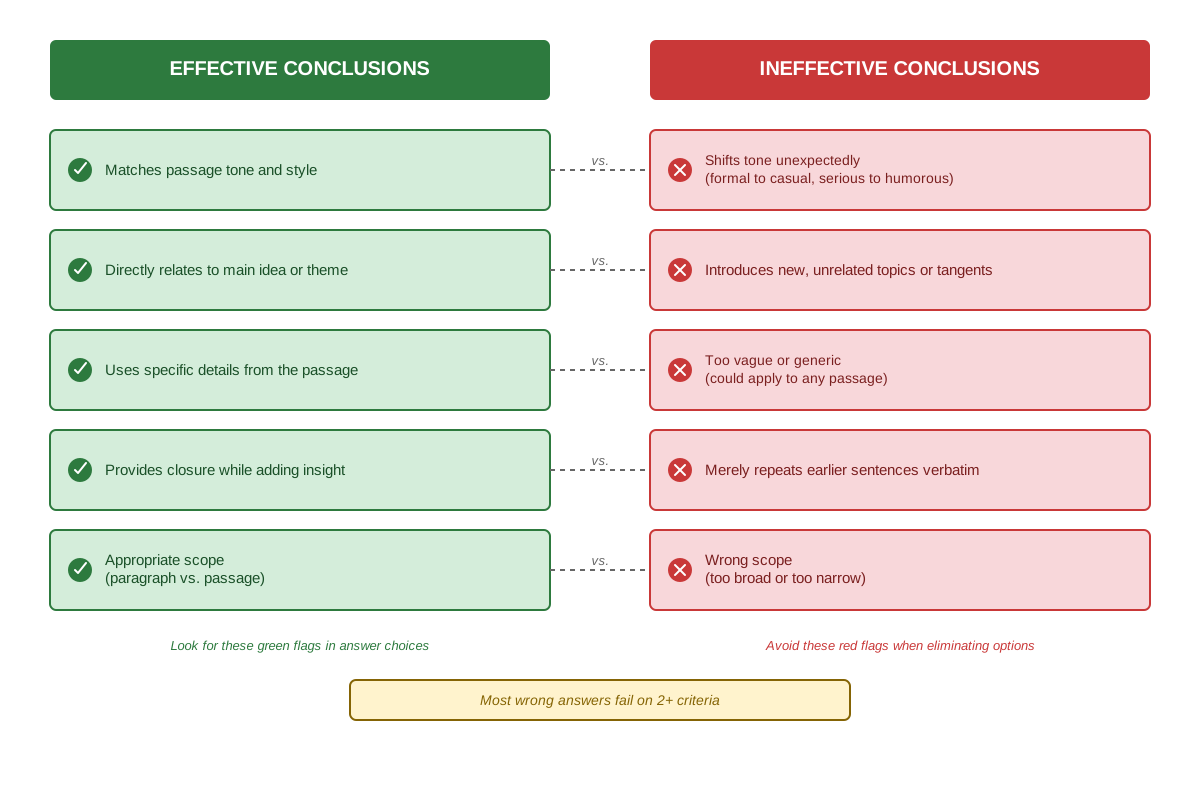
An effective conclusion serves multiple purposes simultaneously. First, it provides closure by signaling to the reader that the discussion has reached its natural end. Second, it reinforces the main idea without simply repeating earlier sentences verbatim. Third, it maintains consistency with the passage's tone, style, and purpose. Fourth, it often provides a sense of completeness by connecting back to ideas introduced earlier or by offering a final insight that feels satisfying.
The best conclusions are specific rather than generic. A conclusion stating "This was an interesting topic" could apply to any passage and therefore adds no value. In contrast, a conclusion that references specific details from the passage while synthesizing them into a final thought demonstrates both comprehension and rhetorical skill. The ACT rewards conclusions that feel tailored to the particular passage rather than interchangeable.
Paragraph Conclusions vs. Passage Conclusions
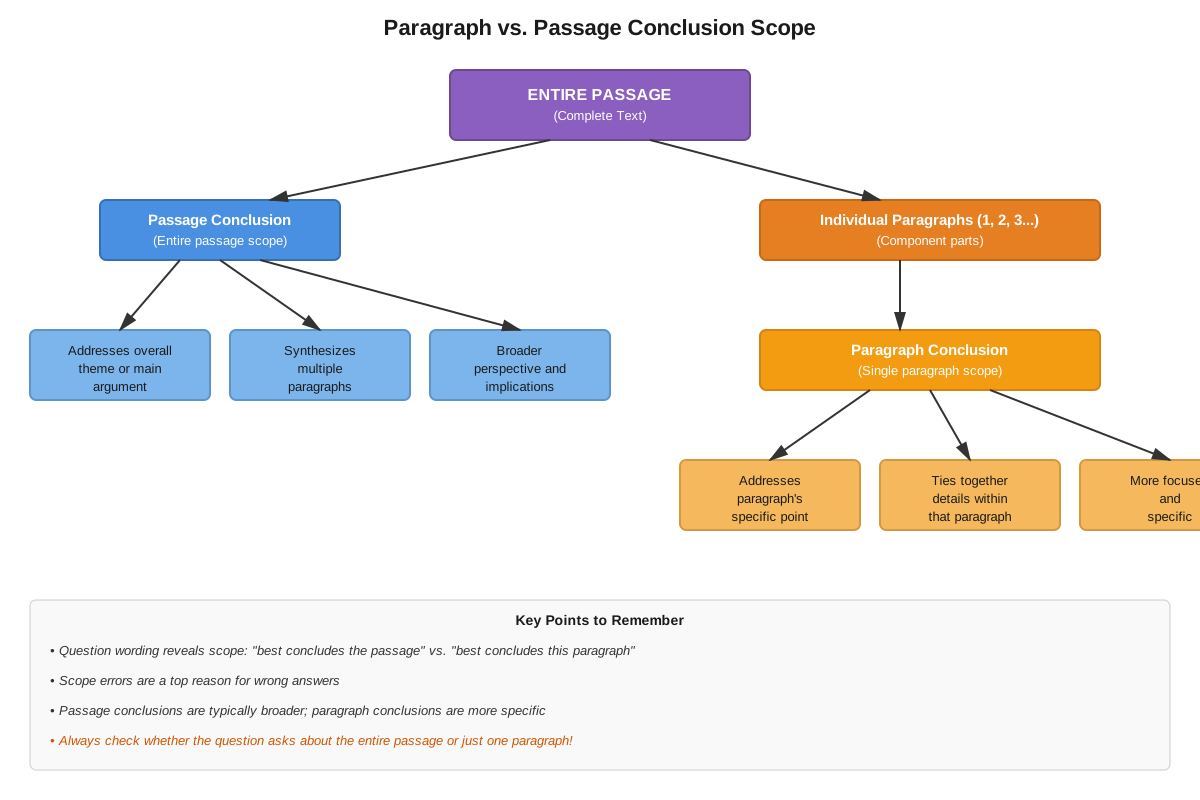
Understanding the scope of the conclusion is critical. Paragraph conclusions should tie together the ideas within that single paragraph, reinforcing its specific focus. If a paragraph discusses the three main features of a particular architectural style, its conclusion should reference those features or their collective significance, not introduce information about other architectural styles or broader topics.
Passage conclusions, by contrast, must address the entire essay's main theme. These conclusions often appear at the very end of the passage and should reflect the overarching message rather than just the final paragraph's content. A passage about the development of jazz music through several decades needs a conclusion that addresses the entire historical arc, not just the final era discussed.
| Conclusion Type | Scope | Focus | Common Errors |
|---|---|---|---|
| Paragraph | Single paragraph | Specific subtopic or aspect | Being too broad; introducing new information |
| Passage | Entire essay | Overall theme or argument | Being too narrow; focusing only on last paragraph |
The Four Criteria for Best Conclusions
When evaluating conclusion options, apply these four essential criteria:
- Relevance: Does the conclusion relate directly to the content that came before? Irrelevant conclusions introduce new topics, shift focus to tangential issues, or discuss matters not addressed in the passage.
- Tone consistency: Does the conclusion match the passage's tone? A serious, academic passage requires a formal conclusion, while a lighthearted personal narrative needs a conclusion that maintains that casual, reflective voice.
- Specificity: Does the conclusion reference specific elements from the passage? Generic statements that could apply to any topic are weak conclusions. Strong conclusions incorporate particular details, names, concepts, or themes from the passage.
- Appropriate closure: Does the conclusion feel like an ending rather than a continuation? Conclusions that raise new questions, introduce unexplored topics, or suggest the discussion is incomplete fail to provide proper closure.
Common Conclusion Strategies
Effective conclusions employ various strategies depending on the passage type and purpose:
The Summary-Plus approach briefly touches on main points while adding a final insight or implication. This works well for informative passages where the conclusion should reinforce what was learned while suggesting broader significance.
The Echo technique references language, imagery, or ideas from the passage's opening, creating a sense of circularity and completeness. This strategy is particularly effective for narrative or descriptive passages.
The Forward-Looking conclusion acknowledges what has been discussed while gesturing toward future implications, applications, or developments. This works for passages about ongoing issues, scientific developments, or historical trends.
The Significance Statement explicitly articulates why the topic matters, what it reveals, or what readers should take away. This approach suits persuasive or analytical passages where the writer wants to emphasize importance.
Red Flags in Wrong Answer Choices
The ACT consistently uses certain types of wrong answers for best conclusion questions:
New information: Conclusions that introduce facts, examples, or topics not previously mentioned in the passage are almost always incorrect. Conclusions should synthesize existing content, not expand it.
Contradictions: Options that contradict the passage's main idea, tone, or specific details are wrong, even if they sound eloquent or sophisticated.
Overgeneralizations: Conclusions that make sweeping claims beyond what the passage supports are incorrect. If a passage discusses three specific examples, a conclusion claiming "this is true in all cases everywhere" oversteps.
Tone mismatches: A humorous conclusion to a serious passage, or a formal conclusion to a casual narrative, will be wrong regardless of other qualities.
Abrupt endings: Conclusions that feel like they belong in the middle of the passage rather than at the end fail to provide closure.
Concept Relationships
The concepts within best conclusion questions form an interconnected system. Understanding what makes an effective conclusion provides the foundation for distinguishing between paragraph and passage conclusions, since scope determines which elements should be emphasized. Both types of conclusions must satisfy the four criteria (relevance, tone, specificity, closure), which serve as the evaluation framework. These criteria help identify red flags in wrong answers, as each wrong answer typically violates at least one criterion. The common conclusion strategies represent different ways to satisfy all four criteria simultaneously, giving students multiple approaches to recognize effective conclusions.
Best conclusion questions connect to prerequisite knowledge in several ways. Reading comprehension enables students to identify the main idea that the conclusion must reinforce. Tone recognition allows students to eliminate options that clash with the passage's voice. Paragraph structure awareness helps students understand where conclusions fit in the organizational hierarchy. These prerequisites flow into best conclusion mastery, which in turn supports other rhetorical skills like transition selection, sentence placement, and organizational strategy.
The relationship map: Reading Comprehension → Main Idea Identification → Scope Determination (paragraph vs. passage) → Application of Four Criteria → Elimination of Red Flags → Selection of Best Conclusion → Verification through Strategy Recognition
High-Yield Facts
- ⭐ Best conclusion questions appear 2-4 times on every ACT English test, making them high-frequency question types
- ⭐ The correct conclusion must match the passage's tone exactly—formal passages need formal conclusions, casual passages need casual conclusions
- ⭐ Conclusions that introduce new information not mentioned in the passage are almost always wrong
- ⭐ Specific conclusions that reference passage details are superior to generic statements that could apply to any topic
- ⭐ Paragraph conclusions focus on that paragraph's specific content; passage conclusions address the entire essay's theme
- Wrong answers often sound sophisticated but fail one or more of the four criteria (relevance, tone, specificity, closure)
- The best conclusion often echoes themes or language from earlier in the passage without directly repeating sentences
- Questions may specify particular requirements ("emphasize the scientific importance" or "maintain the reflective tone")
- Conclusions should provide closure, not raise new questions or suggest the discussion is incomplete
- Effective conclusions synthesize rather than simply summarize—they add a final insight while reinforcing main ideas
- The last sentence of a passage is not always the conclusion being tested; sometimes the question asks about the last sentence of an earlier paragraph
Quick check — test yourself on Best conclusion so far.
Try Flashcards →Common Misconceptions
Misconception: The longest or most detailed answer choice is usually the best conclusion.
Correction: Length does not determine quality. The best conclusion is the one that most effectively satisfies the four criteria, regardless of length. Sometimes the most concise option is correct because it provides focused closure without unnecessary elaboration.
Misconception: A good conclusion must summarize all the main points discussed in the passage.
Correction: While conclusions may touch on main ideas, effective conclusions synthesize rather than summarize. Simply listing previously mentioned points creates redundancy. The best conclusions reinforce the overall message while adding a final insight or perspective.
Misconception: Introducing a new related idea in the conclusion makes it more interesting and sophisticated.
Correction: Conclusions should not introduce new information, even if related to the topic. New ideas belong in body paragraphs where they can be developed. Conclusions that introduce new content fail to provide closure and leave readers feeling the discussion is incomplete.
Misconception: The conclusion should always be formal and serious, regardless of the passage's tone.
Correction: Conclusions must match the passage's established tone. A personal narrative with a conversational tone requires a similarly casual conclusion. Tone consistency is one of the four essential criteria for effective conclusions.
Misconception: If a conclusion sounds good and is grammatically correct, it's probably right.
Correction: Grammatical correctness and eloquent phrasing do not guarantee a conclusion is appropriate. The conclusion must be relevant to the specific passage content, match its tone, reference specific details, and provide appropriate closure. Many wrong answers are well-written but fail these rhetorical requirements.
Misconception: The conclusion should always look toward the future or suggest next steps.
Correction: Forward-looking conclusions are one strategy, but not the only effective approach. Depending on the passage type and purpose, echoing earlier themes, emphasizing significance, or providing reflective insight may be more appropriate than discussing future implications.
Worked Examples
Example 1: Paragraph Conclusion
Passage Context: The paragraph discusses three specific adaptations that allow camels to survive in desert environments: their ability to store fat in their humps, their specialized eyelashes and nostrils that protect against sand, and their capacity to go long periods without water.
Question: Which choice most effectively concludes the paragraph?
Options:
- A) These remarkable features make camels well-suited for desert life.
- B) Camels are interesting animals that have fascinated scientists for decades.
- C) Desert environments present challenges for many animal species.
- D) Together, these adaptations enable camels to thrive where few other large mammals could survive.
Analysis:
First, identify the scope: this is a paragraph conclusion, so it should focus on the specific content of this paragraph about camel adaptations.
Apply the four criteria to each option:
Option A:
- Relevance: ✓ (discusses the features mentioned)
- Tone: ✓ (matches the informative tone)
- Specificity: Partial (uses "features" but doesn't specify what makes them remarkable)
- Closure: ✓ (provides an ending)
Option B:
- Relevance: ✗ (introduces "scientists" and "decades" not mentioned in paragraph)
- Tone: ✓ (informative)
- Specificity: ✗ (generic statement about camels being "interesting")
- Closure: Partial (feels like it could continue)
Option C:
- Relevance: ✗ (shifts focus to "many animal species" rather than camels specifically)
- Tone: ✓ (informative)
- Specificity: ✗ (too broad, doesn't reference the specific adaptations discussed)
- Closure: ✗ (feels like a topic sentence for a new paragraph)
Option D:
- Relevance: ✓ (directly references "these adaptations")
- Tone: ✓ (informative and appropriately formal)
- Specificity: ✓ (uses "together" to synthesize the three adaptations; "few other large mammals" adds specific context)
- Closure: ✓ (emphasizes the collective significance of the adaptations)
Answer: D is the best conclusion because it satisfies all four criteria. It specifically references the adaptations discussed, synthesizes them with "together," maintains the informative tone, and provides strong closure by emphasizing their collective importance. Option A is the second-best but lacks the specificity and synthesis that D provides.
Example 2: Passage Conclusion
Passage Context: The entire essay traces the development of public libraries in America from Benjamin Franklin's subscription library in 1731 through Andrew Carnegie's library-building campaign in the early 1900s to modern digital resources. The passage emphasizes how libraries have consistently adapted to serve their communities' changing needs.
Question: Which choice best concludes the essay by reinforcing its main theme?
Options:
- A) Andrew Carnegie's contributions to library development cannot be overstated.
- B) Today's libraries continue this tradition of evolution, proving that the commitment to public access to knowledge remains as vital as ever.
- C) Digital resources have transformed how people access information in the twenty-first century.
- D) Benjamin Franklin would be amazed to see how his idea has grown over the centuries.
Analysis:
This is a passage conclusion, so it must address the entire essay's theme: libraries' consistent adaptation to serve communities' changing needs.
Option A:
- Relevance: Partial (Carnegie is mentioned but is only one part of the essay)
- Tone: ✓ (matches the informative, appreciative tone)
- Specificity: ✗ (focuses only on Carnegie, ignoring the broader historical arc)
- Closure: ✗ (too narrow for a passage conclusion; feels like a paragraph conclusion)
Option B:
- Relevance: ✓ (addresses the ongoing evolution theme central to the entire passage)
- Tone: ✓ (informative and appreciative)
- Specificity: ✓ (references "this tradition of evolution" connecting to the historical development discussed; "public access to knowledge" echoes Franklin's original purpose)
- Closure: ✓ (brings the historical narrative to the present and emphasizes continuity)
Option C:
- Relevance: Partial (digital resources are mentioned but this focuses only on the modern era)
- Tone: ✓ (informative)
- Specificity: ✗ (too narrow; doesn't synthesize the entire historical development)
- Closure: ✗ (feels like it belongs in the final paragraph, not as the passage's ultimate conclusion)
Option D:
- Relevance: Partial (Franklin is the starting point but this doesn't address the adaptation theme)
- Tone: Questionable (slightly informal with "would be amazed")
- Specificity: ✗ (focuses on Franklin's hypothetical reaction rather than the passage's actual theme)
- Closure: ✗ (doesn't synthesize the main idea about adaptation and service)
Answer: B is the best conclusion because it synthesizes the entire passage's theme of continuous evolution while connecting past to present. It references the "tradition" discussed throughout the essay and emphasizes that the core value (public access to knowledge) persists despite changes in format. This provides both thematic closure and a sense of ongoing relevance.
Exam Strategy
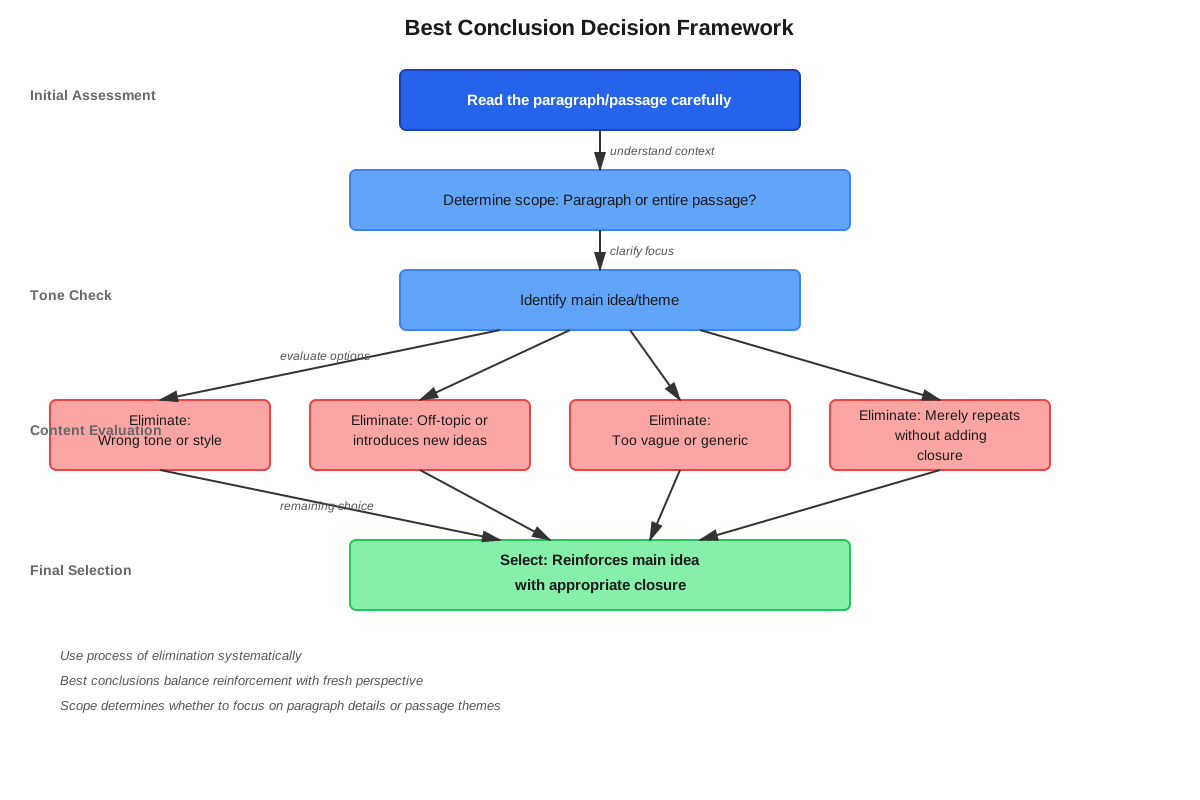
When approaching best conclusion questions on the ACT, follow this systematic process:
Step 1: Identify the scope. Determine whether the question asks for a paragraph conclusion or a passage conclusion. Read the question stem carefully—it will specify "the paragraph" or "the essay/passage." This determines how broad your focus should be.
Step 2: Identify the main idea. Before looking at answer choices, articulate the main idea of the paragraph or passage in your own words. For paragraph conclusions, what is this specific paragraph about? For passage conclusions, what is the overarching theme or argument?
Step 3: Note the tone. Is the passage formal or casual? Serious or lighthearted? Persuasive or informative? The correct conclusion must match this tone exactly.
Step 4: Apply the four criteria. Evaluate each answer choice using relevance, tone consistency, specificity, and appropriate closure. Eliminate options that fail any criterion.
Step 5: Watch for red flags. Immediately eliminate options that introduce new information, contradict the passage, overgeneralize, or mismatch the tone.
Exam Tip: If the question specifies particular requirements ("emphasize the historical significance" or "maintain the reflective tone"), use these as additional criteria. The correct answer must satisfy both the general criteria and the specific requirement.
Trigger words and phrases that signal best conclusion questions include:
- "Which choice most effectively concludes..."
- "Which choice best ends the paragraph/essay..."
- "The writer wants to conclude by..."
- "Which choice provides the most effective conclusion..."
- "The best placement for this sentence would be at the end of the paragraph because..."
Time allocation: Spend 30-45 seconds on best conclusion questions. They require more reading and analysis than pure grammar questions but should not consume excessive time. If you're stuck between two options, choose the more specific one that references passage details.
Process of elimination strategy: First, eliminate options with obvious red flags (new information, tone mismatches, contradictions). Then, compare remaining options using the four criteria. The option that satisfies all four criteria most completely is correct.
Memory Techniques
The RTSC Mnemonic helps remember the four essential criteria:
- Relevance: Does it relate to the passage content?
- Tone: Does it match the passage's voice?
- Specificity: Does it reference specific passage details?
- Closure: Does it feel like an ending?
The "New News is Bad News" rule: If a conclusion introduces new information not mentioned in the passage, it's wrong. Remember: conclusions synthesize, they don't expand.
The Echo Technique visualization: Picture the conclusion as an echo of the passage's main theme. Just as an echo repeats the original sound in a slightly different form, a good conclusion repeats the main idea in a fresh way without exact repetition.
The Scope Circle: Visualize paragraph conclusions as small circles that encompass only that paragraph's content, while passage conclusions are large circles that encompass the entire essay. This mental image helps prevent scope errors.
The Tone Match Test: Before selecting an answer, read it in the same "voice" as the passage. If it sounds jarring or inconsistent, it's wrong. Trust your ear for tone consistency.
Summary
Best conclusion questions test the ability to select the most effective ending for a paragraph or passage by evaluating options against four essential criteria: relevance, tone consistency, specificity, and appropriate closure. These questions appear 2-4 times per ACT English test and require students to understand both the content and purpose of the writing. The correct conclusion must match the scope (paragraph vs. passage), maintain the established tone, reference specific passage details rather than making generic statements, and provide a sense of completeness without introducing new information. Success requires systematic evaluation of each option, immediate elimination of red flags (new information, tone mismatches, contradictions, overgeneralizations), and selection of the answer that best synthesizes the main idea while providing satisfying closure. Understanding common conclusion strategies (summary-plus, echo technique, forward-looking, significance statement) helps recognize effective conclusions quickly.
Key Takeaways
- Best conclusion questions test rhetorical awareness, not grammar, and require understanding the passage's main idea, tone, and purpose
- Apply four criteria to every option: relevance, tone consistency, specificity, and appropriate closure
- Paragraph conclusions focus on that paragraph's specific content; passage conclusions address the entire essay's theme
- Conclusions that introduce new information not mentioned in the passage are almost always wrong
- The correct conclusion must match the passage's tone exactly—formal, casual, serious, or lighthearted
- Specific conclusions that reference passage details are superior to generic statements
- Use the RTSC mnemonic (Relevance, Tone, Specificity, Closure) to evaluate options systematically
Related Topics
Main Idea and Purpose Questions: Understanding how to identify a passage's central theme directly supports best conclusion selection, as conclusions must reinforce the main idea. Mastering best conclusion questions strengthens the ability to recognize what a passage is fundamentally about.
Transition and Organization Questions: These questions test how sentences and paragraphs connect logically. Best conclusion mastery helps with these questions because conclusions represent the final organizational element, demonstrating how ideas reach resolution.
Tone and Style Questions: These questions ask students to identify or maintain a passage's voice. The tone consistency criterion in best conclusion questions develops the same skill set, making these topics mutually reinforcing.
Sentence Placement Questions: Some questions ask where a sentence should be placed within a passage. Understanding what makes an effective conclusion helps determine when a sentence functions as a concluding statement versus a supporting detail.
Practice CTA
Now that you understand the strategies for identifying and selecting the best conclusion, it's time to apply these skills to practice questions. Work through the practice problems systematically, using the RTSC criteria to evaluate each option. Pay special attention to questions where you're torn between two answers—these reveal which criteria you need to apply more carefully. The flashcards will help reinforce the four essential criteria and common red flags. Remember: best conclusion questions reward careful analysis and systematic thinking. With practice, you'll develop the ability to recognize effective conclusions quickly and confidently, turning these questions into reliable points on test day.
Sign up free to keep reading
Create a free AnvayaPrep account to finish this ACT guide on Best conclusion — plus flashcards and practice questions.