Overview
Adverb clauses represent one of the most frequently tested grammatical structures on the ACT English section, appearing in approximately 10-15% of all sentence structure questions. These dependent clauses function as adverbs, modifying verbs, adjectives, or other adverbs by providing information about time, cause, condition, contrast, purpose, or manner. Understanding adverb clauses is essential because the ACT consistently tests students' ability to recognize proper punctuation, placement, and logical relationships between clauses. Questions involving adverb clauses often appear disguised as punctuation problems, sentence fragment issues, or logical flow questions, making them particularly challenging for unprepared test-takers.
The importance of mastering ACT adverb clauses extends beyond isolated grammar questions. These structures form the backbone of complex sentence construction, and the ACT frequently tests whether students can identify when a sentence needs restructuring to clarify relationships between ideas. Students who understand adverb clauses gain a significant advantage in recognizing sentence boundaries, determining appropriate punctuation, and evaluating whether transitions between ideas are logical and grammatically sound. This knowledge directly impacts performance on questions involving comma usage, semicolons, sentence fragments, and run-on sentences.
Within the broader context of ACT English sentence structure, adverb clauses connect intimately with independent clauses, subordinating conjunctions, and punctuation rules. They represent the primary mechanism through which writers create sophisticated, multi-layered sentences that express complex relationships between ideas. The ACT exploits common misunderstandings about these structures by presenting answer choices that create fragments, misuse punctuation, or establish illogical relationships between clauses. Students who master adverb clauses develop the analytical framework necessary to navigate these challenging questions with confidence and accuracy.
Learning Objectives
- [ ] Identify when adverb clauses are being tested in ACT English questions
- [ ] Explain the core rule or strategy behind adverb clauses and their proper usage
- [ ] Apply adverb clauses to ACT-style questions accurately
- [ ] Distinguish between adverb clauses and other dependent clause types (noun clauses, adjective clauses)
- [ ] Recognize and correct punctuation errors involving adverb clauses
- [ ] Evaluate the logical relationship established by subordinating conjunctions in adverb clauses
- [ ] Determine proper placement of adverb clauses within sentences to maintain clarity
Prerequisites
- Independent clauses: Understanding complete sentences is essential because adverb clauses must attach to independent clauses to form grammatically correct sentences
- Dependent clauses: Recognizing that some clauses cannot stand alone provides the foundation for understanding why adverb clauses require attachment to main clauses
- Subordinating conjunctions: Familiarity with words like "because," "although," and "when" is necessary since these signal the beginning of adverb clauses
- Basic punctuation rules: Knowledge of comma usage and semicolon restrictions helps students correctly punctuate sentences containing adverb clauses
- Parts of speech: Understanding what adverbs do (modify verbs, adjectives, or other adverbs) clarifies why these clauses are called "adverb" clauses
Why This Topic Matters
Adverb clauses appear in real-world writing whenever complex ideas require clear expression of relationships between actions, conditions, or circumstances. Professional writing, academic essays, and technical documentation all rely heavily on adverb clauses to establish causation, timing, conditions, and contrasts. Mastering these structures enables students to write more sophisticated prose and comprehend complex texts across all academic disciplines.
On the ACT English section, adverb clause questions appear with remarkable consistency, typically comprising 3-5 questions per test. These questions most commonly appear in three formats: punctuation questions testing comma placement with introductory adverb clauses, sentence structure questions testing whether a clause creates a fragment, and rhetorical skills questions testing whether the subordinating conjunction establishes the appropriate logical relationship. The ACT particularly favors testing introductory adverb clauses (those appearing at the beginning of sentences) and the distinction between adverb clauses and independent clauses that might incorrectly be separated by a comma alone.
In exam passages, adverb clauses typically appear in contexts requiring students to evaluate whether punctuation correctly separates or connects clauses, whether a subordinating conjunction creates the intended meaning, or whether a clause structure creates a fragment. The test writers frequently present incorrect answer choices that use coordinating conjunctions where subordinating conjunctions are needed, omit necessary commas after introductory adverb clauses, or incorrectly use semicolons to separate adverb clauses from independent clauses. Recognizing these patterns enables students to quickly identify the grammatical concept being tested and select the correct answer with confidence.
Core Concepts
Definition and Structure of Adverb Clauses
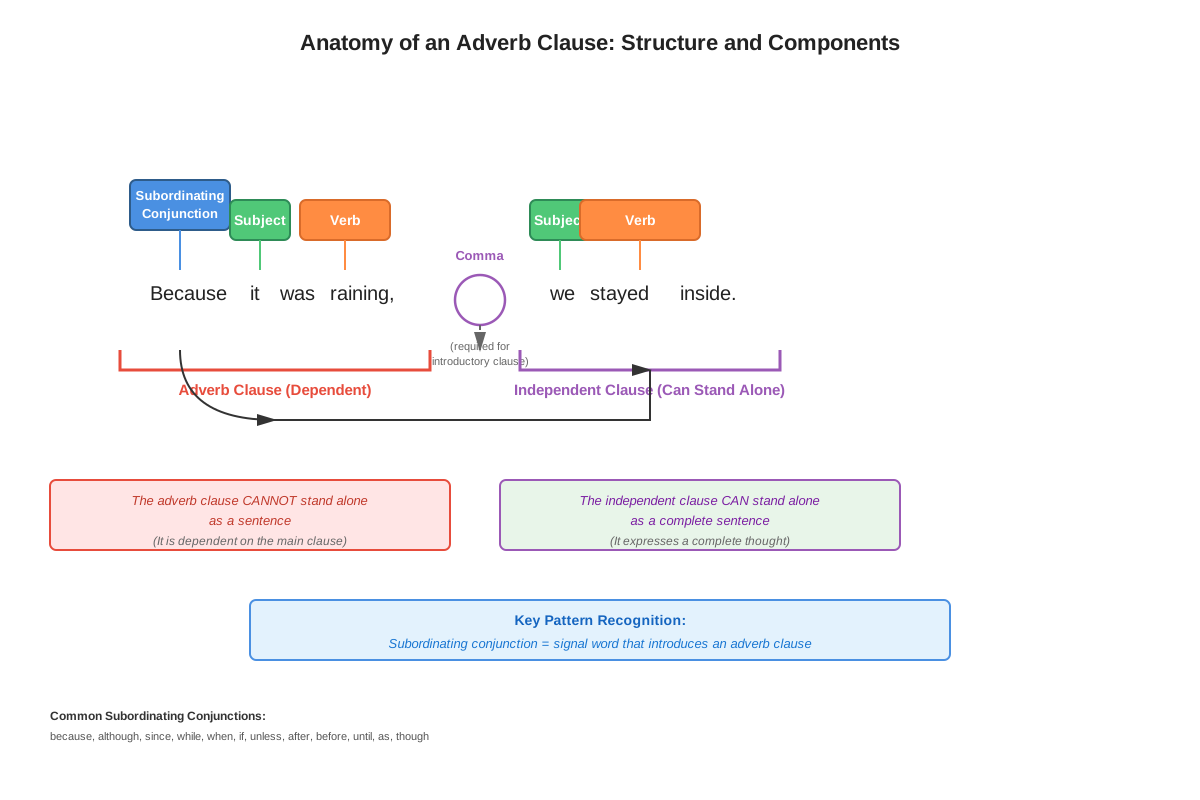
An adverb clause is a dependent clause that functions as an adverb, modifying a verb, adjective, or adverb in the main clause. Like all dependent clauses, adverb clauses contain a subject and a verb but cannot stand alone as complete sentences. The defining characteristic of adverb clauses is that they begin with subordinating conjunctions—words that establish specific relationships between the dependent clause and the independent clause it modifies.
The basic structure follows this pattern: Subordinating Conjunction + Subject + Verb (+ additional words) = Adverb Clause. For example, in "because the storm intensified," "because" is the subordinating conjunction, "storm" is the subject, and "intensified" is the verb. This entire structure functions as a single adverbial unit that must attach to an independent clause to form a complete sentence: "We canceled the picnic because the storm intensified."
Common Subordinating Conjunctions and Their Functions
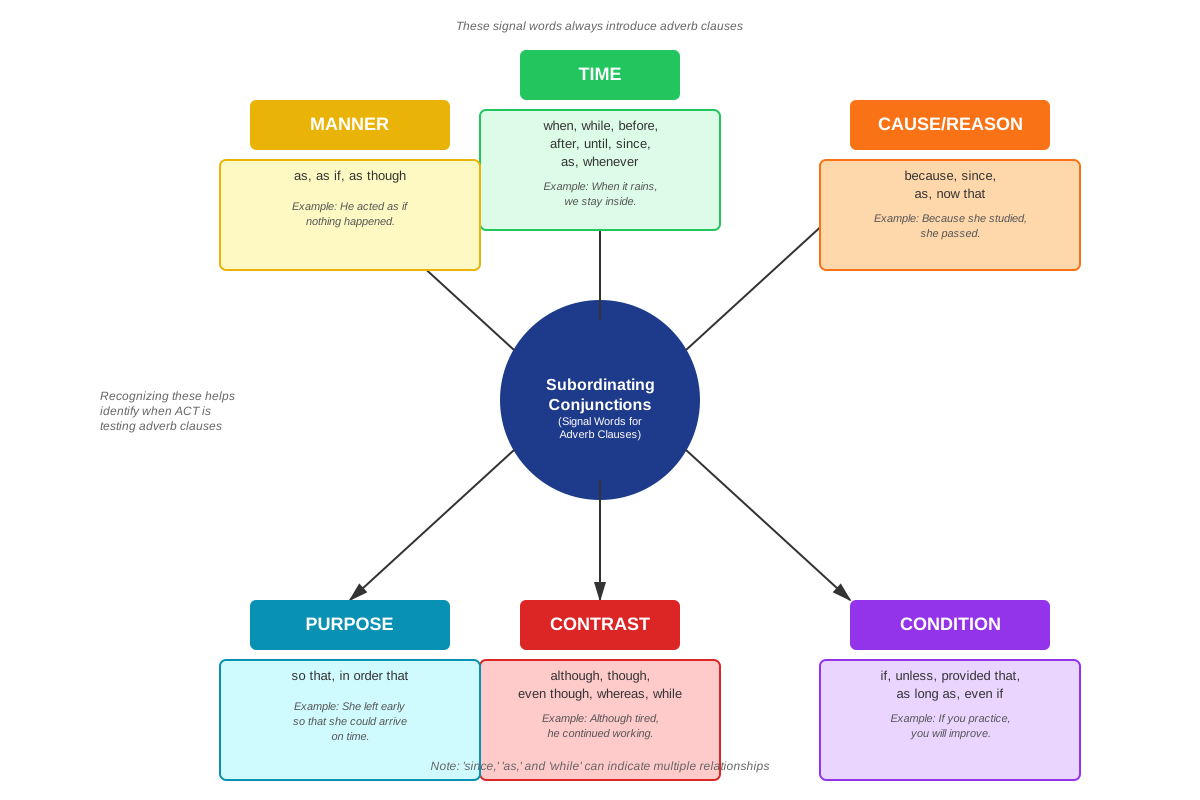
Subordinating conjunctions signal different types of relationships between clauses. Understanding these categories helps students evaluate whether the conjunction creates the logical relationship the sentence intends to express.
| Category | Subordinating Conjunctions | Relationship Established |
|---|---|---|
| Time | when, whenever, while, as, before, after, since, until, once | Indicates temporal relationship between actions |
| Cause/Reason | because, since, as | Explains why something happened |
| Condition | if, unless, provided that, assuming that | Establishes conditions under which something occurs |
| Contrast | although, though, even though, whereas, while | Shows opposition or unexpected results |
| Purpose | so that, in order that | Indicates the goal or intention of an action |
| Manner | as, as if, as though | Describes how something happens |
The ACT frequently tests whether students recognize when a subordinating conjunction creates an illogical relationship. For example, using "because" when "although" is needed fundamentally changes the sentence's meaning and creates a logical error.
Punctuation Rules for Adverb Clauses
Punctuation with adverb clauses follows predictable patterns that the ACT tests extensively:
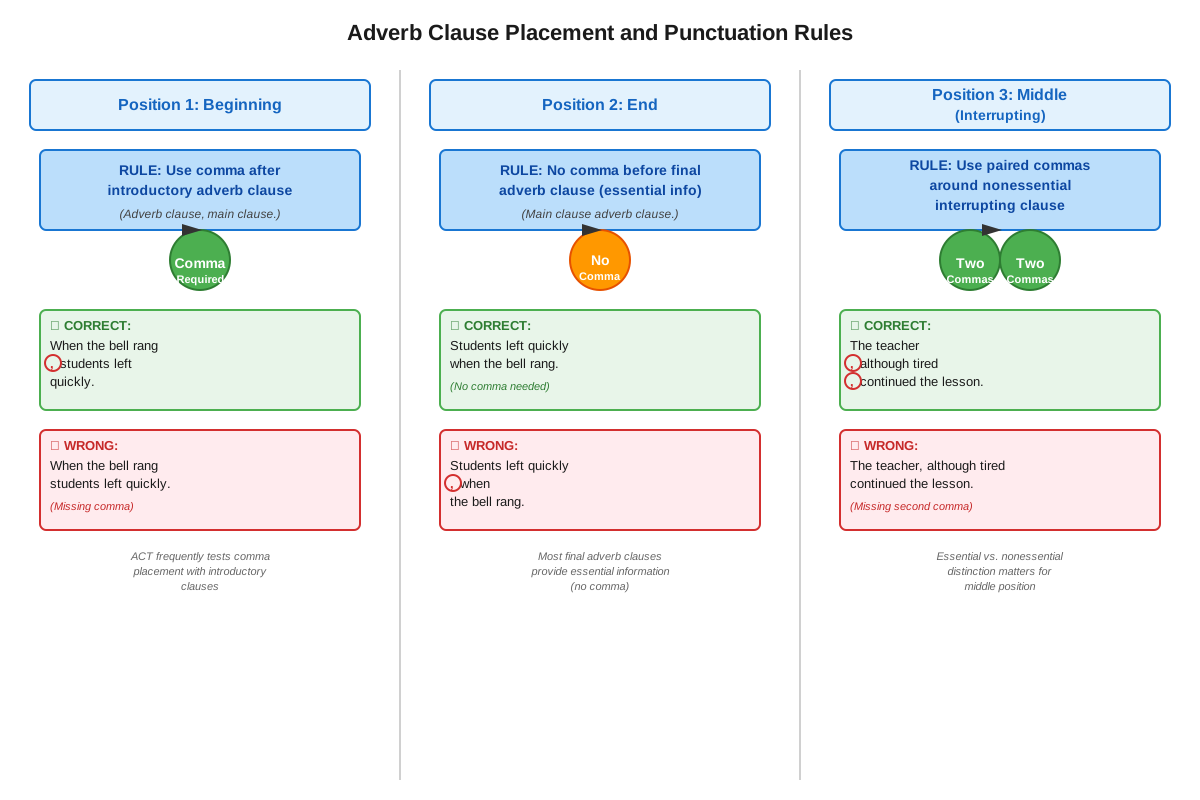
Rule 1: Introductory Adverb Clauses
When an adverb clause appears at the beginning of a sentence (before the independent clause), it must be followed by a comma:
- Correct: "Although the experiment failed, the researchers gained valuable insights."
- Incorrect: "Although the experiment failed the researchers gained valuable insights."
Rule 2: Adverb Clauses Following Independent Clauses
When an adverb clause appears after the independent clause, a comma is typically optional unless the clause is nonessential or begins with "although," "though," or "even though":
- Usually no comma needed: "The researchers gained valuable insights although the experiment failed."
- Comma often used with contrast: "The researchers gained valuable insights, although the experiment failed."
Rule 3: Never Use Semicolons
Semicolons can only separate two independent clauses. Since adverb clauses are dependent, using a semicolon before or after an adverb clause is always incorrect:
- Incorrect: "The experiment failed; although the researchers gained insights."
- Correct: "The experiment failed, although the researchers gained insights."
Adverb Clauses vs. Independent Clauses
The ACT frequently tests whether students can distinguish between adverb clauses (dependent) and independent clauses. This distinction determines correct punctuation and sentence structure:
Independent Clause: Contains a subject and verb and expresses a complete thought. Can stand alone as a sentence.
- Example: "The temperature dropped."
Adverb Clause: Contains a subject and verb but begins with a subordinating conjunction, making it dependent. Cannot stand alone.
- Example: "Because the temperature dropped" (incomplete—leaves the reader asking "what happened?")
The presence of a subordinating conjunction transforms what would be an independent clause into a dependent adverb clause. Compare:
- Independent: "The temperature dropped" + "We canceled the event" = Two complete sentences
- With subordinating conjunction: "Because the temperature dropped" + "we canceled the event" = Adverb clause + independent clause = One complete sentence
Fragment Errors with Adverb Clauses
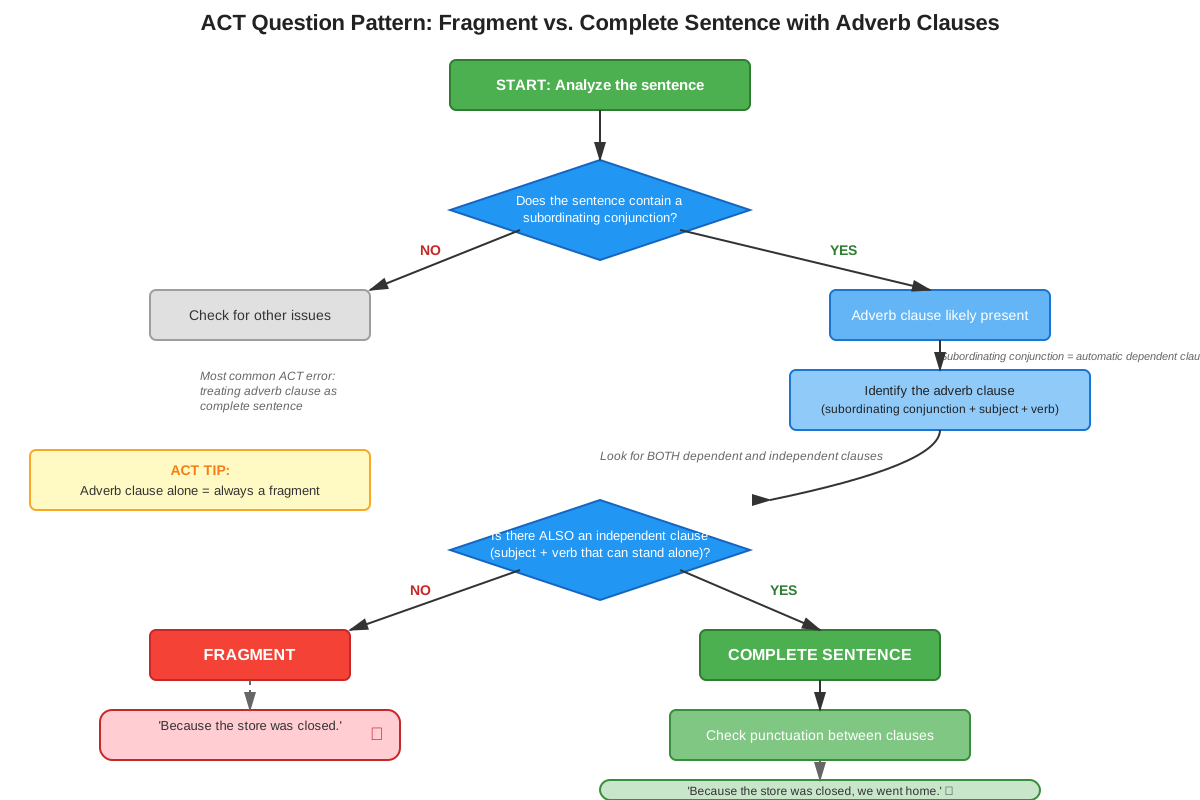
One of the most common errors the ACT tests is treating an adverb clause as if it were a complete sentence. This creates a sentence fragment—a group of words punctuated as a sentence but lacking the ability to stand alone:
Fragment: "Because the temperature dropped suddenly."
Correction: "Because the temperature dropped suddenly, we canceled the event." (adverb clause + independent clause)
The ACT often presents fragments in answer choices by placing a period after an adverb clause or by separating an adverb clause from its independent clause with incorrect punctuation. Students must recognize that adverb clauses require attachment to independent clauses to form grammatically complete sentences.
Placement and Emphasis
Adverb clauses can appear at the beginning, middle, or end of sentences, and their placement affects emphasis and flow:
Beginning (Introductory): Emphasizes the condition, time, or reason before presenting the main action
- "When the results arrived, the team celebrated."
End: Emphasizes the main action before providing additional context
- "The team celebrated when the results arrived."
Middle (Interrupting): Less common; the adverb clause interrupts the main clause
- "The team, when the results arrived, celebrated enthusiastically."
The ACT occasionally tests whether students recognize that changing the placement of an adverb clause affects meaning or creates awkward construction, though this is less common than punctuation and fragment questions.
Concept Relationships
Adverb clauses exist within a hierarchical relationship with other sentence structure concepts. At the foundation, understanding independent clauses is essential because adverb clauses must attach to them. The relationship flows: Independent Clauses → provide the base structure → to which Adverb Clauses attach → creating Complex Sentences.
Subordinating conjunctions serve as the gateway concept to adverb clauses—they transform independent clauses into dependent adverb clauses and establish the logical relationship between clauses. This connection is direct and invariable: Subordinating Conjunction at the beginning of a clause → creates an Adverb Clause → which must attach to an Independent Clause.
The relationship between adverb clauses and punctuation rules is bidirectional. The presence of an adverb clause determines punctuation requirements (introductory adverb clauses require commas), while punctuation choices signal clause relationships to readers (commas after introductory elements, no semicolons with dependent clauses).
Adverb clauses connect laterally to other dependent clause types—adjective clauses and noun clauses—through their shared characteristic of being dependent structures. However, they differ in function: adjective clauses modify nouns, noun clauses act as nouns, and adverb clauses modify verbs, adjectives, or adverbs. Understanding these distinctions prevents confusion when identifying clause types.
Finally, adverb clauses relate to sentence fragments and run-on sentences as both a cause and solution. Improperly punctuated adverb clauses create fragments (when separated from independent clauses) or run-ons (when joined to independent clauses with only a comma and no subordinating conjunction). Properly constructed adverb clauses, however, provide the mechanism for creating sophisticated complex sentences that avoid these errors.
Quick check — test yourself on Adverb clauses so far.
Try Flashcards →High-Yield Facts
⭐ An adverb clause must begin with a subordinating conjunction and cannot stand alone as a complete sentence.
⭐ When an adverb clause appears at the beginning of a sentence, it must be followed by a comma.
⭐ Semicolons can never be used to connect an adverb clause to an independent clause because semicolons only separate two independent clauses.
⭐ The subordinating conjunction determines the logical relationship (time, cause, condition, contrast, etc.) between the adverb clause and the main clause.
⭐ An adverb clause separated from its independent clause by a period creates a sentence fragment.
- Adverb clauses that follow independent clauses typically do not require a comma unless they begin with contrast conjunctions like "although" or "though."
- Common subordinating conjunctions include: because, although, when, while, if, unless, since, after, before, until, and whereas.
- Adverb clauses modify verbs, adjectives, or other adverbs by answering questions like when, why, how, under what conditions, or despite what.
- The ACT frequently tests whether students can identify when a subordinating conjunction creates an illogical relationship between clauses.
- Removing the subordinating conjunction from an adverb clause transforms it into an independent clause, which changes punctuation requirements.
- Adverb clauses can appear at the beginning, middle, or end of sentences, but introductory placement is most commonly tested on the ACT.
- The word "while" can function as either a time subordinating conjunction or a contrast subordinating conjunction depending on context.
Common Misconceptions
Misconception: All dependent clauses are adverb clauses.
Correction: Dependent clauses include three types—adverb clauses (modify verbs, adjectives, or adverbs), adjective clauses (modify nouns), and noun clauses (function as nouns). Only clauses beginning with subordinating conjunctions and functioning as adverbs are adverb clauses.
Misconception: Commas are always optional with adverb clauses.
Correction: When an adverb clause appears at the beginning of a sentence (introductory position), a comma is required after it. The comma is typically optional only when the adverb clause follows the independent clause.
Misconception: Semicolons can separate any two clauses.
Correction: Semicolons can only separate two independent clauses. Since adverb clauses are dependent, using a semicolon before or after an adverb clause is always grammatically incorrect.
Misconception: An adverb clause can stand alone as a sentence if it's long enough or contains enough information.
Correction: Length and information content are irrelevant. An adverb clause is dependent by definition because it begins with a subordinating conjunction, which makes it incomplete regardless of how many words it contains.
Misconception: The words "however," "therefore," and "moreover" are subordinating conjunctions that create adverb clauses.
Correction: These words are conjunctive adverbs, not subordinating conjunctions. They cannot create adverb clauses and require different punctuation (typically semicolon before and comma after when joining independent clauses).
Misconception: Any clause beginning with "since" or "while" is an adverb clause.
Correction: While "since" and "while" commonly function as subordinating conjunctions, context determines their function. "Since" can mean "because" (subordinating conjunction) or refer to a point in time. "While" can indicate simultaneous action or contrast. The clause's function in the sentence determines whether it's truly an adverb clause.
Misconception: Adverb clauses always come before the verb they modify.
Correction: Adverb clauses typically modify the entire main clause rather than a single verb, and they can appear before or after the independent clause. Their position doesn't determine their function as adverb clauses.
Worked Examples
Example 1: Identifying and Correcting Punctuation Errors
ACT-Style Question:
"The research team continued collecting data. Although several instruments malfunctioned during the experiment."
Which of the following is the best revision?
A. NO CHANGE
B. data, although
C. data; although
D. data although
Step 1: Identify the clause structures
- "The research team continued collecting data" = independent clause (subject + verb + complete thought)
- "Although several instruments malfunctioned during the experiment" = adverb clause (subordinating conjunction "although" + subject + verb)
Step 2: Recognize the error
The adverb clause is separated from the independent clause by a period, creating a sentence fragment. The adverb clause cannot stand alone.
Step 3: Evaluate answer choices
- Choice A (NO CHANGE): Keeps the fragment error
- Choice B (data, although): Joins the clauses with a comma. Since the adverb clause follows the independent clause and begins with "although" (contrast), a comma is acceptable and creates a grammatically correct sentence.
- Choice C (data; although): Uses a semicolon before a dependent clause, which is always incorrect
- Choice D (data although): Joins the clauses with no punctuation, creating a run-on sentence
Step 4: Select the correct answer
Choice B is correct. It eliminates the fragment by properly connecting the adverb clause to the independent clause with a comma.
Connection to Learning Objectives: This example demonstrates how to identify when adverb clauses are being tested (fragment recognition), apply the core rule (adverb clauses must attach to independent clauses), and accurately select the correct answer by eliminating choices that violate punctuation rules.
Example 2: Evaluating Logical Relationships
ACT-Style Question:
"Because the new policy increased efficiency, the company decided to implement it across all departments."
The writer is considering replacing "Because" with "Although." Would this be an appropriate change?
A. Yes, because it would clarify the time relationship between events.
B. Yes, because it would emphasize the unexpected nature of the decision.
C. No, because it would reverse the logical relationship between the clauses.
D. No, because it would create a sentence fragment.
Step 1: Analyze the original sentence
- "Because" establishes a cause-and-effect relationship: the policy increased efficiency (cause) → the company implemented it (effect)
- This creates a logical flow: the positive result led to the decision
Step 2: Consider the proposed change
- "Although" establishes a contrast relationship: despite one fact, something unexpected happens
- "Although the new policy increased efficiency, the company decided to implement it" suggests that implementing an efficient policy is surprising or contradictory
- This reverses the logic—it would make sense only if the company did something unexpected despite the efficiency gain
Step 3: Evaluate answer choices
- Choice A: Incorrect—neither "because" nor "although" establishes time relationships; both establish logical relationships (cause vs. contrast)
- Choice B: Incorrect—while "although" does suggest something unexpected, this change would be inappropriate because the decision to implement an efficient policy is not unexpected
- Choice C: Correct—"although" would reverse the logical relationship from cause-and-effect to contrast, making the sentence illogical
- Choice D: Incorrect—replacing one subordinating conjunction with another doesn't create a fragment; the clause structure remains the same
Step 4: Select the correct answer
Choice C is correct. The change would be inappropriate because it would transform a logical cause-and-effect relationship into an illogical contrast.
Connection to Learning Objectives: This example demonstrates how to identify when subordinating conjunctions are being tested, explain the core strategy of matching conjunctions to intended logical relationships, and apply this understanding to evaluate whether a revision improves or damages sentence logic.
Exam Strategy
When approaching ACT questions involving adverb clauses, follow this systematic process:
Step 1: Identify clause structures
Quickly determine whether each clause is independent (can stand alone) or dependent (begins with subordinating conjunction). Circle or mentally note subordinating conjunctions like "because," "although," "when," "if," and "while."
Step 2: Check for fragments
If you see a period, semicolon, or other terminal punctuation, verify that what follows is a complete sentence. If it begins with a subordinating conjunction, it's likely a fragment that needs correction.
Step 3: Apply the introductory comma rule
When an adverb clause appears at the beginning of a sentence, a comma after it is required. This is one of the most frequently tested rules. If you see an introductory adverb clause without a comma, that's likely the error.
Step 4: Eliminate semicolon choices
If any answer choice uses a semicolon before or after an adverb clause, immediately eliminate it. Semicolons can only separate two independent clauses.
Step 5: Evaluate logical relationships
When the question involves choosing or evaluating subordinating conjunctions, ensure the conjunction creates the logical relationship the sentence intends. Ask: Does this show cause, contrast, condition, or time? Does that match the sentence's meaning?
Exam Tip: The ACT loves testing introductory adverb clauses. When you see a sentence beginning with words like "Although," "Because," "When," or "If," immediately check whether a comma appears after the entire introductory clause.
Trigger words and phrases to watch for:
- Question stems mentioning "fragment," "complete sentence," or "run-on" often test adverb clause attachment
- Underlined subordinating conjunctions signal questions about logical relationships
- Underlined commas or semicolons near subordinating conjunctions signal punctuation questions
- Questions asking whether a revision "clarifies the relationship" test subordinating conjunction choice
Process-of-elimination strategy:
- Eliminate any choice that creates a fragment (adverb clause standing alone)
- Eliminate any choice using a semicolon with an adverb clause
- Eliminate any choice that omits the comma after an introductory adverb clause
- Among remaining choices, select the one that creates the most logical relationship
Time allocation:
Adverb clause questions should take 20-30 seconds once you recognize the concept being tested. If you've identified the clause structures and applied the relevant rule, don't second-guess yourself. These questions test mechanical rules with clear right and wrong answers.
Memory Techniques
FANBOYS vs. AAAWWUBBIS
Remember that coordinating conjunctions (FANBOYS: For, And, Nor, But, Or, Yet, So) create different structures than subordinating conjunctions. For subordinating conjunctions, use AAAWWUBBIS:
- Although
- After
- As
- When
- While
- Until
- Because
- Before
- If
- Since
The Comma Rule Rhyme
"When the adverb clause comes first, add a comma or your sentence's cursed."
The Semicolon Rule
Visualize a semicolon as a bridge that can only connect two equal structures (independent clauses). If one side is dependent (adverb clause), the bridge collapses. This mental image helps remember that semicolons never work with adverb clauses.
The Fragment Test
When you see a subordinating conjunction at the beginning of a clause, mentally ask: "And then what happened?" If the clause doesn't answer this question, it's a fragment. For example: "Because the storm arrived" → "And then what happened?" → Incomplete, needs more information.
The Relationship Categories
Use the acronym TIME-CAUSE-CONTRAST-CONDITION to remember the four most commonly tested categories of subordinating conjunctions. When evaluating whether a conjunction is appropriate, determine which category the sentence needs.
Summary
Adverb clauses are dependent clauses that begin with subordinating conjunctions and function as adverbs, modifying verbs, adjectives, or other adverbs by establishing relationships of time, cause, condition, contrast, purpose, or manner. These structures appear frequently on the ACT English section, primarily in questions testing punctuation, sentence fragments, and logical relationships. The fundamental rule governing adverb clauses is that they cannot stand alone as complete sentences—they must attach to independent clauses. When adverb clauses appear at the beginning of sentences (introductory position), they require a comma after them. Semicolons can never be used with adverb clauses because semicolons only separate independent clauses. The subordinating conjunction that begins an adverb clause determines the logical relationship between the dependent and independent clauses, and the ACT frequently tests whether students can identify when a conjunction creates an illogical relationship. Mastering adverb clauses requires recognizing their structure, applying punctuation rules consistently, and evaluating whether subordinating conjunctions establish appropriate logical connections between ideas.
Key Takeaways
- Adverb clauses are dependent clauses beginning with subordinating conjunctions that cannot stand alone as complete sentences
- Introductory adverb clauses (those appearing before the independent clause) must be followed by a comma
- Semicolons can never be used to connect adverb clauses to independent clauses
- The subordinating conjunction determines the logical relationship (time, cause, condition, contrast) between clauses
- Common subordinating conjunctions include because, although, when, while, if, unless, since, before, after, and until
- Separating an adverb clause from its independent clause with a period creates a sentence fragment
- The ACT most frequently tests introductory comma rules, fragment recognition, and logical relationship evaluation with adverb clauses
Related Topics
Independent and Dependent Clauses: Understanding the fundamental distinction between clauses that can stand alone and those that cannot provides the foundation for all sentence structure concepts, including adverb clauses, and enables students to identify fragments and run-ons.
Adjective Clauses: These dependent clauses modify nouns rather than verbs, beginning with relative pronouns (who, which, that) rather than subordinating conjunctions. Mastering adverb clauses makes learning adjective clauses easier because both are dependent structures with specific punctuation rules.
Comma Usage: Adverb clauses represent just one context requiring comma knowledge. Expanding comma mastery to include series, coordinate adjectives, and nonessential elements creates comprehensive punctuation competency.
Sentence Fragments and Run-ons: These errors often involve improperly handled adverb clauses. Understanding adverb clauses provides the tools to identify and correct these common sentence structure problems.
Logical Transitions and Relationships: The logical relationships established by subordinating conjunctions in adverb clauses connect to broader questions about paragraph organization, transition words, and rhetorical effectiveness tested throughout the ACT English section.
Practice CTA
Now that you've mastered the core concepts of adverb clauses, it's time to reinforce your understanding through active practice. Attempt the practice questions to apply these rules to ACT-style scenarios, and use the flashcards to memorize key subordinating conjunctions and punctuation rules. Remember: recognizing adverb clauses quickly and accurately will help you answer multiple questions on test day, making this time investment highly valuable. Each practice question you complete strengthens your ability to spot these structures instantly and apply the correct rules under timed conditions. You've built the knowledge foundation—now build the speed and confidence that lead to a top score!
Sign up free to keep reading
Create a free AnvayaPrep account to finish this ACT guide on Adverb clauses — plus flashcards and practice questions.