Overview
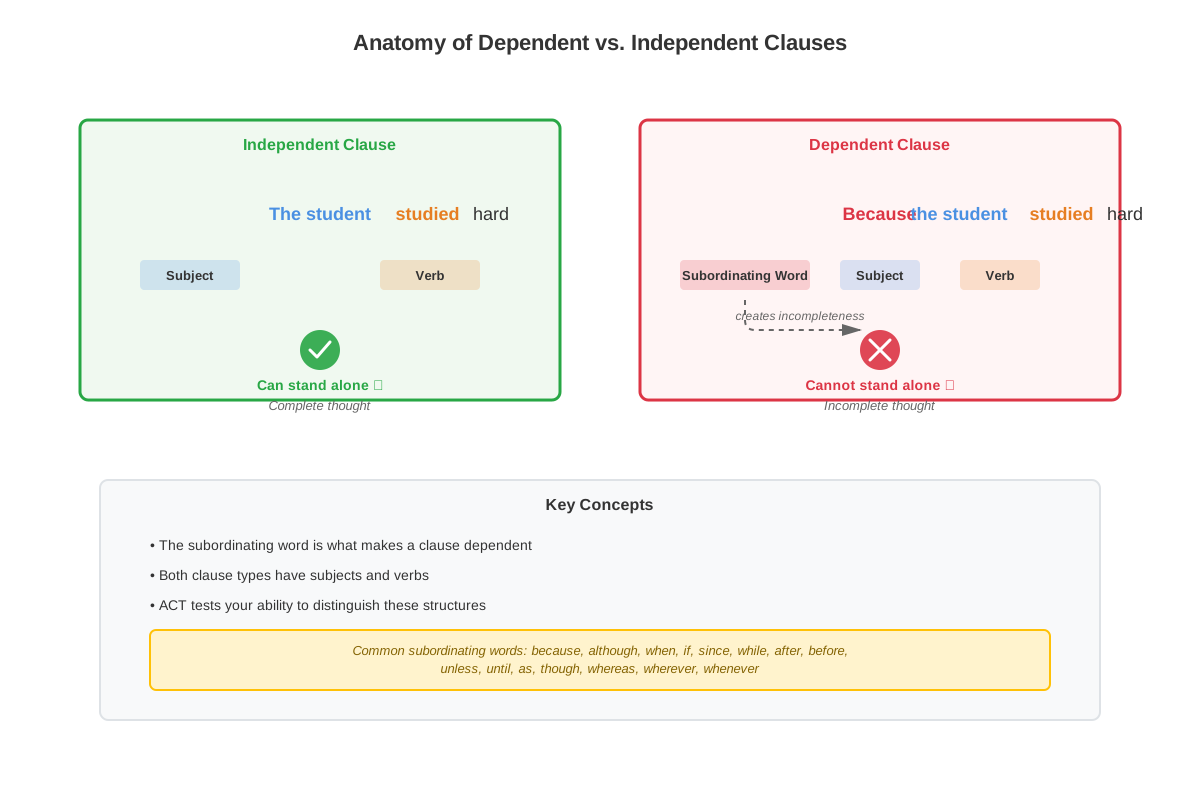
Dependent clauses are one of the most frequently tested concepts in the ACT English section, appearing in approximately 15-20% of all sentence structure questions. Understanding dependent clauses is fundamental to mastering punctuation, sentence boundaries, and grammatical relationships—skills that directly impact your ability to identify run-on sentences, comma splices, and fragments. A dependent clause contains a subject and a verb but cannot stand alone as a complete sentence because it begins with a subordinating word that creates incompleteness. This subordinating element makes the clause "dependent" on an independent clause to form a grammatically complete thought.
The ACT English test consistently evaluates whether students can distinguish between dependent and independent clauses, recognize when clauses are properly connected, and identify errors in clause punctuation. Questions involving ACT dependent clauses often appear disguised as punctuation questions, but the underlying issue is always about understanding clause relationships. Students who master dependent clauses gain a significant advantage because this knowledge unlocks the ability to answer questions about commas, semicolons, dashes, and sentence fragments with confidence and accuracy.
Within the broader context of sentence structure, dependent clauses serve as building blocks for complex and compound-complex sentences. They connect to concepts like independent clauses, conjunctions, and punctuation rules, forming an interconnected web of grammatical principles. Mastering dependent clauses enables students to understand how sentences are constructed, how ideas are subordinated to one another, and how punctuation marks signal these relationships to readers. This foundational knowledge extends beyond the ACT, supporting clear communication in academic writing, professional correspondence, and critical reading comprehension.
Learning Objectives
- [ ] Identify when Dependent clauses is being tested in ACT English questions
- [ ] Explain the core rule or strategy behind Dependent clauses and their function in sentences
- [ ] Apply Dependent clauses concepts to ACT-style questions accurately
- [ ] Distinguish between dependent and independent clauses in complex sentence structures
- [ ] Recognize all types of dependent clauses (subordinate, relative, and noun clauses)
- [ ] Determine correct punctuation when dependent clauses appear in various sentence positions
- [ ] Identify and correct sentence fragments caused by dependent clause errors
Prerequisites
- Independent clauses: Understanding what makes a clause independent (subject + verb + complete thought) is essential because dependent clauses are defined in contrast to independent clauses
- Basic sentence structure: Knowledge of subjects, verbs, and predicates provides the foundation for recognizing clause components
- Parts of speech: Familiarity with conjunctions, pronouns, and adverbs helps identify the subordinating words that create dependent clauses
- Punctuation basics: Understanding comma and semicolon rules provides context for how dependent clauses affect punctuation choices
Why This Topic Matters
Dependent clauses represent a high-yield topic for ACT preparation because they appear across multiple question types and test multiple skills simultaneously. The ACT English section contains approximately 9-12 questions directly testing dependent clause knowledge, but many additional questions require dependent clause understanding to answer correctly. These questions appear as punctuation questions, sentence structure questions, and sentence fragment identification questions, making dependent clauses one of the most versatile concepts on the exam.
In real-world applications, dependent clauses enable sophisticated writing by allowing writers to show relationships between ideas, subordinate less important information, and create sentence variety. Professional writing, academic essays, and effective communication all rely on the proper use of dependent clauses to convey complex thoughts clearly. Students who understand dependent clauses write more mature, nuanced prose and can analyze complex texts more effectively.
On the ACT, dependent clause questions typically appear in several predictable formats: identifying whether a comma is needed when a dependent clause begins a sentence, determining whether a semicolon can separate a dependent clause from an independent clause (it cannot), recognizing sentence fragments created by dependent clauses standing alone, and choosing appropriate punctuation when relative clauses interrupt sentences. The test makers frequently place dependent clause questions in passages where multiple clauses appear in succession, testing whether students can track grammatical relationships across longer, more complex sentences. Understanding dependent clauses also helps students eliminate wrong answers quickly, as many incorrect options create fragments or run-ons by mishandling clause relationships.
Core Concepts
Definition and Structure of Dependent Clauses
A dependent clause (also called a subordinate clause) is a group of words that contains both a subject and a verb but cannot stand alone as a complete sentence. The key characteristic that distinguishes dependent clauses from independent clauses is the presence of a subordinating word—a word that creates grammatical incompleteness and makes the clause dependent on another clause for meaning. When you read a dependent clause in isolation, you instinctively feel that something is missing; the thought is incomplete.
For example, "because the storm arrived" contains a subject (storm) and a verb (arrived), but the subordinating conjunction "because" creates a dependency. The clause leaves readers asking, "What happened because the storm arrived?" This incompleteness requires an independent clause to complete the thought: "We canceled the picnic because the storm arrived."
Types of Subordinating Words
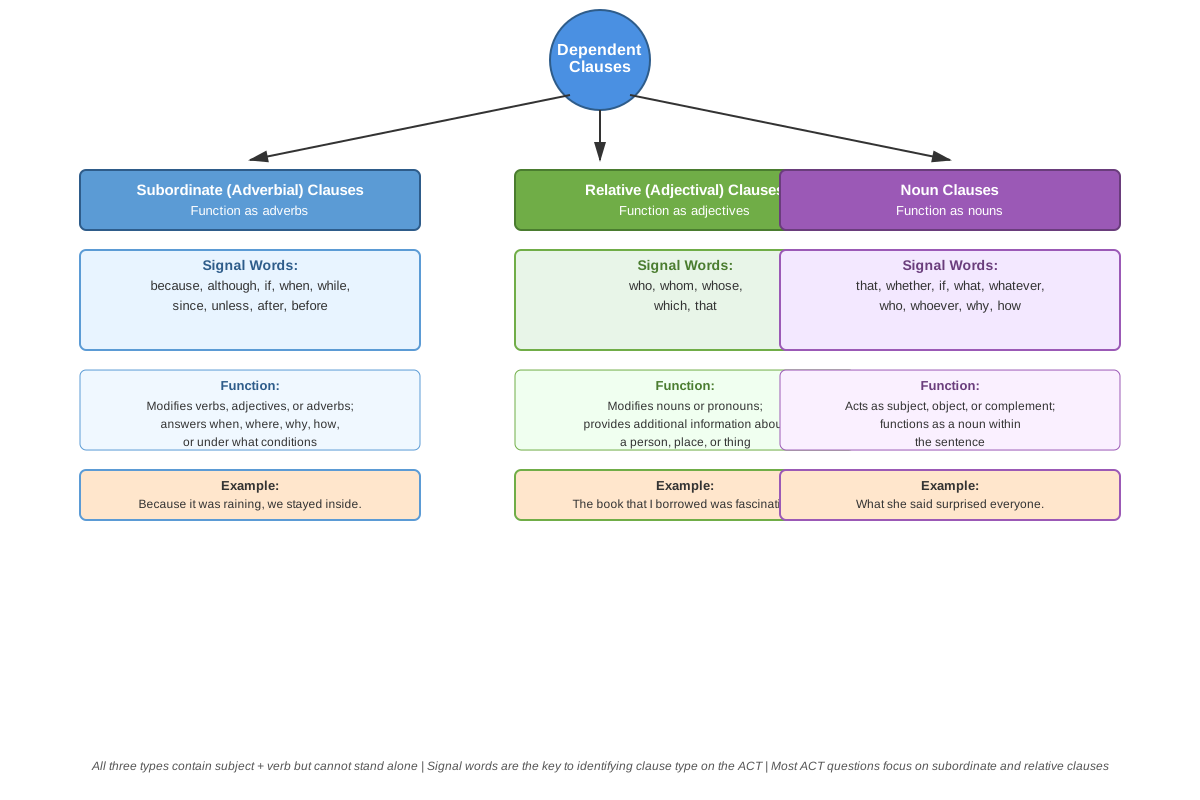
Dependent clauses are created by three main categories of subordinating words:
Subordinating Conjunctions: These words show relationships like time, cause, condition, or contrast. Common subordinating conjunctions include:
| Category | Subordinating Conjunctions |
|---|---|
| Time | when, while, before, after, since, until, as, whenever |
| Cause/Reason | because, since, as |
| Condition | if, unless, provided that, even if |
| Contrast | although, though, even though, whereas, while |
| Purpose | so that, in order that |
| Comparison | as, as if, as though |
Relative Pronouns: These words introduce relative clauses that modify nouns. They include: who, whom, whose, which, that, whoever, whomever, whichever, and whatever.
Subordinating Adverbs: Words like where, wherever, why, and how can also introduce dependent clauses.
Three Main Types of Dependent Clauses
Adverbial Clauses: These dependent clauses function as adverbs, modifying verbs, adjectives, or other adverbs. They typically answer questions like when, where, why, how, or under what conditions. Adverbial clauses begin with subordinating conjunctions.
Example: "After the concert ended, we drove home." (The dependent clause "After the concert ended" modifies the verb "drove" by telling when.)
Adjective Clauses (Relative Clauses): These clauses function as adjectives, modifying nouns or pronouns. They begin with relative pronouns and typically appear immediately after the noun they modify.
Example: "The student who studied consistently scored highest." (The dependent clause "who studied consistently" modifies "student.")
Noun Clauses: These clauses function as nouns within sentences, serving as subjects, objects, or complements. They often begin with words like that, what, whatever, whoever, whether, or if.
Example: "What you said makes sense." (The dependent clause "What you said" serves as the subject of the sentence.)
Punctuation Rules for Dependent Clauses
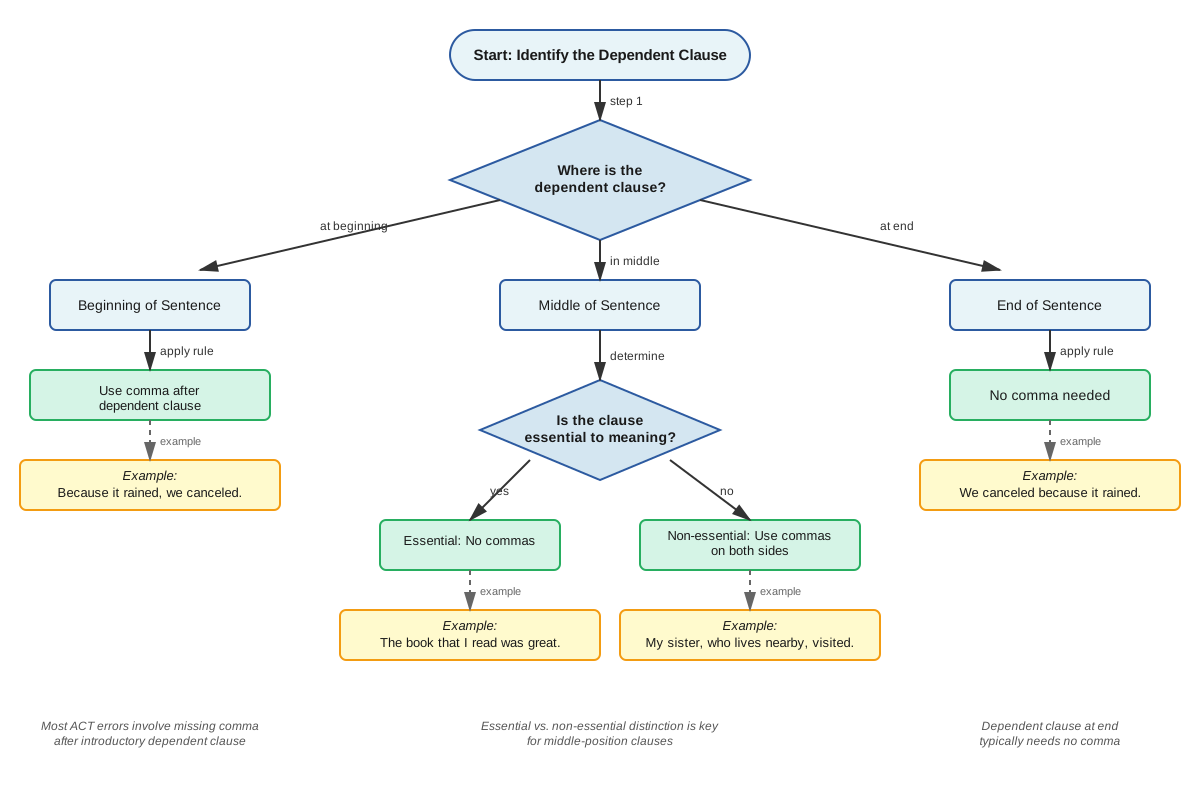
The position of a dependent clause within a sentence determines punctuation requirements:
Dependent Clause at the Beginning: When a dependent clause begins a sentence, it must be followed by a comma before the independent clause.
- Correct: "Because it was raining, we stayed inside."
- Incorrect: "Because it was raining we stayed inside."
Dependent Clause at the End: When a dependent clause follows an independent clause, typically no comma is needed (though exceptions exist for contrast or emphasis).
- Correct: "We stayed inside because it was raining."
- Usually incorrect: "We stayed inside, because it was raining."
Dependent Clause in the Middle: When a dependent clause interrupts an independent clause (common with relative clauses), punctuation depends on whether the clause is essential or nonessential to meaning.
- Essential (no commas): "Students who study regularly perform better."
- Nonessential (commas required): "My sister, who lives in Boston, is visiting."
Critical Rule: Semicolons and Dependent Clauses
One of the most tested rules on the ACT: A semicolon can NEVER separate a dependent clause from an independent clause. Semicolons join two independent clauses or separate items in a complex list. Using a semicolon before or after a dependent clause creates a sentence fragment.
- Incorrect: "Because the weather improved; we went hiking."
- Correct: "Because the weather improved, we went hiking."
- Incorrect: "We went hiking; because the weather improved."
- Correct: "We went hiking because the weather improved."
Recognizing Sentence Fragments
A dependent clause standing alone is a sentence fragment—one of the most common errors tested on the ACT. The presence of a subject and verb does not guarantee a complete sentence; the clause must be independent.
- Fragment: "Although the experiment succeeded."
- Complete: "Although the experiment succeeded, we need to replicate the results."
- Fragment: "Which was the best option available."
- Complete: "We chose the hybrid model, which was the best option available."
Concept Relationships
Dependent clauses form the foundation for understanding complex sentence structures on the ACT. The relationship flows as follows: Basic clause structure (subject + verb) → Independent vs. dependent distinction (can it stand alone?) → Subordinating words (what makes a clause dependent?) → Punctuation rules (how do we connect clauses?) → Error identification (fragments, run-ons, comma splices).
Understanding independent clauses is prerequisite knowledge because dependent clauses are defined in opposition to them. Once students can identify both types, they can apply punctuation rules, which depend entirely on clause relationships. This knowledge then enables recognition of sentence fragments (dependent clauses standing alone) and run-on sentences (clauses improperly connected).
Dependent clauses also connect forward to more advanced concepts like parallel structure (maintaining consistent clause types in lists), modification (ensuring clauses modify the correct nouns), and rhetorical skills (using subordination to emphasize main ideas). The concept of essential versus nonessential clauses bridges to comma usage rules, while the prohibition against semicolons with dependent clauses connects to broader semicolon rules.
Within the topic itself, the three types of dependent clauses (adverbial, adjective, noun) represent different applications of the same principle: a clause with a subject and verb that cannot stand alone. Each type has specific subordinating words and punctuation patterns, but all share the fundamental characteristic of dependency.
Quick check — test yourself on Dependent clauses so far.
Try Flashcards →High-Yield Facts
⭐ A dependent clause contains a subject and verb but cannot stand alone as a complete sentence due to a subordinating word.
⭐ When a dependent clause begins a sentence, it must be followed by a comma before the independent clause.
⭐ A semicolon can NEVER separate a dependent clause from an independent clause; semicolons only join two independent clauses.
⭐ A dependent clause standing alone is a sentence fragment, one of the most commonly tested errors on the ACT.
⭐ Common subordinating conjunctions include: although, because, since, when, while, if, unless, after, before, and though.
- Relative pronouns (who, which, that, whom, whose) introduce adjective clauses that modify nouns.
- When a dependent clause follows an independent clause, typically no comma is needed.
- Essential adjective clauses (restrictive) require no commas; nonessential clauses (nonrestrictive) require commas on both sides.
- The word "that" introduces essential clauses; "which" typically introduces nonessential clauses.
- Dependent clauses can appear at the beginning, middle, or end of sentences, with different punctuation requirements for each position.
- Multiple dependent clauses can appear in a single sentence, each requiring proper punctuation and connection to an independent clause.
- The subordinating conjunction "because" is one of the most frequently tested words in ACT dependent clause questions.
Common Misconceptions
Misconception: Any group of words with a subject and verb is a complete sentence. → Correction: A clause must be independent (able to stand alone) to be a complete sentence. Dependent clauses have subjects and verbs but cannot stand alone due to subordinating words.
Misconception: Semicolons and commas are interchangeable when connecting clauses. → Correction: Semicolons can only join two independent clauses. When a dependent clause is involved, use a comma (if the dependent clause comes first) or no punctuation (if it comes second, in most cases).
Misconception: All dependent clauses at the end of sentences need commas. → Correction: Dependent clauses following independent clauses typically do NOT need commas unless they show strong contrast or are nonessential information.
Misconception: The word "which" and "that" can always be used interchangeably. → Correction: "That" introduces essential clauses (no commas), while "which" typically introduces nonessential clauses (commas required). The ACT tests this distinction regularly.
Misconception: A long group of words is more likely to be a complete sentence than a short group. → Correction: Length does not determine completeness. "Although the comprehensive research study conducted over five years produced remarkable results" is a fragment despite its length, while "She ran" is complete despite being only two words.
Misconception: Starting a sentence with "because" is grammatically incorrect. → Correction: Sentences can begin with "because" or any subordinating conjunction, as long as an independent clause follows: "Because it rained, the game was postponed" is perfectly correct.
Worked Examples
Example 1: Identifying and Correcting Dependent Clause Errors
Question: Which of the following is correct?
A) Although the team practiced diligently. They lost the championship game.
B) Although the team practiced diligently; they lost the championship game.
C) Although the team practiced diligently, they lost the championship game.
D) Although the team practiced diligently they lost the championship game.
Solution Process:
Step 1: Identify the dependent clause. "Although the team practiced diligently" is a dependent clause because it begins with the subordinating conjunction "although" and cannot stand alone.
Step 2: Identify the independent clause. "They lost the championship game" is an independent clause with subject (they), verb (lost), and complete thought.
Step 3: Determine the clause order. The dependent clause comes first, followed by the independent clause.
Step 4: Apply the punctuation rule. When a dependent clause begins a sentence, it must be followed by a comma before the independent clause.
Step 5: Evaluate each option:
- Option A: Creates a sentence fragment ("Although the team practiced diligently.") followed by a complete sentence. Incorrect.
- Option B: Uses a semicolon to separate a dependent clause from an independent clause. This violates the rule that semicolons only join independent clauses. Incorrect.
- Option C: Uses a comma to separate the introductory dependent clause from the independent clause. This follows the correct rule. Correct.
- Option D: Provides no punctuation between the dependent and independent clauses, creating a run-on sentence. Incorrect.
Answer: C
Connection to Learning Objectives: This example demonstrates how to identify dependent clauses (subordinating conjunction "although"), apply the correct punctuation rule (comma after introductory dependent clause), and eliminate incorrect options based on dependent clause principles.
Example 2: Complex Sentence with Multiple Clauses
Question: The research team discovered a new species of beetle, which had adapted to extreme temperatures, while they were exploring the desert ecosystem.
Which revision, if any, is needed?
F) NO CHANGE
G) beetle which had adapted to extreme temperatures while
H) beetle, which had adapted to extreme temperatures while
J) beetle which had adapted to extreme temperatures, while
Solution Process:
Step 1: Identify all clauses in the sentence.
- Independent clause: "The research team discovered a new species of beetle"
- Dependent clause 1: "which had adapted to extreme temperatures" (adjective clause modifying "beetle")
- Dependent clause 2: "while they were exploring the desert ecosystem" (adverbial clause modifying "discovered")
Step 2: Determine if the adjective clause is essential or nonessential. The clause "which had adapted to extreme temperatures" provides additional information about the beetle but is not essential to identifying which beetle. The word "which" (rather than "that") signals a nonessential clause.
Step 3: Apply punctuation rules for nonessential clauses. Nonessential adjective clauses require commas on both sides when they interrupt a sentence.
Step 4: Check the adverbial clause punctuation. The dependent clause "while they were exploring the desert ecosystem" comes at the end of the sentence and modifies the main verb. End-position adverbial clauses typically do not require a comma.
Step 5: Evaluate the original sentence. The original correctly places commas around the nonessential "which" clause and correctly omits a comma before the final "while" clause.
Answer: F (NO CHANGE)
Connection to Learning Objectives: This example shows how to identify multiple dependent clauses in complex sentences, distinguish between essential and nonessential clauses, and apply appropriate punctuation rules based on clause type and position.
Exam Strategy
Trigger Alert: When you see subordinating conjunctions (although, because, since, when, while, if, unless) or relative pronouns (who, which, that) in the underlined portion or immediately before it, dependent clause rules are likely being tested.
Step-by-Step Approach for ACT Dependent Clause Questions:
- Identify all clauses: Locate subjects and verbs to determine where clauses begin and end.
- Classify each clause: Determine whether each clause is independent (can stand alone) or dependent (has a subordinating word).
- Check for fragments: If a dependent clause stands alone as a sentence, it's a fragment—eliminate that option immediately.
- Apply position-based punctuation rules:
- Dependent clause first → comma required
- Dependent clause last → usually no comma
- Dependent clause in middle → commas depend on essential vs. nonessential
- Eliminate semicolon options: If a semicolon appears with a dependent clause, that option is almost always wrong.
Process of Elimination Tips:
- Immediately eliminate any option that places a period after a dependent clause (creating a fragment)
- Eliminate options using semicolons with dependent clauses
- When choosing between comma and no comma, consider clause position: first position needs comma, last position usually doesn't
- If you see "which" with no commas or "that" with commas, those options are likely incorrect
Time Allocation: Dependent clause questions should take 20-30 seconds each. If you've identified the dependent clause and know the position rule, you can answer quickly. Don't overthink these questions—the rules are consistent and mechanical.
Common Question Formats:
- Punctuation choice between comma, semicolon, period, or no punctuation
- Identifying sentence fragments in "Which of the following is NOT acceptable?"
- Choosing between "that" and "which" with appropriate punctuation
- Determining if a sentence should be split or combined based on clause relationships
Memory Techniques
AAAWWWUBBIS Mnemonic: Remember common subordinating conjunctions with this acronym:
- After, Although, As
- When, While, Where
- Unless, Until
- Because, Before
- If
- Since, So that
"Comma After, Not Before" Rule: Visualize a dependent clause as a "warm-up" to the main idea. When you warm up first (dependent clause first), you pause (comma) before the main event. When the main event comes first (independent clause first), you don't pause before the cool-down (dependent clause).
The "Semicolon = Two Independents" Mantra: Repeat: "Semicolons are for independent clauses only." Visualize a semicolon as a balance scale that requires equal weight (independence) on both sides.
The "Incomplete Thought" Test: When you identify a potential dependent clause, read it aloud in isolation. If you instinctively want to say "So what?" or "What happened then?", it's dependent.
WHICH = Nonessential, THAT = Essential: Remember "WHICH needs a WITCH's comma spell" (nonessential clauses with "which" need commas), while "THAT stands alone" (essential clauses with "that" need no commas).
Summary
Dependent clauses are fundamental building blocks of sentence structure that appear frequently on the ACT English test. These clauses contain subjects and verbs but cannot stand alone as complete sentences due to subordinating words like "although," "because," "when," or relative pronouns like "who" and "which." The ACT tests dependent clauses primarily through punctuation questions, sentence fragment identification, and clause connection problems. The most critical rules to remember are: (1) dependent clauses beginning sentences require commas before the independent clause, (2) semicolons can never separate dependent clauses from independent clauses, (3) dependent clauses standing alone are sentence fragments, and (4) essential versus nonessential clauses require different punctuation. Mastering dependent clauses enables students to answer 15-20% of sentence structure questions correctly and provides the foundation for understanding complex grammatical relationships throughout the English section.
Key Takeaways
- Dependent clauses contain subjects and verbs but cannot stand alone due to subordinating words (although, because, when, if, who, which, that)
- When a dependent clause begins a sentence, always place a comma before the following independent clause
- Semicolons can ONLY join two independent clauses; never use semicolons with dependent clauses
- A dependent clause standing alone is a sentence fragment—one of the most commonly tested errors
- Essential clauses (usually with "that") need no commas; nonessential clauses (usually with "which") require commas on both sides
- Dependent clauses at the end of sentences typically do not require commas
- Identifying subordinating conjunctions and relative pronouns is the key to recognizing dependent clauses quickly on test day
Related Topics
Independent Clauses and Sentence Types: Understanding how independent clauses combine with dependent clauses creates complex and compound-complex sentences. Mastering dependent clauses makes identifying sentence types straightforward.
Comma Usage Rules: Many comma rules depend on recognizing dependent clauses, including rules for introductory elements, nonessential information, and clause separation.
Sentence Fragments and Run-ons: Dependent clause knowledge is essential for identifying these major sentence errors, as fragments often result from dependent clauses standing alone, while run-ons involve improperly connected clauses.
Parallel Structure: When sentences contain multiple dependent clauses in a series, they must maintain parallel grammatical structure—a concept that builds directly on dependent clause understanding.
Modification and Relative Clauses: Advanced questions about misplaced modifiers often involve relative clauses (a type of dependent clause), requiring students to ensure clauses modify the correct nouns.
Practice CTA
Now that you understand the core principles of dependent clauses, you're ready to apply this knowledge to ACT-style practice questions. The concepts you've learned—identifying subordinating words, applying position-based punctuation rules, and avoiding semicolon errors—will become automatic with focused practice. Challenge yourself with the practice questions to reinforce these high-yield concepts, and use the flashcards to memorize subordinating conjunctions and key rules. Remember: dependent clause questions are among the most predictable on the ACT, meaning your preparation directly translates to points on test day. You've got this!
Sign up free to keep reading
Create a free AnvayaPrep account to finish this ACT guide on Dependent clauses — plus flashcards and practice questions.