Overview
Compound sentences represent one of the most frequently tested grammatical structures on the ACT English section. Understanding how to properly construct, punctuate, and identify compound sentences is essential for achieving a high score, as these questions appear in approximately 15-20% of all sentence structure items on the exam. A compound sentence joins two or more independent clauses—complete thoughts that could stand alone as separate sentences—using specific punctuation marks and coordinating conjunctions.
The ACT tests compound sentences in multiple ways: through punctuation questions that require choosing between commas, semicolons, and periods; through conjunction usage questions; and through run-on sentence identification. Students who master ACT compound sentences gain the ability to recognize when two complete ideas need proper connection rather than being incorrectly fused together or unnecessarily separated. This skill directly impacts performance on roughly 8-12 questions per test, making it one of the highest-yield topics in the entire English section.
Compound sentences form a critical bridge between simple sentence structure and more complex grammatical constructions. They build upon foundational knowledge of independent clauses while preparing students for understanding complex sentences (which combine independent and dependent clauses) and compound-complex sentences. Mastering compound sentences also strengthens overall writing clarity and style, as the ACT frequently tests whether students can identify the most effective way to join related ideas within a passage's context.
Learning Objectives
- [ ] Identify when Compound sentences is being tested on the ACT
- [ ] Explain the core rule or strategy behind Compound sentences construction and punctuation
- [ ] Apply Compound sentences rules to ACT-style questions accurately
- [ ] Distinguish between properly formed compound sentences and run-on sentences or comma splices
- [ ] Evaluate whether two independent clauses should be joined or separated based on context
- [ ] Select appropriate coordinating conjunctions based on the logical relationship between clauses
- [ ] Recognize all valid punctuation patterns for connecting independent clauses
Prerequisites
- Independent clauses: Understanding what makes a clause independent (subject + verb + complete thought) is fundamental to recognizing when compound sentence rules apply
- Basic punctuation rules: Familiarity with comma, semicolon, and period usage provides the foundation for applying compound sentence punctuation patterns
- Subject-verb agreement: Identifying subjects and verbs within each clause ensures accurate recognition of independent clauses
- Coordinating conjunctions: Basic knowledge of FANBOYS (for, and, nor, but, or, yet, so) helps students recognize valid connection methods
Why This Topic Matters
Compound sentences appear throughout professional writing, academic discourse, and everyday communication. The ability to properly connect related ideas demonstrates sophisticated writing skills and clear thinking. In college-level writing, students must frequently combine information from multiple sources or connect cause-and-effect relationships, making compound sentence mastery essential for academic success beyond the ACT.
On the ACT English section, compound sentence questions typically appear 8-12 times per test, representing roughly 13-20% of the 75 total questions. These questions most commonly test punctuation choices at the junction between two independent clauses, but they also assess conjunction selection, run-on sentence identification, and stylistic effectiveness. The ACT particularly favors testing the distinction between comma + coordinating conjunction versus semicolon usage, as well as identifying comma splices (two independent clauses incorrectly joined with only a comma).
Compound sentence questions appear in several predictable formats: underlined punctuation marks between two clauses with answer choices offering different punctuation options; underlined conjunctions with choices between different coordinating or subordinating conjunctions; and questions about whether a sentence should be divided into two separate sentences. The test also embeds compound sentence concepts within broader questions about sentence effectiveness, requiring students to recognize when joining or separating clauses improves clarity and flow.
Core Concepts
Definition of Compound Sentences
A compound sentence contains two or more independent clauses joined by appropriate punctuation and/or coordinating conjunctions. Each independent clause must contain a subject and a verb and express a complete thought that could stand alone as a sentence. The key distinguishing feature of compound sentences is that they connect ideas of equal grammatical weight—both clauses are independent and neither depends on the other for meaning.
For example: "The student studied diligently, and she earned an excellent score." This sentence contains two independent clauses: "The student studied diligently" (subject: student; verb: studied) and "she earned an excellent score" (subject: she; verb: earned). Each clause could function as a complete sentence, but they are joined to show a logical connection between the ideas.
Valid Methods for Joining Independent Clauses
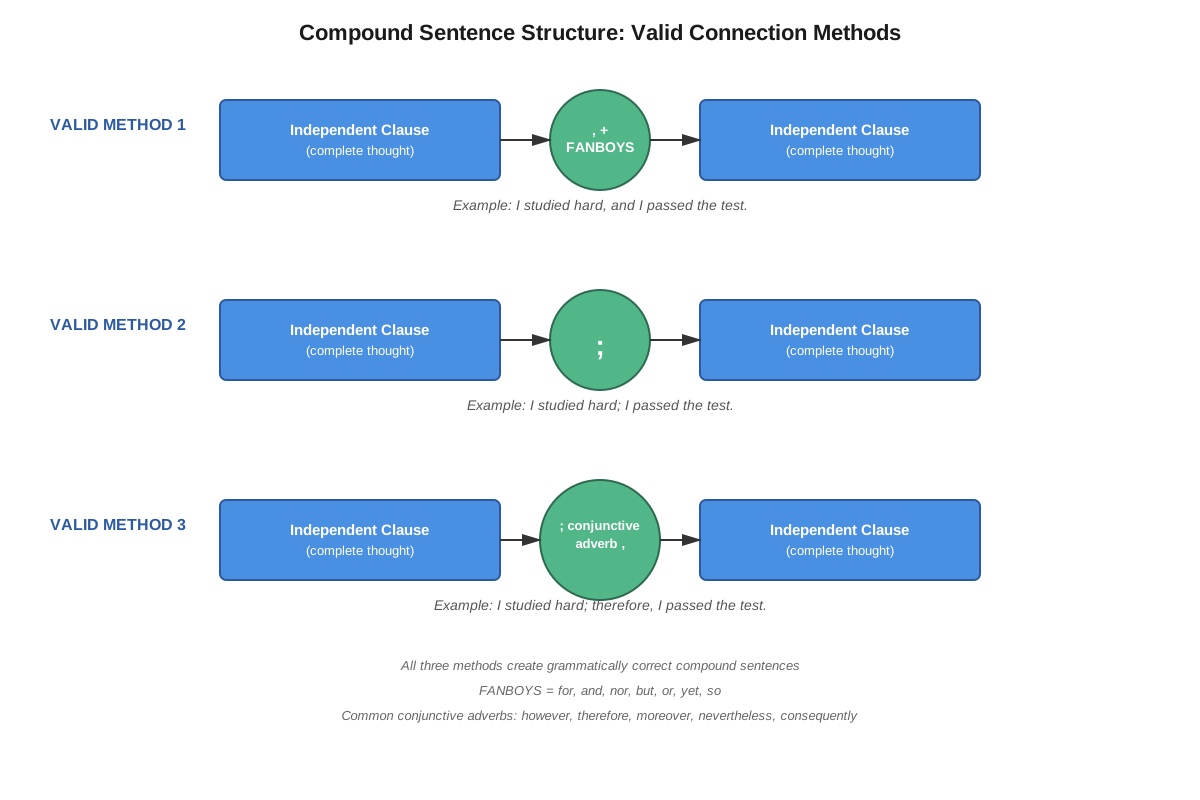
The ACT tests three primary methods for correctly joining independent clauses in compound sentences:
Method 1: Comma + Coordinating Conjunction
The most common pattern uses a comma followed by one of the seven coordinating conjunctions (FANBOYS: for, and, nor, but, or, yet, so). Both elements are required—the comma alone creates a comma splice error, while the conjunction alone (without a comma) is also incorrect in formal writing.
Example: "The experiment failed, but the researchers learned valuable information."
Method 2: Semicolon
A semicolon can join two closely related independent clauses without a coordinating conjunction. This method works best when the clauses are closely connected in meaning and roughly parallel in structure.
Example: "The experiment failed; the researchers learned valuable information."
Method 3: Semicolon + Conjunctive Adverb + Comma
Independent clauses can be joined with a semicolon, followed by a conjunctive adverb (however, therefore, moreover, nevertheless, consequently, etc.), followed by a comma.
Example: "The experiment failed; however, the researchers learned valuable information."
Coordinating Conjunctions and Their Meanings
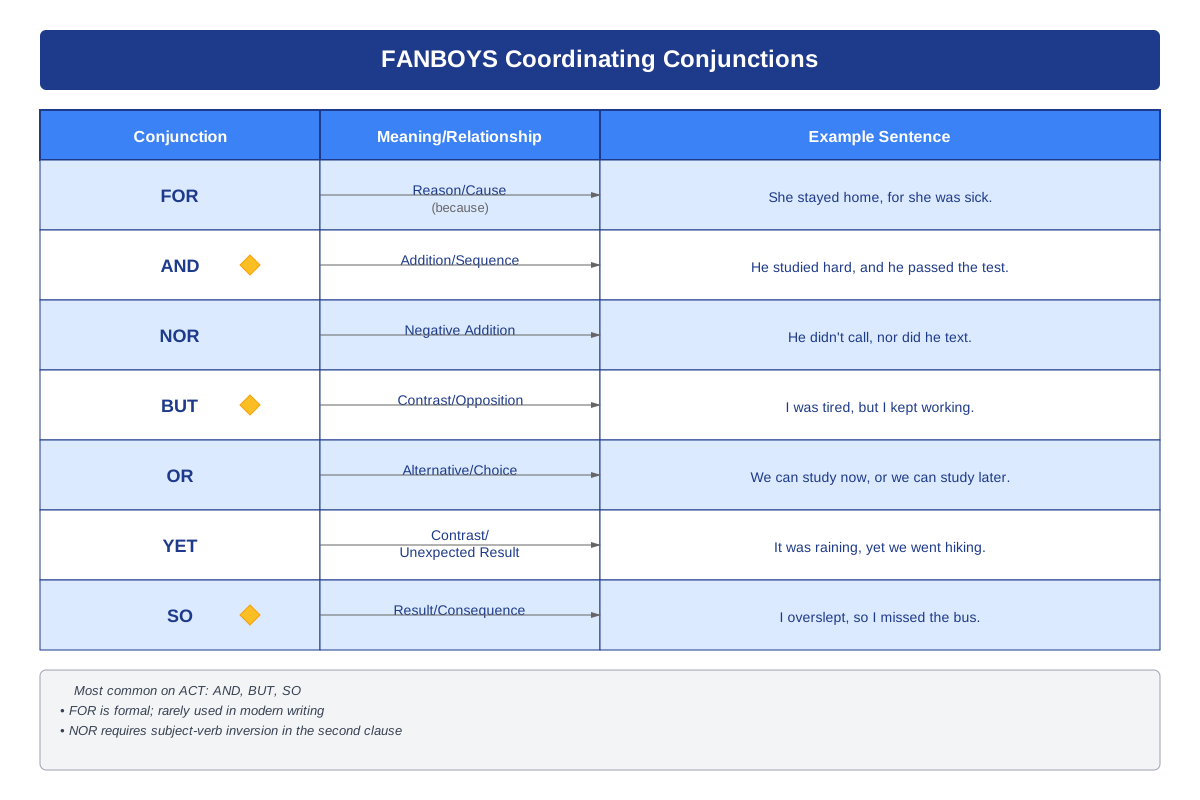
Each coordinating conjunction signals a specific logical relationship between the independent clauses:
| Conjunction | Relationship | Example |
|---|---|---|
| for | Reason/cause | She studied hard, for she wanted to succeed. |
| and | Addition | He finished his homework, and he went to bed. |
| nor | Negative addition | She didn't call, nor did she text. |
| but | Contrast | The task was difficult, but she completed it. |
| or | Alternative | We can study now, or we can study later. |
| yet | Contrast (unexpected) | He was tired, yet he continued working. |
| so | Result/effect | It rained heavily, so the game was cancelled. |
The ACT frequently tests whether students can select the conjunction that best expresses the logical relationship between two clauses. Choosing "and" when the relationship is contrastive, or "but" when the relationship is causal, creates a meaning error even if the punctuation is technically correct.
Common Errors: Run-Ons and Comma Splices
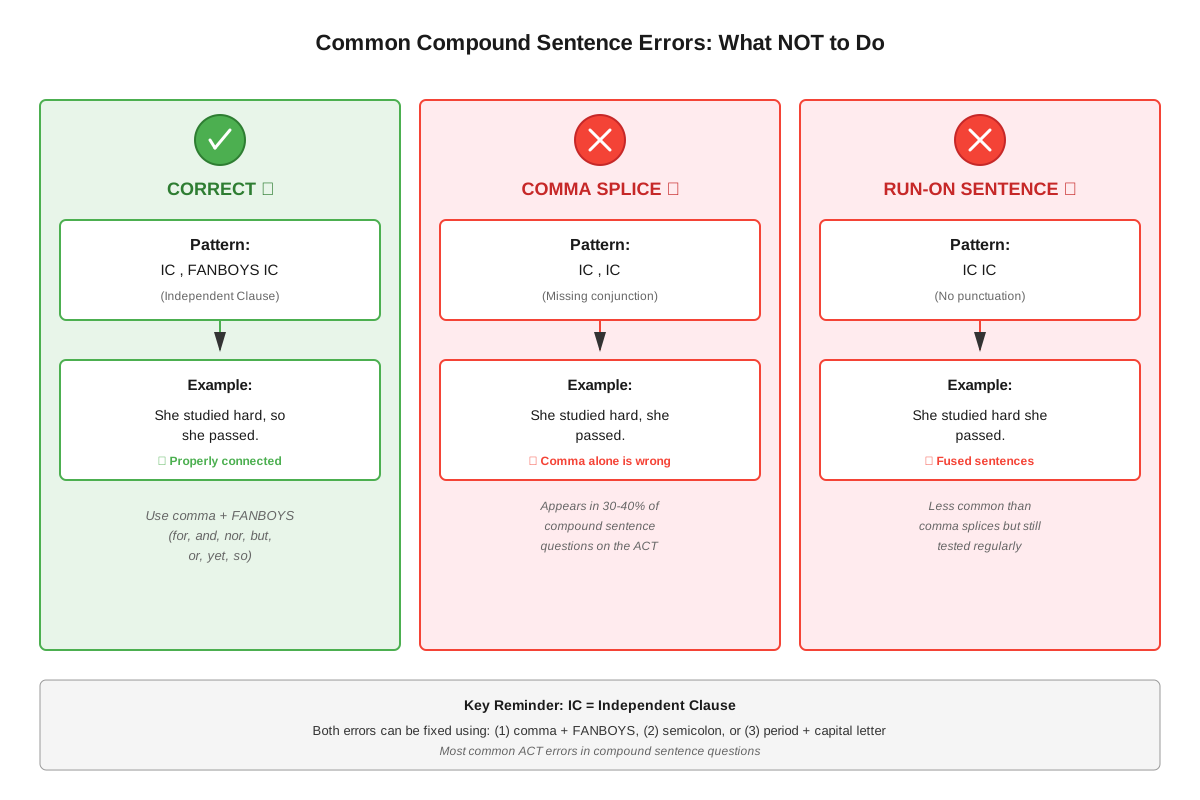
Run-on sentences (also called fused sentences) occur when two independent clauses are joined without any punctuation or conjunction:
Incorrect: "The student studied hard she earned a high score."
Comma splices occur when two independent clauses are joined with only a comma (without a coordinating conjunction):
Incorrect: "The student studied hard, she earned a high score."
Both errors are among the most frequently tested on the ACT. Students must recognize these patterns and select answer choices that properly separate or connect the clauses.
When to Use Each Method
The choice between comma + conjunction, semicolon, or period depends on the relationship between ideas and the surrounding context:
- Use comma + coordinating conjunction when you want to explicitly show the relationship between clauses (addition, contrast, cause, etc.)
- Use a semicolon when the clauses are very closely related and the relationship is obvious without a conjunction; semicolons create a tighter connection than a period but don't specify the exact relationship
- Use a period when the ideas are related but can stand more independently, or when the sentence is becoming too long and complex
- Use semicolon + conjunctive adverb when you want to show a specific relationship (like "however" or "therefore") while maintaining a close connection between clauses
Concept Relationships
Compound sentences build directly upon the concept of independent clauses—students must first identify independent clauses before they can determine whether those clauses are properly joined. The relationship flows: Independent Clause Recognition → Identifying Clause Boundaries → Selecting Appropriate Connection Method → Evaluating Punctuation Correctness.
Compound sentences relate closely to run-on sentences and sentence fragments, forming a triad of sentence structure concepts. While compound sentences represent correct construction, run-ons represent improper joining of independent clauses, and fragments represent incomplete clauses incorrectly punctuated as sentences. Understanding one concept strengthens recognition of the others.
The coordinating conjunction component of compound sentences connects to the broader topic of conjunctions and transitions. Students who understand how coordinating conjunctions differ from subordinating conjunctions (which create dependent clauses) can better distinguish between compound sentences and complex sentences. This distinction is crucial because the punctuation rules differ: Compound Sentence (independent + independent) requires comma before conjunction, while Complex Sentence (dependent + independent) may or may not require a comma depending on clause order.
Compound sentences also relate to parallelism and sentence effectiveness. When two independent clauses are joined, they often work best when they maintain parallel structure. Additionally, the choice to join or separate clauses affects sentence variety and rhythm, which the ACT tests through rhetorical skills questions about effectiveness and style.
High-Yield Facts
⭐ A compound sentence must contain at least two independent clauses joined by proper punctuation and/or a coordinating conjunction.
⭐ Two independent clauses joined by only a comma (without a coordinating conjunction) create a comma splice error.
⭐ The seven coordinating conjunctions are: for, and, nor, but, or, yet, so (FANBOYS).
⭐ A semicolon can join two independent clauses without any conjunction when the clauses are closely related.
⭐ When using a comma + coordinating conjunction, the comma must come BEFORE the conjunction, not after.
- A period can always correctly separate two independent clauses, though it may not be the most stylistically effective choice.
- Conjunctive adverbs (however, therefore, moreover, etc.) require a semicolon before them and a comma after them when joining independent clauses.
- The conjunction "and" does not always signal addition; context determines whether it's the appropriate choice.
- Two independent clauses joined without any punctuation or conjunction create a run-on (fused) sentence.
- Not every comma + "and" signals a compound sentence; "and" can also join two verbs with the same subject (compound predicate), which does not require a comma.
- The ACT will never accept a comma splice as correct, even if it appears in the original passage.
- When a coordinating conjunction joins two dependent clauses or two phrases (not independent clauses), no comma is needed.
- Semicolons should only join independent clauses that are closely related in meaning; unrelated clauses should be separate sentences.
- The word "however" is NOT a coordinating conjunction and cannot be used with just a comma to join independent clauses.
- On the ACT, the shortest grammatically correct answer is often (but not always) the best choice when dealing with compound sentence punctuation.
Quick check — test yourself on Compound sentences so far.
Try Flashcards →Common Misconceptions
Misconception: Any two sentences can be joined with a comma and "and."
Correction: While "and" is a coordinating conjunction, the two clauses must be logically related, and the comma must come before "and," not after. Additionally, "and" must be the appropriate conjunction for the relationship between ideas (addition, not contrast or cause).
Misconception: A semicolon and a comma are interchangeable.
Correction: Semicolons join independent clauses or separate complex items in a list. Commas have many functions but cannot join independent clauses without a coordinating conjunction. Using a comma where a semicolon is needed creates a comma splice.
Misconception: "However" is a coordinating conjunction like "but."
Correction: "However" is a conjunctive adverb, not a coordinating conjunction. It requires a semicolon before it and a comma after it when joining independent clauses: "She studied hard; however, she was nervous." Using only a comma before "however" creates a comma splice.
Misconception: Long sentences are always compound sentences.
Correction: Sentence length doesn't determine sentence type. A sentence can be long but simple (one independent clause with many modifiers) or short but compound (two brief independent clauses joined correctly). Sentence type depends on the number and type of clauses, not word count.
Misconception: If there's a subject and verb on both sides of a comma, it must be a compound sentence requiring a coordinating conjunction.
Correction: A sentence can have multiple subjects and verbs without being compound. For example, "The student who studied hard earned a high score" contains two subject-verb pairs but only one independent clause (the "who studied hard" is a dependent clause). Only independent clauses on both sides create a compound sentence.
Misconception: The ACT accepts comma splices if they appear in the original passage.
Correction: The ACT never accepts comma splices as correct, even if they appear in the underlined portion of the original passage. If you identify a comma splice, you must select an answer choice that corrects it, typically by adding a coordinating conjunction, changing the comma to a semicolon, or separating the clauses into two sentences.
Misconception: A semicolon is more formal or sophisticated than a comma + conjunction, so it's always the better choice.
Correction: Semicolons and comma + conjunction patterns serve different purposes. Semicolons work best for closely related clauses where the relationship is obvious. Coordinating conjunctions explicitly show the relationship (contrast, cause, addition, etc.). The best choice depends on context, clarity, and the logical relationship between ideas.
Worked Examples
Example 1: Identifying and Correcting a Comma Splice
Question: The research team collected extensive data, they analyzed it using advanced statistical methods.
A) NO CHANGE
B) data, and they analyzed
C) data; they analyzed
D) data they analyzed
Step 1: Identify the clauses
- First clause: "The research team collected extensive data" (subject: team; verb: collected) ✓ Independent
- Second clause: "they analyzed it using advanced statistical methods" (subject: they; verb: analyzed) ✓ Independent
Step 2: Identify the current connection method
The original uses only a comma between two independent clauses—this is a comma splice error.
Step 3: Evaluate each answer choice
- Choice A (NO CHANGE): Comma splice—INCORRECT
- Choice B (data, and they analyzed): Comma + coordinating conjunction "and"—this correctly joins the independent clauses and shows an addition relationship. The comma comes before "and" as required. ✓ CORRECT
- Choice C (data; they analyzed): Semicolon joining two independent clauses—grammatically correct and shows the clauses are closely related. ✓ CORRECT
- Choice D (data they analyzed): No punctuation or conjunction—run-on sentence—INCORRECT
Step 4: Choose the best answer
Both B and C are grammatically correct. On the ACT, when multiple answers are grammatically correct, consider conciseness and clarity. Choice C (semicolon) is more concise and the relationship between collecting and analyzing data is clear without "and." However, if the ACT provides both as options, look for additional context clues. In this case, both would likely be acceptable, but the ACT typically favors the semicolon for closely related clauses when no specific relationship needs emphasis.
Answer: C (though B is also grammatically correct; actual ACT questions would provide context to distinguish)
Example 2: Selecting the Appropriate Coordinating Conjunction
Question: The experiment produced unexpected results, _____ the researchers decided to replicate it with a larger sample size.
A) and
B) but
C) so
D) or
Step 1: Identify the clauses and their relationship
- First clause: "The experiment produced unexpected results" (independent)
- Second clause: "the researchers decided to replicate it with a larger sample size" (independent)
- Relationship: The unexpected results caused or led to the decision to replicate—this is a cause-and-effect relationship.
Step 2: Evaluate each conjunction
- Choice A (and): Shows addition or sequence but not causation—doesn't capture the logical relationship—INCORRECT
- Choice B (but): Shows contrast—the second clause doesn't contrast with the first—INCORRECT
- Choice C (so): Shows result or effect—the decision to replicate is a result of the unexpected findings—✓ CORRECT
- Choice D (or): Shows alternative—doesn't fit the relationship—INCORRECT
Step 3: Verify punctuation
The comma appears before the conjunction, which is correct for joining independent clauses.
Answer: C (so)
This example demonstrates that compound sentence questions test not just punctuation but also the logical relationship between clauses. Understanding what each coordinating conjunction signals is essential for ACT success.
Exam Strategy
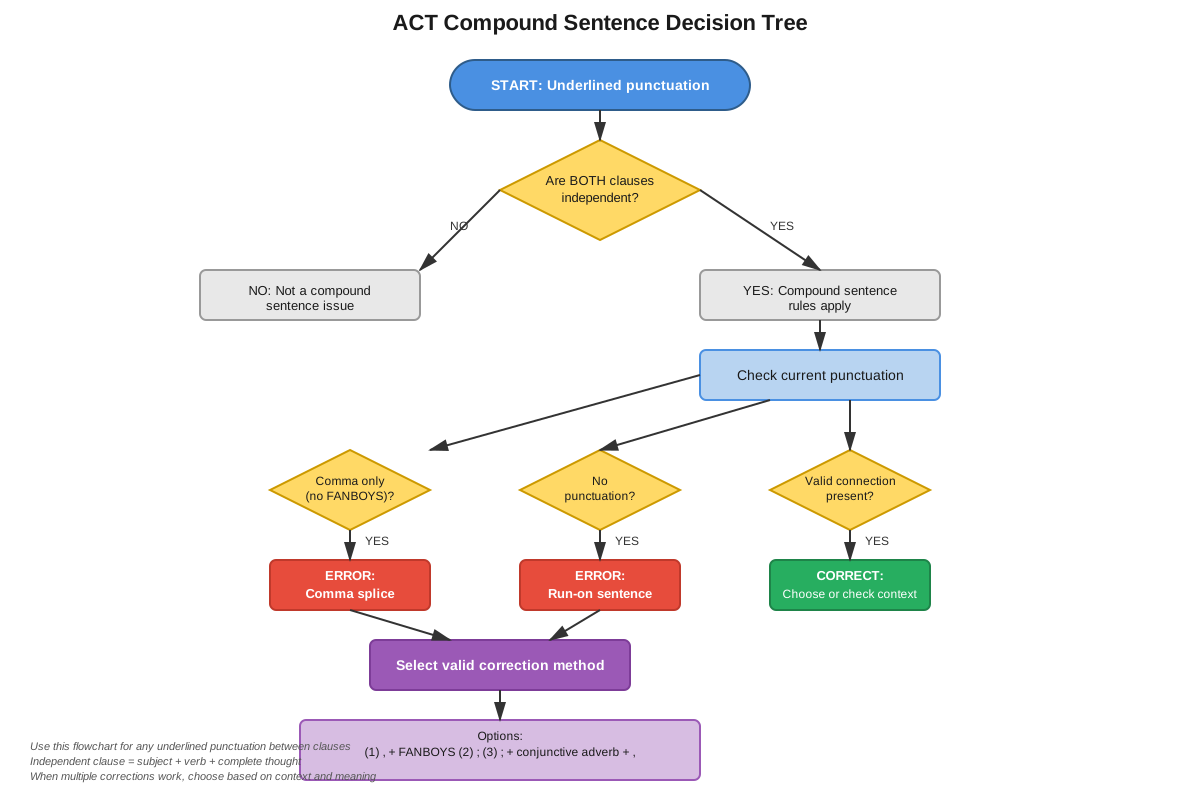
When approaching compound sentence questions on the ACT, follow this systematic process:
Step 1: Identify clause boundaries
Locate the subject and verb in each potential clause. Determine whether each clause can stand alone as a complete sentence (independent) or whether it depends on another clause for meaning (dependent).
Step 2: Check the connection method
If two independent clauses are present, examine what connects them:
- Only a comma? → Comma splice error
- No punctuation? → Run-on error
- Comma + coordinating conjunction? → Check if comma is before the conjunction
- Semicolon? → Verify clauses are closely related
- Period? → Always grammatically correct but may not be most effective
Step 3: Watch for trigger words
- FANBOYS conjunctions (for, and, nor, but, or, yet, so) signal potential compound sentences
- Conjunctive adverbs (however, therefore, moreover, nevertheless) require semicolon + comma pattern
- Words like "because," "although," "when," "if" create dependent clauses, NOT compound sentences
Step 4: Eliminate obviously wrong answers
- Immediately eliminate comma splices and run-ons
- Eliminate answers that use the wrong conjunction for the logical relationship
- Eliminate answers with punctuation after (instead of before) coordinating conjunctions
Step 5: Consider context and effectiveness
When multiple answers are grammatically correct, choose based on:
- Conciseness (shorter is often better)
- Clarity (does the relationship between ideas need to be explicit?)
- Flow (does the choice match the rhythm and style of surrounding sentences?)
Exam Tip: If you see a comma in the underlined portion, immediately check what comes after it. If it's followed by an independent clause (without a coordinating conjunction), you've found a comma splice that must be corrected.
Time allocation: Compound sentence questions should take 20-30 seconds each. If you can quickly identify independent clauses and know the three valid connection methods, these become some of the fastest points on the test.
Memory Techniques
FANBOYS Mnemonic: Remember the seven coordinating conjunctions with FANBOYS:
- For
- And
- Nor
- But
- Or
- Yet
- So
The "Two Complete Thoughts" Test: Before joining clauses, ask: "Could each part stand alone as a complete sentence?" If yes to both, you need compound sentence punctuation. If no to either, it's not a compound sentence.
The "Comma + FANBOYS" Chant: When you see two independent clauses, mentally chant "comma FANBOYS" or "semicolon" to remember the two main options. This prevents comma splices.
The Semicolon = Period Rule: Remember that a semicolon functions like a period but keeps the sentences connected. If you can replace a semicolon with a period and both sentences make sense, the semicolon is used correctly.
The "However Trap" Reminder: Create a visual image of "however" sitting on a semicolon throne with a comma crown. This reminds you that "however" needs a semicolon before it and a comma after it when joining independent clauses—it's not a coordinating conjunction.
Relationship Matching: Create associations for each FANBOYS conjunction:
- For = "because" (reason)
- And = "plus" (addition)
- Nor = "not either" (negative addition)
- But = "opposite" (contrast)
- Or = "choice" (alternative)
- Yet = "surprise opposite" (unexpected contrast)
- So = "therefore" (result)
Summary
Compound sentences join two or more independent clauses using specific punctuation patterns: comma + coordinating conjunction, semicolon alone, or semicolon + conjunctive adverb + comma. The ACT tests compound sentences extensively, appearing in 8-12 questions per test, primarily through punctuation choices and conjunction selection. Students must recognize independent clauses, identify comma splices and run-ons, and select appropriate connection methods based on the logical relationship between ideas. The seven coordinating conjunctions (FANBOYS) each signal different relationships: for (reason), and (addition), nor (negative addition), but (contrast), or (alternative), yet (unexpected contrast), and so (result). Mastering compound sentences requires understanding that both proper punctuation and appropriate conjunction choice are essential—a comma alone creates a comma splice, while the wrong conjunction creates a meaning error even with correct punctuation. Success on these questions comes from systematically identifying clause boundaries, checking connection methods, and eliminating answers that violate compound sentence rules.
Key Takeaways
- Compound sentences contain two or more independent clauses joined by comma + coordinating conjunction, semicolon, or semicolon + conjunctive adverb + comma
- Comma splices (comma only) and run-ons (no punctuation) are always incorrect on the ACT
- The seven coordinating conjunctions (FANBOYS: for, and, nor, but, or, yet, so) each signal specific logical relationships
- Semicolons can only join independent clauses that are closely related in meaning
- The comma must come BEFORE the coordinating conjunction, never after
- "However" and other conjunctive adverbs are NOT coordinating conjunctions and require semicolon + comma pattern
- When multiple answers are grammatically correct, choose based on conciseness, clarity, and context
Related Topics
Complex Sentences: After mastering compound sentences (independent + independent), students should study complex sentences (independent + dependent), which use subordinating conjunctions and different punctuation rules. Understanding the distinction between coordinating and subordinating conjunctions is essential for advanced sentence structure mastery.
Run-On Sentences and Fragments: These represent the errors that occur when compound sentence rules are violated. Studying these topics alongside compound sentences reinforces correct construction through contrast with incorrect patterns.
Parallelism: When joining independent clauses in compound sentences, maintaining parallel structure often improves clarity and effectiveness. This topic builds on compound sentence knowledge to enhance writing quality.
Semicolon and Colon Usage: Expanding beyond compound sentences, comprehensive semicolon study includes their use in complex lists, while colon study covers introducing lists and explanations. These punctuation marks have multiple functions beyond joining independent clauses.
Sentence Variety and Effectiveness: Once students master the technical rules of compound sentences, they can study how to strategically vary sentence types (simple, compound, complex, compound-complex) to improve writing style and rhythm—a skill tested in ACT rhetorical skills questions.
Practice CTA
Now that you understand the rules and strategies for compound sentences, it's time to apply this knowledge! Complete the practice questions to test your ability to identify comma splices, select appropriate coordinating conjunctions, and choose correct punctuation patterns. Use the flashcards to reinforce the FANBOYS conjunctions and their meanings. Remember: compound sentence questions are among the most predictable and high-yield on the ACT English section—mastering them guarantees points on test day. With focused practice, you'll quickly recognize these patterns and answer confidently within seconds. Start practicing now to transform this knowledge into automatic, accurate performance!
Sign up free to keep reading
Create a free AnvayaPrep account to finish this ACT guide on Compound sentences — plus flashcards and practice questions.