Overview
Run-on sentences represent one of the most frequently tested concepts in the ACT English section, appearing in approximately 10-15% of all sentence structure questions. A run-on sentence occurs when two or more independent clauses are joined incorrectly without proper punctuation or coordinating conjunctions. Understanding how to identify and correct these errors is essential for achieving a competitive score on the ACT, as these questions test a student's ability to recognize proper sentence boundaries and apply appropriate punctuation rules.
The ACT English section consistently evaluates whether students can distinguish between grammatically correct sentences and those that improperly connect independent thoughts. ACT run-on sentences questions often appear deceptively simple, but they require careful analysis of clause structure and punctuation usage. Students who master this concept gain a significant advantage because run-on sentence questions are highly predictable and follow consistent patterns throughout the exam.
This topic connects directly to broader sentence structure concepts including comma splices, fragments, and proper punctuation usage. Mastering run-on sentences requires understanding independent and dependent clauses, coordinating conjunctions, subordinating conjunctions, and the proper use of semicolons, colons, and periods. These interconnected skills form the foundation of grammatical competency that the ACT measures, making run-on sentences a gateway topic to understanding more complex sentence structure questions.
Learning Objectives
- [ ] Identify when run-on sentences are being tested in ACT English passages
- [ ] Explain the core rule or strategy behind recognizing and correcting run-on sentences
- [ ] Apply run-on sentence correction strategies to ACT-style questions accurately
- [ ] Distinguish between run-on sentences, comma splices, and correctly punctuated compound sentences
- [ ] Evaluate multiple correction methods and select the most effective solution for a given context
- [ ] Recognize the four primary methods for correcting run-on sentences in timed testing conditions
Prerequisites
- Independent clauses: Understanding what constitutes a complete sentence with a subject and predicate is essential for identifying when two complete thoughts are improperly joined
- Dependent clauses: Recognizing clauses that cannot stand alone helps distinguish between run-ons and complex sentences
- Basic punctuation rules: Familiarity with periods, commas, and semicolons provides the foundation for understanding proper clause connection
- Coordinating conjunctions (FANBOYS): Knowledge of for, and, nor, but, or, yet, so enables recognition of proper compound sentence construction
Why This Topic Matters
Run-on sentences appear with remarkable consistency on every ACT English section, making them one of the highest-yield topics for focused study. Research on ACT question distribution shows that sentence structure questions, including run-ons, comprise approximately 20-25% of the 75 English questions, with run-on sentences specifically accounting for 8-12 questions per test. This frequency makes run-on sentence mastery a high-return investment of study time.
Beyond test performance, understanding run-on sentences develops critical writing skills essential for college-level composition. Clear, properly punctuated sentences communicate ideas effectively and demonstrate academic maturity. Admissions essays, research papers, and professional communication all require the ability to construct grammatically sound sentences that connect ideas appropriately.
On the ACT, run-on sentence questions typically appear in three formats: identifying errors in underlined portions, selecting the best revision from multiple options, and determining whether "NO CHANGE" is appropriate. The test frequently embeds run-on sentences within longer passages where context and meaning must be preserved while correcting the structural error. Common scenarios include biographical narratives, scientific explanations, and historical accounts where multiple related ideas need proper connection. The ACT particularly favors testing run-ons in passages where the incorrect version sounds conversational or natural when read aloud, challenging students to apply formal grammatical rules rather than relying on intuition.
Core Concepts
Definition of Run-On Sentences
A run-on sentence occurs when two or more independent clauses are joined without appropriate punctuation or conjunctions. An independent clause contains a subject and a verb and expresses a complete thought that can stand alone as a sentence. When two such clauses are placed together without proper separation, the result is a run-on sentence that violates standard English grammar conventions.
Run-on sentences create two primary problems: they confuse readers about where one idea ends and another begins, and they demonstrate a lack of control over sentence boundaries. The ACT tests this concept because it represents a fundamental aspect of written communication that college-level writers must master.
Types of Run-On Sentences
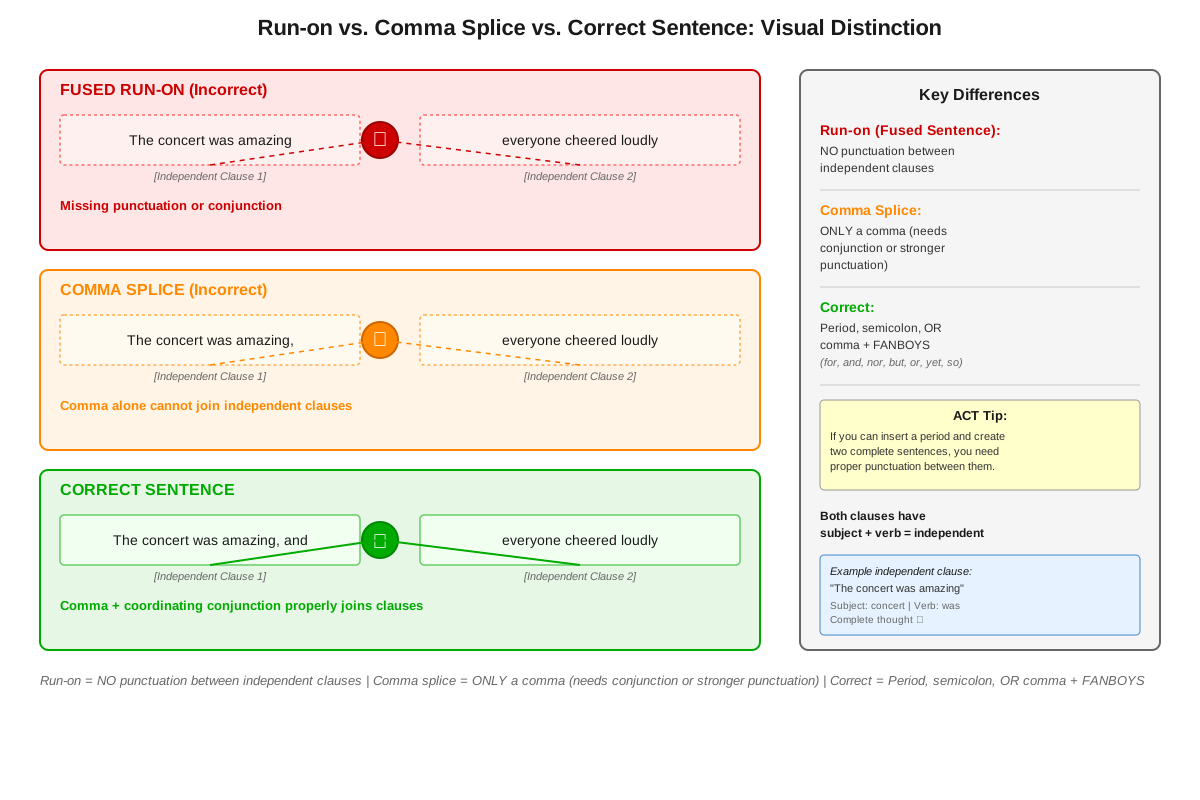
Fused Sentences
A fused sentence joins two independent clauses with no punctuation or conjunction whatsoever. This represents the most obvious type of run-on error:
Incorrect: The experiment concluded successfully the researchers published their findings.
This example contains two complete thoughts ("The experiment concluded successfully" and "the researchers published their findings") with no separation between them.
Comma Splices
A comma splice occurs when two independent clauses are joined with only a comma, without a coordinating conjunction. This error is particularly common because writers often sense that some punctuation is needed but choose insufficient punctuation:
Incorrect: The experiment concluded successfully, the researchers published their findings.
While a comma provides some separation, it is grammatically insufficient to join two independent clauses without an accompanying coordinating conjunction.
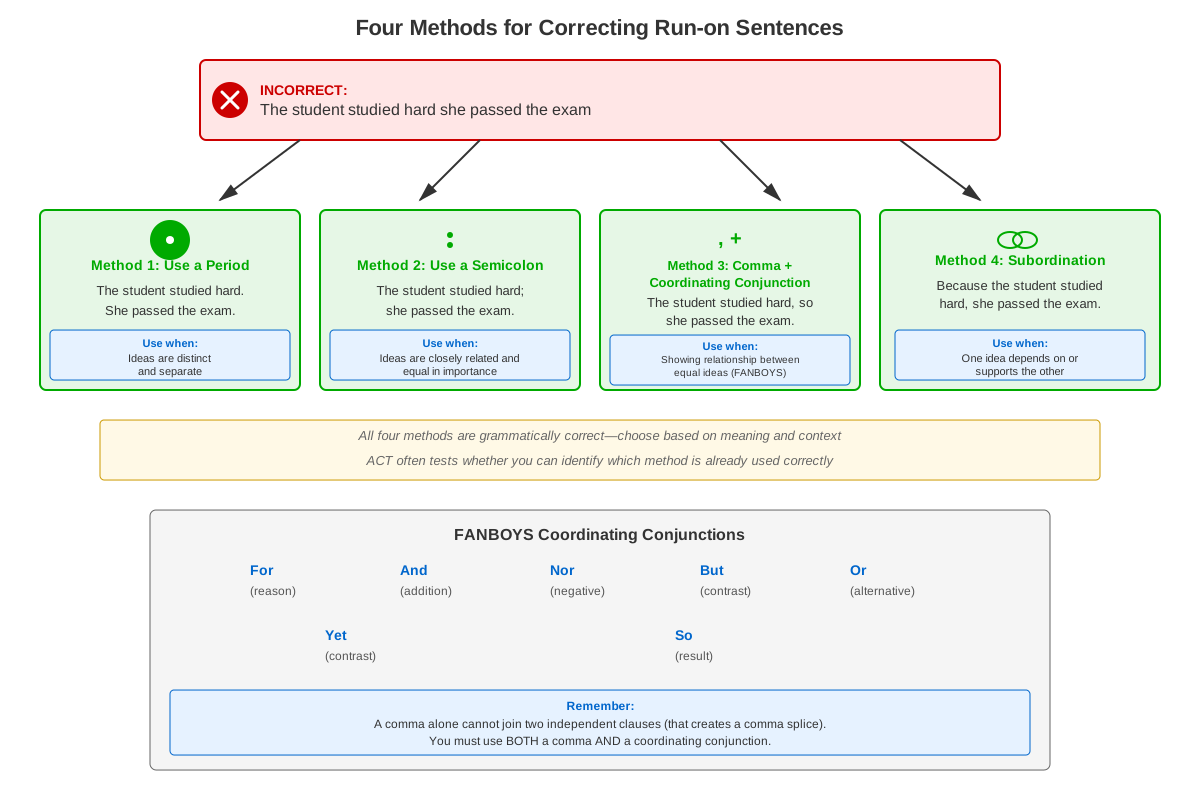
Four Methods for Correcting Run-On Sentences
| Method | Example | When to Use |
|---|---|---|
| Period | The experiment concluded successfully. The researchers published their findings. | When ideas are distinct and deserve equal emphasis |
| Semicolon | The experiment concluded successfully; the researchers published their findings. | When ideas are closely related and of equal importance |
| Comma + Coordinating Conjunction | The experiment concluded successfully, and the researchers published their findings. | When showing a specific relationship between ideas (addition, contrast, cause, etc.) |
| Subordination | After the experiment concluded successfully, the researchers published their findings. | When one idea provides context or background for the other |
Coordinating Conjunctions (FANBOYS)
The seven coordinating conjunctions can join independent clauses when paired with a comma. The acronym FANBOYS helps remember them:
- For (indicates reason or cause)
- And (indicates addition or continuation)
- Nor (indicates negative addition)
- But (indicates contrast)
- Or (indicates alternative)
- Yet (indicates contrast or exception)
- So (indicates result or consequence)
When a coordinating conjunction appears between two independent clauses, a comma must precede it. This combination creates a grammatically correct compound sentence.
Subordinating Conjunctions and Complex Sentences
Subordinating conjunctions create dependent clauses, which cannot stand alone. When a subordinating conjunction begins a clause, that clause becomes dependent and can be attached to an independent clause without creating a run-on:
Common subordinating conjunctions include: although, because, since, when, while, if, unless, after, before, until, as, though, whereas, whenever
Correct: Because the experiment concluded successfully, the researchers published their findings.
The word "because" transforms the first clause into a dependent clause, eliminating the run-on problem. Note that when the dependent clause comes first, a comma separates it from the independent clause.
Semicolon Usage
The semicolon serves as a powerful tool for joining closely related independent clauses. It indicates a closer relationship than a period but doesn't specify the nature of that relationship as coordinating conjunctions do:
Correct: The experiment concluded successfully; the researchers published their findings.
Semicolons work particularly well when the second clause explains, elaborates on, or contrasts with the first. However, semicolons should not be overused, as they can make writing feel formal or stilted.
Transitional Expressions and Semicolons
Conjunctive adverbs (however, therefore, moreover, nevertheless, consequently, furthermore, etc.) often appear between independent clauses. These words are NOT coordinating conjunctions and cannot join independent clauses with only a comma. They require a semicolon before them and typically a comma after:
Incorrect: The experiment concluded successfully, however the researchers delayed publication.
Correct: The experiment concluded successfully; however, the researchers delayed publication.
This pattern is frequently tested on the ACT because it appears correct to many students who mistake conjunctive adverbs for coordinating conjunctions.
Concept Relationships
Run-on sentences connect directly to several fundamental grammar concepts. Understanding independent clauses forms the foundation, as run-ons can only occur when multiple independent clauses are improperly joined. This leads to the need for understanding punctuation rules, particularly the proper use of commas, semicolons, and periods.
The relationship flows as follows: Independent Clause Recognition → Identification of Multiple Independent Clauses → Assessment of Connection Method → Application of Appropriate Correction Strategy.
Coordinating conjunctions branch from this main pathway, offering one correction method that requires understanding both the conjunction itself and the comma that must precede it. Subordinating conjunctions provide an alternative pathway by transforming one independent clause into a dependent clause, fundamentally changing the sentence structure rather than simply correcting the punctuation.
Comma splices represent a specific subset of run-on sentences, distinguished by the presence of a comma without a coordinating conjunction. This concept connects to broader comma usage rules and helps students understand that commas alone cannot join independent clauses.
The correction methods interconnect based on the relationship between ideas: closely related ideas suggest semicolons, ideas with specific logical relationships (cause, contrast, addition) suggest coordinating conjunctions, and ideas where one provides context for another suggest subordination. This decision-making process connects run-on sentence correction to broader writing skills including coherence, emphasis, and style.
High-Yield Facts
⭐ A run-on sentence occurs when two or more independent clauses are joined without proper punctuation or conjunctions
⭐ A comma alone CANNOT join two independent clauses—this creates a comma splice, which is a type of run-on sentence
⭐ The seven coordinating conjunctions (FANBOYS: for, and, nor, but, or, yet, so) can join independent clauses when preceded by a comma
⭐ A semicolon can join two closely related independent clauses without any conjunction
⭐ Conjunctive adverbs (however, therefore, moreover, etc.) are NOT coordinating conjunctions and require a semicolon before them when joining independent clauses
- A period is always a grammatically correct way to separate two independent clauses, though it may not always be the most stylistically effective choice
- Subordinating conjunctions (because, although, when, if, etc.) create dependent clauses that can attach to independent clauses without creating run-ons
- When a dependent clause begins a sentence, it should be followed by a comma before the independent clause
- The ACT frequently tests run-ons in passages where the incorrect version sounds natural in conversational speech
- Run-on sentences can involve more than two independent clauses, requiring careful analysis of each clause boundary
Quick check — test yourself on Run-on sentences so far.
Try Flashcards →Common Misconceptions
Misconception: Long sentences are automatically run-on sentences. → Correction: Sentence length does not determine whether a sentence is a run-on. A sentence can be very long and grammatically correct if it properly uses subordination, coordination, and punctuation. Conversely, a short sentence with two brief independent clauses improperly joined is a run-on.
Misconception: Any sentence with a comma between two clauses is correct. → Correction: A comma alone cannot join two independent clauses. The comma must be accompanied by a coordinating conjunction (FANBOYS), or the clauses must be separated by a semicolon or period. A comma without a coordinating conjunction creates a comma splice.
Misconception: Words like "however" and "therefore" are coordinating conjunctions that can follow a comma. → Correction: Conjunctive adverbs such as however, therefore, moreover, and nevertheless are NOT coordinating conjunctions. They require a semicolon before them when joining independent clauses, not just a comma.
Misconception: If two ideas are closely related, they can be written together without punctuation. → Correction: Even closely related independent clauses must be properly separated using one of the four correction methods: period, semicolon, comma plus coordinating conjunction, or subordination. The relationship between ideas does not eliminate the need for proper punctuation.
Misconception: Starting a sentence with "and" or "but" creates a run-on sentence. → Correction: Coordinating conjunctions can begin sentences without creating run-ons. The issue is not where the conjunction appears but whether independent clauses are properly separated. "And the researchers published their findings" is a complete, correct sentence.
Misconception: A semicolon and a coordinating conjunction can be used together to join independent clauses. → Correction: Use either a semicolon alone OR a comma with a coordinating conjunction, but not both. "The experiment concluded; and the researchers published" is incorrect. Choose one method: "concluded; the researchers" or "concluded, and the researchers."
Worked Examples
Example 1: Identifying and Correcting a Comma Splice
Original Passage: "Marie Curie conducted groundbreaking research on radioactivity, she became the first woman to win a Nobel Prize."
Analysis:
First, identify the clauses:
- Clause 1: "Marie Curie conducted groundbreaking research on radioactivity" (independent—has subject "Marie Curie" and verb "conducted")
- Clause 2: "she became the first woman to win a Nobel Prize" (independent—has subject "she" and verb "became")
Two independent clauses are joined by only a comma, creating a comma splice, which is a type of run-on sentence.
Correction Options:
A) NO CHANGE (incorrect—comma splice remains)
B) radioactivity. She became (correct—separates with period)
C) radioactivity; she became (correct—joins with semicolon)
D) radioactivity, and she became (correct—uses comma + coordinating conjunction)
Best Answer: All options B, C, and D are grammatically correct. On the ACT, choice depends on context and style. Option D (comma + "and") is often preferred because it shows the relationship between the ideas (the second achievement followed from the first). Option C works well when emphasizing the close connection. Option B creates the strongest separation, appropriate when treating the achievements as distinct accomplishments.
Learning Objective Connection: This example demonstrates how to identify when run-on sentences are being tested (recognizing two independent clauses improperly joined) and how to apply multiple correction strategies accurately.
Example 2: Distinguishing Between Run-Ons and Correct Complex Sentences
Passage A: "Although the weather forecast predicted rain the outdoor concert proceeded as scheduled."
Passage B: "The weather forecast predicted rain the outdoor concert proceeded as scheduled."
Analysis:
Passage A contains:
- Dependent clause: "Although the weather forecast predicted rain" (cannot stand alone due to subordinating conjunction "although")
- Independent clause: "the outdoor concert proceeded as scheduled"
This is NOT a run-on sentence; it's a complex sentence. However, it's missing a comma after the introductory dependent clause. The correct version is: "Although the weather forecast predicted rain, the outdoor concert proceeded as scheduled."
Passage B contains:
- Independent clause: "The weather forecast predicted rain"
- Independent clause: "the outdoor concert proceeded as scheduled"
This IS a run-on sentence (specifically, a fused sentence) because two independent clauses are joined without any punctuation or conjunction.
Correction Options for Passage B:
- rain. The outdoor (period)
- rain; the outdoor (semicolon)
- rain, but the outdoor (comma + coordinating conjunction)
- Although the weather forecast predicted rain, the outdoor (subordination)
Learning Objective Connection: This example illustrates the critical difference between run-on sentences and complex sentences, showing how subordinating conjunctions prevent run-ons by creating dependent clauses. It also demonstrates the importance of identifying clause types before determining whether a run-on exists.
Exam Strategy
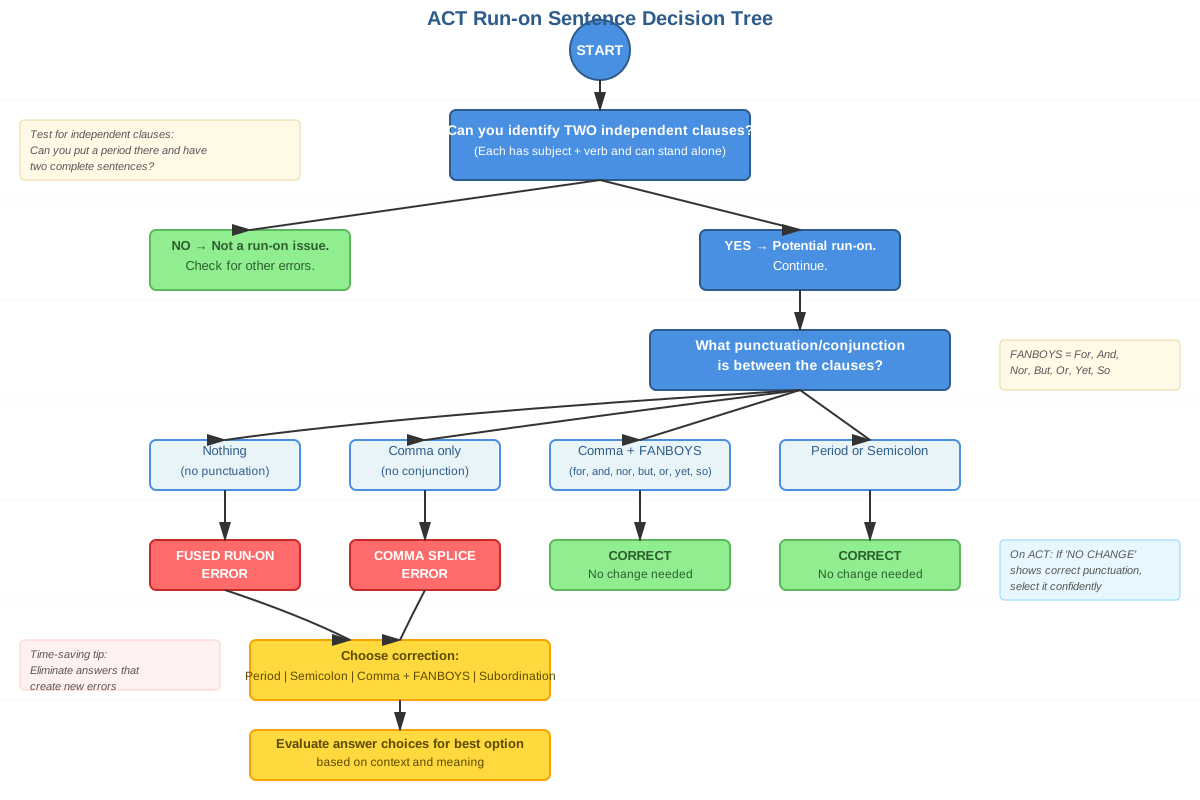
When approaching ACT run-on sentence questions, follow this systematic process:
Step 1: Identify Independent Clauses
Read the underlined portion and surrounding context. Ask: "Could this group of words stand alone as a complete sentence?" Do this for each clause separated by punctuation or conjunctions. If you identify two or more independent clauses, proceed to Step 2.
Step 2: Examine the Connection
Look at what currently joins the clauses:
- Nothing at all? → Fused sentence (definite run-on)
- Only a comma? → Check for coordinating conjunction
- Comma without FANBOYS? → Comma splice (definite run-on)
- Comma with FANBOYS? → Correct compound sentence
- Semicolon? → Likely correct (verify clauses are independent)
Step 3: Evaluate Answer Choices
Eliminate choices that:
- Join independent clauses with only a comma (no coordinating conjunction)
- Use conjunctive adverbs (however, therefore) with only a comma
- Create new grammatical errors while fixing the run-on
Trigger Words and Phrases:
- Watch for "however," "therefore," "moreover," "nevertheless," "consequently"—these require semicolons, not commas
- Be alert when you see two subjects and two verbs in close proximity
- Notice when answer choices offer different punctuation marks (period vs. semicolon vs. comma)
Process of Elimination Tips:
- On the ACT, "NO CHANGE" is correct approximately 25% of the time—don't avoid it, but verify carefully
- If you identify a run-on, immediately eliminate "NO CHANGE"
- Eliminate any choice that creates a sentence fragment
- Between grammatically correct options, choose the one that best maintains the relationship between ideas
Time Allocation:
Run-on sentence questions should take 20-30 seconds each. If you can quickly identify two independent clauses and spot the improper connection, select the correction and move on. Don't overthink stylistic preferences—focus on grammatical correctness first.
Exam Tip: If you're unsure whether a clause is independent, try reading it alone. If it sounds incomplete or leaves you waiting for more information, it's dependent. If it sounds like a complete thought, it's independent.
Memory Techniques
FANBOYS Mnemonic: Remember the seven coordinating conjunctions with "FANBOYS":
- For
- And
- Nor
- But
- Or
- Yet
- So
The "Two Complete Thoughts" Test: Visualize two separate text messages. If you could send each clause as its own text message and it would make complete sense, you have two independent clauses that need proper connection.
The Semicolon Bridge: Picture a semicolon as a bridge connecting two islands (independent clauses). The bridge is strong enough to connect them, but each island must be able to stand alone. If one side can't stand alone, the bridge collapses (the semicolon is incorrect).
Comma + Conjunction = Compound: Remember that a comma needs a "companion" (coordinating conjunction) to join independent clauses. A comma alone is too weak—it needs its FANBOYS friend.
"However" Hierarchy: Create a mental hierarchy: HOWEVER is HIGHER than a comma. It needs the "higher" punctuation mark (semicolon) before it, not the "lower" one (comma).
The Period is Always Safe: When in doubt, remember that a period can always correctly separate two independent clauses. It might not be the most stylistically sophisticated choice, but it's never grammatically wrong.
Summary
Run-on sentences represent a critical concept in ACT English testing, appearing consistently across all test administrations. These errors occur when two or more independent clauses are joined without proper punctuation or conjunctions, creating either fused sentences (no punctuation) or comma splices (comma without coordinating conjunction). Mastering run-on sentences requires the ability to identify independent clauses, recognize improper connections, and apply one of four correction methods: periods, semicolons, comma plus coordinating conjunction, or subordination. The ACT frequently tests this concept by presenting passages where run-ons sound natural in conversational speech but violate formal grammar rules. Success requires understanding that commas alone cannot join independent clauses, that conjunctive adverbs like "however" require semicolons, and that coordinating conjunctions (FANBOYS) must be preceded by commas when joining independent clauses. Students who systematically identify clause types and evaluate connection methods can consistently answer these high-frequency questions correctly.
Key Takeaways
- Run-on sentences occur when two or more independent clauses are improperly joined without adequate punctuation or conjunctions
- A comma alone cannot join independent clauses—this creates a comma splice, which is a type of run-on sentence
- Four methods correct run-ons: period, semicolon, comma + coordinating conjunction (FANBOYS), or subordination
- Conjunctive adverbs (however, therefore, moreover) require semicolons before them, not just commas
- Identifying independent clauses is the essential first step in recognizing run-on sentences
- The ACT tests run-ons frequently, making this a high-yield topic worth mastering for significant score improvement
- Grammatical correctness takes priority over stylistic preferences when selecting answers on the ACT
Related Topics
Sentence Fragments: Understanding fragments complements run-on sentence knowledge, as both involve improper sentence boundaries. While run-ons incorrectly join complete thoughts, fragments present incomplete thoughts as sentences.
Comma Usage: Mastering run-on sentences naturally leads to deeper comma knowledge, including rules for introductory elements, nonessential clauses, and items in a series.
Parallelism: After mastering basic sentence structure through run-on sentence study, parallelism builds on this foundation by addressing how multiple elements within sentences should maintain consistent grammatical form.
Modifier Placement: Correct sentence structure established through run-on sentence mastery enables more sophisticated study of how modifying phrases and clauses should be positioned for clarity.
Rhetorical Skills: Once grammatical sentence construction is mastered, students can focus on higher-level rhetorical decisions about sentence variety, emphasis, and style that the ACT tests in its organization and style questions.
Practice CTA
Now that you've mastered the core concepts of run-on sentences, it's time to reinforce your learning through active practice. Complete the practice questions to test your ability to identify and correct run-on sentences under timed conditions. Use the flashcards to drill the key distinctions between proper and improper clause connections until recognition becomes automatic. Remember: run-on sentence questions are among the most predictable on the ACT—consistent practice with these concepts translates directly into points on test day. Your investment in mastering this high-yield topic will pay dividends across multiple questions on every English section you encounter.
Sign up free to keep reading
Create a free AnvayaPrep account to finish this ACT guide on Run-on sentences — plus flashcards and practice questions.