Overview
Complex sentences represent one of the four fundamental sentence structures tested extensively on the ACT complex sentences section of the English test. A complex sentence contains one independent clause and at least one dependent (subordinate) clause, connected by subordinating conjunctions or relative pronouns. Understanding complex sentences is crucial because approximately 15-20% of ACT English questions directly or indirectly test sentence structure knowledge, and complex sentences appear in roughly half of all tested passages.
Mastering complex sentences enables students to identify and correct common errors involving comma placement, fragment creation, and improper clause connections. The ACT frequently tests whether students can distinguish between independent and dependent clauses, recognize when subordinating elements require specific punctuation, and identify sentence fragments disguised as complete thoughts. Questions may ask students to choose the correct punctuation between clauses, identify the best way to combine sentences, or recognize when a dependent clause has been incorrectly punctuated as a complete sentence.
Complex sentences form a critical bridge between simple sentence structures and more sophisticated compound-complex constructions. They relate directly to concepts of clause dependency, subordination, punctuation rules, and sentence variety. Students who master complex sentences gain the foundation needed to tackle advanced rhetorical skills questions, improve their ability to identify run-on sentences and fragments, and develop stronger instincts for effective sentence construction—all high-value skills for achieving top scores on the ACT English section.
Learning Objectives
- [ ] Identify when Complex sentences is being tested
- [ ] Explain the core rule or strategy behind Complex sentences
- [ ] Apply Complex sentences to ACT-style questions accurately
- [ ] Distinguish between independent and dependent clauses in complex sentence structures
- [ ] Recognize all subordinating conjunctions and relative pronouns that create dependent clauses
- [ ] Determine correct punctuation patterns for complex sentences based on clause order
- [ ] Identify sentence fragments created by treating dependent clauses as complete sentences
Prerequisites
- Independent clauses: Understanding complete thoughts with subject and verb is essential because complex sentences are built by adding dependent clauses to independent clauses
- Dependent clauses: Recognizing incomplete thoughts that cannot stand alone provides the foundation for identifying the subordinate elements in complex sentences
- Basic punctuation rules: Knowledge of comma usage and end punctuation is necessary because complex sentences follow specific punctuation patterns based on clause arrangement
- Parts of speech: Familiarity with conjunctions, pronouns, subjects, and verbs enables students to identify the structural elements that create complex sentences
Why This Topic Matters
Complex sentences appear in virtually every ACT English passage, making them one of the most frequently tested grammatical structures on the exam. Students encounter 3-5 direct questions about complex sentence structure per test, plus numerous additional questions where understanding complex sentences aids in identifying the correct answer. These questions typically appear as sentence structure problems, punctuation questions, or sentence combination tasks.
In real-world writing, complex sentences enable sophisticated expression of relationships between ideas, particularly cause-and-effect, time sequences, conditions, and contrasts. Professional writing, academic essays, and effective communication all rely heavily on complex sentences to show how ideas connect and which ideas are primary versus supporting. Students who master complex sentences improve not only their ACT scores but also their college-level writing abilities.
The ACT tests complex sentences through multiple question formats: identifying fragments, choosing correct punctuation between clauses, selecting the best way to combine sentences, and recognizing run-on sentences. Questions often present four answer choices where the differences involve subordinating conjunctions, comma placement, or clause structure. Understanding complex sentences also helps students eliminate obviously incorrect answers on rhetorical skills questions by recognizing grammatically flawed options.
Core Concepts
Definition and Structure of Complex Sentences
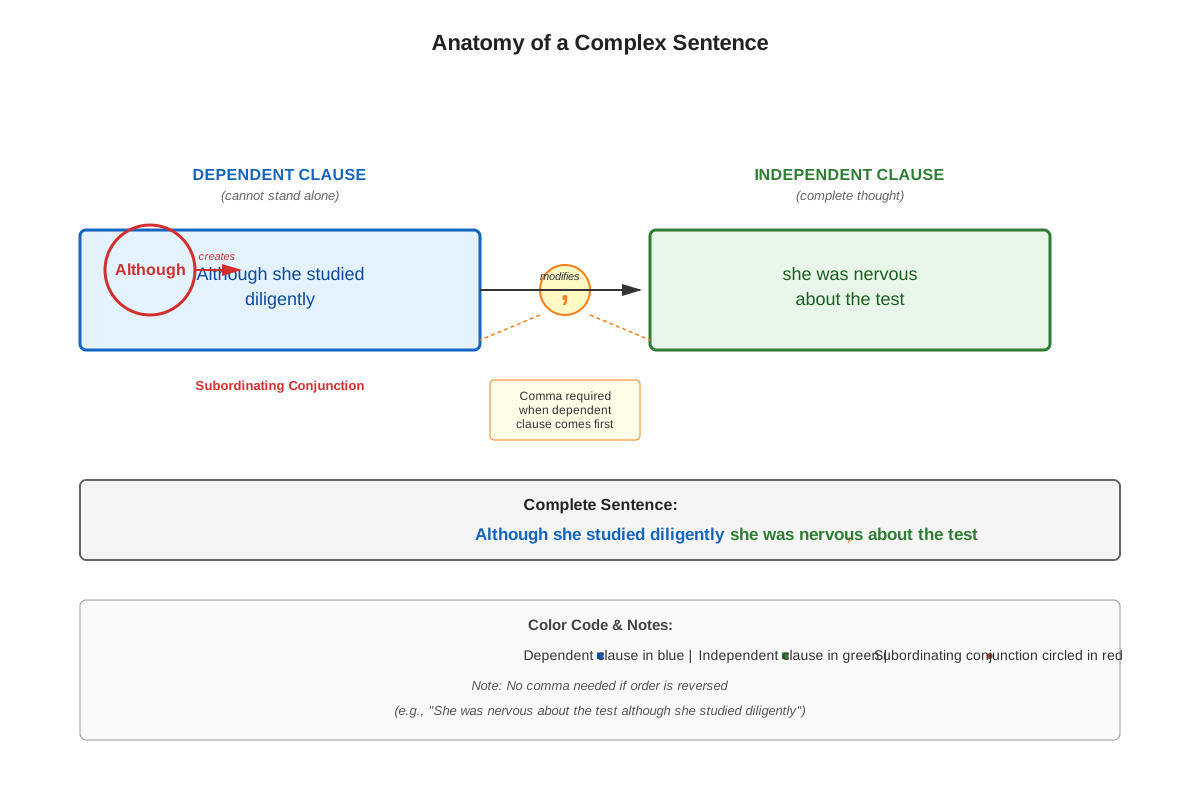
A complex sentence consists of exactly one independent clause (a complete thought that can stand alone) and at least one dependent clause (an incomplete thought that cannot stand alone). The dependent clause begins with either a subordinating conjunction or a relative pronoun, which signals that the clause depends on the main clause for complete meaning.
The independent clause contains a subject and predicate and expresses a complete thought: "The student studied diligently." The dependent clause also contains a subject and predicate but begins with a subordinating word that makes it incomplete: "because she wanted to improve her score." When combined, these form a complex sentence: "The student studied diligently because she wanted to improve her score."
Subordinating Conjunctions
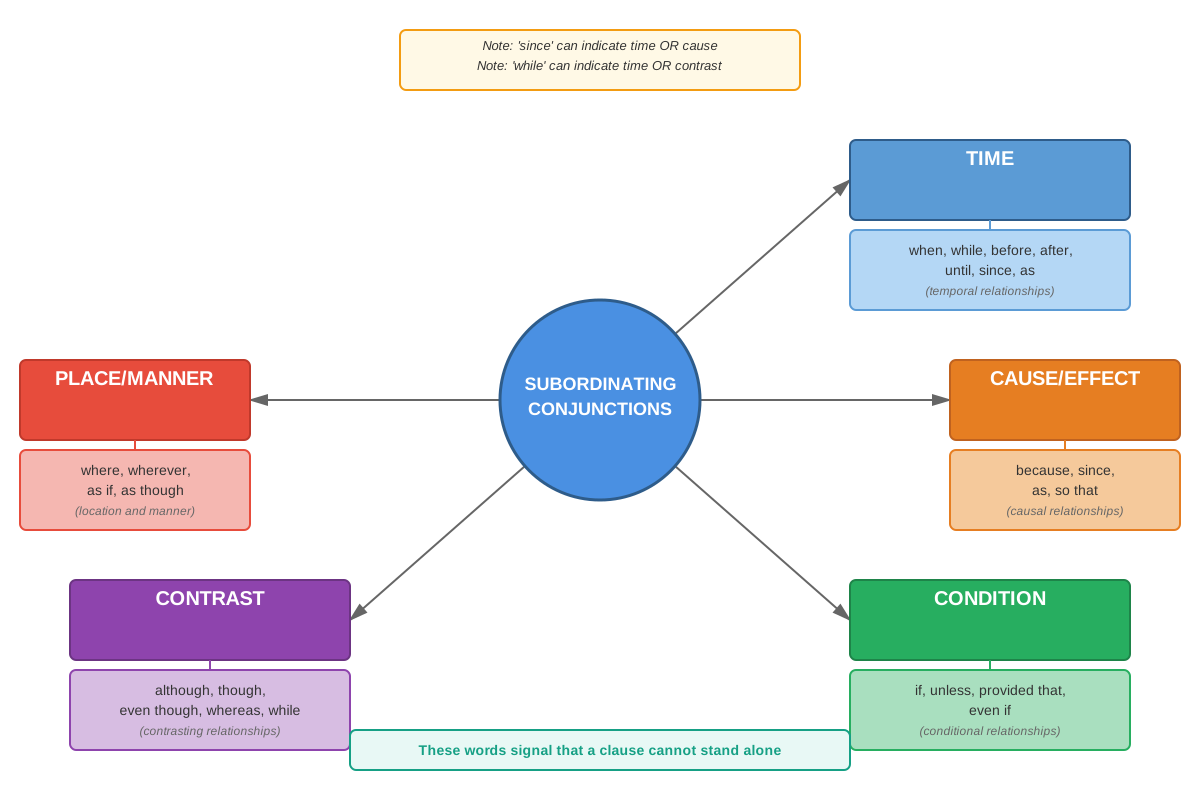
Subordinating conjunctions are words that introduce dependent clauses and show specific relationships between the dependent and independent clauses. The most common subordinating conjunctions include:
| Relationship Type | Subordinating Conjunctions |
|---|---|
| Time | after, before, when, while, until, since, as, once |
| Cause/Reason | because, since, as |
| Condition | if, unless, provided that, even if |
| Contrast | although, though, even though, whereas, while |
| Purpose | so that, in order that |
| Place | where, wherever |
When a subordinating conjunction appears at the beginning of a clause, it transforms that clause into a dependent clause that must attach to an independent clause. For example, "Although the test was difficult" cannot stand alone as a sentence—it requires completion with an independent clause like "the students performed well."
Relative Pronouns
Relative pronouns (who, whom, whose, which, that) also create dependent clauses, specifically relative clauses that modify nouns in the sentence. These clauses provide additional information about a person, place, thing, or idea mentioned in the independent clause.
Example: "The strategy that the teacher recommended proved effective." Here, "that the teacher recommended" is a dependent clause modifying "strategy." The relative pronoun "that" introduces the dependent clause and connects it to the noun it describes.
Punctuation Patterns in Complex Sentences
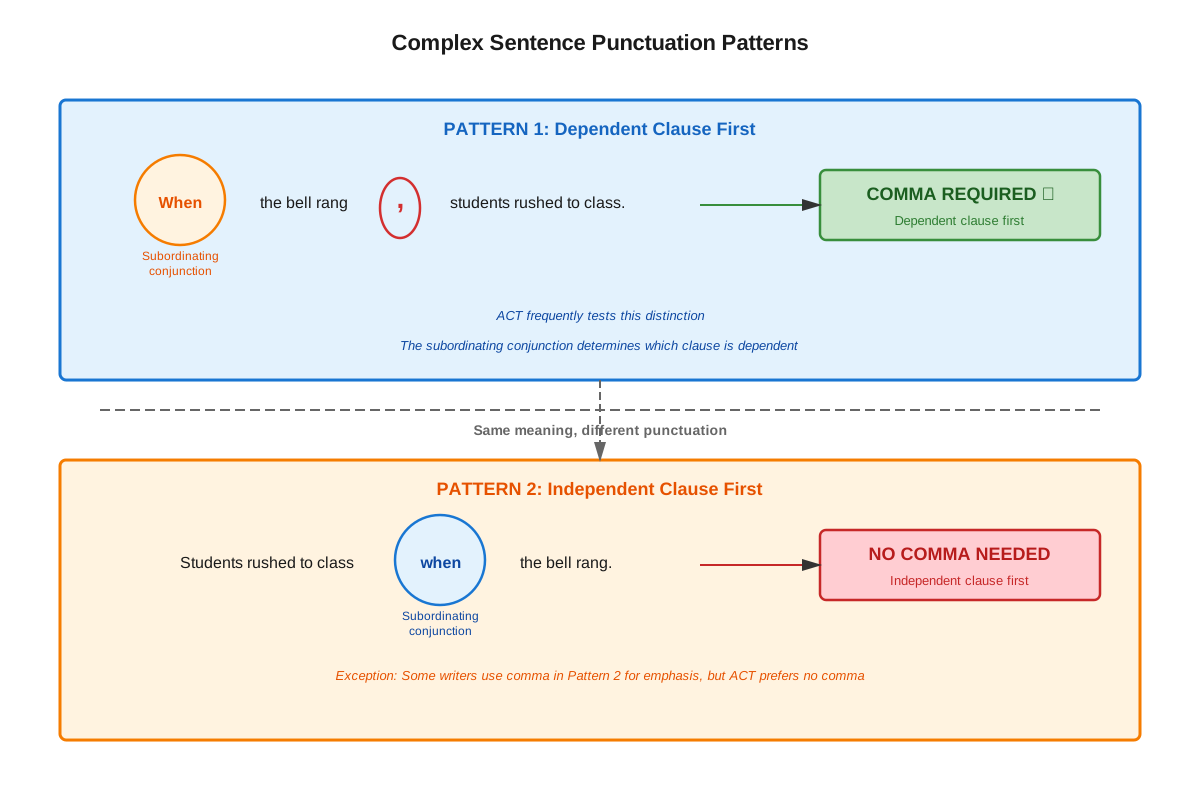
Complex sentences follow specific punctuation rules based on the order of clauses:
Pattern 1: Dependent Clause + Independent Clause
When the dependent clause comes first, use a comma to separate it from the independent clause.
- "Because the weather was severe, the test was postponed."
- "Although she arrived late, she completed all sections."
Pattern 2: Independent Clause + Dependent Clause
When the independent clause comes first, generally no comma is needed before the dependent clause (with some exceptions for contrast).
- "The test was postponed because the weather was severe."
- "She completed all sections although she arrived late."
Pattern 3: Interrupting Dependent Clauses
When a dependent clause interrupts an independent clause, use commas on both sides if the information is nonessential.
- "The student, who had prepared thoroughly, earned a perfect score."
Essential vs. Nonessential Dependent Clauses
Essential (restrictive) clauses provide information necessary to identify the noun they modify and require no commas. Nonessential (nonrestrictive) clauses provide additional information that could be removed without changing the sentence's core meaning and require commas.
Essential: "Students who study regularly perform better." (Identifies which students)
Nonessential: "Maria, who studies regularly, performs better." (Adds extra information about Maria)
The relative pronoun "that" typically introduces essential clauses, while "which" typically introduces nonessential clauses. This distinction frequently appears on ACT questions.
Common Fragment Errors with Complex Sentences
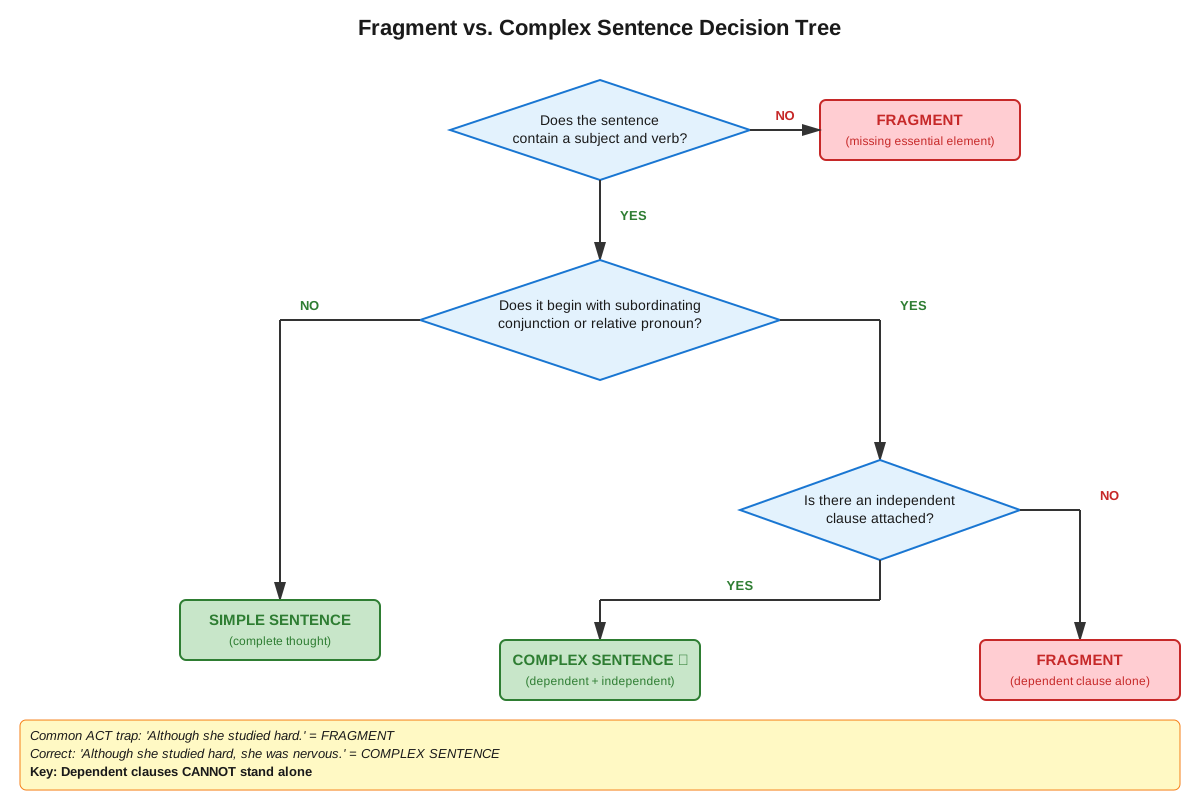
The most frequent error involving complex sentences occurs when writers treat a dependent clause as a complete sentence, creating a fragment. This happens when a subordinating conjunction or relative pronoun begins what appears to be a sentence but lacks an independent clause.
Fragment: "Because the ACT tests complex sentences extensively."
Correction: "Because the ACT tests complex sentences extensively, students must master this concept."
Fragment: "Which requires understanding both clause types."
Correction: "Complex sentences require understanding both clause types."
Concept Relationships
Complex sentences build directly upon understanding of independent and dependent clauses. The independent clause serves as the foundation → the dependent clause adds subordinate information → subordinating conjunctions or relative pronouns create the dependency relationship → punctuation rules govern how clauses connect based on their order.
Complex sentences relate to simple sentences (one independent clause only) by adding complexity through subordination. They differ from compound sentences (two or more independent clauses joined by coordinating conjunctions) by establishing hierarchical rather than equal relationships between ideas. Complex sentences also form the basis for compound-complex sentences, which combine both coordination and subordination.
The punctuation patterns in complex sentences connect to broader comma rules, particularly those governing introductory elements and nonessential information. Understanding when dependent clauses require commas reinforces general principles about separating sentence elements and setting off additional information.
Fragment identification depends on recognizing complex sentence structure—many fragments are actually dependent clauses incorrectly punctuated as complete sentences. Similarly, run-on sentence correction often involves converting compound sentences into complex sentences by changing coordinating conjunctions to subordinating conjunctions.
High-Yield Facts
⭐ A complex sentence contains exactly one independent clause and at least one dependent clause.
⭐ When a dependent clause begins a sentence, place a comma after it before the independent clause.
⭐ When an independent clause begins a sentence, generally no comma precedes the dependent clause that follows.
⭐ Subordinating conjunctions (because, although, when, if, etc.) create dependent clauses that cannot stand alone.
⭐ A dependent clause punctuated as a complete sentence is a fragment—one of the most common ACT errors.
- Relative pronouns (who, which, that) introduce dependent clauses that modify nouns.
- "That" introduces essential clauses (no commas); "which" introduces nonessential clauses (requires commas).
- Common subordinating conjunctions include: although, because, since, when, while, if, unless, after, before, until.
- Complex sentences show relationships like cause-effect, time, condition, and contrast between ideas.
- The dependent clause can appear before, after, or within the independent clause.
- Multiple dependent clauses can attach to a single independent clause, still forming a complex sentence.
- Removing the subordinating conjunction from a dependent clause typically creates an independent clause.
Quick check — test yourself on Complex sentences so far.
Try Flashcards →Common Misconceptions
Misconception: All sentences with commas are complex sentences. → Correction: Complex sentences require a specific structure (one independent + one dependent clause), not just comma usage. Compound sentences, sentences with introductory phrases, and sentences with items in a series all use commas but aren't necessarily complex.
Misconception: Dependent clauses always require commas. → Correction: Comma usage depends on clause order. When the dependent clause follows the independent clause, no comma is typically needed. Only when the dependent clause comes first or provides nonessential information are commas required.
Misconception: Any sentence with "and," "but," or "or" is complex. → Correction: These are coordinating conjunctions that create compound sentences (joining two independent clauses), not complex sentences. Complex sentences use subordinating conjunctions like "because," "although," or "when."
Misconception: Longer sentences are automatically complex sentences. → Correction: Sentence length doesn't determine structure. A short sentence like "When it rained, we left" is complex, while a longer sentence with multiple independent clauses joined by coordinating conjunctions is compound, not complex.
Misconception: Starting a sentence with "because" is always wrong. → Correction: Starting with "because" creates a dependent clause that's perfectly acceptable when followed by a comma and an independent clause: "Because she studied, she succeeded." The error occurs only when the independent clause is missing, creating a fragment.
Misconception: "Which" and "that" are interchangeable in complex sentences. → Correction: "That" introduces essential information (no commas), while "which" introduces nonessential information (requires commas). The ACT frequently tests this distinction, and choosing incorrectly changes the sentence's meaning and punctuation.
Worked Examples
Example 1: Identifying and Correcting Fragment Errors
Question: Which of the following is correct?
A) Although the ACT English section tests grammar extensively. Students should review sentence structure.
B) Although the ACT English section tests grammar extensively, students should review sentence structure.
C) Although the ACT English section tests grammar extensively; students should review sentence structure.
D) Although, the ACT English section tests grammar extensively students should review sentence structure.
Analysis:
Step 1: Identify the clauses. "Although the ACT English section tests grammar extensively" is a dependent clause (begins with subordinating conjunction "although"). "Students should review sentence structure" is an independent clause.
Step 2: Determine the structure. This is a complex sentence with the dependent clause first.
Step 3: Apply punctuation rules. When a dependent clause begins a sentence, use a comma (not a period or semicolon) to separate it from the independent clause.
Step 4: Evaluate choices. Choice A creates a fragment by ending the dependent clause with a period. Choice C incorrectly uses a semicolon (semicolons join independent clauses only). Choice D incorrectly places a comma after "although" rather than after the entire dependent clause. Choice B correctly uses a comma after the complete dependent clause.
Answer: B
Connection to Learning Objectives: This example demonstrates identifying when complex sentences are tested (sentence structure/punctuation question), explaining the core rule (dependent clause first requires comma), and applying the concept to an ACT-style question.
Example 2: Choosing Between Essential and Nonessential Clauses
Question: The students [who studied with practice tests] performed significantly better on the actual exam.
Should the bracketed portion be set off with commas?
F) Yes, because all relative clauses require commas.
G) Yes, because the clause provides additional information.
H) No, because the clause is essential to identifying which students.
J) No, because "who" never requires commas.
Analysis:
Step 1: Identify the clause type. "Who studied with practice tests" is a relative clause modifying "students."
Step 2: Determine if the clause is essential or nonessential. Ask: "Does this clause identify which students we're discussing, or does it add extra information about students already identified?" The clause tells us specifically which students performed better—those who studied with practice tests, not all students.
Step 3: Apply the rule. Essential clauses (those necessary for identification) require no commas. Nonessential clauses (those adding extra information) require commas on both sides.
Step 4: Evaluate choices. F is incorrect because not all relative clauses require commas—only nonessential ones. G is incorrect because the clause provides identifying information, not merely additional information. J is incorrect because "who" can introduce both essential and nonessential clauses. H correctly identifies that the clause is essential for specifying which students.
Answer: H
Connection to Learning Objectives: This example shows how to identify complex sentence testing (punctuation with relative clauses), explain the strategy (distinguish essential from nonessential information), and apply the concept accurately.
Exam Strategy
Trigger Alert: When you see subordinating conjunctions (although, because, when, if, since, while) or relative pronouns (who, which, that) in answer choices, immediately think "complex sentence question."
Approach Process:
- Identify all clauses: Locate subjects and verbs to determine how many clauses exist and whether each is independent or dependent.
- Check for subordinating words: Look for subordinating conjunctions or relative pronouns that create dependent clauses.
- Determine clause order: Note whether the dependent clause comes before, after, or within the independent clause.
- Apply punctuation rules: Use comma after initial dependent clause; generally no comma when dependent clause follows; commas around nonessential interrupting clauses.
- Verify completeness: Ensure at least one independent clause exists—dependent clauses alone create fragments.
Process of Elimination Tips:
- Eliminate any choice that punctuates a dependent clause as a complete sentence (fragment error)
- Eliminate choices using semicolons between independent and dependent clauses (semicolons join only independent clauses)
- Eliminate choices that omit the comma after an initial dependent clause
- Eliminate choices that add unnecessary commas when the independent clause comes first
- When choosing between "which" and "that," eliminate "which" for essential information and "that" for nonessential information
Time Allocation: Complex sentence questions should take 20-30 seconds each. If you can quickly identify the clause structure, these become fast points. Don't overthink—apply the rules systematically and move forward.
Memory Techniques
AAAWWWUBBIS Mnemonic for common subordinating conjunctions:
- After, Although, As
- When, While, Where
- Until, Unless
- Because, Before
- If
- Since, So that
Comma Rule Visualization: Picture a dependent clause as a "helper" that needs to introduce itself before the main idea. When the helper comes first, it waves (comma) before stepping aside for the main clause. When the main clause comes first, the helper just follows along without fanfare (no comma needed).
Fragment Check Acronym - STOP:
- Subordinating word present?
- Two clauses exist?
- One independent clause included?
- Punctuation appropriate for structure?
Essential vs. Nonessential Memory Device: "THAT's essential" (use "that" for essential clauses with no commas). "WHICH one? The extra one" (use "which" for nonessential/extra information with commas).
Dependent Clause Test: If you can remove a clause and the sentence still makes complete sense, the removed clause was dependent. If removing it destroys the sentence's completeness, you removed the independent clause.
Summary
Complex sentences form a cornerstone of ACT English testing, appearing in approximately 15-20% of questions either directly or as underlying knowledge needed to answer correctly. A complex sentence contains exactly one independent clause and at least one dependent clause, with the dependent clause beginning with a subordinating conjunction or relative pronoun. The key to mastering complex sentences lies in recognizing clause types, understanding how subordinating words create dependency, and applying punctuation rules based on clause order. When a dependent clause begins a sentence, a comma must separate it from the following independent clause; when the independent clause comes first, no comma typically precedes the dependent clause. The most common errors involve treating dependent clauses as complete sentences (fragments) or misapplying punctuation rules. Students must also distinguish between essential clauses (no commas, often using "that") and nonessential clauses (commas required, often using "which"). Mastering these concepts enables students to quickly identify and correct sentence structure errors, making complex sentence questions among the fastest points available on the ACT English section.
Key Takeaways
- Complex sentences contain one independent clause and at least one dependent clause connected by subordinating conjunctions or relative pronouns
- Dependent clause first = comma required; independent clause first = generally no comma needed
- Subordinating conjunctions (because, although, when, if, since, while, etc.) create dependent clauses that cannot stand alone
- A dependent clause punctuated as a complete sentence is a fragment—one of the most frequently tested ACT errors
- Essential clauses (using "that") need no commas; nonessential clauses (using "which") require commas
- Quickly identifying clause structure and subordinating words enables efficient answering of complex sentence questions
- Understanding complex sentences provides the foundation for recognizing fragments, run-ons, and proper punctuation throughout the ACT English section
Related Topics
Compound Sentences: After mastering complex sentences, students should study compound sentences (two or more independent clauses joined by coordinating conjunctions). Understanding the distinction between coordination and subordination is crucial for advanced sentence structure questions.
Compound-Complex Sentences: These combine elements of both compound and complex sentences, containing at least two independent clauses and at least one dependent clause. Mastering complex sentences provides the foundation for understanding these more sophisticated structures.
Sentence Fragments: Deep knowledge of complex sentences directly enables identification of fragments, particularly those created by treating dependent clauses as complete sentences—a high-frequency ACT error pattern.
Run-on Sentences and Comma Splices: Understanding how clauses properly connect in complex sentences helps identify improper connections in run-ons, where independent clauses are incorrectly joined or where commas are misused.
Parallel Structure: Complex sentences often test parallel structure when multiple dependent clauses attach to one independent clause, requiring consistent grammatical form across the dependent elements.
Practice CTA
Now that you've mastered the fundamentals of complex sentences, reinforce your learning by attempting the practice questions designed specifically for this topic. These questions mirror actual ACT formats and difficulty levels, giving you the opportunity to apply the strategies and rules you've learned. Work through each question systematically, identifying clause types and applying punctuation rules before selecting your answer. Review the flashcards to cement your knowledge of subordinating conjunctions, relative pronouns, and punctuation patterns. Consistent practice with these concepts will transform complex sentence questions from challenging problems into quick, confident points on test day. You've built a strong foundation—now strengthen it through targeted practice!
Sign up free to keep reading
Create a free AnvayaPrep account to finish this ACT guide on Complex sentences — plus flashcards and practice questions.