Overview
Essential clauses (also called restrictive clauses) represent one of the most frequently tested punctuation and grammar concepts on the ACT English section. These clauses provide information that is necessary to identify or define the noun they modify, and they must not be set off by commas. Understanding essential clauses is critical because the ACT consistently tests whether students can distinguish between information that is essential to a sentence's meaning versus information that is merely supplementary. This distinction directly impacts comma placement, which accounts for a significant portion of punctuation questions on the exam.
The concept of ACT essential clauses extends beyond simple comma rules—it requires students to analyze the logical relationship between a clause and the noun it modifies, determine whether removing that clause would fundamentally change the sentence's meaning, and apply the correct punctuation accordingly. Mastery of this topic enables students to confidently tackle questions involving relative pronouns (that, which, who, whom), participial phrases, and appositives. The ACT frequently embeds essential clause questions within longer passages where context clues help determine whether information is necessary or supplementary.
Essential clauses connect directly to broader sentence structure concepts including independent and dependent clauses, comma usage, and modification. They represent the intersection of grammar rules and logical reasoning, requiring students to think critically about meaning rather than simply memorizing punctuation patterns. This topic appears in approximately 3-5 questions per ACT English section, making it a high-yield area for score improvement.
Learning Objectives
- [ ] Identify when Essential clauses is being tested
- [ ] Explain the core rule or strategy behind Essential clauses
- [ ] Apply Essential clauses to ACT-style questions accurately
- [ ] Distinguish between essential (restrictive) and nonessential (nonrestrictive) clauses in complex sentences
- [ ] Recognize trigger words and relative pronouns that signal potential essential clause questions
- [ ] Evaluate whether removing a clause changes the fundamental meaning of a sentence
- [ ] Apply correct punctuation to sentences containing both essential and nonessential elements
Prerequisites
- Independent and dependent clauses: Understanding clause structure is necessary because essential clauses are a specific type of dependent clause that modifies nouns
- Basic comma rules: Students must know fundamental comma usage to recognize when commas should NOT be used around essential information
- Parts of speech (nouns, verbs, adjectives): Identifying what words or phrases modify helps determine whether a clause is essential to meaning
- Relative pronouns (who, whom, which, that, whose): These words frequently introduce essential clauses and serve as key identifiers on the ACT
Why This Topic Matters
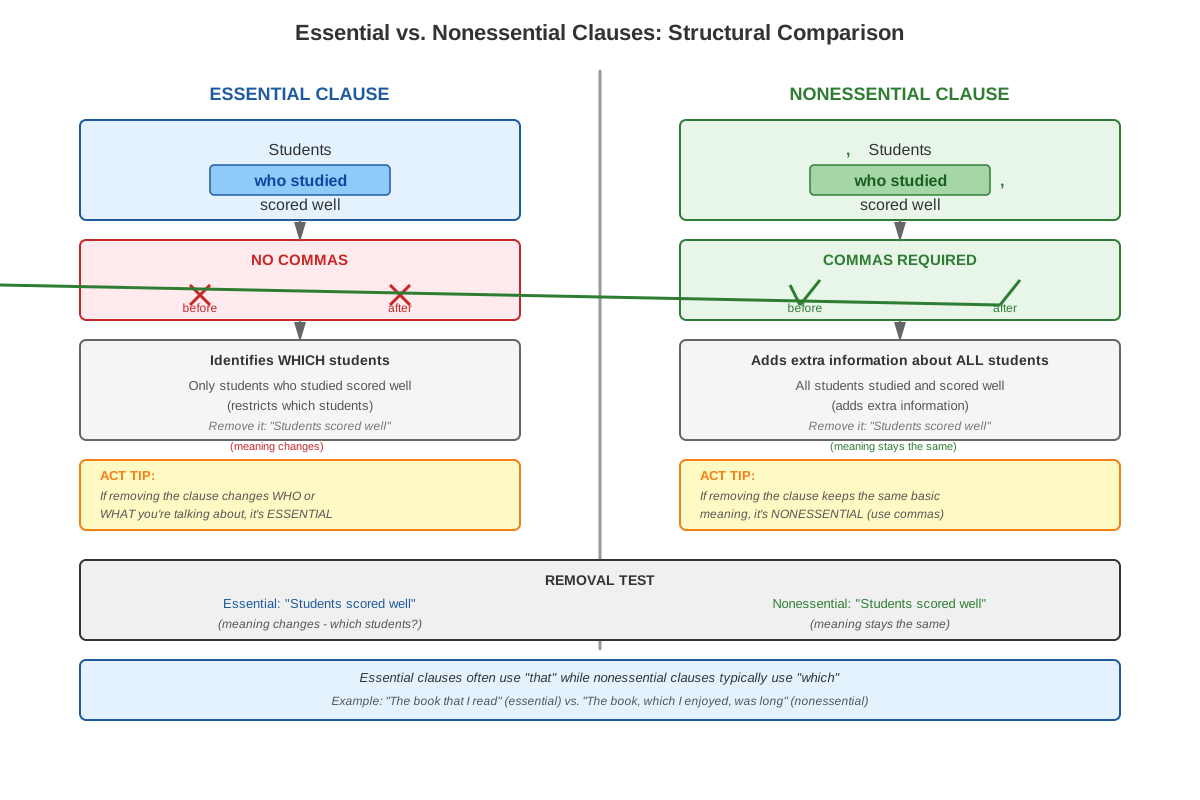
Essential clauses appear in virtually all forms of professional and academic writing, making them crucial for clear communication. In legal documents, scientific papers, and technical writing, the distinction between essential and nonessential information can change meaning entirely. For example, "Students who studied scored well" (essential clause—only those who studied) versus "Students, who studied, scored well" (nonessential clause—all students studied and scored well) conveys fundamentally different information.
On the ACT English section, essential clause questions appear with remarkable consistency—typically 3-5 questions per test, representing approximately 4-7% of the English section. These questions most commonly appear in two formats: comma placement questions where students must decide whether to include or omit commas around a clause, and relative pronoun questions where students must choose between "that" (for essential clauses) and "which" (typically for nonessential clauses). The ACT also tests essential clauses through questions about dashes and parentheses, which can set off nonessential information but should never enclose essential clauses.
Essential clause questions frequently appear in passages discussing specific individuals, scientific processes, historical events, or technical procedures—contexts where precise identification matters. The ACT favors testing this concept in the middle of longer sentences where multiple modifying elements create complexity, requiring students to carefully analyze which information is truly necessary to identify the noun being discussed.
Core Concepts
Definition of Essential Clauses
An essential clause (also called a restrictive clause) is a dependent clause that provides information necessary to identify or define the noun it modifies. Without this clause, the sentence's meaning becomes unclear, overly broad, or fundamentally different. Essential clauses answer the question "Which one?" or "What kind?" and narrow down the noun they modify from a general category to a specific instance.
The defining characteristic of essential clauses is that they are NOT set off by commas, dashes, or parentheses. This punctuation rule reflects their grammatical function: because the information is necessary to the sentence's core meaning, it must be integrated directly into the sentence structure without separating punctuation.
Essential vs. Nonessential Clauses
Understanding the distinction between essential and nonessential clauses is fundamental to ACT success. The following table illustrates key differences:
| Feature | Essential Clause | Nonessential Clause |
|---|---|---|
| Function | Identifies/defines the noun | Adds extra information |
| Punctuation | No commas | Set off by commas |
| Removal test | Changes meaning significantly | Meaning remains clear |
| Relative pronouns | "that" (preferred), "who," "whom" | "which" (preferred), "who," "whom" |
| Example | The book that changed my life was a gift. | The book, which I read last summer, was excellent. |
The Removal Test
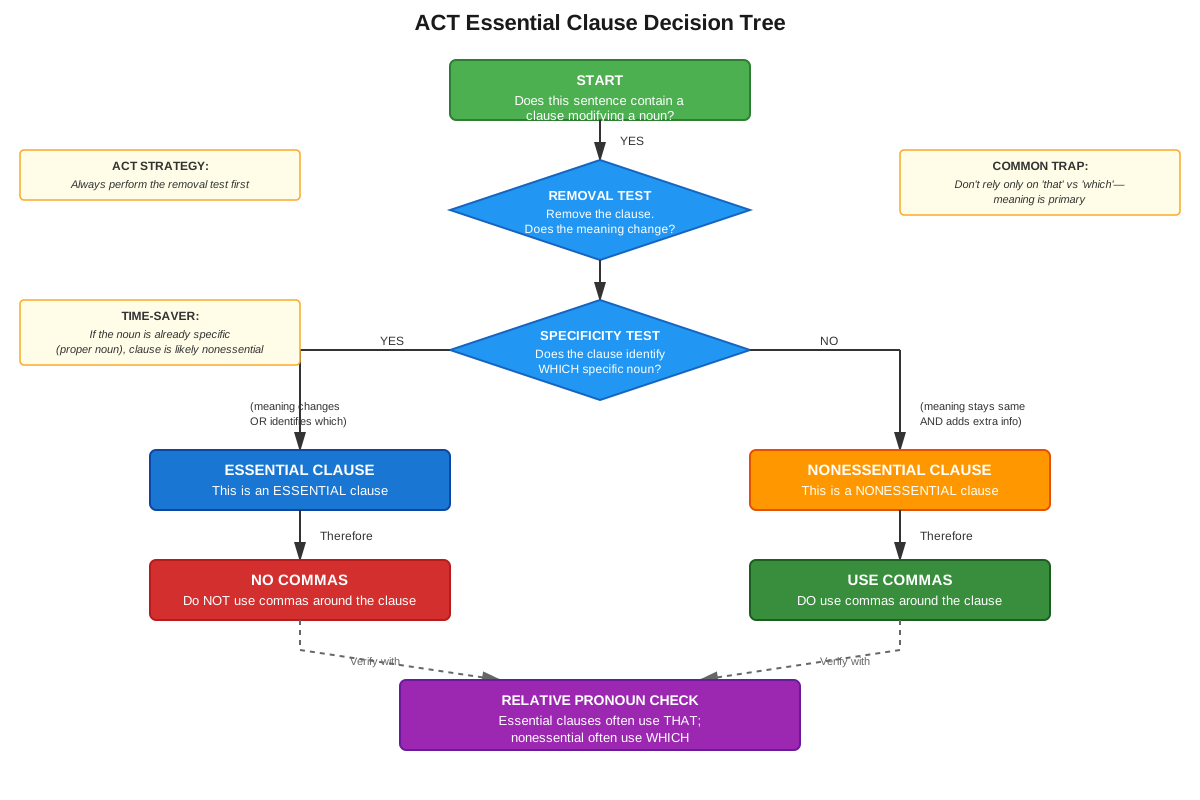
The most reliable method for identifying essential clauses is the removal test: mentally remove the clause from the sentence and evaluate whether the core meaning remains intact and specific.
Example 1: "Students who studied for the test scored higher."
- Remove "who studied for the test" → "Students scored higher."
- Result: The meaning changes significantly. The original sentence specifies WHICH students scored higher (only those who studied), while the shortened version suggests ALL students scored higher.
- Conclusion: Essential clause—no commas needed.
Example 2: "My sister, who lives in Boston, is visiting next week."
- Remove "who lives in Boston" → "My sister is visiting next week."
- Result: The meaning remains clear and complete. We still know who is visiting.
- Conclusion: Nonessential clause—commas are required.
Relative Pronouns and Essential Clauses
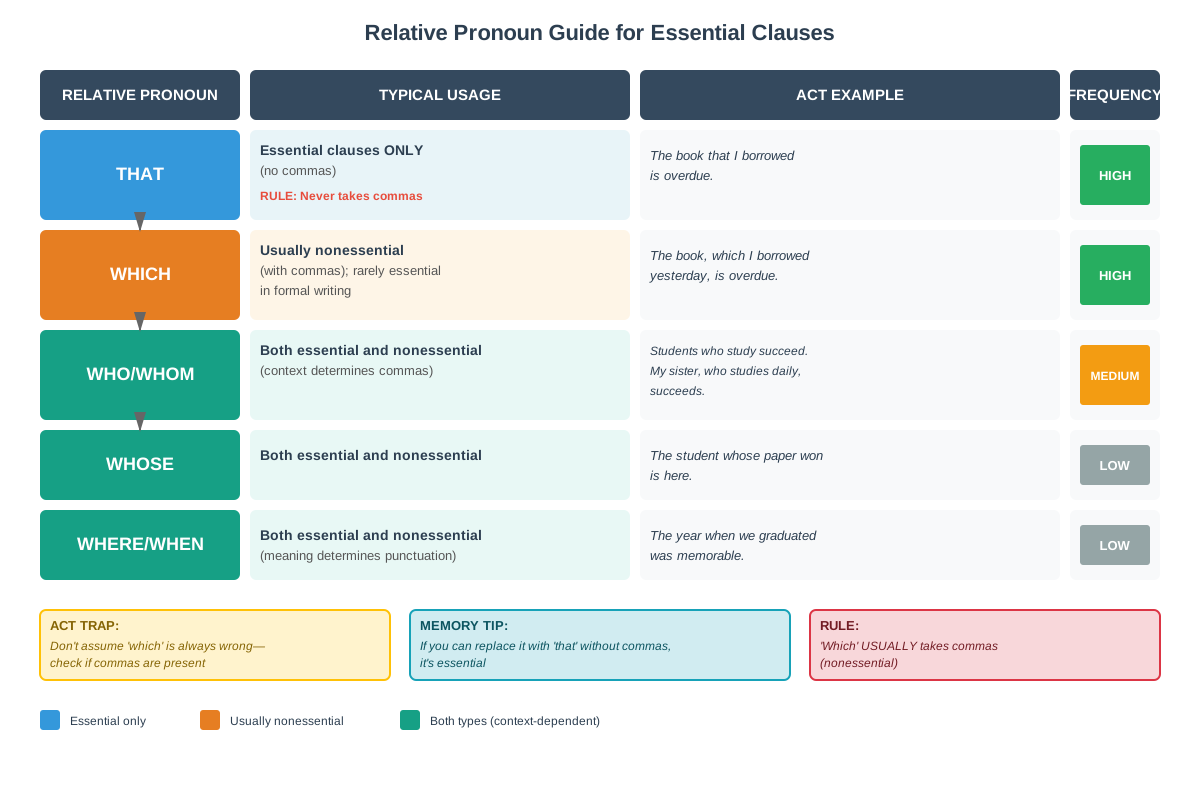
Essential clauses frequently begin with relative pronouns that connect the clause to the noun it modifies:
- That: Strongly preferred for essential clauses referring to things or animals; never used with commas
- Who/Whom: Used for people in both essential and nonessential clauses; punctuation determines function
- Which: Traditionally preferred for nonessential clauses; when used for essential clauses (less common), no commas appear
- Whose: Indicates possession; can introduce both essential and nonessential clauses
The ACT particularly favors testing the "that" versus "which" distinction, as "that" signals an essential clause while "which" typically introduces a nonessential clause.
Context Clues for Determining Essentiality
Several contextual factors help determine whether a clause is essential:
- Specificity of the noun: If the noun is already specific (proper noun, possessive, "the only," "my"), additional information is likely nonessential
- Number of possible referents: If multiple items could fit the description, the clause is likely essential to specify which one
- Logical necessity: Ask whether the information answers "Which one?" (essential) or "By the way..." (nonessential)
Example: "The restaurant that serves authentic Thai food is closing."
- "The restaurant" is general—many restaurants exist
- "that serves authentic Thai food" specifies WHICH restaurant
- Essential clause—no commas
Example: "Pho Palace, which serves authentic Thai food, is closing."
- "Pho Palace" is already specific (proper noun)
- "which serves authentic Thai food" adds extra information but doesn't identify which restaurant
- Nonessential clause—commas required
Participial Phrases as Essential Elements
Essential clauses aren't limited to relative pronoun constructions. Participial phrases (phrases beginning with present or past participles) can also function as essential modifiers:
Essential participial phrase: "The woman wearing the red coat is my aunt."
- "wearing the red coat" identifies WHICH woman
- No commas needed
Nonessential participial phrase: "My aunt, wearing a red coat, arrived early."
- "My aunt" is already specific
- "wearing a red coat" adds descriptive detail
- Commas required
Common ACT Patterns
The ACT tests essential clauses through predictable patterns:
- Comma insertion/deletion: Answer choices vary only by comma placement around a clause
- Relative pronoun selection: Choosing between "that" and "which" with corresponding punctuation
- Dash/parentheses alternatives: Determining whether dashes or parentheses (which set off nonessential information) are appropriate
- Multiple modifiers: Sentences with several clauses where students must identify which are essential
Concept Relationships
Essential clauses exist within a hierarchy of sentence structure concepts. At the foundation, understanding independent and dependent clauses enables recognition that essential clauses are dependent clauses serving a specific modifying function. This connects to comma rules, where essential clauses represent an exception to the general principle that dependent clauses are often set off by punctuation.
The relationship flows as follows: Sentence structure → Dependent clauses → Adjective clauses → Essential vs. nonessential distinction → Punctuation application
Essential clauses also connect horizontally to other modification concepts. Appositives (noun phrases that rename other nouns) follow the same essential/nonessential logic: essential appositives receive no commas, while nonessential appositives require them. Similarly, participial phrases and prepositional phrases can function as essential or nonessential modifiers depending on whether they're necessary for identification.
The concept bridges to relative pronouns, which serve as the grammatical mechanism introducing most essential clauses. Understanding pronoun-antecedent relationships helps students recognize what noun a clause modifies, which is prerequisite to determining essentiality.
Finally, essential clauses connect forward to more advanced concepts like parallel structure (maintaining consistent treatment of multiple essential or nonessential elements) and sentence combining (where understanding essentiality helps determine appropriate punctuation when merging sentences).
High-Yield Facts
⭐ Essential clauses provide information necessary to identify or define the noun they modify and are NOT set off by commas
⭐ The removal test is the most reliable method: if removing the clause significantly changes the sentence's meaning, the clause is essential
⭐ "That" is strongly preferred for essential clauses referring to things; "which" typically introduces nonessential clauses
⭐ Essential clauses answer "Which one?" or "What kind?" while nonessential clauses answer "By the way, what else?"
⭐ If the noun is already specific (proper noun, possessive, "the only"), additional information is usually nonessential
- Essential clauses are also called restrictive clauses because they restrict or narrow the meaning of the noun
- Nonessential clauses can be set off by commas, dashes, or parentheses; essential clauses cannot be enclosed by any of these
- "Who" and "whom" can introduce both essential and nonessential clauses; punctuation determines the function
- Participial phrases can function as essential modifiers when they're necessary to identify which noun is being discussed
- The ACT will never use a comma before "that" when it introduces an essential clause
- Multiple essential clauses in one sentence all remain unpuncuated, while multiple nonessential clauses each require punctuation
- Essential clauses typically appear immediately after the noun they modify without intervening punctuation
Quick check — test yourself on Essential clauses so far.
Try Flashcards →Common Misconceptions
Misconception: All clauses beginning with "which" must be set off by commas.
Correction: While "which" typically introduces nonessential clauses in American English, it can occasionally introduce essential clauses (without commas) in formal or British English. However, the ACT strongly prefers "that" for essential clauses, so if "which" appears with commas as an option, it's likely correct.
Misconception: Long clauses are nonessential and should be set off by commas, while short clauses are essential.
Correction: Length is irrelevant to essentiality. A clause's function—whether it's necessary to identify the noun—determines punctuation, not its word count. "The book that I borrowed from the library last Tuesday afternoon" contains a long essential clause requiring no commas.
Misconception: All clauses beginning with "who" are nonessential because they refer to people who are already identified.
Correction: "Who" introduces both essential and nonessential clauses. "Students who study regularly perform better" uses an essential clause (no commas) because it specifies WHICH students perform better. Context and the removal test determine essentiality, not the relative pronoun alone.
Misconception: If a sentence sounds correct with pauses where commas might go, commas are needed.
Correction: Spoken pauses don't reliably indicate comma placement. Many speakers pause before essential clauses for emphasis or breath, but these pauses don't justify commas. Grammar rules, not speech patterns, govern punctuation.
Misconception: Essential clauses only modify the noun immediately before them.
Correction: While essential clauses typically follow the noun they modify directly, complex sentences may have intervening words. The clause modifies the nearest logical noun, which requires careful analysis of sentence structure and meaning.
Misconception: Proper nouns never take essential clauses because they're already specific.
Correction: While proper nouns often take nonessential clauses, some proper nouns can be modified by essential clauses when multiple entities share the same name. "The John Smith who works in accounting" uses an essential clause to distinguish between multiple people named John Smith.
Worked Examples
Example 1: Identifying Essential vs. Nonessential
Question: Which version is correct?
A) The students, who completed the assignment, received extra credit.
B) The students who completed the assignment received extra credit.
C) The students, who completed the assignment received extra credit.
D) The students who completed the assignment, received extra credit.
Solution Process:
Step 1: Identify the clause in question: "who completed the assignment"
Step 2: Apply the removal test
- Original: "The students who completed the assignment received extra credit"
- Removed: "The students received extra credit"
- Analysis: The meaning changes significantly. The original specifies that ONLY students who completed the assignment received extra credit. The shortened version suggests ALL students received extra credit.
Step 3: Determine essentiality
- The clause is essential because it identifies WHICH students received extra credit
- Essential clauses require no commas
Step 4: Evaluate answer choices
- A: Incorrect—commas make the clause nonessential, changing the meaning
- B: Correct—no commas, preserving the essential function
- C: Incorrect—inconsistent punctuation (comma before but not after)
- D: Incorrect—comma only after disrupts the sentence structure
Answer: B
Connection to Learning Objectives: This example demonstrates identifying when essential clauses are tested (comma placement variations), explaining the core rule (essential clauses aren't set off by commas), and applying the concept accurately (using the removal test to determine essentiality).
Example 2: Relative Pronoun Selection
Question: The research paper [that/which] I submitted last week received the highest grade in the class.
Which relative pronoun is correct, and should commas be used?
A) that (no commas)
B) that, (commas)
C) which (no commas)
D) which, (commas)
Solution Process:
Step 1: Identify what the clause modifies
- The clause modifies "research paper"
- It specifies WHICH research paper received the highest grade
Step 2: Determine if the noun is already specific
- "The research paper" is general—many research papers exist
- The clause is needed to identify which specific paper is being discussed
Step 3: Apply the removal test
- Original: "The research paper that I submitted last week received the highest grade"
- Removed: "The research paper received the highest grade"
- Analysis: Without the clause, we don't know WHICH research paper received the grade. The information is essential.
Step 4: Select the appropriate relative pronoun
- Essential clauses prefer "that" for things
- Essential clauses never take commas
Step 5: Evaluate answer choices
- A: Correct—"that" with no commas for an essential clause
- B: Incorrect—essential clauses don't take commas
- C: Incorrect—"which" is typically reserved for nonessential clauses
- D: Incorrect—creates a nonessential clause, changing the meaning
Answer: A
Connection to Learning Objectives: This example shows how to identify essential clause testing through relative pronoun choices, explains the "that" vs. "which" distinction, and applies the rule by analyzing the noun's specificity and the clause's necessity.
Exam Strategy
Recognizing Essential Clause Questions
The ACT signals essential clause questions through specific patterns in answer choices:
- Comma variation: Answer choices differ only in comma placement around a clause (with commas, without commas, comma before only, comma after only)
- Relative pronoun alternatives: Choices offer "that" versus "which" with corresponding punctuation changes
- Dash/parentheses options: Choices include dashes or parentheses as alternatives to commas, testing whether information is nonessential
Exam Tip: When you see answer choices that vary only by punctuation around a clause beginning with "who," "which," or "that," immediately apply the removal test to determine essentiality.
Trigger Words and Phrases
Watch for these indicators that an essential clause question is being tested:
- Relative pronouns: that, which, who, whom, whose
- Phrases like "the one," "the kind," "the type" (suggesting specification is needed)
- General nouns followed by descriptive clauses: "the student," "the book," "the method"
- Questions asking about comma placement or "proper punctuation"
Step-by-Step Approach
- Identify the clause: Locate the modifying clause and determine what noun it modifies
- Apply the removal test: Mentally remove the clause and assess meaning change
- Evaluate specificity: Determine if the noun is already specific or needs identification
- Check the relative pronoun: Ensure "that" is used for essential clauses about things
- Verify punctuation: Confirm no commas, dashes, or parentheses enclose essential clauses
Process of Elimination
- Eliminate choices with inconsistent punctuation: If a comma appears before but not after a clause (or vice versa), eliminate that choice
- Eliminate "which" with no commas: While grammatically possible, the ACT strongly prefers "that" for essential clauses
- Eliminate comma + "that" combinations: "That" never follows a comma when introducing an essential clause
- Eliminate choices that change meaning: If adding commas would fundamentally alter what the sentence communicates, eliminate those options
Time Management
Essential clause questions typically require 20-30 seconds to answer accurately. Spend the time applying the removal test rather than relying on "what sounds right"—many students' speech patterns include pauses that don't correspond to grammatical comma placement. If you're uncertain, mark the question and return to it after completing faster questions, but don't skip the removal test process.
Memory Techniques
The REMOVE Mnemonic
Read the sentence without the clause
Evaluate if meaning changes significantly
Meaning changed? It's essential (no commas)
Otherwise, it's nonessential (use commas)
Verify the relative pronoun choice
Eliminate inconsistent punctuation
The "That" vs. "Which" Visualization
Visualize "that" as a tight connection (no space for commas) between the noun and essential information. Visualize "which" as having breathing room (commas create space) because the information is extra.
The Specificity Spectrum
Create a mental spectrum:
- Left side (General): "the student," "a book," "restaurants" → likely need essential clauses
- Right side (Specific): "Maria," "my favorite book," "Olive Garden" → likely take nonessential clauses
The Question Test
Essential clauses answer "Which one?" or "What kind?"
Nonessential clauses answer "By the way, what else?"
If you can phrase the clause as answering "Which one?" it's essential. If it feels like a "by the way" addition, it's nonessential.
The Acronym: ESSENTIAL
Examine the noun being modified
Specific already? Probably nonessential
Strip the clause away (removal test)
Evaluate meaning change
No commas if meaning changes
That (not which) for things
Identification needed? Essential
Add commas only for extras
Logic determines punctuation
Summary
Essential clauses represent a critical intersection of grammar rules and logical analysis on the ACT English section. These clauses provide information necessary to identify or define the nouns they modify, and they must never be set off by commas, dashes, or parentheses. The fundamental principle is that essential clauses answer "Which one?" or "What kind?" and restrict the meaning of general nouns to specific instances. The most reliable method for identifying essential clauses is the removal test: if removing the clause significantly changes the sentence's meaning or makes it unclear which noun is being discussed, the clause is essential. The ACT consistently tests this concept through comma placement variations and relative pronoun choices, particularly the distinction between "that" (preferred for essential clauses about things) and "which" (typically used for nonessential clauses). Success requires moving beyond "what sounds right" to systematic analysis of whether information is necessary for identification or merely supplementary. Mastering essential clauses enables students to confidently tackle 3-5 questions per test, representing a high-yield opportunity for score improvement in the English section.
Key Takeaways
- Essential clauses provide necessary information to identify nouns and are never set off by commas, dashes, or parentheses
- The removal test is the most reliable method: if meaning changes significantly when the clause is removed, it's essential
- "That" is strongly preferred for essential clauses referring to things; "which" typically introduces nonessential clauses
- Essential clauses answer "Which one?" while nonessential clauses answer "By the way, what else?"
- If the noun is already specific (proper noun, possessive), additional information is usually nonessential
- ACT questions signal essential clause testing through comma placement variations and relative pronoun choices
- Systematic analysis using the removal test is more reliable than relying on speech patterns or "what sounds right"
Related Topics
Nonessential Clauses and Phrases: Understanding essential clauses naturally leads to mastering nonessential elements, which require commas, dashes, or parentheses. This topic explores when information is supplementary rather than necessary.
Relative Pronouns: Deep study of who, whom, which, that, and whose—including their grammatical functions, antecedent agreement, and proper usage—builds on essential clause knowledge.
Appositives: These noun phrases that rename other nouns follow the same essential/nonessential logic, making them a natural extension of essential clause mastery.
Comma Usage: Essential clauses represent one application of broader comma rules. Comprehensive comma mastery includes coordinating conjunctions, introductory elements, and series.
Sentence Combining: Advanced sentence construction often requires determining whether combined elements are essential or nonessential, directly applying the principles learned in this topic.
Practice CTA
Now that you've mastered the core concepts of essential clauses, it's time to cement your understanding through active practice. The practice questions and flashcards are specifically designed to mirror ACT question patterns and difficulty levels. Each practice question provides detailed explanations that reinforce the removal test and systematic analysis strategies you've learned. Consistent practice with these materials will build the automaticity needed to quickly and accurately identify essential clause questions on test day. Remember: understanding the concept is the first step, but applying it under timed conditions is what translates to score improvement. Challenge yourself with the practice materials, and watch your confidence and accuracy soar!
Sign up free to keep reading
Create a free AnvayaPrep account to finish this ACT guide on Essential clauses — plus flashcards and practice questions.