Overview
Sentence emphasis is a critical rhetorical skill tested on the ACT English section that evaluates a student's ability to determine which sentence structure, word choice, or placement best emphasizes the intended meaning or most important information in a passage. This concept goes beyond simple grammatical correctness—it requires understanding how writers create focus, highlight key ideas, and guide readers' attention through strategic sentence construction and organization.
On the ACT, ACT sentence emphasis questions typically ask students to choose the most effective way to express an idea, often with answer choices that are all grammatically correct but differ in what they emphasize or how they direct the reader's focus. These questions might involve choosing between active and passive voice, deciding where to place modifying phrases, selecting the most appropriate sentence structure to highlight specific information, or determining which word order creates the desired emphasis. Understanding sentence emphasis is essential because approximately 10-15% of ACT English questions test rhetorical skills related to emphasis, style, and effectiveness.
Sentence emphasis connects directly to broader writing concepts including sentence structure, parallelism, and organization. It also relates to the ACT's focus on effective communication—the test doesn't just assess whether students can identify errors, but whether they can recognize superior writing that communicates ideas clearly and powerfully. Mastering sentence emphasis helps students excel not only on direct emphasis questions but also on questions about transitions, organization, and overall passage effectiveness.
Learning Objectives
- [ ] Identify when Sentence emphasis is being tested on the ACT English section
- [ ] Explain the core rule or strategy behind Sentence emphasis
- [ ] Apply Sentence emphasis to ACT-style questions accurately
- [ ] Distinguish between grammatically correct options based on emphasis and rhetorical effect
- [ ] Recognize how sentence position, structure, and word order affect emphasis
- [ ] Evaluate which sentence elements should receive primary focus based on context and author's purpose
- [ ] Analyze how active versus passive voice impacts emphasis in different contexts
Prerequisites
- Basic sentence structure: Understanding subjects, predicates, and clauses is essential because emphasis questions require manipulating these elements while maintaining grammatical correctness
- Parts of speech: Recognizing nouns, verbs, adjectives, and adverbs helps identify which elements can be emphasized through positioning or modification
- Active and passive voice: Distinguishing between these voices is crucial since voice choice significantly affects what receives emphasis in a sentence
- Modifying phrases and clauses: Understanding how modifiers work enables recognition of how their placement affects emphasis
- Context clues and reading comprehension: Determining appropriate emphasis requires understanding the passage's overall meaning and purpose
Why This Topic Matters
In real-world writing, emphasis determines whether communication succeeds or fails. Professional writers, journalists, marketers, and academics all use emphasis techniques to ensure their most important points resonate with readers. A resume that emphasizes the wrong accomplishments, a news article that buries the lead, or a scientific paper that obscures key findings all fail because of poor emphasis choices. Learning to control emphasis makes students more effective communicators in college essays, professional correspondence, and any context requiring persuasive or clear writing.
On the ACT English section, emphasis questions appear in approximately 4-6 questions per test, making them a high-yield topic for score improvement. These questions typically appear in the rhetorical skills category and often carry the stem "Which choice most effectively emphasizes..." or "Which choice best highlights..." Unlike pure grammar questions, emphasis questions require students to read surrounding context carefully and understand the author's purpose. They frequently appear in passages about scientific discoveries, historical events, or personal narratives where certain information needs prominence.
Common manifestations include questions about whether to use active or passive voice (emphasizing the actor versus the action), where to place a phrase within a sentence (beginning, middle, or end position), how to structure a sentence to highlight cause versus effect, and which words to use when multiple synonyms exist but carry different connotative weight. The ACT also tests emphasis through questions about sentence placement within paragraphs and whether information should be in an independent or dependent clause.
Core Concepts
Understanding Emphasis Through Position
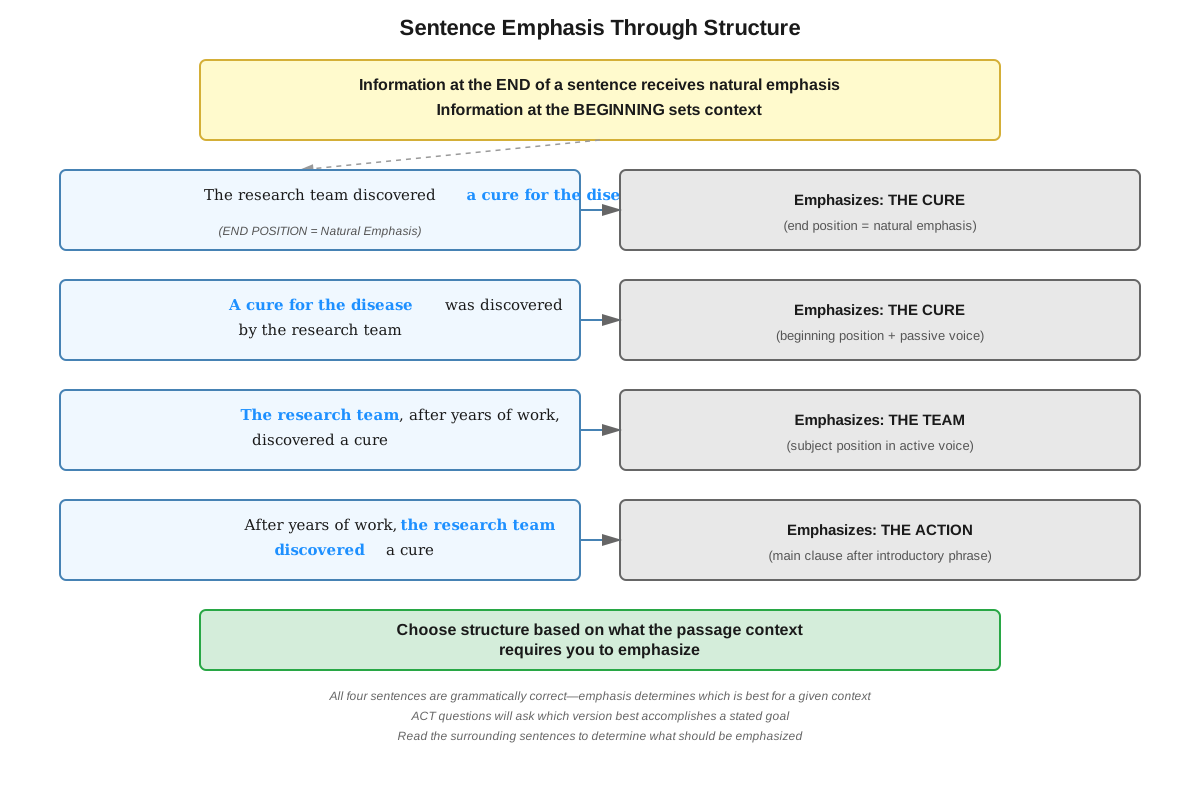
The principle of end emphasis states that information placed at the end of a sentence receives the most emphasis, while information at the beginning receives secondary emphasis. The middle of a sentence is the weakest position for emphasis. This occurs because readers naturally remember what they read last and pay special attention to how sentences conclude. On the ACT, questions often test whether students can identify which sentence structure places the most important information in the emphatic final position.
Consider these variations:
- "The scientist discovered penicillin in 1928." (Emphasizes the date)
- "In 1928, the scientist discovered penicillin." (Emphasizes penicillin)
- "Penicillin was discovered by the scientist in 1928." (Emphasizes the date, de-emphasizes the scientist)
Active vs. Passive Voice for Emphasis
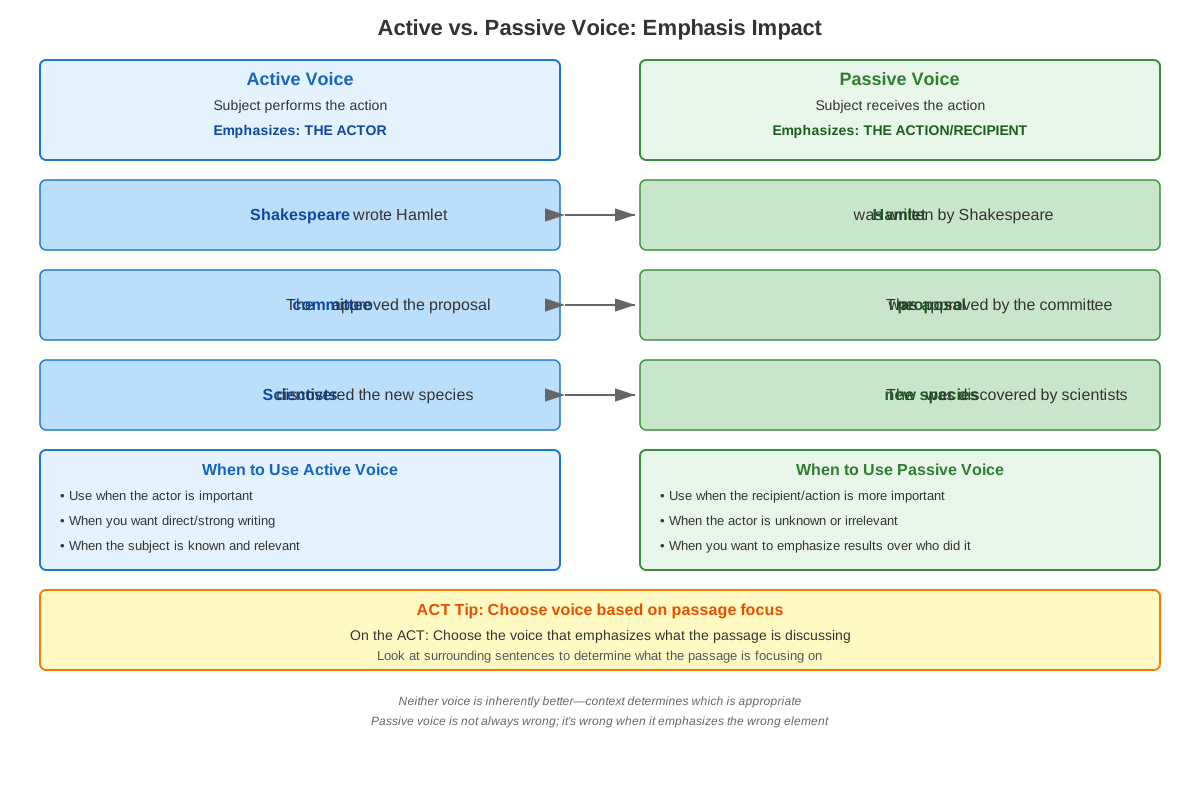
Active voice (subject performs action) emphasizes the actor: "The committee approved the proposal." Passive voice (subject receives action) emphasizes the action or recipient: "The proposal was approved by the committee." Neither voice is inherently superior—the choice depends on what deserves emphasis.
Use active voice when:
- The actor is more important than the action
- You want direct, forceful writing
- The actor is known and relevant
Use passive voice when:
- The action or recipient is more important than the actor
- The actor is unknown or irrelevant
- You want to de-emphasize responsibility
| Voice Type | Example | What's Emphasized |
|---|---|---|
| Active | "Shakespeare wrote Hamlet" | Shakespeare (the author) |
| Passive | "Hamlet was written by Shakespeare" | Hamlet (the work) |
| Passive (agent omitted) | "Hamlet was written in 1600" | Hamlet and the date |
Subordination and Emphasis
Subordination involves placing less important information in dependent clauses and more important information in independent clauses. Independent clauses receive more emphasis because they can stand alone and carry the main assertion. Dependent clauses (beginning with words like "although," "because," "while," "when") provide supporting or contextual information.
Compare:
- "Although it was raining, we continued hiking." (Emphasizes continuing to hike)
- "We continued hiking, although it was raining." (Still emphasizes hiking, but end position gives slight emphasis to the rain)
- "It was raining, but we continued hiking." (Two independent clauses give more equal weight)
Periodic vs. Cumulative Sentences
A periodic sentence delays the main clause until the end, building suspense and emphasizing the conclusion: "Despite the obstacles, the setbacks, and the doubters, she succeeded." A cumulative sentence presents the main clause first, then adds details: "She succeeded, overcoming obstacles, setbacks, and doubters." Periodic sentences create more dramatic emphasis on the final point, while cumulative sentences emphasize the main idea by stating it immediately.
Repetition and Parallelism for Emphasis
Strategic repetition of key words or phrases creates emphasis through reinforcement. Parallelism (using similar grammatical structures) emphasizes the relationship between ideas and makes them more memorable. The ACT tests whether students recognize when repetition strengthens emphasis versus when it becomes redundant.
Effective repetition: "We shall fight on the beaches, we shall fight on the landing grounds, we shall fight in the fields..."
Ineffective repetition: "The very, very, very important discovery..." (redundant intensifiers)
Conciseness and Emphasis
Conciseness enhances emphasis by eliminating distractions. Wordy constructions dilute emphasis by burying key information in unnecessary words. However, conciseness doesn't always mean shortest—sometimes additional words provide necessary emphasis through rhythm or repetition.
Compare:
- Wordy: "Due to the fact that the experiment was a failure, the scientists decided to try again." (Emphasis lost in wordiness)
- Concise: "Because the experiment failed, the scientists tried again." (Clearer emphasis on the failure and response)
- Emphatic: "The experiment failed. The scientists tried again." (Short sentences create dramatic emphasis)
Concept Relationships
The concepts within sentence emphasis form an interconnected system where each technique serves the overarching goal of directing reader attention. Position-based emphasis (end and beginning positions) provides the foundation, determining where to place information within sentences. This connects directly to active versus passive voice, which determines what occupies those emphatic positions—the actor or the action. Subordination builds on positional emphasis by creating a hierarchy between independent and dependent clauses, ensuring important information receives independent clause status.
Periodic and cumulative sentence structures represent advanced applications of positional emphasis, manipulating entire sentence architecture to control when readers encounter the main point. These structures often incorporate subordination to delay or accelerate the main clause. Repetition and parallelism work across multiple sentences or clauses, creating emphasis through pattern and reinforcement rather than position alone. Finally, conciseness supports all other emphasis techniques by removing obstacles that prevent readers from focusing on what matters.
This topic connects to prerequisite knowledge of sentence structure because emphasis requires manipulating sentence components while maintaining grammatical integrity. Understanding active and passive voice is prerequisite because voice choice is a primary emphasis tool. The topic relates to transitions and organization because emphasis at the sentence level must align with emphasis at the paragraph and passage level—a sentence that emphasizes the wrong information disrupts logical flow.
Relationship map: Basic Sentence Structure → Position-Based Emphasis → Active/Passive Voice Choice → Subordination Hierarchy → Periodic/Cumulative Structures → Repetition/Parallelism → Conciseness → Overall Rhetorical Effectiveness
High-Yield Facts
- ⭐ The end of a sentence is the most emphatic position; the beginning is second-most emphatic; the middle is least emphatic
- ⭐ Active voice emphasizes the actor/subject; passive voice emphasizes the action or recipient
- ⭐ Information in independent clauses receives more emphasis than information in dependent clauses
- ⭐ Shorter, simpler sentences create more emphasis than longer, complex sentences for the same information
- ⭐ The ACT prefers active voice unless there's a specific rhetorical reason to use passive voice
- Periodic sentences (main clause at end) create suspense and emphasize the conclusion
- Cumulative sentences (main clause at beginning) emphasize the main idea through immediate presentation
- Strategic repetition of key terms reinforces emphasis; redundant repetition weakens it
- Parallel structure emphasizes relationships between ideas and makes them more memorable
- Conciseness generally enhances emphasis by eliminating distractions, but brevity alone doesn't guarantee proper emphasis
- Questions asking "which choice most effectively emphasizes" require reading surrounding context to determine what should be emphasized
- The correct answer to emphasis questions is often grammatically identical to wrong answers but differs in what it highlights
Quick check — test yourself on Sentence emphasis so far.
Try Flashcards →Common Misconceptions
Misconception: The shortest answer is always correct on emphasis questions because conciseness is always better.
Correction: While the ACT generally favors conciseness, emphasis questions specifically test rhetorical effectiveness. Sometimes a longer option better emphasizes the intended meaning. The correct answer emphasizes what the context requires, whether that's the shortest option or not.
Misconception: Active voice is always better than passive voice on the ACT.
Correction: Active voice is generally preferred, but passive voice is correct when the action or recipient deserves more emphasis than the actor, when the actor is unknown, or when the context focuses on what was done rather than who did it.
Misconception: Emphasis questions can be answered without reading the surrounding sentences.
Correction: Unlike pure grammar questions, emphasis questions require understanding context. The correct answer depends on what the passage is discussing and what information the author wants to highlight, which requires reading at least 2-3 sentences before and after the question.
Misconception: Placing information at the beginning of a sentence always emphasizes it most.
Correction: The end position is actually most emphatic. Beginning position is second-most emphatic. This is why periodic sentences (which delay the main point until the end) create such strong emphasis on their conclusions.
Misconception: Repetition always creates emphasis.
Correction: Strategic repetition of key terms or parallel structures creates emphasis, but redundant repetition (saying the same thing with different words unnecessarily) weakens emphasis by diluting the message. The ACT distinguishes between emphatic repetition and wordy redundancy.
Misconception: Independent and dependent clauses create equal emphasis.
Correction: Independent clauses receive more emphasis because they carry the main assertion and can stand alone. Dependent clauses provide supporting information and receive less emphasis. Choosing which information goes in which clause type is a key emphasis strategy.
Worked Examples
Example 1: Active vs. Passive Voice for Emphasis
Question: The passage discusses Marie Curie's groundbreaking research. Which choice most effectively emphasizes Curie's role as the discoverer?
A) Radium was discovered in 1898 by Marie Curie.
B) Marie Curie discovered radium in 1898.
C) In 1898, radium was discovered by Marie Curie.
D) The discovery of radium occurred in 1898 when Marie Curie found it.
Analysis:
First, identify what should be emphasized: "Curie's role as the discoverer." This means Curie should be the subject and should be in an emphatic position.
Option A uses passive voice with "Radium was discovered," making radium the subject and placing it in the emphatic beginning position. Curie appears at the end but as the object of a prepositional phrase, which de-emphasizes her role. This doesn't emphasize Curie's role.
Option B uses active voice with "Marie Curie discovered," making Curie the subject in the emphatic beginning position. The sentence structure clearly shows Curie as the actor performing the discovery. This emphasizes Curie's role effectively.
Option C uses passive voice and places "In 1898" at the beginning, pushing both radium and Curie away from emphatic positions. Curie appears at the very end but still as the object of a preposition, not as the grammatical subject. This doesn't emphasize Curie's role.
Option D uses a wordy construction "The discovery of radium occurred" that makes "discovery" the subject rather than Curie. Curie appears in a subordinate clause "when Marie Curie found it," which de-emphasizes her role. This doesn't emphasize Curie's role.
Answer: B. Active voice with Curie as the subject in the emphatic beginning position most effectively emphasizes her role as the discoverer.
Example 2: Subordination and Position for Emphasis
Question: The passage describes how a small town overcame economic challenges. Which choice most effectively emphasizes the town's success?
A) Although the factory closed and unemployment rose, the town eventually thrived through tourism.
B) The factory closed and unemployment rose, but the town eventually thrived through tourism.
C) The town eventually thrived through tourism, although the factory closed and unemployment rose.
D) Despite the factory closing and unemployment rising, the town's eventual success came through tourism.
Analysis:
The question asks us to emphasize "the town's success," so the success should be in an independent clause and in an emphatic position (preferably the end).
Option A places the challenges in a dependent clause ("Although...") and the success in an independent clause. The success appears at the end in the emphatic position. The structure clearly subordinates the challenges and emphasizes the positive outcome. This effectively emphasizes success.
Option B uses two independent clauses connected by "but," giving relatively equal weight to both the challenges and the success. While "but" signals contrast, the parallel structure doesn't subordinate the challenges as clearly. The success is at the end, which is good, but the equal clause structure dilutes the emphasis somewhat.
Option C places the success in the main clause at the beginning, which is emphatic, but then ends with the challenges in a dependent clause. This structure emphasizes the success through the independent clause, but ending with challenges (even in a dependent clause) leaves the reader focused on the negative. The end position emphasis on challenges works against the goal.
Option D uses a dependent clause for challenges and an independent clause for success, which is good. However, the phrasing "the town's eventual success came through tourism" is wordier and less direct than "the town eventually thrived through tourism." The word "success" is more abstract than "thrived," and the construction is less forceful.
Answer: A. This option subordinates the challenges in a dependent clause, places the success in an independent clause, and positions the success at the emphatic end of the sentence, most effectively emphasizing the town's success.
Exam Strategy
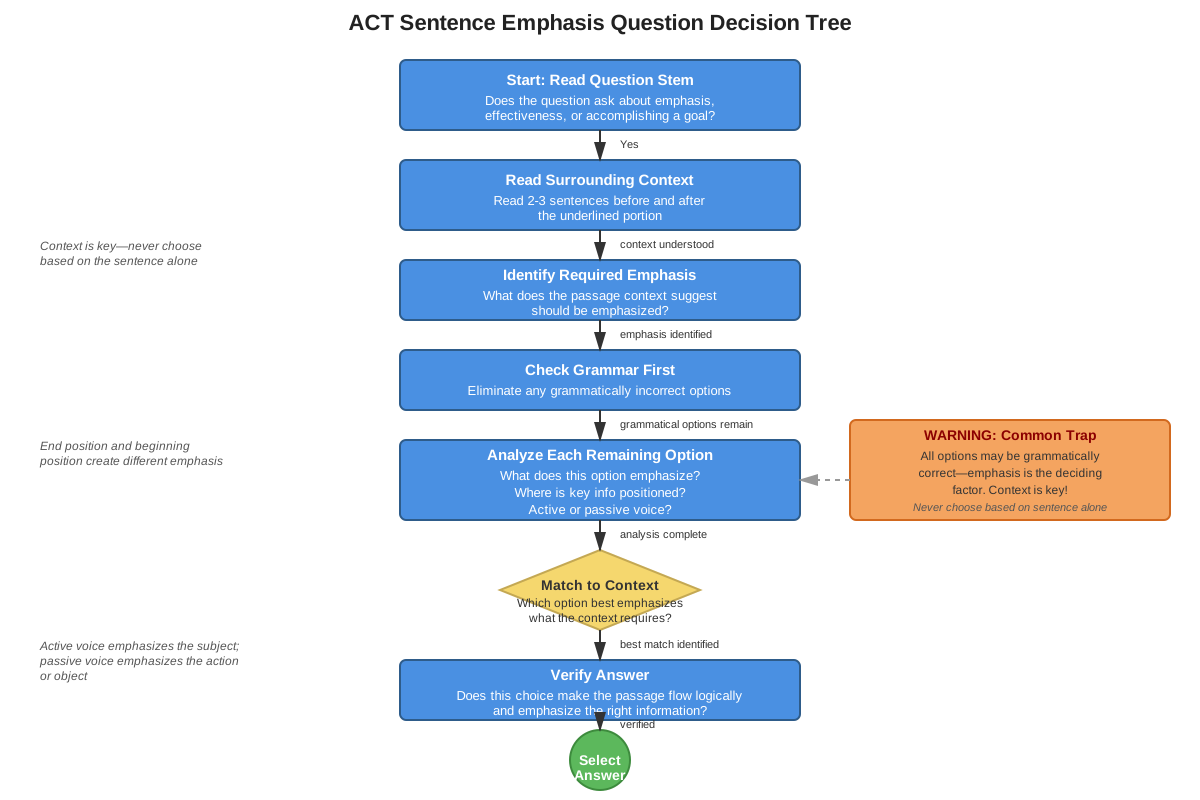
When approaching ACT sentence emphasis questions, first identify what the question asks you to emphasize. The question stem usually contains phrases like "most effectively emphasizes," "best highlights," or "most clearly focuses on." Read this carefully to understand the specific element that should receive emphasis—it might be a person, an action, a result, or a particular aspect of the situation.
Next, read the surrounding context. Unlike grammar questions that can often be answered in isolation, emphasis questions require understanding what the passage is about and what the author's purpose is. Read at least 2-3 sentences before and after the underlined portion. Ask yourself: What is this paragraph mainly about? What point is the author making? What information is most important to the author's argument or narrative?
Trigger words and phrases that signal emphasis questions include:
- "Most effectively emphasizes"
- "Best highlights"
- "Most clearly focuses on"
- "Places the most emphasis on"
- "Most strongly suggests"
- "Best conveys the significance of"
When evaluating answer choices, use this systematic approach:
- Eliminate grammatically incorrect options first (though emphasis questions often have all grammatically correct choices)
- Identify what each option emphasizes by noting what appears in emphatic positions (end and beginning), what's in independent versus dependent clauses, and whether active or passive voice is used
- Match the emphasis to the question's requirement and the passage context
- Check for conciseness as a tiebreaker if two options emphasize the same thing equally well
For process of elimination, recognize that wrong answers typically:
- Emphasize the wrong element (e.g., emphasizing the date when the question asks you to emphasize the person)
- Use passive voice when active voice would better emphasize the required element
- Place important information in the middle of the sentence or in dependent clauses
- Are unnecessarily wordy, diluting emphasis
- End with less important information, leaving the reader focused on the wrong thing
Time allocation: Spend 30-45 seconds on emphasis questions. They require more reading than pure grammar questions but shouldn't take as long as organization questions. If you're stuck, eliminate options that clearly emphasize the wrong thing, then choose the most concise remaining option that places the required information at the end.
Memory Techniques
END = Emphasis Naturally Dominates: Remember that the end of a sentence is the most emphatic position. When you need to emphasize something, put it at the END.
ACTIVE = Actor Creates The Impact, Very Emphasized: Use this to remember that active voice emphasizes the actor/subject. If the question wants you to emphasize who did something, choose active voice.
PASSIVE = Put Action (or recipient) in Spotlight, Subject Is Very Excluded: Use this to remember that passive voice emphasizes the action or what was acted upon, while de-emphasizing or excluding the actor.
I.D. for Emphasis (Independent = Dominant): Information in Independent clauses receives more emphasis than information in Dependent clauses. If something is important, put it in an I.D. (Independent) clause.
The 3 P's of Emphasis:
- Position: End is most emphatic, beginning is second, middle is least
- Priority: Independent clauses over dependent clauses
- Power: Active voice for actor emphasis, passive for action emphasis
Visualization strategy: Picture a spotlight on a stage. The spotlight (emphasis) can only shine on one area at a time. When you read a sentence, imagine where the spotlight naturally falls—usually at the end. Ask yourself: "Is the spotlight shining on what the question wants emphasized?" If not, choose an answer that moves the spotlight to the right place.
CONTEXT = Check Other Nearby Text for Emphasis Xtras: Always read the context. This acronym reminds you that emphasis questions can't be answered without checking the surrounding sentences.
Summary
Sentence emphasis is a crucial rhetorical skill on the ACT English section that tests students' ability to recognize and create effective emphasis through sentence structure, word choice, and positioning. The core principle is that emphasis is controlled through multiple techniques: positional emphasis (end and beginning positions are most emphatic), voice choice (active emphasizes the actor, passive emphasizes the action or recipient), subordination (independent clauses receive more emphasis than dependent clauses), sentence structure (periodic versus cumulative), and conciseness (eliminating distractions). Unlike pure grammar questions, emphasis questions require reading context to determine what should be emphasized based on the author's purpose and the passage's focus. Success on these questions depends on systematically identifying what the question asks you to emphasize, evaluating what each answer choice actually emphasizes through its structure and positioning, and selecting the option that best matches the required emphasis while maintaining clarity and conciseness. Mastering sentence emphasis improves not only ACT scores but also overall writing effectiveness.
Key Takeaways
- The end of a sentence is the most emphatic position; place the most important information there when possible
- Active voice emphasizes the actor/subject; passive voice emphasizes the action or recipient—choose based on what deserves emphasis
- Independent clauses receive more emphasis than dependent clauses; put important information in independent clauses
- Emphasis questions require reading surrounding context to determine what should be emphasized
- All answer choices may be grammatically correct; the correct answer emphasizes what the question and context require
- Conciseness generally enhances emphasis by removing distractions, but the shortest answer isn't automatically correct
- Systematic evaluation of what each option emphasizes (through position, voice, and clause type) leads to the correct answer
Related Topics
Transitions and Logical Flow: Understanding emphasis helps with transitions because emphasized information in one sentence often connects to the topic of the next sentence. Mastering emphasis enables better recognition of logical connections between sentences.
Organization and Paragraph Structure: Sentence-level emphasis must align with paragraph-level emphasis. Topics that receive emphasis within sentences should relate to the paragraph's main idea, making organization questions easier to answer.
Style and Tone: Emphasis techniques like sentence length variation, active versus passive voice, and repetition all contribute to a passage's overall style and tone. Understanding emphasis provides tools for analyzing and creating appropriate style.
Conciseness and Wordiness: While related, conciseness and emphasis are distinct concepts. Studying emphasis deepens understanding of when additional words serve a rhetorical purpose versus when they're merely redundant.
Parallelism: Parallel structure creates emphasis by highlighting relationships between ideas. Understanding emphasis explains why parallelism is effective and when to use it.
Practice CTA
Now that you've mastered the core concepts of sentence emphasis, it's time to apply this knowledge! Work through the practice questions to test your ability to identify what's being emphasized in different sentence structures and to choose the most effective emphasis for various contexts. The flashcards will help you memorize key principles like positional emphasis and voice choice. Remember: emphasis questions reward careful reading of context and systematic analysis of what each answer choice emphasizes. With practice, you'll develop the instinct to quickly identify what should be emphasized and which sentence structure accomplishes that goal. Your improved understanding of emphasis will not only boost your ACT score but also make you a more effective writer in all contexts!
Sign up free to keep reading
Create a free AnvayaPrep account to finish this ACT guide on Sentence emphasis — plus flashcards and practice questions.