Overview
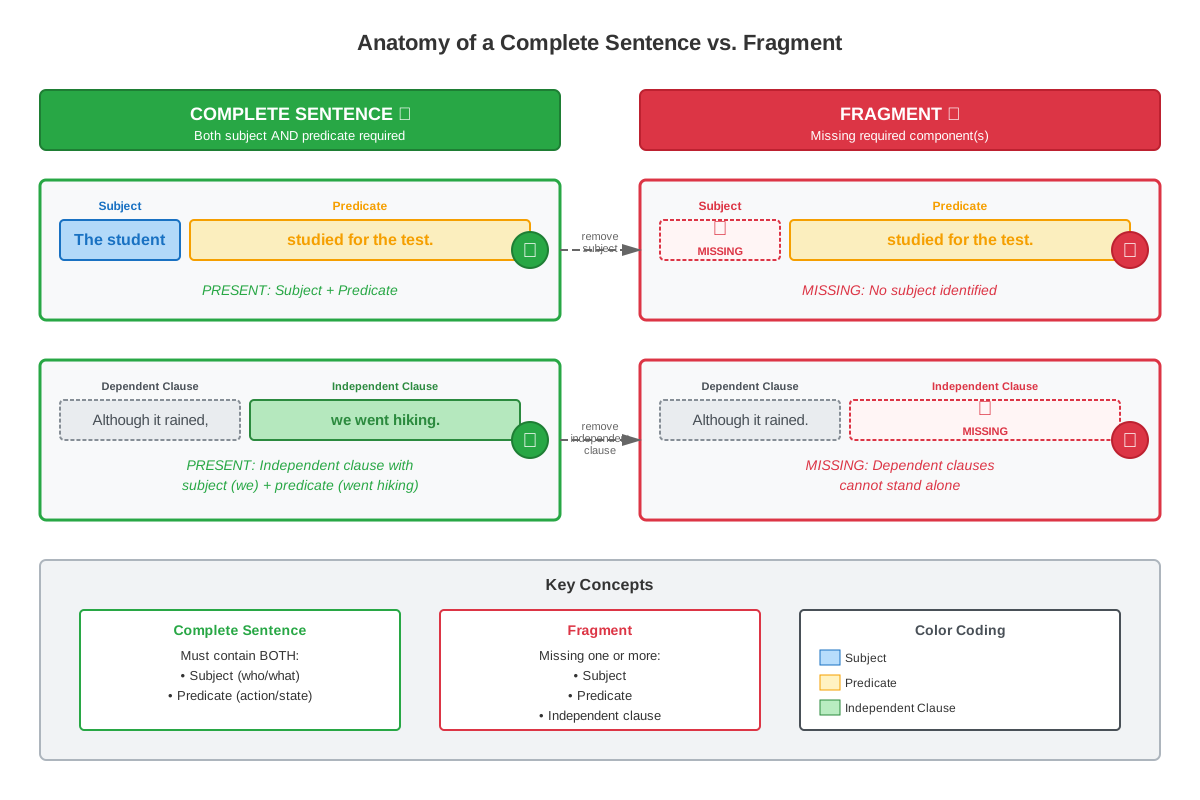
Subject and predicate completeness is a fundamental concept in English grammar that appears frequently on the ACT English test. This topic tests whether students can identify and correct sentences that are missing essential components—either a complete subject (who or what is performing the action) or a complete predicate (what the subject is doing or what is being said about the subject). A complete sentence must contain both elements to express a full thought. When either component is missing or incomplete, the result is a sentence fragment, which is considered a grammatical error on the ACT.
Understanding ACT subject and predicate completeness is crucial because these questions appear in approximately 10-15% of all ACT English questions, making them among the most frequently tested sentence structure concepts. The ACT often disguises incomplete sentences by using complex punctuation, long descriptive phrases, or subordinating conjunctions that trick students into thinking a fragment is actually a complete sentence. Mastering this topic requires the ability to strip away modifying phrases and identify the core grammatical structure of any sentence.
This topic serves as a foundational element within the broader Sentence Structure unit on the ACT. It connects directly to concepts like run-on sentences, comma splices, and coordination/subordination. Before students can effectively combine sentences or use complex punctuation, they must first ensure that each independent clause contains both a subject and a predicate. This skill also supports understanding of verb tense consistency, subject-verb agreement, and pronoun-antecedent relationships, as all these concepts require identifying the subject and predicate first.
Learning Objectives
- [ ] Identify when subject and predicate completeness is being tested on ACT questions
- [ ] Explain the core rule or strategy behind subject and predicate completeness
- [ ] Apply subject and predicate completeness to ACT-style questions accurately
- [ ] Distinguish between complete sentences and sentence fragments in complex passages
- [ ] Recognize common ACT patterns that create incomplete subjects or predicates
- [ ] Evaluate multiple answer choices to select the option that creates a grammatically complete sentence
- [ ] Analyze sentences with multiple clauses to verify each independent clause has both subject and predicate
Prerequisites
- Basic sentence structure: Understanding what constitutes a sentence is essential because subject and predicate completeness builds directly on knowing that sentences express complete thoughts.
- Parts of speech identification: Recognizing nouns, verbs, and pronouns enables students to locate subjects and predicates within sentences.
- Clause types (independent vs. dependent): Distinguishing between clauses that can stand alone and those that cannot is necessary for identifying fragments.
- Common subordinating conjunctions: Knowing words like "although," "because," and "when" helps identify dependent clauses that cannot function as complete sentences.
Why This Topic Matters
In real-world communication, subject and predicate completeness ensures clarity and professionalism. Incomplete sentences in academic writing, business correspondence, or professional documents undermine credibility and can create confusion about the intended meaning. While fragments may be used stylistically in creative writing or informal communication, standardized tests like the ACT assess students' command of formal written English, where complete sentences are the standard.
On the ACT English test, subject and predicate completeness questions appear in approximately 3-5 questions per test, typically distributed across different passages. These questions usually appear as "sentence structure" problems where students must choose between keeping a sentence as written or revising it to create completeness. The ACT frequently tests this concept by:
- Presenting sentences that begin with subordinating conjunctions but lack an independent clause
- Including long descriptive phrases that separate subjects from predicates, making incompleteness harder to spot
- Offering answer choices that create fragments by removing essential verbs or subjects
- Embedding fragments within longer passages where context might mislead students into accepting incomplete thoughts
- Using participial phrases or appositives that students might mistake for complete predicates
The high frequency and point value of these questions make subject and predicate completeness a high-yield topic for score improvement. Students who master this concept can quickly identify and correct these errors, gaining an advantage in both accuracy and time management.
Core Concepts
What Makes a Subject Complete
A complete subject includes the noun or pronoun that performs the action of the sentence, along with all its modifiers. The subject answers "who" or "what" is performing the action or being described. On the ACT, incomplete subjects typically occur when:
- A sentence begins with a prepositional phrase but lacks a noun to serve as the subject
- Modifying phrases are mistaken for subjects
- The subject is implied but not explicitly stated (common in commands, which are acceptable, but not in declarative sentences)
For example, "Running through the park every morning" lacks a subject—we don't know WHO is running. A complete version would be "Sarah runs through the park every morning," where "Sarah" serves as the complete subject.
What Makes a Predicate Complete
A complete predicate includes the verb and all words that complete its meaning, including objects, complements, and modifiers. The predicate tells what the subject does or what is being said about the subject. Incomplete predicates on the ACT often result from:
- Using a participle (verb form ending in -ing or -ed) without a helping verb
- Removing the main verb entirely
- Using a verb form that cannot stand alone as the main verb
Consider this fragment: "The students in the library studying for their exams." The word "studying" is a present participle, not a complete verb. To complete the predicate, we need: "The students in the library are studying for their exams" or "The students in the library study for their exams."
Identifying Sentence Fragments
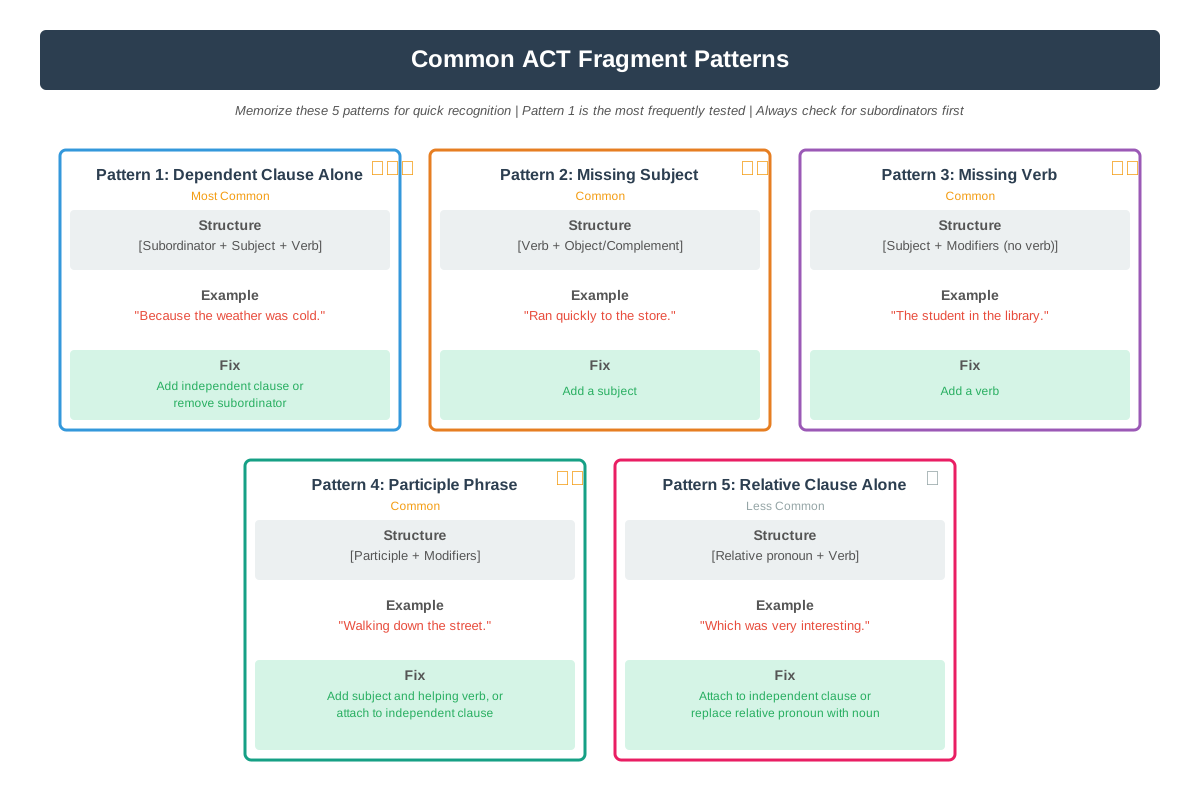
A sentence fragment is a group of words punctuated as a sentence but lacking either a subject, a predicate, or both. The ACT tests three main types of fragments:
| Fragment Type | Characteristic | Example | Correction |
|---|---|---|---|
| Dependent clause fragment | Begins with subordinating conjunction; has subject and verb but cannot stand alone | "Because the weather was cold." | Add independent clause: "Because the weather was cold, we stayed inside." |
| Phrase fragment | Lacks either subject or verb | "Walking down the street." | Add subject and complete verb: "She was walking down the street." |
| Missing subject fragment | Has a verb but no clear subject | "Went to the store yesterday." | Add subject: "Maria went to the store yesterday." |
The Role of Subordinating Conjunctions
Subordinating conjunctions (such as although, because, since, when, while, if, unless, after, before) create dependent clauses that cannot stand alone as complete sentences. When a clause begins with a subordinating conjunction, it must be attached to an independent clause to form a complete sentence.
Fragment: "Although the team practiced every day."
Complete: "Although the team practiced every day, they lost the championship."
The ACT frequently tests this by presenting a dependent clause punctuated as a complete sentence, with answer choices that either maintain the fragment or correct it by removing the subordinating conjunction or adding an independent clause.
Distinguishing Between Fragments and Complete Sentences
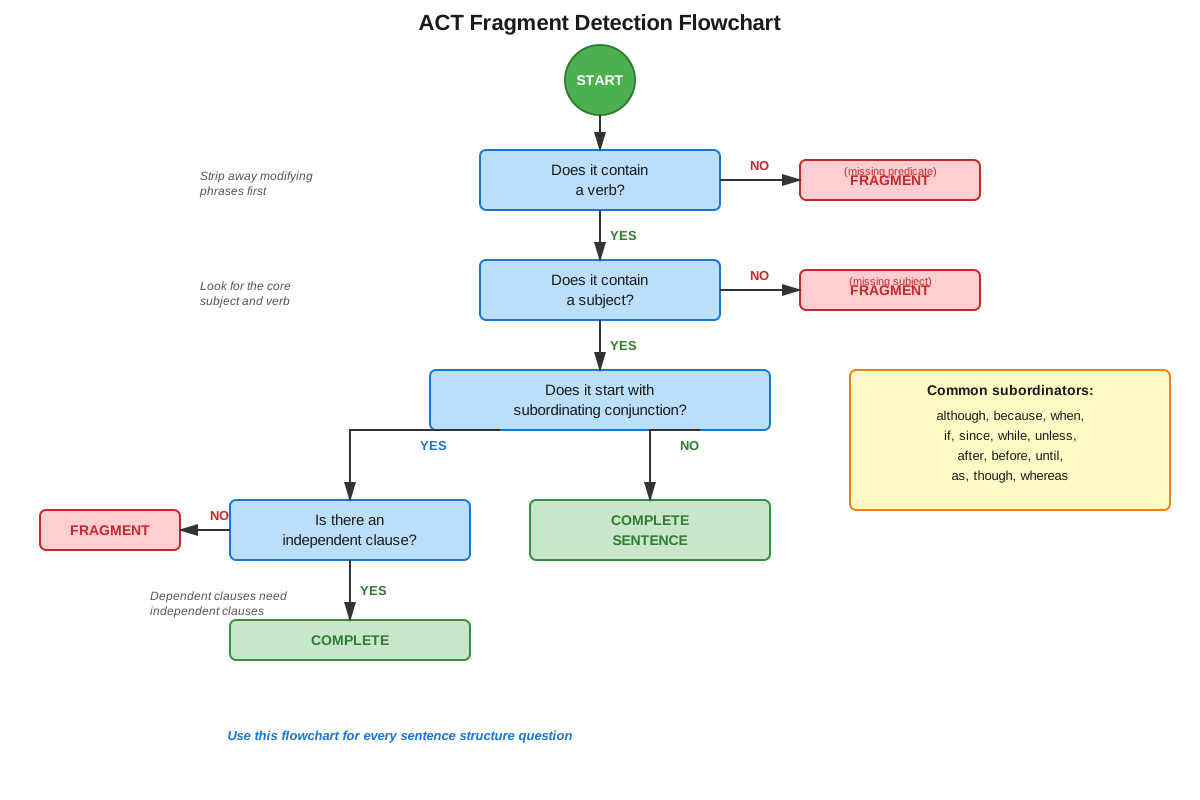
To determine whether a sentence is complete, use this systematic approach:
- Locate the verb: Find the word or words that express action or state of being
- Verify it's a complete verb: Ensure it's not just a participle or infinitive without a helping verb
- Find the subject: Identify who or what is performing the action
- Check for subordinating conjunctions: If the sentence begins with one, ensure an independent clause follows
- Read it aloud: A complete sentence should express a full thought that makes sense standing alone
Common Verb Forms That Create Fragments
Certain verb forms cannot serve as the main verb in a sentence without additional helping verbs:
- Present participles (-ing forms): "running," "thinking," "being"
- Past participles (often -ed, -en, -t forms): "broken," "written," "kept"
- Infinitives (to + verb): "to run," "to think," "to be"
These forms need helping verbs (is, are, was, were, has, have, had, will, would, can, could, etc.) to create complete predicates.
Fragment: "The book written by the famous author."
Complete: "The book was written by the famous author."
Acceptable Sentence Structures
Not all short sentences are fragments. The ACT recognizes several grammatically complete sentence types:
- Simple sentences: One independent clause with subject and predicate ("The dog barked.")
- Commands (imperative sentences): Subject "you" is implied ("Stop!")
- Questions: Complete with subject and predicate, even if inverted ("Did you finish?")
- Exclamations: Express complete thoughts with subject and predicate ("What a beautiful day this is!")
Concept Relationships
Subject and predicate completeness serves as the foundation for all other sentence structure concepts on the ACT. The relationship flows as follows:
Complete Sentence Identification → enables → Fragment Recognition → supports → Run-on Sentence Correction
Before students can identify run-on sentences (two independent clauses improperly joined), they must first verify that each clause contains a complete subject and predicate. Similarly, understanding completeness connects to:
- Comma splice correction: Requires identifying two complete independent clauses incorrectly joined by only a comma
- Coordination and subordination: Demands recognizing which clauses are complete (independent) and which are incomplete (dependent)
- Punctuation rules: Many punctuation decisions depend on whether clauses are complete or incomplete
The prerequisite knowledge of clause types directly enables subject and predicate completeness analysis. Students must distinguish independent clauses (which require both subject and predicate) from dependent clauses (which have both but cannot stand alone due to subordinating conjunctions) and phrases (which lack either subject or predicate).
Within this topic itself, concepts build progressively: understanding what makes subjects and predicates complete → recognizing when they're missing → identifying fragment types → applying correction strategies → evaluating answer choices on the ACT.
Quick check — test yourself on Subject and predicate completeness so far.
Try Flashcards →High-Yield Facts
⭐ A complete sentence must contain both a subject (who/what) and a predicate (action/state of being) and express a complete thought.
⭐ Subordinating conjunctions (although, because, since, when, while, if, unless) create dependent clauses that cannot stand alone as sentences.
⭐ Present participles (-ing verbs) and past participles (-ed/-en verbs) cannot serve as main verbs without helping verbs.
⭐ The ACT frequently tests fragments by presenting dependent clauses punctuated as complete sentences.
⭐ Long descriptive phrases between subject and verb do not make a sentence complete if the essential subject or verb is missing.
- A sentence fragment is a group of words punctuated as a sentence but lacking subject, predicate, or both.
- Prepositional phrases (in the house, on the table, during the meeting) cannot serve as subjects or predicates.
- Commands (imperative sentences) are complete even without an explicit subject because "you" is implied.
- Appositive phrases that rename nouns are not complete predicates even though they provide information.
- Relative pronouns (who, which, that) can introduce dependent clauses that need independent clauses to be complete.
- Infinitive phrases (to + verb) cannot function as the main verb of a sentence.
- A sentence can have a compound subject or compound predicate and still be complete with just one independent clause.
- The ACT will never mark a grammatically complete sentence as incorrect simply because it's short or simple.
Common Misconceptions
Misconception: Any group of words with a verb is a complete sentence.
Correction: The verb must be a complete verb form (not just a participle or infinitive), and the sentence must also have a subject and express a complete thought. "Running quickly" has a verb form but is not complete.
Misconception: Long sentences with many descriptive words are automatically complete.
Correction: Length does not determine completeness. "The beautiful, ornate, historically significant building constructed in 1887" is a long fragment because it lacks a predicate. Subject and predicate completeness depends on grammatical structure, not word count.
Misconception: A sentence beginning with a capital letter and ending with a period is automatically correct.
Correction: Punctuation and capitalization do not make a sentence grammatically complete. The ACT frequently presents fragments with proper punctuation to test whether students can identify the missing grammatical elements.
Misconception: Dependent clauses are incomplete because they're missing subjects or verbs.
Correction: Dependent clauses actually have both subjects and verbs, but they cannot stand alone because they begin with subordinating conjunctions or relative pronouns. "Because she studied hard" has a subject (she) and verb (studied) but is incomplete because "because" makes it dependent.
Misconception: If you can understand what a sentence means from context, it's grammatically complete.
Correction: Comprehensibility and grammatical completeness are different. While readers might understand "After finishing the project" in context, it remains a fragment because it lacks an independent clause with a subject and predicate.
Misconception: Removing words always creates fragments, while adding words always creates complete sentences.
Correction: Sometimes removing unnecessary subordinating conjunctions fixes fragments, and sometimes adding words creates run-on sentences. The goal is grammatical completeness, which may require adding, removing, or changing words.
Misconception: Sentences with multiple subjects or verbs are always complete.
Correction: A sentence can have compound subjects or predicates and still be a fragment if it begins with a subordinating conjunction without an independent clause, or if the verbs are not in complete form.
Worked Examples
Example 1: Identifying and Correcting a Dependent Clause Fragment
Original passage: "The research team collected data from five different countries. Although the sample size was relatively small. The results provided valuable insights into consumer behavior."
Analysis:
Step 1: Examine the second sentence: "Although the sample size was relatively small."
Step 2: Identify the subject: "sample size"
Step 3: Identify the verb: "was"
Step 4: Check for subordinating conjunctions: "Although" begins the sentence
Step 5: Determine if it expresses a complete thought: No—"although" creates a dependent clause that requires an independent clause
Diagnosis: This is a dependent clause fragment. It has a subject and verb but cannot stand alone because "although" makes it dependent.
ACT answer choices might look like:
- A) NO CHANGE
- B) Although, the sample size was relatively small.
- C) The sample size was relatively small.
- D) Although the sample size was relatively small, the
Correct answer: C
Reasoning: Option C removes the subordinating conjunction "although," creating an independent clause with subject "sample size" and predicate "was relatively small." Option A maintains the fragment. Option B incorrectly adds a comma but doesn't fix the fragment. Option D creates a new problem by making the sentence incomplete in a different way.
Connection to learning objectives: This example demonstrates how to identify when subject and predicate completeness is being tested (subordinating conjunction creating a fragment) and how to apply the core rule (remove the subordinating conjunction or attach to an independent clause).
Example 2: Recognizing Missing Predicate
Original passage: "The ancient manuscript, discovered in a monastery in Tibet and carefully preserved for centuries by monks who dedicated their lives to protecting historical documents."
Analysis:
Step 1: Identify potential subject: "manuscript"
Step 2: Look for the main verb: "discovered" and "preserved" are past participles; "dedicated" is also a past participle in a relative clause
Step 3: Check if there's a complete verb: No helping verb accompanies these participles
Step 4: Determine what the sentence says about the manuscript: Nothing—there's no complete predicate
Diagnosis: This is a phrase fragment with a subject but no complete predicate. All the verbs are participles modifying the subject or appearing in dependent clauses.
ACT answer choices might look like:
- A) NO CHANGE
- B) The ancient manuscript, discovered in a monastery in Tibet and carefully preserved for centuries by monks who dedicated their lives to protecting historical documents,
- C) The ancient manuscript was discovered in a monastery in Tibet and carefully preserved for centuries by monks who dedicated their lives to protecting historical documents.
- D) Discovering the ancient manuscript in a monastery in Tibet and carefully preserving it for centuries were monks who dedicated their lives to protecting historical documents.
Correct answer: C
Reasoning: Option C adds the helping verb "was" to create a complete predicate "was discovered...and carefully preserved." Option A maintains the fragment. Option B adds a comma but still lacks a complete predicate. Option D restructures awkwardly and changes the meaning, though it is technically complete.
Connection to learning objectives: This example shows how to identify incomplete predicates even in long, complex sentences with multiple modifying phrases, and demonstrates the strategy of adding helping verbs to participles to create completeness.
Exam Strategy
When approaching ACT questions testing subject and predicate completeness, follow this systematic process:
Step 1: Identify the question type
Look for underlined portions that include:
- Sentence beginnings (especially with subordinating conjunctions)
- Punctuation marks (periods, semicolons) that separate clauses
- Verb forms that might be incomplete
- Answer choices that vary significantly in length or structure
Step 2: Apply the completeness test
For any sentence in question, ask:
- Where is the subject? (Who or what is this about?)
- Where is the complete verb? (What action or state of being?)
- Does this express a complete thought?
- Are there any subordinating conjunctions making this dependent?
Step 3: Watch for trigger words and phrases
High-yield trigger words: although, because, since, when, while, if, unless, after, before, as, whereas, whether
When you see these words beginning a sentence, immediately check whether an independent clause follows. If the sentence ends without one, it's likely a fragment.
Step 4: Use elimination strategically
- Eliminate any answer choice that creates a fragment (no subject, no complete verb, or dependent clause standing alone)
- Eliminate choices that add unnecessary subordinating conjunctions to complete sentences
- Keep choices that either remove subordinating conjunctions or properly connect dependent clauses to independent ones
Step 5: Read in context
Sometimes the ACT presents a fragment that should be connected to the previous or following sentence. Read one sentence before and after the underlined portion to determine if combining sentences would create completeness.
Time allocation: Subject and predicate completeness questions should take 20-30 seconds each once you've mastered the concept. If you're spending more than 45 seconds, mark the question and return to it after completing easier questions.
Process-of-elimination tip: On the ACT, if three answer choices create complete sentences and one creates a fragment, the fragment is almost certainly wrong. Conversely, if three choices create fragments and one creates a complete sentence, the complete sentence is almost certainly correct.
Memory Techniques
SIPS Mnemonic for Completeness Check:
- Subject: Who or what?
- Independent: Can it stand alone?
- Predicate: What's the complete action/state?
- Subordinator: Any dependent-making words?
The "Stand Alone" Test: Imagine each sentence is a person at a party. Can it stand alone and make sense, or does it need to lean on another sentence for support? Complete sentences stand alone; fragments need support.
Subordinator Song: Remember common subordinating conjunctions with the acronym A WHITE BUS:
- Although, After, As
- When, While, Whereas
- How
- If
- Though
- Even though
- Because, Before
- Unless, Until
- Since
Participle Alert: When you see an -ing or -ed verb, visualize a red flag. Ask: "Where's the helper?" (helping verb). No helper = incomplete predicate.
The Capital-Period Trap: Visualize a trap with a capital letter as the entrance and a period as the exit. Just because words walk through this trap doesn't mean they're a complete sentence. Check the structure inside!
Summary
Subject and predicate completeness is a foundational sentence structure concept that appears frequently on the ACT English test. A complete sentence must contain both a subject (who or what the sentence is about) and a complete predicate (what the subject does or what is being said about it), and it must express a complete thought. The ACT tests this concept by presenting sentence fragments—groups of words punctuated as sentences but lacking essential grammatical elements. Common fragment types include dependent clauses beginning with subordinating conjunctions, phrases with incomplete verb forms (participles without helping verbs), and sentences missing either subjects or predicates. To identify and correct these errors, students must systematically locate subjects and verbs, verify that verbs are complete forms, check for subordinating conjunctions that create dependency, and ensure each sentence can stand alone as a complete thought. Mastering this topic requires recognizing that length and complexity don't determine completeness—only proper grammatical structure does.
Key Takeaways
- Every complete sentence must have both a subject and a complete predicate that together express a full thought
- Subordinating conjunctions (although, because, when, while, if, since) create dependent clauses that cannot stand alone as sentences
- Participles (-ing and -ed verb forms) need helping verbs to create complete predicates
- The ACT frequently disguises fragments with long descriptive phrases or complex punctuation
- Length and comprehensibility don't determine grammatical completeness—structure does
- Apply the SIPS test (Subject, Independent, Predicate, Subordinator) to verify completeness
- When in doubt, check if the sentence can stand alone and make complete sense without surrounding context
Related Topics
Run-on Sentences and Comma Splices: After mastering subject and predicate completeness, students learn how to handle the opposite problem—two complete sentences improperly joined. Understanding what makes sentences complete is essential for recognizing when two independent clauses need proper punctuation or conjunctions.
Coordination and Subordination: This advanced topic builds directly on subject and predicate completeness by teaching students how to properly combine complete and incomplete clauses using coordinating conjunctions, subordinating conjunctions, and appropriate punctuation.
Verb Tense and Form: Recognizing complete predicates requires understanding verb forms, which connects to the broader topic of verb tense consistency and proper verb usage throughout passages.
Modification and Parallelism: Once students can identify core sentence structures (subject and predicate), they can better understand how modifying phrases attach to sentences and how parallel structures should maintain consistent grammatical forms.
Practice CTA
Now that you've mastered the core concepts of subject and predicate completeness, it's time to reinforce your learning through active practice. Complete the practice questions to test your ability to identify fragments and select corrections under timed conditions, just as you'll encounter on test day. Use the flashcards to drill the high-yield facts and common subordinating conjunctions until recognition becomes automatic. Remember: understanding the concept is just the first step—consistent practice transforms knowledge into the quick, confident decision-making that leads to a higher ACT score. You've built a strong foundation; now strengthen it through application!
Sign up free to keep reading
Create a free AnvayaPrep account to finish this ACT guide on Subject and predicate completeness — plus flashcards and practice questions.