Overview
Combining like terms is one of the most fundamental algebraic skills tested on the ACT Math section. This technique involves simplifying algebraic expressions by adding or subtracting terms that share identical variable components and exponents. Mastery of this skill is absolutely essential because it appears not only as a standalone concept but also as a critical step in solving equations, simplifying expressions, factoring polynomials, and working with functions. Students who can quickly and accurately combine like terms gain a significant advantage on the ACT, as this skill underlies approximately 15-20% of all algebra questions on the exam.
The ability to identify and combine like terms efficiently separates students who struggle with algebraic manipulation from those who breeze through multi-step problems. On the ACT, ACT combining like terms questions rarely appear in isolation; instead, they're embedded within larger problems involving equation solving, coordinate geometry, or word problems. A student might need to combine like terms to simplify an expression before factoring, to collect variables on one side of an equation, or to simplify the result of distributing terms across parentheses. The skill becomes automatic with practice, reducing cognitive load and allowing students to focus on the problem-solving strategy rather than mechanical manipulation.
Understanding combining like terms creates a foundation for virtually all higher-level algebra topics. It connects directly to the distributive property, polynomial operations, solving linear and quadratic equations, and even calculus concepts that occasionally appear on the ACT. Students who master this topic develop algebraic fluency that accelerates their problem-solving speed across the entire Math section, making it one of the highest-yield topics to perfect during ACT preparation.
Learning Objectives
- [ ] Identify when combining like terms is being tested in ACT questions
- [ ] Explain the core rule or strategy behind combining like terms
- [ ] Apply combining like terms to ACT-style questions accurately
- [ ] Distinguish between like terms and unlike terms in complex expressions containing multiple variables
- [ ] Simplify expressions involving fractions, decimals, and negative coefficients through combining like terms
- [ ] Recognize when combining like terms is a necessary intermediate step in multi-step ACT problems
Prerequisites
- Basic arithmetic operations: Addition, subtraction, multiplication, and division are required to manipulate coefficients when combining terms
- Understanding of variables: Recognition that letters represent unknown quantities and that the same letter in an expression represents the same value
- Exponent rules: Knowledge that x² and x are different terms because they have different exponents
- Order of operations: Understanding PEMDAS to know when combining like terms should occur in the simplification process
- Distributive property: The ability to expand expressions like 3(x + 2) before combining like terms
Why This Topic Matters
In real-world applications, combining like terms represents the mathematical process of consolidating similar quantities. When calculating total costs (3 apples + 5 apples = 8 apples, but 3 apples + 5 oranges cannot be combined), budgeting with multiple expense categories, or analyzing scientific data with multiple variables, the principle of combining like terms ensures accurate calculations. Engineers use this skill when simplifying formulas, economists apply it when modeling financial systems, and computer scientists employ it when optimizing algorithms.
On the ACT Math section, combining like terms appears with remarkable frequency. Research of released ACT exams shows that approximately 8-12 questions per test either directly test this skill or require it as an essential step toward the solution. These questions typically appear in several formats: pure simplification problems (worth 1 point each), as intermediate steps in equation-solving questions, within coordinate geometry problems requiring slope or distance calculations, and embedded in word problems where students must first translate English into algebra before simplifying. The skill appears across difficulty levels, from early easy questions to challenging problems in the final third of the Math section.
Common ACT question types include: simplifying polynomial expressions after distribution, collecting variable terms when solving for x, combining terms in function notation problems, simplifying expressions before factoring, and reducing complex fractions with algebraic numerators or denominators. The ACT particularly favors questions that combine this skill with the distributive property, requiring students to first expand parentheses and then combine the resulting like terms—a two-step process that trips up unprepared students.
Core Concepts
Definition of Like Terms
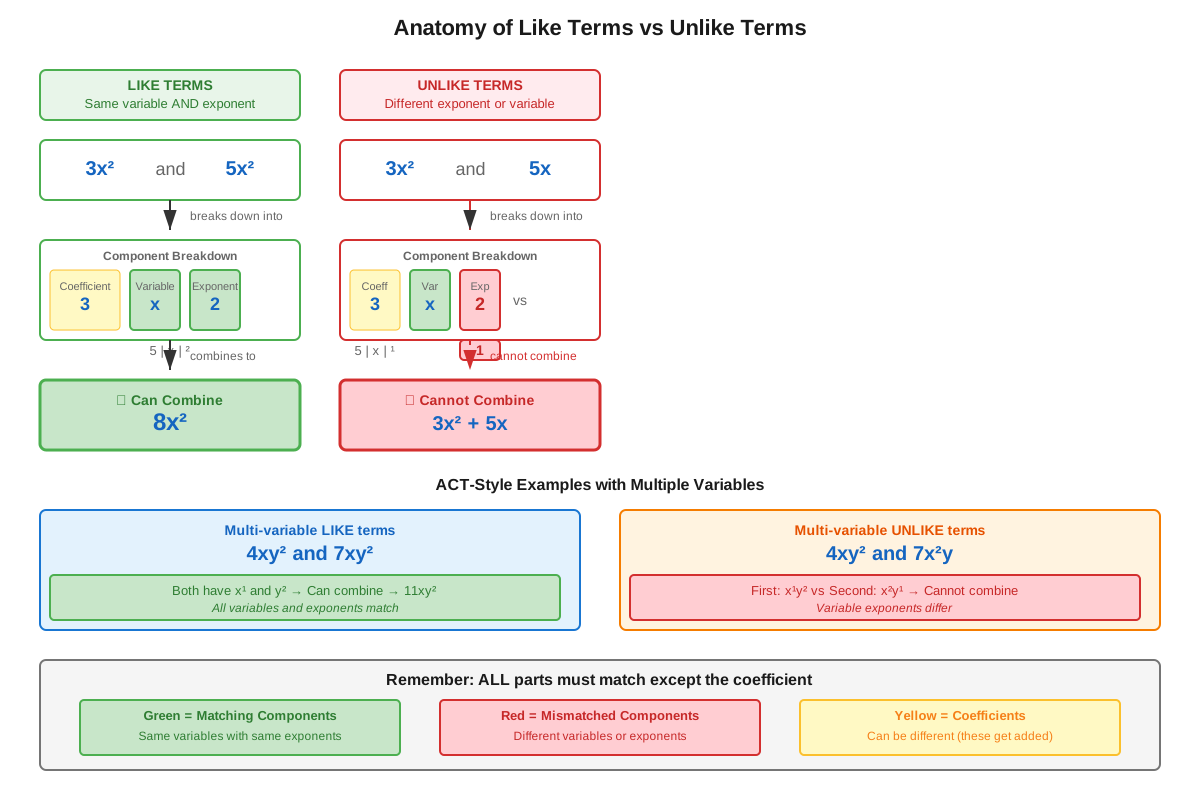
Like terms are algebraic terms that contain exactly the same variables raised to exactly the same powers. The coefficients (the numerical parts) can differ, but the variable components must be identical. For example, 3x and 7x are like terms because both contain the variable x raised to the first power. Similarly, 4x²y and -9x²y are like terms because both contain x² and y. However, 5x and 5x² are NOT like terms because the exponents differ, and 3xy and 3xz are NOT like terms because the variables differ.
The key principle: only the coefficients change when combining like terms; the variable part remains unchanged. When adding 3x + 7x, think of it as 3(x) + 7(x) = (3 + 7)(x) = 10x. The variable x is a common factor that remains in the simplified expression.
Identifying Like Terms
To identify like terms in an expression, examine each term's variable component:
- List all variables in each term
- Check the exponent on each variable
- Match terms that have identical variable-exponent combinations
- Ignore coefficients during the matching process
Consider the expression: 5x² + 3xy - 2x² + 7y - 4xy + 9
| Term | Variables | Exponents | Like Terms Group |
|---|---|---|---|
| 5x² | x | 2 | Group A |
| 3xy | x, y | 1, 1 | Group B |
| -2x² | x | 2 | Group A |
| 7y | y | 1 | Group C |
| -4xy | x, y | 1, 1 | Group B |
| 9 | none | n/a | Group D (constants) |
The Combining Process
To combine like terms systematically:
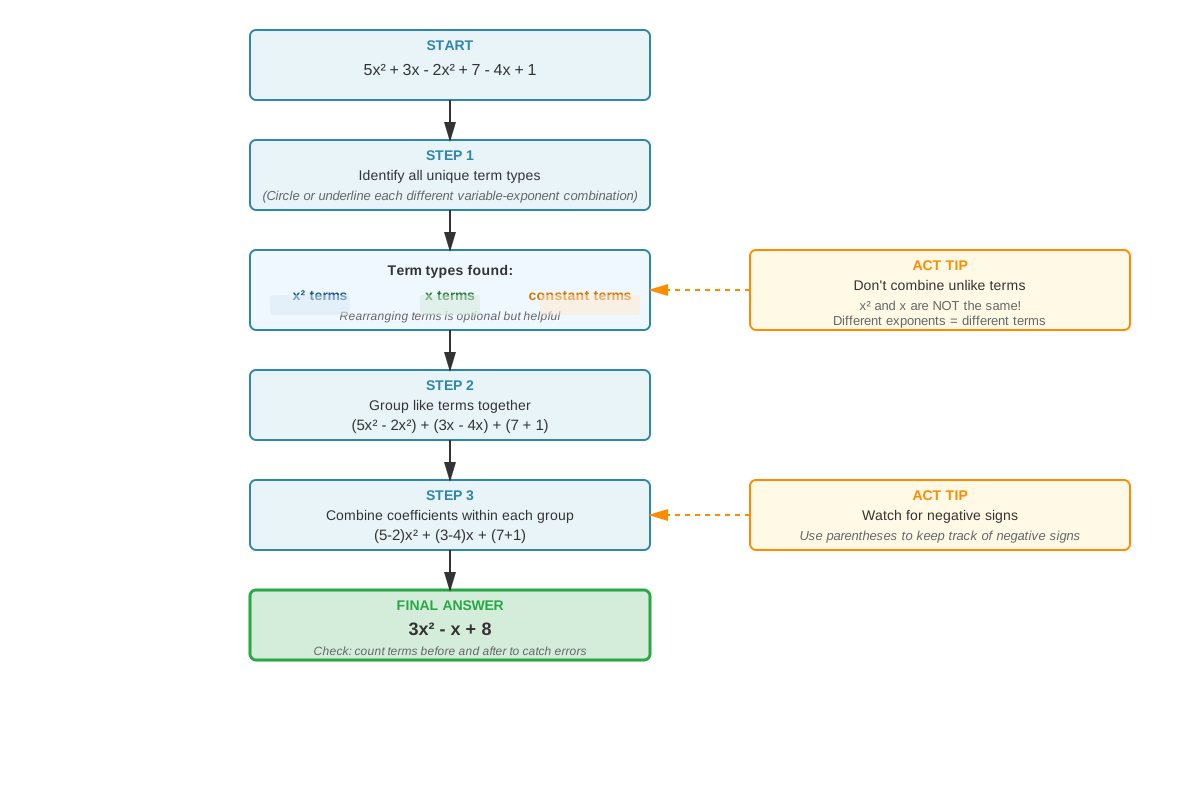
- Identify all like terms in the expression
- Keep the variable part exactly as it appears
- Add or subtract the coefficients according to their signs
- Write the simplified term with the combined coefficient and original variable part
- Repeat for each group of like terms
- Write the final expression with all simplified terms
For the expression 5x² + 3xy - 2x² + 7y - 4xy + 9:
- Group A (x² terms): 5x² - 2x² = 3x²
- Group B (xy terms): 3xy - 4xy = -xy
- Group C (y terms): 7y (only one term, already simplified)
- Group D (constants): 9 (only one term, already simplified)
Final answer: 3x² - xy + 7y + 9
Special Cases and Considerations
Constants are like terms: All numbers without variables are like terms with each other. In the expression 5x + 3 - 2x + 7, the constants 3 and 7 combine to give 10.
Negative coefficients: Pay careful attention to signs. When combining 4x - 7x, think of it as 4x + (-7x) = -3x. The negative sign belongs to the coefficient.
Fractional coefficients: Terms like (1/2)x and (3/4)x are like terms. Combine them by finding a common denominator: (1/2)x + (3/4)x = (2/4)x + (3/4)x = (5/4)x.
Multiple variables: For terms like 3x²y³ and -5x²y³, all variables and all exponents must match. These are like terms that combine to give -2x²y³.
Order doesn't matter: The commutative property means 3x + 5y + 2x can be rearranged to 3x + 2x + 5y before combining.
Common Expression Types on the ACT
Linear expressions: 4x + 7 - 2x + 3 simplifies to 2x + 10
Quadratic expressions: 3x² + 5x - x² + 2x simplifies to 2x² + 7x
Multi-variable expressions: 2a + 3b - 5a + b simplifies to -3a + 4b
Expressions after distribution: 3(2x + 1) + 4(x - 2) expands to 6x + 3 + 4x - 8, which simplifies to 10x - 5
Concept Relationships
The skill of combining like terms sits at the intersection of several fundamental algebraic concepts. It directly builds upon understanding of variables (recognizing that x represents a quantity) and coefficient recognition (identifying the numerical multiplier). The process relies heavily on integer operations, particularly addition and subtraction with positive and negative numbers, since combining coefficients requires accurate arithmetic with signs.
Combining like terms → enables → Simplifying polynomial expressions: Once terms are combined, polynomials become easier to evaluate, factor, or graph.
Distributive property → requires → Combining like terms: After expanding expressions like 2(x + 3) + 5(x - 1), students must combine the resulting like terms to complete the simplification.
Combining like terms → prerequisite for → Solving equations: To solve 3x + 5 = 2x + 11, students must combine like terms by moving all x terms to one side (3x - 2x = 11 - 5).
Combining like terms → connects to → Function operations: When adding or subtracting functions, like f(x) + g(x), the result requires combining like terms in the expressions.
The relationship map: Variables & Coefficients → Identifying Like Terms → Combining Like Terms → Simplified Expressions → Equation Solving, Factoring, Graphing
This skill also connects forward to more advanced topics. In coordinate geometry, combining like terms helps simplify slope calculations and distance formulas. In systems of equations, it's essential for the elimination method. Even in trigonometry problems that occasionally appear on the ACT, combining like trigonometric terms follows the same principles.
Quick check — test yourself on Combining like terms so far.
Try Flashcards →High-Yield Facts
⭐ Like terms must have identical variables raised to identical exponents; only coefficients can differ
⭐ When combining like terms, add or subtract only the coefficients; the variable part remains unchanged
⭐ Constants (numbers without variables) are always like terms with each other
⭐ The terms 3x and 3x² are NOT like terms because the exponents differ (1 vs. 2)
⭐ Combining like terms is required after using the distributive property to fully simplify expressions
- The order of terms doesn't affect the final answer due to the commutative property of addition
- Negative signs belong to the coefficient that follows them: in 5x - 3x, the second term is -3x
- Terms with no visible coefficient have an implied coefficient of 1: x means 1x
- Terms with multiple variables must match ALL variables and ALL exponents to be like terms
- Combining like terms reduces the number of terms in an expression but doesn't change its value
- On the ACT, expressions with 4-6 terms commonly reduce to 2-3 terms after combining like terms
- Fractional coefficients require finding common denominators before combining
- The expression 0x simplifies to 0, so terms that cancel completely disappear from the final answer
Common Misconceptions
Misconception: Terms with the same coefficient are like terms (e.g., 3x and 3y can be combined)
Correction: Like terms must have identical variable parts, not identical coefficients. 3x and 3y cannot be combined because x and y are different variables. The coefficient similarity is irrelevant.
Misconception: When combining 5x + 3x, the answer is 8x²
Correction: Combining like terms involves adding coefficients, not exponents. 5x + 3x = 8x. The variable part (x) stays the same; only the coefficients (5 and 3) are added to get 8.
Misconception: The terms 4x and 4 are like terms because they both have 4
Correction: A constant (4) and a variable term (4x) are not like terms. Think of 4 as 4x⁰ and 4x as 4x¹—the exponents differ, so they cannot be combined.
Misconception: In the expression 7 - 3x + 2x, the answer is 9x because 7 + 2 = 9
Correction: Constants and variable terms cannot be combined. First combine the x terms: -3x + 2x = -x. The final answer is 7 - x (or -x + 7). The 7 remains separate.
Misconception: When simplifying 2(x + 3) + 4x, you can combine 2 and 4x first to get 6x + 3
Correction: You must distribute before combining like terms. First: 2(x + 3) = 2x + 6. Then: 2x + 6 + 4x = 6x + 6. Following the correct order of operations is essential.
Misconception: The terms 5xy and 5yx are different and cannot be combined
Correction: Due to the commutative property of multiplication, xy = yx. These are like terms: 5xy + 5yx = 10xy.
Misconception: Combining 3x² - 5x² gives -2
Correction: The variable part must remain in the answer. 3x² - 5x² = -2x². The x² doesn't disappear; only the coefficients are subtracted.
Worked Examples
Example 1: Multi-Step Simplification with Distribution
Problem: Simplify the expression 4(2x - 3) + 5(x + 2) - 3x
Solution:
Step 1: Apply the distributive property to each set of parentheses
- 4(2x - 3) = 8x - 12
- 5(x + 2) = 5x + 10
Step 2: Rewrite the expression with distributed terms
- 8x - 12 + 5x + 10 - 3x
Step 3: Identify like terms
- x terms: 8x, 5x, -3x
- Constant terms: -12, 10
Step 4: Combine like terms
- x terms: 8x + 5x - 3x = 10x
- Constants: -12 + 10 = -2
Step 5: Write the final simplified expression
- 10x - 2
Connection to learning objectives: This problem demonstrates the ACT's common pattern of combining distribution with like terms. Recognizing this two-step process is essential for identifying when combining like terms is being tested.
Example 2: Complex Expression with Multiple Variables
Problem: Simplify 3a²b - 5ab² + 2a²b + 7ab² - ab² + 4
Solution:
Step 1: Identify groups of like terms by examining variable-exponent combinations
- Group 1 (a²b terms): 3a²b, 2a²b
- Group 2 (ab² terms): -5ab², 7ab², -ab²
- Group 3 (constants): 4
Step 2: Combine Group 1 (a²b terms)
- 3a²b + 2a²b = 5a²b
Step 3: Combine Group 2 (ab² terms)
- -5ab² + 7ab² - ab² = -5ab² + 7ab² - 1ab² = 1ab² = ab²
- (Remember: -ab² means -1ab²)
Step 4: Group 3 is already simplified
- 4 (only one constant term)
Step 5: Write the final answer with all simplified groups
- 5a²b + ab² + 4
Connection to learning objectives: This example shows how to distinguish between like terms when multiple variables are present. Notice that a²b and ab² are NOT like terms because the exponents on a and b differ between the two expressions. This type of problem frequently appears in the middle-to-difficult range of ACT questions.
Exam Strategy
When approaching ACT questions involving combining like terms, follow this strategic process:
Recognition triggers: Watch for these phrases and formats that signal combining like terms is required:
- "Simplify the expression..."
- "Which of the following is equivalent to..."
- "What is the value of [expression] when simplified?"
- Any problem showing an expression with multiple terms containing the same variables
- Questions that provide an expanded form and ask for a simplified form
Step-by-step approach:
- Scan the expression for repeated variable patterns before doing any work
- Circle or underline groups of like terms mentally or on scratch paper
- Handle distribution first if parentheses are present
- Combine one group at a time rather than trying to do everything simultaneously
- Double-check signs carefully, especially with subtraction and negative coefficients
- Verify your answer by checking that no like terms remain uncombined
Process of elimination tips:
- Eliminate answer choices that have different numbers of terms than your simplified expression
- Eliminate answers where the variable parts don't match your result (e.g., if you got x², eliminate answers with x³)
- Check the constant term first—it's often the easiest to verify and can eliminate 2-3 wrong answers immediately
- If two answers differ only in the sign of one term, carefully recheck your arithmetic with signs
Time management: Combining like terms problems should take 30-45 seconds on average. If you find yourself spending more than one minute, you may be overcomplicating the problem. These questions test mechanical skill, not complex reasoning, so a systematic approach should yield quick results. Practice until the process becomes automatic.
Common trap answers: The ACT often includes wrong answers that result from:
- Combining unlike terms (e.g., adding x and x² together)
- Forgetting to distribute before combining
- Sign errors (getting 2x instead of -2x)
- Combining coefficients incorrectly (arithmetic errors)
Memory Techniques
VASE mnemonic for identifying like terms:
- Variables must match
- All exponents must match
- Signs affect coefficients only
- Everything else (the variable part) stays the same
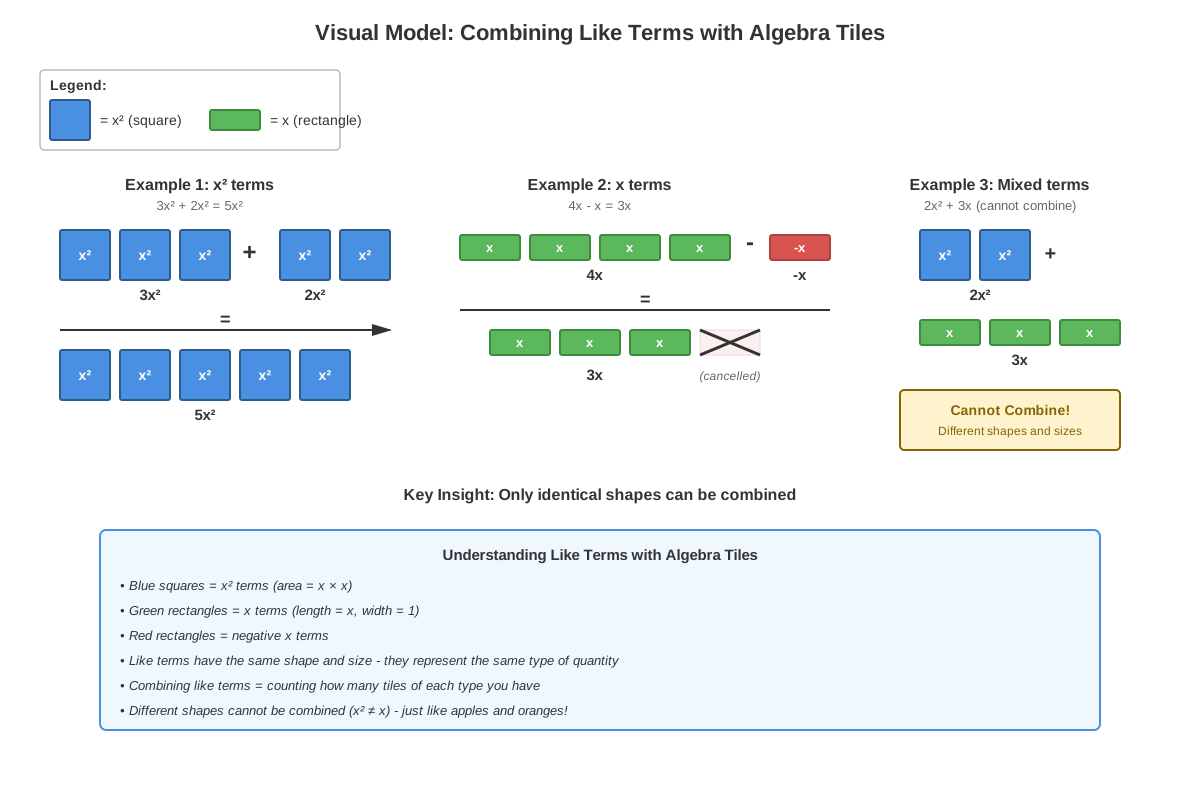
The "Fruit Basket" visualization: Imagine like terms as identical fruits. You can count "3 apples + 5 apples = 8 apples," but you cannot combine "3 apples + 5 oranges" into a single fruit type. The variable is the fruit type; the coefficient is the count.
"Coefficient Changes, Variables Stay" mantra: Repeat this phrase when combining terms. It reinforces that only the numerical part changes during the combining process.
The "Same Outfit" rule: Like terms wear the same "outfit" (same variables with same exponents). Only terms wearing identical outfits can be combined. 3x² and 5x² wear the same outfit (x²), but 3x² and 5x wear different outfits.
Sign tracking technique: When dealing with subtraction, rewrite the expression with addition of negative terms. Change "5x - 3x" to "5x + (-3x)" to make the arithmetic clearer and reduce sign errors.
Summary
Combining like terms is a foundational algebraic skill that requires students to identify terms with identical variable components and exponents, then add or subtract their coefficients while keeping the variable part unchanged. This process appears throughout the ACT Math section, both as a standalone simplification task and as a critical intermediate step in solving equations, working with functions, and manipulating polynomial expressions. Success requires careful attention to three elements: recognizing which terms are "like" (same variables, same exponents), performing accurate arithmetic with the coefficients (especially with negative numbers), and maintaining the variable structure in the final answer. The ACT frequently combines this skill with the distributive property, creating two-step problems where students must first expand parentheses and then combine the resulting like terms. Mastery comes from systematic practice that develops pattern recognition and automatic execution, allowing students to simplify expressions quickly and accurately under test conditions.
Key Takeaways
- Like terms have identical variables raised to identical exponents; only coefficients differ
- When combining like terms, add or subtract coefficients only—the variable part remains unchanged
- Constants are always like terms with each other and combine separately from variable terms
- Distribution must be completed before combining like terms in expressions with parentheses
- The ACT tests this skill both directly (simplification problems) and indirectly (as steps in larger problems)
- Careful sign tracking prevents the most common errors on these questions
- Systematic identification of like term groups before combining reduces mistakes and saves time
Related Topics
Distributive Property: Expanding expressions like a(b + c) creates terms that must then be combined. Mastering combining like terms makes distribution problems significantly easier.
Solving Linear Equations: Moving all variable terms to one side and constants to the other requires combining like terms as a key step.
Polynomial Operations: Adding, subtracting, and multiplying polynomials all require combining like terms to express answers in simplified form.
Factoring: Before factoring expressions, they often must be simplified by combining like terms to reveal factorable patterns.
Function Notation: Operations with functions like f(x) + g(x) require combining like terms in the resulting expression.
Practice CTA
Now that you understand the principles and strategies for combining like terms, it's time to solidify your mastery through practice. Work through the practice questions to apply these concepts to ACT-style problems, and use the flashcards to reinforce the key definitions and rules. Remember, combining like terms is a skill that becomes faster and more automatic with repetition—each practice problem you complete builds the fluency that will save you valuable time on test day. You've got this!
Sign up free to keep reading
Create a free AnvayaPrep account to finish this ACT guide on Combining like terms — plus flashcards and practice questions.