Overview
The distributive property is one of the most fundamental algebraic principles tested on the ACT Math section, appearing in approximately 10-15% of all algebra questions. This property describes how multiplication interacts with addition and subtraction, allowing students to expand expressions, simplify equations, and solve complex problems efficiently. Mastery of the distributive property is not merely about memorizing a formula—it's about recognizing when and how to apply this principle across diverse problem types, from basic polynomial expansion to multi-step equation solving.
On the ACT, the ACT distributive property questions rarely appear in isolation. Instead, they're woven into more complex problems involving factoring, combining like terms, solving equations, and simplifying algebraic expressions. Students who can quickly identify when distribution is required—and execute it flawlessly—gain significant time advantages and accuracy improvements. The property serves as a bridge between arithmetic and algebra, making it essential for success on medium to high-difficulty questions.
Understanding the distributive property creates a foundation for advanced algebraic manipulation, including polynomial operations, factoring techniques, and equation solving strategies. It connects directly to concepts like combining like terms, order of operations, and the properties of real numbers. Students who struggle with this topic often find themselves unable to progress through multi-step problems, making it a critical skill for achieving competitive ACT Math scores.
Learning Objectives
- [ ] Identify when Distributive property is being tested in ACT questions
- [ ] Explain the core rule or strategy behind Distributive property
- [ ] Apply Distributive property to ACT-style questions accurately
- [ ] Recognize and correct common distribution errors, particularly with negative signs
- [ ] Use the distributive property in reverse (factoring) to simplify expressions
- [ ] Combine the distributive property with other algebraic operations in multi-step problems
- [ ] Evaluate expressions using distribution with fractions, decimals, and variables
Prerequisites
- Basic multiplication and addition operations: The distributive property fundamentally combines these operations, requiring fluency with both
- Understanding of negative numbers: Distribution with negative values is a common error source that requires solid integer operation skills
- Variable manipulation: Since most ACT applications involve algebraic expressions, comfort with variables and coefficients is essential
- Order of operations (PEMDAS): Knowing when to distribute versus when to simplify parentheses first prevents systematic errors
- Combining like terms: Distribution often produces terms that must be combined, making this skill necessary for complete solutions
Why This Topic Matters
The distributive property appears in real-world applications ranging from calculating total costs with tax (price × quantity + tax × quantity) to determining areas of composite shapes and analyzing financial scenarios with multiple rates. Engineers use distribution when simplifying complex formulas, while business professionals apply it when calculating bulk pricing with discounts. The mental flexibility developed through mastering distribution enhances problem-solving abilities across quantitative disciplines.
On the ACT Math section, distributive property questions appear in approximately 3-5 questions per test, but the skill is required as a component step in 10-15 additional problems. Questions may directly test distribution through expression simplification, or embed it within equation solving, polynomial operations, or word problems. The property appears most frequently in questions numbered 20-45 (medium difficulty range), though it's also essential for several high-difficulty questions in the 46-60 range.
Common ACT question formats include: expanding expressions like 3(2x - 5), simplifying expressions with multiple distribution steps such as 2(x + 3) - 4(x - 1), solving equations requiring distribution before combining like terms, factoring expressions (reverse distribution), and word problems where distribution models real-world scenarios. The ACT particularly favors questions that combine distribution with negative signs, as this tests both conceptual understanding and careful execution.
Core Concepts
The Fundamental Distributive Property
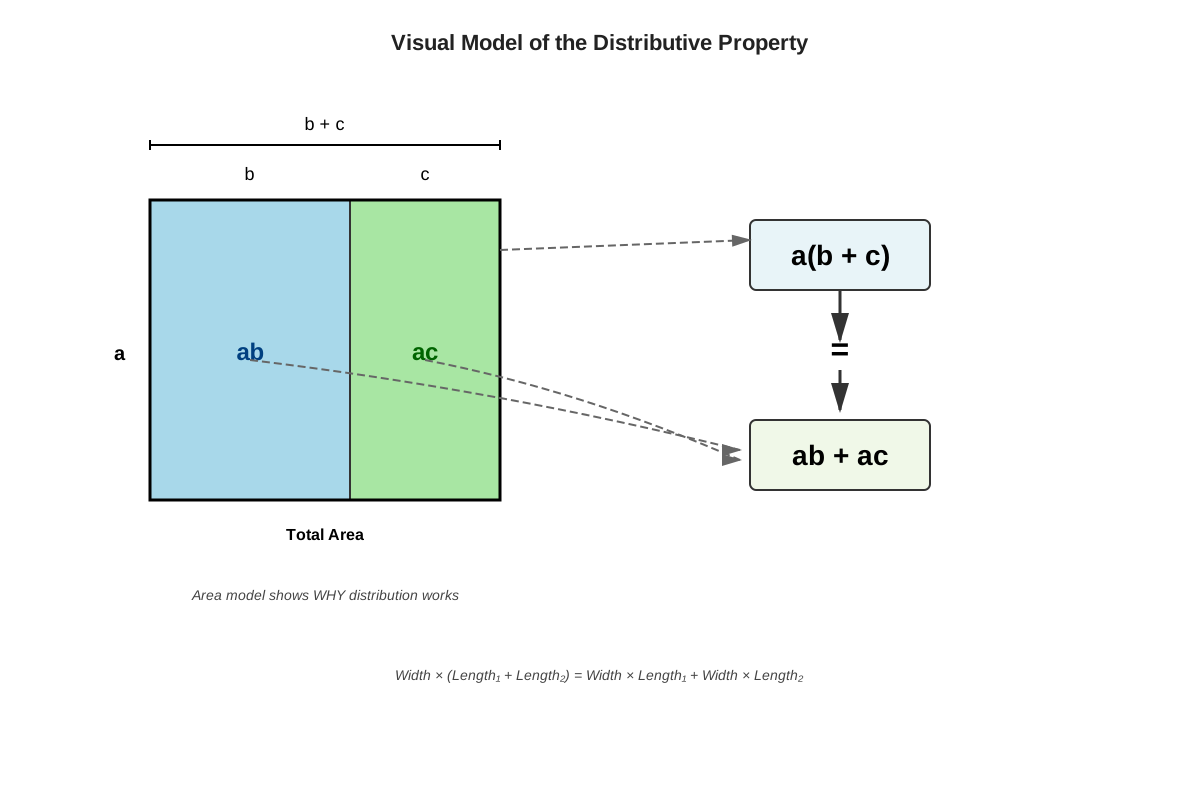
The distributive property states that for any real numbers a, b, and c:
a(b + c) = ab + acThis principle means that when a number or variable multiplies a sum (or difference), it multiplies each term inside the parentheses separately. The property works identically with subtraction:
a(b - c) = ab - acThe key insight is that multiplication "distributes" over addition and subtraction. This property is axiomatic in algebra—it's a fundamental rule that defines how our number system operates, not something that needs proof at this level.
Standard Distribution (Expanding Expressions)
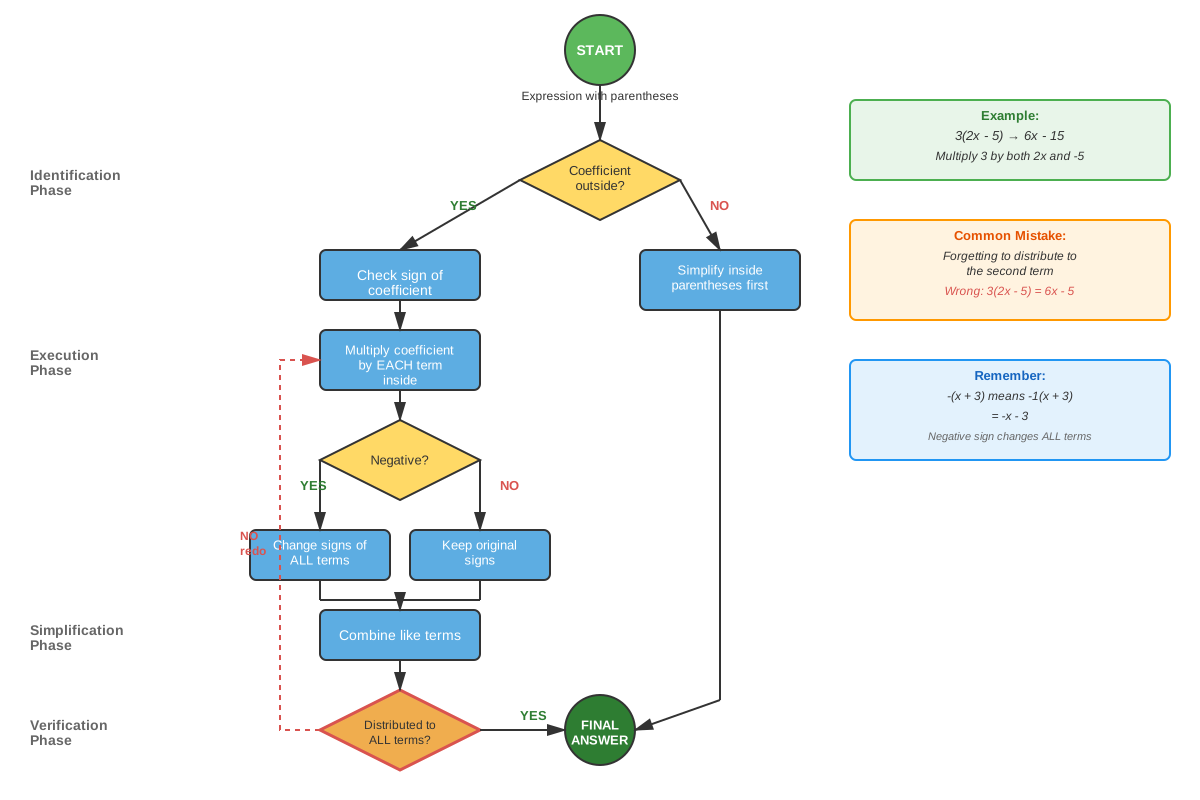
When applying distribution, follow these steps:
- Identify the term outside the parentheses (the multiplier)
- Multiply this term by each term inside the parentheses
- Maintain the operation signs (+ or -) between terms
- Simplify the resulting expression by combining like terms if possible
Example: Expand 5(3x + 4)
- Multiply 5 by 3x: 5 × 3x = 15x
- Multiply 5 by 4: 5 × 4 = 20
- Result: 15x + 20
Distribution with Negative Multipliers
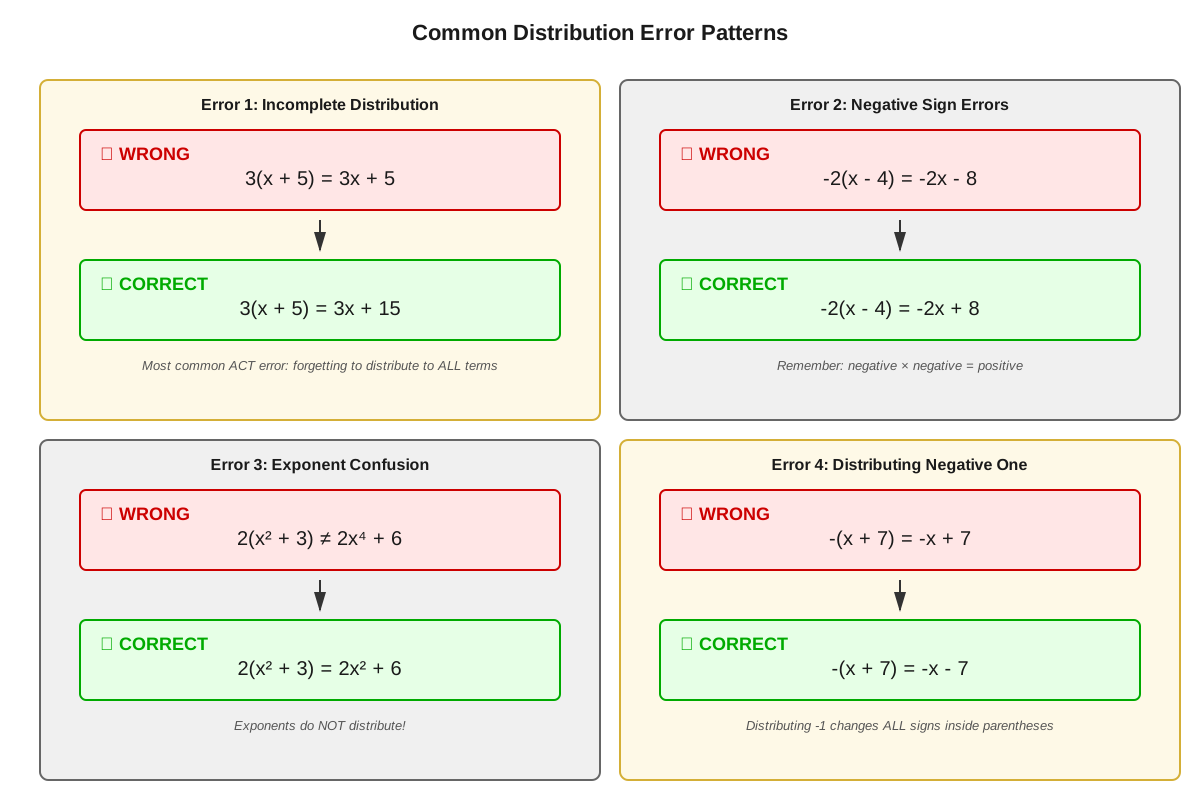
One of the most error-prone scenarios involves distributing a negative number or negative variable. When the multiplier is negative, it changes the sign of every term inside the parentheses:
-a(b + c) = -ab - acCritical Rule: A negative sign outside parentheses distributes to every term inside, changing all signs.
Example: Expand -3(2x - 5)
- Multiply -3 by 2x: -3 × 2x = -6x
- Multiply -3 by -5: -3 × (-5) = +15
- Result: -6x + 15
Distribution with Variables
When the multiplier contains variables, apply the same principle while following exponent rules:
Example: Expand 2x(3x² - 4x + 7)
- 2x × 3x² = 6x³
- 2x × (-4x) = -8x²
- 2x × 7 = 14x
- Result: 6x³ - 8x² + 14x
Double Distribution (FOIL and Beyond)
When two binomials multiply, distribution occurs twice. The FOIL method (First, Outer, Inner, Last) is a specific application:
(a + b)(c + d) = ac + ad + bc + bdExample: Expand (2x + 3)(x - 4)
- First: 2x × x = 2x²
- Outer: 2x × (-4) = -8x
- Inner: 3 × x = 3x
- Last: 3 × (-4) = -12
- Result: 2x² - 8x + 3x - 12 = 2x² - 5x - 12
Reverse Distribution (Factoring)
Factoring is the distributive property applied in reverse. When terms share a common factor, it can be "factored out":
ab + ac = a(b + c)Example: Factor 12x² + 18x
- Identify the greatest common factor (GCF): 6x
- Divide each term by 6x: 12x² ÷ 6x = 2x, and 18x ÷ 6x = 3
- Result: 6x(2x + 3)
Distribution in Equations
When solving equations, distribution often serves as the first step before combining like terms and isolating variables:
Example: Solve 3(x - 2) = 15
- Distribute: 3x - 6 = 15
- Add 6 to both sides: 3x = 21
- Divide by 3: x = 7
Distribution with Fractions and Decimals
The distributive property works identically with fractions and decimals, though calculations require more care:
Example: Expand ½(6x - 8)
- ½ × 6x = 3x
- ½ × (-8) = -4
- Result: 3x - 4
| Distribution Type | Example | Result |
|---|---|---|
| Positive integer | 4(x + 5) | 4x + 20 |
| Negative integer | -2(3x - 7) | -6x + 14 |
| Variable | x(x + 3) | x² + 3x |
| Fraction | ⅓(9x - 6) | 3x - 2 |
| Binomial × Binomial | (x + 2)(x - 5) | x² - 3x - 10 |
Concept Relationships
The distributive property serves as a central hub connecting multiple algebraic concepts. It builds directly on multiplication and addition fundamentals, extending these basic operations into algebraic contexts. When students distribute, they're simultaneously applying order of operations principles, as distribution must occur before combining like terms.
The relationship flows as follows: Basic arithmetic operations → Distributive property → Polynomial operations → Factoring techniques → Equation solving. Each step depends on the previous one, with distribution serving as the bridge between simple arithmetic and complex algebra.
Distribution connects intimately with combining like terms—after expanding expressions through distribution, like terms must typically be combined to reach simplified form. This two-step process (distribute, then combine) appears in countless ACT problems. The property also enables factoring, which is distribution in reverse: recognizing common factors and extracting them from expressions.
In equation solving, distribution often precedes isolating variables. Students must distribute first, then combine like terms, then use inverse operations to solve. This sequence appears in linear equations, systems of equations, and inequality problems. The distributive property also underlies polynomial multiplication, where multiple distribution steps occur systematically.
High-Yield Facts
⭐ The distributive property states a(b + c) = ab + ac, meaning multiplication distributes over addition and subtraction
⭐ When distributing a negative number, the sign of every term inside the parentheses changes
⭐ Distribution must occur before combining like terms in the order of operations
⭐ Factoring is the reverse of distribution: ab + ac = a(b + c)
⭐ When multiplying two binomials, four distribution steps occur (FOIL method)
- The distributive property works with all real numbers: integers, fractions, decimals, and variables
- Distribution with variables requires applying exponent rules: x(x²) = x³
- A common factor can be factored out from all terms in an expression using reverse distribution
- Distribution applies to subtraction identically to addition, but sign errors are more common
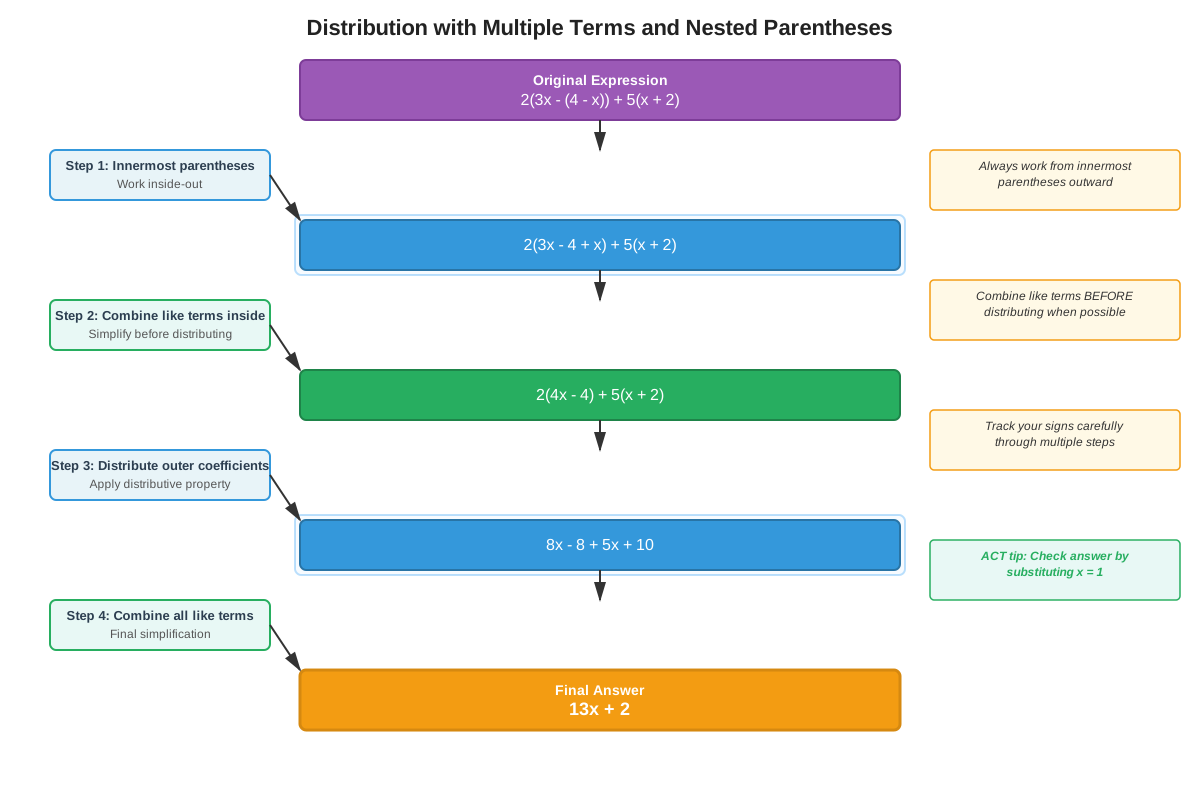
- Multiple distribution steps may be required in complex expressions with nested parentheses
- The property enables simplification of expressions before substituting values for variables
- Distribution errors account for approximately 30% of algebra mistakes on the ACT
- When distributing fractions, multiply the numerator by each term and keep the denominator
- The distributive property is commutative: a(b + c) = (b + c)a
- Zero distributed over any expression equals zero: 0(b + c) = 0
Quick check — test yourself on Distributive property so far.
Try Flashcards →Common Misconceptions
Misconception: Only the first term inside parentheses gets multiplied by the outside term → Correction: Every term inside the parentheses must be multiplied by the outside term. In 3(x + 5), both x and 5 must be multiplied by 3, giving 3x + 15, not 3x + 5.
Misconception: A negative sign outside parentheses only affects the first term → Correction: A negative sign (or negative coefficient) distributes to all terms, changing every sign. The expression -(x - 3) becomes -x + 3, not -x - 3.
Misconception: Distribution and combining like terms are the same operation → Correction: Distribution multiplies a term across parentheses, while combining like terms adds or subtracts coefficients of identical variable terms. These are distinct steps that occur in sequence.
Misconception: When factoring, any common number can be factored out → Correction: Only the greatest common factor (GCF) should be factored out to achieve complete factorization. Factoring 12x + 18 as 2(6x + 9) is incomplete; the correct factorization is 6(2x + 3).
Misconception: Distribution is unnecessary when parentheses contain only one term → Correction: While 3(x) simplifies directly to 3x, this is still technically distribution. However, when parentheses contain a single term, they can often be removed immediately without formal distribution steps.
Misconception: The distributive property only works with addition inside parentheses → Correction: Distribution works identically with subtraction. The expression 4(x - 2) distributes to 4x - 8, following the same principle as addition.
Misconception: In expressions like 2 + 3(x + 4), the 2 should be distributed → Correction: Only terms directly multiplying the parentheses distribute. Here, only the 3 distributes: 2 + 3(x + 4) = 2 + 3x + 12 = 3x + 14.
Worked Examples
Example 1: Multi-Step Distribution with Negative Signs
Problem: Simplify 3(2x - 5) - 2(x + 4)
Solution:
Step 1: Distribute 3 to both terms in the first parentheses
- 3 × 2x = 6x
- 3 × (-5) = -15
- Result so far: 6x - 15
Step 2: Distribute -2 to both terms in the second parentheses
- -2 × x = -2x
- -2 × 4 = -8
- Result: -2x - 8
Step 3: Combine the distributed expressions
- 6x - 15 - 2x - 8
Step 4: Combine like terms
- Combine x terms: 6x - 2x = 4x
- Combine constants: -15 - 8 = -23
- Final answer: 4x - 23
Key insight: This problem tests Learning Objective 4 (recognizing and correcting distribution errors with negative signs). The critical step is recognizing that -2 distributes to both x and 4, changing the +4 to -8. Many students incorrectly write -2x + 8, leading to a final answer of 4x - 7.
Example 2: Equation Solving with Distribution
Problem: Solve for x: 4(x + 3) = 2(x - 1) + 20
Solution:
Step 1: Distribute on the left side
- 4 × x = 4x
- 4 × 3 = 12
- Left side: 4x + 12
Step 2: Distribute on the right side
- 2 × x = 2x
- 2 × (-1) = -2
- Right side before adding 20: 2x - 2
- Right side complete: 2x - 2 + 20 = 2x + 18
Step 3: Write the equation with distributed terms
- 4x + 12 = 2x + 18
Step 4: Collect variable terms on one side
- Subtract 2x from both sides: 2x + 12 = 18
Step 5: Isolate the variable
- Subtract 12 from both sides: 2x = 6
- Divide by 2: x = 3
Step 6: Verify the solution
- Left side: 4(3 + 3) = 4(6) = 24
- Right side: 2(3 - 1) + 20 = 2(2) + 20 = 4 + 20 = 24 ✓
Key insight: This problem addresses Learning Objectives 3 and 6 (applying distribution accurately and combining it with other operations). The ACT frequently presents equations requiring distribution on both sides before solving, testing whether students can execute multiple steps systematically.
Example 3: Factoring Using Reverse Distribution
Problem: Factor completely: 15x³ - 10x²
Solution:
Step 1: Identify the greatest common factor (GCF)
- Factors of 15x³: 1, 3, 5, 15, x, x², x³
- Factors of 10x²: 1, 2, 5, 10, x, x²
- Common factors: 1, 5, x, x²
- GCF: 5x²
Step 2: Factor out the GCF
- Divide the first term: 15x³ ÷ 5x² = 3x
- Divide the second term: 10x² ÷ 5x² = 2
Step 3: Write the factored form
- 5x²(3x - 2)
Step 4: Verify by distributing
- 5x² × 3x = 15x³ ✓
- 5x² × (-2) = -10x² ✓
Key insight: This problem demonstrates Learning Objective 5 (using distribution in reverse). Factoring is essential for simplifying rational expressions and solving quadratic equations, making it a high-value skill that builds on distribution mastery.
Exam Strategy
When approaching ACT questions involving the distributive property, first scan for parentheses with a coefficient or variable in front—this is the primary trigger indicating distribution is required. Look for phrases like "expand the expression," "simplify," or "solve for x" in problems containing parentheses, as these signal distribution steps.
Trigger words and phrases to watch for include: "simplify the expression," "expand," "factor," "solve the equation," "which expression is equivalent to," and "combine like terms." Questions asking which answer choice is "equivalent" to a given expression often require distribution to match the format of the answer choices.
Process of elimination strategy: When answer choices differ in their signs or coefficients, distribution errors are being tested. Eliminate choices that show incomplete distribution (only one term multiplied) or incorrect sign handling. If answer choices are in factored form while the question shows an expanded expression, reverse distribution (factoring) is required.
Time allocation: Standard distribution problems should take 30-45 seconds. If a problem requires more than one minute, verify that distribution is the correct approach—sometimes expressions can be simplified through substitution or other methods. For complex multi-step problems combining distribution with equation solving, allocate 60-90 seconds.
Systematic approach: (1) Identify all terms requiring distribution, (2) Distribute carefully, writing each step, (3) Combine like terms, (4) Verify by checking one term's calculation. On test day, resist the urge to skip steps mentally—distribution errors are most common when students rush.
ACT Tip: When distributing negative numbers, circle or underline the negative sign before distributing to maintain awareness. This simple visual cue prevents the most common distribution error.
Calculator usage: While calculators can't directly perform algebraic distribution, use them to verify numerical results after substituting test values. If the problem allows, substitute x = 2 into both the original and simplified expressions to confirm equivalence.
Memory Techniques
Mnemonic for distribution steps: "MEMS" - Multiply Every term, Maintain Signs
- Multiply: The outside term multiplies each inside term
- Every: Don't skip any terms in the parentheses
- Maintain: Keep the operation signs between terms
- Signs: Pay special attention when distributing negatives
Visualization strategy: Picture distribution as "sharing" or "delivering" the outside term to each term inside the parentheses. Imagine the outside term as a delivery truck that must stop at each term's house inside the parentheses neighborhood.
Negative distribution reminder: "Negative Nancy Changes Everything" - When a negative distributes, it changes every sign inside the parentheses. Visualize a negative sign as a "sign flipper" that reverses + to - and - to +.
FOIL acronym: For multiplying binomials, remember First, Outer, Inner, Last to ensure all four distribution steps occur. Draw arrows connecting the terms to visualize each multiplication.
Factoring check: "Distribute to Verify" - After factoring, always distribute the factored form to confirm it matches the original expression. This self-check catches errors immediately.
Sign tracking technique: When distributing expressions with multiple terms, write a small + or - above each term before distributing to track sign changes systematically.
Summary
The distributive property is a foundational algebraic principle stating that multiplication distributes over addition and subtraction: a(b + c) = ab + ac. This property appears throughout the ACT Math section, both as a direct testing point and as an essential component of more complex problems. Mastery requires recognizing when distribution is needed, executing it accurately (especially with negative multipliers), and combining it with other algebraic operations like combining like terms and solving equations. The property works in reverse as factoring, where common factors are extracted from expressions. Common errors include incomplete distribution, sign mistakes with negative multipliers, and confusing distribution with combining like terms. Success on ACT questions demands systematic application: identify the multiplier, distribute to every term, maintain signs carefully, and combine like terms to simplify. Students who master distribution gain speed and accuracy across numerous question types, from basic simplification to complex equation solving, making this a high-yield topic for score improvement.
Key Takeaways
- The distributive property (a(b + c) = ab + ac) requires multiplying the outside term by every term inside the parentheses
- Distributing a negative number changes the sign of every term inside the parentheses—this is the most common error source
- Distribution must occur before combining like terms in the order of operations
- Factoring is reverse distribution: identifying and extracting the greatest common factor from all terms
- When multiplying binomials, four distribution steps occur (FOIL: First, Outer, Inner, Last)
- ACT questions test distribution through expression simplification, equation solving, factoring, and equivalence problems
- Systematic execution and sign tracking prevent the majority of distribution errors on test day
Related Topics
Combining Like Terms: After distributing, expressions often contain like terms that must be combined. This skill works hand-in-hand with distribution to fully simplify algebraic expressions.
Factoring Polynomials: Reverse distribution (factoring out the GCF) is the first step in factoring more complex polynomials, including trinomials and difference of squares.
Solving Linear Equations: Distribution frequently serves as the first step in solving equations, followed by combining like terms and isolating variables through inverse operations.
Polynomial Operations: Multiplying polynomials requires systematic distribution across multiple terms, extending the basic distributive property to more complex expressions.
Quadratic Equations: Expanding quadratic expressions through distribution and factoring quadratics using reverse distribution are essential skills for solving these equations.
Mastering the distributive property creates a solid foundation for all these advanced topics, making it a gateway skill for algebraic proficiency on the ACT.
Practice CTA
Now that you've mastered the core concepts of the distributive property, it's time to solidify your understanding through practice. Work through the practice questions to test your ability to identify, explain, and apply distribution in various ACT-style scenarios. Use the flashcards to reinforce high-yield facts and common error patterns. Remember: distribution mastery comes from recognizing patterns and executing systematically—skills that develop through deliberate practice. Each problem you solve correctly builds the confidence and automaticity you need to excel on test day. You've got this!
Sign up free to keep reading
Create a free AnvayaPrep account to finish this ACT guide on Distributive property — plus flashcards and practice questions.