Overview
Compound inequalities are mathematical statements that combine two or more inequalities into a single expression, connected by the words "and" or "or." These expressions define ranges of values that satisfy multiple conditions simultaneously or alternatively. On the ACT Math test, compound inequalities appear frequently in algebra questions, testing a student's ability to manipulate algebraic expressions, understand number line representations, and interpret solution sets. Mastery of this topic is essential because compound inequalities form the foundation for understanding domains and ranges of functions, solving absolute value inequalities, and working with systems of inequalities—all of which appear regularly on the exam.
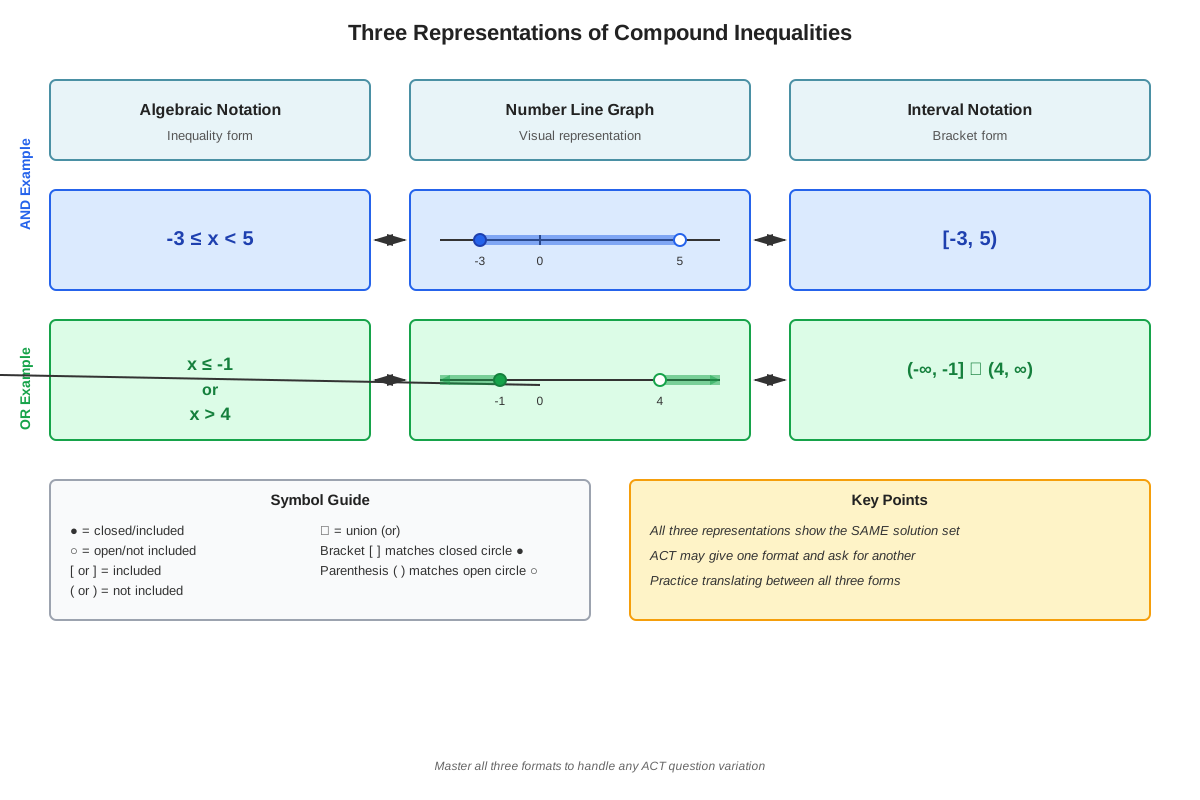
The ACT tests compound inequalities both directly and indirectly. Direct questions may ask students to solve a compound inequality and identify the solution set from multiple-choice options. Indirect applications appear in word problems involving constraints (such as budget limitations or acceptable measurement ranges), coordinate geometry questions about regions in the plane, and function problems requiring domain restrictions. Understanding ACT compound inequalities requires not just mechanical solving skills but also the ability to translate between algebraic notation, number line graphs, and interval notation—all common representations on the test.
Compound inequalities connect to broader mathematical concepts including set theory (unions and intersections), absolute value equations and inequalities, linear programming, and piecewise functions. They represent a critical bridge between basic inequality solving and more advanced topics like optimization problems and systems of inequalities. Students who master compound inequalities develop stronger logical reasoning skills and gain confidence in handling multi-step algebraic manipulations under timed test conditions.
Learning Objectives
- [ ] Identify when Compound inequalities is being tested in ACT Math questions
- [ ] Explain the core rule or strategy behind Compound inequalities, including "and" versus "or" logic
- [ ] Apply Compound inequalities to ACT-style questions accurately and efficiently
- [ ] Convert between different representations of compound inequalities (algebraic, number line, interval notation)
- [ ] Distinguish between conjunction ("and") and disjunction ("or") compound inequalities and their solution sets
- [ ] Solve multi-step compound inequalities involving variables on both sides
- [ ] Graph compound inequality solutions on number lines with correct notation for inclusive and exclusive boundaries
Prerequisites
- Basic inequality solving: Understanding how to isolate variables and apply inverse operations while reversing inequality signs when multiplying or dividing by negative numbers—essential for manipulating compound inequality expressions
- Number line representation: Ability to plot points and intervals on a number line—necessary for visualizing and verifying compound inequality solutions
- Set notation basics: Familiarity with concepts of union and intersection—directly corresponds to "or" and "and" compound inequalities
- Algebraic manipulation: Proficiency with combining like terms, distributive property, and multi-step equation solving—required for working with complex compound inequalities
Why This Topic Matters
Compound inequalities appear in approximately 2-4 questions per ACT Math test, making them a high-yield topic for score improvement. These questions typically appear in the first 40 questions of the 60-question Math section, placing them in the easy-to-medium difficulty range where students can reliably earn points with proper preparation. The ACT tests compound inequalities through direct algebraic problems, word problems requiring inequality setup, and coordinate geometry questions involving shaded regions.
In real-world applications, compound inequalities model countless practical scenarios: acceptable temperature ranges for food storage, safe dosage ranges for medications, profit margins for businesses, acceptable tolerances in manufacturing, and eligibility criteria for programs with multiple requirements. Engineers use compound inequalities to define operating parameters for machinery, while financial analysts use them to identify investment opportunities meeting multiple criteria. Understanding compound inequalities develops critical thinking skills applicable to any field requiring constraint-based decision making.
On the ACT, compound inequalities commonly appear disguised in word problems about age restrictions ("must be at least 16 but under 25"), measurement tolerances ("within 0.5 inches of 12 inches"), or budget constraints ("spend more than $50 but no more than $100"). Recognition of these verbal cues is crucial for identifying when compound inequality concepts are being tested, even when the question doesn't explicitly use inequality symbols.
Core Concepts
Definition and Types of Compound Inequalities
A compound inequality consists of two or more simple inequalities joined by either "and" or "or." The type of connector fundamentally changes the solution set:
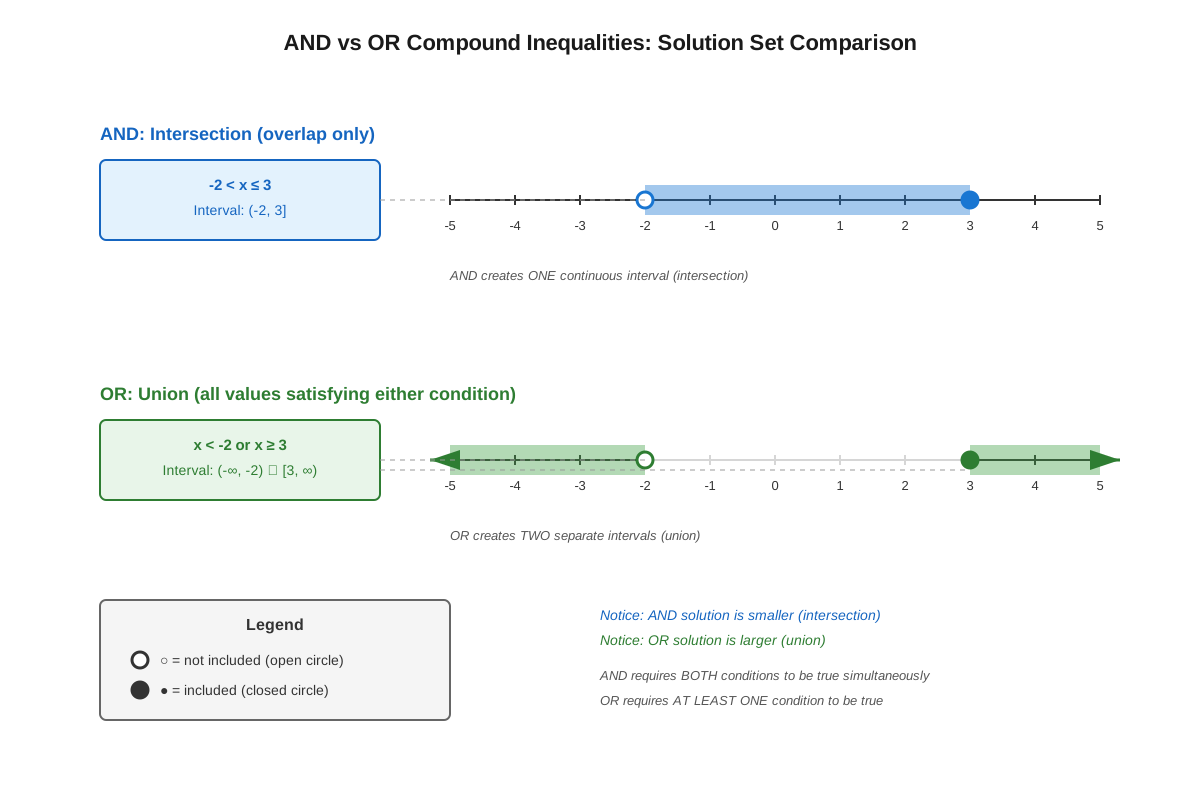
Conjunction (AND) compound inequalities require both conditions to be true simultaneously. Written as "a < x < b" or "a < x AND x < b," these inequalities define a bounded interval. For example, "x > 2 AND x < 7" describes all numbers between 2 and 7, excluding the endpoints. The solution set is the intersection of the individual inequality solutions—only values satisfying both conditions qualify.
Disjunction (OR) compound inequalities require at least one condition to be true. Written as "x < a OR x > b," these inequalities define two separate regions. For example, "x < -3 OR x > 5" describes all numbers less than -3 together with all numbers greater than 5. The solution set is the union of the individual inequality solutions—values satisfying either condition qualify.
Solving Conjunction Compound Inequalities
To solve conjunction compound inequalities written in the form "a < x + b < c":
- Isolate the variable in the middle by performing the same operation on all three parts
- Maintain inequality direction unless multiplying or dividing by a negative number
- Simplify to the form "lower bound < x < upper bound"
Example: Solve 3 < 2x - 1 < 9
3 < 2x - 1 < 9
3 + 1 < 2x - 1 + 1 < 9 + 1    (Add 1 to all parts)
4 < 2x < 10
4/2 < 2x/2 < 10/2              (Divide all parts by 2)
2 < x < 5
The solution is all real numbers between 2 and 5, exclusive of endpoints.
Solving Disjunction Compound Inequalities
For disjunction compound inequalities, solve each inequality separately, then combine the solutions:
- Separate the compound inequality into two distinct inequalities
- Solve each inequality independently using standard techniques
- Combine solutions using "or" logic—the final answer includes all values from either solution
Example: Solve x + 3 < 1 OR 2x - 4 ≥ 6
First inequality:          Second inequality:
x + 3 < 1                 2x - 4 ≥ 6
x < 1 - 3                 2x ≥ 6 + 4
x < -2                    2x ≥ 10
                          x ≥ 5
Solution: x < -2 OR x ≥ 5
Graphing Compound Inequalities on Number Lines
Number line representation provides visual confirmation of solutions:
| Symbol | Meaning | Number Line Notation |
|---|---|---|
| < or > | Strict inequality (not equal) | Open circle ○ |
| ≤ or ≥ | Inclusive inequality (or equal) | Closed circle ● |
| AND | Intersection of regions | Single continuous segment |
| OR | Union of regions | Two or more separate segments |
For "2 < x < 5": Draw open circles at 2 and 5, shade the region between them.
For "x < -2 OR x ≥ 5": Draw an open circle at -2 with shading extending left to negative infinity, and a closed circle at 5 with shading extending right to positive infinity.
Interval Notation for Compound Inequalities
Interval notation provides a concise way to express solution sets:
- (a, b): All numbers between a and b, excluding endpoints (corresponds to a < x < b)
- [a, b]: All numbers between a and b, including endpoints (corresponds to a ≤ x ≤ b)
- (a, b]: Numbers between a and b, excluding a but including b (corresponds to a < x ≤ b)
- (-∞, a): All numbers less than a (corresponds to x < a)
- (a, ∞): All numbers greater than a (corresponds to x > a)
- Union symbol ∪: Combines disjoint intervals for OR compound inequalities
Example conversions:
- "2 < x < 5" becomes (2, 5)
- "x ≤ -3 OR x > 4" becomes (-∞, -3] ∪ (4, ∞)
Special Cases and Complex Scenarios
Variables on both sides: When variables appear in multiple parts of a compound inequality, isolate the variable systematically while maintaining the inequality structure.
Example: Solve 1 < 3x + 4 < x + 10
1 < 3x + 4  AND  3x + 4 < x + 10
1 - 4 < 3x                3x - x < 10 - 4
-3 < 3x                   2x < 6
-1 < x                    x < 3
Combined: -1 < x < 3 or (-1, 3)
No solution scenarios: Some compound inequalities have no values satisfying all conditions. For example, "x > 5 AND x < 2" has no solution because no number can simultaneously be greater than 5 and less than 2.
All real numbers: Some compound inequalities are satisfied by all real numbers. For example, "x < 5 OR x ≥ 2" includes all real numbers because every number is either less than 5 or greater than/equal to 2.
Concept Relationships
Compound inequalities build directly on simple inequality solving by adding logical connectors that combine multiple constraints. The relationship flows: Simple inequalities → Compound inequalities → Systems of inequalities → Linear programming.
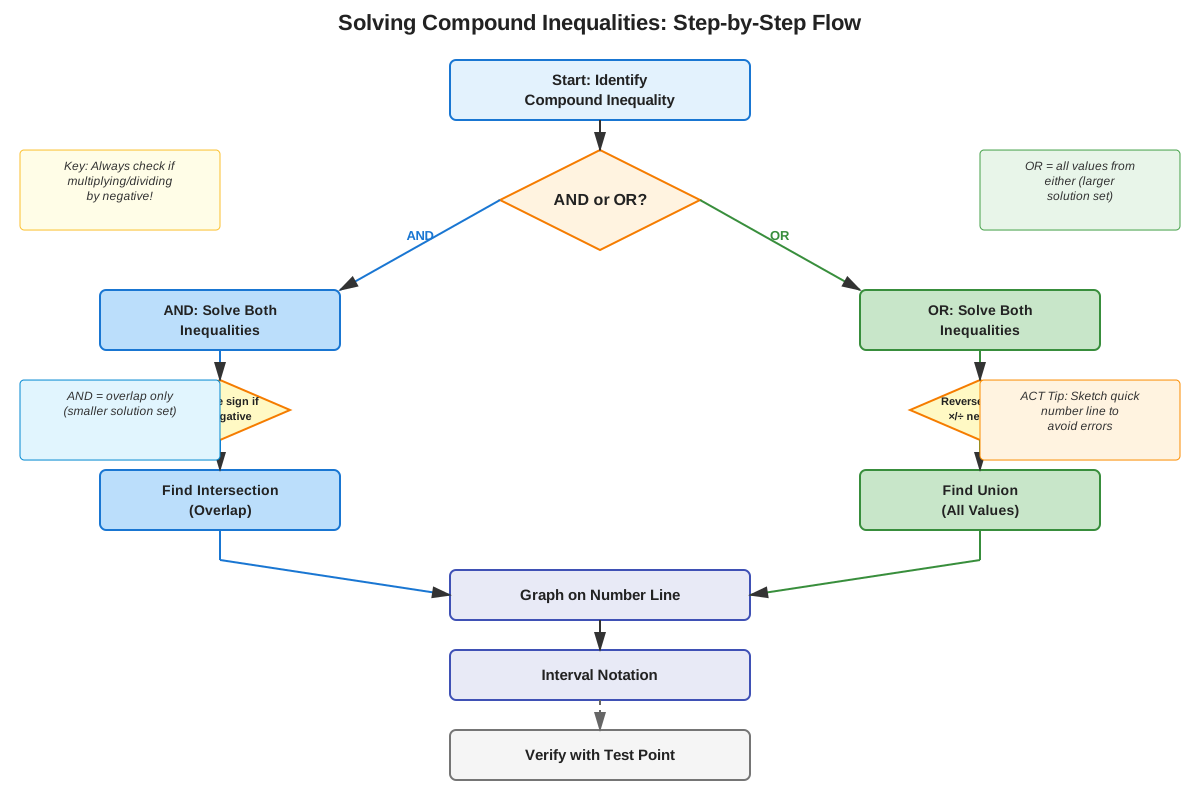
Within compound inequalities, the concepts connect as follows: Understanding AND/OR logic → Determines solution method → Leads to graphical representation → Converts to interval notation. The choice between conjunction and disjunction fundamentally determines whether solutions form a single bounded interval or multiple disjoint regions.
Compound inequalities connect backward to prerequisite topics: Set theory provides the logical foundation for unions (OR) and intersections (AND). Number line skills enable visualization of solution sets. Algebraic manipulation provides the tools for isolating variables.
Forward connections include: Absolute value inequalities (which decompose into compound inequalities), domain and range problems (which use compound inequality notation), piecewise functions (which define different rules over intervals specified by compound inequalities), and optimization problems (which use compound inequalities to define feasible regions).
Quick check — test yourself on Compound inequalities so far.
Try Flashcards →High-Yield Facts
⭐ Conjunction (AND) compound inequalities produce a single bounded interval; disjunction (OR) compound inequalities produce two or more separate regions
⭐ When multiplying or dividing all parts of a compound inequality by a negative number, reverse all inequality signs simultaneously
⭐ The compact form "a < x < b" is always a conjunction (AND) inequality, never a disjunction
⭐ Open circles on number lines correspond to strict inequalities (< or >); closed circles correspond to inclusive inequalities (≤ or ≥)
⭐ Interval notation uses parentheses for exclusive boundaries and brackets for inclusive boundaries
- The solution to "x < a AND x > b" where a < b is the empty set (no solution)
- The solution to "x < a OR x > b" where a < b includes all real numbers except those between a and b
- Compound inequalities can be verified by testing values from each region in the original inequality
- Word problems with phrases like "between," "at least but no more than," or "outside the range" typically indicate compound inequalities
- Converting between algebraic form, number line graphs, and interval notation is a common ACT question format
Common Misconceptions
Misconception: When solving "a < x + b < c," students can solve only one side and ignore the other.
Correction: All parts of a compound inequality must be manipulated simultaneously using the same operations to maintain the relationships between all three expressions.
Misconception: "x > 3 OR x > 7" means x must be greater than both 3 and 7.
Correction: OR means at least one condition must be true. Since any number greater than 7 is automatically greater than 3, the solution simplifies to just x > 3 (the less restrictive condition).
Misconception: The solution to "x < 2 AND x > 5" is "2 < x < 5."
Correction: No number can be simultaneously less than 2 and greater than 5. This compound inequality has no solution (empty set). The correct bounded interval would require "x > 2 AND x < 5."
Misconception: When graphing "x ≤ 3 OR x ≥ 3," students draw two separate rays.
Correction: Since every real number is either less than, equal to, or greater than 3, this compound inequality includes all real numbers. The graph should show the entire number line shaded, or be written as (-∞, ∞).
Misconception: Interval notation (2, 5) means the same as the ordered pair (2, 5) in coordinate geometry.
Correction: Context determines meaning. In inequality solutions, (2, 5) represents all real numbers between 2 and 5. In coordinate geometry, (2, 5) represents a single point. The ACT will make the context clear through the question wording.
Misconception: "AND" compound inequalities always have solutions, while "OR" compound inequalities sometimes don't.
Correction: The opposite is often true. "AND" requires both conditions simultaneously (more restrictive, can result in no solution), while "OR" requires only one condition (less restrictive, usually has solutions).
Worked Examples
Example 1: Conjunction Compound Inequality with Algebraic Manipulation
Problem: Solve and graph: -4 ≤ 3x + 2 < 11
Solution:
Step 1: Identify this as a conjunction (AND) compound inequality in compact form.
Step 2: Isolate x by performing the same operations on all three parts.
-4 ≤ 3x + 2 < 11
-4 - 2 ≤ 3x + 2 - 2 < 11 - 2    (Subtract 2 from all parts)
-6 ≤ 3x < 9
-6/3 ≤ 3x/3 < 9/3               (Divide all parts by 3)
-2 ≤ x < 3
Step 3: Express in interval notation: [-2, 3)
Step 4: Graph on number line: Closed circle at -2 (inclusive), open circle at 3 (exclusive), shade the region between them.
Step 5: Verify by testing a value in the solution set. Try x = 0:
-4 ≤ 3(0) + 2 < 11
-4 ≤ 2 < 11  ✓ (True)
Connection to learning objectives: This example demonstrates applying compound inequalities to ACT-style questions by showing systematic algebraic manipulation and multiple representation formats (algebraic, interval notation, and graphical).
Example 2: Disjunction Compound Inequality with Word Problem Context
Problem: A manufacturing process requires that a metal rod be either less than 10.2 cm or greater than 10.8 cm in length to be rejected. Write and solve a compound inequality representing acceptable rod lengths, then express the answer in interval notation.
Solution:
Step 1: Translate the problem. Rejected rods satisfy: x < 10.2 OR x > 10.8
Step 2: Acceptable rods are the opposite (complement) of rejected rods. Use logical negation:
- NOT(x < 10.2 OR x > 10.8)
- This becomes: x ≥ 10.2 AND x ≤ 10.8
Step 3: Write in compact form: 10.2 ≤ x ≤ 10.8
Step 4: Express in interval notation: [10.2, 10.8]
Step 5: Interpret: Acceptable rods must be between 10.2 and 10.8 cm, inclusive of both endpoints.
Alternative approach (if the question asked for rejected rods):
The compound inequality x < 10.2 OR x > 10.8 is already solved. In interval notation: (-∞, 10.2) ∪ (10.8, ∞)
Connection to learning objectives: This example demonstrates identifying when compound inequalities are being tested (recognizing the word problem context), explaining the core strategy (translating verbal constraints into mathematical notation), and applying the concept accurately (solving and expressing in multiple formats).
Exam Strategy
Trigger words and phrases that signal compound inequality questions on the ACT:
- "Between" (usually indicates AND: a < x < b)
- "At least... but no more than" (indicates AND with inclusive boundaries)
- "Either... or" (indicates OR compound inequality)
- "Outside the range" (indicates OR: x < a OR x > b)
- "Within" or "tolerance" (indicates AND with boundaries around a central value)
Approach strategy:
- Identify the type first (AND vs. OR) before solving—this determines whether you'll have one interval or multiple regions
- For compact form inequalities (a < x + b < c), work all three parts simultaneously rather than splitting into two separate inequalities
- For word problems, translate constraints into mathematical notation before attempting to solve
- Check answer choices for format clues—if choices show interval notation with union symbols, expect an OR inequality; if choices show single intervals, expect an AND inequality
Process of elimination tips:
- Eliminate answer choices with incorrect boundary types (open vs. closed circles, parentheses vs. brackets)
- Test the boundary values in the original inequality—they should satisfy ≤ or ≥ but not < or >
- For OR inequalities, eliminate any answer showing a single continuous interval
- For AND inequalities, eliminate any answer showing disjoint regions
Time allocation: Compound inequality questions typically require 45-60 seconds. Spend 15 seconds identifying the type and setting up, 25 seconds solving, and 10 seconds verifying your answer matches an available choice. If a question requires more than 90 seconds, mark it and return later—these questions are designed to be solved quickly with proper technique.
Common ACT tricks to watch for:
- Answer choices mixing up AND and OR solutions
- Reversed inequality signs in answer choices
- Incorrect boundary notation (open vs. closed)
- Simplified vs. unsimplified forms of the same solution
Memory Techniques
AND vs. OR mnemonic: "AND means All conditions, OR means One condition"
Boundary notation mnemonic: "Parentheses for Pointed (open circles), Brackets for Bullets (closed circles)"
Visualization strategy: Picture a number line as a road. AND compound inequalities create a single segment of road you can travel. OR compound inequalities create two separate road segments with a gap between them you cannot cross.
Compact form reminder: "The sandwich inequality" - when x is "sandwiched" between two values (a < x < b), it's always AND, never OR. You can't sandwich something in two separate places.
Solving steps acronym - SIDE:
- Separate (if OR) or keep together (if AND)
- Isolate the variable using inverse operations
- Determine boundary types (inclusive or exclusive)
- Express in requested format (algebraic, interval, or graph)
Interval notation memory aid: "Parentheses are open like an open mouth ( ), brackets are closed like closed doors [ ]"
Summary
Compound inequalities combine two or more simple inequalities using AND (conjunction) or OR (disjunction) logic to define solution sets. AND compound inequalities require all conditions to be satisfied simultaneously, producing single bounded intervals, while OR compound inequalities require at least one condition to be satisfied, producing multiple disjoint regions. Solving compound inequalities requires systematic algebraic manipulation—performing identical operations on all parts while reversing inequality signs when multiplying or dividing by negative numbers. Solutions can be represented algebraically, graphically on number lines using open and closed circles, or using interval notation with parentheses and brackets. The ACT tests compound inequalities through direct algebraic problems, word problems requiring translation of verbal constraints, and questions requiring conversion between different representation formats. Success requires recognizing trigger words, distinguishing between AND and OR logic, maintaining proper boundary notation, and efficiently converting between algebraic, graphical, and interval notation forms. Mastery of compound inequalities provides essential foundation for more advanced topics including absolute value inequalities, domain and range problems, and systems of inequalities.
Key Takeaways
- Compound inequalities use AND (intersection, single interval) or OR (union, multiple regions) to combine multiple constraints
- AND compound inequalities in compact form "a < x < b" require simultaneous operations on all three parts to isolate the variable
- OR compound inequalities require solving each inequality separately, then combining solutions with union notation
- Open circles/parentheses indicate strict inequalities (< or >); closed circles/brackets indicate inclusive inequalities (≤ or ≥)
- Interval notation provides concise representation: (a, b) for exclusive boundaries, [a, b] for inclusive boundaries, ∪ for unions
- ACT questions test recognition of compound inequalities in word problems through trigger phrases like "between," "at least but no more than," and "outside the range"
- Always verify solutions by testing values from each region in the original inequality, especially at boundary points
Related Topics
Absolute Value Inequalities: Compound inequalities form the foundation for solving absolute value inequalities, which decompose into AND or OR compound inequalities depending on the inequality direction. Mastering compound inequalities makes absolute value inequalities significantly more approachable.
Systems of Inequalities: Multiple compound inequalities can be combined to define feasible regions in coordinate geometry. Understanding single compound inequalities prepares students for graphing systems and identifying solution regions.
Domain and Range: Function domains and ranges are often expressed using compound inequality notation or interval notation. The skills developed with compound inequalities transfer directly to analyzing function behavior.
Piecewise Functions: These functions define different rules over intervals specified by compound inequalities. Understanding how to work with compound inequalities enables students to evaluate and graph piecewise functions effectively.
Linear Programming: Optimization problems use systems of compound inequalities to define constraints. Mastery of compound inequalities provides the algebraic foundation for more advanced optimization techniques.
Practice CTA
Now that you've mastered the core concepts, strategies, and common pitfalls of compound inequalities, it's time to solidify your understanding through active practice. Work through the practice questions to apply these techniques to ACT-style problems, and use the flashcards to reinforce key definitions and procedures. Remember: compound inequalities appear on nearly every ACT Math test, making them a high-yield topic where focused practice directly translates to points on test day. Approach each practice problem systematically using the SIDE method, and don't hesitate to review the worked examples if you encounter difficulty. Your investment in mastering this topic will pay dividends across multiple areas of the ACT Math section!
Sign up free to keep reading
Create a free AnvayaPrep account to finish this ACT guide on Compound inequalities — plus flashcards and practice questions.