Overview
The elimination method is a fundamental algebraic technique used to solve systems of linear equations by strategically adding or subtracting equations to eliminate one variable, making it possible to solve for the remaining variable. This method is one of the most powerful tools in a student's mathematical arsenal and appears frequently on the ACT Math section, particularly in questions involving two or more equations with two or more unknowns.
On the ACT, the ACT elimination method is tested both directly—where students must solve a system of equations—and indirectly, where recognizing that elimination can simplify a problem saves valuable time. Understanding this method is crucial because it often provides the fastest path to the correct answer, especially when compared to substitution or graphing methods. The ACT typically includes 2-4 questions per test that either explicitly require solving systems of equations or can be dramatically simplified using elimination techniques.
The elimination method connects to broader algebraic concepts including linear equations, coefficients, variables, and the properties of equality. It serves as a bridge between basic equation-solving and more advanced topics like matrices, linear programming, and multivariable calculus. Mastering elimination not only helps students score points on the ACT but also builds critical thinking skills about how mathematical relationships can be manipulated to reveal hidden information.
Learning Objectives
- [ ] Identify when Elimination method is being tested in ACT questions
- [ ] Explain the core rule or strategy behind Elimination method
- [ ] Apply Elimination method to ACT-style questions accurately
- [ ] Determine the optimal coefficient to eliminate when given a system of equations
- [ ] Recognize when to multiply one or both equations before applying elimination
- [ ] Verify solutions by substituting back into original equations
- [ ] Distinguish between systems with one solution, no solution, and infinitely many solutions using elimination
Prerequisites
- Solving single-variable linear equations: The elimination method ultimately reduces a system to a single-variable equation that must be solved using basic algebraic techniques
- Understanding coefficients and variables: Recognizing and manipulating the numerical coefficients in front of variables is essential for the elimination process
- Properties of equality: The elimination method relies on the principle that equal quantities can be added to or subtracted from both sides of an equation
- Combining like terms: After adding or subtracting equations, students must simplify by combining terms with the same variable
- Multiplication and division of equations: Sometimes equations must be multiplied by constants before elimination can occur
Why This Topic Matters
In real-world applications, systems of equations model countless practical scenarios: calculating break-even points in business, determining optimal mixtures in chemistry, analyzing supply and demand in economics, and solving engineering problems involving multiple constraints. The elimination method provides a systematic, reliable approach to finding solutions when multiple conditions must be satisfied simultaneously.
On the ACT Math section, systems of equations questions appear with high frequency—typically 2-4 questions per 60-question test, representing approximately 3-7% of the total score. These questions often appear in the medium-to-difficult range (questions 30-50) and can be worth crucial points for students aiming for scores above 25. The elimination method is particularly valuable because it can be executed quickly and mechanically, reducing the chance of careless errors under time pressure.
The ACT presents elimination method questions in several common formats: direct "solve for x and y" problems, word problems that require setting up a system first, questions asking for the value of an expression like "x + y" or "2x - y" (which can sometimes be found without solving for individual variables), and questions embedded in coordinate geometry contexts. Recognizing these patterns allows students to immediately activate their elimination strategy, saving precious seconds on test day.
Core Concepts
The Fundamental Principle of Elimination
The elimination method works by exploiting a simple but powerful mathematical principle: when two equations are both true, adding or subtracting them produces a new equation that is also true. By strategically choosing which equations to combine, students can eliminate one variable entirely, reducing a two-variable system to a single-variable equation that can be solved directly.
Consider the basic principle: if a = b and c = d, then a + c = b + d. When applied to systems of equations, this means we can add the left sides of two equations together and set them equal to the sum of the right sides. The same principle applies to subtraction.
Standard Form and Alignment
Before applying elimination, equations should be written in standard form: Ax + By = C, where A, B, and C are constants. This alignment ensures that like terms are positioned vertically, making it easy to see which variables will combine or cancel when equations are added or subtracted.
For example:
3x + 2y = 14
5x - 2y = 10
In this aligned format, the y-terms have opposite coefficients (+2y and -2y), making them ideal candidates for elimination through addition.
Direct Elimination (Opposite Coefficients)
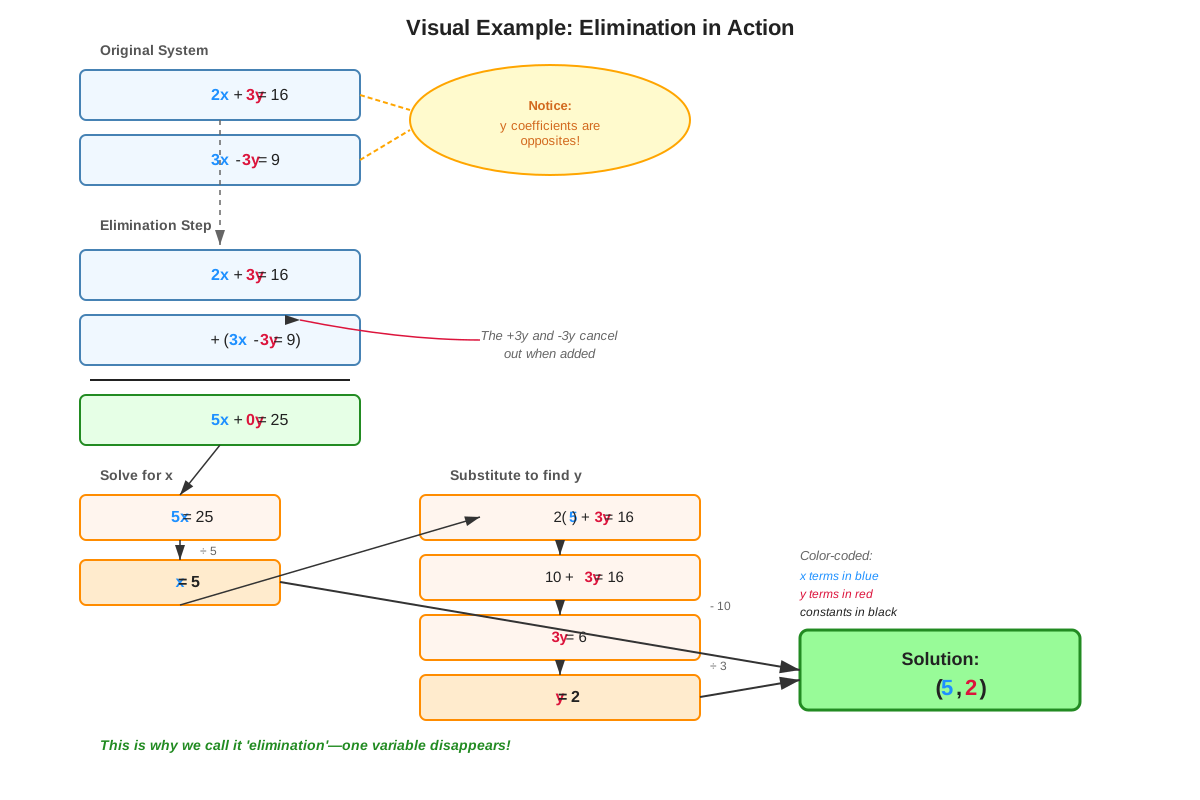
The simplest scenario occurs when one variable already has opposite coefficients in the two equations. In this case, simply add the equations together to eliminate that variable.
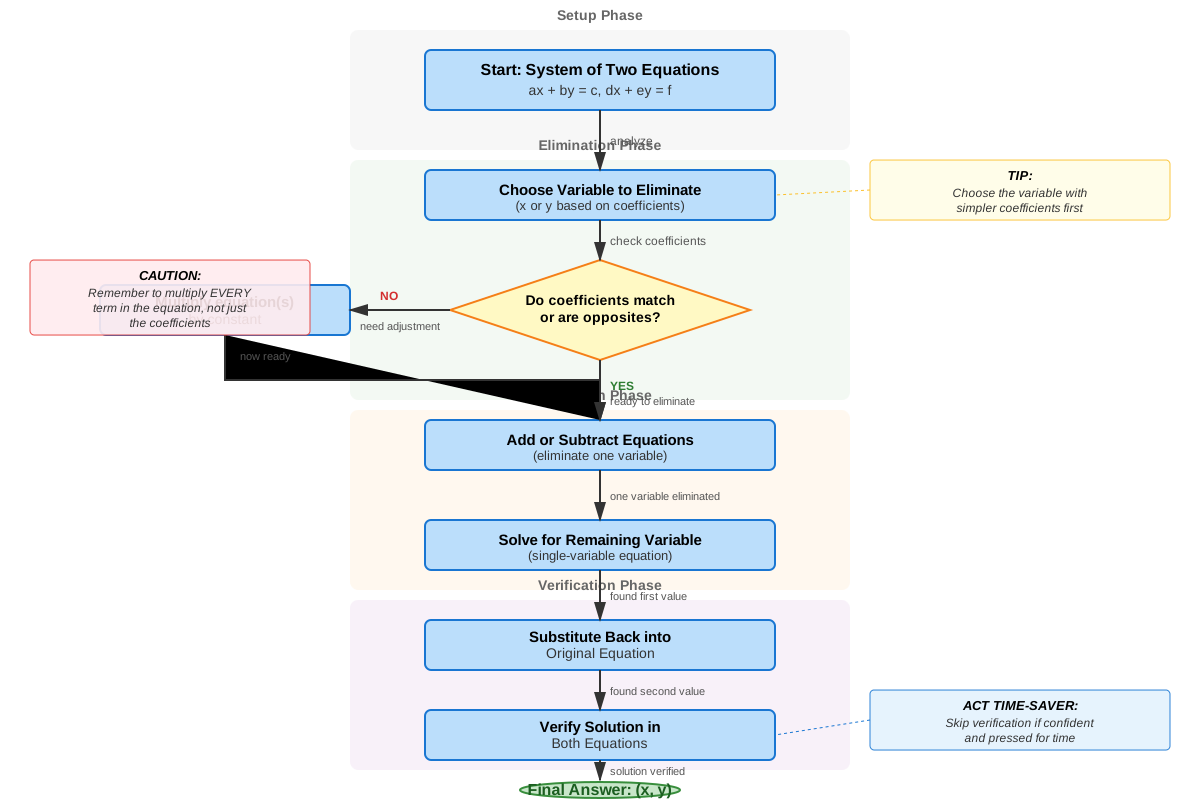
Steps for direct elimination:
- Verify equations are in standard form and aligned
- Identify the variable with opposite coefficients
- Add the equations (left side to left side, right side to right side)
- Solve the resulting single-variable equation
- Substitute the found value back into either original equation
- Solve for the remaining variable
- Verify the solution in both original equations
Elimination with Multiplication
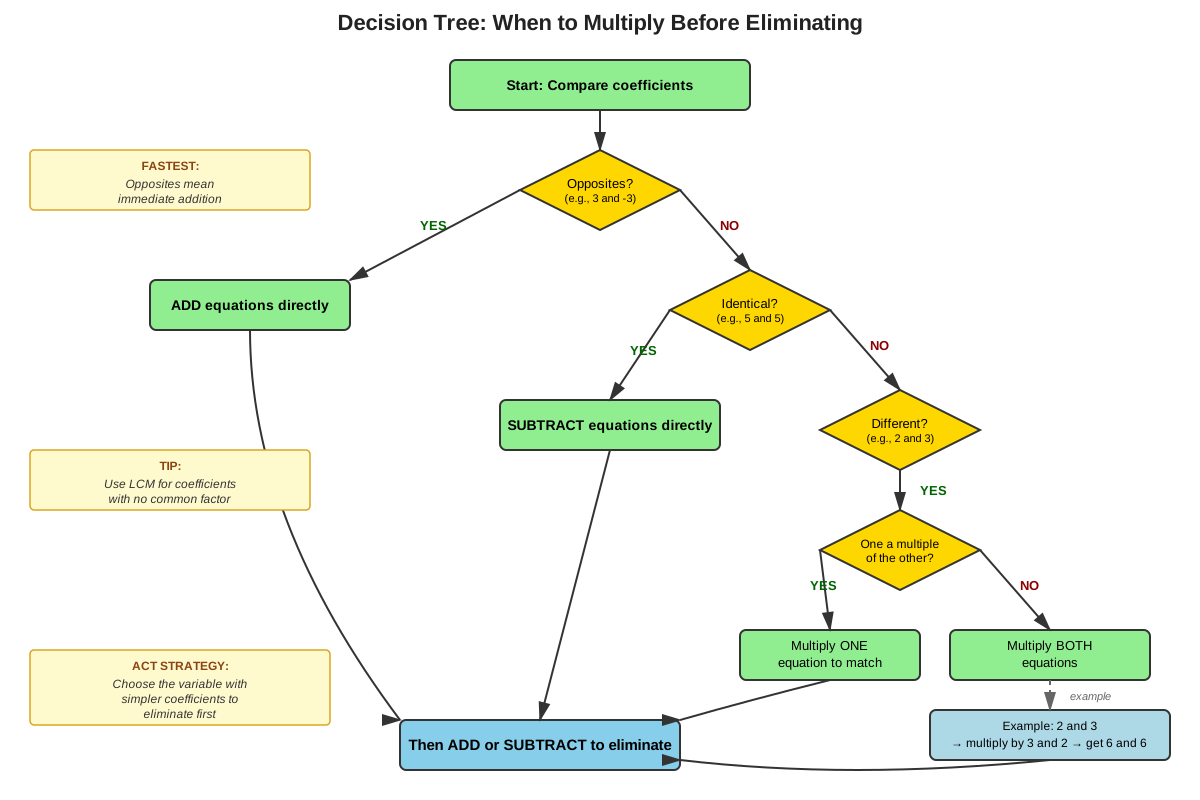
When coefficients are not already opposites, students must multiply one or both equations by carefully chosen constants to create opposite coefficients. This is where strategic thinking becomes crucial.
Single equation multiplication: If one coefficient is a multiple of the other, multiply only one equation. For example, if the coefficients are 3 and 6, multiply the first equation by 2 or the second by 1/2.
Both equations multiplication: When coefficients share no convenient relationship, multiply each equation by the coefficient from the other equation. For variables with coefficients a and b, multiply the first equation by b and the second by a (or their negatives) to create coefficients of ab and -ab.
Choosing Which Variable to Eliminate
While either variable can theoretically be eliminated first, strategic selection saves time and reduces arithmetic errors. Consider these factors:
| Factor | Recommendation |
|---|---|
| Opposite coefficients already exist | Eliminate that variable immediately |
| One coefficient is 1 | Eliminate the other variable (simpler multiplication) |
| Coefficients are small integers | Eliminate that variable (easier arithmetic) |
| Question asks for specific variable | Consider eliminating the other one first |
| Fractions present | Eliminate to avoid fractional arithmetic if possible |
Special Cases: No Solution and Infinitely Many Solutions
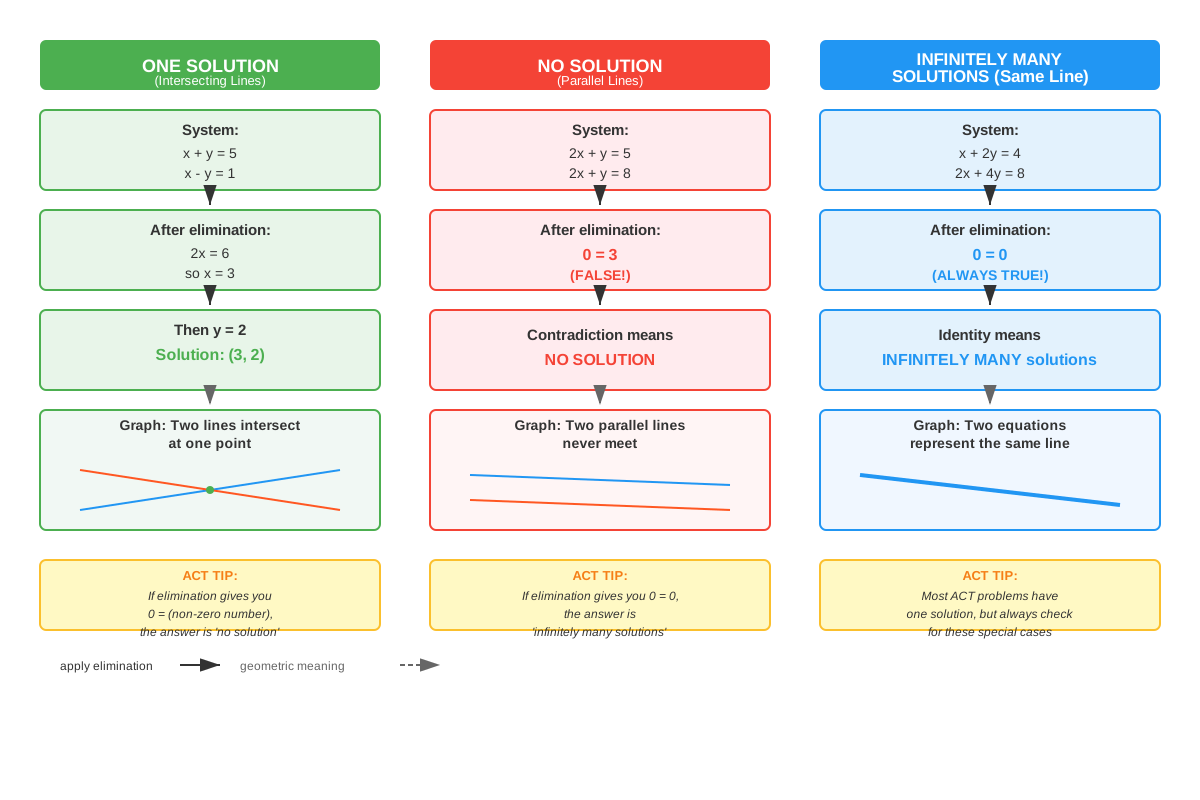
Not all systems have exactly one solution. The elimination method reveals these special cases:
No solution (inconsistent system): When elimination removes both variables but leaves a false statement (like 0 = 5), the lines are parallel and never intersect. The system has no solution.
Infinitely many solutions (dependent system): When elimination removes both variables and leaves a true statement (like 0 = 0), the equations represent the same line. Every point on the line is a solution.
The ACT Shortcut: Solving for Expressions
A high-yield ACT strategy involves recognizing when the question asks for an expression rather than individual variables. Sometimes you can find the value of "x + y" or "2x - 3y" without solving for x and y separately by cleverly adding or subtracting the original equations.
Concept Relationships
The elimination method builds directly on foundational equation-solving skills. Single-variable equation solving provides the endpoint of elimination—once one variable is eliminated, students must solve the resulting equation using inverse operations and properties of equality. Coefficient manipulation through multiplication connects to the distributive property and the multiplication property of equality.
Within the topic itself, concepts flow logically: Standard form alignment → Identifying elimination candidates → Strategic multiplication → Addition/subtraction to eliminate → Solving the reduced equation → Back-substitution → Verification. Each step depends on the previous one, creating a systematic problem-solving chain.
The elimination method relates closely to the substitution method (another technique for solving systems) and to graphing systems of equations (a visual approach). All three methods solve the same types of problems but offer different advantages: elimination excels when coefficients align nicely, substitution works well when one variable is already isolated, and graphing provides geometric intuition. Understanding elimination also prepares students for matrix operations and linear algebra in advanced mathematics, where elimination principles underlie row reduction techniques.
The connection to word problems is particularly important for the ACT. Many real-world scenarios naturally produce systems of equations, and elimination provides the computational engine to solve them once they're set up. This links algebraic technique to problem translation and mathematical modeling skills.
High-Yield Facts
⭐ The elimination method works by adding or subtracting equations to eliminate one variable, creating a single-variable equation that can be solved directly
⭐ When coefficients of a variable are opposites (like 3x and -3x), add the equations; when they're the same (like 4y and 4y), subtract the equations
⭐ If coefficients aren't opposites or equal, multiply one or both equations by constants to create matching or opposite coefficients
⭐ After finding one variable, always substitute back into one of the original equations to find the other variable
⭐ The ACT often asks for the value of an expression like "x + y" rather than individual variables—look for shortcuts by adding or subtracting equations directly
- When elimination produces a false statement like 0 = 7, the system has no solution (parallel lines)
- When elimination produces a true statement like 0 = 0, the system has infinitely many solutions (same line)
- Always verify your solution by substituting both values into both original equations
- Multiplying an entire equation by a constant doesn't change its solutions—this is the key to creating opposite coefficients
- The elimination method typically requires fewer steps than substitution when both variables have coefficients other than 1
- On the ACT, systems of equations questions often appear in the second half of the test (questions 30-50)
- If one equation has a variable with coefficient 1, substitution might be faster than elimination
- Fractions can be eliminated from equations by multiplying through by the least common denominator before applying elimination
- The order in which you eliminate variables doesn't affect the final answer, but one order may involve simpler arithmetic
- Systems with two equations and two unknowns typically have exactly one solution unless the lines are parallel or identical
Quick check — test yourself on Elimination method so far.
Try Flashcards →Common Misconceptions
Misconception: When adding equations, add only the left sides and keep one of the right sides unchanged → Correction: Both sides of the equation must be added. If 3x + 2y = 14 and 5x - 2y = 10, adding gives (3x + 2y) + (5x - 2y) = 14 + 10, which simplifies to 8x = 24.
Misconception: After finding one variable, the problem is complete → Correction: Unless the question specifically asks for only one variable, both must be found. After solving for x, substitute that value back into either original equation to find y, then verify both values in both equations.
Misconception: Multiply only the coefficient of the variable being eliminated, not the entire equation → Correction: When multiplying to create opposite coefficients, multiply every term in the equation by the constant, including the constant term on the right side. If multiplying 2x + 3y = 8 by 2, the result is 4x + 6y = 16, not 4x + 3y = 8.
Misconception: If elimination produces 0 = 0, there is no solution → Correction: The statement 0 = 0 is always true, indicating infinitely many solutions (the equations represent the same line). A false statement like 0 = 5 indicates no solution.
Misconception: The elimination method only works when coefficients are already opposites → Correction: The elimination method works for any system of linear equations. When coefficients aren't opposites, multiply one or both equations by appropriate constants to create opposite coefficients before adding.
Misconception: You must always eliminate x first → Correction: Either variable can be eliminated first. Choose the variable whose elimination requires simpler arithmetic or whose coefficients are already opposites or equal.
Misconception: Subtracting equations means subtracting the coefficients only → Correction: When subtracting equations, subtract the entire second equation from the entire first equation, term by term, including the constant on the right side. Be especially careful with signs: (3x - 2y) - (3x + 5y) = 3x - 2y - 3x - 5y = -7y.
Worked Examples
Example 1: Direct Elimination with Opposite Coefficients
Problem: Solve the system:
4x + 3y = 22
4x - 3y = 10Solution:
Step 1: Identify the elimination opportunity
Notice that the y-terms have opposite coefficients (+3y and -3y). This means we can eliminate y by adding the equations.
Step 2: Add the equations
  4x + 3y = 22
+ 4x - 3y = 10
_____________
  8x + 0y = 32
The y-terms cancel: 3y + (-3y) = 0
The x-terms combine: 4x + 4x = 8x
The constants combine: 22 + 10 = 32
Step 3: Solve for x
8x = 32
x = 4
Step 4: Substitute back to find y
Using the first equation: 4x + 3y = 22
4(4) + 3y = 22
16 + 3y = 22
3y = 6
y = 2
Step 5: Verify the solution
Check in both equations:
- First equation: 4(4) + 3(2) = 16 + 6 = 22 ✓
- Second equation: 4(4) - 3(2) = 16 - 6 = 10 ✓
Answer: x = 4, y = 2
This example demonstrates the learning objective of applying the elimination method accurately to ACT-style questions, specifically recognizing when direct elimination is possible.
Example 2: Elimination Requiring Multiplication
Problem: At a school fundraiser, adult tickets cost $8 and student tickets cost $5. If 120 tickets were sold for a total of $750, how many adult tickets were sold?
Solution:
Step 1: Set up the system
Let a = number of adult tickets, s = number of student tickets
Total tickets equation: a + s = 120
Total revenue equation: 8a + 5s = 750
Step 2: Choose which variable to eliminate
Since the question asks for adult tickets (a), we'll eliminate s. The coefficients of s are 1 and 5.
Step 3: Multiply to create opposite coefficients
Multiply the first equation by -5:
-5(a + s) = -5(120)
-5a - 5s = -600
Now we have:
-5a - 5s = -600
 8a + 5s = 750
Step 4: Add the equations
  -5a - 5s = -600
+  8a + 5s = 750
________________
   3a + 0s = 150
Step 5: Solve for a
3a = 150
a = 50
Step 6: Find s (optional for this question, but good practice)
Using a + s = 120:
50 + s = 120
s = 70
Step 7: Verify
- Total tickets: 50 + 70 = 120 ✓
- Total revenue: 8(50) + 5(70) = 400 + 350 = 750 ✓
Answer: 50 adult tickets were sold
This example addresses the learning objective of identifying when elimination is being tested (in a word problem context) and demonstrates the strategy of multiplying equations before elimination.
Exam Strategy
When approaching ACT questions involving systems of equations, follow this strategic framework:
Recognition triggers: Watch for these phrases that signal elimination method questions: "solve the system," "how many of each," "if two equations are satisfied," "the solution to the system," or any problem presenting two equations with two unknowns. Word problems involving two types of items with different prices, rates, or quantities almost always require systems of equations.
Initial assessment (5 seconds): Before diving in, quickly scan both equations. Are coefficients already opposites? Is one coefficient equal to 1 (suggesting substitution might be faster)? Does the question ask for a single variable or an expression? This brief assessment determines your approach.
Execution strategy:
- If coefficients are already opposites, add immediately
- If one coefficient is 1, consider substitution instead
- If the question asks for x + y or x - y, look for a way to add/subtract equations directly without solving for individual variables
- If multiplication is needed, choose the simpler path (multiply one equation vs. both)
Time management: Allocate approximately 60-90 seconds for a straightforward elimination problem. If you're spending more than 2 minutes, you may have made an arithmetic error or missed a shortcut. On the ACT, it's often better to make an educated guess and move on than to spend 3+ minutes on a single question.
Process of elimination for answer choices: If you solve for one variable and find x = 3, immediately eliminate any answer choice that doesn't include x = 3. If the question asks "what is x + y?" and you find x = 4, you can eliminate answers less than 4 (since y must be positive in most ACT contexts) or use estimation to narrow choices before completing the calculation.
Common ACT tricks: The test makers know students sometimes forget to find the second variable or substitute back. They'll include answer choices that represent only x or only y when the question asks for both. They'll also include the result of common arithmetic errors. Always read what the question asks for and verify your answer makes sense in context.
Calculator usage: The ACT allows calculators, and they're helpful for arithmetic in elimination problems. However, don't rely on calculator equation-solving functions—you need to understand the method. Use your calculator to check arithmetic, especially when multiplying equations by constants or adding/subtracting large numbers.
Memory Techniques
EASE mnemonic for the elimination process:
- Equations in standard form (align variables)
- Adjust coefficients (multiply if needed)
- Subtract or add to eliminate
- Evaluate and substitute back
Opposite Coefficients Rule: "Opposite signs? Add them up!" When coefficients have opposite signs (like +3 and -3), add the equations. When they have the same sign, subtract.
The Multiplication Mantra: "All terms All the time" — When multiplying an equation by a constant, multiply ALL terms, including the constant on the right side. Visualize a multiplication sign in front of the entire equation: 2 × (3x + 4y = 10) = 6x + 8y = 20.
Verification Visualization: Picture a balance scale. Your solution (x, y) must balance both original equations. If it doesn't balance both, it's not the solution. This mental image reminds you to check your answer in both equations.
Special Cases Memory:
- 0 = 0 means "Zero differences = Zero problems = Infinite solutions" (the equations are identical)
- 0 = [number] means "Zero chance = No solution" (the lines are parallel)
The Substitution Decision Tree:
- See a 1 coefficient? Think substitution
- See opposite coefficients? Think elimination
- See nothing special? Think elimination with multiplication
Summary
The elimination method is a systematic algebraic technique for solving systems of linear equations by strategically combining equations to eliminate variables. By adding or subtracting equations—sometimes after multiplying by constants to create opposite coefficients—students reduce a two-variable system to a single-variable equation that can be solved directly. The method requires careful attention to signs, thorough arithmetic, and consistent verification through back-substitution. On the ACT, elimination questions appear frequently (2-4 per test) and often in the medium-to-difficult range, making mastery essential for competitive scores. The key to success lies in recognizing when elimination is optimal, executing the mechanical steps accurately, and watching for special cases like no solution or infinitely many solutions. Students who master elimination gain not only points on the ACT but also a powerful problem-solving tool applicable to countless real-world scenarios involving multiple constraints and unknowns.
Key Takeaways
- The elimination method solves systems by adding or subtracting equations to eliminate one variable, then solving for the remaining variable and substituting back
- When coefficients are opposites (like 5x and -5x), add the equations; when they're equal, subtract one from the other
- If coefficients aren't conducive to immediate elimination, multiply one or both equations by constants to create opposite coefficients
- Always verify solutions by substituting both values into both original equations—this catches arithmetic errors and confirms the answer
- Watch for ACT shortcuts: when questions ask for expressions like "x + y," you may be able to find the answer by adding equations without solving for individual variables
- Special cases matter: 0 = 0 means infinitely many solutions; 0 = [non-zero number] means no solution
- Strategic variable selection (choosing which to eliminate first) can significantly reduce arithmetic complexity and save time on test day
Related Topics
Substitution Method: An alternative technique for solving systems of equations where one variable is isolated in one equation and substituted into the other. Mastering elimination makes substitution easier to understand as both methods achieve the same goal through different means.
Graphing Systems of Equations: The visual approach to solving systems by finding intersection points. Understanding elimination provides algebraic confirmation of graphical solutions and helps students recognize when lines are parallel (no solution) or identical (infinite solutions).
Linear Inequalities and Systems of Inequalities: Extends the concepts of systems to inequality relationships. The elimination method's logic applies with modifications for inequality signs, making it a natural progression after mastering systems of equations.
Matrices and Linear Algebra: Advanced mathematics courses formalize elimination as "row reduction" or "Gaussian elimination" in matrix form. Strong elimination skills provide the conceptual foundation for these college-level topics.
Word Problems and Mathematical Modeling: Many ACT word problems require setting up systems of equations before solving them. Elimination mastery ensures that once the system is established, the solution follows efficiently.
Practice CTA
Now that you've mastered the elimination method, it's time to cement your understanding through practice! Work through the practice questions to apply these concepts to ACT-style problems, and use the flashcards to reinforce the key facts and procedures. Remember, the elimination method is one of the highest-yield topics on the ACT Math section—every minute you invest in practice translates directly to points on test day. You've learned the strategy; now build the speed and confidence that will make you unstoppable when you encounter these questions on the actual exam. Start practicing now and watch your accuracy and efficiency soar!
Sign up free to keep reading
Create a free AnvayaPrep account to finish this ACT guide on Elimination method — plus flashcards and practice questions.