Overview
The substitution method is a fundamental algebraic technique used to solve systems of equations by replacing one variable with an equivalent expression. This method transforms a system of two or more equations into a single equation with one variable, making it significantly easier to solve. On the ACT Math test, the substitution method appears frequently in questions involving systems of linear equations, word problems requiring multiple equations, and scenarios where relationships between variables must be determined.
Understanding the substitution method is crucial for ACT success because it provides a systematic approach to solving complex problems that would otherwise require guessing or time-consuming trial-and-error. The ACT regularly tests this concept through direct system-solving questions, application problems involving real-world scenarios, and multi-step problems where substitution serves as an intermediate step. Students who master this technique can confidently tackle approximately 3-5 questions per test, directly impacting their overall Math score.
The substitution method connects to broader mathematical concepts including linear equations, coordinate geometry, and algebraic manipulation. It serves as a bridge between basic equation-solving and more advanced topics like matrices and linear programming. Additionally, the logical reasoning required for substitution develops problem-solving skills applicable across all ACT Math domains, making it an essential tool in every test-taker's arsenal.
Learning Objectives
- [ ] Identify when Substitution method is being tested
- [ ] Explain the core rule or strategy behind Substitution method
- [ ] Apply Substitution method to ACT-style questions accurately
- [ ] Determine which variable to solve for first to minimize calculation complexity
- [ ] Verify solutions by substituting back into both original equations
- [ ] Recognize when substitution is more efficient than elimination or graphing methods
Prerequisites
- Solving single-variable linear equations: The substitution method requires isolating variables and performing inverse operations, which are fundamental skills in equation manipulation
- Understanding of variables and expressions: Students must recognize that variables represent unknown quantities and that expressions can be equivalent to one another
- Basic algebraic manipulation: Combining like terms, distributing, and simplifying expressions are essential for working through substitution problems efficiently
- Coordinate plane basics: Many substitution problems involve finding intersection points of lines, requiring understanding of ordered pairs and their meaning
Why This Topic Matters
The ACT substitution method appears in multiple contexts throughout the Math section, making it one of the highest-yield topics for focused study. Real-world applications include business scenarios involving cost and revenue equations, mixture problems in chemistry and cooking, distance-rate-time problems in physics, and financial planning situations requiring multiple constraints. These practical applications frequently appear as word problems on the ACT, requiring students to first translate scenarios into equations before applying substitution.
Statistically, the ACT Math section includes 2-4 questions directly testing systems of equations, with substitution being the most efficient solution method for at least half of these. Additionally, 3-5 more questions may require substitution as an intermediate step within larger problems. This means approximately 8-15% of the Math section involves substitution skills, making it a high-impact topic for score improvement.
On the exam, substitution appears in several formats: straightforward "solve the system" questions, word problems requiring equation setup, questions asking for specific variable values, problems involving the intersection of two lines, and multi-step questions where finding one variable enables solving for others. The ACT particularly favors scenarios where one equation is already solved for a variable (like y = 3x + 2), making substitution the natural choice.
Core Concepts
The Fundamental Principle of Substitution
The substitution method operates on a simple but powerful principle: if two expressions are equal, one can replace the other in any equation. When working with a system of equations, this means solving one equation for a single variable, then replacing that variable in the other equation with the expression found. This transformation reduces a two-variable system to a single-variable equation that can be solved using standard techniques.
The process relies on the transitive property of equality: if a = b and b = c, then a = c. In the context of systems, if y equals some expression in x, and another equation also contains y, then that y can be replaced with the expression, creating a direct relationship that can be solved.
Step-by-Step Substitution Process
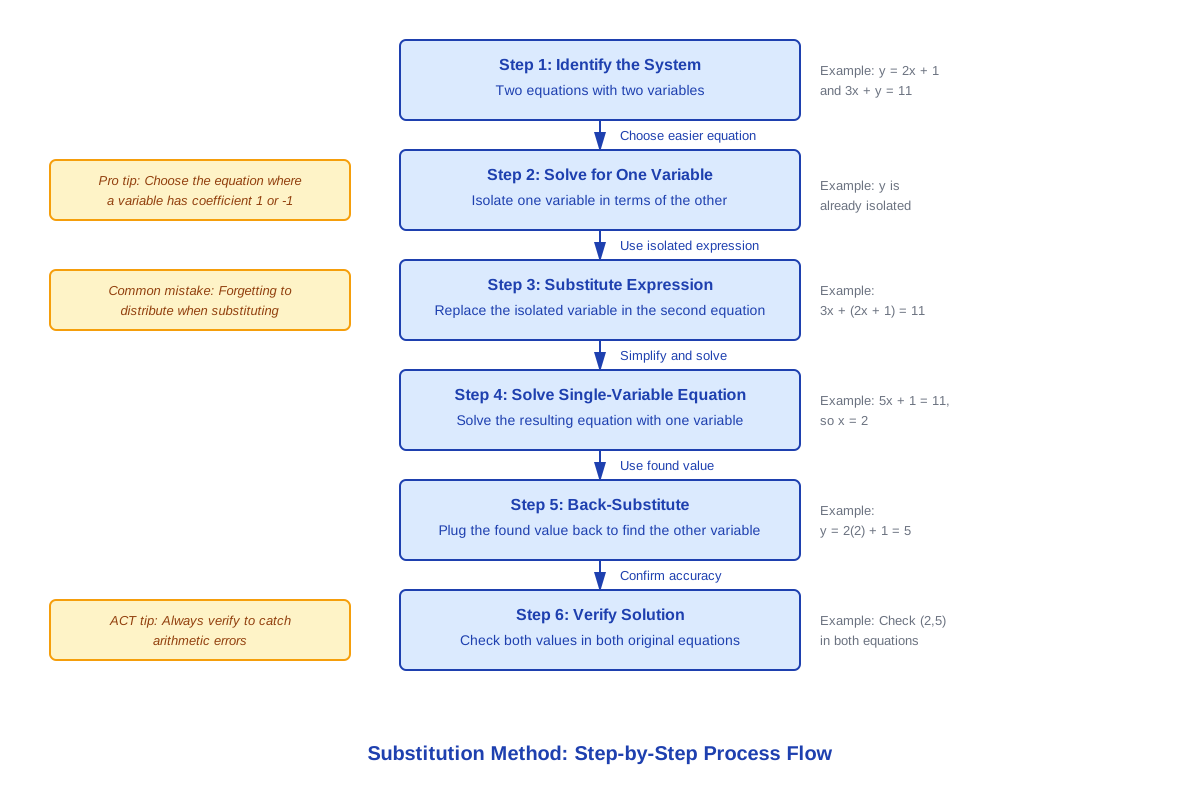
The systematic approach to substitution follows these numbered steps:
- Identify the system: Recognize that you have two or more equations with two or more variables
- Choose an equation to manipulate: Select the equation that is easiest to solve for one variable (look for coefficients of 1 or variables already isolated)
- Solve for one variable: Isolate a single variable on one side of the equation using inverse operations
- Substitute the expression: Replace every occurrence of that variable in the other equation with the expression you found
- Solve the resulting single-variable equation: Use standard algebraic techniques to find the value of the remaining variable
- Back-substitute: Plug the value you found into either original equation to find the value of the other variable
- Verify the solution: Check both values in both original equations to ensure accuracy
Choosing the Optimal Variable
Strategic selection of which variable to solve for first can dramatically reduce calculation complexity. Consider these factors:
- Coefficient of 1: Variables with a coefficient of 1 require no division, minimizing fraction work
- Already isolated: If one equation is already in y = or x = form, use it immediately
- Simpler resulting equation: Anticipate which choice will create easier arithmetic in subsequent steps
- Avoiding fractions: When possible, choose the path that delays or eliminates fraction manipulation
For example, given the system:
x + y = 10
2x - 3y = 4
Solving the first equation for x (giving x = 10 - y) is simpler than solving for y (giving y = 10 - x) because the first equation has both variables with coefficient 1, making either choice equally simple. However, solving the second equation for x would require dividing by 2, creating fractions unnecessarily.
Substitution with Different Equation Forms
The substitution method adapts to various equation formats:
| Equation Form | Example | Substitution Strategy |
|---|---|---|
| Standard form | 2x + 3y = 12 | Solve for the variable with the smallest coefficient |
| Slope-intercept | y = 2x + 5 | Use directly; y is already isolated |
| Point-slope | y - 3 = 2(x - 1) | Simplify first, then substitute |
| Variable on both sides | 3x + y = 2x - 4 | Simplify to standard form first |
Handling Special Cases
Certain systems produce unexpected results that students must recognize:
No solution (inconsistent system): When substitution leads to a false statement like 0 = 5, the lines are parallel and never intersect. The system has no solution.
Infinitely many solutions (dependent system): When substitution leads to a true statement like 0 = 0 or 3 = 3, the equations represent the same line. Every point on the line is a solution.
Unique solution: When substitution yields specific values for both variables, the lines intersect at exactly one point, which is the solution.
Substitution in Word Problems
The ACT frequently embeds substitution within word problems. The process expands to include:
- Define variables: Clearly state what each variable represents
- Translate to equations: Convert word relationships into mathematical equations
- Apply substitution: Use the standard method to solve
- Interpret the answer: Translate the numerical solution back to the context of the problem
- Check reasonableness: Verify that the answer makes sense in the real-world scenario
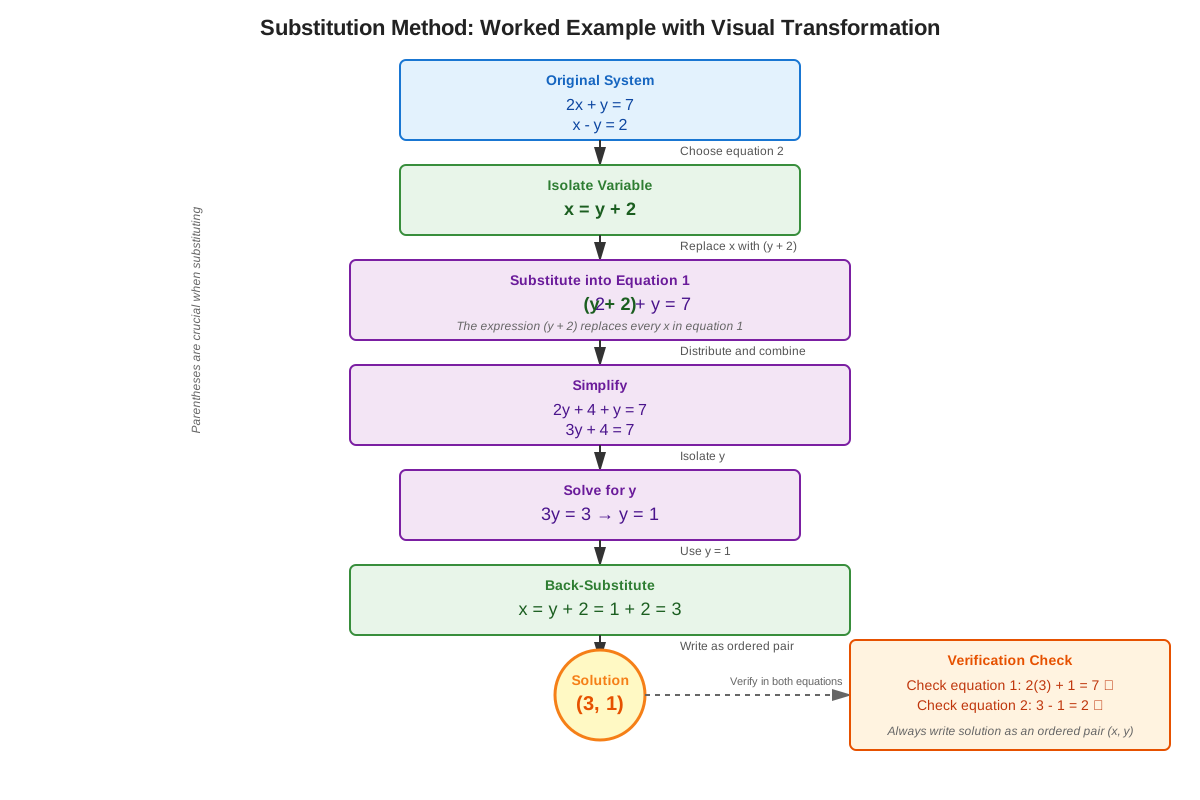
For instance, "The sum of two numbers is 15, and their difference is 3" translates to x + y = 15 and x - y = 3, where x and y represent the two numbers.
Concept Relationships
The substitution method builds directly on single-variable equation solving, as the core technique involves reducing a multi-variable system to a single-variable equation. Once substitution creates an equation with one variable, all previously learned solving techniques apply: combining like terms, using inverse operations, and isolating the variable.
The relationship flows as follows: Basic equation solving → Expression manipulation → Substitution method → System solutions → Coordinate geometry applications. Each step requires mastery of the previous concept.
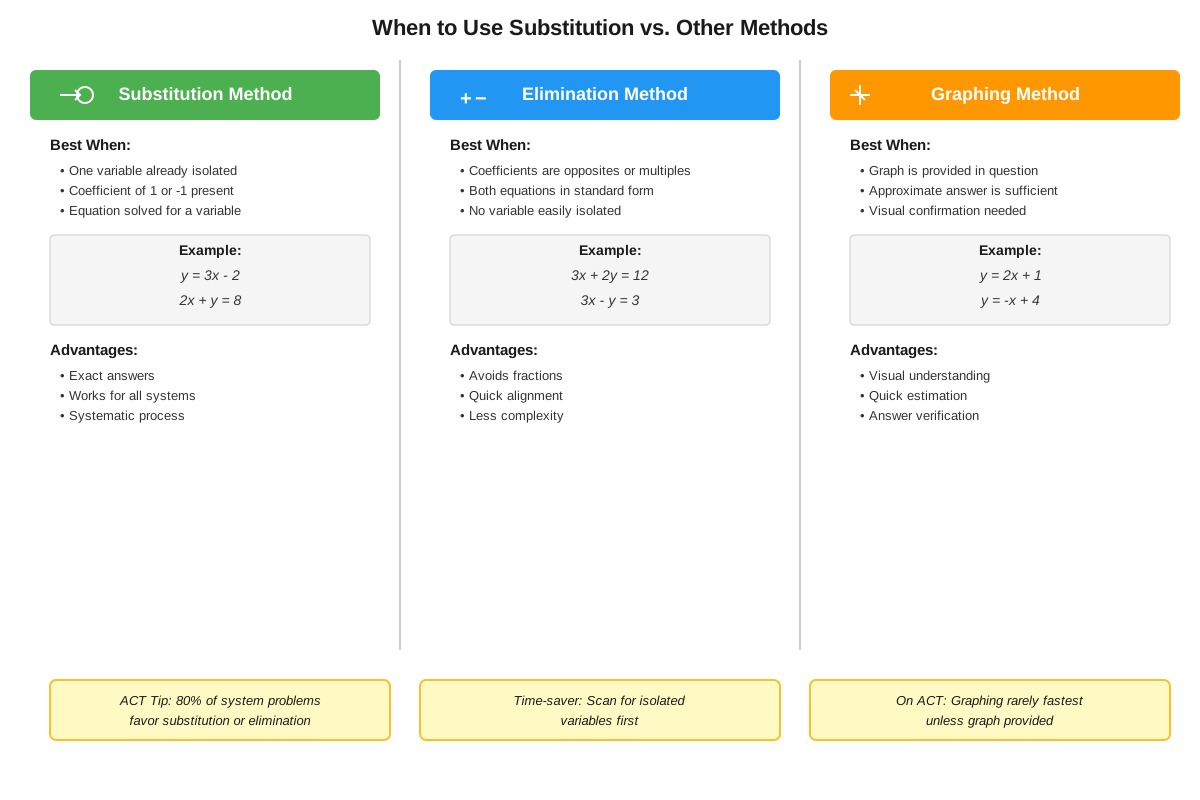
Substitution connects horizontally to the elimination method (another technique for solving systems) and graphing method (visual approach to finding intersections). These three methods often produce the same answer through different paths, with substitution being most efficient when one equation is already solved for a variable.
The method also relates to function composition in more advanced mathematics, where one function is substituted into another. This connection appears on the ACT when questions involve function notation and systems simultaneously.
Understanding substitution enables progression to systems of inequalities, linear programming, and matrix operations—topics that occasionally appear in the most challenging ACT Math questions. The logical reasoning developed through substitution also supports algebraic proof and mathematical modeling skills.
High-Yield Facts
⭐ The substitution method is most efficient when one equation is already solved for a variable or can easily be solved for a variable with coefficient 1
⭐ After finding the first variable's value, you must substitute back into one of the original equations to find the second variable's value
⭐ The solution to a system of two linear equations is the ordered pair (x, y) that satisfies both equations simultaneously
⭐ If substitution results in a false statement (like 0 = 5), the system has no solution and the lines are parallel
⭐ If substitution results in a true statement (like 0 = 0), the system has infinitely many solutions and the equations represent the same line
- Always verify your solution by substituting both values into both original equations
- The ACT typically presents systems where substitution requires 3-5 steps, making it manageable within time constraints
- Word problems requiring substitution often involve "sum and difference" relationships or "cost and quantity" scenarios
- When both equations are in standard form with no coefficients of 1, elimination may be more efficient than substitution
- Substitution can be used for systems with more than two equations, though this rarely appears on the ACT
- The geometric interpretation of substitution is finding the intersection point of two lines on the coordinate plane
- Fractional coefficients in the original equations often indicate that substitution will involve fraction arithmetic
Quick check — test yourself on Substitution method so far.
Try Flashcards →Common Misconceptions
Misconception: After solving for one variable, that value is the complete answer to the problem.
Correction: The substitution method requires finding both variables. After determining the first variable's value, you must substitute it back into one of the original equations to find the second variable. The complete solution is an ordered pair (x, y), not a single number.
Misconception: You can substitute into the same equation you just manipulated to find the second variable.
Correction: While mathematically this works, it's inefficient and error-prone. After finding one variable's value, substitute it into the OTHER original equation (the one you didn't manipulate) to find the second variable. This provides a built-in check of your work.
Misconception: The substitution method only works when one equation is already solved for y.
Correction: Substitution works regardless of which variable is isolated or whether any variable is initially isolated. You can solve for x, y, or any other variable in either equation. Choose the path that creates the simplest arithmetic.
Misconception: If you get a false statement like 3 = 7, you made an arithmetic error.
Correction: A false statement after correct substitution indicates the system has no solution (the lines are parallel). Before assuming an error, verify your arithmetic. If your work is correct, "no solution" is the answer.
Misconception: The substitution method and elimination method always take the same amount of time.
Correction: Different systems favor different methods. Substitution is faster when one variable is already isolated or has a coefficient of 1. Elimination is often faster when both equations are in standard form with no obvious variable to isolate. Recognizing which method suits each problem saves valuable ACT time.
Worked Examples
Example 1: Classic Two-Equation System
Problem: Solve the system:
y = 2x - 3
3x + 4y = 7Solution:
Step 1 - Identify the system: We have two equations with two variables (x and y).
Step 2 - Choose which equation to use: The first equation is already solved for y, making it perfect for substitution.
Step 3 - Substitute: Replace y in the second equation with (2x - 3):
3x + 4(2x - 3) = 7Step 4 - Solve for x:
3x + 8x - 12 = 7
11x - 12 = 7
11x = 19
x = 19/11
Step 5 - Back-substitute: Use x = 19/11 in the first equation:
y = 2(19/11) - 3
y = 38/11 - 33/11
y = 5/11
Step 6 - Verify: Check in the second equation:
3(19/11) + 4(5/11) = 57/11 + 20/11 = 77/11 = 7 ✓Answer: The solution is (19/11, 5/11).
Connection to learning objectives: This example demonstrates applying the substitution method to ACT-style questions and verifying solutions through back-substitution.
Example 2: Word Problem Application
Problem: At a school fundraiser, adult tickets cost $8 and student tickets cost $5. The school sold 150 tickets total and collected $930. How many adult tickets were sold?
Solution:
Step 1 - Define variables:
- Let a = number of adult tickets
- Let s = number of student tickets
Step 2 - Write equations:
- Total tickets: a + s = 150
- Total revenue: 8a + 5s = 930
Step 3 - Solve the first equation for one variable:
a + s = 150
a = 150 - s
Step 4 - Substitute into the second equation:
8(150 - s) + 5s = 930
1200 - 8s + 5s = 930
1200 - 3s = 930
-3s = -270
s = 90
Step 5 - Find the other variable:
a = 150 - s
a = 150 - 90
a = 60
Step 6 - Verify: Check both conditions:
- Total tickets: 60 + 90 = 150 ✓
- Total revenue: 8(60) + 5(90) = 480 + 450 = 930 ✓
Step 7 - Answer the question: The problem asks specifically for adult tickets.
Answer: 60 adult tickets were sold.
Connection to learning objectives: This example shows how to identify when substitution is being tested in word problems and demonstrates the complete process from translation through verification.
Exam Strategy
ACT Trigger Phrase Alert: Watch for "solve the system," "find the value of x and y," "where the lines intersect," "if both equations are true," or word problems with two unknowns and two conditions.
When approaching substitution questions on the ACT, follow this strategic framework:
Time allocation: Spend 60-90 seconds on straightforward substitution problems and up to 2 minutes on word problems requiring equation setup. If a problem exceeds this time, mark it and return later.
Recognition strategy: Substitution is being tested when you see two equations with two variables, especially when one equation is in y = form or when the problem describes two related conditions. The ACT rarely uses more than two equations, making substitution manageable.
Method selection: Choose substitution over elimination when:
- One equation is already solved for a variable
- One variable has a coefficient of 1 in either equation
- The problem explicitly gives you one relationship in isolated form
Choose elimination instead when both equations are in standard form with no obvious variable to isolate easily.
Process-of-elimination tips:
- If answer choices are ordered pairs, substitute each into both equations (though this is slower than solving)
- Eliminate answers that don't satisfy the simpler equation first
- If the problem asks for only one variable, you can sometimes avoid finding the second variable by checking answer choices
Common ACT tricks to avoid:
- Answer choices may include the value of only one variable when both are needed
- The test may list (y, x) instead of (x, y) to catch careless readers
- Incorrect answers often result from arithmetic errors in the substitution step
- Some choices represent the value found before back-substitution
Efficiency techniques:
- If the problem asks for x + y or 2x - y (a combination), you might solve for that expression directly without finding individual values
- When verifying, check your answer in the equation you didn't use for back-substitution
- Keep work organized by labeling each step to avoid losing track
Memory Techniques
SOLVE mnemonic for the substitution process:
- Select an equation to manipulate
- Obtain one variable in terms of the other
- Locate that variable in the other equation
- Vanquish the variable by substituting
- Evaluate and back-substitute
Visualization strategy: Picture substitution as a "plug and play" operation. Imagine the variable as a socket and the expression as a plug. When you substitute, you're plugging the expression into every socket (occurrence of that variable) in the other equation.
The "Already Done" rule: If an equation is already solved for a variable (y = something or x = something), that's your green light to use substitution immediately. No additional work needed before substituting.
The "1 is Fun" principle: When choosing which variable to solve for, look for coefficients of 1 first. They make the algebra fun (easy) because you avoid division and fractions.
Verification chant: "Two equations, two checks" - remind yourself that the solution must satisfy BOTH original equations. Check both to ensure accuracy.
Summary
The substitution method is an essential algebraic technique for solving systems of equations by expressing one variable in terms of another and replacing it in a second equation. This method transforms multi-variable problems into single-variable equations that can be solved using fundamental algebra skills. On the ACT Math test, substitution appears in 2-4 direct questions and serves as an intermediate step in several additional problems, making it a high-yield topic for focused study. The key to success lies in recognizing when substitution is most efficient (particularly when one equation is already solved for a variable), executing the seven-step process systematically, and always verifying solutions by checking both values in both original equations. Students must also distinguish between unique solutions, no solution (parallel lines), and infinitely many solutions (identical lines) based on the results of their substitution work. Mastery of this method, combined with strategic time management and careful attention to what the question asks for, enables confident handling of systems of equations on test day.
Key Takeaways
- The substitution method solves systems by replacing one variable with an equivalent expression, reducing two equations to one
- Always choose the equation and variable that minimize arithmetic complexity, prioritizing variables already isolated or with coefficients of 1
- The complete solution requires finding both variables: solve for one, then back-substitute to find the other
- Verify every solution by checking both values in both original equations to catch arithmetic errors
- False statements (0 = 5) indicate no solution; true statements (0 = 0) indicate infinitely many solutions
- On the ACT, substitution is most efficient when one equation is in y = form or when word problems provide one relationship explicitly
- Time management is crucial: spend 60-90 seconds on direct problems and up to 2 minutes on word problems requiring translation
Related Topics
Elimination Method: An alternative technique for solving systems of equations by adding or subtracting equations to eliminate one variable. Mastering substitution provides the foundation for understanding when elimination is more efficient, particularly with equations in standard form.
Graphing Systems of Equations: The visual approach to solving systems by finding intersection points on the coordinate plane. Understanding substitution deepens comprehension of why intersection points represent solutions.
Systems of Inequalities: Extending substitution concepts to problems involving inequality constraints rather than equations. The logical reasoning developed through substitution transfers directly to this more complex topic.
Matrices and Linear Algebra: Advanced methods for solving larger systems of equations. Substitution provides the conceptual foundation for understanding why these methods work.
Function Composition: The process of substituting one function into another, which appears in higher-level ACT questions. The substitution method develops the algebraic manipulation skills necessary for function composition.
Practice CTA
Now that you've mastered the core concepts of the substitution method, it's time to solidify your understanding through practice. Attempt the practice questions to apply these techniques to ACT-style problems, and use the flashcards to reinforce the high-yield facts and common misconceptions. Remember, the difference between understanding a concept and scoring points on test day lies in deliberate practice. Each problem you solve builds the pattern recognition and confidence needed to tackle substitution questions quickly and accurately under timed conditions. You've got this—start practicing!
Sign up free to keep reading
Create a free AnvayaPrep account to finish this ACT guide on Substitution method — plus flashcards and practice questions.