Overview
Factoring quadratics is one of the most frequently tested algebraic skills on the ACT Math section, appearing in approximately 3-5 questions per exam. This fundamental technique involves rewriting a quadratic expression in the form ax² + bx + c as a product of two binomial factors. Mastery of this skill is essential not only for solving quadratic equations but also for simplifying rational expressions, finding zeros of functions, and analyzing parabolic graphs—all common question types on the ACT.
The ability to factor quadratics efficiently separates high-scoring students from average performers because it enables rapid problem-solving without relying on the quadratic formula or graphing calculator for every question. ACT factoring quadratics questions often appear in multiple-choice format where recognizing factored forms can eliminate incorrect answers within seconds. Additionally, factoring serves as a gateway skill that connects to more advanced topics like polynomial division, rational functions, and systems of equations.
Understanding factoring quadratics creates a strong foundation for success across the entire algebra domain of the ACT. This topic bridges basic arithmetic operations with higher-level mathematical reasoning, requiring students to recognize patterns, apply systematic strategies, and verify solutions. The techniques learned here will be applied repeatedly throughout the exam, making this 20-minute investment in mastery one of the highest-yield study activities available for ACT preparation.
Learning Objectives
- [ ] Identify when Factoring quadratics is being tested in ACT questions
- [ ] Explain the core rule or strategy behind Factoring quadratics
- [ ] Apply Factoring quadratics to ACT-style questions accurately
- [ ] Factor quadratics with leading coefficients of 1 using the standard method
- [ ] Factor quadratics with leading coefficients greater than 1 using multiple strategies
- [ ] Recognize special factoring patterns including difference of squares and perfect square trinomials
- [ ] Verify factored forms by expanding and checking equivalence
Prerequisites
- Multiplication of binomials (FOIL method): Essential for understanding how factoring reverses the expansion process and for verifying factored answers
- Integer operations and sign rules: Required to determine correct sign combinations when finding factor pairs
- Basic algebraic manipulation: Necessary for rearranging terms and combining like terms during the factoring process
- Understanding of quadratic expressions: Foundational knowledge of the standard form ax² + bx + c and the meaning of coefficients
Why This Topic Matters
Factoring quadratics represents a critical intersection between algebraic manipulation and problem-solving efficiency. In real-world applications, factoring helps engineers determine break-even points in cost analysis, physicists calculate projectile motion trajectories, and architects design parabolic structures. The skill of recognizing patterns and decomposing complex expressions into simpler components translates directly to computational thinking valued across STEM fields.
On the ACT Math section, factoring quadratics appears with remarkable consistency. Statistical analysis of recent exams reveals that 5-8% of all math questions directly test factoring skills, while an additional 10-15% require factoring as an intermediate step toward the final answer. Questions typically present in several formats: solving quadratic equations, simplifying rational expressions, finding x-intercepts of parabolas, and determining equivalent algebraic forms. The ACT particularly favors questions where factoring provides a faster solution path than alternative methods like the quadratic formula.
Common exam scenarios include: identifying factored forms from multiple-choice options, solving equations by setting factors equal to zero, simplifying complex fractions containing quadratic expressions, and analyzing graphs by connecting factored form to x-intercepts. Time-conscious test-takers who master factoring can solve these questions in 30-45 seconds compared to 90+ seconds using calculator-dependent methods, creating significant time advantages for tackling more challenging problems later in the section.
Core Concepts
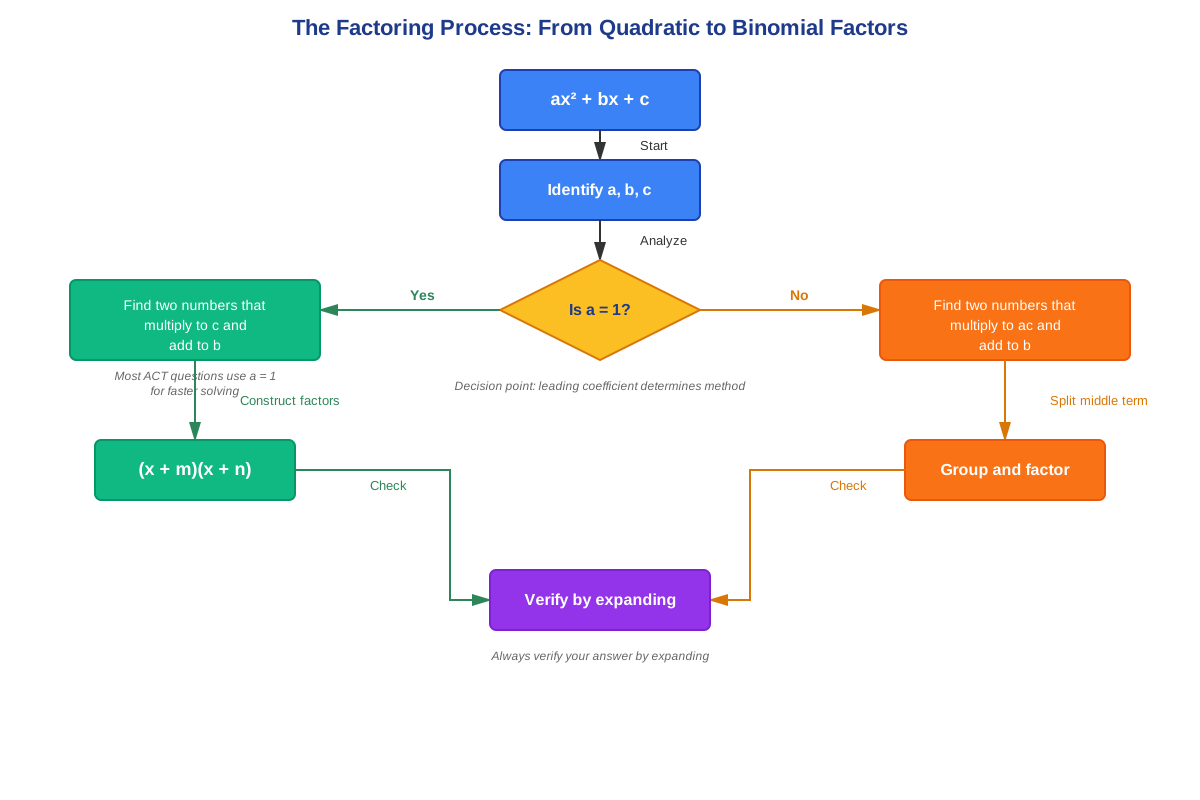
Understanding the Factoring Process
Factoring quadratics is the reverse operation of multiplying binomials. When two binomials (x + m)(x + n) are multiplied using the distributive property, the result is x² + (m + n)x + mn. Factoring reverses this process: given x² + bx + c, the goal is to find two numbers m and n where m + n = b and m × n = c. This fundamental relationship forms the basis for all factoring strategies.
The factored form reveals critical information about the quadratic expression. Each factor represents a potential zero of the function, meaning if (x + m) is a factor, then x = -m makes the entire expression equal to zero. This connection between factored form and solutions makes factoring an invaluable tool for equation-solving.
Factoring When a = 1
For quadratics in the form x² + bx + c (where the coefficient of x² is 1), the standard factoring method follows these steps:
- Identify the values of b (the coefficient of x) and c (the constant term)
- List all factor pairs of c (both positive and negative combinations)
- Find the pair that adds to b
- Write the factored form as (x + m)(x + n) where m and n are the identified numbers
Example: Factor x² + 7x + 12
- Factor pairs of 12: (1, 12), (2, 6), (3, 4)
- Which pair adds to 7? 3 + 4 = 7
- Factored form: (x + 3)(x + 4)
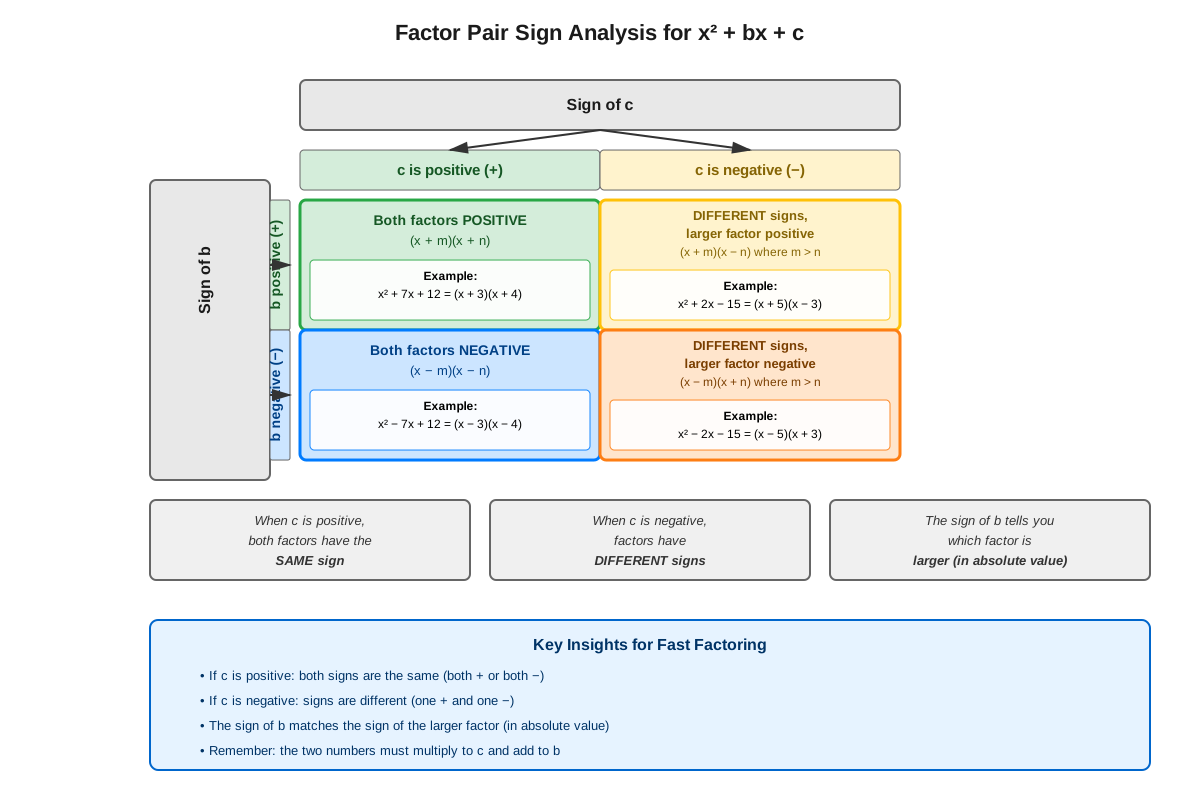
Sign considerations are crucial. When c is positive, both factors have the same sign (determined by the sign of b). When c is negative, the factors have opposite signs, with the larger absolute value matching the sign of b.
Factoring When a ≠ 1
When the leading coefficient is not 1 (ax² + bx + c where a ≠ 1), the factoring process becomes more complex. The AC method provides a systematic approach:
- Multiply a and c to get the product AC
- Find two numbers that multiply to AC and add to b
- Rewrite the middle term (bx) using these two numbers
- Factor by grouping: group the first two terms and last two terms separately
- Factor out the common factor from each group
- Factor out the common binomial
Example: Factor 2x² + 7x + 3
- AC = 2 × 3 = 6
- Numbers that multiply to 6 and add to 7: 6 and 1
- Rewrite: 2x² + 6x + 1x + 3
- Group: (2x² + 6x) + (1x + 3)
- Factor each group: 2x(x + 3) + 1(x + 3)
- Factor out common binomial: (x + 3)(2x + 1)
An alternative approach involves trial and error with possible factor combinations, testing (ax + m)(dx + n) where a × d equals the leading coefficient and m × n equals the constant term.
Special Factoring Patterns
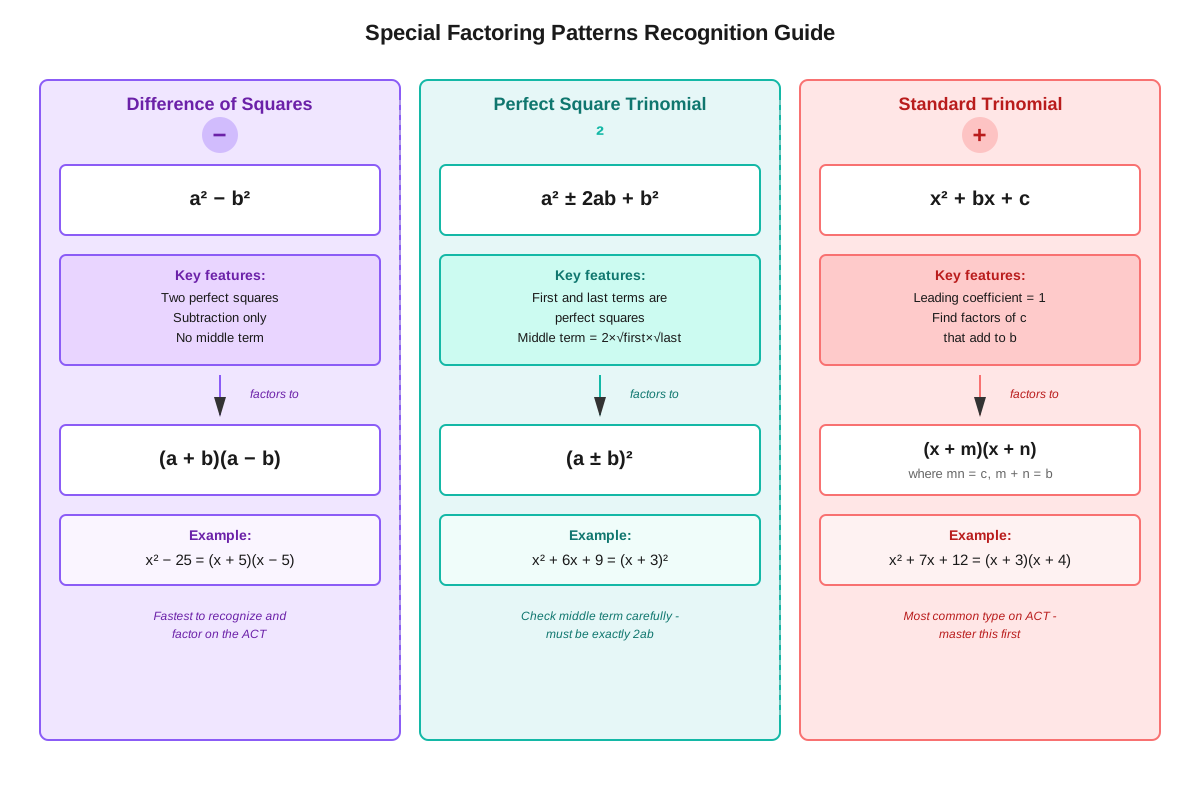
Certain quadratic forms follow predictable patterns that enable instant factoring:
Difference of Squares: a² - b² = (a + b)(a - b)
This pattern applies when a quadratic has no middle term and the constant is negative. Both terms must be perfect squares.
Example: x² - 25 = (x + 5)(x - 5)
Perfect Square Trinomials: a² + 2ab + b² = (a + b)² or a² - 2ab + b² = (a - b)²
These occur when the first and last terms are perfect squares and the middle term equals twice the product of their square roots.
Example: x² + 10x + 25 = (x + 5)²
Recognizing these patterns saves significant time on the ACT, as they appear in approximately 20% of factoring questions.
Verification Strategy
Always verify factored answers by expanding using FOIL (First, Outer, Inner, Last):
(x + m)(x + n) = x² + nx + mx + mn = x² + (m + n)x + mn
This check takes 5-10 seconds but prevents careless errors that cost points. On the ACT, verification is particularly important because incorrect factorizations often appear as distractor answer choices.
Factoring Strategy Selection
| Quadratic Form | Best Strategy | Time Estimate |
|---|---|---|
| x² + bx + c (a = 1) | Standard method | 15-20 seconds |
| ax² + bx + c (a ≠ 1) | AC method or trial | 30-45 seconds |
| x² - c (difference of squares) | Pattern recognition | 5-10 seconds |
| Perfect square trinomial | Pattern recognition | 10-15 seconds |
| Prime (unfactorable) | Recognize quickly, use alternative | 20 seconds |
Concept Relationships
The factoring process directly reverses binomial multiplication, creating a bidirectional relationship where mastery of one reinforces understanding of the other. When students multiply (x + 3)(x + 5) to get x² + 8x + 15, they're building the mental pathways needed to factor x² + 8x + 15 back into (x + 3)(x + 5).
Factoring quadratics serves as the foundation for solving quadratic equations through the Zero Product Property: if ab = 0, then a = 0 or b = 0. This principle connects factoring → setting each factor equal to zero → finding solutions. For example, factoring x² + 5x + 6 = 0 into (x + 2)(x + 3) = 0 immediately reveals solutions x = -2 and x = -3.
The relationship map flows as follows:
Integer Operations → Binomial Multiplication → Factoring Quadratics → Solving Quadratic Equations → Graphing Parabolas → Analyzing Functions
Special factoring patterns (difference of squares, perfect square trinomials) represent shortcuts within the broader factoring framework, offering faster paths when specific conditions are met. These patterns also connect to geometric interpretations: the difference of squares relates to area models, while perfect square trinomials connect to completing the square.
Factoring with leading coefficients greater than 1 builds upon the basic factoring method, adding complexity through the AC method or systematic trial and error. This progression from simple to complex mirrors the ACT's question difficulty curve, where early problems test basic factoring while later questions embed factoring within multi-step problems.
Quick check — test yourself on Factoring quadratics so far.
Try Flashcards →High-Yield Facts
⭐ The sum of the two numbers in factored form equals the coefficient of x (b), while their product equals the constant term (c)
⭐ When c is positive, both factors have the same sign; when c is negative, factors have opposite signs
⭐ The difference of squares pattern (a² - b²) factors instantly as (a + b)(a - b) with no middle term
⭐ For ax² + bx + c where a ≠ 1, the AC method requires finding numbers that multiply to ac and add to b
⭐ Perfect square trinomials follow the pattern a² ± 2ab + b² = (a ± b)²
- Factoring reveals the zeros/x-intercepts of a quadratic function directly from the factored form
- Always verify factored answers by expanding to check equivalence with the original expression
- Prime quadratics (unfactorable over integers) appear occasionally on the ACT and require alternative solution methods
- The leading coefficient in factored form must multiply to equal the original leading coefficient
- Factoring by grouping works for four-term expressions and is essential for the AC method
- Common factors should be factored out first before attempting other factoring methods (GCF first)
- The sign of the constant term determines whether to look for factor pairs with the same or opposite signs
Common Misconceptions
Misconception: The numbers in the factored form are the solutions to the equation.
Correction: The numbers in (x + m)(x + n) are m and n, but the solutions are x = -m and x = -n. Students must set each factor equal to zero and solve, changing the sign of the constant in each factor.
Misconception: When factoring x² + bx - c (negative constant), both factors must be negative.
Correction: A negative constant requires one positive and one negative factor. The factor with the larger absolute value takes the sign of b. For x² + 2x - 15, the factors are (x + 5)(x - 3), not (x - 5)(x - 3).
Misconception: The AC method only works for specific types of quadratics.
Correction: The AC method works for all factorable quadratics where a ≠ 1. It's a universal strategy that systematically finds the correct factorization when applied correctly, though it may be slower than pattern recognition for special cases.
Misconception: If a quadratic doesn't factor easily in 30 seconds, it must be prime (unfactorable).
Correction: Some quadratics require more systematic work, especially those with larger coefficients. Before concluding a quadratic is prime, complete the full AC method or systematically test all reasonable factor combinations.
Misconception: The factored form (x + 3)(x + 5) is the same as (x + 5)(x + 3).
Correction: This is actually correct—factored forms are equivalent regardless of order due to the commutative property of multiplication. However, students should recognize that answer choices may present factors in either order.
Misconception: Perfect square trinomials always have a positive middle term.
Correction: Perfect square trinomials can have either positive or negative middle terms: x² + 6x + 9 = (x + 3)² and x² - 6x + 9 = (x - 3)² are both perfect square trinomials.
Worked Examples
Example 1: Standard Factoring (a = 1)
Problem: Factor x² - 3x - 18 and use the factored form to solve x² - 3x - 18 = 0
Solution:
Step 1: Identify b = -3 and c = -18
Step 2: Since c is negative, we need factors with opposite signs. List factor pairs of 18:
- (1, 18), (2, 9), (3, 6)
Step 3: Which pair has a difference of 3 (since b = -3)?
- 6 - 9 = -3 ✓
Step 4: The larger number (9) must be negative to produce -3:
- -9 + 6 = -3 ✓
- -9 × 6 = -54... wait, we need -18
Step 5: Reconsider: We need factors that multiply to -18 and add to -3
- 3 and -6: 3 × (-6) = -18 ✓ and 3 + (-6) = -3 ✓
Step 6: Write factored form: (x + 3)(x - 6)
Step 7: Verify by expanding: x² - 6x + 3x - 18 = x² - 3x - 18 ✓
Step 8: Solve the equation by setting each factor to zero:
- x + 3 = 0 → x = -3
- x - 6 = 0 → x = 6
Answer: Factored form is (x + 3)(x - 6); solutions are x = -3 and x = 6
This example demonstrates Learning Objective 3 (applying factoring to ACT-style questions) and shows the complete process from factoring through solving.
Example 2: Factoring with a ≠ 1 Using AC Method
Problem: Factor 3x² - 11x + 6
Solution:
Step 1: Identify a = 3, b = -11, c = 6
Step 2: Calculate AC = 3 × 6 = 18
Step 3: Find two numbers that multiply to 18 and add to -11
- Both numbers must be negative (since their product is positive and sum is negative)
- Factor pairs of 18: (-1, -18), (-2, -9), (-3, -6)
- Which adds to -11? -2 + (-9) = -11 ✓
Step 4: Rewrite the middle term using -2 and -9:
- 3x² - 11x + 6 = 3x² - 2x - 9x + 6
Step 5: Factor by grouping:
- Group 1: 3x² - 2x = x(3x - 2)
- Group 2: -9x + 6 = -3(3x - 2)
Step 6: Factor out the common binomial (3x - 2):
- x(3x - 2) - 3(3x - 2) = (3x - 2)(x - 3)
Step 7: Verify by expanding:
- (3x - 2)(x - 3) = 3x² - 9x - 2x + 6 = 3x² - 11x + 6 ✓
Answer: (3x - 2)(x - 3)
This example illustrates Learning Objective 2 (explaining the core strategy) through the systematic AC method and addresses the more challenging case where a ≠ 1.
Exam Strategy
ACT Trigger Words: "factor," "which of the following is equivalent to," "solve for x," "find the zeros," "x-intercepts," "roots of the equation"
When approaching ACT factoring quadratics questions, first scan for special patterns before applying general methods. Spend 3-5 seconds checking for difference of squares (no middle term, negative constant) or perfect square trinomials (first and last terms are perfect squares). These patterns allow instant factoring and can save 30+ seconds per question.
For standard factoring questions, use this decision tree:
- Is a = 1? → Use standard method (find factors of c that add to b)
- Is a ≠ 1? → Use AC method or systematic trial
- Can't factor quickly? → Check answer choices by expanding them (often faster than completing the factoring)
The ACT frequently presents factoring questions in reverse: giving you factored forms and asking which quadratic they represent. For these questions, quickly expand the answer choices using FOIL rather than factoring the original expression. This reverse approach often proves faster.
Process of Elimination Tips:
- Eliminate choices where the constant term doesn't match (multiply the constants in the factors)
- Eliminate choices where the leading coefficient doesn't match (multiply the x-coefficients in the factors)
- Check the middle term last, as it's most prone to sign errors in distractor answers
Time Allocation: Budget 30-45 seconds for straightforward factoring questions, 60-75 seconds for multi-step problems requiring factoring as an intermediate step. If you haven't made progress after 45 seconds, mark the question and return later—the ACT rewards moving forward over getting stuck.
For questions asking you to solve equations, factor first, then apply the Zero Product Property. Don't waste time with the quadratic formula if the expression factors cleanly—factoring is typically 2-3 times faster.
Memory Techniques
FOIL Backwards = LIOF: When factoring, think "Last, Inner, Outer, First" to remember that the constant term comes from multiplying the last terms, helping you identify which factor pairs to test.
"Same Sign, Same Side": When the constant (c) is positive, both factors have the same sign, which matches the sign of b. This mnemonic prevents sign errors in 80% of factoring problems.
"AC/DC Method": Remember the AC method by thinking "AC" (multiply a and c) then "DC" (Divide and Conquer by grouping). This playful connection to the rock band makes the method memorable.
"DOTS" for Difference of Squares: Difference, Of, Two, Squares = (sum)(difference). Visualize two squares with different areas to remember this pattern.
Perfect Square Trinomial Check - "1-2-1 Pattern": The coefficients follow a 1-2-1 ratio when written as perfect squares: 1x², 2(something)x, 1(something)². If you see this pattern, you have a perfect square trinomial.
Visualization Strategy: Picture factoring as "un-FOILing" a present. The wrapped present is the expanded form (x² + bx + c), and factoring reveals the two gifts inside (the factors). This mental image reinforces that factoring reverses multiplication.
Summary
Factoring quadratics is a high-yield ACT skill that transforms expressions in the form ax² + bx + c into products of binomial factors. The fundamental strategy depends on the leading coefficient: when a = 1, find two numbers that multiply to c and add to b; when a ≠ 1, use the AC method to systematically rewrite and group terms. Special patterns including difference of squares (a² - b²) and perfect square trinomials (a² ± 2ab + b²) enable instant factoring when recognized. Mastery requires understanding the relationship between factored form and solutions, recognizing that factors reveal zeros of the function through the Zero Product Property. Success on ACT factoring questions demands pattern recognition, systematic application of methods, and verification through expansion. Students who internalize these strategies can solve factoring questions in 30-45 seconds, creating significant time advantages. The ability to factor quadratics serves as a gateway skill connecting basic algebra to equation-solving, function analysis, and graph interpretation—making it one of the most valuable topics for ACT Math preparation.
Key Takeaways
- Factoring reverses binomial multiplication: find two numbers that multiply to c and add to b when a = 1
- Sign rules are critical: positive c means same-sign factors, negative c means opposite-sign factors
- The AC method provides a systematic approach for factoring when a ≠ 1: multiply a and c, find factors that add to b, then group
- Special patterns (difference of squares, perfect square trinomials) enable instant factoring and appear in 20% of questions
- Always verify factored forms by expanding to catch errors before selecting answers
- Factored form directly reveals solutions through the Zero Product Property: (x + m) = 0 means x = -m
- Pattern recognition and strategic method selection separate efficient test-takers from those who struggle with time management
Related Topics
Solving Quadratic Equations: Factoring serves as the primary method for solving quadratics when expressions factor cleanly over integers. Mastering factoring enables rapid equation-solving without calculator dependence.
Quadratic Formula: When quadratics don't factor easily, the quadratic formula provides an alternative solution method. Understanding when to factor versus when to use the formula optimizes time management.
Graphing Parabolas: Factored form reveals x-intercepts directly, connecting algebraic factoring to geometric visualization. This relationship appears frequently in coordinate geometry questions.
Rational Expressions: Factoring quadratics in numerators and denominators enables simplification of complex fractions, a skill tested in advanced algebra questions.
Polynomial Operations: The factoring techniques learned here extend to higher-degree polynomials, making this topic foundational for advanced algebra and precalculus.
Practice CTA
Now that you've mastered the core concepts and strategies for factoring quadratics, it's time to solidify your understanding through active practice. Complete the practice questions to test your ability to recognize factoring opportunities, apply appropriate methods, and solve problems efficiently under timed conditions. Use the flashcards to reinforce pattern recognition and memorize key formulas. Remember: factoring is a skill that improves dramatically with deliberate practice—each problem you solve builds the mental pathways that enable instant recognition on test day. Your investment in mastering this high-yield topic will pay dividends across multiple questions on the ACT Math section!
Sign up free to keep reading
Create a free AnvayaPrep account to finish this ACT guide on Factoring quadratics — plus flashcards and practice questions.