Overview
Literal equations are algebraic equations that involve two or more variables, where the goal is to solve for one variable in terms of the others rather than finding a numerical answer. Unlike traditional equations where students solve for a specific numeric value (e.g., x = 5), literal equations require rearranging formulas to isolate a particular variable while treating all other variables as constants. This skill is fundamental to algebra and appears frequently on the ACT Math section, testing a student's ability to manipulate algebraic expressions and understand the relationships between multiple variables.
The ACT regularly tests literal equations because they assess multiple mathematical competencies simultaneously: understanding of inverse operations, facility with algebraic manipulation, recognition of equivalent expressions, and the ability to work abstractly with variables. Questions involving ACT literal equations typically appear 2-4 times per test and may be embedded within geometry problems (solving for radius in a volume formula), physics-based scenarios (isolating velocity in a distance formula), or pure algebra contexts. Mastering this topic is essential not only for direct literal equation questions but also for success with more complex algebraic reasoning throughout the exam.
Literal equations connect to broader mathematical concepts including function notation, formula manipulation, systems of equations, and applied problem-solving. They serve as a bridge between basic equation-solving and more advanced topics like parametric equations and mathematical modeling. Students who develop strong skills with literal equations gain confidence in their algebraic reasoning and improve their performance across multiple ACT Math content areas, particularly in the Higher Math category where approximately 57-60% of questions appear.
Learning Objectives
- [ ] Identify when Literal equations is being tested in ACT Math questions
- [ ] Explain the core rule or strategy behind Literal equations manipulation
- [ ] Apply Literal equations techniques to ACT-style questions accurately
- [ ] Isolate any specified variable from a multi-variable equation using inverse operations
- [ ] Recognize when literal equations appear disguised within geometry, physics, or word problems
- [ ] Verify solutions by substituting back into the original equation
- [ ] Simplify complex literal equations involving fractions, radicals, and exponents
Prerequisites
- Basic algebraic equation solving: Understanding how to isolate variables using inverse operations is the foundation for manipulating literal equations with multiple variables
- Order of operations (PEMDAS): Necessary for correctly reversing operations in the proper sequence when solving for a variable
- Properties of equality: The ability to perform the same operation on both sides of an equation ensures valid algebraic manipulations
- Fraction operations: Many literal equations involve fractional coefficients or variables in denominators, requiring comfort with fraction arithmetic
- Exponent rules: Literal equations frequently include squared terms, square roots, and other exponential expressions that must be manipulated correctly
Why This Topic Matters
Literal equations represent a critical thinking skill that extends far beyond the ACT exam. In real-world applications, professionals in science, engineering, finance, and technology constantly rearrange formulas to solve for unknown quantities. A chemist might need to solve the ideal gas law (PV = nRT) for temperature, an engineer might isolate radius from a volume formula, and a financial analyst might rearrange compound interest formulas to determine time periods or interest rates. The ability to manipulate formulas flexibly demonstrates mathematical maturity and problem-solving versatility.
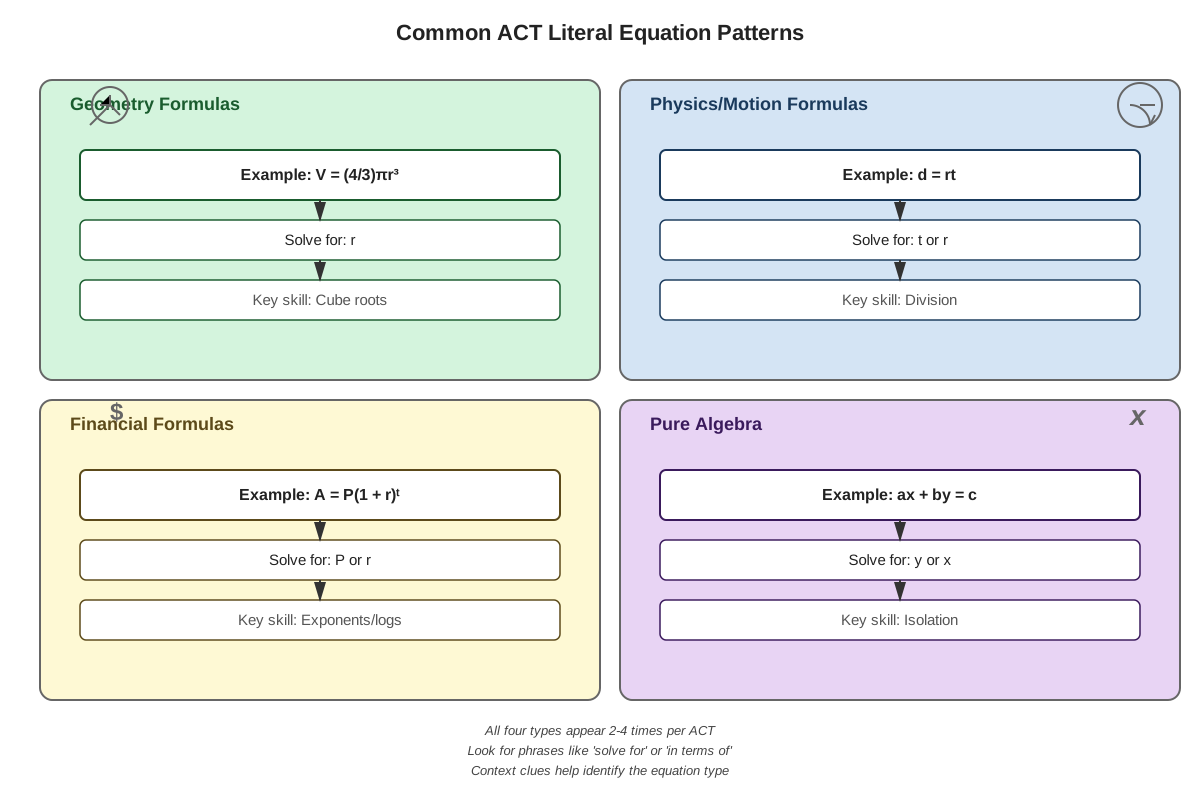
On the ACT Math section, literal equations appear with notable frequency and variety. Statistical analysis of recent ACT exams shows that 3-5% of all math questions directly test literal equation manipulation, with an additional 5-8% incorporating these skills within applied contexts. Questions typically appear in the Preparing for Higher Mathematics category, specifically within the Algebra subcategory. The ACT presents literal equations in multiple formats: straightforward "solve for x" problems, geometry formula rearrangements (area, volume, surface area), physics-based scenarios (distance, velocity, acceleration), and financial mathematics (interest, growth rates).
Common question formats include: providing a formula and asking students to solve for a specific variable; presenting a scenario where a formula must be rearranged before numerical values can be substituted; asking which expression is equivalent to a given variable after rearrangement; and multi-step problems where formula manipulation is one component of a larger solution process. The ACT particularly favors questions that combine literal equation skills with other concepts, testing whether students can recognize when formula rearrangement is necessary within a broader problem-solving context.
Core Concepts
Definition and Purpose of Literal Equations
A literal equation is an equation containing two or more variables where the objective is to express one variable explicitly in terms of the others. The term "literal" refers to the use of letters (variables) rather than specific numbers. For example, the equation A = πr² is a literal equation relating area (A) to radius (r). When asked to "solve for r," students must rearrange this equation to isolate r on one side: r = √(A/π). This process treats A and π as known quantities while manipulating the equation to express r as a function of these other values.
The fundamental principle underlying literal equation manipulation is that any operation performed on one side of an equation must be performed on the other side to maintain equality. This principle remains constant whether working with numbers or variables. The key difference from numerical equation-solving is that the solution will be an algebraic expression rather than a single number.
The Systematic Approach to Solving Literal Equations
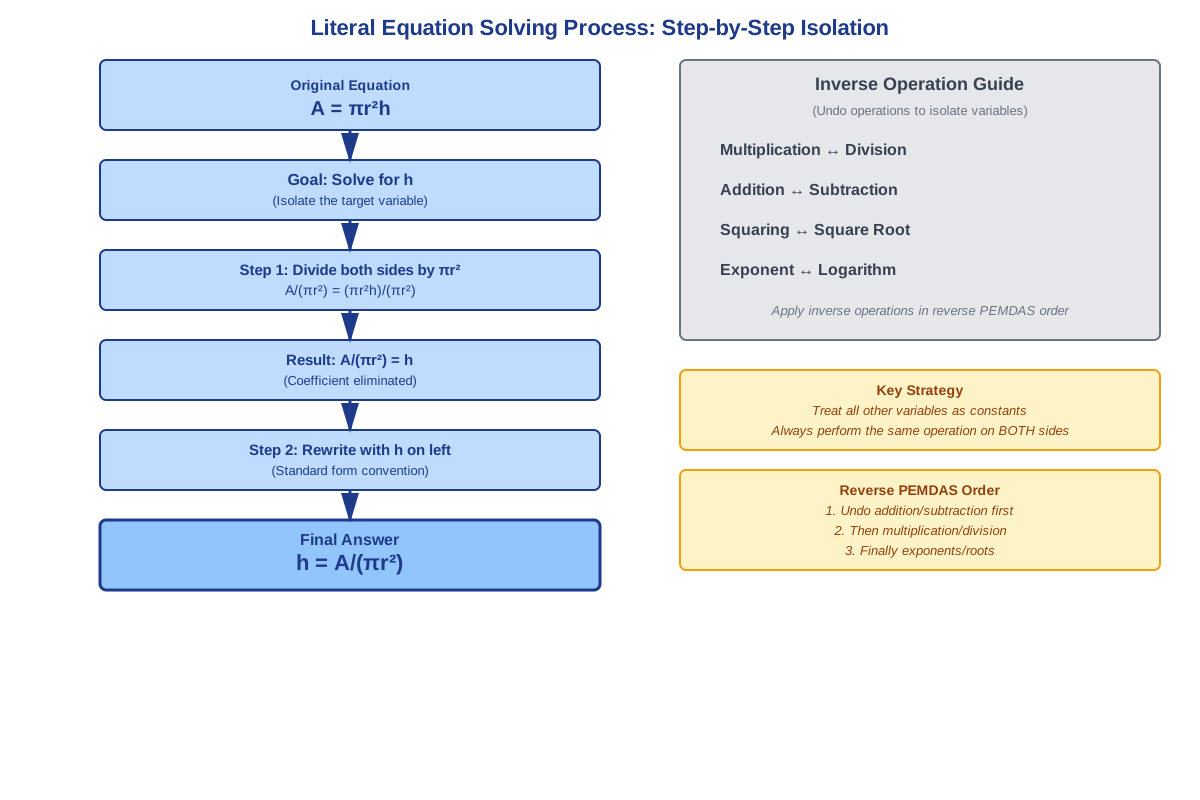
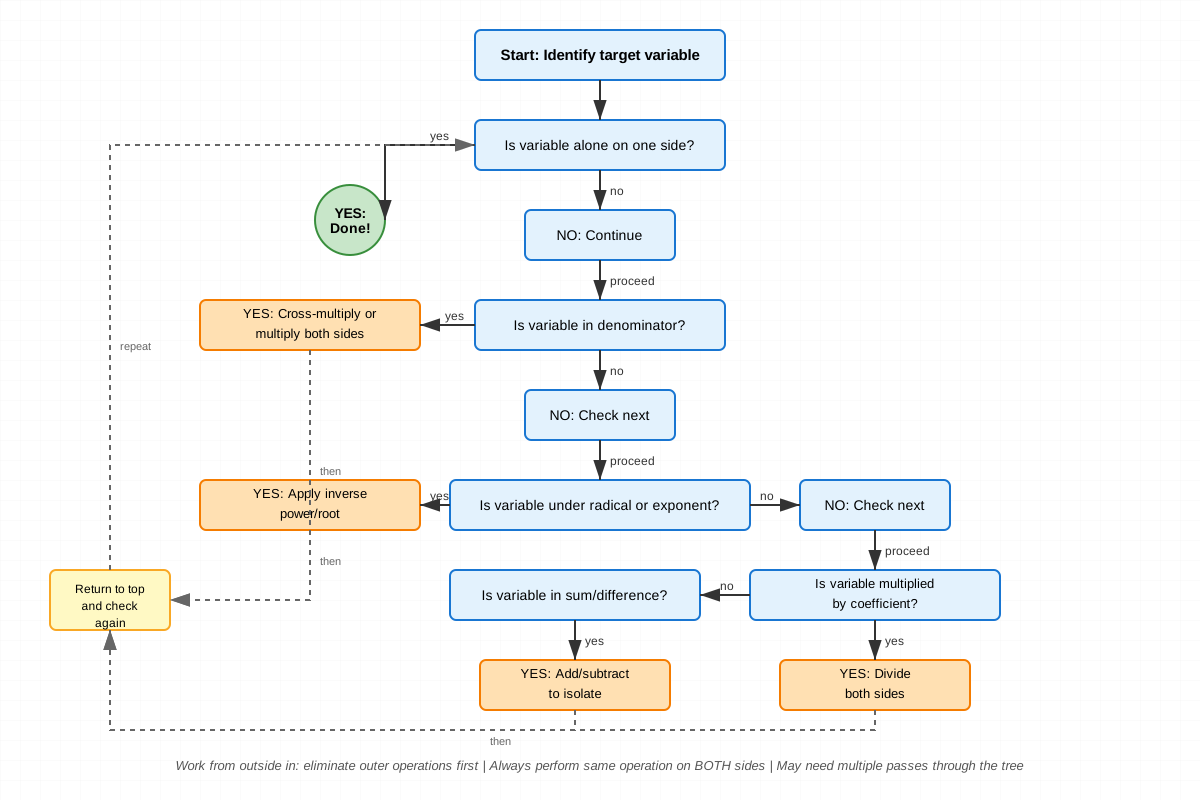
Solving literal equations follows a structured process that mirrors the steps used for numerical equations, applied in reverse order of operations:
- Identify the target variable: Determine which variable needs to be isolated
- Analyze the equation structure: Note how the target variable appears (coefficient, denominator, under a radical, etc.)
- Plan the operation sequence: Determine which operations to undo and in what order
- Execute inverse operations systematically: Work through operations in reverse PEMDAS order
- Simplify the result: Combine like terms and reduce fractions where possible
- Verify the solution: Check that the target variable appears alone on one side
When the target variable appears multiple times in the equation, additional steps are required: collect all terms containing the target variable on one side, factor out the target variable, then divide by the remaining factor.
Working with Fractions in Literal Equations
Literal equations frequently involve variables in denominators or as parts of complex fractions. The most efficient strategy is typically to eliminate fractions early by multiplying both sides by the least common denominator (LCD) or by the denominator containing the target variable.
For example, to solve 1/f = 1/a + 1/b for f:
- Recognize that f appears in a denominator
- Multiply both sides by f to eliminate it from the denominator: 1 = f/a + f/b
- Multiply both sides by the LCD (ab): ab = fb + fa
- Factor out f: ab = f(b + a)
- Divide both sides by (b + a): f = ab/(a + b)
Handling Exponents and Radicals
When the target variable appears under a radical or raised to a power, inverse operations must be applied carefully:
| If the variable is... | Apply this inverse operation |
|---|---|
| Squared (x²) | Take the square root of both sides |
| Cubed (x³) | Take the cube root of both sides |
| Under a square root (√x) | Square both sides |
| Raised to power n (xⁿ) | Take the nth root of both sides |
Important consideration: When taking even roots, consider whether both positive and negative solutions are meaningful in context. On the ACT, geometric contexts typically require only positive solutions.
Example: Solve V = (4/3)πr³ for r
- Multiply both sides by 3: 3V = 4πr³
- Divide both sides by 4π: 3V/(4π) = r³
- Take the cube root: r = ∛(3V/(4π))
Variables Appearing Multiple Times
When the target variable appears in multiple terms, the strategy involves:
- Collect all terms containing the target variable on one side
- Move all other terms to the opposite side
- Factor out the target variable
- Divide by the remaining factor
Example: Solve ax + b = cx + d for x
- Subtract cx from both sides: ax - cx + b = d
- Subtract b from both sides: ax - cx = d - b
- Factor out x: x(a - c) = d - b
- Divide by (a - c): x = (d - b)/(a - c)
Common Formula Types on the ACT
The ACT frequently uses these formula categories for literal equation questions:
Geometric formulas:
- Area: A = lw, A = πr², A = (1/2)bh
- Volume: V = lwh, V = (4/3)πr³, V = πr²h
- Surface area: SA = 2lw + 2lh + 2wh
Physics formulas:
- Distance: d = rt
- Kinetic energy: KE = (1/2)mv²
- Force: F = ma
Financial formulas:
- Simple interest: I = Prt
- Compound interest: A = P(1 + r)ᵗ
Concept Relationships
The concepts within literal equations build upon each other in a logical progression. Basic inverse operations (addition/subtraction, multiplication/division) form the foundation → these extend to fraction manipulation when variables appear in denominators → which connects to exponent and radical operations when variables are raised to powers → culminating in multi-occurrence variable problems that require factoring techniques.
Literal equations connect backward to prerequisite topics: they rely heavily on basic equation-solving skills learned in introductory algebra, require fluency with fraction operations from arithmetic, and depend on exponent rules from earlier algebra units. The distributive property and factoring skills are essential when variables appear multiple times.
Looking forward, literal equations enable progression to more advanced topics: they provide the foundation for function notation and transformation, where expressing one variable in terms of another becomes routine; they prepare students for systems of equations, where multiple literal equations must be manipulated simultaneously; and they develop the algebraic flexibility needed for parametric equations and mathematical modeling in advanced mathematics.
The relationship map: Basic Equation Solving → Inverse Operations with Variables → Fraction Elimination Techniques → Exponent/Radical Manipulation → Multi-Variable Factoring → Function Notation → Systems of Equations → Mathematical Modeling
Quick check — test yourself on Literal equations so far.
Try Flashcards →High-Yield Facts
⭐ Literal equations require solving for one variable in terms of others, producing an algebraic expression rather than a numerical answer
⭐ The same operation must be performed on both sides of the equation to maintain equality, regardless of whether working with numbers or variables
⭐ When a variable appears in a denominator, multiply both sides by that denominator early in the solution process
⭐ To isolate a variable that appears multiple times, collect all terms containing it on one side, factor it out, then divide
⭐ Apply inverse operations in reverse PEMDAS order: undo addition/subtraction first, then multiplication/division, then exponents/roots
- When a variable is squared, take the square root of both sides; when under a square root, square both sides
- The ACT commonly embeds literal equations within geometry problems requiring formula rearrangement
- Fractions in literal equations are best eliminated by multiplying both sides by the LCD or relevant denominator
- Verification can be performed by substituting the derived expression back into the original equation
- Common ACT formulas include d = rt, A = πr², V = (4/3)πr³, and I = Prt
- When factoring out a variable, the remaining factor becomes the divisor in the final step
- Literal equations with exponents may require fractional exponents in the final answer (e.g., r = V^(1/3))
- The ACT may present literal equations in word problem format requiring formula identification before manipulation
- Parentheses must be distributed correctly when variables appear as coefficients of grouped terms
- Some literal equations cannot be simplified further and should be left in fractional or radical form
Common Misconceptions
Misconception: Only the variable being solved for needs to be isolated; other variables can remain on the same side.
Correction: The target variable must be completely alone on one side of the equation, with all other variables and constants on the opposite side. The goal is to express the target variable as a function of everything else.
Misconception: When a variable appears in a denominator, it can be moved to the numerator by simply "flipping" it.
Correction: Variables in denominators must be eliminated through multiplication. To solve 5/x = y for x, multiply both sides by x to get 5 = xy, then divide both sides by y to get x = 5/y. There is no shortcut that bypasses proper algebraic steps.
Misconception: Taking the square root of both sides when x² appears automatically gives x as the answer.
Correction: Taking the square root of both sides gives x = ±√(expression). However, in most ACT contexts (especially geometry), only the positive root is meaningful. The ± symbol should be considered, then the appropriate solution selected based on context.
Misconception: When a variable appears twice, both instances must be isolated separately.
Correction: When a variable appears multiple times, all terms containing it must be collected on one side, then the variable is factored out as a common factor. For ax + b = cx, the solution is x = b/(c - a), not two separate solutions.
Misconception: Literal equations always simplify to a single variable or simple fraction.
Correction: Many literal equations result in complex expressions involving multiple variables, fractions, and radicals. The expression r = ∛(3V/(4π)) is a complete and correct answer even though it appears complex. Further simplification may not be possible or necessary.
Misconception: The order of operations doesn't matter when working with variables.
Correction: PEMDAS applies equally to variables and numbers. When solving for a variable, inverse operations must be applied in reverse PEMDAS order. Failing to follow this sequence leads to incorrect algebraic manipulation.
Misconception: Multiplying both sides by a variable is always safe.
Correction: While multiplying by a variable is often necessary, students should be aware that if that variable equals zero, the equation's meaning changes. On the ACT, this rarely causes issues because contexts typically exclude zero values, but mathematical rigor requires this awareness.
Worked Examples
Example 1: Geometry Formula Rearrangement
Problem: The surface area of a cylinder is given by the formula SA = 2πr² + 2πrh, where r is the radius and h is the height. Solve for h in terms of SA and r.
Solution:
Step 1: Identify the target variable: h
Step 2: Analyze the equation structure: h appears in only one term (2πrh), multiplied by 2πr
Step 3: Isolate the term containing h by subtracting 2πr² from both sides:
SA - 2πr² = 2πrhStep 4: Divide both sides by the coefficient of h (2πr):
(SA - 2πr²)/(2πr) = hStep 5: Rewrite with h on the left:
h = (SA - 2πr²)/(2πr)Step 6: Optional simplification by splitting the fraction:
h = SA/(2πr) - 2πr²/(2πr) = SA/(2πr) - rFinal Answer: h = (SA - 2πr²)/(2πr) or h = SA/(2πr) - r
Connection to Learning Objectives: This example demonstrates identifying literal equations in geometric contexts (Learning Objective 1), applying the systematic strategy of isolating variables (Learning Objective 2), and executing the solution accurately (Learning Objective 3).
Example 2: Multi-Occurrence Variable Problem
Problem: The lens equation in physics is given by 1/f = 1/d₀ + 1/dᵢ, where f is focal length, d₀ is object distance, and dᵢ is image distance. Solve for f.
Solution:
Step 1: Identify the target variable: f (appears in a denominator)
Step 2: Eliminate the fraction containing f by multiplying both sides by f:
f · (1/f) = f · (1/d₀ + 1/dᵢ)
1 = f/d₀ + f/dᵢ
Step 3: Recognize that f now appears twice; collect terms on one side (already done)
Step 4: Find a common denominator for the right side:
1 = f·dᵢ/(d₀·dᵢ) + f·d₀/(d₀·dᵢ)
1 = (f·dᵢ + f·d₀)/(d₀·dᵢ)
Step 5: Factor out f from the numerator:
1 = f(dᵢ + d₀)/(d₀·dᵢ)Step 6: Multiply both sides by d₀·dᵢ:
d₀·dᵢ = f(dᵢ + d₀)Step 7: Divide both sides by (dᵢ + d₀):
f = (d₀·dᵢ)/(d₀ + dᵢ)Final Answer: f = (d₀·dᵢ)/(d₀ + dᵢ)
Verification: Substitute back into the original equation:
1/f = 1/d₀ + 1/dᵢ
1/[(d₀·dᵢ)/(d₀ + dᵢ)] = 1/d₀ + 1/dᵢ
(d₀ + dᵢ)/(d₀·dᵢ) = 1/d₀ + 1/dᵢ
d₀/(d₀·dᵢ) + dᵢ/(d₀·dᵢ) = 1/d₀ + 1/dᵢ ✓
Connection to Learning Objectives: This example shows how to handle variables in denominators, demonstrates the factoring technique for multi-occurrence variables (Learning Objective 4), and illustrates verification methods (Learning Objective 6).
Exam Strategy
When approaching ACT literal equations questions, begin by carefully reading what variable the question asks you to solve for—this is often highlighted in the question stem with phrases like "solve for x" or "express h in terms of r." The ACT occasionally tests whether students can identify the correct target variable, so attention to detail is crucial.
Trigger words and phrases that signal literal equation questions include:
- "Solve for [variable]"
- "Express [variable] in terms of..."
- "Which of the following gives [variable]..."
- "Isolate [variable]"
- "Rearrange the formula to find..."
- "What is [variable] equal to?"
Strategic approach sequence:
- Circle or underline the target variable in the question
- Identify where the target variable appears in the equation (once or multiple times, in numerator or denominator, under radical, etc.)
- Plan your operation sequence before writing
- Execute operations systematically, showing work for complex problems
- Check that your final answer matches one of the given options
Process of elimination tips:
- Eliminate answer choices where the target variable still appears on both sides of the equation
- Eliminate options where the target variable appears in a denominator if the original equation had it in a numerator (and vice versa, unless operations justify the change)
- Check dimensional consistency: if the original equation had the target variable squared, the solution should involve a square root
- Substitute simple values (like 1 or 2) for all variables in both the original equation and answer choices to verify equivalence
Time allocation: Straightforward literal equation problems should take 30-45 seconds. More complex problems involving multiple occurrences of the variable or complicated fractions may require 60-90 seconds. If a problem is taking longer than 90 seconds, mark it and return later—the ACT rewards efficient time management.
Common ACT tricks to watch for:
- Answer choices that show intermediate steps rather than the final answer
- Options that have correct operations but incorrect signs
- Choices that fail to completely isolate the target variable
- Answers that are algebraically equivalent but not simplified to match the given options
Exam Tip: When stuck, work backwards by substituting the answer choices into the original equation with simple test values. This verification approach can confirm the correct answer even if the algebraic manipulation is challenging.
Memory Techniques
DAISY - Remember the systematic approach to literal equations:
- Determine the target variable
- Analyze where it appears
- Inverse operations in reverse PEMDAS
- Simplify the result
- You verify by substitution
"Fraction Fraction, Multiply to Action" - When variables appear in fractions, multiply both sides by denominators to eliminate them early in the solution process.
"Same Side, Factor and Divide" - When the target variable appears multiple times, get all terms containing it on the same side, factor it out, then divide by what remains.
The "Opposite Operation" visualization: Picture each operation as a layer wrapping around your target variable. To unwrap it, peel off layers in reverse order using opposite operations:
- Addition ↔ Subtraction
- Multiplication ↔ Division
- Squaring ↔ Square root
- Cubing ↔ Cube root
"PEMDAS Reversed is SADMEP" - When isolating a variable, undo operations in reverse order:
- Subtraction/Addition first
- Division/Multiplication second
- Exponents/Radicals last
The "Denominator Danger" reminder: Variables in denominators are like "trapped prisoners"—multiply to set them free before attempting other operations.
Summary
Literal equations represent a fundamental algebraic skill requiring students to solve for one variable in terms of others, producing algebraic expressions rather than numerical answers. The core strategy involves applying inverse operations systematically in reverse PEMDAS order while maintaining equality by performing identical operations on both sides. Success with literal equations demands recognizing when variables appear in denominators (requiring early multiplication to eliminate fractions), under radicals or with exponents (requiring root or power operations), or multiple times (requiring collection, factoring, and division). The ACT tests this skill frequently through geometry formula rearrangements, physics-based scenarios, and pure algebraic contexts, making it essential for achieving high scores. Students must develop fluency with the systematic approach: identify the target variable, analyze its position in the equation, plan the operation sequence, execute inverse operations methodically, simplify the result, and verify the solution. Mastery of literal equations builds algebraic flexibility and problem-solving confidence that extends across multiple ACT Math content areas.
Key Takeaways
- Literal equations require isolating one variable in terms of others, producing algebraic expressions as solutions rather than numerical values
- Apply inverse operations in reverse PEMDAS order (undo addition/subtraction first, then multiplication/division, finally exponents/roots)
- When variables appear in denominators, multiply both sides by the denominator early to eliminate fractions
- For variables appearing multiple times, collect all terms containing the target variable on one side, factor it out, then divide by the remaining factor
- The ACT frequently embeds literal equations within geometry, physics, and financial contexts requiring formula identification and rearrangement
- Verification through substitution confirms correct manipulation and helps catch algebraic errors
- Common ACT formulas include d = rt, A = πr², V = (4/3)πr³, and SA = 2πr² + 2πrh—practice rearranging these in advance
Related Topics
Function Notation and Transformation: Literal equations provide the foundation for understanding functions as relationships between variables. Mastering the ability to express one variable in terms of another directly enables work with function notation f(x) and transformations.
Systems of Equations: Advanced problems require manipulating multiple literal equations simultaneously, using substitution or elimination methods. Strong literal equation skills make systems problems significantly more manageable.
Quadratic Formula Derivation: Understanding how the quadratic formula is derived from completing the square on the general form ax² + bx + c = 0 deepens comprehension of both literal equations and quadratic relationships.
Parametric Equations: In advanced mathematics, parametric equations express both x and y in terms of a third variable (parameter). The algebraic manipulation skills from literal equations transfer directly to this context.
Mathematical Modeling: Real-world applications require creating and manipulating formulas to represent relationships between quantities—literal equation mastery is essential for this higher-level mathematical thinking.
Practice CTA
Now that you've mastered the core concepts of literal equations, it's time to solidify your understanding through practice! Work through the practice questions to apply these strategies to ACT-style problems, and use the flashcards to reinforce the high-yield facts and common formulas. Remember, literal equations appear frequently on the ACT, and developing fluency with these techniques will boost your confidence and speed on test day. Each practice problem you complete strengthens your algebraic reasoning and brings you closer to your target score. You've got this!
Sign up free to keep reading
Create a free AnvayaPrep account to finish this ACT guide on Literal equations — plus flashcards and practice questions.