Overview
Parallel lines represent one of the most frequently tested geometry concepts on the ACT parallel lines section of the Math test. Understanding parallel lines and their properties is essential for solving a wide range of problems involving angles, coordinate geometry, and algebraic relationships. On the ACT, parallel lines questions typically appear 2-4 times per test, making this a high-yield topic that can significantly impact your score. These questions often integrate multiple mathematical concepts, requiring students to recognize parallel line relationships quickly and apply the appropriate angle theorems or slope properties.
The concept of parallel lines extends beyond simple geometry into coordinate plane problems, systems of equations, and even word problems involving real-world scenarios. Mastering parallel lines means understanding both their geometric properties (such as corresponding angles, alternate interior angles, and same-side interior angles) and their algebraic representation (equal slopes in the coordinate plane). This dual nature makes parallel lines a bridge concept that connects pure geometry with algebra, reinforcing the integrated approach that the ACT Math section demands.
Success with parallel lines questions requires pattern recognition, quick recall of angle relationships, and the ability to set up equations based on geometric properties. Students who master this topic gain confidence in tackling multi-step problems and develop problem-solving strategies that apply across various mathematical domains. The time invested in thoroughly understanding parallel lines pays dividends not only in direct parallel line questions but also in more complex problems involving polygons, coordinate geometry, and proof-based reasoning.
Learning Objectives
- [ ] Identify when Parallel lines is being tested
- [ ] Explain the core rule or strategy behind Parallel lines
- [ ] Apply Parallel lines to ACT-style questions accurately
- [ ] Determine whether two lines are parallel using slope calculations in the coordinate plane
- [ ] Calculate unknown angle measures using parallel line theorems and transversal properties
- [ ] Solve algebraic equations derived from parallel line angle relationships
- [ ] Distinguish between parallel, perpendicular, and intersecting lines in various representations
Prerequisites
- Basic angle vocabulary: Understanding terms like acute, obtuse, supplementary, and complementary angles is essential for applying parallel line theorems
- Linear equations and slope: Knowledge of slope-intercept form (y = mx + b) enables recognition of parallel lines through equal slopes
- Algebraic equation solving: Setting up and solving equations is necessary when working with angle relationships involving variables
- Coordinate plane fundamentals: Plotting points and understanding the x-y coordinate system supports parallel line identification in graphical contexts
Why This Topic Matters
Parallel lines appear throughout mathematics, architecture, engineering, and design. In real-world applications, parallel lines ensure structural stability in buildings, create perspective in art, and define lanes on highways. Understanding parallel relationships helps in reading maps, designing layouts, and analyzing spatial relationships in three-dimensional objects. The mathematical principles governing parallel lines form the foundation for more advanced topics in trigonometry, calculus, and physics.
On the ACT Math test, parallel lines questions appear with remarkable consistency, typically comprising 3-5% of all math questions. This translates to approximately 2-3 questions per test, making it a high-frequency topic that directly impacts your score. These questions appear in various formats: pure geometry problems with diagrams showing transversals cutting parallel lines, coordinate geometry questions requiring slope analysis, and word problems that describe parallel relationships verbally. The ACT particularly favors questions that combine parallel line properties with algebraic reasoning, such as finding the value of x when given angle expressions.
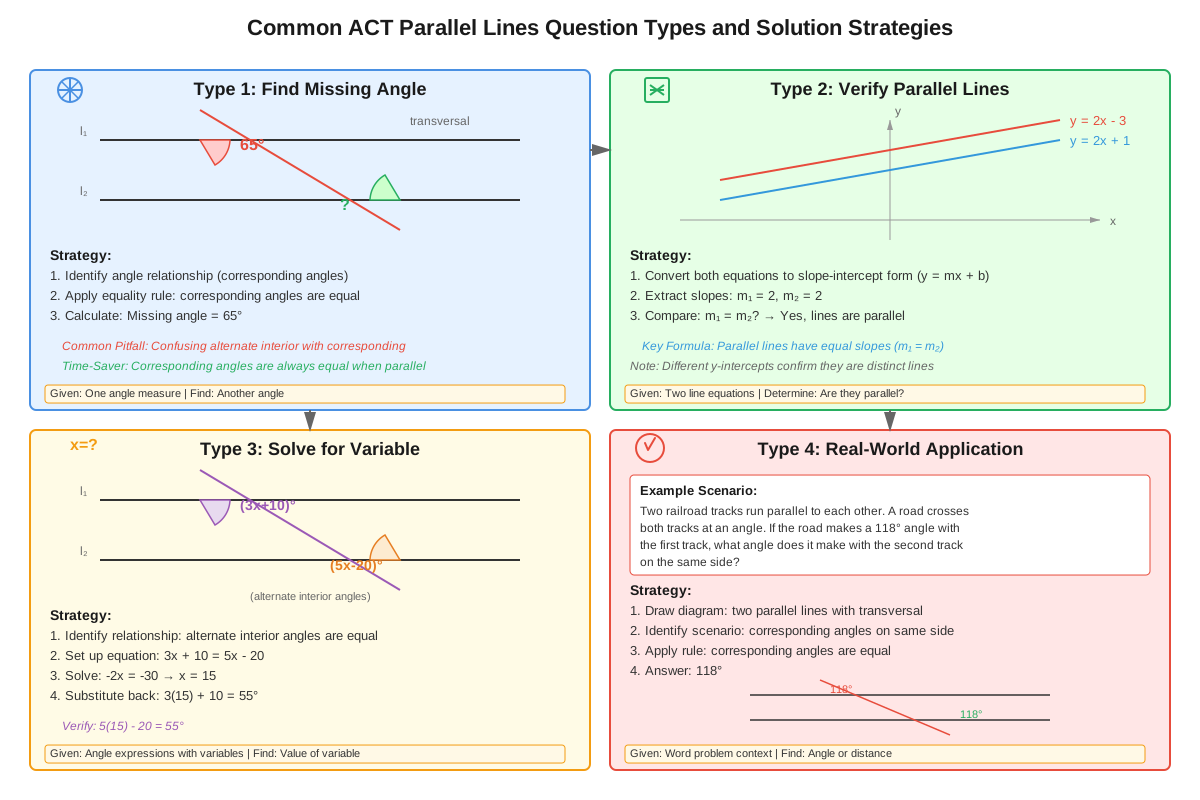
Common question types include: identifying angle relationships when a transversal crosses parallel lines, determining if lines are parallel based on given slopes or equations, calculating missing angle measures using supplementary or congruent angle pairs, solving for variables in expressions representing angles formed by parallel lines and transversals, and analyzing geometric figures that contain parallel sides. The test often embeds parallel line concepts within more complex figures like parallelograms, trapezoids, or coordinate plane scenarios, requiring students to extract the relevant parallel relationships from the broader context.
Core Concepts
Definition and Basic Properties
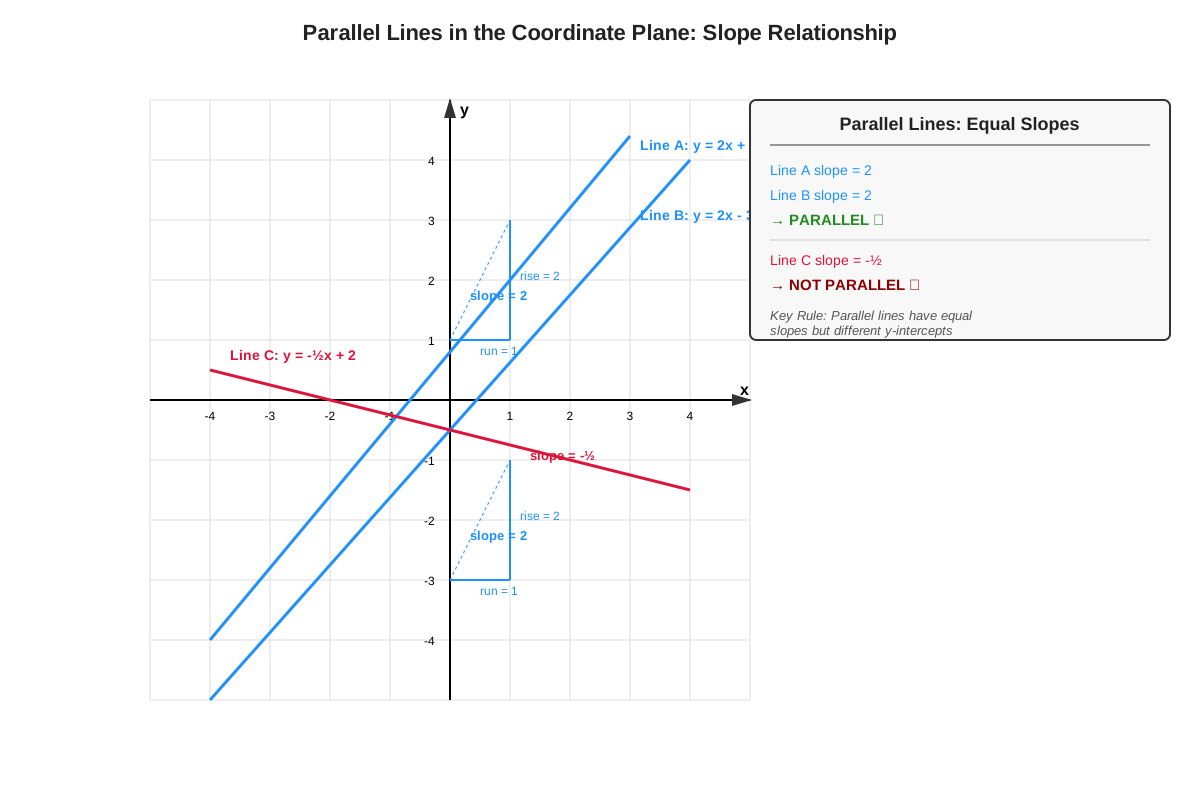
Parallel lines are two or more lines in the same plane that never intersect, no matter how far they are extended in either direction. These lines maintain a constant distance from each other at all points. The symbol for parallel is ∥, so if line l is parallel to line m, we write l ∥ m. The fundamental property of parallel lines is that they have the same slope when graphed on a coordinate plane, which provides an algebraic method for determining parallelism.
In coordinate geometry, two non-vertical lines are parallel if and only if their slopes are equal. For lines in the form y = mx + b, the lines are parallel when they have the same m-value (slope) but different b-values (y-intercepts). If the y-intercepts were also equal, the lines would be identical rather than parallel. Vertical lines (with undefined slope) are parallel to other vertical lines, and horizontal lines (with slope 0) are parallel to other horizontal lines.
Transversals and Angle Relationships
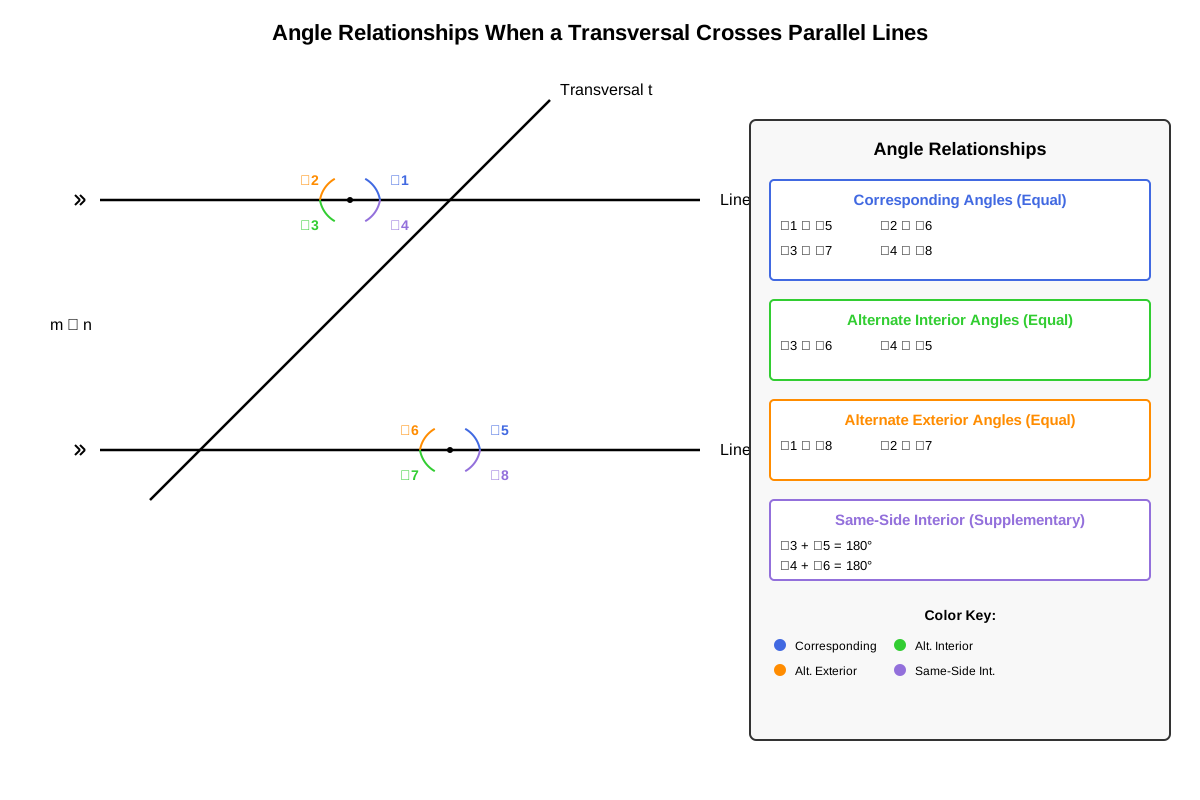
A transversal is a line that intersects two or more lines at distinct points. When a transversal crosses parallel lines, it creates eight angles with specific relationships. Understanding these angle pairs is crucial for ACT success. The angles formed can be classified into several important categories, each with predictable relationships.
Corresponding angles are angles that occupy the same relative position at each intersection point. When a transversal crosses parallel lines, corresponding angles are congruent (equal in measure). For example, if the transversal creates an angle of 65° in the upper-left position at the first intersection, the upper-left angle at the second intersection will also measure 65°.
Alternate interior angles are angles that lie between the parallel lines but on opposite sides of the transversal. These angles are also congruent when the lines are parallel. If you identify one interior angle on the left side of the transversal, its alternate interior angle partner will be on the right side of the transversal, also between the parallel lines.
Alternate exterior angles are angles that lie outside the parallel lines on opposite sides of the transversal. Like the previous two categories, alternate exterior angles are congruent when lines are parallel.
Same-side interior angles (also called consecutive interior angles or co-interior angles) are angles between the parallel lines on the same side of the transversal. Unlike the previous angle pairs, same-side interior angles are supplementary, meaning they add up to 180°. This relationship is particularly useful for setting up equations on the ACT.
Angle Relationship Summary Table
| Angle Pair Type | Location | Relationship When Lines Are Parallel |
|---|---|---|
| Corresponding Angles | Same position at each intersection | Congruent (equal) |
| Alternate Interior Angles | Between lines, opposite sides of transversal | Congruent (equal) |
| Alternate Exterior Angles | Outside lines, opposite sides of transversal | Congruent (equal) |
| Same-Side Interior Angles | Between lines, same side of transversal | Supplementary (sum to 180°) |
| Vertical Angles | Opposite angles at intersection point | Always congruent (regardless of parallel lines) |
Parallel Lines in the Coordinate Plane
In coordinate geometry, identifying parallel lines requires calculating and comparing slopes. The slope of a line passing through points (x₁, y₁) and (x₂, y₂) is calculated using the formula:
m = (y₂ - y₁) / (x₂ - x₁)Two lines are parallel if their slopes are equal. When given equations of lines, convert them to slope-intercept form (y = mx + b) to easily identify the slope. For example, the lines y = 3x + 5 and y = 3x - 2 are parallel because both have slope m = 3.
When given a line and asked to find a parallel line through a specific point, use the same slope as the original line and substitute the given point into the point-slope form:
y - y₁ = m(x - x₁)Parallel Lines and Polygons
Many polygons contain parallel sides, and recognizing these relationships helps solve complex problems. A parallelogram has two pairs of parallel sides, which creates specific angle and side relationships. Opposite angles in a parallelogram are congruent, and consecutive angles are supplementary. A trapezoid has exactly one pair of parallel sides, called bases, while the non-parallel sides are called legs.
When the ACT presents a polygon problem, identifying parallel sides often unlocks the solution by allowing you to apply angle theorems. For instance, if you know two sides of a quadrilateral are parallel and a transversal (another side or a diagonal) crosses them, you can use the angle relationships discussed earlier.
Proving Lines Are Parallel
While the ACT rarely asks for formal proofs, understanding the conditions that guarantee parallel lines helps solve problems. Lines are parallel if:
- Corresponding angles formed by a transversal are congruent
- Alternate interior angles formed by a transversal are congruent
- Alternate exterior angles formed by a transversal are congruent
- Same-side interior angles formed by a transversal are supplementary
- The lines have equal slopes (in coordinate geometry)
- Both lines are perpendicular to the same line
Concept Relationships
The concepts within parallel lines form an interconnected web of geometric and algebraic relationships. The fundamental definition of parallel lines (never intersecting, constant distance) leads directly to the slope property (equal slopes in coordinate geometry). This algebraic representation connects parallel lines to linear equations and systems of equations, where parallel lines represent systems with no solution.
The introduction of a transversal creates the angle relationships that form the core of geometric parallel line problems. These angle relationships (corresponding, alternate interior, alternate exterior, same-side interior) all stem from the basic property that parallel lines maintain consistent angular relationships. Each angle relationship provides a different tool for solving problems, and recognizing which relationship applies in a given situation is key to efficient problem-solving.
Relationship Map:
Parallel Lines Definition → Equal Slopes (coordinate plane) → Linear Equations → Systems of Equations
Parallel Lines Definition → Transversal Intersection → Angle Pairs → Congruent or Supplementary Relationships → Algebraic Equations → Variable Solutions
Angle Relationships → Polygon Properties → Parallelograms and Trapezoids → Area and Perimeter Calculations
The connection to prerequisite topics is equally important. Basic angle vocabulary provides the language for describing relationships, while algebraic equation-solving skills enable students to find unknown angle measures or variable values. Linear equations and slope knowledge bridge the gap between geometric and algebraic representations of parallel lines. Understanding supplementary angles (from basic angle relationships) is essential for working with same-side interior angles.
Quick check — test yourself on Parallel lines so far.
Try Flashcards →High-Yield Facts
⭐ Two lines are parallel if and only if they have equal slopes (for non-vertical lines in the coordinate plane)
⭐ Corresponding angles are congruent when a transversal crosses parallel lines
⭐ Alternate interior angles are congruent when a transversal crosses parallel lines
⭐ Same-side interior angles are supplementary (sum to 180°) when a transversal crosses parallel lines
⭐ Vertical angles are always congruent, regardless of whether lines are parallel
- Alternate exterior angles are congruent when a transversal crosses parallel lines
- Parallel lines never intersect and maintain constant distance from each other
- If two lines are both parallel to a third line, they are parallel to each other (transitive property)
- In a parallelogram, opposite sides are parallel and congruent
- A trapezoid has exactly one pair of parallel sides
- Horizontal lines have slope 0 and are parallel to other horizontal lines
- Vertical lines have undefined slope and are parallel to other vertical lines
- If two lines are perpendicular to the same line, they are parallel to each other
- The symbol ∥ denotes parallel lines (e.g., line l ∥ line m)
- When parallel lines are cut by a transversal, eight angles are formed, but only two distinct angle measures exist (one acute/obtuse pair)
Common Misconceptions
Misconception: All lines that don't touch are parallel → Correction: Lines must be in the same plane to be parallel. In three-dimensional space, lines can be skew (not parallel and not intersecting). On the ACT, focus on two-dimensional scenarios where non-intersecting coplanar lines are indeed parallel.
Misconception: Alternate interior angles are always congruent → Correction: Alternate interior angles are congruent only when the lines cut by the transversal are parallel. If the lines are not parallel, these angles will have different measures. The ACT may test whether you can determine if lines are parallel based on angle measurements.
Misconception: Lines with similar slopes are parallel → Correction: Lines must have exactly equal slopes to be parallel, not just similar slopes. Lines with slopes of 2 and 2.1 are not parallel; they will eventually intersect. Even small differences in slope mean the lines will cross.
Misconception: Same-side interior angles are congruent when lines are parallel → Correction: Same-side interior angles are supplementary (add to 180°), not congruent, when lines are parallel. This is a critical distinction that the ACT frequently tests. If you see angles on the same side of a transversal between parallel lines, set up an equation where they sum to 180°.
Misconception: Parallel lines must be horizontal → Correction: Parallel lines can have any orientation—horizontal, vertical, or diagonal. The only requirement is that they have the same slope (or both be vertical). The ACT will present parallel lines in various orientations to test true understanding.
Misconception: If two angles are equal, the lines must be parallel → Correction: Equal angles alone don't guarantee parallel lines. The angles must be in specific positions (corresponding, alternate interior, or alternate exterior) relative to a transversal. Two random equal angles in a figure don't establish parallelism.
Misconception: The y-intercepts of parallel lines must be different → Correction: While distinct parallel lines do have different y-intercepts, if the y-intercepts are the same, the lines are identical (the same line), not parallel. Parallel lines are separate lines that never meet.
Worked Examples
Example 1: Finding Unknown Angles with Parallel Lines
Problem: Lines l and m are parallel, and a transversal t intersects both lines. The angle formed at the intersection of t and l measures (3x + 15)°, and the corresponding angle at the intersection of t and m measures (5x - 25)°. Find the value of x and the measure of these angles.
Solution:
Step 1: Identify the angle relationship. The problem states these are corresponding angles, which are congruent when lines are parallel.
Step 2: Set up an equation based on the congruent relationship:
3x + 15 = 5x - 25Step 3: Solve for x:
3x + 15 = 5x - 25
15 + 25 = 5x - 3x
40 = 2x
x = 20
Step 4: Find the angle measure by substituting x = 20 into either expression:
3(20) + 15 = 60 + 15 = 75°Step 5: Verify using the other expression:
5(20) - 25 = 100 - 25 = 75° ✓Answer: x = 20, and both corresponding angles measure 75°.
Connection to Learning Objectives: This problem demonstrates identifying when parallel lines are being tested (corresponding angles mentioned with parallel lines), explaining the core rule (corresponding angles are congruent), and applying the concept to solve an ACT-style algebraic equation.
Example 2: Determining Parallelism in the Coordinate Plane
Problem: Line p passes through points (-2, 5) and (4, 11). Line q passes through points (1, 3) and (7, 9). Determine whether lines p and q are parallel.
Solution:
Step 1: Calculate the slope of line p using the slope formula:
m_p = (y₂ - y₁) / (x₂ - x₁) = (11 - 5) / (4 - (-2)) = 6 / 6 = 1Step 2: Calculate the slope of line q:
m_q = (9 - 3) / (7 - 1) = 6 / 6 = 1Step 3: Compare the slopes. Since m_p = m_q = 1, the lines have equal slopes.
Step 4: Verify the lines are distinct (not the same line) by checking if one point from line p satisfies line q's equation. Using point-slope form for line q through (1, 3) with slope 1:
y - 3 = 1(x - 1)
y = x + 2
Testing point (-2, 5) from line p:
5 ≟ -2 + 2
5 ≠ 0
The point doesn't satisfy line q's equation, so the lines are distinct.
Answer: Yes, lines p and q are parallel because they have equal slopes (m = 1) and are distinct lines.
Connection to Learning Objectives: This example shows how to identify parallel lines in coordinate geometry, apply the core rule that parallel lines have equal slopes, and work through a complete ACT-style problem involving calculation and reasoning.
Exam Strategy
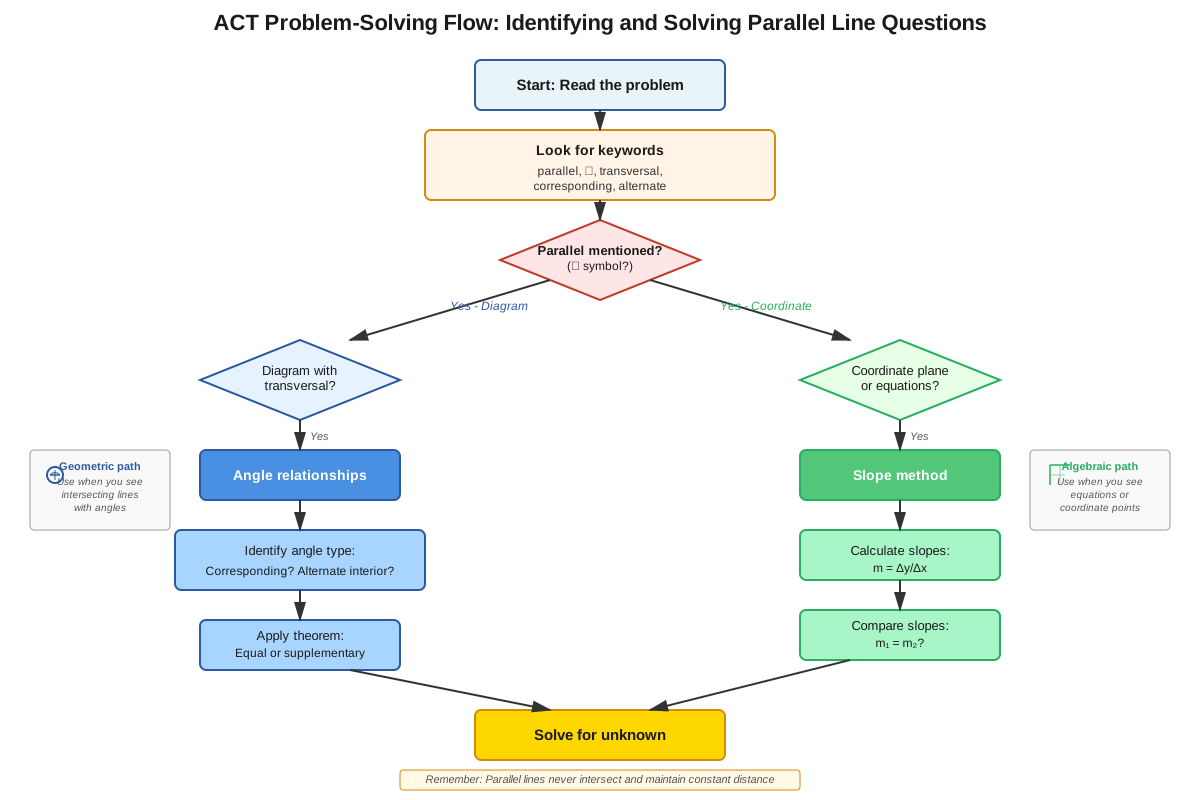
When approaching ACT parallel lines questions, begin by identifying the visual or verbal cues that indicate parallel lines are involved. Look for the parallel symbol (∥), phrases like "lines l and m are parallel," or diagrams showing lines that appear parallel with matching arrow marks. Once you've identified a parallel lines question, determine whether it's a geometry problem (involving angles and transversals) or a coordinate geometry problem (involving slopes and equations).
Trigger words and phrases to watch for:
- "parallel lines"
- "corresponding angles"
- "alternate interior angles"
- "same-side interior angles"
- "transversal"
- "equal slopes"
- "never intersect"
- "lines l ∥ m"
For geometry problems with diagrams, immediately mark all known angles and use angle relationships to find unknown angles. Remember that when a transversal crosses parallel lines, only two distinct angle measures exist—all acute angles are congruent to each other, and all obtuse angles are congruent to each other. Any acute angle and any obtuse angle are supplementary. This insight can dramatically speed up your work.
Process-of-elimination tips:
- If answer choices include angle measures, eliminate any that would violate the supplementary or congruent relationships
- For slope problems, eliminate answer choices with slopes that don't match the given parallel line
- If asked whether lines are parallel, calculate slopes precisely—don't estimate from a diagram
- When variables are involved, eliminate answers that would result in negative angle measures or angles greater than 180°
Time allocation advice:
Parallel lines questions typically require 45-60 seconds for straightforward angle calculations and 60-90 seconds for problems involving algebraic setup and solving. Don't spend excessive time trying to visualize complex angle relationships—instead, write down what you know and systematically apply the angle theorems. For coordinate geometry problems, write out the slope formula and calculate carefully to avoid arithmetic errors. If a problem seems to require multiple steps, quickly outline your approach before diving into calculations to ensure you're on the right track.
Exam Tip: When you see a diagram with parallel lines and a transversal, immediately identify one angle measure you know or can easily find, then use that to find all other angles. This systematic approach prevents confusion and ensures accuracy.
Memory Techniques
Mnemonic for angle relationships: "CAI-CAI" (pronounced "kai-kai")
- Corresponding angles are Congruent
- Alternate Interior angles are Congruent
- Alternate Exterior angles are Congruent (modified to fit)
- Same-side Interior angles are Supplementary
Visualization strategy for transversals: Imagine the transversal as a "cutting line" that slices through the parallel lines like a knife through parallel layers of a cake. The angles on each "slice" maintain their relationships—corresponding positions have equal angles, and angles on the same side of the knife add to 180°.
Acronym for parallel line conditions: "SCAPES"
- Slopes are equal (coordinate geometry)
- Corresponding angles congruent
- Alternate interior angles congruent
- Perpendicular to same line
- Exterior alternate angles congruent
- Same-side interior angles supplementary
Slope memory trick: "Parallel lines are pals with the same slope" (same = equal slopes)
Same-side interior angles trick: Think "same side = supplementary" (both start with 's'). When angles are on the same side of the transversal between parallel lines, they're "friendly" and work together to make 180°.
Summary
Parallel lines represent a fundamental geometric concept that bridges pure geometry and coordinate algebra on the ACT Math test. The essential principle is that parallel lines never intersect and maintain constant distance, which translates to equal slopes in coordinate geometry. When a transversal crosses parallel lines, it creates predictable angle relationships: corresponding angles are congruent, alternate interior angles are congruent, alternate exterior angles are congruent, and same-side interior angles are supplementary. These relationships enable students to solve for unknown angles and variables through algebraic equations. In the coordinate plane, identifying parallel lines requires calculating slopes using the formula m = (y₂ - y₁)/(x₂ - x₁) and confirming equality. Success on ACT parallel lines questions demands quick recognition of which angle relationship applies, accurate setup of equations, and careful arithmetic. The topic appears consistently on every ACT, making it a high-yield area for focused study and practice.
Key Takeaways
- Parallel lines have equal slopes in coordinate geometry and never intersect in the same plane
- Corresponding angles, alternate interior angles, and alternate exterior angles are all congruent when a transversal crosses parallel lines
- Same-side interior angles are supplementary (sum to 180°) when formed by parallel lines and a transversal
- Vertical angles are always congruent, regardless of whether the lines involved are parallel
- To determine if lines are parallel, calculate their slopes and check for equality, or verify that appropriate angle pairs are congruent or supplementary
- ACT parallel lines questions appear 2-3 times per test, making this a high-frequency, high-value topic
- Systematic angle identification using one known angle and angle relationships is the fastest approach to solving parallel lines geometry problems
Related Topics
Perpendicular Lines: Lines that intersect at 90° angles have slopes that are negative reciprocals. Understanding perpendicular lines complements parallel lines knowledge and frequently appears alongside parallel line questions on the ACT.
Systems of Linear Equations: Parallel lines represent systems with no solution, while intersecting lines have one solution. Mastering parallel lines enhances understanding of solution types in systems.
Coordinate Geometry: Parallel lines concepts integrate with distance formula, midpoint formula, and equation of a line problems, creating comprehensive coordinate plane questions.
Polygons and Quadrilaterals: Parallelograms, rectangles, rhombuses, and trapezoids all involve parallel sides. Understanding parallel lines unlocks properties of these shapes, including angle relationships and area formulas.
Transformations: Translations preserve parallel relationships, and understanding how parallel lines behave under transformations supports more advanced geometry topics.
Practice CTA
Now that you've mastered the core concepts of parallel lines, it's time to solidify your understanding through practice! Attempt the practice questions to apply these angle relationships and slope calculations to realistic ACT scenarios. Use the flashcards to reinforce the key angle theorems and ensure instant recall during the test. Remember, parallel lines questions are high-yield—every minute you invest in practice translates directly to points on test day. You've built a strong foundation; now demonstrate your mastery through application!
Sign up free to keep reading
Create a free AnvayaPrep account to finish this ACT guide on Parallel lines — plus flashcards and practice questions.