Overview
Perpendicular lines represent one of the most frequently tested coordinate geometry concepts on the ACT Math section. Understanding perpendicular lines requires mastery of slope relationships, linear equations, and the ability to quickly identify geometric relationships in both algebraic and visual formats. On the ACT, perpendicular line questions typically appear 2-3 times per exam and often integrate multiple algebraic concepts, making them high-value targets for score improvement.
The fundamental principle underlying perpendicular lines is elegant yet powerful: two non-vertical lines are perpendicular if and only if their slopes are negative reciprocals of each other. This relationship bridges pure algebra with geometric visualization, requiring students to move fluidly between equations, graphs, and numerical calculations. Questions involving ACT perpendicular lines frequently appear disguised within larger problems about rectangles, distance calculations, or systems of equations, making pattern recognition essential.
Mastering perpendicular lines creates a foundation for advanced coordinate geometry topics and strengthens overall algebraic reasoning. This concept connects directly to parallel lines (which share equal slopes), distance formulas, and the properties of geometric shapes in the coordinate plane. Students who develop fluency with perpendicular line relationships gain significant advantages on multi-step ACT problems that combine geometry with algebra, particularly those involving quadrilaterals, circles, and optimization scenarios.
Learning Objectives
- [ ] Identify when Perpendicular lines is being tested
- [ ] Explain the core rule or strategy behind Perpendicular lines
- [ ] Apply Perpendicular lines to ACT-style questions accurately
- [ ] Calculate the slope of a line perpendicular to a given line in under 15 seconds
- [ ] Determine whether two lines are perpendicular given their equations in any form
- [ ] Write the equation of a perpendicular line passing through a specific point
- [ ] Recognize perpendicular relationships in geometric figures on the coordinate plane
Prerequisites
- Slope calculation: Understanding how to find slope from two points or from an equation is essential because perpendicular line relationships are defined through slope comparisons
- Linear equations: Familiarity with slope-intercept form (y = mx + b) and standard form (Ax + By = C) enables quick identification of slopes from various equation formats
- Negative numbers and fractions: Comfort with multiplying and dividing negative numbers and taking reciprocals is necessary for applying the negative reciprocal rule
- Coordinate plane basics: Understanding how to plot points and visualize lines helps verify perpendicular relationships geometrically
- Basic algebraic manipulation: Solving for y and rearranging equations allows conversion between different linear equation forms
Why This Topic Matters
Perpendicular lines appear throughout mathematics, engineering, architecture, and computer graphics. In real-world applications, perpendicular relationships define right angles in construction, determine optimal paths in navigation systems, and establish orthogonal coordinate systems used in physics and computer science. Understanding perpendicular lines enables analysis of rectangular structures, calculation of shortest distances from points to lines, and design of perpendicular bisectors in geometric constructions.
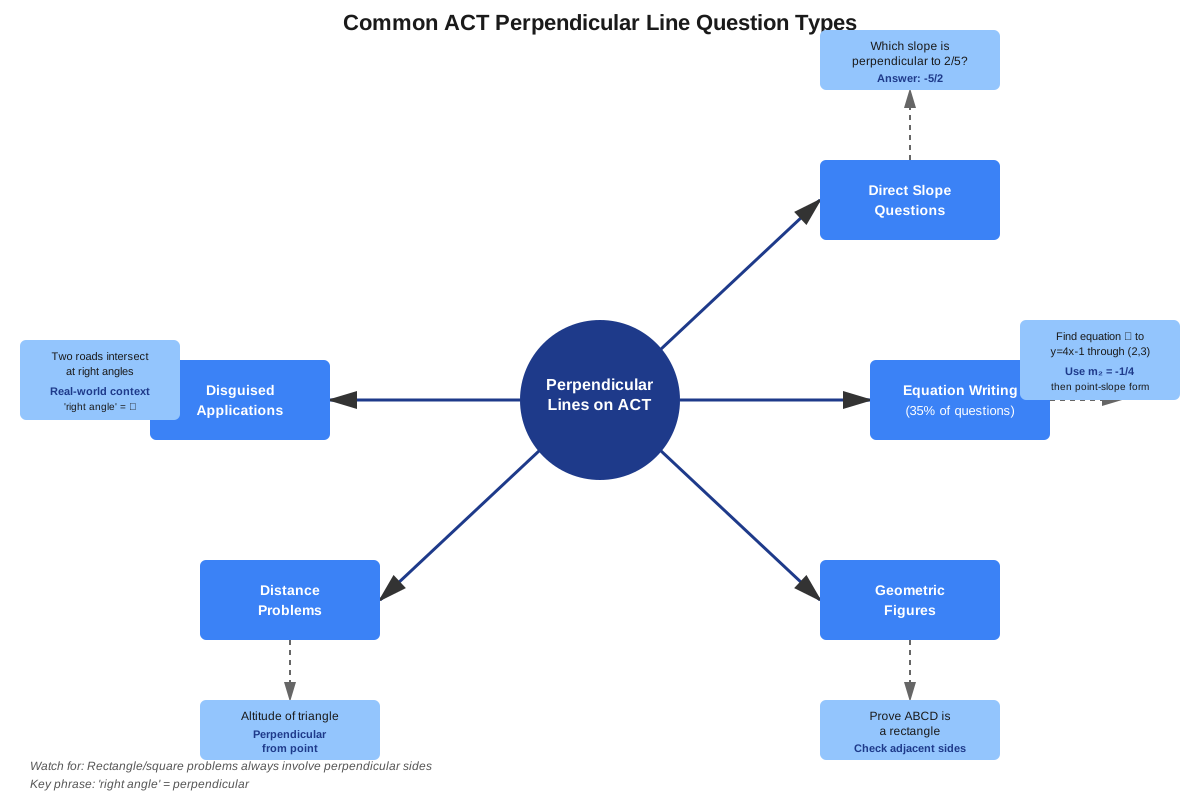
On the ACT Math section, perpendicular line questions appear with remarkable consistency, typically comprising 4-6% of all math questions. These problems most commonly appear in the Coordinate Geometry category but also integrate into Plane Geometry questions. The ACT tests perpendicular lines through multiple question formats: direct identification of perpendicular slopes, writing equations of perpendicular lines, determining properties of rectangles or squares on the coordinate plane, and multi-step problems requiring perpendicular line concepts as intermediate steps.
Common ACT question patterns include: identifying which line from a set of options is perpendicular to a given line; finding the equation of a line perpendicular to a given line passing through a specific point; determining whether a quadrilateral is a rectangle by checking for perpendicular sides; and calculating coordinates of vertices when perpendicular relationships are specified. The exam frequently embeds perpendicular line concepts within more complex scenarios, testing whether students can recognize when to apply the negative reciprocal relationship even when the question doesn't explicitly use the word "perpendicular."
Core Concepts
The Negative Reciprocal Rule
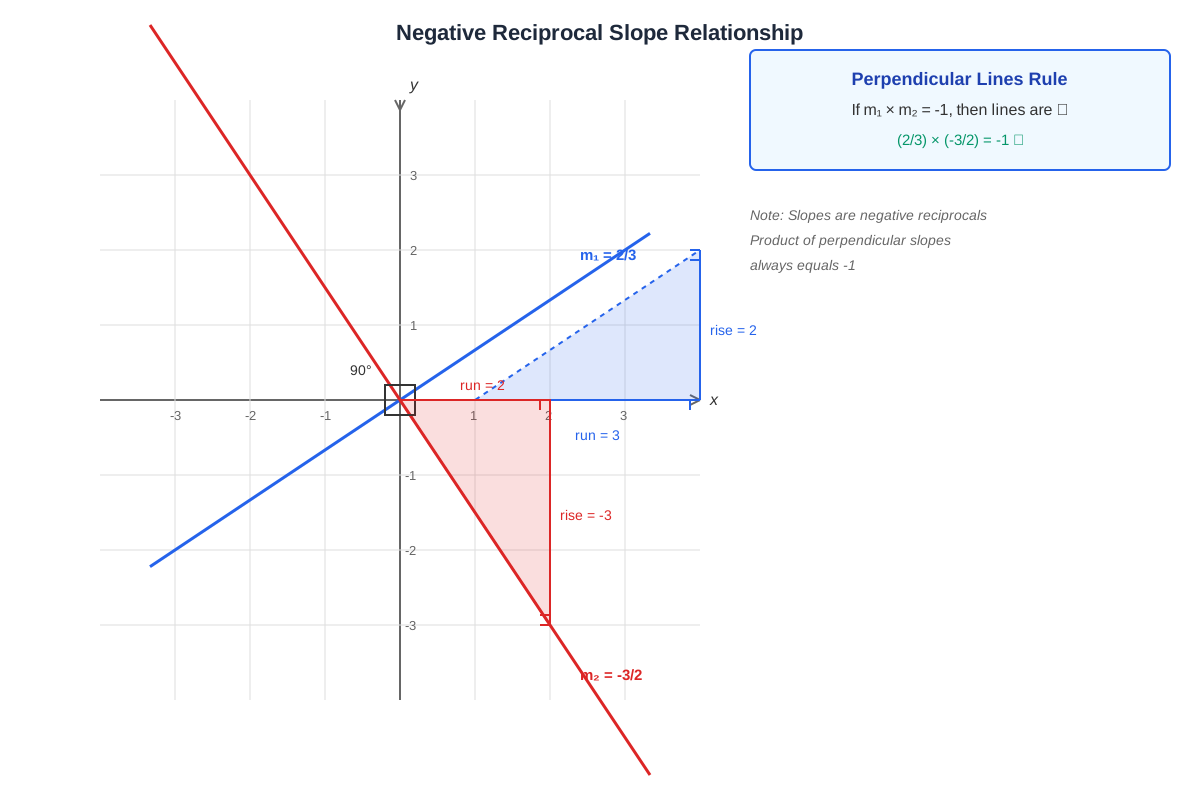
The fundamental principle governing perpendicular lines states that two non-vertical lines are perpendicular if and only if the product of their slopes equals -1. Equivalently, the slopes are negative reciprocals of each other. If line 1 has slope m₁ and line 2 has slope m₂, then the lines are perpendicular when:
m₁ × m₂ = -1Or equivalently:
m₂ = -1/m₁To find the negative reciprocal of any slope: flip the fraction (take the reciprocal) and change the sign. For example, if a line has slope 3/4, a perpendicular line has slope -4/3. If a line has slope -2 (which equals -2/1), a perpendicular line has slope 1/2.
This relationship emerges from the geometric definition of perpendicular lines as lines that intersect at a 90-degree angle. The algebraic expression of this right angle relationship through slopes provides a powerful computational tool that eliminates the need for angle measurements or geometric constructions.
Special Cases: Horizontal and Vertical Lines
Horizontal and vertical lines represent special perpendicular pairs that don't follow the standard negative reciprocal formula because vertical lines have undefined slope. A horizontal line has slope 0 and equation y = k (where k is a constant). A vertical line has undefined slope and equation x = h (where h is a constant). These two line types are always perpendicular to each other.
This special case frequently appears on the ACT because it tests whether students understand the conceptual meaning of perpendicularity beyond just applying a formula. When a question asks for a line perpendicular to y = 5, the answer must be a vertical line (x = some number), not a line with undefined slope written in slope-intercept form.
Finding Slopes from Different Equation Forms
ACT questions present linear equations in multiple formats, requiring quick slope identification:
| Equation Form | Example | Slope Extraction Method |
|---|---|---|
| Slope-intercept | y = 3x - 7 | Slope is the coefficient of x: m = 3 |
| Standard form | 2x + 5y = 10 | Solve for y or use m = -A/B: m = -2/5 |
| Point-slope | y - 4 = -3(x + 2) | Slope is the coefficient: m = -3 |
| Two points given | (1, 3) and (4, 11) | Use m = (y₂-y₁)/(x₂-x₁): m = 8/3 |
For standard form Ax + By = C, the slope equals -A/B (when B ≠ 0). This shortcut saves time compared to solving for y. For example, in 3x - 4y = 12, the slope is -3/(-4) = 3/4, so a perpendicular line has slope -4/3.
Writing Equations of Perpendicular Lines
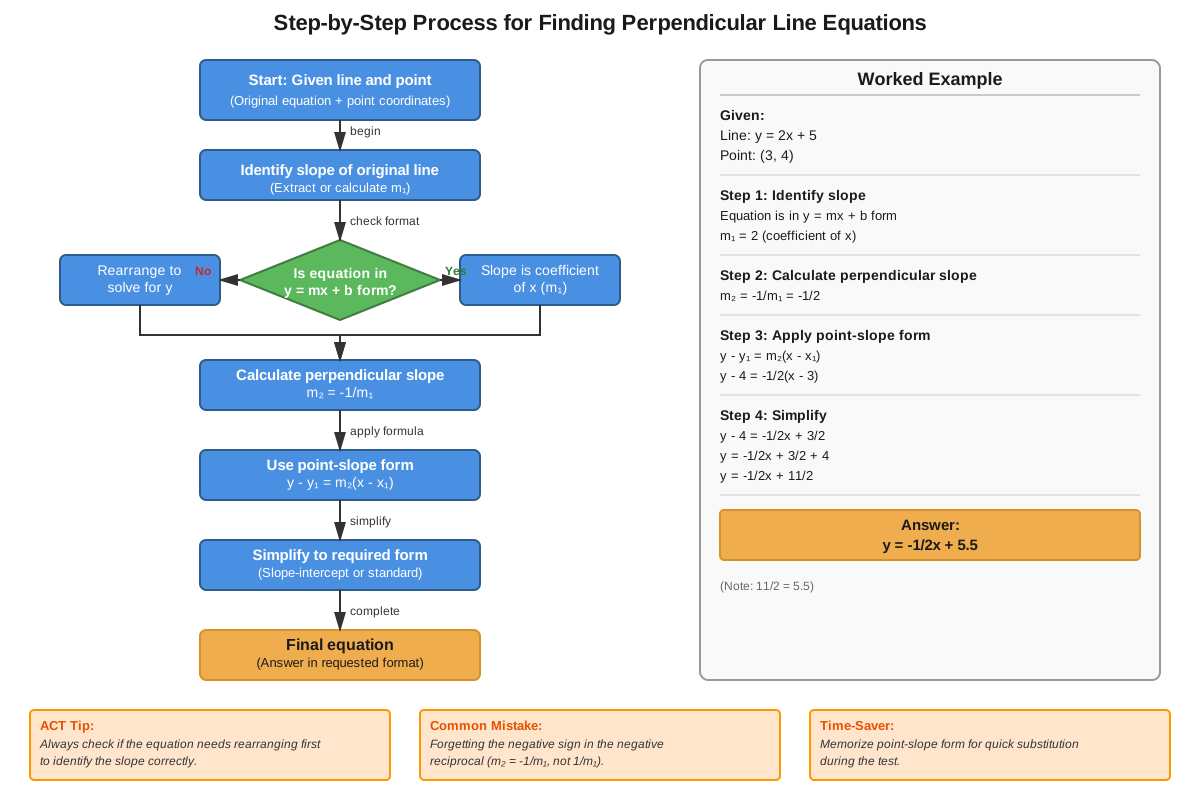
The most common ACT task involves writing the equation of a line perpendicular to a given line and passing through a specific point. This requires a three-step process:
- Find the slope of the given line by identifying it from the equation
- Calculate the perpendicular slope using the negative reciprocal
- Write the new equation using point-slope form or by finding the y-intercept
For example, to find the equation of a line perpendicular to y = 2x + 5 passing through point (4, 3):
- Original slope: m = 2
- Perpendicular slope: m⊥ = -1/2
- Using point-slope form: y - 3 = -1/2(x - 4)
- Simplifying: y - 3 = -1/2x + 2, so y = -1/2x + 5
Alternatively, substitute the point into y = mx + b with the perpendicular slope to find b: 3 = -1/2(4) + b, giving b = 5.
Verifying Perpendicular Relationships
To verify whether two lines are perpendicular, extract both slopes and check whether their product equals -1. Consider lines with equations y = 3x - 2 and 3x + 9y = 18:
- First line slope: m₁ = 3
- Second line slope: Rewrite as 9y = -3x + 18, so y = -1/3x + 2, giving m₂ = -1/3
- Product: 3 × (-1/3) = -1 ✓
The lines are perpendicular. This verification method works regardless of equation format and provides certainty even when slopes aren't obvious negative reciprocals at first glance.
Perpendicular Lines in Geometric Figures
The ACT frequently tests perpendicular line concepts through geometric figures on the coordinate plane. Rectangles and squares have perpendicular adjacent sides, making slope calculations essential for verifying these shapes. To confirm a quadrilateral is a rectangle:
- Calculate slopes of all four sides
- Verify opposite sides are parallel (equal slopes)
- Verify adjacent sides are perpendicular (negative reciprocal slopes)
For example, given vertices A(0,0), B(4,2), C(6,-2), and D(2,-4), calculate slopes AB = 1/2, BC = -2, CD = 1/2, and DA = -2. Since AB ∥ CD and BC ∥ DA (parallel), and AB ⊥ BC (since 1/2 × -2 = -1), the figure is a rectangle.
Concept Relationships
The perpendicular lines concept builds directly on slope calculation, which provides the numerical foundation for identifying perpendicular relationships. Without fluency in finding slopes from equations and points, students cannot efficiently apply the negative reciprocal rule. This relationship flows: coordinate plane basics → slope calculation → perpendicular line identification → geometric figure analysis.
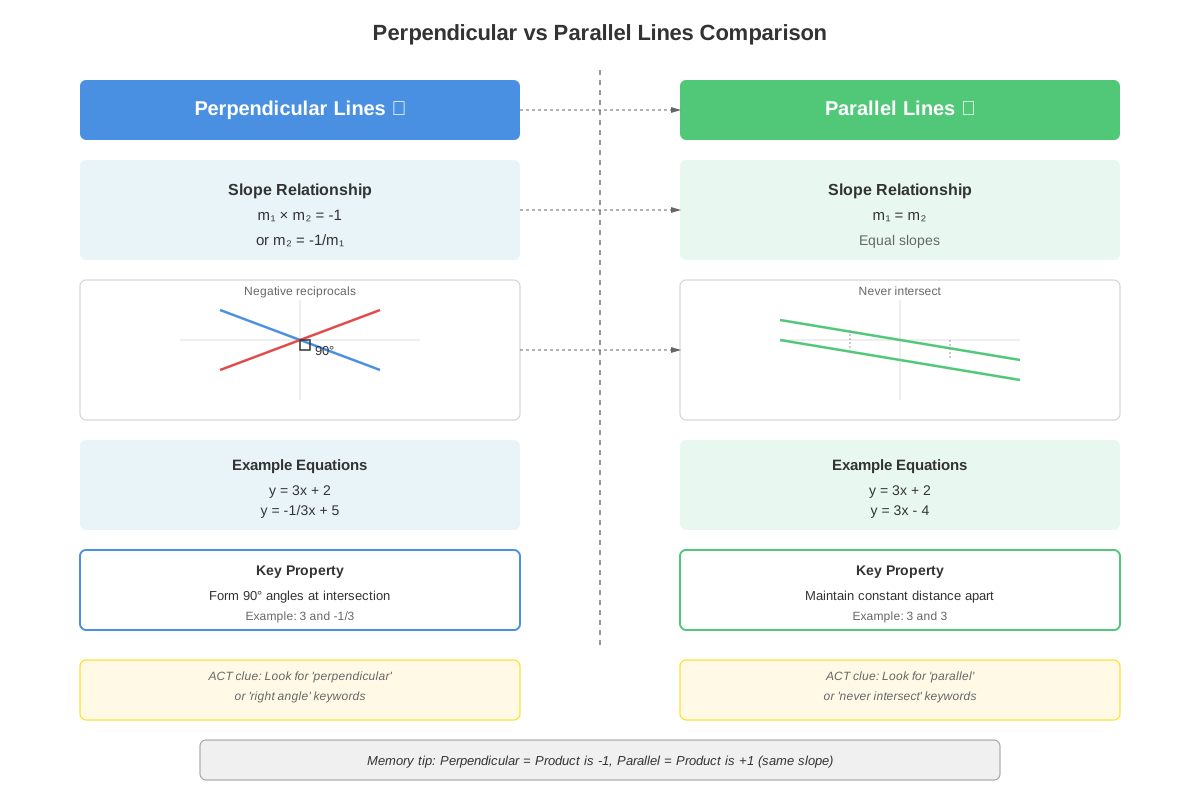
Perpendicular lines connect intimately with parallel lines, forming a complementary pair of line relationships. While parallel lines share identical slopes, perpendicular lines have slopes that multiply to -1. Together, these concepts enable complete classification of line relationships: lines are either parallel, perpendicular, or neither. This classification appears repeatedly in ACT questions about quadrilaterals and geometric proofs.
The concept extends into distance formulas and geometric optimization. The shortest distance from a point to a line always occurs along a perpendicular segment, making perpendicular line equations essential for distance calculations. This relationship connects: perpendicular lines → perpendicular distance → optimization problems.
Within systems of equations, perpendicular lines guarantee exactly one intersection point (unless one is vertical and the other horizontal with no intersection). This connects to solving systems of linear equations and understanding solution uniqueness. The relationship flows: perpendicular lines → guaranteed intersection → unique solution to system.
Finally, perpendicular lines form the foundation for coordinate transformations and rotations, where 90-degree rotations transform a line into a perpendicular line. This advanced connection appears less frequently on the ACT but underlies transformation geometry questions.
Quick check — test yourself on Perpendicular lines so far.
Try Flashcards →High-Yield Facts
⭐ Two non-vertical lines are perpendicular if and only if the product of their slopes equals -1
⭐ To find a perpendicular slope, take the negative reciprocal: flip the fraction and change the sign
⭐ Horizontal lines (y = k) and vertical lines (x = h) are always perpendicular to each other
⭐ For a line in standard form Ax + By = C, the slope is -A/B, so a perpendicular line has slope B/A
⭐ Adjacent sides of rectangles and squares are always perpendicular, making slope checks essential for verifying these shapes
- If a line has slope m, any line perpendicular to it has slope -1/m (when m ≠ 0)
- The slope of a line perpendicular to y = mx + b is -1/m
- Two lines with slopes 3/4 and -4/3 are perpendicular because (3/4)(-4/3) = -1
- A line perpendicular to a horizontal line must be vertical, and vice versa
- When writing a perpendicular line equation through a point, use point-slope form: y - y₁ = m(x - x₁)
- Perpendicular lines always intersect at exactly one point (unless one is vertical and they're parallel to axes)
- The negative reciprocal of a negative slope is positive, and vice versa
- If line 1 has slope 0 (horizontal), line 2 must be vertical (undefined slope) to be perpendicular
Common Misconceptions
Misconception: Perpendicular lines have slopes that are simply negatives of each other (e.g., 2 and -2).
Correction: Perpendicular slopes are negative reciprocals, not just negatives. The slope 2 (or 2/1) has perpendicular slope -1/2, not -2. You must flip the fraction AND change the sign.
Misconception: The perpendicular slope of -3/4 is 3/4 (just changing the sign).
Correction: The perpendicular slope of -3/4 is 4/3. Take the reciprocal (flip to get -4/3) and change the sign (to get 4/3). Both operations are required.
Misconception: Vertical lines have slope 0.
Correction: Vertical lines have undefined slope (division by zero), while horizontal lines have slope 0. These two line types are perpendicular to each other, representing the special case where the negative reciprocal rule doesn't apply numerically.
Misconception: If two lines look perpendicular on a graph, they are perpendicular.
Correction: Visual appearance can be deceiving, especially on distorted or non-square grids. Always verify perpendicularity algebraically by checking that slopes multiply to -1. The ACT often uses misleading diagrams where lines appear perpendicular but aren't.
Misconception: To find a perpendicular line, just swap the x and y coefficients in standard form.
Correction: While swapping coefficients (A and B) in Ax + By = C gives a perpendicular line direction, you must also change one sign to ensure the correct perpendicular relationship. From 3x + 4y = 12, a perpendicular line has form 4x - 3y = k (not 4x + 3y = k).
Misconception: The perpendicular slope of 5 is -5.
Correction: The number 5 equals 5/1, so its reciprocal is 1/5, and the negative reciprocal is -1/5. Always express whole numbers as fractions over 1 before finding the negative reciprocal.
Misconception: Perpendicular lines never intersect.
Correction: This confuses perpendicular lines with parallel lines. Perpendicular lines always intersect (at a 90-degree angle), while parallel lines never intersect. This is a critical distinction the ACT tests directly.
Worked Examples
Example 1: Finding a Perpendicular Line Equation
Problem: Line ℓ has equation 2x - 6y = 18. What is the equation of the line perpendicular to ℓ that passes through point (3, -4)?
Solution:
Step 1: Find the slope of line ℓ
Convert to slope-intercept form by solving for y:
- 2x - 6y = 18
- -6y = -2x + 18
- y = (1/3)x - 3
The slope of line ℓ is m = 1/3.
Alternatively, use the shortcut for standard form Ax + By = C: slope = -A/B = -2/(-6) = 1/3.
Step 2: Find the perpendicular slope
The perpendicular slope is the negative reciprocal of 1/3:
- Reciprocal of 1/3 is 3/1 = 3
- Negative reciprocal is -3
So m⊥ = -3.
Step 3: Write the equation using point-slope form
Using point (3, -4) and slope -3:
- y - y₁ = m(x - x₁)
- y - (-4) = -3(x - 3)
- y + 4 = -3x + 9
- y = -3x + 5
Step 4: Verify (optional but recommended)
Check that the point (3, -4) satisfies the equation:
- y = -3(3) + 5 = -9 + 5 = -4 ✓
Answer: y = -3x + 5
This problem demonstrates the standard three-step process and connects to Learning Objective 3 (applying perpendicular lines to ACT-style questions). The key insight is recognizing that standard form requires either conversion to slope-intercept form or using the -A/B shortcut.
Example 2: Verifying a Rectangle on the Coordinate Plane
Problem: A quadrilateral has vertices at P(1, 2), Q(4, 6), R(8, 3), and S(5, -1). Determine whether this quadrilateral is a rectangle.
Solution:
Step 1: Calculate all four side slopes
Slope of PQ: m = (6-2)/(4-1) = 4/3
Slope of QR: m = (3-6)/(8-4) = -3/4
Slope of RS: m = (-1-3)/(5-8) = -4/(-3) = 4/3
Slope of SP: m = (2-(-1))/(1-5) = 3/(-4) = -3/4
Step 2: Check for parallel opposite sides
PQ and RS both have slope 4/3, so PQ ∥ RS ✓
QR and SP both have slope -3/4, so QR ∥ SP ✓
The opposite sides are parallel, confirming this is at least a parallelogram.
Step 3: Check for perpendicular adjacent sides
Check if PQ ⊥ QR by multiplying their slopes:
- (4/3) × (-3/4) = -12/12 = -1 ✓
Since adjacent sides are perpendicular, the parallelogram is a rectangle.
Step 4: Verify with another pair (optional)
Check if QR ⊥ RS:
- (-3/4) × (4/3) = -12/12 = -1 ✓
Answer: Yes, the quadrilateral is a rectangle because opposite sides are parallel and adjacent sides are perpendicular.
This problem illustrates how perpendicular line concepts integrate with geometric figure analysis, addressing Learning Objective 1 (identifying when perpendicular lines are being tested) even when the question doesn't explicitly mention perpendicularity. The systematic approach—calculating all slopes, checking parallelism, then checking perpendicularity—provides a reliable method for any quadrilateral verification problem.
Exam Strategy
When approaching ACT questions involving perpendicular lines, begin by identifying the question type: Are you finding a perpendicular slope, writing an equation, or verifying a geometric property? This classification determines your solution path and helps avoid common traps.
Trigger words and phrases that signal perpendicular line questions include: "perpendicular," "right angle," "90 degrees," "rectangle," "square," "orthogonal," and "normal to" (in advanced contexts). However, many ACT questions test perpendicular concepts without using these explicit terms—watch for questions about "sides of a rectangle," "adjacent sides," or "intersecting at right angles."
Process-of-elimination strategies work particularly well for perpendicular line questions:
- When finding a perpendicular slope, immediately eliminate any answer choice that equals the original slope or is just its negative
- For perpendicular line equations, eliminate options that don't pass through the given point by substituting coordinates
- When verifying perpendicularity, eliminate answer choices that claim lines are perpendicular if their slope product doesn't equal -1
- For geometric figures, eliminate "rectangle" or "square" if any adjacent sides aren't perpendicular
Time allocation: Most perpendicular line questions should take 45-60 seconds. If you're spending more than 90 seconds, you may be overcomplicating the problem. The ACT rewards efficient application of the negative reciprocal rule rather than elaborate geometric reasoning.
Common shortcuts:
- For standard form Ax + By = C, a perpendicular line has form Bx - Ay = k (swap coefficients and change one sign)
- When given a slope as a whole number n, immediately write the perpendicular slope as -1/n
- If answer choices are in slope-intercept form, check slopes first before worrying about y-intercepts
- For rectangle verification, you only need to verify one pair of adjacent sides is perpendicular (if opposite sides are already confirmed parallel)
Avoiding traps: The ACT frequently includes answer choices with common errors—the negative instead of negative reciprocal, the reciprocal without the negative, or equations that have the correct slope but wrong y-intercept. Always complete all steps and verify your answer when time permits.
Memory Techniques
Negative Reciprocal Mnemonic: "Flip it, Negate it" (FN) reminds you to take the reciprocal (flip the fraction) and change the sign (negate). Think of "FN" as "Function for perpendicularity."
Slope Product Rule: Remember "Perpendicular = Product of -1" or the acronym PP-1 (Perpendicular Product equals negative one). Visualize two perpendicular lines forming a plus sign (+) and minus sign (−) to remember the -1 product.
Horizontal-Vertical Pair: Visualize a plus sign (+) or crosshair to remember that horizontal and vertical lines are perpendicular. The horizontal line of the + has slope 0, while the vertical line has undefined slope.
Reciprocal Visualization: Picture a fraction as a fraction bar with numbers on top and bottom. To find the reciprocal, imagine flipping the fraction bar upside down—the top number moves to the bottom and vice versa. Then add a negative sign to the result.
Rectangle Check Acronym: PAPP = Parallel opposite sides, Adjacent sides Perpendicular = Parallelogram becomes rectangle. This reminds you that both conditions must be verified.
Whole Number Trick: For whole numbers, remember "Under One"—put the number under 1 to make a fraction, then flip it. The perpendicular slope of 3 is -1/3 because 3 = 3/1, flipped is 1/3, negated is -1/3.
Summary
Perpendicular lines represent a fundamental coordinate geometry concept tested consistently on the ACT Math section. The core principle—that perpendicular lines have slopes that are negative reciprocals (with product equal to -1)—provides a powerful algebraic tool for solving geometric problems. Mastery requires fluency in extracting slopes from various equation forms, calculating negative reciprocals quickly, and writing equations of perpendicular lines through given points. Special attention must be given to the horizontal-vertical perpendicular pair, which represents the exception to the negative reciprocal rule due to undefined slope. ACT questions integrate perpendicular line concepts into rectangle verification, distance problems, and multi-step algebraic scenarios, making pattern recognition essential. Success depends on systematic application of the three-step process: identify the original slope, calculate the perpendicular slope, and construct the new equation or verify the relationship. Students who develop automatic recognition of perpendicular relationships and avoid common misconceptions (confusing negative with negative reciprocal) gain significant advantages on coordinate geometry questions.
Key Takeaways
- Perpendicular lines have slopes that are negative reciprocals: multiply the slopes to get -1, or flip the fraction and change the sign
- The perpendicular slope formula is m⊥ = -1/m: this single relationship solves the majority of ACT perpendicular line questions
- Horizontal and vertical lines are always perpendicular: this special case appears frequently and doesn't follow the standard formula
- Extract slopes efficiently from any equation form: use y = mx + b directly, or apply m = -A/B for standard form Ax + By = C
- Verify perpendicularity algebraically, not visually: ACT diagrams can be misleading; always check that slope product equals -1
- Rectangle verification requires both parallel opposite sides and perpendicular adjacent sides: check slopes systematically for all four sides
- Use point-slope form for writing perpendicular line equations: y - y₁ = m(x - x₁) with the perpendicular slope and given point provides the fastest path to the answer
Related Topics
Parallel Lines: Understanding parallel lines (which have equal slopes) complements perpendicular line mastery and enables complete classification of line relationships. Together, these concepts form the foundation for analyzing quadrilaterals and other geometric figures on the coordinate plane.
Distance Formula and Perpendicular Distance: The shortest distance from a point to a line always occurs along a perpendicular segment. Mastering perpendicular lines enables advanced distance calculations and optimization problems.
Systems of Linear Equations: Perpendicular lines guarantee unique intersection points, connecting to solution methods for systems. Understanding line relationships helps predict whether systems have one solution, no solution, or infinitely many solutions.
Transformations and Rotations: Perpendicular lines emerge naturally from 90-degree rotations in the coordinate plane. This connection extends perpendicular line concepts into transformation geometry.
Circle Equations and Tangent Lines: Tangent lines to circles are perpendicular to radii at the point of tangency. This relationship appears in advanced coordinate geometry problems involving circles.
Practice CTA
Now that you've mastered the core concepts of perpendicular lines, it's time to solidify your understanding through active practice. Work through the practice questions to apply the negative reciprocal rule, write perpendicular line equations, and verify geometric relationships. Use the flashcards to build automatic recognition of perpendicular slopes and common question patterns. Remember: the ACT rewards speed and accuracy, both of which come from deliberate practice. Each problem you solve strengthens your pattern recognition and builds the confidence needed to tackle perpendicular line questions efficiently on test day. You've got this!
Sign up free to keep reading
Create a free AnvayaPrep account to finish this ACT guide on Perpendicular lines — plus flashcards and practice questions.