Overview
Polynomial expressions form one of the most fundamental and frequently tested topics in ACT Math. These algebraic expressions consist of variables and coefficients combined using addition, subtraction, and multiplication, with variables raised to non-negative integer exponents. On the ACT, polynomial expressions appear in approximately 15-20% of algebra questions, making them a high-yield topic that directly impacts your score. Understanding how to manipulate, simplify, and evaluate these expressions is essential for success on test day.
The importance of mastering polynomial expressions extends far beyond isolated algebra problems. These expressions serve as building blocks for more complex mathematical concepts tested on the ACT, including quadratic equations, rational expressions, and function analysis. When you encounter questions involving parabolas, factoring, or polynomial division, you're applying the fundamental principles of polynomial manipulation. The ACT frequently embeds polynomial concepts within word problems, coordinate geometry questions, and even trigonometry items, making this topic truly cross-cutting.
ACT polynomial expressions questions test not just computational ability but also conceptual understanding and pattern recognition. The exam writers design questions that reward students who can quickly identify polynomial structure, apply appropriate operations, and recognize equivalent forms. Success requires fluency with combining like terms, understanding degree and leading coefficients, applying the distributive property efficiently, and recognizing special products. This guide provides comprehensive coverage of all polynomial concepts you'll encounter on the ACT, with strategies tailored specifically to the exam's format and time constraints.
Learning Objectives
- [ ] Identify when Polynomial expressions is being tested
- [ ] Explain the core rule or strategy behind Polynomial expressions
- [ ] Apply Polynomial expressions to ACT-style questions accurately
- [ ] Classify polynomials by degree and number of terms
- [ ] Perform all four arithmetic operations on polynomial expressions with speed and accuracy
- [ ] Recognize and apply special polynomial products (difference of squares, perfect square trinomials)
- [ ] Evaluate polynomial expressions for given variable values efficiently
Prerequisites
- Basic algebraic operations: Understanding how to combine like terms and apply the distributive property is essential for polynomial manipulation
- Exponent rules: Knowledge of how to multiply and divide terms with exponents (x² · x³ = x⁵) is required for polynomial operations
- Order of operations: Correctly applying PEMDAS ensures accurate polynomial evaluation and simplification
- Integer arithmetic: Facility with positive and negative numbers is necessary for coefficient calculations
- Variable manipulation: Comfort working with variables and understanding that they represent unknown quantities forms the foundation of polynomial work
Why This Topic Matters
Polynomial expressions represent one of the most practical applications of algebra in real-world contexts. Engineers use polynomials to model trajectories and structural loads, economists employ them to represent cost and revenue functions, and scientists apply them to describe physical phenomena from population growth to chemical reactions. The ability to manipulate polynomial expressions translates directly to problem-solving skills valued across STEM fields and quantitative disciplines.
On the ACT Math section, polynomial expressions appear with remarkable frequency and variety. Approximately 4-6 questions per test directly assess polynomial skills, while another 6-8 questions incorporate polynomial concepts as part of more complex problems. These questions typically appear in the first 40 questions of the 60-question Math section, though more challenging polynomial applications can appear later. The ACT tests polynomials through multiple question types: straightforward simplification problems, word problems requiring polynomial setup, questions involving polynomial evaluation, and items that combine polynomials with functions or coordinate geometry.
Common ACT question formats include: asking students to simplify the sum or difference of two polynomials presented in standard form; providing a polynomial expression and requesting evaluation at a specific value; presenting a word problem where the solution requires setting up and simplifying a polynomial; asking which expression is equivalent to a given polynomial after factoring or expanding; and testing recognition of polynomial degree or leading coefficient. The exam particularly favors questions that combine multiple skills, such as simplifying a polynomial expression and then evaluating it, or expanding a product and identifying the coefficient of a specific term.
Core Concepts
Definition and Structure of Polynomials
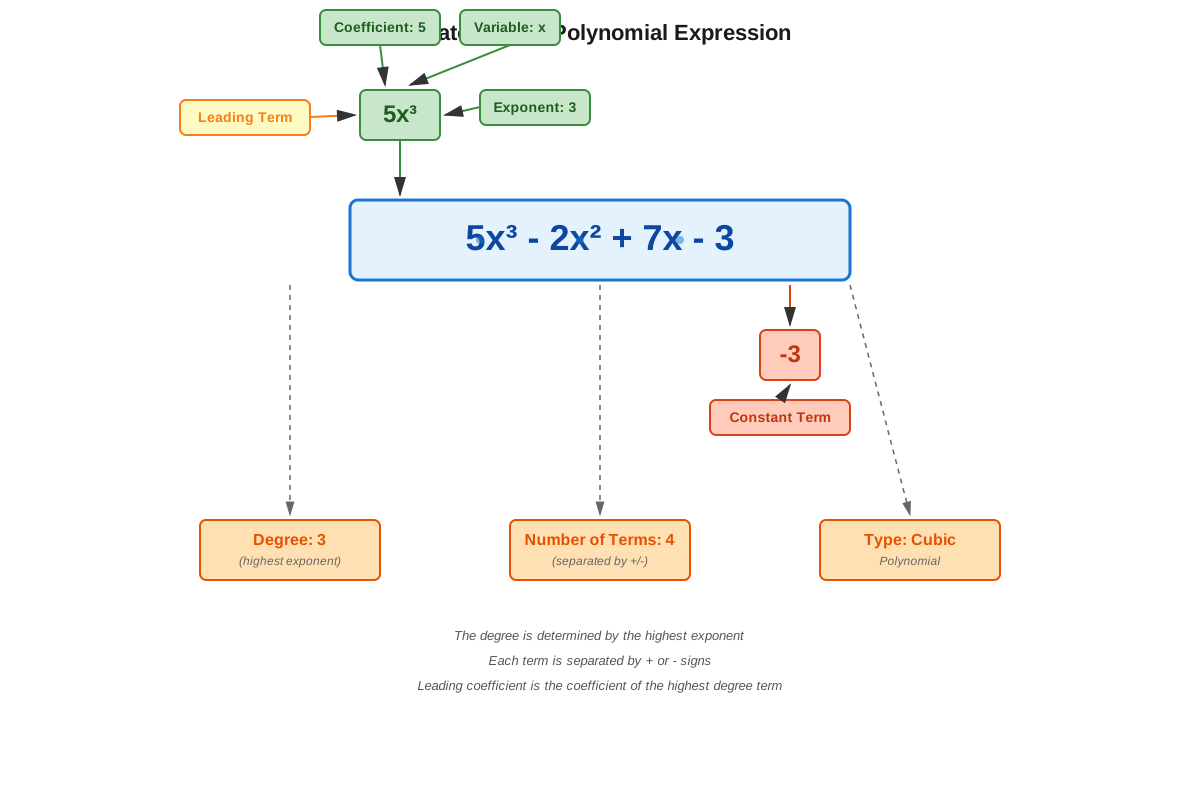
A polynomial expression is an algebraic expression consisting of variables and coefficients, combined using only addition, subtraction, and multiplication, where variables appear with non-negative integer exponents. The general form of a polynomial in one variable is: a_n·x^n + a_(n-1)·x^(n-1) + ... + a_2·x² + a_1·x + a_0, where the coefficients (a_n, a_(n-1), etc.) are real numbers and n is a non-negative integer.
Each component of a polynomial separated by addition or subtraction is called a term. For example, in the polynomial 3x² - 5x + 7, there are three terms: 3x², -5x, and 7. The numerical factor in each term is the coefficient (3, -5, and 7 in this example), while the variable part with its exponent forms the variable component. A term without a variable is called a constant term or constant.
The degree of a polynomial is the highest exponent appearing on the variable when the polynomial is written in standard form. A polynomial of degree 0 is a constant (like 5), degree 1 is linear (like 2x + 3), degree 2 is quadratic (like x² - 4x + 1), degree 3 is cubic (like 2x³ + x² - 5), and so forth. The leading coefficient is the coefficient of the term with the highest degree. Understanding degree is crucial for the ACT because questions often ask about the degree of a resulting polynomial after operations.
Classification of Polynomials
Polynomials can be classified both by degree and by the number of terms they contain. This classification system appears frequently in ACT questions, particularly in answer choices where you must identify equivalent expressions.
| Number of Terms | Name | Example |
|---|---|---|
| 1 | Monomial | 5x³ |
| 2 | Binomial | 3x² - 7 |
| 3 | Trinomial | x² + 4x - 5 |
| 4 or more | Polynomial | 2x⁴ - x³ + 3x - 8 |
| Degree | Name | General Form | Example |
|---|---|---|---|
| 0 | Constant | a | 7 |
| 1 | Linear | ax + b | 3x - 2 |
| 2 | Quadratic | ax² + bx + c | 2x² + 5x - 3 |
| 3 | Cubic | ax³ + bx² + cx + d | x³ - 4x² + x + 6 |
| 4 | Quartic | ax⁴ + bx³ + cx² + dx + e | 3x⁴ + 2x² - 1 |
Adding and Subtracting Polynomials
Adding and subtracting polynomials requires combining like terms—terms that have identical variable parts with the same exponents. The process involves:
- Identify all like terms across the polynomials
- Combine the coefficients of like terms through addition or subtraction
- Keep the variable part unchanged
- Write the result in standard form (descending order of exponents)
For addition: (3x² + 5x - 2) + (2x² - 3x + 7) = (3x² + 2x²) + (5x - 3x) + (-2 + 7) = 5x² + 2x + 5
For subtraction, distribute the negative sign to every term in the second polynomial before combining: (4x³ - 2x + 1) - (x³ + 3x - 5) = 4x³ - 2x + 1 - x³ - 3x + 5 = 3x³ - 5x + 6
ACT Tip: When subtracting polynomials, the most common error is forgetting to distribute the negative sign to all terms. Always rewrite subtraction as adding the opposite.
Multiplying Polynomials
Multiplying polynomials requires applying the distributive property systematically. Each term in the first polynomial must multiply each term in the second polynomial. The key steps are:
- Multiply each term in the first polynomial by each term in the second
- Apply exponent rules: when multiplying like bases, add the exponents (x² · x³ = x⁵)
- Combine like terms in the result
- Write in standard form
For monomial times polynomial: 3x(2x² - 5x + 4) = 6x³ - 15x² + 12x
For binomial times binomial, use FOIL (First, Outer, Inner, Last): (2x + 3)(x - 4) = 2x² - 8x + 3x - 12 = 2x² - 5x - 12
For larger polynomials, systematic distribution is essential: (x + 2)(x² - 3x + 1) = x(x² - 3x + 1) + 2(x² - 3x + 1) = x³ - 3x² + x + 2x² - 6x + 2 = x³ - x² - 5x + 2
Special Polynomial Products
Certain polynomial products appear so frequently on the ACT that recognizing them instantly saves valuable time. These special products include:
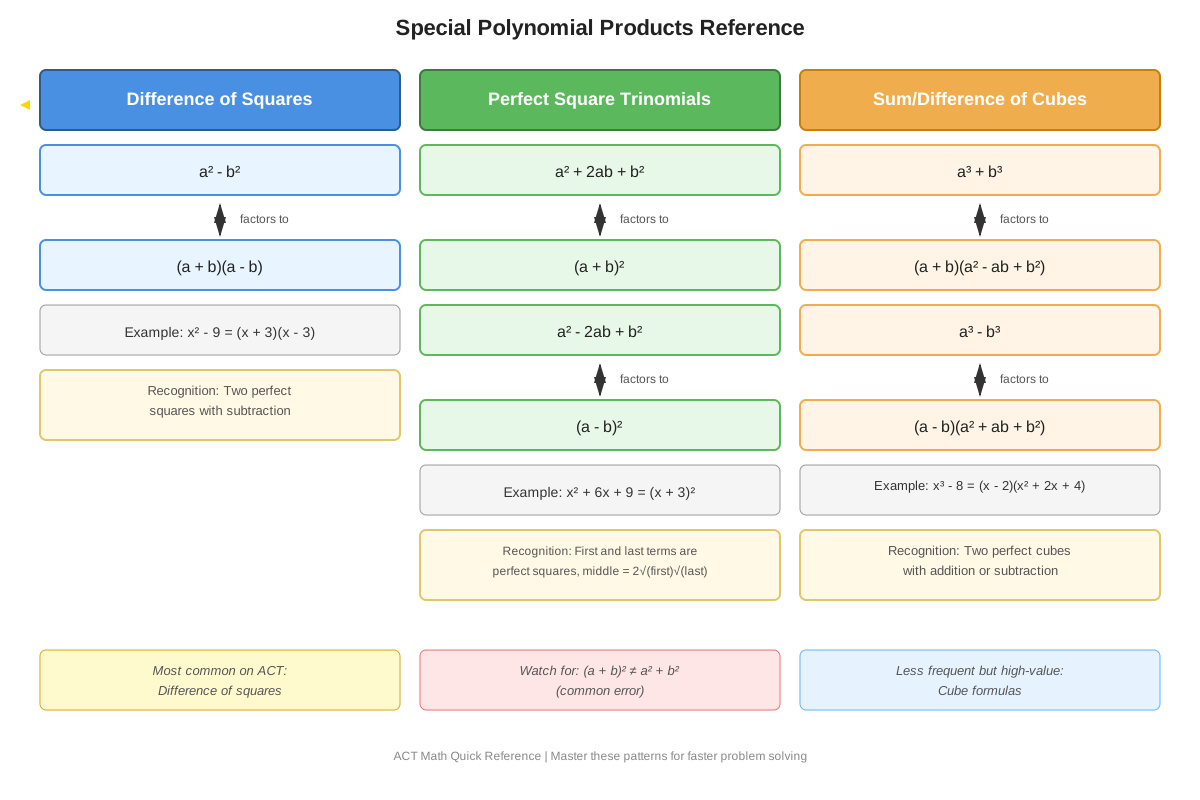
Difference of Squares: (a + b)(a - b) = a² - b²
Example: (x + 5)(x - 5) = x² - 25
Perfect Square Trinomials:
- (a + b)² = a² + 2ab + b²
- (a - b)² = a² - 2ab + b²
Examples: (x + 3)² = x² + 6x + 9 and (2x - 1)² = 4x² - 4x + 1
Sum and Difference of Cubes (less common but tested):
- a³ + b³ = (a + b)(a² - ab + b²)
- a³ - b³ = (a - b)(a² + ab + b²)
Recognizing these patterns in reverse (factoring) is equally important for ACT success.
Evaluating Polynomials
Polynomial evaluation means finding the value of a polynomial expression when the variable(s) take specific numerical values. The process requires:
- Substitute the given value for every instance of the variable
- Apply the order of operations (exponents first, then multiplication/division, then addition/subtraction)
- Simplify to a single numerical value
Example: Evaluate 2x³ - 5x² + 3x - 1 when x = -2
= 2(-2)³ - 5(-2)² + 3(-2) - 1
= 2(-8) - 5(4) + (-6) - 1
= -16 - 20 - 6 - 1
= -43
ACT Strategy: When evaluating polynomials with negative values, use parentheses around the substituted value to avoid sign errors, especially with exponents.
Polynomial Division
While less common than other operations, polynomial division occasionally appears on the ACT. The two methods are long division and synthetic division (for division by linear factors).
For simple cases, factor and cancel: (x² - 4) ÷ (x - 2) = (x + 2)(x - 2) ÷ (x - 2) = x + 2
The ACT typically tests division in contexts where factoring makes the problem manageable, rather than requiring full long division algorithms.
Concept Relationships
The concepts within polynomial expressions build systematically upon each other. Understanding polynomial structure and classification → enables accurate identification of like terms → which is essential for addition and subtraction → these operations form the foundation for multiplication → which requires combining addition with exponent rules → leading to recognition of special products → all of which support polynomial evaluation and division.
Polynomial expressions connect directly to prerequisite topics: exponent rules govern how terms combine during multiplication; the distributive property is the mechanism for all polynomial multiplication; and order of operations ensures correct evaluation. Moving forward, polynomial mastery enables progression to factoring polynomials (the reverse of multiplication), solving polynomial equations (setting polynomials equal to values), polynomial functions (viewing polynomials as input-output relationships), and rational expressions (ratios of polynomials).
The relationship between polynomials and graphing is particularly important for the ACT. The degree of a polynomial determines the maximum number of x-intercepts and turning points its graph can have. Linear polynomials (degree 1) produce straight lines, quadratic polynomials (degree 2) produce parabolas, and higher-degree polynomials produce more complex curves. This connection appears in coordinate geometry questions where polynomial expressions describe curves.
Quick check — test yourself on Polynomial expressions so far.
Try Flashcards →High-Yield Facts
⭐ A polynomial's degree equals the highest exponent when written in standard form; the degree of a product equals the sum of the degrees of the factors
⭐ Like terms must have identical variable parts with the same exponents; only coefficients are combined when adding or subtracting
⭐ When multiplying polynomials, each term in the first polynomial multiplies each term in the second; the number of terms before simplification equals the product of the number of terms in each factor
⭐ (a + b)(a - b) = a² - b² is the difference of squares pattern; recognizing this saves significant time on the ACT
⭐ (a + b)² = a² + 2ab + b², NOT a² + b²; the middle term 2ab is essential and frequently tested
- The leading coefficient is the coefficient of the highest-degree term and affects the end behavior of polynomial graphs
- When subtracting polynomials, distribute the negative sign to every term in the subtracted polynomial
- A polynomial in one variable with degree n has at most n real zeros (x-intercepts)
- The constant term in a polynomial is the value when x = 0
- Polynomial expressions are closed under addition, subtraction, and multiplication (the result is always another polynomial)
- When evaluating polynomials with negative values, exponents apply only to what they're directly attached to: -x² ≠ (-x)²
- Standard form for polynomials arranges terms in descending order of exponents
- The coefficient of a term includes its sign; in 3x² - 5x, the coefficient of x is -5, not 5
- Multiplying a polynomial by a monomial requires distributing the monomial to every term
- The degree of a sum or difference of polynomials is the highest degree among the terms (unless leading terms cancel)
Common Misconceptions
Misconception: When squaring a binomial, simply square each term: (x + 3)² = x² + 9
Correction: Squaring a binomial requires the full expansion (x + 3)² = (x + 3)(x + 3) = x² + 6x + 9. The middle term 2ab is essential. Use the pattern (a + b)² = a² + 2ab + b².
Misconception: Like terms are any terms with the same variable, so 3x² and 5x are like terms
Correction: Like terms must have identical variable parts including the same exponents. 3x² and 5x are not like terms because the exponents differ (2 vs. 1). Only 3x² and 7x² would be like terms.
Misconception: When subtracting polynomials, only subtract the first term of the second polynomial: (5x - 3) - (2x - 7) = 5x - 3 - 2x = 3x - 3
Correction: The subtraction applies to the entire second polynomial. Distribute the negative: (5x - 3) - (2x - 7) = 5x - 3 - 2x + 7 = 3x + 4. Every term in the second polynomial changes sign.
Misconception: The degree of a polynomial is the number of terms it contains
Correction: The degree is the highest exponent on the variable, not the number of terms. The polynomial x⁵ + 2x - 1 has three terms but degree 5. A polynomial can have many terms but low degree, or few terms but high degree.
Misconception: When multiplying polynomials, only multiply the first terms and last terms: (x + 2)(x + 3) = x² + 6
Correction: Every term in the first polynomial must multiply every term in the second. Using FOIL: (x + 2)(x + 3) = x² + 3x + 2x + 6 = x² + 5x + 6. The middle terms (outer and inner products) are essential.
Misconception: Negative exponents and fractional exponents are allowed in polynomials
Correction: Polynomial expressions require non-negative integer exponents only. Expressions like 3x⁻² or 5x^(1/2) are not polynomials. This restriction is part of the definition and occasionally tested directly.
Misconception: When evaluating at x = -2, the expression -x² equals (-2)² = 4
Correction: The exponent applies only to what it's directly attached to. In -x², the negative is not part of the base being squared, so -x² = -(x²) = -(-2)² = -(4) = -4. If the expression were (-x)², then (-(-2))² = (2)² = 4.
Worked Examples
Example 1: Polynomial Operations and Simplification
Problem: Simplify the expression (3x² - 5x + 2) - 2(x² + 3x - 4) and identify the degree and leading coefficient of the result.
Solution:
Step 1: Distribute the -2 to every term in the second polynomial.
-2(x² + 3x - 4) = -2x² - 6x + 8
Step 2: Rewrite the original expression with the distributed terms.
(3x² - 5x + 2) - 2(x² + 3x - 4) = 3x² - 5x + 2 - 2x² - 6x + 8
Step 3: Identify and combine like terms.
- x² terms: 3x² - 2x² = x²
- x terms: -5x - 6x = -11x
- Constant terms: 2 + 8 = 10
Step 4: Write the simplified polynomial in standard form.
x² - 11x + 10
Step 5: Identify degree and leading coefficient.
- Degree: 2 (highest exponent)
- Leading coefficient: 1 (coefficient of x²)
Connection to Learning Objectives: This problem demonstrates identifying polynomial structure, applying subtraction with distribution, combining like terms accurately, and recognizing polynomial characteristics—all core ACT skills.
Example 2: Special Products and Evaluation
Problem: If (2x - 3)² = 4x² + bx + c, what are the values of b and c? Then evaluate the expression when x = 5.
Solution:
Step 1: Recognize this as a perfect square trinomial pattern: (a - b)² = a² - 2ab + b²
Step 2: Identify a and b in the pattern.
Here, a = 2x and b = 3
Step 3: Apply the pattern.
(2x - 3)² = (2x)² - 2(2x)(3) + (3)²
= 4x² - 12x + 9
Step 4: Match coefficients to find b and c.
Comparing 4x² - 12x + 9 with 4x² + bx + c:
b = -12
c = 9
Step 5: Evaluate at x = 5.
4(5)² - 12(5) + 9
= 4(25) - 60 + 9
= 100 - 60 + 9
= 49
Alternative verification: (2(5) - 3)² = (10 - 3)² = 7² = 49 ✓
Connection to Learning Objectives: This problem tests recognition of special products (a high-yield ACT skill), coefficient identification, and polynomial evaluation—three distinct but related competencies frequently combined in ACT questions.
Exam Strategy
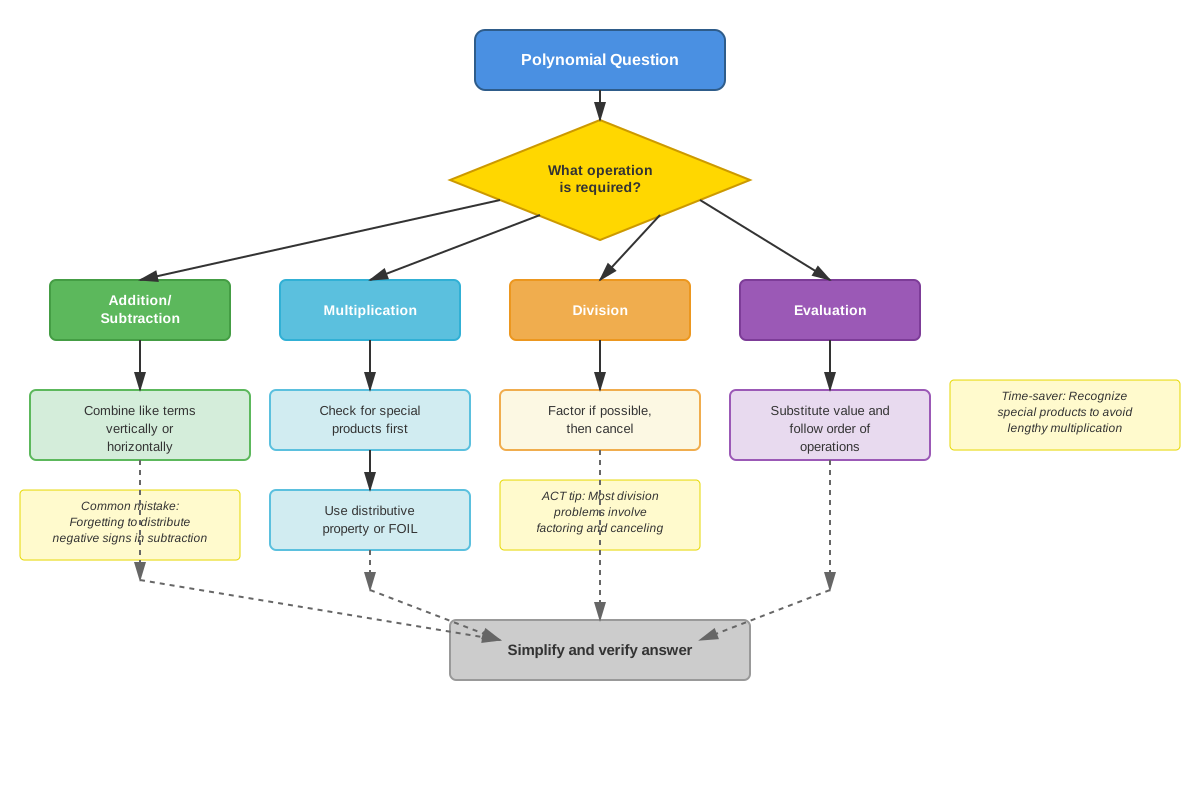
When approaching ACT polynomial questions, begin by identifying what operation or concept is being tested. Look for trigger words: "simplify" indicates combining like terms, "expand" means multiply out, "evaluate" requires substitution, and "equivalent to" suggests you need to manipulate the expression into a different form. The ACT rarely asks you to perform operations without purpose—usually the simplified form reveals something (a coefficient, a degree, or a value) that answers the question.
Time management is crucial for polynomial questions. Straightforward simplification problems should take 30-45 seconds, while multi-step problems involving multiplication and evaluation might require 60-90 seconds. If a problem requires extensive polynomial long division or complex factoring, consider whether there's a faster approach—the ACT typically rewards pattern recognition over lengthy computation. When you see answer choices, use them strategically: if they're numerical, you might evaluate the original expression and each answer choice at a convenient value like x = 1 or x = 0 to eliminate options.
Process of elimination works particularly well for polynomial questions. If asked for the degree of a result, you can often determine it without full simplification—just identify the highest-degree terms and see if they cancel. If asked which expression is equivalent, check the constant term first (set x = 0) or the leading coefficient (compare highest-degree terms). These quick checks eliminate wrong answers faster than complete simplification.
Watch for these trigger phrases that indicate specific polynomial concepts: "combine like terms" (addition/subtraction), "distribute" or "expand" (multiplication), "factor out" (reverse of distribution), "difference of squares" (special product), "perfect square trinomial" (special product), "degree of the polynomial" (identify highest exponent), "leading coefficient" (coefficient of highest-degree term), and "evaluate when x = ..." (substitution). Each phrase signals a specific approach.
Common trap answers include: results where the negative sign wasn't distributed during subtraction, expressions where only some terms were multiplied (incomplete distribution), perfect square trinomials missing the middle term, and evaluations with sign errors from negative substitutions. The ACT deliberately includes these as wrong answer choices because they represent predictable student errors.
Memory Techniques
FOIL for multiplying binomials: First terms, Outer terms, Inner terms, Last terms. While this only applies to binomials, it's the most common multiplication on the ACT.
"DOTS" for difference of squares: Difference Of Two Squares = (a + b)(a - b) = a² - b². When you see two perfect squares being subtracted, think DOTS.
"Please Square All Terms" for perfect square trinomials: When squaring a binomial, you must square the first term (P), create the middle term from 2ab (Square involves doubling), and square the last term (All Terms get attention). This reminds you that (a + b)² ≠ a² + b².
"Like Likes Like" for combining terms: Only like terms (same variable, same exponent) can be combined. If the variable parts don't match exactly, they're not like terms and must remain separate.
"Degree = Highest Power" visualization: Imagine polynomial terms arranged by height, with the tallest (highest exponent) determining the degree. This visual helps you quickly identify degree without getting distracted by number of terms or coefficient size.
"Distribute the Negative" song rhythm: When subtracting polynomials, mentally sing "distribute, distribute, distribute the negative" to the tune of a familiar song. This rhythmic reminder helps prevent the most common polynomial error.
"PEMDAS for Evaluation": When evaluating polynomials, use the standard order of operations mnemonic, but emphasize Exponents come before Multiplication—crucial when substituting negative values.
Summary
Polynomial expressions form a cornerstone of ACT Math, appearing in 15-20% of algebra questions and underlying many other mathematical concepts. A polynomial consists of variables with non-negative integer exponents combined with coefficients through addition, subtraction, and multiplication. Mastery requires fluency with polynomial classification (by degree and number of terms), addition and subtraction (combining like terms), multiplication (systematic distribution), and evaluation (substitution with careful attention to order of operations). Special products—particularly the difference of squares (a² - b²) and perfect square trinomials (a² ± 2ab + b²)—appear frequently and reward instant recognition. The most common errors involve forgetting to distribute negative signs during subtraction, omitting the middle term when squaring binomials, and making sign mistakes when evaluating with negative values. Success on ACT polynomial questions requires both computational accuracy and strategic thinking: recognizing patterns, using answer choices to guide your approach, and applying efficient methods rather than lengthy calculations. With the concepts, strategies, and practice provided in this guide, you have the tools to confidently tackle any polynomial expression question the ACT presents.
Key Takeaways
- Polynomials are expressions with variables raised to non-negative integer exponents; degree equals the highest exponent, and like terms must have identical variable parts to combine
- Adding and subtracting polynomials requires combining like terms; when subtracting, distribute the negative sign to every term in the second polynomial
- Multiplying polynomials demands that each term in the first polynomial multiply each term in the second; use FOIL for binomials and systematic distribution for larger polynomials
- Special products save time: (a + b)(a - b) = a² - b² and (a ± b)² = a² ± 2ab + b² appear frequently on the ACT
- When evaluating polynomials, substitute carefully (especially with negative values), use parentheses, and follow order of operations with exponents before multiplication
- The ACT tests polynomials through direct simplification, word problems, evaluation questions, and identification of equivalent expressions
- Strategic approaches—checking constant terms, comparing degrees, and using answer choices—often solve problems faster than complete algebraic manipulation
Related Topics
Factoring Polynomials: The reverse process of polynomial multiplication, where you express a polynomial as a product of simpler polynomials. Mastering polynomial operations makes factoring more intuitive, as you recognize products you've created through multiplication.
Polynomial Equations: Setting polynomial expressions equal to values and solving for variables. Your ability to manipulate polynomial expressions directly determines your success with polynomial equations.
Polynomial Functions: Viewing polynomials as functions f(x) that map inputs to outputs. Understanding polynomial evaluation prepares you for function notation and analyzing polynomial behavior.
Rational Expressions: Fractions where numerator and denominator are polynomials. All polynomial operations extend to rational expressions, making this topic a natural progression.
Quadratic Equations and Parabolas: Special cases of polynomial equations (degree 2) with extensive ACT coverage. Your polynomial foundation makes quadratic-specific techniques more meaningful.
Systems of Equations: Many systems involve polynomial expressions, and your manipulation skills apply directly to solving systems algebraically.
Practice CTA
Now that you've mastered the core concepts of polynomial expressions, it's time to cement your understanding through active practice. The practice questions and flashcards designed for this topic will challenge you to apply these concepts in ACT-style scenarios, building both speed and accuracy. Each practice problem reinforces the patterns and strategies covered in this guide, transforming conceptual knowledge into test-day performance. Remember: polynomial questions are high-yield on the ACT, and every minute you invest in deliberate practice translates directly to points on test day. You've built the foundation—now strengthen it through application. Start your practice session with confidence, knowing you have the tools to excel!
Sign up free to keep reading
Create a free AnvayaPrep account to finish this ACT guide on Polynomial expressions — plus flashcards and practice questions.