Overview
Simplifying expressions is one of the most fundamental and frequently tested skills in ACT Math. This topic encompasses the ability to manipulate algebraic expressions by combining like terms, applying the distributive property, working with exponents, and reducing expressions to their most compact form. Mastery of this skill is not merely about performing mechanical operations—it's about recognizing patterns, understanding structural relationships within expressions, and efficiently transforming complex mathematical statements into manageable forms.
On the ACT, ACT simplifying expressions questions appear with remarkable consistency, typically accounting for 4-6 questions per test. These questions rarely appear in isolation; instead, they're woven into problems involving equations, inequalities, functions, and word problems. The ability to simplify expressions quickly and accurately serves as a gateway skill that enables students to solve more complex problems efficiently. Without this foundation, students often find themselves stuck on problems they theoretically understand but cannot execute due to algebraic manipulation errors.
The relationship between simplifying expressions and other mathematical concepts is deeply interconnected. This skill builds directly on arithmetic operations and extends into virtually every algebraic topic tested on the ACT: solving equations requires simplification as an intermediate step, factoring depends on recognizing simplified forms, and function evaluation demands expression manipulation. Furthermore, simplifying expressions connects to geometry problems involving perimeter and area formulas, coordinate geometry requiring slope calculations, and even trigonometric identities. In essence, this topic represents the "grammar" of algebra—the set of rules that allows mathematical ideas to be communicated clearly and problems to be solved systematically.
Learning Objectives
- [ ] Identify when Simplifying expressions is being tested
- [ ] Explain the core rule or strategy behind Simplifying expressions
- [ ] Apply Simplifying expressions to ACT-style questions accurately
- [ ] Combine like terms efficiently in expressions with multiple variables
- [ ] Apply the distributive property correctly in expressions with parentheses and negative signs
- [ ] Simplify expressions involving exponent rules (product, quotient, and power rules)
- [ ] Recognize when an expression is fully simplified and cannot be reduced further
Prerequisites
- Basic arithmetic operations: Addition, subtraction, multiplication, and division form the foundation for all algebraic manipulation
- Understanding of variables: Recognizing that letters represent numbers and can be manipulated according to arithmetic rules is essential
- Order of operations (PEMDAS): Knowing the correct sequence for evaluating expressions prevents errors during simplification
- Properties of real numbers: Commutative, associative, and distributive properties govern how terms can be rearranged and combined
- Integer exponent rules: Basic understanding of what exponents represent enables manipulation of exponential expressions
Why This Topic Matters
In real-world applications, simplifying expressions is crucial for fields ranging from engineering to economics. Engineers simplify complex formulas to make calculations more efficient and identify key relationships between variables. Financial analysts simplify algebraic models to understand how different factors affect investment returns. Computer scientists simplify algorithms to optimize code performance. Even in everyday situations, simplifying expressions helps when calculating discounts, comparing phone plans with different pricing structures, or determining the most cost-effective option among alternatives.
On the ACT Math test, simplifying expressions appears in approximately 10-15% of all questions, making it one of the highest-yield topics for focused study. These questions appear in multiple formats: standalone simplification problems, intermediate steps within equation-solving questions, and embedded within word problems requiring algebraic modeling. The ACT particularly favors questions that combine simplification with other skills, such as "Simplify the expression, then evaluate when x = 3" or "Which of the following is equivalent to the given expression?"
Common question formats include: expressions with multiple sets of parentheses requiring the distributive property; expressions with fractional coefficients that must be combined; expressions involving negative exponents that need to be rewritten; and expressions with multiple variables where only certain terms can be combined. The ACT also frequently tests whether students can recognize that two different-looking expressions are actually equivalent after simplification—a skill that requires both computational accuracy and conceptual understanding.
Core Concepts
Combining Like Terms
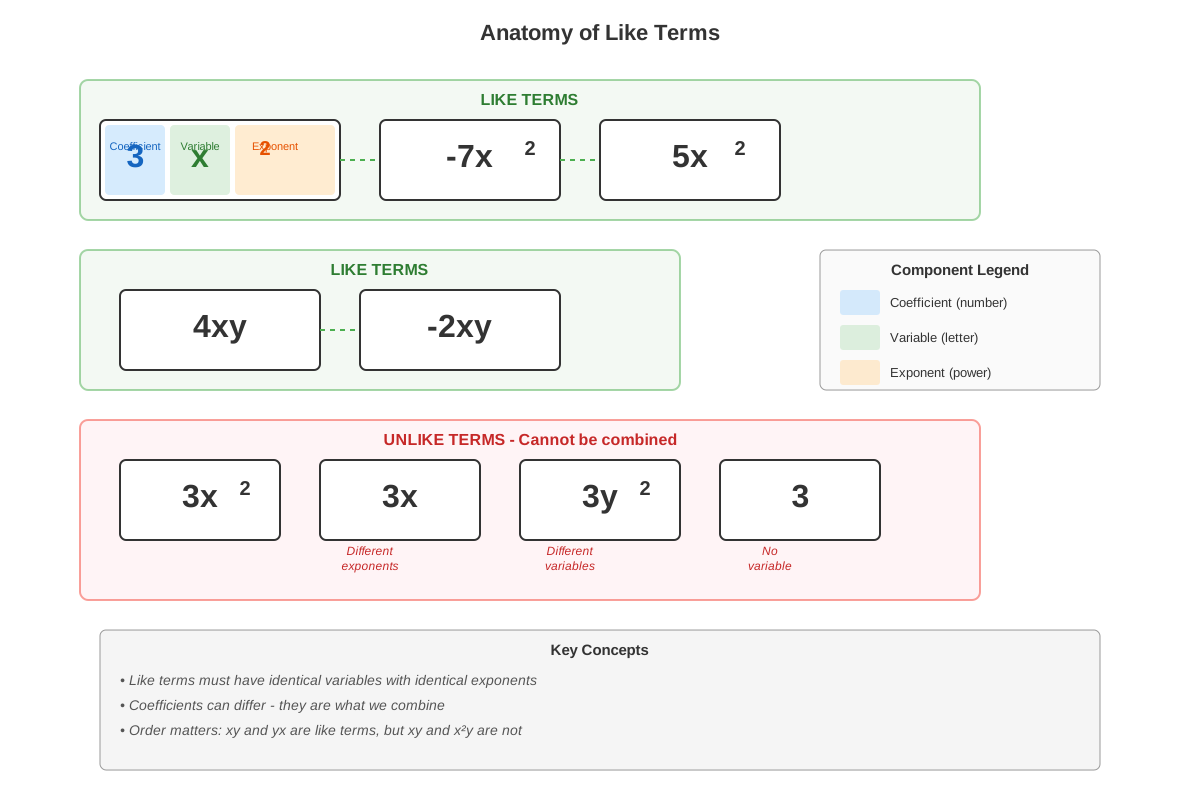
Like terms are terms that contain exactly the same variables raised to the same powers. The coefficients (numerical parts) may differ, but the variable parts must be identical. For example, 3x² and -7x² are like terms, but 3x² and 3x are not. The fundamental principle is that only like terms can be combined through addition or subtraction.
When combining like terms, add or subtract the coefficients while keeping the variable part unchanged:
- 5x + 3x = 8x (add coefficients: 5 + 3 = 8)
- 7y² - 2y² = 5y² (subtract coefficients: 7 - 2 = 5)
- 4ab + 6ab - 2ab = 8ab (combine all coefficients: 4 + 6 - 2 = 8)
A critical skill is recognizing which terms cannot be combined. In the expression 3x² + 5x + 2, none of the terms are like terms: the first contains x², the second contains x, and the third is a constant. This expression is already fully simplified.
The Distributive Property
The distributive property states that a(b + c) = ab + ac. This property is essential for removing parentheses and simplifying expressions. On the ACT, the distributive property appears in several forms:
Basic distribution:
- 3(x + 4) = 3x + 12
- -2(5y - 3) = -10y + 6 (note the sign changes)
Distributing negative signs:
- -(x - 7) = -x + 7 (equivalent to multiplying by -1)
- -(3a + 2b - c) = -3a - 2b + c
Distributing binomials (FOIL method):
- (x + 3)(x + 5) = x² + 5x + 3x + 15 = x² + 8x + 15
- (2a - 1)(3a + 4) = 6a² + 8a - 3a - 4 = 6a² + 5a - 4
The most common error involves sign mistakes, particularly when distributing negative numbers or subtracting expressions in parentheses. Always distribute to every term inside the parentheses.
Exponent Rules for Simplification
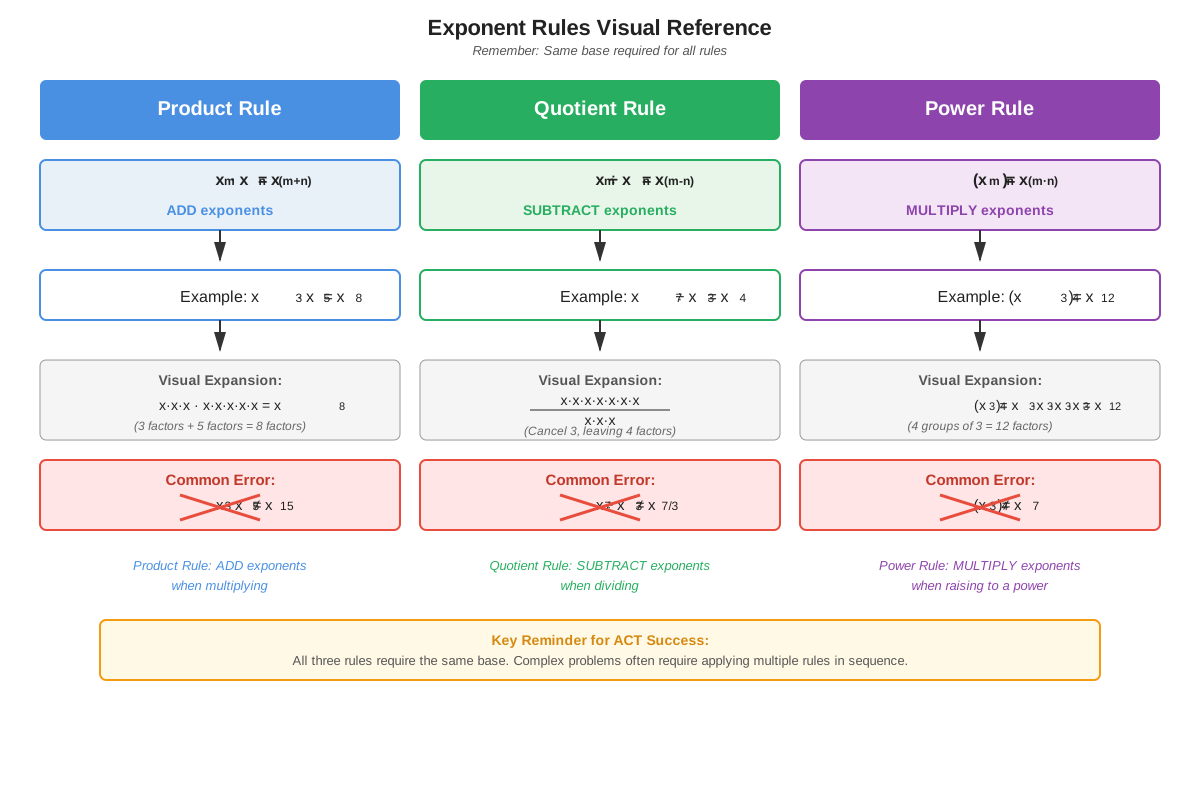
Understanding exponent rules is crucial for simplifying expressions with powers:
| Rule | Formula | Example |
|---|---|---|
| Product Rule | x^m · x^n = x^(m+n) | x³ · x⁵ = x⁸ |
| Quotient Rule | x^m ÷ x^n = x^(m-n) | y⁷ ÷ y² = y⁵ |
| Power Rule | (x^m)^n = x^(mn) | (a⁴)³ = a¹² |
| Power of Product | (xy)^n = x^n · y^n | (2b)³ = 8b³ |
| Power of Quotient | (x/y)^n = x^n/y^n | (a/3)² = a²/9 |
| Zero Exponent | x⁰ = 1 (x ≠ 0) | 5⁰ = 1 |
| Negative Exponent | x^(-n) = 1/x^n | x^(-3) = 1/x³ |
When simplifying expressions with exponents, apply these rules systematically. For example:
- (3x²y³)(2x⁴y) = 6x⁶y⁴ (multiply coefficients, add exponents of like bases)
- (12a⁵b³)/(4a²b) = 3a³b² (divide coefficients, subtract exponents)
Working with Fractions in Expressions
Expressions involving fractional coefficients require careful attention to arithmetic. The key strategies include:
Finding common denominators:
- (1/2)x + (1/3)x = (3/6)x + (2/6)x = (5/6)x
Distributing fractions:
- (1/2)(4x - 6) = 2x - 3
- (2/3)(9a + 6b) = 6a + 4b
Simplifying complex fractions:
When an expression contains fractions within fractions, multiply the numerator and denominator by the least common denominator (LCD) of all fractions involved.
Multi-Step Simplification
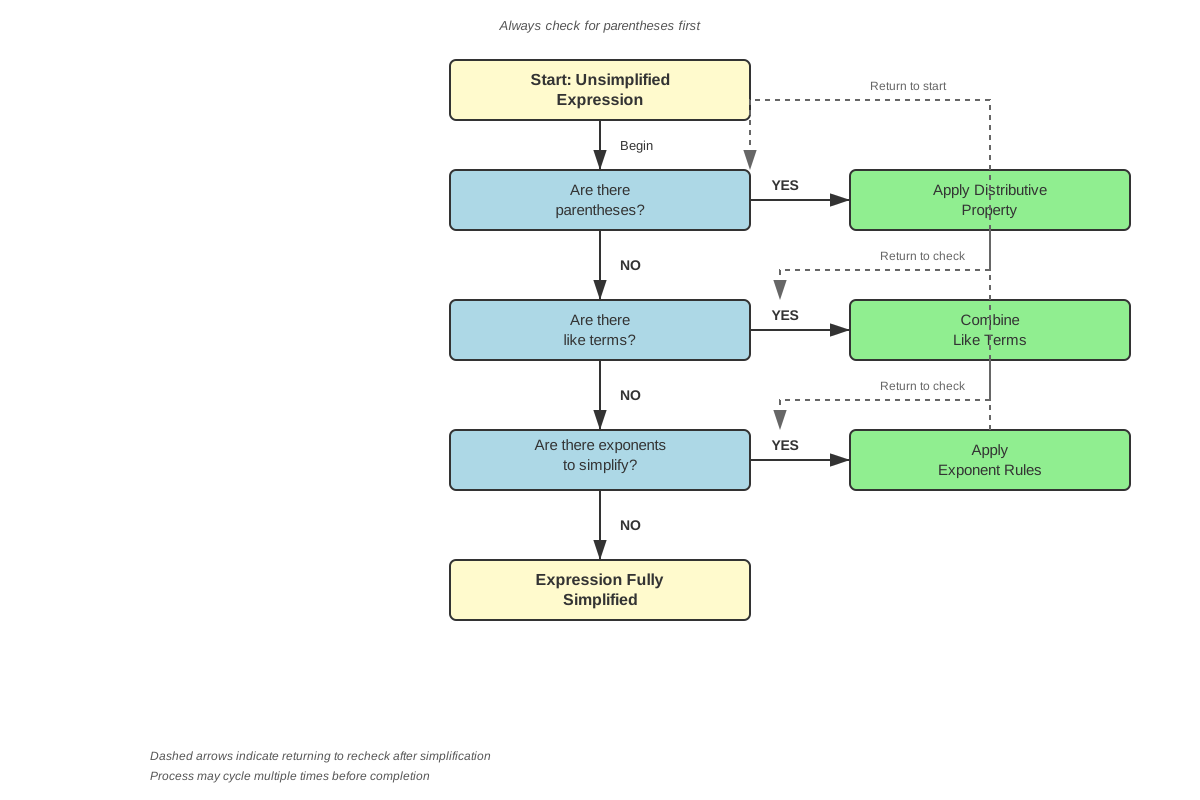
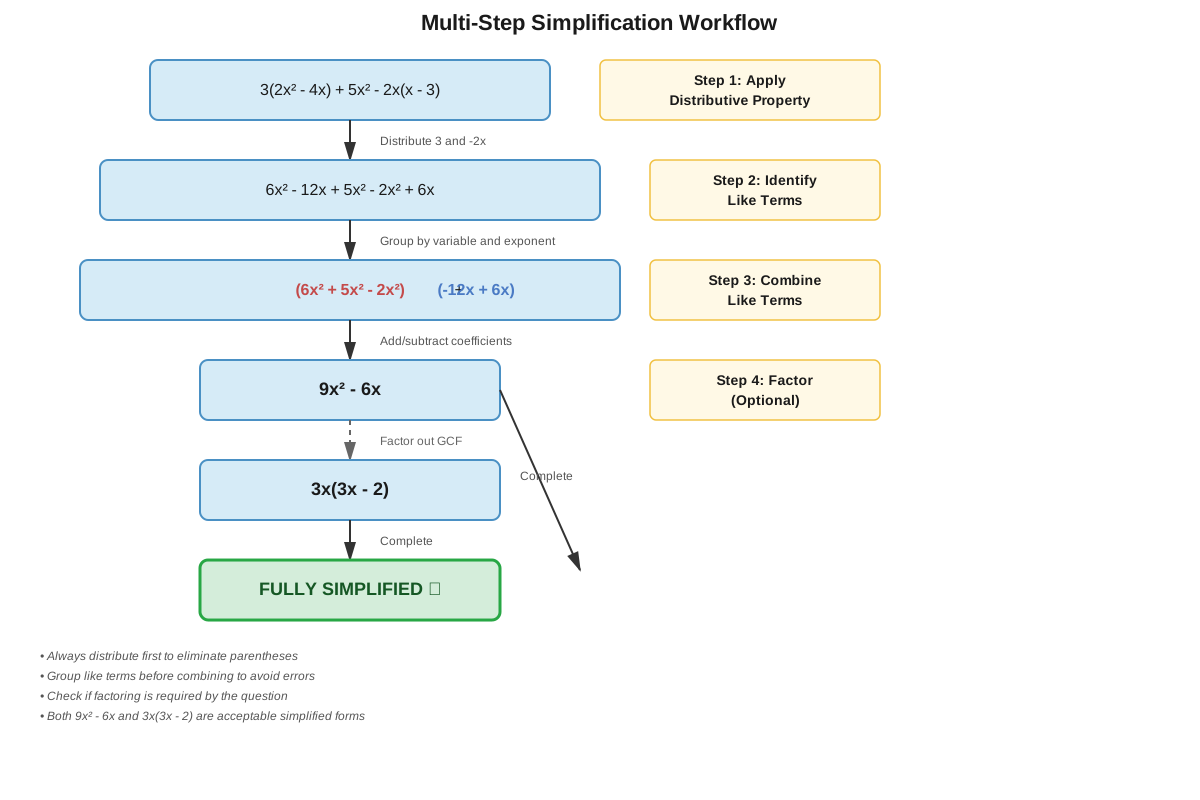
Most ACT questions require combining multiple simplification techniques in sequence. The general approach follows this order:
- Remove parentheses using the distributive property
- Combine like terms by grouping terms with identical variable parts
- Apply exponent rules where applicable
- Simplify numerical coefficients including fractions
- Arrange terms in standard form (typically descending order of exponents)
For example, simplifying 3(2x - 1) - 2(x + 4) + 5x:
- Distribute: 6x - 3 - 2x - 8 + 5x
- Combine like terms: (6x - 2x + 5x) + (-3 - 8)
- Simplify: 9x - 11
Concept Relationships
The concepts within simplifying expressions form a hierarchical structure where foundational skills enable more complex operations. Combining like terms serves as the most basic operation, requiring only addition and subtraction of coefficients. This skill directly supports multi-step simplification, where like terms must be identified and combined after other operations.
The distributive property acts as a bridge between expressions with parentheses and expressions ready for term combination. Before like terms can be combined, parentheses must typically be eliminated through distribution. This creates a natural sequence: distribute first, then combine like terms.
Exponent rules operate somewhat independently but frequently appear alongside other simplification techniques. When expressions contain both exponents and parentheses, the order of operations dictates that exponents within parentheses are handled during distribution, then exponent rules are applied to combine terms with the same base.
Fractional coefficients add complexity to any of the above operations but don't fundamentally change the process. They require additional arithmetic care but follow the same structural rules.
The relationship map flows as follows:
Distributive Property → eliminates parentheses → Combining Like Terms → produces simplified form
Exponent Rules → applied throughout → Multi-Step Simplification → produces final answer
Fractional Coefficients → adds complexity to → all other operations
This topic connects to prerequisite knowledge through direct application of arithmetic operations and order of operations. It extends forward to equation solving (where simplification is step one), factoring (which is essentially "reverse simplification"), and function operations (where expressions must be simplified after substitution or combination).
High-Yield Facts
⭐ Only terms with identical variable parts (same variables raised to same powers) can be combined through addition or subtraction
⭐ When distributing a negative sign or negative number, the sign of every term inside the parentheses must change
⭐ The product rule for exponents (x^m · x^n = x^(m+n)) only applies when the bases are identical
⭐ An expression is fully simplified when it contains no parentheses, no like terms remain uncombined, and all exponent rules have been applied
⭐ The distributive property must be applied to every term inside parentheses: a(b + c + d) = ab + ac + ad
- Constants (numbers without variables) are like terms with each other and can always be combined
- When subtracting an entire expression in parentheses, distribute the negative to all terms: a - (b + c) = a - b - c
- The coefficient 1 is implied when no number appears before a variable: x means 1x
- Zero exponent rule: any nonzero base raised to the zero power equals 1 (x⁰ = 1)
- Negative exponents indicate reciprocals: x^(-n) = 1/x^n, not a negative number
- Terms can be rearranged using the commutative property before combining: 3x + 5 - 2x = 3x - 2x + 5
- When multiplying terms with the same base, add the exponents; when dividing, subtract them
- Fractional coefficients should be combined using common denominators before final simplification
- The order of terms in a simplified expression doesn't affect correctness, but standard form places highest degree terms first
- Simplification never changes the value of an expression—it only changes its appearance
Quick check — test yourself on Simplifying expressions so far.
Try Flashcards →Common Misconceptions
Misconception: Terms with different exponents can be combined (e.g., 3x² + 2x = 5x³)
Correction: Only like terms (identical variable parts) can be combined. The expression 3x² + 2x cannot be simplified further because x² and x are different terms. The exponents must match exactly for terms to be combined.
Misconception: When distributing a negative sign, only the first term inside parentheses becomes negative
Correction: The negative sign (or negative coefficient) must be distributed to every single term inside the parentheses. For -(3x - 2y + 5), the result is -3x + 2y - 5, not -3x - 2y + 5.
Misconception: Exponents can be added when multiplying different bases (e.g., x² · y³ = xy⁵)
Correction: The product rule for exponents only applies to identical bases. The expression x² · y³ cannot be simplified further because x and y are different bases. You can only add exponents when multiplying powers of the same base: x² · x³ = x⁵.
Misconception: Simplifying expressions means solving for a variable
Correction: Simplifying expressions means rewriting them in a more compact form without changing their value. No equation is involved, so there's nothing to "solve for." The expression 2(x + 3) - 4 simplifies to 2x + 2, but this doesn't tell us what x equals.
Misconception: The distributive property applies to exponents over addition (e.g., (x + y)² = x² + y²)
Correction: Exponents do not distribute over addition or subtraction. The expression (x + y)² must be expanded as (x + y)(x + y) = x² + 2xy + y², not x² + y². This is one of the most common and costly errors on the ACT.
Misconception: All terms in an expression must be combined to reach the final answer
Correction: An expression is fully simplified when no like terms remain, even if multiple different terms still exist. The expression 3x² + 5x - 2 is fully simplified because no terms share the same variable part.
Misconception: Negative exponents make the entire term negative
Correction: Negative exponents indicate reciprocals, not negative values. The expression x^(-2) equals 1/x², which is positive when x is positive. The negative sign affects the position (numerator vs. denominator), not the sign of the result.
Worked Examples
Example 1: Multi-Step Simplification with Distribution and Like Terms
Problem: Simplify the expression 4(2x - 3) - 3(x - 5) + 2x
Solution:
Step 1: Apply the distributive property to both sets of parentheses
- 4(2x - 3) = 8x - 12
- -3(x - 5) = -3x + 15 (note: -3 times -5 gives +15)
- The expression becomes: 8x - 12 - 3x + 15 + 2x
Step 2: Identify and group like terms
- Terms with x: 8x, -3x, and 2x
- Constant terms: -12 and 15
Step 3: Combine like terms
- x terms: 8x - 3x + 2x = 7x
- Constants: -12 + 15 = 3
Step 4: Write the final simplified expression
- Answer: 7x + 3
Connection to learning objectives: This problem demonstrates the core strategy of simplifying expressions by first eliminating parentheses through distribution, then combining like terms. It tests the ability to handle negative coefficients correctly and recognize when an expression is fully simplified.
Example 2: Simplification with Exponents and Fractions
Problem: Simplify the expression (6x⁴y²)/(2x²y) · (x³y)/(3y²)
Solution:
Step 1: Rewrite as a single fraction by multiplying numerators and denominators
- Numerator: (6x⁴y²)(x³y) = 6x⁷y³
- Denominator: (2x²y)(3y²) = 6x²y³
Step 2: Write as a single fraction
- (6x⁷y³)/(6x²y³)
Step 3: Simplify the coefficient
- 6/6 = 1
Step 4: Apply the quotient rule for exponents (subtract exponents when dividing like bases)
- For x: x⁷/x² = x^(7-2) = x⁵
- For y: y³/y³ = y^(3-3) = y⁰ = 1
Step 5: Write the final answer
- Answer: x⁵
Connection to learning objectives: This problem requires applying exponent rules systematically while also managing fractional expressions. It demonstrates that simplification often involves multiple techniques working together and shows how terms can completely cancel (like y³/y³ = 1) during the process.
Example 3: Complex Expression with Multiple Variables
Problem: Simplify 2(3a - b) - 4(a + 2b) + 5(2a - 3b)
Solution:
Step 1: Distribute each coefficient to its respective parentheses
- 2(3a - b) = 6a - 2b
- -4(a + 2b) = -4a - 8b
- 5(2a - 3b) = 10a - 15b
Step 2: Write all terms in a single expression
- 6a - 2b - 4a - 8b + 10a - 15b
Step 3: Group like terms (terms with 'a' and terms with 'b')
- Terms with a: 6a - 4a + 10a
- Terms with b: -2b - 8b - 15b
Step 4: Combine each group
- a terms: 6a - 4a + 10a = 12a
- b terms: -2b - 8b - 15b = -25b
Step 5: Write the final simplified expression
- Answer: 12a - 25b
Connection to learning objectives: This example shows how to handle expressions with multiple variables, requiring careful tracking of different variable types and proper sign management throughout multiple distribution steps.
Exam Strategy
When approaching ACT simplifying expressions questions, begin by quickly scanning the answer choices. Often, the format of the answers reveals what form your simplified expression should take—this helps you know when to stop simplifying and prevents over-working the problem.
Trigger words and phrases that indicate simplification is required:
- "Which expression is equivalent to..."
- "Simplify the following expression..."
- "Which of the following equals..."
- "The expression above can be written as..."
- "Combine like terms..."
Process-of-elimination strategies:
- Check the degree of terms: If the original expression has x² as its highest power, eliminate any answer choice with x³ or higher
- Substitute x = 0: This makes all variable terms disappear, leaving only the constant. Calculate the constant in the original expression and eliminate answers with different constants
- Substitute x = 1: This makes all exponents irrelevant (1 to any power is 1), simplifying verification
- Check signs: If the original expression is clearly positive for all positive x values, eliminate negative answer choices
Time allocation advice: Simplification problems should take 30-45 seconds on average. If you find yourself spending more than one minute, you've likely made an error or are using an inefficient approach. In such cases, try substituting a simple number (like x = 2) into both the original expression and each answer choice to find the match.
Common ACT tricks to watch for:
- Answer choices that differ only in signs (testing whether you distributed negatives correctly)
- Answer choices with the same terms but different coefficients (testing whether you combined like terms accurately)
- Answer choices that look similar to the original but aren't actually simplified
- Distractors that represent common errors (like incorrectly combining unlike terms)
Systematic approach:
- Identify all parentheses and plan your distribution
- Execute distribution carefully, writing out each step
- Circle or underline like terms before combining them
- Combine like terms one variable at a time
- Double-check your answer by substituting a simple value
ACT Tip: When in doubt, substitute x = 2 into the original expression and all answer choices. The correct answer must give the same numerical result as the original expression.
Memory Techniques
DECO - The order of simplification operations:
- Distribute (remove parentheses)
- Exponents (apply exponent rules)
- Combine (like terms)
- Order (arrange in standard form)
"Like Likes Like" - Remember that only like terms can be combined. If the variable parts aren't identical twins, they can't be added or subtracted.
"Negative Nancy Visits Everyone" - When distributing a negative sign, it must visit (change) every single term inside the parentheses, not just the first one.
MADSPM for exponent rules:
- Multiply → Add exponents (x² · x³ = x⁵)
- Divide → Subtract exponents (x⁵ ÷ x² = x³)
- Power → Multiply exponents ((x²)³ = x⁶)
Visualization for distribution: Picture parentheses as a fence. The number or term outside must "touch" (multiply) everything inside the fence before the fence can be removed.
The "Same Base Club": Only members of the same base club can have their exponents combined. x³ and x⁵ are in the x-club, so they can interact. But x³ and y⁵ are in different clubs and must stay separate.
"Zero Makes One": Any base (except zero itself) raised to the zero power equals one. Visualize the exponent shrinking to zero and the result popping up to one.
Summary
Simplifying expressions is a foundational algebraic skill that requires systematic application of several key principles: combining like terms (terms with identical variable parts), applying the distributive property to eliminate parentheses, using exponent rules to consolidate powers of the same base, and managing fractional coefficients through common denominators. The process follows a logical sequence—distribute first, then apply exponent rules, then combine like terms, and finally arrange in standard form. Success on ACT simplifying expressions questions depends on careful attention to signs (especially when distributing negatives), accurate identification of like terms, and proper application of exponent rules only to identical bases. An expression is fully simplified when all parentheses are removed, all like terms are combined, all exponent rules are applied, and no further reduction is possible. The most common errors involve incorrectly combining unlike terms, failing to distribute to all terms in parentheses, and misapplying exponent rules to different bases. Mastery of this topic enables efficient problem-solving across virtually all ACT Math questions, as simplification serves as a critical intermediate step in equations, inequalities, functions, and word problems.
Key Takeaways
- Only like terms (identical variable parts with same exponents) can be combined through addition or subtraction
- The distributive property must be applied to every term inside parentheses, with special care for negative signs
- Exponent rules (product, quotient, and power rules) apply only when bases are identical
- An expression is fully simplified when no parentheses remain, no like terms can be combined, and all exponent rules have been applied
- The systematic approach—distribute, apply exponent rules, combine like terms, arrange—prevents errors and ensures complete simplification
- Substituting simple values (like x = 0, 1, or 2) provides a quick verification method for checking answers
- Simplification changes the appearance of an expression but never changes its value
Related Topics
Solving Linear Equations: Mastering simplification enables efficient equation solving, as most equations require simplification before isolation of variables. The techniques learned here apply directly to combining terms on each side of an equation.
Factoring Polynomials: Factoring is essentially the reverse of simplification through distribution. Understanding how expressions expand helps recognize factored forms and vice versa.
Function Operations: Adding, subtracting, and multiplying functions requires simplifying the resulting expressions. The skills developed here transfer directly to function composition and transformation problems.
Rational Expressions: Simplifying algebraic fractions builds on these foundational skills, adding complexity through polynomial division and factoring.
Systems of Equations: Solving systems often requires simplifying expressions after substitution or elimination steps, making this topic essential for multi-equation problems.
Practice CTA
Now that you've mastered the core concepts of simplifying expressions, it's time to put your knowledge into action! Work through the practice questions to reinforce these techniques and build the speed and accuracy needed for ACT success. Each practice problem is designed to mirror actual ACT question formats, helping you develop both computational skills and strategic thinking. Review the flashcards to cement key rules and common patterns in your memory. Remember, simplification is a skill that improves dramatically with practice—the more expressions you simplify, the faster and more confident you'll become. You've got this!
Sign up free to keep reading
Create a free AnvayaPrep account to finish this ACT guide on Simplifying expressions — plus flashcards and practice questions.