Overview
The y-intercept is one of the most fundamental concepts in coordinate geometry and appears frequently throughout the ACT Math test. It represents the point where a line, curve, or function crosses the y-axis, and understanding this concept is essential for solving problems involving linear equations, graphing, systems of equations, and function analysis. On the ACT, y-intercept questions can appear in multiple forms: identifying the y-intercept from an equation, determining it from a graph, or using it to write or manipulate equations.
Mastering the y-intercept is crucial because it serves as a gateway to understanding more complex algebraic concepts. The ACT y-intercept questions test not only your ability to identify this value but also your understanding of how it relates to the overall behavior of functions and equations. These questions often integrate multiple skills, requiring students to move fluidly between algebraic and graphical representations. The y-intercept frequently appears in word problems involving initial values, starting points, or fixed costs in real-world scenarios.
The y-intercept connects directly to slope-intercept form, point-slope form, standard form equations, and function notation. It plays a vital role in understanding linear relationships, interpreting graphs, solving systems of equations, and analyzing function transformations. On the ACT, approximately 3-5 questions per test directly or indirectly involve y-intercept concepts, making this a high-yield topic that deserves thorough understanding and practice.
Learning Objectives
- [ ] Identify when Y-intercept is being tested in ACT questions
- [ ] Explain the core rule or strategy behind Y-intercept
- [ ] Apply Y-intercept to ACT-style questions accurately
- [ ] Convert between different equation forms to identify the y-intercept
- [ ] Determine the y-intercept from a graph, table, or word problem
- [ ] Use the y-intercept to write equations and solve real-world problems
- [ ] Recognize how transformations affect the y-intercept of functions
Prerequisites
- Coordinate plane basics: Understanding x and y axes is essential because the y-intercept is defined as the point where a graph crosses the y-axis
- Solving linear equations: Ability to isolate variables and substitute values is necessary for finding y-intercepts algebraically
- Function notation: Understanding f(x) notation helps recognize that the y-intercept equals f(0)
- Basic graphing skills: Reading and plotting points on a coordinate plane enables visual identification of y-intercepts
- Order of operations: Correctly evaluating expressions when x = 0 is fundamental to calculating y-intercepts
Why This Topic Matters
The y-intercept appears in countless real-world applications, making it both practically useful and frequently tested. In business contexts, the y-intercept represents fixed costs or initial values before any variable changes occur. In science, it indicates starting conditions in experiments. In everyday situations, it might represent the base fee for a service, the initial amount in a savings account, or the starting temperature before heating begins.
On the ACT Math test, y-intercept questions appear in approximately 8-12% of algebra questions, which translates to 3-5 questions per exam. These questions span multiple difficulty levels and often appear in the following formats: identifying the y-intercept from slope-intercept form (y = mx + b), finding it from standard form (Ax + By = C), determining it from a graph or table, extracting it from word problems, and using it to write equations. The ACT particularly favors questions that require students to recognize the y-intercept in non-standard forms or to apply it in context-based problems.
The topic commonly appears in questions about linear modeling, where students must interpret what the y-intercept represents in a real-world scenario. It also frequently shows up in coordinate geometry questions, systems of equations problems, and function transformation questions. Understanding y-intercepts is essential for success on medium to high-difficulty ACT Math questions, particularly those in the latter half of the test.
Core Concepts
Definition and Fundamental Understanding
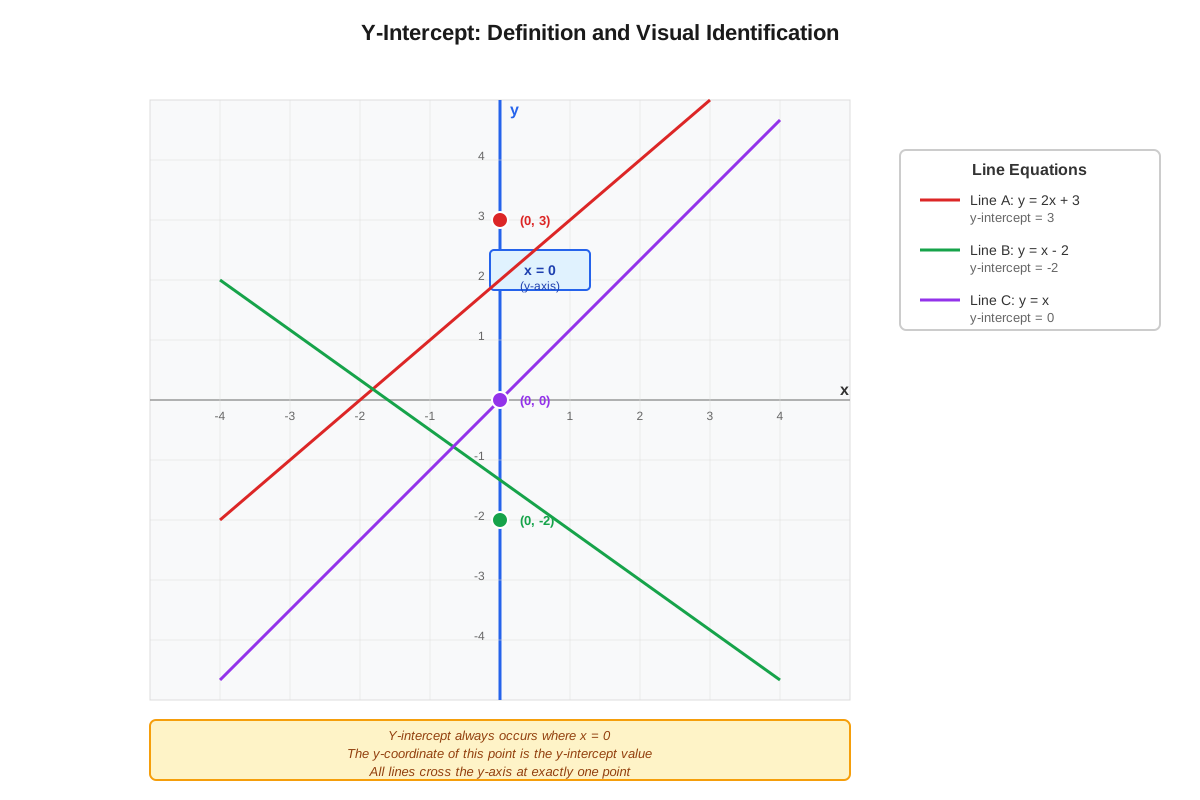
The y-intercept is the y-coordinate of the point where a graph intersects the y-axis. At this point, the x-coordinate is always zero because the y-axis is defined by the equation x = 0. For any function f(x), the y-intercept can be found by evaluating f(0). The y-intercept is typically denoted as the value b in slope-intercept form or as the ordered pair (0, b).
Understanding that x = 0 at the y-intercept is the key to finding this value algebraically. When given any equation, substituting x = 0 and solving for y will always yield the y-intercept. This principle applies to linear equations, quadratic functions, exponential functions, and any other function that crosses the y-axis.
Identifying Y-Intercepts in Different Equation Forms
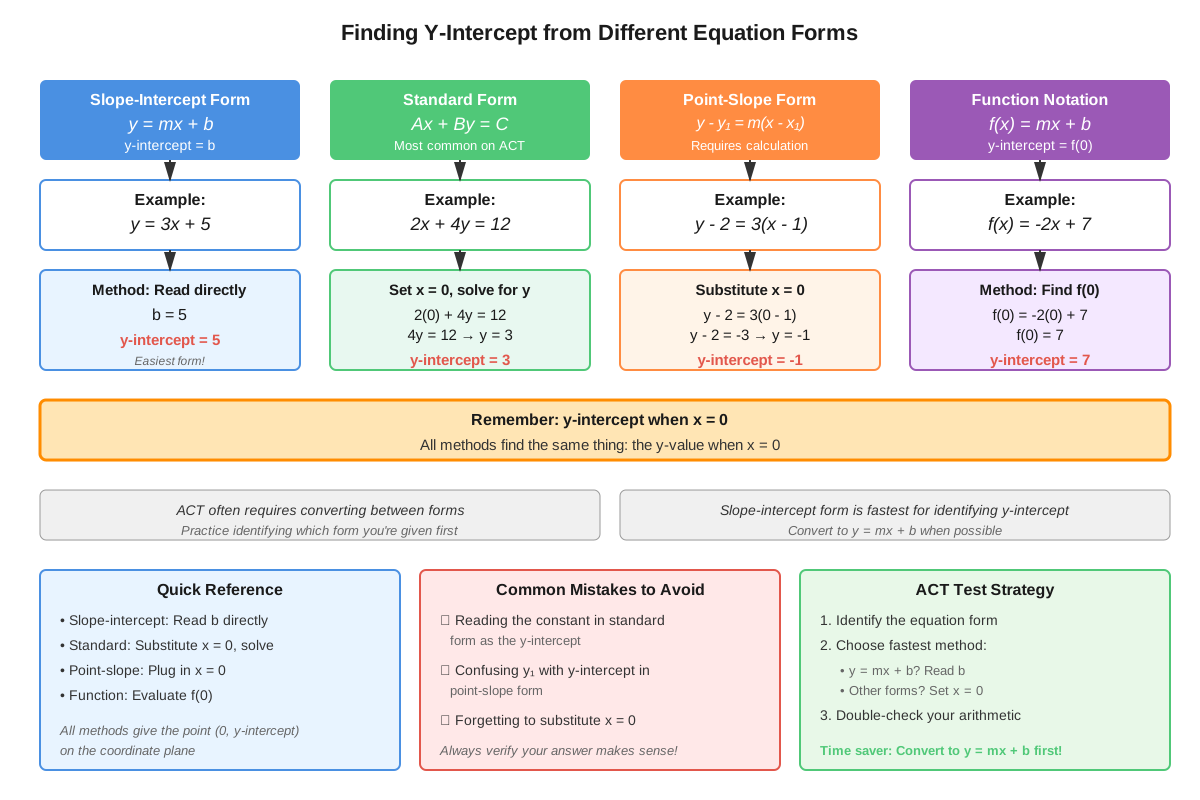
Slope-Intercept Form (y = mx + b): This is the most direct form for identifying the y-intercept. The constant term b represents the y-intercept. For example, in the equation y = 3x + 7, the y-intercept is 7, meaning the graph crosses the y-axis at the point (0, 7).
Standard Form (Ax + By = C): To find the y-intercept from standard form, set x = 0 and solve for y. For the equation 2x + 3y = 12, substituting x = 0 gives 3y = 12, so y = 4. The y-intercept is 4.
Point-Slope Form (y - y₁ = m(x - x₁)): While this form doesn't immediately show the y-intercept, you can find it by substituting x = 0 and solving for y, or by converting to slope-intercept form.
| Equation Form | How to Find Y-Intercept | Example | Y-Intercept |
|---|---|---|---|
| y = mx + b | Read the constant b | y = 2x - 5 | -5 |
| Ax + By = C | Set x = 0, solve for y | 4x + 2y = 10 | 5 |
| y - y₁ = m(x - x₁) | Substitute x = 0 | y - 3 = 2(x - 1) | 1 |
| f(x) notation | Evaluate f(0) | f(x) = x² + 3x + 2 | 2 |
Y-Intercept from Graphs and Tables
When working with graphs, the y-intercept is the point where the line or curve crosses the y-axis. Visually locate where the graph intersects the vertical axis and read the y-coordinate. Be careful with scale—each grid line may represent more than one unit.
For tables of values, find the row where x = 0 and read the corresponding y-value. If x = 0 is not explicitly shown in the table, you may need to use other points to write an equation and then find the y-intercept algebraically.
Y-Intercept in Word Problems
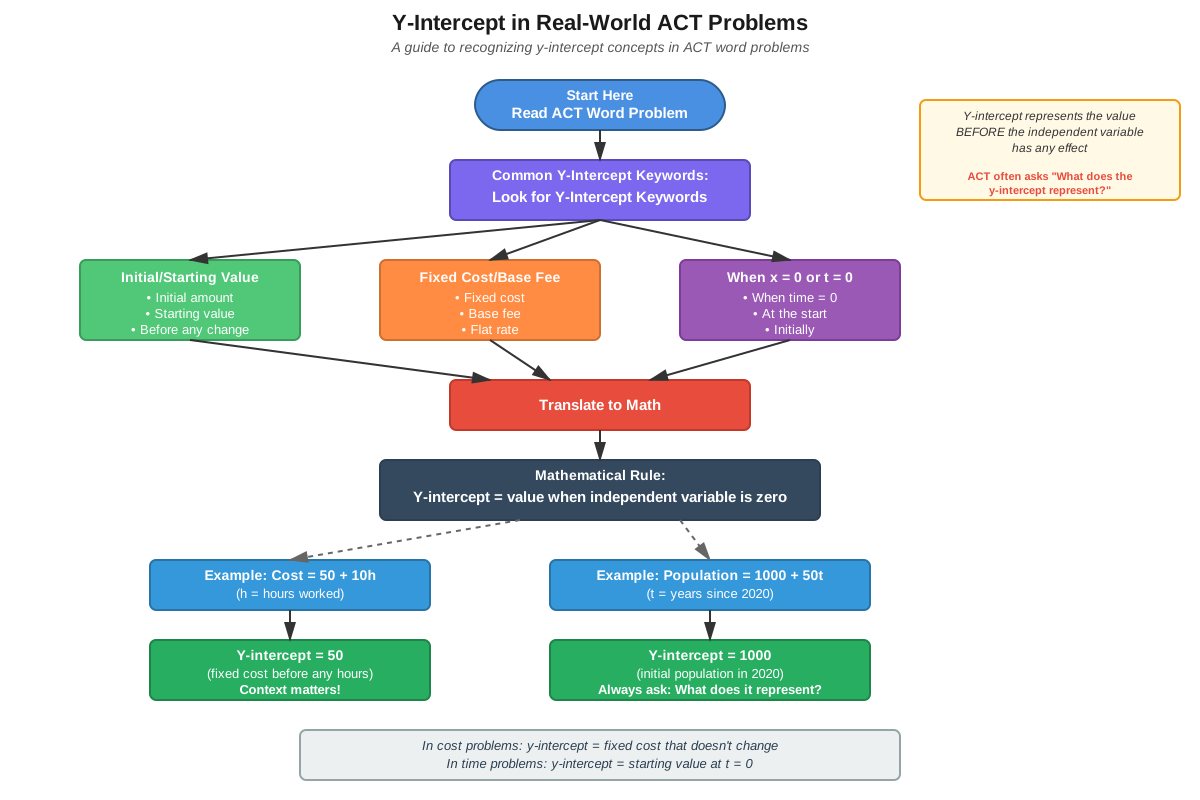
In real-world contexts, the y-intercept represents the initial value or starting point before any changes occur. Common scenarios include:
- Fixed costs: The base price before variable costs are added
- Initial amounts: Starting balance, population, or quantity at time zero
- Base fees: Flat charges before per-unit costs
- Starting conditions: Initial temperature, height, or position
When reading word problems, look for phrases like "initial," "starting," "base," "fixed," or "when x = 0" to identify the y-intercept.
Using Y-Intercept to Write Equations
When given the y-intercept and slope, you can immediately write an equation in slope-intercept form: y = mx + b, where b is the y-intercept. When given the y-intercept and another point, first calculate the slope using the two points (0, b) and the given point, then write the equation.
Y-Intercept and Function Transformations
Vertical translations affect the y-intercept directly. If f(x) has y-intercept b, then f(x) + k has y-intercept b + k. Vertical stretches and compressions multiply the y-intercept by the stretch factor. Horizontal translations do not directly change the y-intercept value, though they change where the function crosses the y-axis.
Concept Relationships
The y-intercept concept connects intimately with slope to form complete linear equations. Together, slope and y-intercept provide all the information needed to graph a line or write its equation. The relationship flows as: coordinate plane understanding → point identification → y-intercept recognition → equation writing → graphing and analysis.
The y-intercept links to prerequisite knowledge of the coordinate plane because understanding axes and coordinates is necessary to comprehend what "crossing the y-axis" means. It connects to solving equations because finding the y-intercept often requires substitution and algebraic manipulation. The concept extends to systems of equations, where comparing y-intercepts helps determine if lines are parallel or if they intersect.
Within function analysis, the y-intercept represents f(0), connecting algebraic and graphical representations. This relationship extends to: function notation → evaluation at x = 0 → y-intercept identification → graph interpretation. Understanding y-intercepts enables progression to more advanced topics like quadratic functions (where the y-intercept is the constant term c in y = ax² + bx + c), exponential functions (where it represents the initial value), and function transformations.
Quick check — test yourself on Y-intercept so far.
Try Flashcards →High-Yield Facts
⭐ The y-intercept occurs where x = 0, making the coordinates (0, b) where b is the y-intercept value
⭐ In slope-intercept form y = mx + b, the y-intercept is the constant term b
⭐ To find the y-intercept from any equation, substitute x = 0 and solve for y
⭐ The y-intercept represents the initial value or starting point in word problems
⭐ In standard form Ax + By = C, the y-intercept equals C/B when x = 0
- For any function f(x), the y-intercept equals f(0)
- Parallel lines have the same slope but different y-intercepts
- A vertical line (x = k) has no y-intercept unless k = 0
- The y-intercept can be positive, negative, or zero
- Vertical translations shift the y-intercept by adding or subtracting a constant
- In a table of values, the y-intercept is the y-value when x = 0
- Two lines with the same y-intercept intersect at that point on the y-axis
Common Misconceptions
Misconception: The y-intercept is always positive → Correction: The y-intercept can be any real number—positive, negative, or zero. For example, y = 2x - 5 has a y-intercept of -5.
Misconception: The y-intercept is a point, so it should be written as just a number → Correction: While we often refer to "the y-intercept is 3," the complete answer is the point (0, 3). On the ACT, pay attention to whether the question asks for the y-coordinate or the point itself.
Misconception: In standard form Ax + By = C, the y-intercept is always C → Correction: The y-intercept is C/B, not C. You must divide C by the coefficient of y after setting x = 0.
Misconception: The y-intercept and slope are the same thing → Correction: These are distinct concepts. The slope (m) measures steepness and direction, while the y-intercept (b) indicates where the line crosses the y-axis. In y = mx + b, m is slope and b is y-intercept.
Misconception: If a line passes through the origin, it has no y-intercept → Correction: A line through the origin has a y-intercept of 0, which is still a valid y-intercept. The point (0, 0) is where it crosses the y-axis.
Misconception: Horizontal translations change the y-intercept by the same amount → Correction: Horizontal shifts (replacing x with x - h) change the y-intercept in non-obvious ways. For example, y = (x - 2)² has y-intercept 4, not -2. Always evaluate f(0) to find the new y-intercept after transformations.
Misconception: The y-intercept is where the line crosses any axis → Correction: The y-intercept specifically refers to crossing the y-axis only. The x-intercept is where the line crosses the x-axis, and these are different values.
Worked Examples
Example 1: Finding Y-Intercept from Standard Form
Problem: What is the y-intercept of the line 3x - 4y = 24?
Solution:
Step 1: Recognize that we need to find where the line crosses the y-axis, which occurs when x = 0.
Step 2: Substitute x = 0 into the equation:
3(0) - 4y = 24
-4y = 24
Step 3: Solve for y:
y = 24 ÷ (-4)
y = -6
Step 4: State the answer. The y-intercept is -6, or the point (0, -6).
Connection to Learning Objectives: This example demonstrates applying the core strategy of substituting x = 0 to find the y-intercept, and it shows how to identify when y-intercept is being tested even when the equation isn't in slope-intercept form.
Example 2: Y-Intercept in a Word Problem
Problem: A phone company charges a base fee of $25 per month plus $0.10 per minute of calls. Which equation represents the total monthly cost C in terms of minutes m, and what does the y-intercept represent?
Solution:
Step 1: Identify the components. The base fee ($25) is the fixed cost that doesn't change with minutes used. The per-minute charge ($0.10) is the rate of change.
Step 2: Recognize that this follows the form y = mx + b, where:
- C represents total cost (dependent variable, like y)
- m represents minutes (independent variable, like x)
- The rate is $0.10 per minute (slope)
- The base fee is $25 (y-intercept)
Step 3: Write the equation:
C = 0.10m + 25Step 4: Interpret the y-intercept. The y-intercept is 25, which represents the monthly cost when m = 0 (no minutes used). This is the base fee charged regardless of usage.
Connection to Learning Objectives: This example shows how to identify y-intercept in context, explain what it represents in a real-world scenario, and apply the concept to write an equation accurately.
Exam Strategy
When approaching ACT y-intercept questions, first determine what form the information is presented in: equation, graph, table, or word problem. Each format requires a slightly different approach, but all rely on the fundamental principle that the y-intercept occurs when x = 0.
Trigger words and phrases to watch for include: "y-intercept," "crosses the y-axis," "when x = 0," "initial value," "starting amount," "base fee," "fixed cost," and "f(0)." In word problems, phrases like "before any changes" or "at the beginning" often indicate the y-intercept.
For process of elimination, remember these tips:
- If a line slopes upward and crosses the y-axis above the origin, the y-intercept must be positive
- If the graph shows the line crossing below the origin, eliminate any positive y-intercept answers
- If you're given two points and neither has x = 0, you can eliminate answers that would make the slope inconsistent with those points
Time allocation: Most y-intercept questions should take 30-45 seconds if you recognize the concept immediately. If you need to convert between forms or solve algebraically, allow up to 60 seconds. Don't spend more than 90 seconds on any single y-intercept question—if you're stuck, mark it and return later.
ACT Tip: When a question asks for "the y-coordinate of the y-intercept," they want just the number. When it asks for "the y-intercept," you can usually answer with just the number, but if answer choices are points, give the full coordinate (0, b).
For graphing calculator users, you can verify y-intercepts by graphing the equation and using the trace function to find where x = 0, but this should be a verification method rather than your primary strategy due to time constraints.
Memory Techniques
"Y-Zero" Mnemonic: Remember "Y-intercept? Set X to ZERO!" This simple phrase reminds you of the fundamental strategy for finding any y-intercept algebraically.
"B for Beginning" Mnemonic: In y = mx + b, remember that B stands for "Beginning point" on the y-axis. This helps you remember which letter represents the y-intercept in slope-intercept form.
Visual Anchor: Picture a vertical line (the y-axis) and imagine a dot where your function crosses it. That dot is always directly above or below the origin, never to the left or right, reinforcing that x = 0 at the y-intercept.
"Initial = Intercept" Association: In word problems, whenever you see "initial," "starting," or "base," mentally translate it to "y-intercept." This creates an automatic connection between context clues and the mathematical concept.
The "Zero-In" Technique: When looking at a graph, "zero in" on the y-axis first, then scan along it to find where the function crosses. This systematic approach prevents you from confusing x-intercepts with y-intercepts.
Summary
The y-intercept is the point where a graph crosses the y-axis, occurring when x = 0 and represented by the coordinates (0, b). This fundamental concept appears throughout ACT Math in various forms: as the constant term b in slope-intercept form (y = mx + b), as the value obtained by setting x = 0 in any equation, as the point where a graph crosses the vertical axis, and as the initial value in real-world word problems. Mastering y-intercept requires fluency in converting between different equation forms, reading graphs accurately, interpreting tables, and translating word problems into mathematical representations. The y-intercept works in conjunction with slope to completely define linear relationships and serves as a foundation for understanding more complex functions. Success on ACT y-intercept questions depends on quickly recognizing when this concept is being tested, applying the core strategy of evaluating at x = 0, and understanding what the y-intercept represents in context.
Key Takeaways
- The y-intercept always occurs at x = 0, making the coordinates (0, b)
- In y = mx + b, the y-intercept is the constant b; in standard form, substitute x = 0 and solve for y
- The y-intercept represents initial values, starting points, or fixed costs in word problems
- To find any y-intercept algebraically, substitute x = 0 into the equation and solve for y
- The y-intercept can be positive, negative, or zero—don't assume it's always positive
- On graphs, locate where the function crosses the y-axis; in tables, find the y-value when x = 0
- Understanding y-intercepts is essential for writing equations, graphing lines, and solving systems
Related Topics
Slope: Understanding how to calculate and interpret slope complements y-intercept knowledge, as together they provide complete information about linear functions. Mastering y-intercept enables you to write complete equations when given slope.
X-intercept: The parallel concept of where graphs cross the x-axis uses similar strategies (setting y = 0 instead of x = 0) and often appears alongside y-intercept questions on the ACT.
Systems of Linear Equations: Comparing y-intercepts helps determine relationships between lines (parallel, intersecting, or coincident), building directly on y-intercept mastery.
Function Transformations: Understanding how vertical translations, stretches, and compressions affect the y-intercept extends this foundational concept to more complex function analysis.
Quadratic Functions: The y-intercept of parabolas (the constant term c in y = ax² + bx + c) follows the same principles, making this topic a stepping stone to quadratic analysis.
Practice CTA
Now that you've mastered the core concepts of y-intercepts, it's time to solidify your understanding through practice! Work through the practice questions to apply these strategies to ACT-style problems, and use the flashcards to reinforce key facts and formulas. Remember, the difference between understanding a concept and mastering it for test day comes from deliberate practice. Each practice question you complete builds the pattern recognition and speed you need to confidently tackle y-intercept questions on the actual ACT. You've got this—let's turn this knowledge into points!
Sign up free to keep reading
Create a free AnvayaPrep account to finish this ACT guide on Y-intercept — plus flashcards and practice questions.