Overview
Collinearity is a fundamental concept in coordinate geometry that appears regularly on the ACT Math test. Three or more points are considered collinear when they all lie on the same straight line. While this may seem like a simple geometric property, ACT collinearity questions require students to apply multiple mathematical skills simultaneously, including slope calculations, distance formulas, and algebraic reasoning. Understanding collinearity is essential because it bridges pure geometry with coordinate-based analysis, allowing students to solve complex spatial problems using algebraic methods.
On the ACT, collinearity questions typically appear 1-2 times per test and are often embedded within larger coordinate geometry problems. These questions may ask students to determine whether given points are collinear, find missing coordinates that would make points collinear, or identify relationships between lines and points. The concept connects directly to linear equations, slope, and the fundamental principle that any two points determine exactly one line. Mastering collinearity provides students with powerful problem-solving tools that extend beyond simple point identification to more sophisticated geometric reasoning.
The importance of collinearity extends throughout coordinate geometry and connects to numerous other mathematical concepts. Understanding when points share a line helps students recognize patterns in data, verify geometric properties algebraically, and solve optimization problems. This topic serves as a bridge between basic graphing skills and advanced geometric proofs, making it a critical component of ACT Math preparation. Students who master collinearity gain confidence in tackling multi-step problems that require both geometric intuition and algebraic precision.
Learning Objectives
- [ ] Identify when Collinearity is being tested in ACT Math questions
- [ ] Explain the core rule or strategy behind Collinearity and its mathematical foundation
- [ ] Apply Collinearity to ACT-style questions accurately and efficiently
- [ ] Calculate and compare slopes between multiple pairs of points to verify collinearity
- [ ] Determine missing coordinates that would make three or more points collinear
- [ ] Distinguish between collinearity problems and similar coordinate geometry questions
- [ ] Solve multi-step problems that combine collinearity with other geometric concepts
Prerequisites
- Slope formula and calculation: Essential for determining whether points lie on the same line by comparing slopes between point pairs
- Coordinate plane fundamentals: Understanding ordered pairs, quadrants, and point plotting enables visualization of collinearity problems
- Linear equations: Knowledge of y = mx + b form helps verify that multiple points satisfy the same linear equation
- Basic algebraic manipulation: Required for solving equations when finding missing coordinates in collinearity problems
- Distance formula: Sometimes needed to verify relationships between collinear points or eliminate answer choices
Why This Topic Matters
Collinearity represents a critical intersection between pure geometry and algebraic reasoning, making it a favorite testing ground for ACT question writers. In real-world applications, collinearity helps engineers verify alignment in construction, allows computer graphics programmers to optimize rendering algorithms, and enables data scientists to identify linear trends in datasets. Urban planners use collinearity to ensure that streets, utility lines, and property boundaries align correctly, while surveyors rely on this concept to establish accurate measurements across large distances.
On the ACT Math test, collinearity appears in approximately 2-4% of questions, typically manifesting in 1-2 problems per exam. These questions usually fall into the "Integrating Essential Skills" or "Modeling" categories and carry medium to high difficulty ratings. The ACT tests collinearity through various question formats: direct verification problems asking whether given points are collinear, coordinate-finding problems where students must determine a missing value, and application problems embedded within larger geometric scenarios. Questions may appear as standalone items or as part of multi-step problems involving triangles, quadrilaterals, or other geometric figures.
The strategic importance of mastering collinearity extends beyond individual questions. Students who understand this concept can often eliminate incorrect answer choices more quickly, verify their solutions using multiple methods, and approach complex coordinate geometry problems with greater confidence. Additionally, collinearity questions frequently combine with other high-yield topics like midpoint formulas, parallel and perpendicular lines, and geometric transformations, making this concept a multiplier for overall ACT Math performance.
Core Concepts
Definition of Collinearity
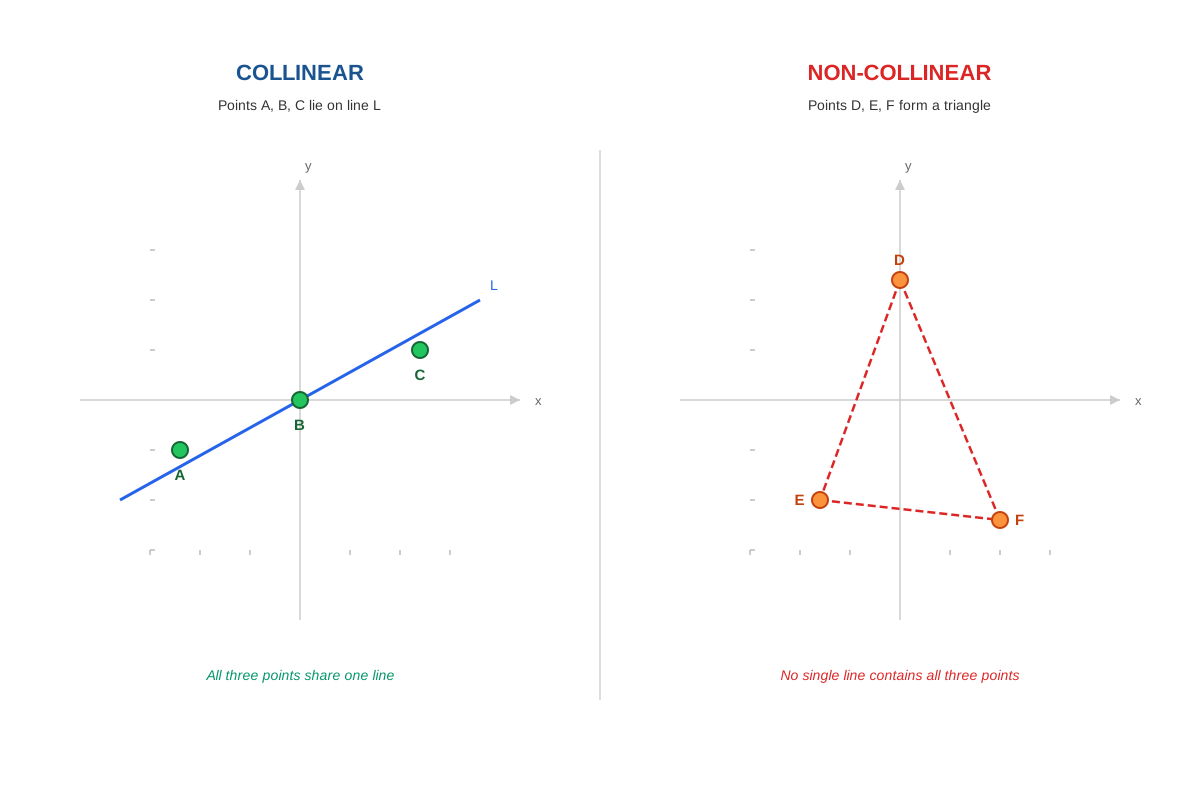
Collinearity refers to the property of three or more points lying on the same straight line. When points are collinear, they share a linear relationship that can be expressed through a single equation of the form y = mx + b. The fundamental principle underlying collinearity is that any two distinct points determine exactly one unique line; therefore, a third point is collinear with the first two if and only if it also lies on that same line. This concept extends to any number of points—four, five, or more points can all be collinear if they satisfy the equation of a single line.
The geometric interpretation of collinearity is straightforward: if you can draw one straight line through all the points without lifting your pencil or bending the line, those points are collinear. However, the ACT requires algebraic verification rather than visual estimation, making it essential to master computational methods for proving collinearity.
The Slope Method for Verifying Collinearity
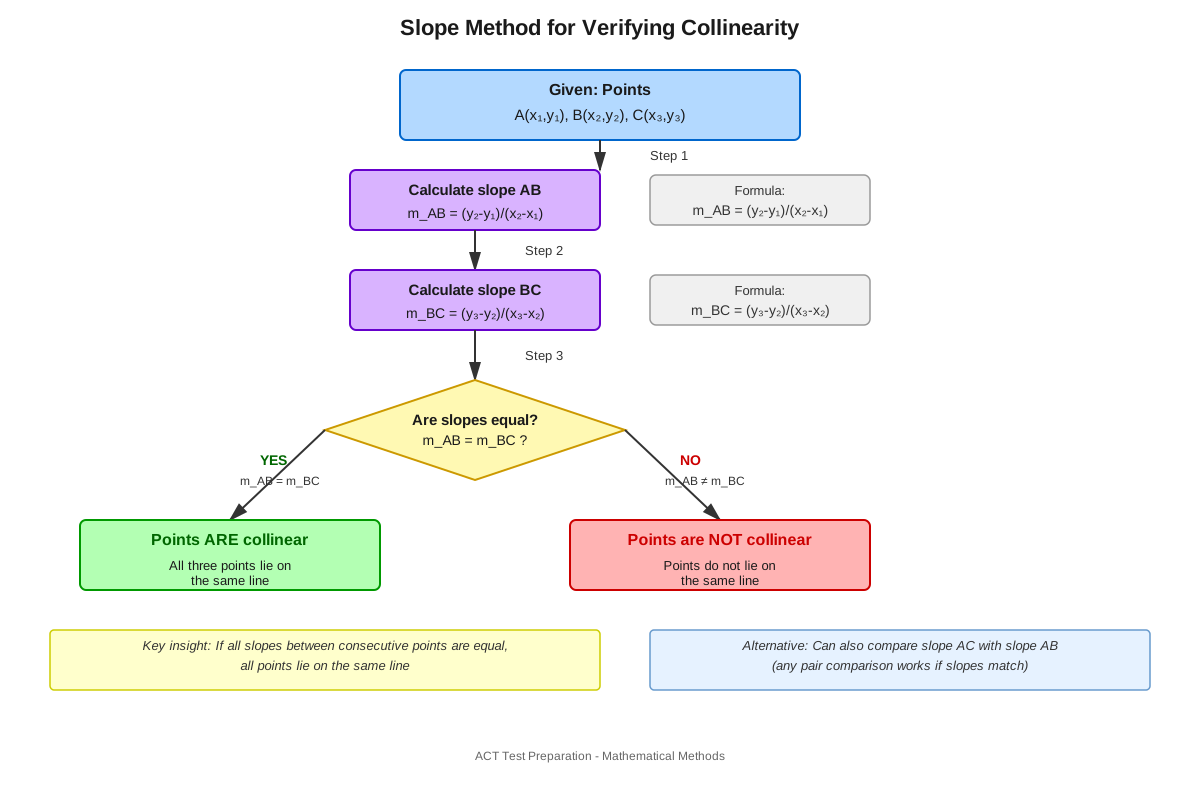
The most common and reliable method for determining collinearity involves calculating and comparing slopes. For three points A, B, and C to be collinear, the slope from A to B must equal the slope from B to C (and consequently, the slope from A to C). This method works because slope represents the rate of change between points, and points on the same line must have a constant rate of change.
The slope formula between two points (x₁, y₁) and (x₂, y₂) is:
m = (y₂ - y₁) / (x₂ - x₁)Step-by-step process for verifying collinearity using slopes:
- Label the three points as A(x₁, y₁), B(x₂, y₂), and C(x₃, y₃)
- Calculate the slope from A to B: m₁ = (y₂ - y₁)/(x₂ - x₁)
- Calculate the slope from B to C: m₂ = (y₃ - y₂)/(x₃ - x₂)
- Compare the slopes: if m₁ = m₂, the points are collinear
- Alternatively, calculate the slope from A to C and verify it matches both m₁ and m₂
This method is particularly powerful because it works regardless of the order in which points are arranged and handles both positive and negative slopes effectively. Students should be cautious with vertical lines (undefined slope) and horizontal lines (zero slope), as these special cases require careful attention.
The Area Method for Verifying Collinearity
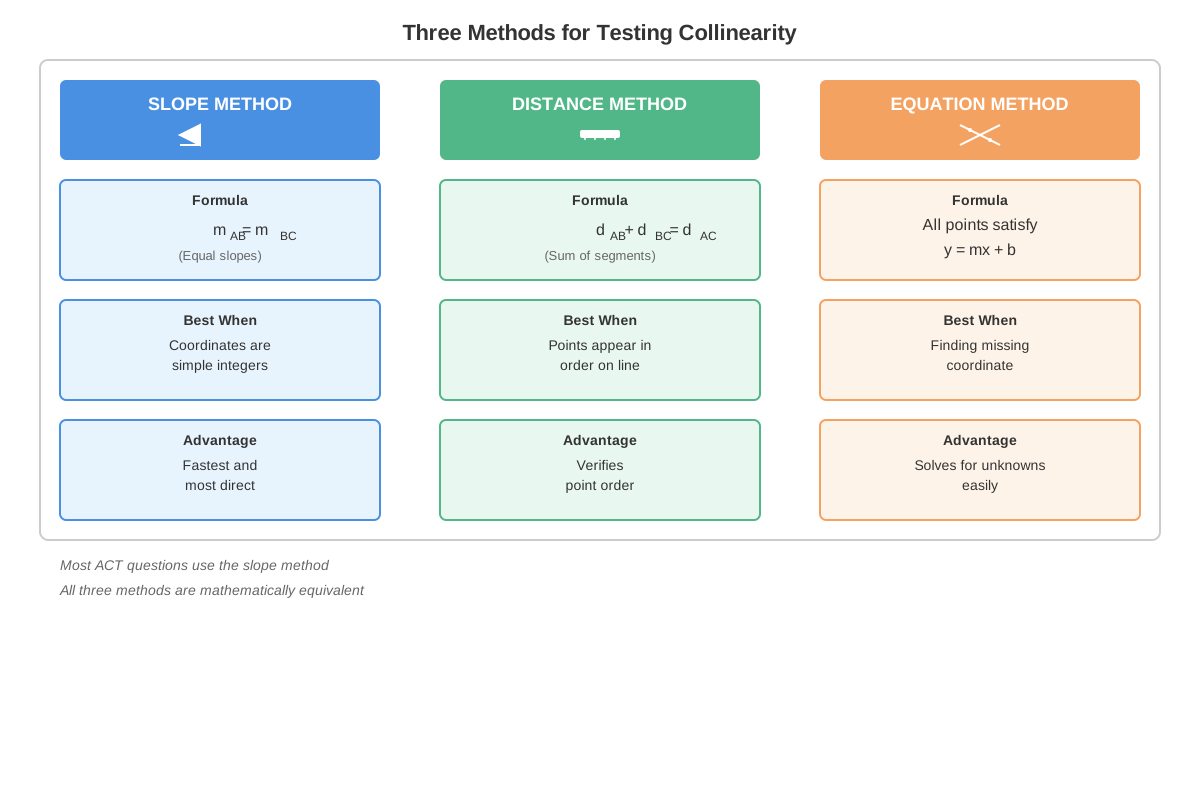
An alternative approach uses the principle that three collinear points form a triangle with zero area. If three points form a triangle with any positive area, they cannot be collinear. The formula for the area of a triangle given three vertices (x₁, y₁), (x₂, y₂), and (x₃, y₃) is:
Area = (1/2)|x₁(y₂ - y₃) + x₂(y₃ - y₁) + x₃(y₁ - y₂)|For collinear points, this area equals zero. While this method is mathematically elegant, it's generally less intuitive for ACT test-takers and more prone to calculation errors due to the multiple terms involved. However, it can be useful when dealing with problems that already involve area calculations or when the slope method becomes cumbersome.
Finding Missing Coordinates
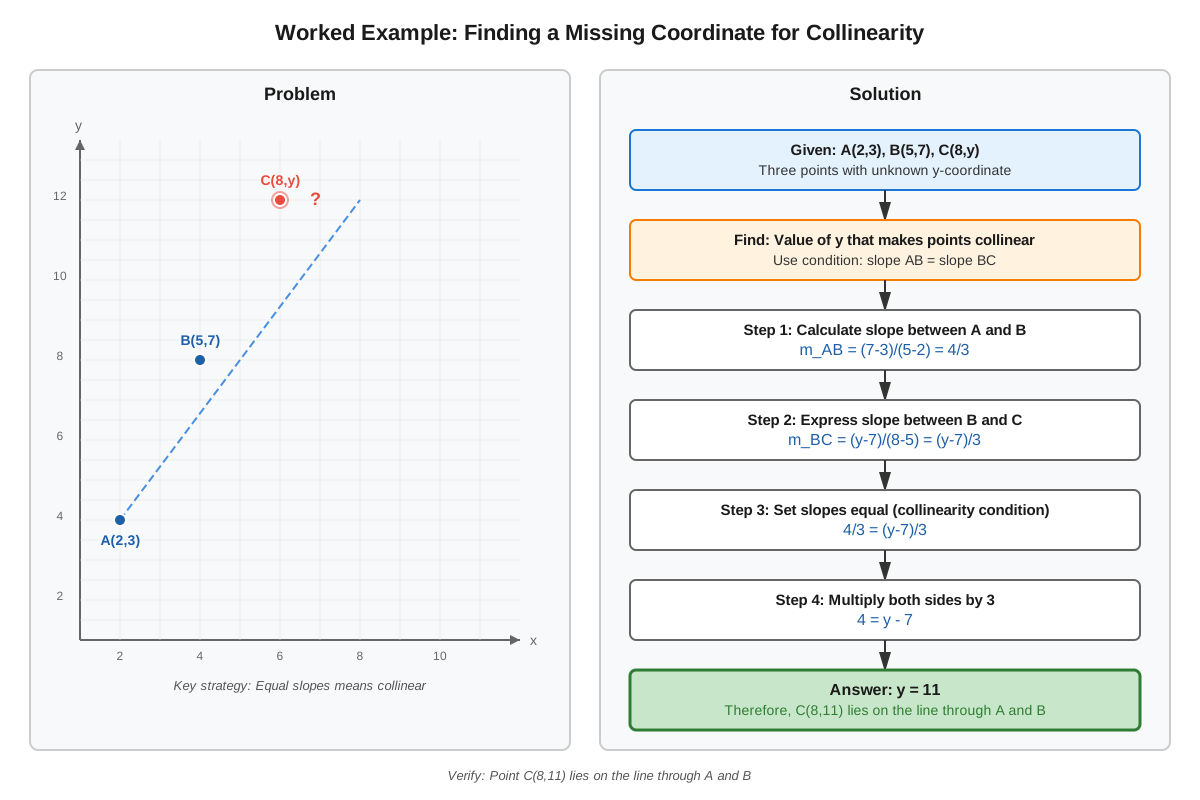
A common ACT question type provides two complete points and one point with a missing coordinate, asking students to find the value that makes all three points collinear. This problem type requires setting up an equation based on equal slopes.
Process for finding a missing coordinate:
- Identify which coordinate is missing (x or y)
- Set up the slope equation between the first two complete points
- Set up the slope equation between one complete point and the incomplete point
- Set these slopes equal to each other
- Solve the resulting equation for the missing variable
For example, if points (2, 3), (4, 7), and (6, y) are collinear, the slope from the first to second point is (7-3)/(4-2) = 4/2 = 2. The slope from the second to third point must also equal 2, so (y-7)/(6-4) = 2, which gives y-7 = 4, therefore y = 11.
Special Cases and Edge Conditions
Several special cases require particular attention when working with collinearity:
Vertical lines: When points share the same x-coordinate, they lie on a vertical line. The slope is undefined, but the points are still collinear. Check for this by verifying all x-coordinates are identical.
Horizontal lines: When points share the same y-coordinate, they lie on a horizontal line with slope zero. Verify by checking that all y-coordinates are identical.
Two identical points: If any two of the three points are the same, the slope calculation becomes 0/0, which is indeterminate. Technically, any third point would be "collinear" with two identical points, but such questions rarely appear on the ACT.
Order of operations: The order in which points are considered doesn't affect collinearity, but it does affect the sign and calculation of slopes. Consistency in applying the slope formula prevents errors.
Relationship to Linear Equations
Collinearity connects directly to linear equations because collinear points all satisfy the same linear equation. If three points are collinear, students can find the equation of the line passing through them by:
- Using any two points to calculate the slope
- Applying point-slope form: y - y₁ = m(x - x₁)
- Converting to slope-intercept form if needed
- Verifying the third point satisfies this equation
This relationship allows for an alternative verification method: find the equation of the line through two points, then substitute the third point's coordinates to verify the equation holds true.
Concept Relationships
The concepts within collinearity form a hierarchical structure where the fundamental definition leads to multiple verification methods. The definition of collinearity (points on the same line) → requires verification methods → which branch into slope comparison (most common), area calculation (alternative), and linear equation verification (algebraic). These three methods are mathematically equivalent but differ in computational efficiency and intuitive appeal.
Collinearity connects strongly to prerequisite topics: slope calculation serves as the foundation for the primary verification method, while linear equations provide the algebraic framework for understanding why collinear points share a relationship. The coordinate plane gives spatial context to the abstract algebraic relationships, and algebraic manipulation enables solving for missing coordinates.
Looking forward, collinearity connects to advanced topics including geometric proofs (where collinearity might need to be proven or assumed), vectors (where collinear points have proportional direction vectors), and parametric equations (where collinear points can be expressed with a single parameter). Understanding collinearity also enhances comprehension of parallel and perpendicular lines, as these concepts all involve comparing slopes and understanding linear relationships in the coordinate plane.
The relationship map flows as: Basic Graphing → Slope Calculation → Collinearity Verification → Complex Geometric Proofs and Optimization Problems. Each level builds upon the previous, with collinearity serving as a critical middle step that transforms basic coordinate skills into sophisticated problem-solving capabilities.
High-Yield Facts
⭐ Three or more points are collinear if and only if the slope between any two pairs of points is identical
⭐ The fastest method to verify collinearity on the ACT is to calculate and compare two slopes
⭐ If three points form a triangle with zero area, they must be collinear
⭐ To find a missing coordinate that makes points collinear, set up equal slope equations and solve
⭐ Points with identical x-coordinates are collinear on a vertical line (undefined slope)
- Points with identical y-coordinates are collinear on a horizontal line (slope = 0)
- The order in which you calculate slopes doesn't affect whether points are collinear
- Collinear points all satisfy the same linear equation y = mx + b
- You only need to verify two slope calculations to prove three points are collinear (not all three possible pairs)
- If the ACT asks "which point is NOT collinear with the others," calculate slopes to find the outlier
- Collinearity problems often combine with midpoint, distance, or geometric figure questions
- When slopes are equal but expressed as fractions, cross-multiply to verify equality quickly
- Negative slopes indicate collinear points on a line decreasing from left to right
Quick check — test yourself on Collinearity so far.
Try Flashcards →Common Misconceptions
Misconception: Points that look collinear on a graph are definitely collinear → Correction: Visual estimation is unreliable on the ACT; always verify collinearity algebraically using slope calculations or the area method. The ACT deliberately uses scales and point placements that can deceive the eye.
Misconception: You must calculate all three possible slopes (A to B, B to C, and A to C) to verify collinearity → Correction: Only two slope calculations are necessary. If the slope from A to B equals the slope from B to C, then the slope from A to C must also equal these values. Calculating all three wastes valuable test time.
Misconception: If two points have the same slope relative to the origin, they are collinear with the origin → Correction: This is only true if both points and the origin are being tested for collinearity. The slope from the origin to each point must be calculated separately and compared, not assumed.
Misconception: Collinear points must be evenly spaced along the line → Correction: Collinear points can be any distance apart. The spacing between points doesn't affect collinearity—only whether they lie on the same line matters. Points (0,0), (1,1), and (10,10) are collinear despite uneven spacing.
Misconception: When finding a missing coordinate, you can use any two points to set up the equation → Correction: While mathematically this works, strategically you should use the two complete points to calculate the known slope, then use this slope with one complete point and the incomplete point to find the missing value. This minimizes variables in your equation.
Misconception: A slope of 0/0 means the points are collinear → Correction: A slope calculation resulting in 0/0 indicates two identical points, which makes the slope undefined. This situation requires special handling and doesn't directly prove or disprove collinearity with a third point.
Misconception: Collinearity only applies to three points → Correction: Any number of points (three or more) can be collinear. For four or more points, verify that each consecutive pair maintains the same slope, or that all points satisfy the same linear equation.
Worked Examples
Example 1: Verifying Collinearity with Three Given Points
Problem: Determine whether the points A(2, 5), B(4, 9), and C(7, 15) are collinear.
Solution:
Step 1: Calculate the slope from A to B.
Using the slope formula m = (y₂ - y₁)/(x₂ - x₁):
m₁ = (9 - 5)/(4 - 2) = 4/2 = 2
Step 2: Calculate the slope from B to C.
m₂ = (15 - 9)/(7 - 4) = 6/3 = 2
Step 3: Compare the slopes.
Since m₁ = m₂ = 2, the points are collinear.
Verification: We can double-check by calculating the slope from A to C:
m₃ = (15 - 5)/(7 - 2) = 10/5 = 2 ✓
Connection to Learning Objectives: This example demonstrates the core strategy for identifying and applying collinearity—calculating slopes and comparing them. The consistent slope of 2 proves all three points lie on the same line with equation y = 2x + 1.
Example 2: Finding a Missing Coordinate
Problem: Points P(1, 3), Q(4, 9), and R(6, k) are collinear. Find the value of k.
Solution:
Step 1: Calculate the slope from P to Q (this is our known slope).
m = (9 - 3)/(4 - 1) = 6/3 = 2
Step 2: Set up the slope equation from Q to R using the unknown k.
The slope from Q to R must also equal 2:
(k - 9)/(6 - 4) = 2
Step 3: Solve for k.
(k - 9)/2 = 2
k - 9 = 4
k = 13
Step 4: Verify the answer.
Check the slope from P to R: (13 - 3)/(6 - 1) = 10/5 = 2 ✓
Alternative Method: We could also find the equation of the line through P and Q:
Using point-slope form with point P(1, 3) and slope 2:
y - 3 = 2(x - 1)
y = 2x + 1
Substitute x = 6 (from point R):
y = 2(6) + 1 = 13
Therefore k = 13.
Connection to Learning Objectives: This example shows how to apply collinearity to find missing coordinates, a common ACT question type. The problem requires understanding that collinear points share the same slope and demonstrates two valid solution methods.
Example 3: Multi-Step Problem with Collinearity
Problem: In the coordinate plane, points A(0, 2), B(3, 8), and C lie on the same line. If the x-coordinate of C is 5, and point D has coordinates (5, 14), is point D collinear with A, B, and C?
Solution:
Step 1: Find the y-coordinate of point C.
First, find the slope of line AB:
m = (8 - 2)/(3 - 0) = 6/3 = 2
Since C is collinear with A and B, and C has x-coordinate 5:
Using the slope from B to C:
(y - 8)/(5 - 3) = 2
(y - 8)/2 = 2
y - 8 = 4
y = 12
So C is at (5, 12).
Step 2: Check if D(5, 14) is collinear with A, B, and C.
Since C and D both have x-coordinate 5, they lie on a vertical line x = 5.
However, A and B do not have x-coordinate 5, so A, B, C, and D cannot all be collinear.
Alternatively, check the slope from C to D:
m = (14 - 12)/(5 - 5) = 2/0 = undefined
This undefined slope indicates a vertical line, which contradicts the slope of 2 for line ABC.
Answer: No, point D is not collinear with A, B, and C.
Connection to Learning Objectives: This multi-step problem combines finding missing coordinates with verifying collinearity, demonstrating how ACT questions layer multiple concepts. It also highlights the importance of recognizing special cases like vertical lines.
Exam Strategy
When approaching ACT collinearity questions, begin by identifying the question type: verification (are these points collinear?), coordinate-finding (what value makes these points collinear?), or application (using collinearity within a larger problem). This identification determines your solution strategy and helps allocate time appropriately.
Trigger words and phrases that signal collinearity questions include: "lie on the same line," "are collinear," "points on line L," "what value of x/y makes the points collinear," and "which point is NOT on the line." When you see these phrases, immediately think "slope comparison" and prepare to calculate slopes between point pairs.
Process-of-elimination strategies work particularly well for collinearity questions with multiple-choice answers:
- For verification questions, calculate one slope and eliminate any answer choice that would require a different slope
- For coordinate-finding questions, test each answer choice by calculating slopes—the correct answer will produce equal slopes
- For "which is NOT collinear" questions, calculate slopes between the first two points and each subsequent point, eliminating matches until you find the outlier
Time allocation for collinearity questions should typically be 45-90 seconds, depending on complexity. Simple verification questions (are three given points collinear?) should take 45-60 seconds: 20 seconds for the first slope, 20 seconds for the second slope, and 5-10 seconds for comparison. Coordinate-finding questions require 60-90 seconds: 30 seconds to set up the equation, 30 seconds to solve, and 15-30 seconds to verify. If a problem takes longer than 90 seconds, mark it for review and move on—you may be missing a shortcut or making an error.
Strategic shortcuts include:
- When all answer choices for a missing coordinate are integers, test them directly rather than solving algebraically
- If two points share an x-coordinate or y-coordinate, immediately check for vertical or horizontal lines
- For three points with obvious patterns (like consecutive integers), look for arithmetic sequences in the coordinates
- When slopes involve fractions, leave them as fractions rather than converting to decimals to avoid rounding errors
Common traps to avoid include: assuming visual collinearity without calculation, forgetting to check your arithmetic when slopes don't match, and confusing the order of coordinates in the slope formula. Always write out the slope formula explicitly for at least the first calculation to avoid sign errors.
Memory Techniques
Mnemonic for the slope method: "Same Line, Same Slope" (SLSS) reminds students that collinear points must have identical slopes between any pair.
Visualization strategy: Picture three dots on a ruler. If you can lay a straight ruler through all three dots without any dot falling off the edge, they're collinear. This mental image helps reinforce the geometric meaning while solving algebraically.
Acronym for the verification process: "CALC"
- Choose two points
- Apply slope formula
- Look at the next pair
- Compare the slopes
Memory aid for special cases: "Horizontal Zero, Vertical Undefined" (HZVU) helps remember that horizontal lines have zero slope and vertical lines have undefined slope.
Rhyme for finding missing coordinates: "Set the slopes the same, solve the equation game" reminds students that equal slopes lead to an equation they can solve.
Finger technique: Use three fingers to represent three points. If you can align all three fingertips along a straight edge (like a pencil), they're collinear. This physical reinforcement helps kinesthetic learners internalize the concept.
Summary
Collinearity is a fundamental coordinate geometry concept that tests whether three or more points lie on the same straight line. The most efficient method for verifying collinearity on the ACT involves calculating slopes between pairs of points and confirming they are equal—if the slope from point A to B equals the slope from B to C, all three points are collinear. This concept appears regularly on the ACT in various forms: direct verification questions, problems requiring students to find missing coordinates that would make points collinear, and multi-step problems where collinearity is embedded within larger geometric scenarios. Students must master both the computational technique (slope formula application) and the conceptual understanding (points on the same line share a constant rate of change). Special cases including vertical lines (undefined slope) and horizontal lines (zero slope) require particular attention. The ability to quickly identify collinearity questions, apply the appropriate solution method, and verify answers makes this a high-yield topic for ACT preparation. Success with collinearity questions demonstrates mastery of coordinate geometry fundamentals and provides a foundation for more advanced geometric reasoning.
Key Takeaways
- Collinearity means three or more points lie on the same straight line, verified by comparing slopes between point pairs
- The slope method is the fastest and most reliable: calculate slope from A to B and from B to C; if equal, points are collinear
- To find a missing coordinate, set up equal slope equations using the known points and solve for the unknown variable
- Special cases require attention: vertical lines have undefined slope (same x-coordinates), horizontal lines have zero slope (same y-coordinates)
- Collinearity questions appear 1-2 times per ACT and often combine with other coordinate geometry concepts
- Always verify collinearity algebraically rather than relying on visual estimation—the ACT deliberately creates misleading graphs
- Time management is crucial: allocate 45-90 seconds per collinearity question and use answer-testing strategies when appropriate
Related Topics
Slope and Linear Equations: Mastering collinearity deepens understanding of how slope represents constant rate of change and how multiple points can satisfy the same linear equation. This connection enables students to move fluidly between geometric and algebraic representations.
Parallel and Perpendicular Lines: Collinearity extends naturally to understanding parallel lines (same slope, never intersect) and perpendicular lines (slopes are negative reciprocals). These concepts share the fundamental tool of slope comparison.
Midpoint and Distance Formulas: These coordinate geometry tools often appear alongside collinearity in complex problems. Understanding how to find midpoints and distances between collinear points enhances problem-solving flexibility.
Geometric Proofs in Coordinate Plane: Advanced applications of collinearity include proving geometric properties algebraically, such as showing that the medians of a triangle intersect at a single point or that certain quadrilaterals have collinear diagonals.
Vectors and Parametric Equations: In more advanced mathematics, collinearity connects to vector concepts where collinear points have proportional direction vectors, providing an alternative framework for understanding linear relationships.
Practice CTA
Now that you've mastered the core concepts of collinearity, it's time to reinforce your understanding through active practice. Attempt the practice questions designed specifically for this topic—they mirror actual ACT question formats and difficulty levels. Work through each problem systematically, applying the slope comparison method and checking your answers carefully. Use the flashcards to drill the high-yield facts and special cases until they become automatic. Remember, collinearity questions are highly predictable once you recognize the patterns, and consistent practice transforms this medium-difficulty topic into a reliable source of points on test day. Your investment in mastering collinearity will pay dividends not only on direct collinearity questions but also on the many multi-step problems where this concept appears as a critical component. You've got this!
Sign up free to keep reading
Create a free AnvayaPrep account to finish this ACT guide on Collinearity — plus flashcards and practice questions.