Overview
The midpoint formula is one of the most frequently tested concepts in coordinate geometry on the ACT Math section. This formula allows students to find the exact center point between any two points on a coordinate plane, and it appears in approximately 1-2 questions per ACT exam. Understanding this concept is essential not only for direct midpoint questions but also for more complex problems involving line segments, geometric figures, and distance calculations that require finding intermediate points.
The midpoint formula represents a fundamental bridge between algebraic thinking and geometric visualization. When working with coordinate geometry, students must often determine the location of a point that divides a line segment into two equal parts. This skill extends beyond simple calculation—it requires spatial reasoning and the ability to translate between numerical coordinates and visual representations. The ACT midpoint formula questions often combine multiple concepts, such as requiring students to find a midpoint and then use that point in subsequent calculations involving distance, slope, or area.
Mastery of the midpoint formula connects directly to broader mathematical concepts including symmetry, bisectors, and the properties of geometric figures. On the ACT, this topic frequently appears alongside questions about distance formula, slope, and equation of a line. Students who thoroughly understand the midpoint formula gain a significant advantage in tackling multi-step coordinate geometry problems, which are among the higher-difficulty questions that separate top scorers from average performers.
Learning Objectives
- [ ] Identify when Midpoint formula is being tested
- [ ] Explain the core rule or strategy behind Midpoint formula
- [ ] Apply Midpoint formula to ACT-style questions accurately
- [ ] Derive the midpoint formula from the concept of averaging coordinates
- [ ] Solve reverse midpoint problems where one endpoint and the midpoint are given
- [ ] Integrate midpoint calculations with other coordinate geometry concepts such as distance and slope
- [ ] Recognize and solve multi-step problems that require finding midpoints of multiple segments
Prerequisites
- Coordinate plane basics: Understanding x and y coordinates is essential because the midpoint formula operates on ordered pairs in the Cartesian coordinate system
- Basic arithmetic operations: The ability to add, subtract, multiply, and divide is necessary for calculating the average of coordinates
- Fraction and decimal manipulation: Midpoint coordinates often result in non-integer values that require comfort with fractions or decimals
- Algebraic equation solving: Some midpoint problems require setting up and solving equations when working backward from a known midpoint
- Ordered pair notation: Familiarity with (x, y) notation ensures proper organization of coordinate information
Why This Topic Matters
The midpoint formula has practical applications far beyond standardized testing. Engineers use midpoint calculations when designing structures that require symmetry or when finding center points for load distribution. Computer graphics programmers rely on midpoint algorithms to render smooth curves and determine collision points. Urban planners use midpoint concepts to identify optimal locations for public facilities that serve multiple communities. Architects apply midpoint principles when creating balanced, symmetrical designs.
On the ACT Math section, midpoint questions appear with high frequency—typically 1-2 questions per exam, representing approximately 2-3% of the total Math section. These questions range from straightforward applications of the formula to complex multi-step problems. The ACT tests midpoint concepts in several ways: direct calculation of a midpoint given two endpoints, finding an unknown endpoint when given one endpoint and the midpoint, determining whether a point is the midpoint of a segment, and incorporating midpoint calculations into larger geometry problems involving triangles, rectangles, or other polygons.
Common question formats include: coordinate geometry problems where students must find the center of a line segment, word problems describing real-world scenarios that require finding a middle point, questions about geometric figures where the midpoint helps determine properties like area or perimeter, and multi-step problems where the midpoint serves as an intermediate calculation. The ACT particularly favors questions that combine the midpoint formula with other concepts, testing whether students can integrate multiple skills within a single problem.
Core Concepts
The Midpoint Formula Definition
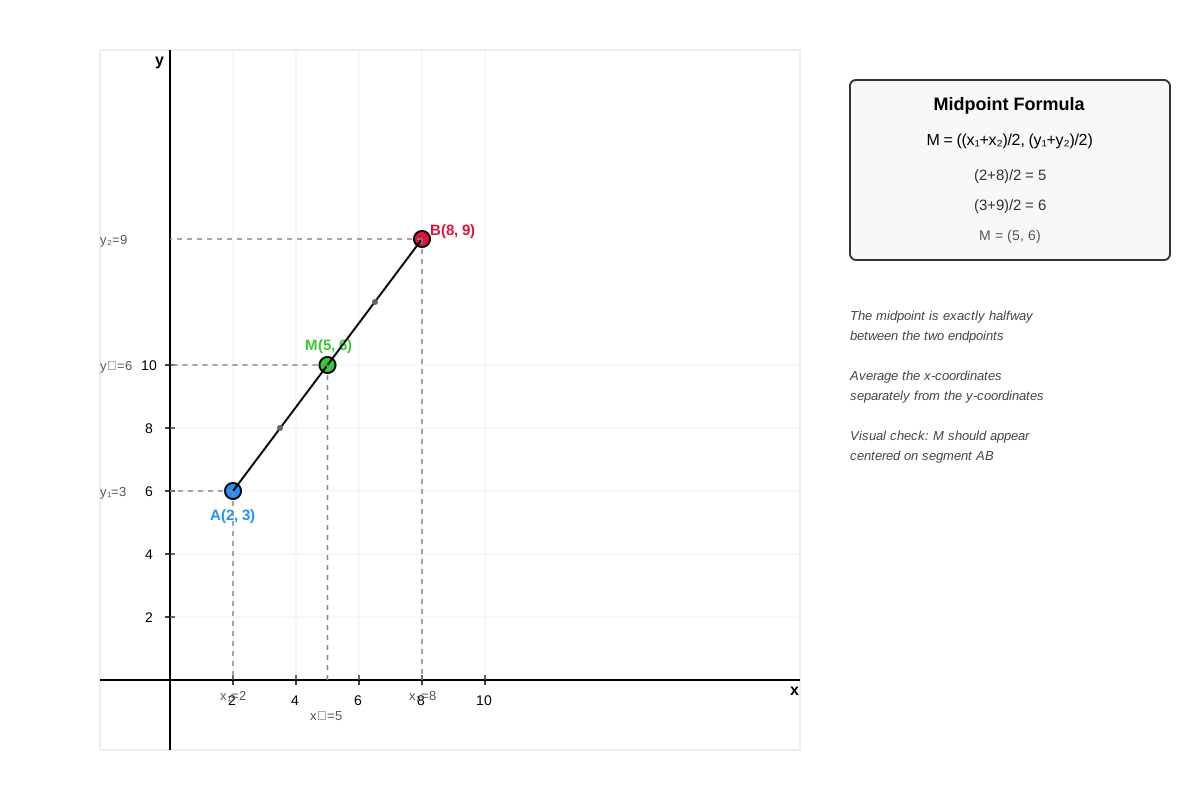
The midpoint formula provides a method for finding the point that lies exactly halfway between two given points on a coordinate plane. Given two points with coordinates (x₁, y₁) and (x₂, y₂), the midpoint M has coordinates:
M = ((x₁ + x₂)/2, (y₁ + y₂)/2)This formula essentially calculates the average of the x-coordinates and the average of the y-coordinates separately. The resulting point represents the geometric center of the line segment connecting the two original points. The midpoint divides the segment into two congruent parts, meaning each half has exactly the same length.
Conceptual Understanding: Why Averaging Works
The midpoint formula works because of the fundamental principle that the center point between two values is their average. Consider a one-dimensional number line: the midpoint between 2 and 8 is 5, which equals (2 + 8)/2. This same logic extends to two dimensions by treating the x-coordinates and y-coordinates independently. The x-coordinate of the midpoint is the average of the two x-coordinates, and the y-coordinate of the midpoint is the average of the two y-coordinates.
This averaging principle reflects the symmetric nature of midpoints. If you travel from point A to the midpoint M, you cover exactly the same distance as traveling from M to point B. The midpoint represents perfect balance—it's equidistant from both endpoints in every direction.
Step-by-Step Application Process
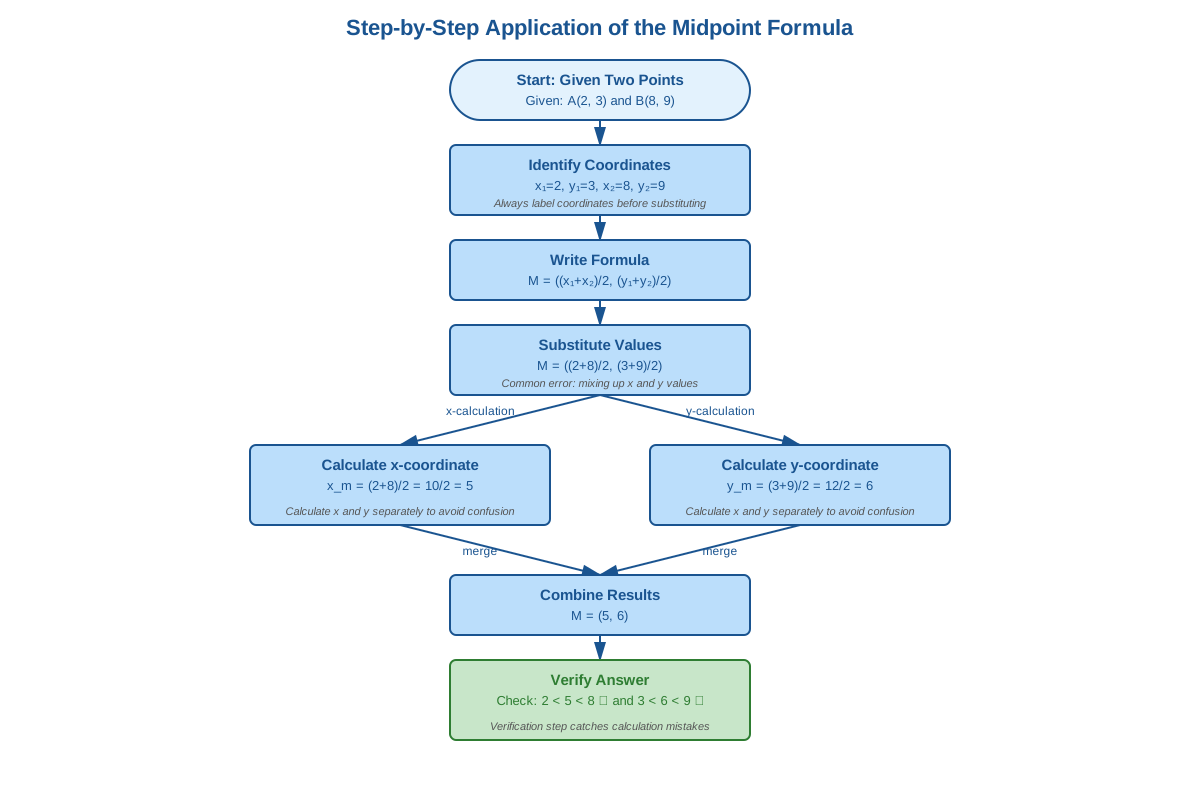
To apply the midpoint formula systematically:
- Identify and label the two endpoints: Clearly designate which point is (x₁, y₁) and which is (x₂, y₂). Note that the order doesn't matter—you'll get the same midpoint either way.
- Calculate the x-coordinate of the midpoint: Add the two x-coordinates together and divide by 2: (x₁ + x₂)/2
- Calculate the y-coordinate of the midpoint: Add the two y-coordinates together and divide by 2: (y₁ + y₂)/2
- Write the midpoint as an ordered pair: Combine your results as M = (x-coordinate, y-coordinate)
- Verify your answer: Check that your midpoint makes intuitive sense by ensuring it falls between the original points
Working with Different Coordinate Types
The midpoint formula works identically regardless of whether coordinates are positive, negative, integers, fractions, or decimals. However, different coordinate types require careful attention to arithmetic:
| Coordinate Type | Example Points | Midpoint Calculation | Result |
|---|---|---|---|
| Positive integers | (2, 4) and (8, 10) | ((2+8)/2, (4+10)/2) | (5, 7) |
| Negative integers | (-3, -5) and (-7, -1) | ((-3-7)/2, (-5-1)/2) | (-5, -3) |
| Mixed signs | (-4, 6) and (8, -2) | ((-4+8)/2, (6-2)/2) | (2, 2) |
| Fractions | (1/2, 3/4) and (5/2, 7/4) | ((1/2+5/2)/2, (3/4+7/4)/2) | (3/2, 5/4) |
| Decimals | (2.5, 3.7) and (4.1, 5.3) | ((2.5+4.1)/2, (3.7+5.3)/2) | (3.3, 4.5) |
Reverse Midpoint Problems
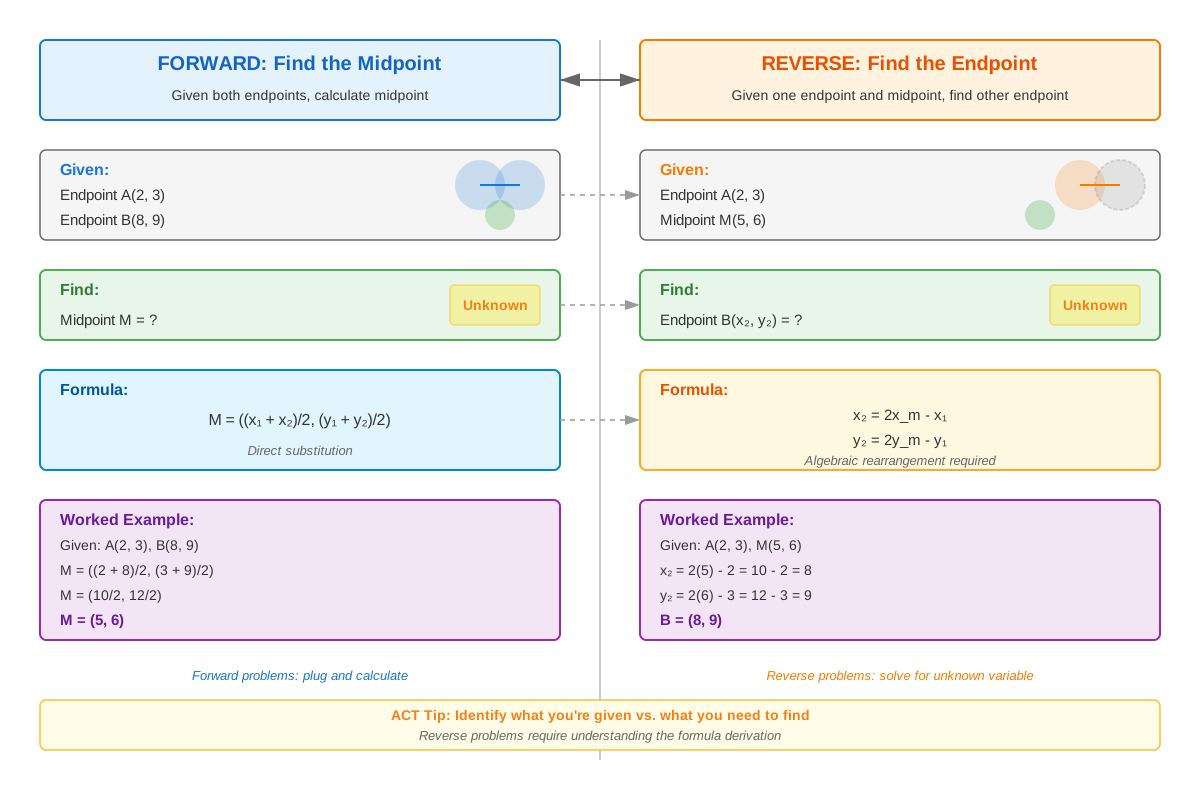
A more challenging application involves finding an unknown endpoint when given one endpoint and the midpoint. This requires algebraic manipulation of the midpoint formula. If you know point A = (x₁, y₁) and midpoint M = (xₘ, yₘ), and need to find point B = (x₂, y₂):
From the midpoint formula: xₘ = (x₁ + x₂)/2
Solving for x₂: 2xₘ = x₁ + x₂, therefore x₂ = 2xₘ - x₁
Similarly: y₂ = 2yₘ - y₁
This reverse calculation essentially says: to find the unknown endpoint, double the midpoint coordinate and subtract the known endpoint coordinate.
Multiple Midpoints and Segment Division
Some ACT problems involve finding multiple midpoints or determining points that divide segments into more than two parts. When finding the midpoint of a midpoint, apply the formula twice. For example, to find the point one-quarter of the way from A to B, first find the midpoint M between A and B, then find the midpoint between A and M.
Understanding that the midpoint formula divides a segment into two equal parts helps solve problems about trisection (dividing into thirds) or other divisions, though these require modified approaches beyond the basic midpoint formula.
Concept Relationships
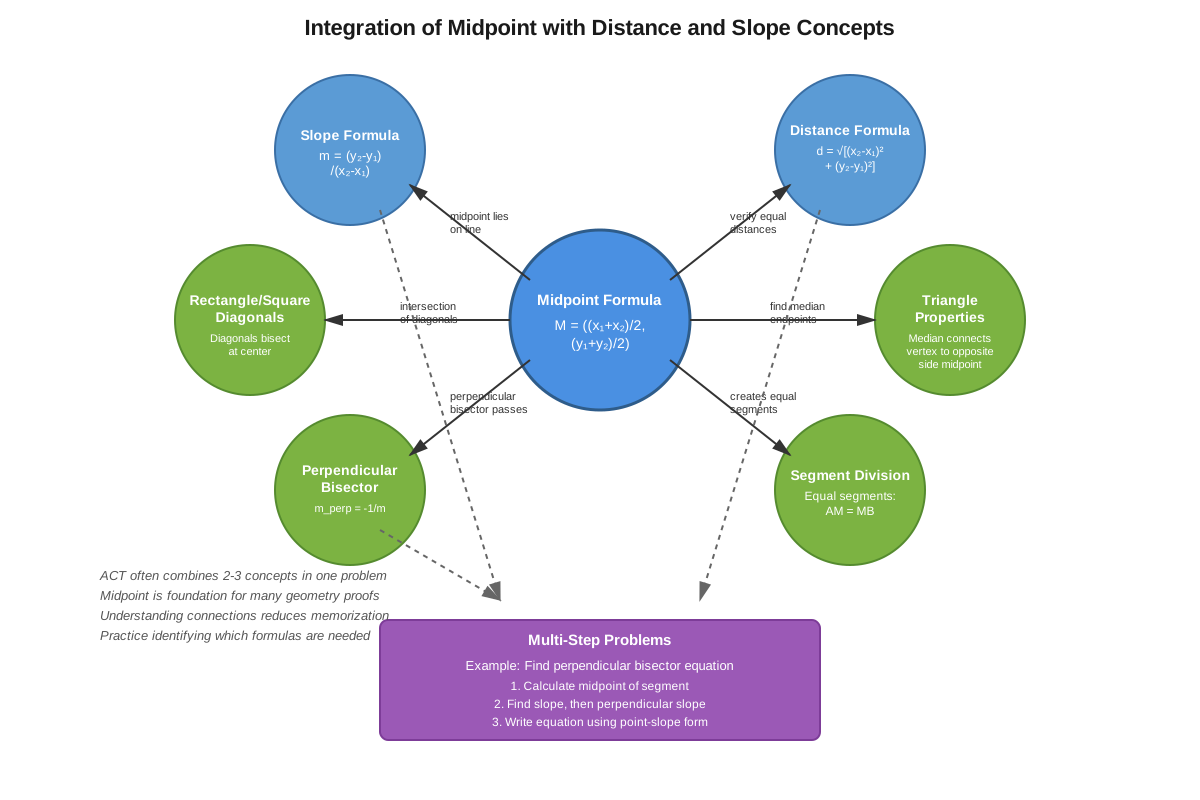
The midpoint formula connects intimately with several other coordinate geometry concepts. The distance formula and midpoint formula often appear together in problems: students might need to find the midpoint of a segment and then calculate the distance from that midpoint to another point. Both formulas work with the same coordinate pairs, making them natural companions in multi-step problems.
The relationship flows as: Coordinate points → Midpoint formula → Midpoint location → Distance formula → Length calculations. Additionally, the midpoint concept connects to slope calculations because the slope of a line segment remains constant, so the slope from one endpoint to the midpoint equals the slope from the midpoint to the other endpoint.
Within the broader context of coordinate geometry, the midpoint formula supports understanding of geometric figures. Finding the midpoint of a diagonal in a rectangle or parallelogram helps determine the center of the figure. The midpoint of the hypotenuse of a right triangle has special properties related to the circumcenter. These connections demonstrate how the midpoint formula serves as a building block for more complex geometric analysis.
The concept also relates to symmetry and transformations. The midpoint represents a point of symmetry between two endpoints. Understanding midpoints helps visualize reflections and rotations in the coordinate plane. When a figure is reflected across a line, corresponding points on the original and reflected figures have their midpoint on the line of reflection.
High-Yield Facts
⭐ The midpoint formula is M = ((x₁ + x₂)/2, (y₁ + y₂)/2), where (x₁, y₁) and (x₂, y₂) are the endpoints
⭐ The midpoint formula calculates the average of x-coordinates and the average of y-coordinates separately
⭐ The order of the two points doesn't matter—you'll get the same midpoint regardless of which point you call point 1 or point 2
⭐ To find an unknown endpoint given one endpoint and the midpoint, use: x₂ = 2xₘ - x₁ and y₂ = 2yₘ - y₁
⭐ The midpoint divides a line segment into two segments of equal length
- The midpoint always lies on the line segment between the two endpoints, never outside it
- When both coordinates of the endpoints are integers, the midpoint coordinates may be fractions or decimals
- The midpoint of a diagonal of a rectangle or parallelogram is the center of that figure
- If three points are collinear (on the same line) and one is the midpoint of the other two, the distances from the midpoint to each endpoint are equal
- The midpoint formula works in any quadrant of the coordinate plane and with any combination of positive and negative coordinates
- Finding the midpoint of multiple segments in a polygon can help determine centers of symmetry or balance points
Quick check — test yourself on Midpoint formula so far.
Try Flashcards →Common Misconceptions
Misconception: Students add the coordinates incorrectly, calculating (x₁ + y₁)/2 and (x₂ + y₂)/2 instead of keeping x's with x's and y's with y's → Correction: The midpoint formula requires adding the two x-coordinates together and dividing by 2, then separately adding the two y-coordinates together and dividing by 2. Never mix x and y coordinates in the same calculation.
Misconception: Students forget to divide by 2, simply adding the coordinates and writing M = (x₁ + x₂, y₁ + y₂) → Correction: The midpoint is the average of the coordinates, not just their sum. Always divide by 2 after adding each pair of coordinates. The sum alone gives a point much farther from the origin than the actual midpoint.
Misconception: When working with negative numbers, students make sign errors, treating -3 + (-7) as -3 + 7 → Correction: When adding two negative numbers, the result is more negative: -3 + (-7) = -10, not 4. Pay careful attention to signs, especially when both coordinates are negative or when mixing positive and negative values.
Misconception: Students believe the midpoint must have integer coordinates if the endpoints have integer coordinates → Correction: The midpoint can have fractional or decimal coordinates even when both endpoints have integer coordinates. For example, the midpoint of (1, 3) and (4, 6) is (2.5, 4.5).
Misconception: When finding an unknown endpoint, students incorrectly use the formula x₂ = xₘ - x₁ instead of x₂ = 2xₘ - x₁ → Correction: To reverse the midpoint formula, remember that the midpoint equals the average, so xₘ = (x₁ + x₂)/2. Multiplying both sides by 2 gives 2xₘ = x₁ + x₂, then subtracting x₁ from both sides yields x₂ = 2xₘ - x₁. You must double the midpoint coordinate before subtracting.
Misconception: Students think the midpoint formula only works for horizontal or vertical line segments → Correction: The midpoint formula works for any line segment in any direction on the coordinate plane. The segment can be diagonal, horizontal, vertical, or at any angle—the formula applies universally.
Worked Examples
Example 1: Direct Midpoint Calculation
Problem: Find the midpoint of the line segment with endpoints A(3, 7) and B(11, -5).
Solution:
Step 1: Identify the coordinates of both endpoints.
- Point A: (x₁, y₁) = (3, 7)
- Point B: (x₂, y₂) = (11, -5)
Step 2: Apply the midpoint formula for the x-coordinate.
- x-coordinate of midpoint = (x₁ + x₂)/2
- x-coordinate = (3 + 11)/2 = 14/2 = 7
Step 3: Apply the midpoint formula for the y-coordinate.
- y-coordinate of midpoint = (y₁ + y₂)/2
- y-coordinate = (7 + (-5))/2 = 2/2 = 1
Step 4: Write the midpoint as an ordered pair.
- M = (7, 1)
Step 5: Verify the answer makes sense.
- The x-coordinate 7 is between 3 and 11 ✓
- The y-coordinate 1 is between 7 and -5 ✓
Answer: The midpoint is (7, 1).
This example demonstrates the direct application of the midpoint formula and addresses the learning objective of applying the formula to ACT-style questions accurately. Notice how careful attention to the negative sign in the y-coordinate of point B ensures the correct calculation.
Example 2: Reverse Midpoint Problem
Problem: Point M(4, 9) is the midpoint of segment PQ. If point P has coordinates (-2, 5), what are the coordinates of point Q?
Solution:
Step 1: Identify what is known and what needs to be found.
- Known: P = (x₁, y₁) = (-2, 5) and M = (xₘ, yₘ) = (4, 9)
- Unknown: Q = (x₂, y₂) = (?, ?)
Step 2: Use the reverse midpoint formula for the x-coordinate.
- From xₘ = (x₁ + x₂)/2, we derive x₂ = 2xₘ - x₁
- x₂ = 2(4) - (-2)
- x₂ = 8 - (-2)
- x₂ = 8 + 2 = 10
Step 3: Use the reverse midpoint formula for the y-coordinate.
- From yₘ = (y₁ + y₂)/2, we derive y₂ = 2yₘ - y₁
- y₂ = 2(9) - 5
- y₂ = 18 - 5 = 13
Step 4: Write point Q as an ordered pair.
- Q = (10, 13)
Step 5: Verify by checking that M is indeed the midpoint of P and Q.
- x-coordinate check: (-2 + 10)/2 = 8/2 = 4 ✓
- y-coordinate check: (5 + 13)/2 = 18/2 = 9 ✓
Answer: Point Q has coordinates (10, 13).
This example illustrates a more challenging application that frequently appears on the ACT. It requires algebraic manipulation and demonstrates the learning objective of solving reverse midpoint problems. The verification step is crucial for catching calculation errors.
Exam Strategy
When approaching ACT midpoint formula questions, begin by identifying the question type. Look for trigger phrases such as "midpoint," "halfway between," "center of the segment," "divides the segment equally," or "equidistant from both endpoints." These phrases signal that the midpoint formula is required.
Exam Tip: Always write down the midpoint formula at the top of your scratch work before beginning calculations. This prevents formula confusion and ensures accuracy under time pressure.
For direct midpoint problems, use this systematic approach:
- Circle or underline the coordinates of both endpoints in the problem
- Label them clearly as (x₁, y₁) and (x₂, y₂)
- Calculate the x-coordinate of the midpoint first, showing your work
- Calculate the y-coordinate of the midpoint second, showing your work
- Write your answer as an ordered pair and check that it appears among the answer choices
For reverse midpoint problems where you need to find an unknown endpoint:
- Identify which point is the midpoint and which is the known endpoint
- Write the reverse formula: x₂ = 2xₘ - x₁ and y₂ = 2yₘ - y₁
- Substitute carefully, paying attention to negative signs
- Calculate each coordinate separately
- Verify your answer by checking that the given point is indeed the midpoint
Process of elimination strategies specific to midpoint questions:
- Eliminate any answer choice where the coordinates don't fall between the endpoints (for direct midpoint problems)
- Eliminate answers with obvious arithmetic errors (if endpoints are (2, 4) and (8, 10), the midpoint x-coordinate must be between 2 and 8)
- Check whether the answer choices are integers or fractions—this can guide your calculation expectations
- For reverse problems, eliminate any answer that would place the midpoint outside the segment
Time allocation: Straightforward midpoint problems should take 30-45 seconds. Multi-step problems involving midpoint plus another concept (distance, slope, area) may require 60-90 seconds. If a problem is taking longer than 90 seconds, mark it and return later.
Watch for combination questions that require multiple steps. The ACT often asks students to find a midpoint and then use that midpoint in a subsequent calculation. Read the entire question before beginning to ensure you understand what the final answer should be—don't stop after finding the midpoint if the question asks for something else.
Memory Techniques
Mnemonic for the formula: "Midpoint Means Mean" (average)—The midpoint is found by taking the mean (average) of the coordinates.
Acronym for the process: AADW - Add the x's, Add the y's, Divide both by 2, Write as ordered pair.
Visualization strategy: Picture a seesaw or balance beam. The midpoint is where you'd place the fulcrum to achieve perfect balance. Just as the fulcrum must be centered between two people of equal weight, the midpoint must be centered between the two endpoints.
Finger technique: Hold up two fingers to represent the two endpoints. The space between them represents the segment. Your midpoint is exactly in the middle of that space—not closer to either finger.
Reverse formula memory: "Double the Middle, Subtract the Side"—To find an unknown endpoint, double the midpoint coordinate and subtract the known endpoint coordinate. This phrase captures the formula x₂ = 2xₘ - x₁.
Coordinate organization: Use the phrase "X's with X's, Y's with Y's" to remember never to mix x and y coordinates in your calculations. Keep them in separate channels.
Summary
The midpoint formula is an essential coordinate geometry tool that finds the exact center point between two given points by averaging their x-coordinates and y-coordinates separately. The formula M = ((x₁ + x₂)/2, (y₁ + y₂)/2) appears frequently on the ACT Math section, both as direct applications and as components of multi-step problems. Mastery requires understanding not only the mechanical application of the formula but also the conceptual foundation of why averaging coordinates produces the geometric center. Students must be proficient in both forward applications (finding a midpoint given two endpoints) and reverse applications (finding an unknown endpoint given one endpoint and the midpoint). Success on ACT midpoint questions demands careful attention to arithmetic details, especially when working with negative numbers, fractions, or decimals. The midpoint formula connects to broader coordinate geometry concepts including distance, slope, and properties of geometric figures, making it a foundational skill for achieving high scores on the ACT Math section.
Key Takeaways
- The midpoint formula M = ((x₁ + x₂)/2, (y₁ + y₂)/2) calculates the average of x-coordinates and y-coordinates separately to find the center point of a line segment
- Always keep x-coordinates with x-coordinates and y-coordinates with y-coordinates—never mix them in calculations
- The midpoint always falls between the two endpoints; if your answer doesn't, recheck your arithmetic
- For reverse problems where you need to find an unknown endpoint, use x₂ = 2xₘ - x₁ and y₂ = 2yₘ - y₁
- Pay careful attention to negative signs when adding coordinates, especially when both coordinates are negative or when mixing positive and negative values
- The midpoint can have fractional or decimal coordinates even when both endpoints have integer coordinates
- Verify your answers by checking that the calculated midpoint makes geometric sense and falls within the expected range
Related Topics
Distance Formula: After mastering the midpoint formula, students should study the distance formula, which calculates the length of a line segment between two points. These formulas often appear together in ACT problems, with students finding a midpoint and then calculating distances from that midpoint.
Slope and Equation of a Line: Understanding midpoints enhances the ability to work with slopes and line equations. The slope between an endpoint and the midpoint equals the slope of the entire segment, a property useful in verifying calculations.
Circles in the Coordinate Plane: The midpoint of a diameter is the center of a circle. Mastering midpoint calculations enables students to solve circle problems involving centers, radii, and equations.
Geometric Figures in Coordinate Geometry: Finding midpoints of sides or diagonals helps determine properties of triangles, rectangles, parallelograms, and other polygons, including centers of symmetry and areas.
Practice CTA
Now that you've mastered the midpoint formula concepts, it's time to solidify your understanding through practice! Attempt the practice questions to test your ability to apply the formula in various contexts, from straightforward calculations to challenging multi-step problems. Use the flashcards to reinforce the formula itself and key strategies for avoiding common errors. Remember, consistent practice with ACT-style questions is the key to achieving automaticity and confidence on test day. Each problem you solve strengthens your pattern recognition and speeds up your problem-solving process. You've got this!
Sign up free to keep reading
Create a free AnvayaPrep account to finish this ACT guide on Midpoint formula — plus flashcards and practice questions.