Overview
Line equations represent one of the most frequently tested topics in ACT Math, appearing in approximately 4-6 questions per test within the Coordinate Geometry domain. Mastery of this topic is non-negotiable for students aiming for scores above 28, as these questions range from straightforward slope calculations to complex applications involving parallel and perpendicular lines, systems of equations, and geometric transformations.
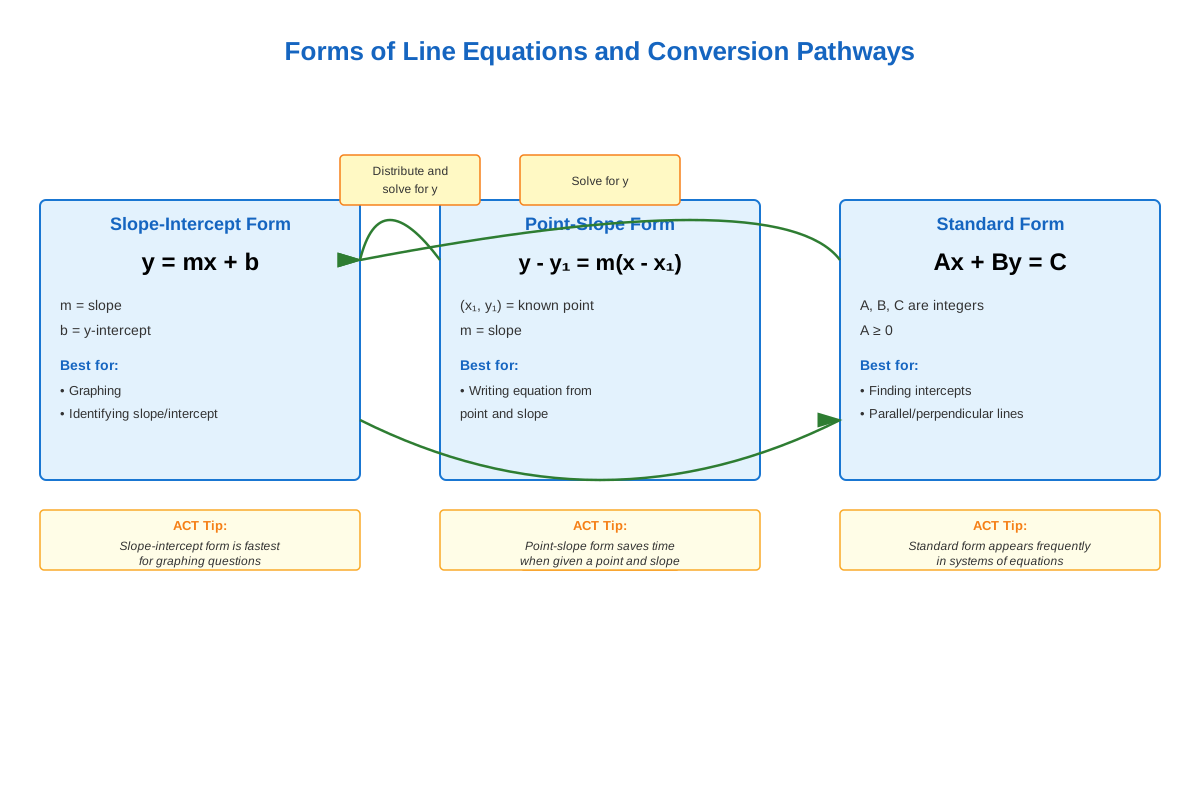
Understanding ACT line equations requires fluency with multiple representations of linear relationships: slope-intercept form, point-slope form, standard form, and the ability to convert between them seamlessly. The ACT tests not just computational ability but also conceptual understanding—students must recognize when a line is horizontal or vertical, interpret the meaning of slope and y-intercept in context, and apply these concepts to solve real-world problems involving rates of change, distance, and geometric relationships.
This topic serves as foundational knowledge for more advanced coordinate geometry concepts including circles, parabolas, and distance calculations. Line equations also connect directly to systems of equations, inequalities, and functions—making it a central pillar of the entire ACT Math section. Students who master line equations gain confidence across multiple content areas and can approach complex multi-step problems with systematic strategies.
Learning Objectives
- [ ] Identify when Line equations is being tested in ACT Math questions
- [ ] Explain the core rule or strategy behind Line equations and their various forms
- [ ] Apply Line equations to ACT-style questions accurately and efficiently
- [ ] Convert fluently between slope-intercept, point-slope, and standard forms
- [ ] Determine equations of parallel and perpendicular lines given constraints
- [ ] Calculate slope from two points, a graph, or a table of values
- [ ] Interpret the meaning of slope and intercepts in real-world contexts
Prerequisites
- Basic algebraic manipulation: Solving for variables, distributing, and combining like terms is essential for converting between line equation forms and isolating variables
- Coordinate plane understanding: Plotting points and understanding the x-y coordinate system enables visualization of lines and interpretation of slope
- Fraction operations: Slope calculations frequently involve fractions, requiring comfort with simplification and arithmetic
- Negative number operations: Many ACT questions involve negative slopes or coordinates, demanding accuracy with signs
Why This Topic Matters
Line equations appear in everyday applications from calculating speed (distance over time) to determining pricing models (cost per unit plus fixed fees) to analyzing trends in data. Engineers use linear equations to model relationships between variables, economists use them to represent supply and demand, and scientists use them to express proportional relationships. The ability to translate between verbal descriptions, tables, graphs, and algebraic representations of linear relationships is a fundamental quantitative literacy skill.
On the ACT, line equations appear in approximately 8-10% of all Math questions, making this one of the highest-yield topics for focused study. Questions typically appear in several formats: finding the equation of a line given two points or a point and slope; determining slope from a graph or table; identifying parallel or perpendicular lines; solving systems of linear equations; and interpreting slope and intercepts in word problems. The ACT particularly favors questions that combine multiple concepts—for example, finding the equation of a line perpendicular to a given line that passes through a specific point.
Common question types include: direct calculation of slope from coordinates, conversion between equation forms, graphical interpretation of slope and intercepts, application problems involving rate of change, and geometric problems where lines represent sides of polygons or paths. The test writers frequently include answer choices that represent common errors (sign mistakes, reciprocal instead of negative reciprocal, incorrect form conversions), making conceptual understanding crucial for avoiding traps.
Core Concepts
Slope: The Foundation of Linear Relationships
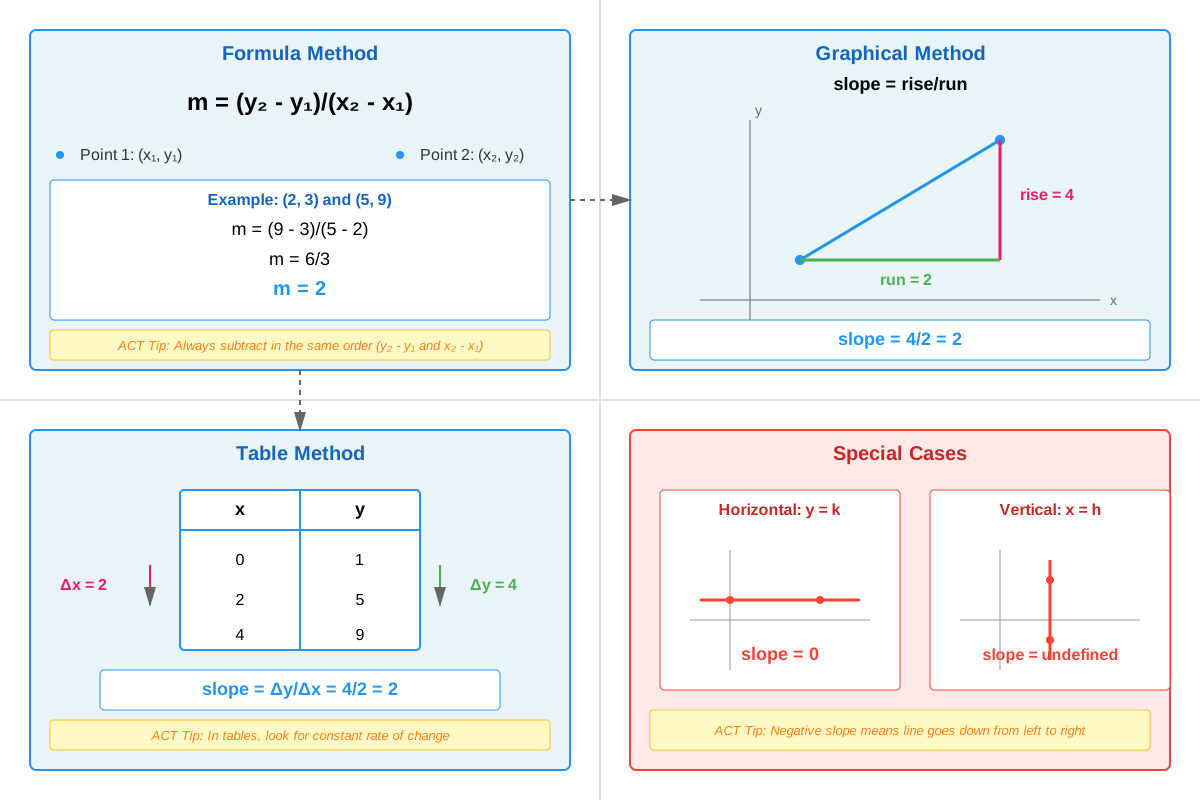
Slope represents the rate of change of a line—how much the y-value changes for each unit change in x. The slope formula is fundamental:
m = (y₂ - y₁)/(x₂ - x₁)where (x₁, y₁) and (x₂, y₂) are any two distinct points on the line. The numerator represents the rise (vertical change) and the denominator represents the run (horizontal change). Slope can be positive (line rises from left to right), negative (line falls from left to right), zero (horizontal line), or undefined (vertical line).
Key slope properties:
- Positive slope: as x increases, y increases
- Negative slope: as x increases, y decreases
- Zero slope: horizontal line, equation form y = k (constant)
- Undefined slope: vertical line, equation form x = k (constant)
The ACT frequently tests whether students can calculate slope correctly, particularly with negative coordinates or when points are given in non-standard order. Always subtract coordinates in the same order: if you use y₂ - y₁ in the numerator, you must use x₂ - x₁ in the denominator.
Slope-Intercept Form: y = mx + b
Slope-intercept form is the most commonly used representation on the ACT because it immediately reveals two crucial pieces of information: the slope (m) and the y-intercept (b). The y-intercept is the point where the line crosses the y-axis, which occurs when x = 0.
To write an equation in slope-intercept form:
- Identify or calculate the slope (m)
- Identify or calculate the y-intercept (b)
- Substitute into y = mx + b
When given a point (x₁, y₁) and slope m, substitute these values into y = mx + b and solve for b:
y₁ = mx₁ + b
b = y₁ - mx₁
This form is particularly useful for graphing (start at b on the y-axis, then use slope to find additional points) and for quickly comparing lines (same slope means parallel, negative reciprocal slopes means perpendicular).
Point-Slope Form: y - y₁ = m(x - x₁)
Point-slope form is the most efficient form when you know a point on the line and the slope but haven't yet calculated the y-intercept. The equation y - y₁ = m(x - x₁) uses a known point (x₁, y₁) and slope m directly.
This form is especially valuable for ACT questions involving parallel or perpendicular lines, where you know the slope relationship and a point the new line must pass through. After writing the equation in point-slope form, you can expand and rearrange to convert to slope-intercept or standard form if needed.
Standard Form: Ax + By = C
Standard form presents the equation with both variables on the same side, typically with integer coefficients and A positive. While less intuitive than slope-intercept form, standard form is useful for certain applications and appears regularly on the ACT.
To find slope from standard form Ax + By = C:
m = -A/BTo find the y-intercept from standard form:
y-intercept = C/B (set x = 0)To find the x-intercept from standard form:
x-intercept = C/A (set y = 0)Converting from slope-intercept to standard form involves eliminating fractions and moving all variable terms to one side:
- Start with y = mx + b
- Multiply through to eliminate fractions if necessary
- Rearrange to -mx + y = b or mx - y = -b
- Multiply by -1 if needed to make A positive
Parallel and Perpendicular Lines
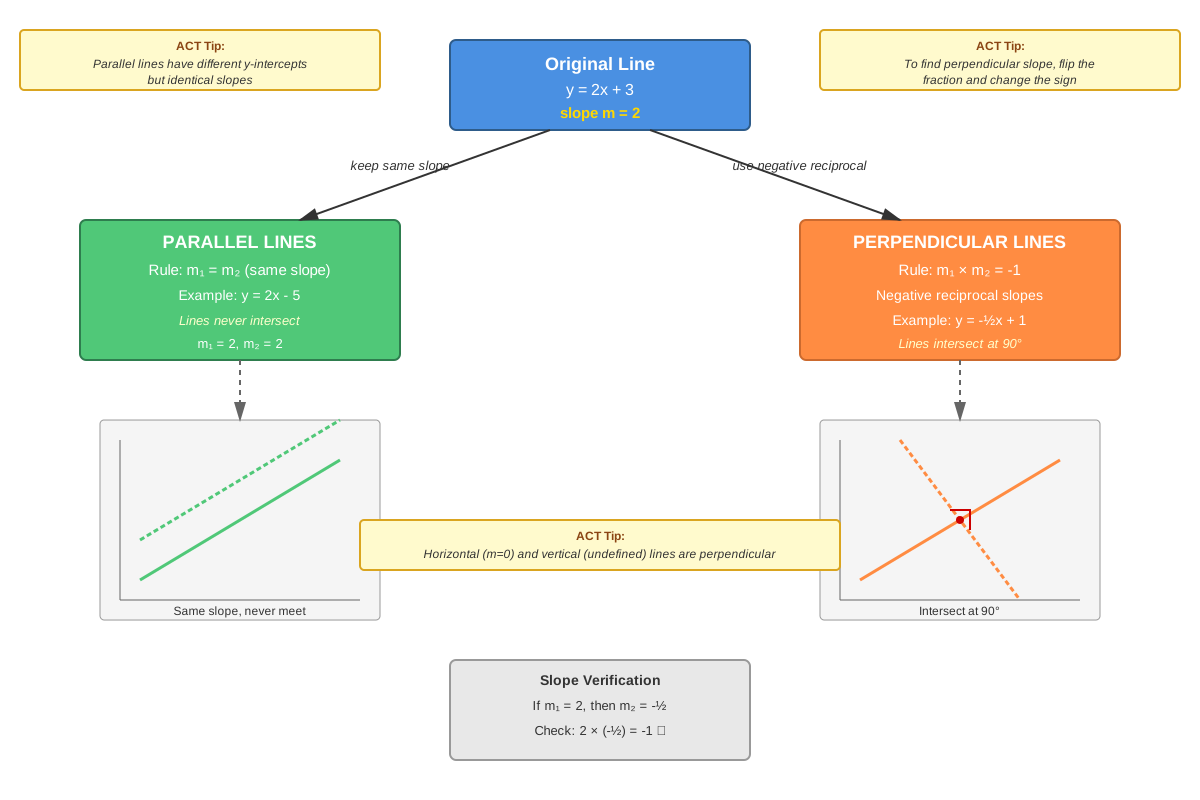
Parallel lines have identical slopes but different y-intercepts. If two lines are parallel, m₁ = m₂. The ACT frequently asks students to find the equation of a line parallel to a given line passing through a specific point.
Perpendicular lines have slopes that are negative reciprocals of each other. If two lines are perpendicular, m₁ × m₂ = -1, or equivalently, m₂ = -1/m₁.
Key relationships:
| Original Slope | Parallel Slope | Perpendicular Slope |
|---|---|---|
| 2 | 2 | -1/2 |
| -3/4 | -3/4 | 4/3 |
| 1/5 | 1/5 | -5 |
| -1 | -1 | 1 |
Special cases to memorize:
- Horizontal lines (slope = 0) are perpendicular to vertical lines (undefined slope)
- A line with slope m is perpendicular to a line with slope -1/m
Finding Equations from Two Points
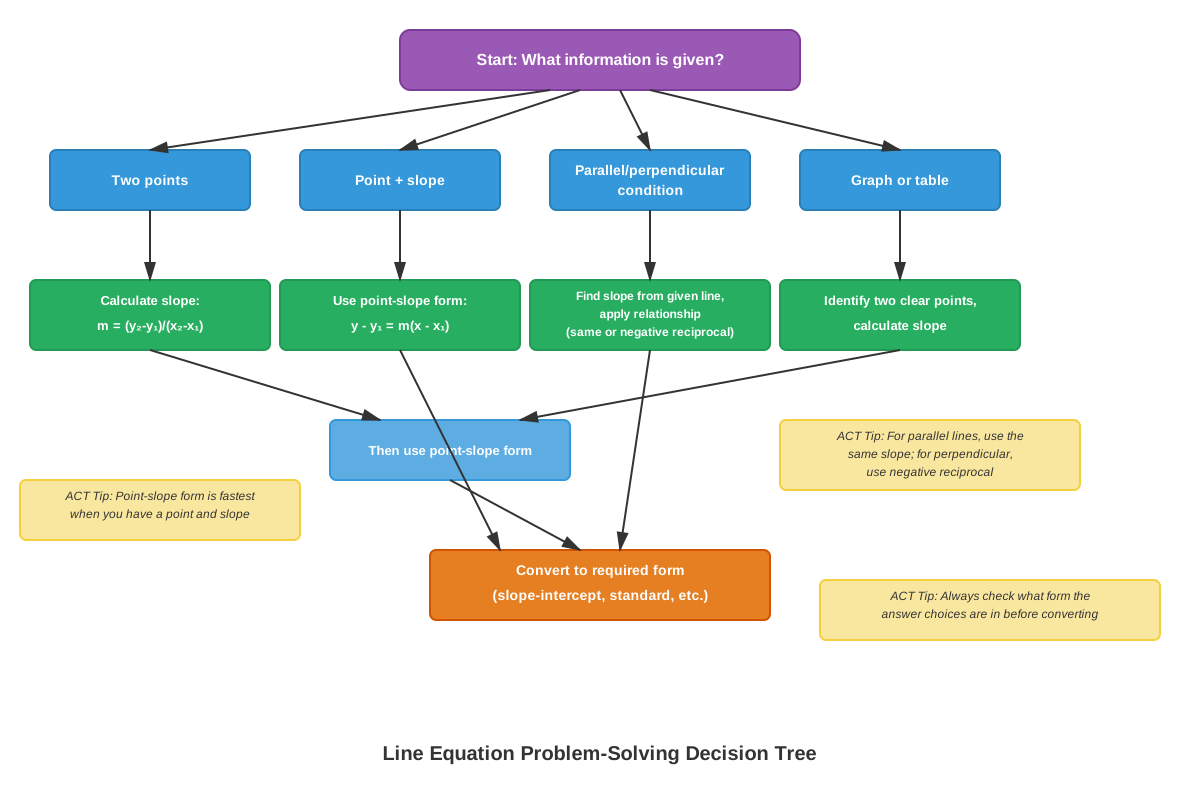
When given two points but no explicit slope, follow this systematic process:
- Calculate slope using m = (y₂ - y₁)/(x₂ - x₁)
- Choose either point as (x₁, y₁)
- Use point-slope form: y - y₁ = m(x - x₁)
- Convert to requested form (usually slope-intercept)
Example: Find the equation of the line through (2, 5) and (6, 13)
- Slope: m = (13 - 5)/(6 - 2) = 8/4 = 2
- Point-slope: y - 5 = 2(x - 2)
- Expand: y - 5 = 2x - 4
- Slope-intercept: y = 2x + 1
Interpreting Slope and Intercepts in Context
The ACT frequently embeds line equations in word problems where slope and intercepts have real-world meanings. The slope represents a rate of change (dollars per hour, miles per gallon, degrees per minute), while the y-intercept represents an initial value or fixed cost.
Common contexts:
- Cost problems: y = mx + b where m is cost per unit and b is fixed/startup cost
- Distance problems: y = mx + b where m is speed and b is initial distance
- Temperature problems: y = mx + b where m is rate of temperature change and b is initial temperature
- Population problems: y = mx + b where m is growth rate and b is initial population
When solving contextual problems, always identify what the variables represent and verify that your answer makes sense in context.
Concept Relationships
The core concepts of line equations build upon each other in a logical progression. Slope serves as the foundational concept—without understanding rate of change, none of the equation forms make sense. From slope, students progress to slope-intercept form (y = mx + b), which directly incorporates slope and adds the y-intercept concept.
Point-slope form emerges as an alternative representation that's more efficient when the y-intercept isn't immediately known, while standard form provides a third representation useful for certain calculations and applications. All three forms are mathematically equivalent and can be converted between each other through algebraic manipulation.
The concepts of parallel and perpendicular lines depend entirely on understanding slope relationships—parallel lines share identical slopes, while perpendicular lines have slopes that are negative reciprocals. These relationships connect to geometric concepts like rectangles, squares, and right triangles in the coordinate plane.
Finding equations from two points synthesizes multiple concepts: calculating slope from coordinates, then applying either point-slope or slope-intercept form. This process represents the most common ACT question type and requires fluency with all preceding concepts.
Finally, contextual interpretation connects abstract algebraic representations to real-world scenarios, requiring students to translate between verbal descriptions and mathematical equations. This highest-level skill demonstrates true mastery of line equations.
Relationship map: Slope → Slope-Intercept Form → Point-Slope Form → Standard Form → Parallel/Perpendicular Lines → Two-Point Equations → Contextual Applications
Quick check — test yourself on Line equations so far.
Try Flashcards →High-Yield Facts
⭐ The slope formula is m = (y₂ - y₁)/(x₂ - x₁), and the order of subtraction must be consistent in numerator and denominator
⭐ Parallel lines have equal slopes (m₁ = m₂), while perpendicular lines have slopes that are negative reciprocals (m₁ × m₂ = -1)
⭐ In slope-intercept form y = mx + b, m is the slope and b is the y-intercept (where the line crosses the y-axis)
⭐ Horizontal lines have slope = 0 and equations of the form y = k; vertical lines have undefined slope and equations of the form x = k
⭐ To find the equation of a line through two points: calculate slope, then use point-slope form with either point
- Point-slope form y - y₁ = m(x - x₁) is most efficient when you know a point and the slope but not the y-intercept
- In standard form Ax + By = C, the slope equals -A/B
- The y-intercept can be found by setting x = 0; the x-intercept by setting y = 0
- A positive slope means the line rises from left to right; a negative slope means it falls from left to right
- To convert from slope-intercept to standard form, move all terms to one side and eliminate fractions
- When finding a perpendicular slope, flip the fraction and change the sign: 2/3 becomes -3/2
- In word problems, slope represents a rate of change (per unit), while y-intercept represents an initial value or fixed amount
Common Misconceptions
Misconception: When calculating slope, students can subtract coordinates in any order without consistency.
Correction: The order must be consistent—if you calculate y₂ - y₁ in the numerator, you must calculate x₂ - x₁ in the denominator. Mixing orders (like y₂ - y₁ over x₁ - x₂) produces the wrong sign.
Misconception: Perpendicular lines have slopes that are simply the reciprocal of each other (without the negative).
Correction: Perpendicular slopes are negative reciprocals. If one line has slope 2/3, a perpendicular line has slope -3/2, not 3/2. The product of perpendicular slopes always equals -1.
Misconception: In the equation y = mx + b, the value of b is always positive.
Correction: The y-intercept b can be any real number—positive, negative, or zero. A negative b means the line crosses the y-axis below the origin.
Misconception: Vertical lines have a slope of zero.
Correction: Vertical lines have undefined slope (division by zero in the slope formula), not zero slope. Horizontal lines have zero slope. This is a frequently tested distinction on the ACT.
Misconception: When converting from standard form Ax + By = C to slope-intercept form, the slope is A/B.
Correction: The slope from standard form is -A/B (negative A divided by B). Students often forget the negative sign, leading to incorrect slopes.
Misconception: Point-slope form can only be used with one specific point on the line.
Correction: Point-slope form can be written using any point on the line. If a line passes through (2, 3) and (5, 9), you can write the equation using either point—both will simplify to the same slope-intercept form.
Misconception: In word problems, the independent variable (x) is always time.
Correction: While time is often the independent variable, x can represent any input quantity—distance, number of items, temperature, etc. Always read carefully to identify what each variable represents.
Worked Examples
Example 1: Finding the Equation of a Line Through Two Points
Problem: What is the equation, in slope-intercept form, of the line that passes through the points (-3, 7) and (5, -1)?
Solution:
Step 1: Calculate the slope using the slope formula.
m = (y₂ - y₁)/(x₂ - x₁) = (-1 - 7)/(5 - (-3)) = -8/8 = -1Step 2: Use point-slope form with either point. Using (-3, 7):
y - 7 = -1(x - (-3))
y - 7 = -1(x + 3)
Step 3: Expand and convert to slope-intercept form:
y - 7 = -x - 3
y = -x - 3 + 7
y = -x + 4
Step 4: Verify using the other point (5, -1):
y = -x + 4
-1 = -(5) + 4
-1 = -5 + 4
-1 = -1 ✓Answer: y = -x + 4
This problem demonstrates the complete process of finding a line equation from two points, addressing Learning Objective 3 (applying line equations accurately). The verification step is crucial for catching calculation errors on the ACT.
Example 2: Perpendicular Line Through a Given Point
Problem: Line k has the equation 2x + 3y = 12. What is the equation of the line perpendicular to line k that passes through the point (6, -2)?
Solution:
Step 1: Find the slope of line k by converting to slope-intercept form:
2x + 3y = 12
3y = -2x + 12
y = -2/3 x + 4
The slope of line k is -2/3.
Step 2: Find the perpendicular slope (negative reciprocal):
m_perpendicular = -1/(-2/3) = 3/2Step 3: Use point-slope form with the given point (6, -2):
y - (-2) = 3/2(x - 6)
y + 2 = 3/2(x - 6)
Step 4: Convert to slope-intercept form:
y + 2 = 3/2 x - 9
y = 3/2 x - 9 - 2
y = 3/2 x - 11
Step 5: Verify the perpendicular relationship:
m₁ × m₂ = (-2/3) × (3/2) = -6/6 = -1 ✓Answer: y = 3/2 x - 11 (or in standard form: 3x - 2y = 22)
This example addresses multiple learning objectives: converting between forms, understanding perpendicular relationships, and applying strategies to ACT-style questions. The perpendicular line concept appears frequently on the ACT and requires careful attention to the negative reciprocal relationship.
Exam Strategy
When approaching ACT line equation questions, first identify what information is given and what form is requested. The test typically provides either two points, a point and a slope, or an existing equation with a parallel/perpendicular relationship. Recognizing the question type immediately tells you which strategy to employ.
Trigger words and phrases to watch for:
- "slope-intercept form" → answer must be y = mx + b
- "passes through" → you're given a point on the line
- "parallel to" → slopes are equal
- "perpendicular to" → slopes are negative reciprocals
- "rate of change" → refers to slope
- "initial value" or "y-intercept" → the constant term when x = 0
- "standard form" → answer must be Ax + By = C
Process-of-elimination strategies:
- Quickly eliminate answers with incorrect slope by checking if the line should be increasing or decreasing
- Test the given point(s) by substituting coordinates—the correct equation must satisfy all given points
- For parallel/perpendicular questions, eliminate any answer with the wrong slope relationship
- Check the sign of the y-intercept if you can determine whether it should be positive or negative
- For word problems, eliminate answers that don't make contextual sense (negative quantities where they're impossible, unrealistic rates)
Time allocation advice:
Basic slope calculation or form conversion questions should take 30-45 seconds. Multi-step problems involving perpendicular lines or word problems may require 60-90 seconds. If a problem requires more than 2 minutes, mark it and return later—you may be making it more complicated than necessary.
Common ACT traps to avoid:
- Answer choices that use the reciprocal instead of negative reciprocal for perpendicular lines
- Equations that pass through one given point but not the other
- Sign errors in slope calculations (especially with negative coordinates)
- Confusing x-intercept with y-intercept
- Standard form answers where A is negative (ACT typically expects A > 0)
Exam Tip: Always verify your answer by substituting a given point back into your equation. This 5-second check catches most calculation errors and is worth the time investment.
Memory Techniques
Slope Formula Mnemonic: "You Rise Over Run" → (Y₂ - Y₁)/(X₂ - X₁)
Parallel vs. Perpendicular:
- Parallel = Perfectly Paired slopes (same slope)
- Perpendicular = Product is Negative One (m₁ × m₂ = -1)
Slope-Intercept Form Visualization: Picture a ski slope—m is how steep the mountain is, b is the base camp where you start (y-intercept)
Negative Reciprocal Trick: To find perpendicular slope, perform two operations: Flip the fraction, Change the sign (Flip-Change)
Horizontal vs. Vertical Lines:
- Horizontal lines are Happy (smile shape) with slope = 0 (looks like a smile)
- Vertical lines are Very steep with Undefined slope (U for Undefined)
Standard Form Slope: "Negative A over B" → slope = -A/B
Y-intercept Quick Find: "Y-intercept happens when X is Zero" (X = 0)
Summary
Line equations represent a cornerstone of ACT Math, requiring fluency with multiple forms (slope-intercept, point-slope, and standard), the ability to calculate slope from various representations, and understanding of parallel and perpendicular relationships. Mastery demands both computational accuracy and conceptual understanding—knowing not just how to manipulate equations but what slope and intercepts mean in context. The most successful students develop automatic recognition of question types and deploy efficient strategies: using point-slope form when given a point and slope, recognizing that parallel lines share slopes while perpendicular lines have negative reciprocal slopes, and systematically converting between forms through algebraic manipulation. Every line equation problem ultimately reduces to finding or using slope and a point, making these the two fundamental pieces of information to identify. With consistent practice applying these concepts to ACT-style questions, students can confidently tackle any line equation problem within the time constraints of the exam.
Key Takeaways
- Slope (m = (y₂ - y₁)/(x₂ - x₁)) is the foundation—calculate it accurately with consistent subtraction order and recognize its meaning as rate of change
- Master all three forms: slope-intercept (y = mx + b) for quick graphing and interpretation, point-slope (y - y₁ = m(x - x₁)) for efficient equation-building, and standard form (Ax + By = C) for specific applications
- Parallel lines have identical slopes; perpendicular lines have negative reciprocal slopes (m₁ × m₂ = -1)—this relationship is tested extensively on the ACT
- Horizontal lines have zero slope (y = k); vertical lines have undefined slope (x = k)—don't confuse these special cases
- In word problems, identify what slope and y-intercept represent contextually—slope is always a rate of change, y-intercept is an initial value
- Verify answers by substituting given points—this quick check catches most calculation errors
- Convert between forms systematically—know the algebraic steps to move from any form to any other form
Related Topics
Systems of Linear Equations: Building on single line equations, systems involve finding where two lines intersect, requiring solution by substitution, elimination, or graphing. Mastering line equations makes systems significantly more accessible.
Linear Inequalities: These extend line equations by replacing the equals sign with inequality symbols, creating regions of the coordinate plane rather than single lines. Understanding line equations is prerequisite to graphing and solving inequalities.
Functions and Function Notation: Linear functions are the simplest function type, and line equations provide the foundation for understanding f(x) notation, domain and range, and function transformations.
Distance and Midpoint Formulas: These coordinate geometry concepts frequently combine with line equations in multi-step problems involving geometric figures in the coordinate plane.
Quadratic and Polynomial Functions: After mastering linear equations, students progress to curves, where concepts like slope become instantaneous rate of change and require calculus for full understanding.
Practice CTA
Now that you've mastered the core concepts of line equations, it's time to cement your understanding through active practice. Work through the practice questions systematically, applying the strategies and formulas you've learned. Pay special attention to questions involving perpendicular lines and word problems, as these tend to challenge students most. Use the flashcards to drill the key formulas and relationships until they become automatic—speed and accuracy on these foundational concepts will save you valuable time on test day. Remember, every ACT Math section includes multiple line equation questions, making this one of the highest-return topics for your study time. You've got this!
Sign up free to keep reading
Create a free AnvayaPrep account to finish this ACT guide on Line equations — plus flashcards and practice questions.