Overview
Ordered pairs form the foundation of coordinate geometry and are among the most frequently tested concepts on the ACT Math section. An ordered pair is a fundamental mathematical notation written as (x, y) that represents a specific point's location on the coordinate plane. The first number (x-coordinate) indicates horizontal position, while the second number (y-coordinate) indicates vertical position. Understanding ordered pairs is not merely about plotting points—it encompasses interpreting relationships between variables, analyzing functions, understanding transformations, and solving systems of equations.
The ACT consistently includes 3-5 questions per test that directly or indirectly require mastery of ordered pairs. These questions appear across multiple difficulty levels and often integrate with other coordinate geometry concepts such as slope, distance, midpoint, and graphing functions. Students who thoroughly understand ordered pairs gain a significant advantage because this knowledge serves as the gateway to more complex topics including linear equations, parabolas, circles, and trigonometric functions on the coordinate plane.
Ordered pairs connect to virtually every aspect of coordinate geometry tested on the ACT. They provide the language for describing geometric transformations (translations, reflections, rotations), enable the calculation of distances and midpoints between points, and allow students to verify solutions to equations and inequalities. Additionally, ordered pairs are essential for understanding function notation, as f(x) = y can be represented as the ordered pair (x, y). This interconnectedness makes ordered pairs a high-yield topic that rewards thorough study with improved performance across multiple question types.
Learning Objectives
- [ ] Identify when Ordered pairs is being tested in ACT Math questions
- [ ] Explain the core rule or strategy behind Ordered pairs and their representation on the coordinate plane
- [ ] Apply Ordered pairs to ACT-style questions accurately and efficiently
- [ ] Determine the coordinates of points after geometric transformations
- [ ] Interpret ordered pairs in the context of real-world scenarios and word problems
- [ ] Recognize the relationship between ordered pairs and function notation
- [ ] Calculate new ordered pairs based on algebraic operations and coordinate rules
Prerequisites
- Basic number line understanding: Students must know how to locate positive and negative numbers on a horizontal line, as this extends to the x-axis
- Understanding of positive and negative integers: Essential for working with all four quadrants of the coordinate plane
- Basic algebraic substitution: Necessary for evaluating expressions to find coordinates and verify if ordered pairs satisfy equations
- Function notation fundamentals: Required to connect f(x) notation with ordered pair representation (x, f(x))
Why This Topic Matters
Ordered pairs serve as the universal language for describing position and relationships in mathematics, science, engineering, and data analysis. In real-world applications, ordered pairs represent GPS coordinates, data points in statistical analysis, positions in computer graphics, and relationships between variables in scientific experiments. Every graph students encounter in economics, physics, biology, or social sciences relies on ordered pairs to communicate information visually.
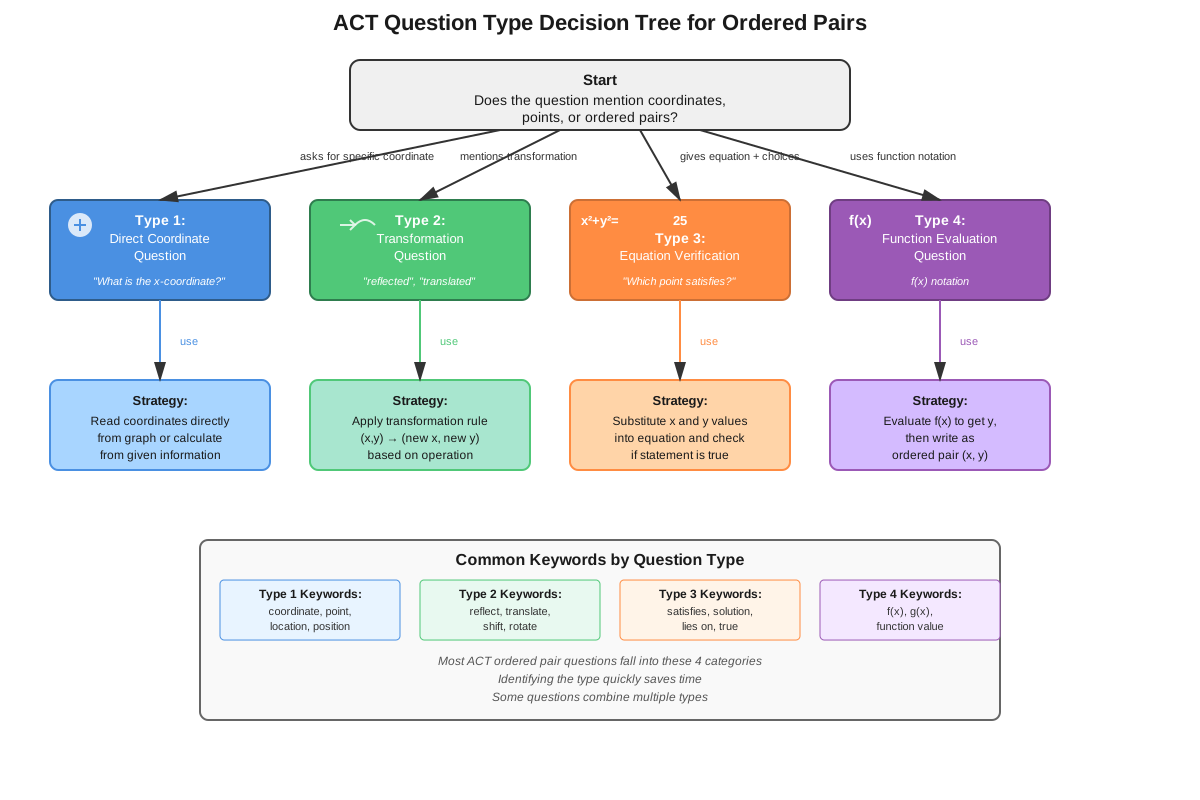
On the ACT Math section, ordered pairs appear in approximately 8-12% of all questions, making them one of the highest-yield topics for test preparation. Questions involving ordered pairs typically appear in three formats: direct coordinate identification (asking for specific x or y values), transformation problems (requiring students to find new coordinates after shifts or reflections), and verification problems (determining whether given ordered pairs satisfy equations or inequalities). The ACT frequently embeds ordered pair concepts within more complex questions about functions, systems of equations, and geometric figures on the coordinate plane.
The strategic importance of mastering ordered pairs extends beyond direct questions. Many ACT problems that appear to test other concepts—such as slope, distance formula, or graphing—actually require quick, accurate interpretation of ordered pairs as a preliminary step. Students who struggle with ordered pairs often lose points not because they don't understand the primary concept being tested, but because they misread coordinates or make sign errors when working with negative values. Conversely, students with strong ordered pair fluency can often solve complex coordinate geometry problems more quickly by recognizing patterns and relationships between points.
Core Concepts
Definition and Notation of Ordered Pairs
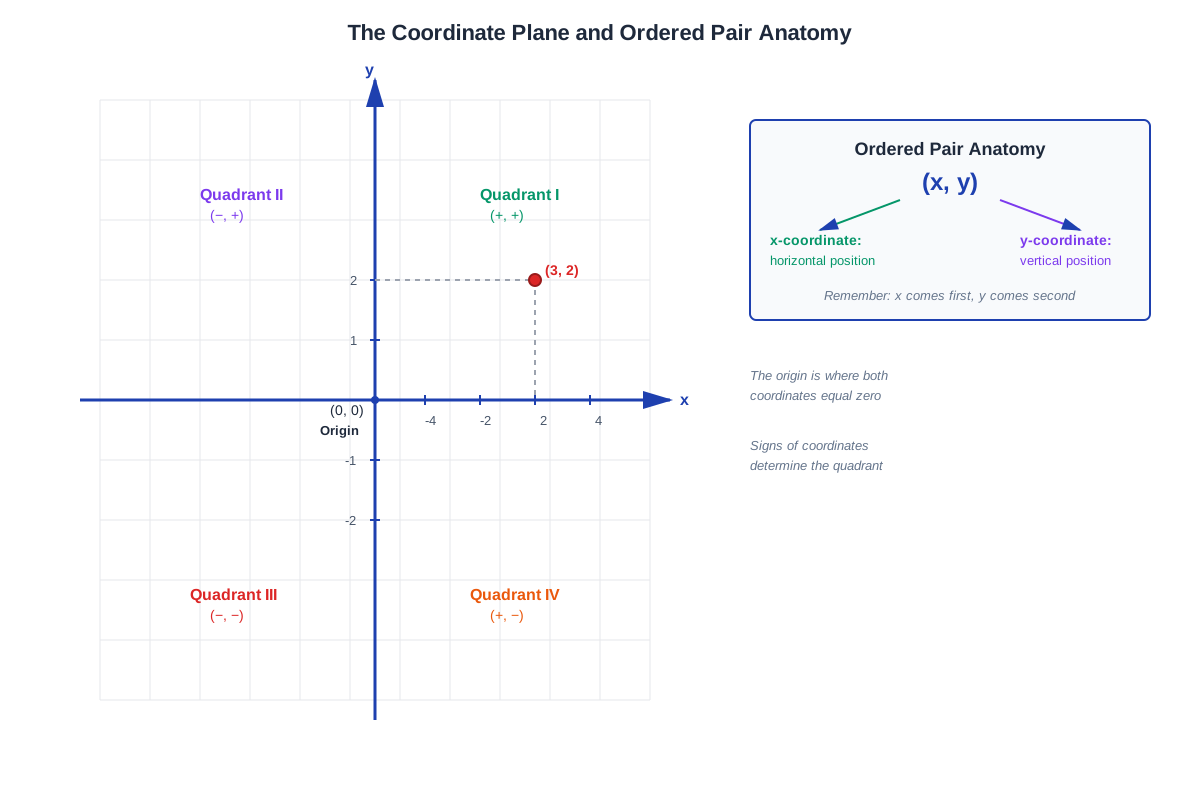
An ordered pair is a mathematical notation (x, y) where the order of the numbers is significant and meaningful. The first element, called the x-coordinate or abscissa, represents the horizontal distance from the origin. The second element, called the y-coordinate or ordinate, represents the vertical distance from the origin. The term "ordered" is crucial because (3, 5) and (5, 3) represent entirely different points on the coordinate plane.
The coordinate plane (also called the Cartesian plane) consists of two perpendicular number lines: the horizontal x-axis and the vertical y-axis. These axes intersect at the origin, which has coordinates (0, 0). The axes divide the plane into four regions called quadrants, numbered counterclockwise starting from the upper right:
- Quadrant I: Both x and y are positive (x > 0, y > 0)
- Quadrant II: x is negative, y is positive (x < 0, y > 0)
- Quadrant III: Both x and y are negative (x < 0, y < 0)
- Quadrant IV: x is positive, y is negative (x > 0, y < 0)
Points located on the axes themselves are not considered to be in any quadrant. For example, (5, 0) lies on the x-axis, and (0, -3) lies on the y-axis.
Reading and Plotting Ordered Pairs
To plot an ordered pair (x, y) on the coordinate plane, follow this systematic process:
- Start at the origin (0, 0)
- Move horizontally according to the x-coordinate: right if positive, left if negative
- From that position, move vertically according to the y-coordinate: up if positive, down if negative
- Mark the point at the final position
For example, to plot (-4, 3):
- Start at the origin
- Move 4 units left (because x = -4)
- Move 3 units up (because y = 3)
- Mark the point in Quadrant II
When reading coordinates from a graph, reverse this process: identify the horizontal distance from the y-axis (this is x), then identify the vertical distance from the x-axis (this is y). Always write the x-coordinate first.
Ordered Pairs and Functions
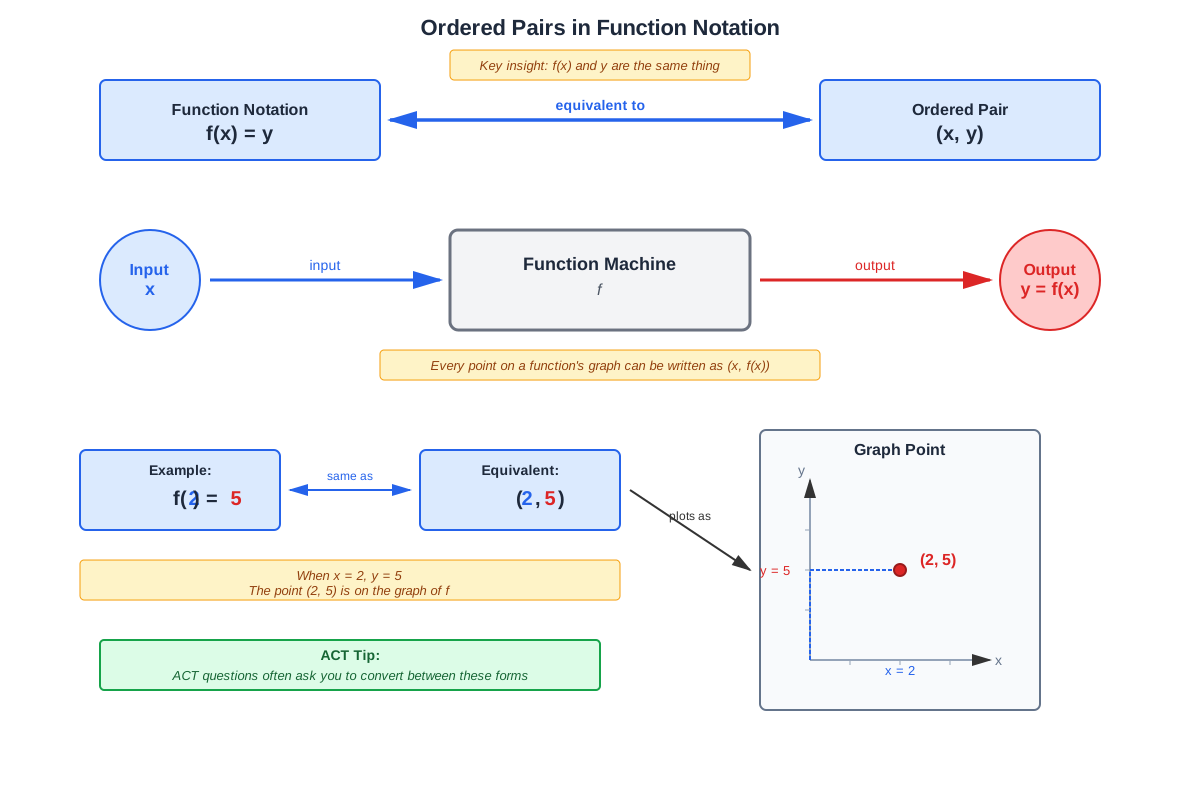
In function notation, f(x) = y creates an ordered pair (x, y) that lies on the graph of function f. This connection is fundamental to understanding how functions behave visually. When the ACT asks "What is f(3)?" and provides a graph, students must locate the point where x = 3 and read the corresponding y-value.
Conversely, if given an ordered pair like (2, 7) and told it lies on the graph of function g, this means g(2) = 7. This bidirectional relationship between function notation and ordered pairs appears frequently on the ACT, particularly in questions about function composition, inverse functions, and piecewise functions.
Transformations and Ordered Pairs
The ACT frequently tests understanding of how ordered pairs change under geometric transformations:
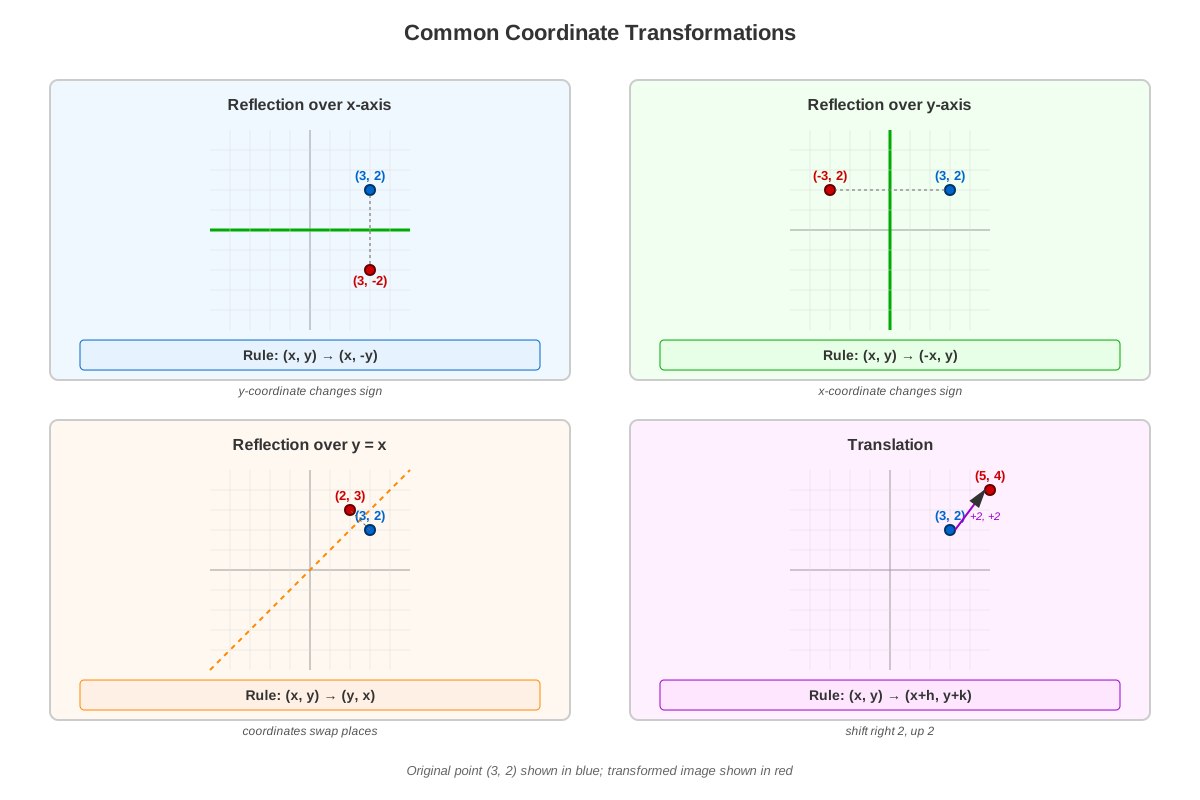
| Transformation | Original Point | New Point | Rule |
|---|---|---|---|
| Horizontal shift right by h | (x, y) | (x + h, y) | Add to x-coordinate |
| Horizontal shift left by h | (x, y) | (x - h, y) | Subtract from x-coordinate |
| Vertical shift up by k | (x, y) | (x, y + k) | Add to y-coordinate |
| Vertical shift down by k | (x, y) | (x, y - k) | Subtract from y-coordinate |
| Reflection over x-axis | (x, y) | (x, -y) | Negate y-coordinate |
| Reflection over y-axis | (x, y) | (-x, y) | Negate x-coordinate |
| Reflection over origin | (x, y) | (-x, -y) | Negate both coordinates |
| Reflection over line y = x | (x, y) | (y, x) | Swap coordinates |
These transformation rules allow students to quickly determine new coordinates without graphing, saving valuable time on the ACT.
Ordered Pairs in Equations and Inequalities
An ordered pair (a, b) satisfies an equation if substituting x = a and y = b makes the equation true. For example, to verify whether (3, 5) satisfies the equation 2x + y = 11:
- Substitute: 2(3) + 5 = 6 + 5 = 11
- Since this equals 11, the ordered pair satisfies the equation
For inequalities, the same substitution process applies, but the result must satisfy the inequality relationship. The ordered pair (1, 4) satisfies y > 2x because 4 > 2(1) is true.
The ACT often presents multiple ordered pairs and asks which ones satisfy a given equation or inequality. Efficient students develop a systematic approach: substitute the x-value, calculate the expected y-value, and compare with the given y-value.
Distance Between Ordered Pairs
While the distance formula itself is a separate topic, understanding that distance is calculated between two ordered pairs is essential. Given points (x₁, y₁) and (x₂, y₂), the distance represents how far apart these points are on the coordinate plane. The ACT may ask students to identify which ordered pair is closest to or farthest from a given point, requiring quick distance estimation or calculation.
Midpoint of Ordered Pairs
The midpoint between two ordered pairs (x₁, y₁) and (x₂, y₂) is found by averaging the x-coordinates and averaging the y-coordinates separately, producing a new ordered pair. This concept frequently appears in ACT questions about bisectors, centers of geometric figures, and average positions.
Concept Relationships
Ordered pairs serve as the foundational concept that enables all other coordinate geometry topics. The relationship flow follows this pattern:
Ordered Pairs → Plotting Points → Graphing Lines and Curves → Analyzing Functions
Understanding ordered pairs directly enables students to work with the slope formula, which requires two ordered pairs (x₁, y₁) and (x₂, y₂) to calculate the rate of change between points. Similarly, the distance formula and midpoint formula both operate on ordered pairs as inputs, producing either a distance value or a new ordered pair as output.
The connection to function notation creates a bidirectional relationship: every function value f(a) = b corresponds to the ordered pair (a, b), and every ordered pair on a function's graph represents a valid input-output relationship. This connection extends to inverse functions, where the ordered pair (a, b) on function f corresponds to the ordered pair (b, a) on function f⁻¹.
Transformations modify ordered pairs according to specific rules, and understanding these rules allows students to predict how entire graphs shift, reflect, or rotate without plotting individual points. This connects to parent functions and their transformations, a high-yield ACT topic.
Within systems of equations, the solution is expressed as an ordered pair that satisfies both equations simultaneously. This connects ordered pairs to algebraic solution methods and graphical intersection points.
The prerequisite knowledge of number lines extends naturally to ordered pairs: the x-coordinate represents position on a horizontal number line, while the y-coordinate represents position on a vertical number line. Understanding positive and negative integers is essential because coordinates can be negative, and sign errors are among the most common mistakes students make with ordered pairs.
Quick check — test yourself on Ordered pairs so far.
Try Flashcards →High-Yield Facts
⭐ The x-coordinate always comes first in an ordered pair (x, y), representing horizontal position
⭐ Points in Quadrant I have both coordinates positive; Quadrant II has negative x and positive y; Quadrant III has both negative; Quadrant IV has positive x and negative y
⭐ An ordered pair (a, b) satisfies an equation when substituting x = a and y = b makes the equation true
⭐ Reflecting a point over the x-axis negates the y-coordinate: (x, y) becomes (x, -y)
⭐ Reflecting a point over the y-axis negates the x-coordinate: (x, y) becomes (-x, y)
- The origin has coordinates (0, 0) and is the intersection point of the x-axis and y-axis
- Points on the x-axis have y-coordinate equal to zero: (x, 0)
- Points on the y-axis have x-coordinate equal to zero: (0, y)
- Swapping the coordinates of an ordered pair reflects the point over the line y = x
- The ordered pair (x, y) and the function notation f(x) = y represent the same point on a graph
- Horizontal shifts affect only the x-coordinate; vertical shifts affect only the y-coordinate
- The distance between two ordered pairs is always positive or zero, never negative
- If two ordered pairs have the same x-coordinate, they lie on a vertical line
- If two ordered pairs have the same y-coordinate, they lie on a horizontal line
- The midpoint of two ordered pairs is found by averaging x-coordinates and y-coordinates separately
Common Misconceptions
Misconception: The ordered pair (5, 3) and (3, 5) represent the same point because they contain the same numbers.
Correction: Order matters critically in ordered pairs. The first number is always the x-coordinate (horizontal), and the second is always the y-coordinate (vertical). These two ordered pairs represent different points: (5, 3) is 5 units right and 3 units up, while (3, 5) is 3 units right and 5 units up.
Misconception: When reflecting over the x-axis, both coordinates change sign.
Correction: Only the y-coordinate changes sign when reflecting over the x-axis. The point (4, 7) becomes (4, -7), not (-4, -7). Think of the x-axis as a mirror: points stay the same horizontal distance from the y-axis but flip to the opposite side vertically.
Misconception: Points in Quadrant III have coordinates where x is negative but y is positive.
Correction: Quadrant III contains points where both coordinates are negative. The quadrants go counterclockwise: I (both positive), II (negative x, positive y), III (both negative), IV (positive x, negative y). Quadrant II is where x is negative and y is positive.
Misconception: If an ordered pair satisfies one equation in a system, it's the solution to the system.
Correction: An ordered pair must satisfy all equations in a system simultaneously to be the solution. The ACT often includes distractor answers that satisfy only one equation. Always verify by substituting into every equation in the system.
Misconception: Moving right on the coordinate plane means adding to the y-coordinate.
Correction: Moving right means adding to the x-coordinate (horizontal movement). Moving up means adding to the y-coordinate (vertical movement). This confusion often stems from not clearly distinguishing between horizontal and vertical directions.
Misconception: The point (0, 5) is in Quadrant I because 5 is positive.
Correction: Points that lie on the axes are not in any quadrant. The point (0, 5) lies on the y-axis. Only points that are strictly between the axes (not touching them) belong to quadrants.
Misconception: When a question asks for f(3), the answer is the ordered pair (3, y).
Correction: When asked for f(3), provide only the y-value, not the ordered pair. The notation f(3) asks "what is the output when the input is 3?" which is a single number. However, the ordered pair (3, f(3)) does lie on the graph.
Worked Examples
Example 1: Identifying Ordered Pairs After Transformations
Question: Point P has coordinates (6, -4). If point P is reflected over the y-axis and then shifted up 3 units, what are the coordinates of the resulting point?
Solution:
Step 1: Identify the original ordered pair.
- Original point P: (6, -4)
Step 2: Apply the first transformation (reflection over y-axis).
- Reflecting over the y-axis negates the x-coordinate
- The y-coordinate remains unchanged
- After reflection: (-6, -4)
Step 3: Apply the second transformation (shift up 3 units).
- Shifting up means adding to the y-coordinate
- The x-coordinate remains unchanged
- New y-coordinate: -4 + 3 = -1
- After shifting: (-6, -1)
Step 4: Verify the quadrant makes sense.
- The x-coordinate is negative and y-coordinate is negative
- This point is in Quadrant III, which makes sense given our transformations
Answer: The resulting point has coordinates (-6, -1).
Connection to Learning Objectives: This problem tests the ability to apply ordered pair transformation rules accurately, a key ACT skill. It requires understanding that transformations are applied sequentially and that each transformation affects specific coordinates according to established rules.
Example 2: Determining Which Ordered Pairs Satisfy an Equation
Question: Which of the following ordered pairs satisfies the equation 3x - 2y = 10?
A) (2, -2)
B) (4, 1)
C) (0, -5)
D) (6, 4)
E) (3, 0)
Solution:
Step 1: Understand what "satisfies" means.
- An ordered pair (x, y) satisfies an equation if substituting those values makes the equation true
- We need to test each option systematically
Step 2: Test option A: (2, -2)
- Substitute x = 2 and y = -2 into 3x - 2y = 10
- 3(2) - 2(-2) = 6 - (-4) = 6 + 4 = 10 ✓
- This equals 10, so (2, -2) satisfies the equation
Step 3: Verify this is the only correct answer by testing others.
Option B: (4, 1)
- 3(4) - 2(1) = 12 - 2 = 10 ✓
- This also works!
Option C: (0, -5)
- 3(0) - 2(-5) = 0 + 10 = 10 ✓
- This works too!
Option D: (6, 4)
- 3(6) - 2(4) = 18 - 8 = 10 ✓
- This also satisfies the equation!
Option E: (3, 0)
- 3(3) - 2(0) = 9 - 0 = 9 ✗
- This does not equal 10
Step 4: Recognize the question format.
- If the question asks "which" (singular), only one answer should work
- If multiple answers work, the question likely asks "which of the following" meaning any correct option
- On the actual ACT, the question would be more specific
Answer: Options A, B, C, and D all satisfy the equation. Option E does not.
Connection to Learning Objectives: This example demonstrates the systematic approach needed to verify whether ordered pairs satisfy equations, a frequent ACT question type. It also highlights the importance of reading questions carefully to understand whether one or multiple answers might be correct.
Exam Strategy
When approaching ACT ordered pairs questions, begin by identifying the question type: Are you plotting points, applying transformations, verifying solutions, or reading coordinates from a graph? Each type requires a specific approach.
Trigger words and phrases that indicate ordered pair questions include:
- "coordinates of point"
- "lies on the graph"
- "satisfies the equation"
- "reflected over"
- "shifted" or "translated"
- "what is f(x)" when a graph is provided
- "in which quadrant"
- "x-coordinate" or "y-coordinate"
For transformation questions, write down the transformation rule before applying it. Don't try to visualize complex transformations mentally—use the systematic rules. If a point undergoes multiple transformations, apply them one at a time in the order given, writing the intermediate result.
When verifying if ordered pairs satisfy equations, develop this efficient process:
- Substitute the x-value first
- Calculate what the y-value should be
- Compare with the given y-value
- If they match, the ordered pair satisfies the equation
For process of elimination, use these strategies:
- Eliminate ordered pairs in the wrong quadrant if the question provides quadrant information
- Eliminate options where the x and y coordinates are swapped if you've calculated the correct order
- Check extreme cases: if x = 0 or y = 0, calculations become simpler
- Use estimation: if a point should be "close to" another point, eliminate options that are far away
Time allocation: Most ordered pair questions should take 30-45 seconds. If you're spending more than one minute, you may be overcomplicating the problem. Look for shortcuts like recognizing transformation patterns or using the answer choices to work backward.
For questions involving graphs, use your pencil to mark points clearly. Draw light lines from the point to each axis to read coordinates accurately. Many students lose points not because they don't understand ordered pairs, but because they misread the scale on the axes.
Memory Techniques
Quadrant Memory Device: Use the phrase "All Students Take Calculus" to remember which functions are positive in each quadrant (though for ordered pairs, adapt it to: "All Signs Turn Counterclockwise"):
- All: Quadrant I - All (both x and y) positive
- Signs: Quadrant II - Second coordinate (y) positive, first (x) negative
- Turn: Quadrant III - Third quadrant, both negative (think "turn negative")
- Counterclockwise: Quadrant IV - Fourth quadrant, x positive, y negative
Transformation Visualization: Remember "X-axis flips Y, Y-axis flips X" - when you reflect over an axis, you negate the coordinate that's perpendicular to that axis.
Coordinate Order Mnemonic: Think "X comes before Y in the alphabet" to remember that x-coordinate always comes first in an ordered pair.
Horizontal vs. Vertical: "Horizontal = X" (both have crossing lines in their letters) and "Vertical = Y" (Y points up and down). This helps remember which coordinate controls which direction.
Origin Memory: The origin is (0, 0) - think "Origin starts with O, which looks like 0."
For remembering which transformations affect which coordinates:
- Horizontal shifts and x-axis reflections change y (opposite pairs)
- Vertical shifts and y-axis reflections change x (opposite pairs)
Summary
Ordered pairs (x, y) are the fundamental notation for representing points on the coordinate plane, with the x-coordinate indicating horizontal position and the y-coordinate indicating vertical position. Mastery of ordered pairs requires understanding how to plot points, identify coordinates from graphs, apply transformation rules, and verify whether ordered pairs satisfy equations or inequalities. The coordinate plane is divided into four quadrants with distinct sign patterns: Quadrant I (both positive), Quadrant II (negative x, positive y), Quadrant III (both negative), and Quadrant IV (positive x, negative y). Transformations follow predictable rules: reflections over the x-axis negate y-coordinates, reflections over the y-axis negate x-coordinates, horizontal shifts affect x-coordinates, and vertical shifts affect y-coordinates. The connection between ordered pairs and function notation is essential—every point (a, b) on a function's graph means f(a) = b. Success on ACT ordered pair questions requires systematic substitution when verifying solutions, careful attention to coordinate order, and accurate application of transformation rules in sequence.
Key Takeaways
- Ordered pairs (x, y) always list the x-coordinate first and y-coordinate second; order is critical and cannot be reversed
- Each quadrant has a unique sign pattern for coordinates that must be memorized for quick identification
- Reflections over the x-axis change only the y-coordinate's sign; reflections over the y-axis change only the x-coordinate's sign
- An ordered pair satisfies an equation only when substituting its values makes the equation true; always verify by substitution
- Transformations should be applied sequentially, one at a time, writing intermediate results to avoid errors
- The connection between ordered pairs and function notation is bidirectional: (x, y) on a graph means f(x) = y
- Points on the axes (where one coordinate is zero) do not belong to any quadrant
Related Topics
Slope and Rate of Change: Understanding ordered pairs enables calculation of slope between two points, which measures the rate of change and is essential for linear equations and real-world applications.
Distance and Midpoint Formulas: These formulas operate on ordered pairs as inputs, allowing students to find distances between points and locate points exactly halfway between two given points.
Graphing Linear Equations: Ordered pairs that satisfy linear equations form straight lines on the coordinate plane, connecting algebraic and geometric representations.
Systems of Equations: The solution to a system is an ordered pair that satisfies all equations simultaneously, representing the intersection point of graphs.
Function Transformations: Understanding how ordered pairs change under transformations enables prediction of how entire function graphs shift, stretch, compress, and reflect.
Circles and Parabolas: These conic sections are defined by sets of ordered pairs that satisfy specific distance or algebraic conditions, extending coordinate geometry to curved figures.
Practice CTA
Now that you've mastered the fundamentals of ordered pairs, it's time to solidify your understanding through practice. Attempt the practice questions to test your ability to identify coordinates, apply transformations, and verify solutions under timed conditions. Use the flashcards to reinforce the quadrant sign patterns and transformation rules until they become automatic. Remember, ordered pairs appear in multiple question types on the ACT, so fluency with this topic will improve your performance across the entire coordinate geometry section. Every practice problem you complete builds the speed and accuracy you need for test day success!
Sign up free to keep reading
Create a free AnvayaPrep account to finish this ACT guide on Ordered pairs — plus flashcards and practice questions.