Overview
Perimeter in the coordinate plane is a fundamental topic in ACT Math that combines geometric measurement with coordinate geometry principles. This concept requires students to calculate the total distance around polygons whose vertices are defined by coordinate points on the Cartesian plane. Unlike traditional geometry problems where side lengths are explicitly given, these questions demand that students first determine distances between points using coordinate geometry techniques, then sum these distances to find the perimeter.
The ACT frequently tests this topic because it efficiently assesses multiple mathematical skills simultaneously: understanding of the distance formula, ability to work with coordinates, recognition of special right triangles, and basic perimeter concepts. Questions typically present polygons—most commonly triangles, rectangles, and other quadrilaterals—with vertices given as ordered pairs. Students must navigate between algebraic and geometric thinking, making this a medium-difficulty topic that separates proficient test-takers from those who struggle with integrated mathematical reasoning.
Mastering ACT perimeter in the coordinate plane problems is essential because these questions appear regularly on every ACT Math section, often accounting for 2-3 questions per test. This topic serves as a bridge between pure coordinate geometry and applied measurement, connecting to broader concepts like area calculations, polygon properties, and distance relationships. Success with perimeter problems builds confidence for tackling more complex coordinate geometry scenarios and demonstrates the spatial reasoning skills that the ACT values highly.
Learning Objectives
- [ ] Identify when Perimeter in the coordinate plane is being tested
- [ ] Explain the core rule or strategy behind Perimeter in the coordinate plane
- [ ] Apply Perimeter in the coordinate plane to ACT-style questions accurately
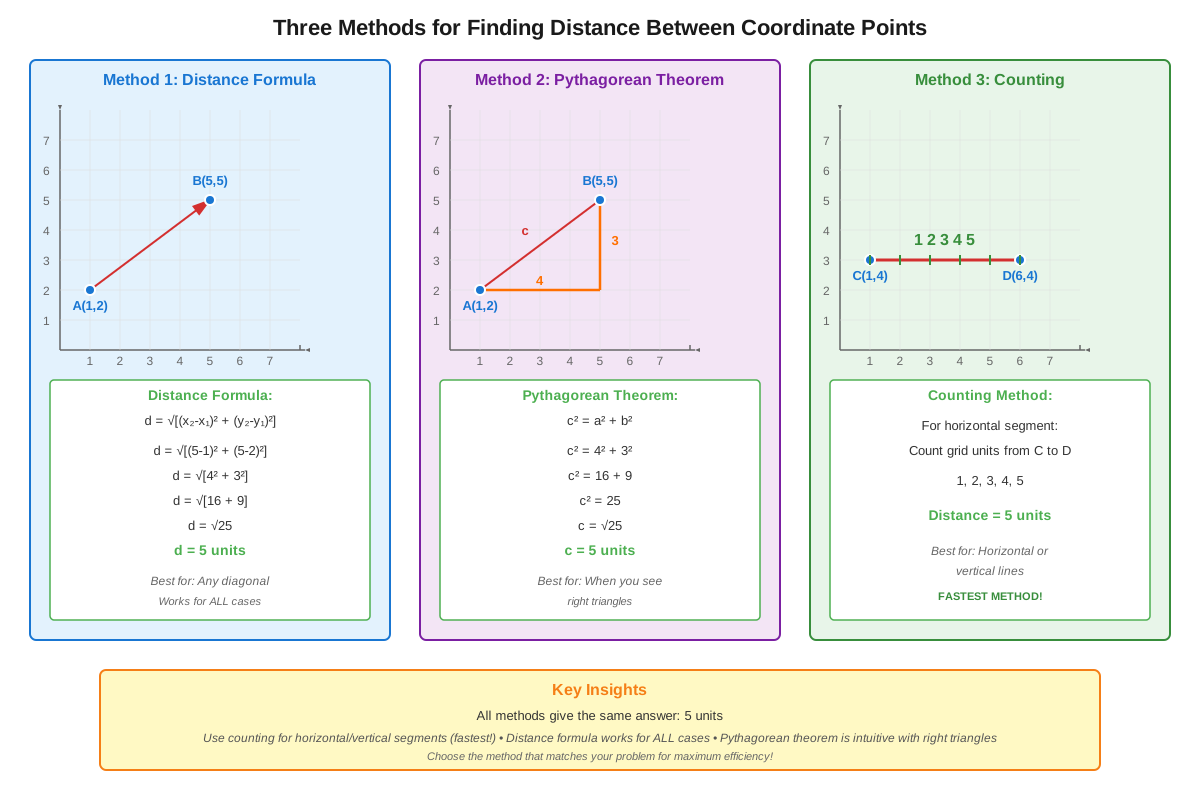
- [ ] Calculate distances between coordinate points using multiple methods (distance formula, Pythagorean theorem, and counting)
- [ ] Recognize when special geometric properties (parallel/perpendicular lines, special triangles) simplify perimeter calculations
- [ ] Efficiently determine which calculation method is fastest for a given problem configuration
Prerequisites
- Distance formula: Essential for calculating the length of any side when vertices are given as coordinates; forms the foundation of all perimeter calculations in the coordinate plane
- Pythagorean theorem: Provides an alternative method for finding distances and helps recognize right triangles, which frequently appear in ACT coordinate geometry
- Basic perimeter concept: Understanding that perimeter equals the sum of all side lengths is necessary before applying this concept to coordinate-based problems
- Coordinate plane fundamentals: Ability to plot points, understand quadrants, and work with ordered pairs (x, y) is required to visualize and solve these problems
- Properties of polygons: Knowledge of triangle, rectangle, and quadrilateral properties helps identify shortcuts and verify answers
Why This Topic Matters
In real-world applications, coordinate-based perimeter calculations appear in urban planning, computer graphics, GPS navigation systems, and architectural design. Engineers use these principles when designing property boundaries, calculating fencing requirements, or determining walking distances on mapped routes. Computer programmers apply coordinate geometry when creating collision detection algorithms or calculating boundaries in video games and simulations.
On the ACT Math section, perimeter in the coordinate plane appears with remarkable consistency. Approximately 4-6% of all ACT Math questions involve coordinate geometry, and perimeter calculations represent a significant portion of these. Students can expect to encounter 2-3 questions per test that either directly ask for perimeter or require perimeter calculations as an intermediate step. These questions typically appear in the medium-difficulty range (questions 25-45 out of 60), making them crucial for students aiming for scores above 24.
The ACT presents this topic in several characteristic ways: vertices of a polygon given as coordinate points with a direct request for perimeter; word problems describing geometric shapes on a coordinate grid; questions requiring students to first identify the shape type before calculating perimeter; and multi-step problems where perimeter calculation is combined with other concepts like area or midpoint. The test particularly favors rectangles and triangles with vertices at integer coordinates, though more challenging questions may involve non-integer coordinates or irregular polygons.
Core Concepts
The Distance Formula Foundation
The distance formula serves as the primary tool for calculating perimeter in the coordinate plane. Given two points (x₁, y₁) and (x₂, y₂), the distance between them is:
d = √[(x₂ - x₁)² + (y₂ - y₁)²]This formula derives directly from the Pythagorean theorem, treating the horizontal distance (x₂ - x₁) and vertical distance (y₂ - y₁) as legs of a right triangle, with the actual distance as the hypotenuse. For ACT purposes, students must apply this formula quickly and accurately, recognizing that each side of a polygon requires a separate distance calculation.
Perimeter Calculation Process
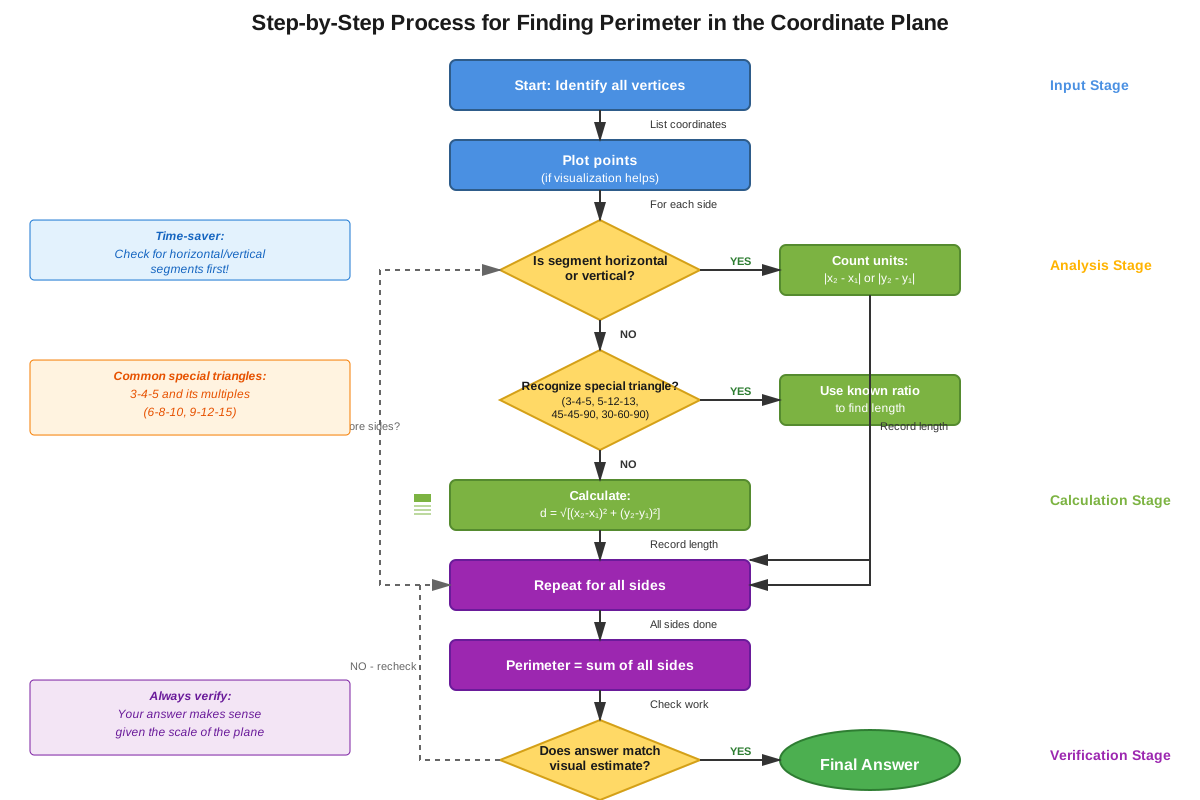
The systematic approach to finding perimeter in the coordinate plane follows these steps:
- Identify all vertices of the polygon and list them in order (clockwise or counterclockwise)
- Determine which points connect to form sides of the polygon
- Calculate the distance for each side using the distance formula or alternative methods
- Sum all distances to obtain the total perimeter
The key insight is that perimeter equals the sum of all side lengths, regardless of the polygon's shape or orientation. For a triangle with vertices A, B, and C, the perimeter P = AB + BC + CA, where each term represents the distance between consecutive vertices.
Special Cases and Shortcuts
Horizontal and vertical segments provide significant time-saving opportunities. When two points share the same y-coordinate (forming a horizontal line), the distance equals the absolute difference of x-coordinates: |x₂ - x₁|. Similarly, when points share the same x-coordinate (vertical line), the distance equals |y₂ - y₁|. Recognizing these cases eliminates the need for the distance formula entirely.
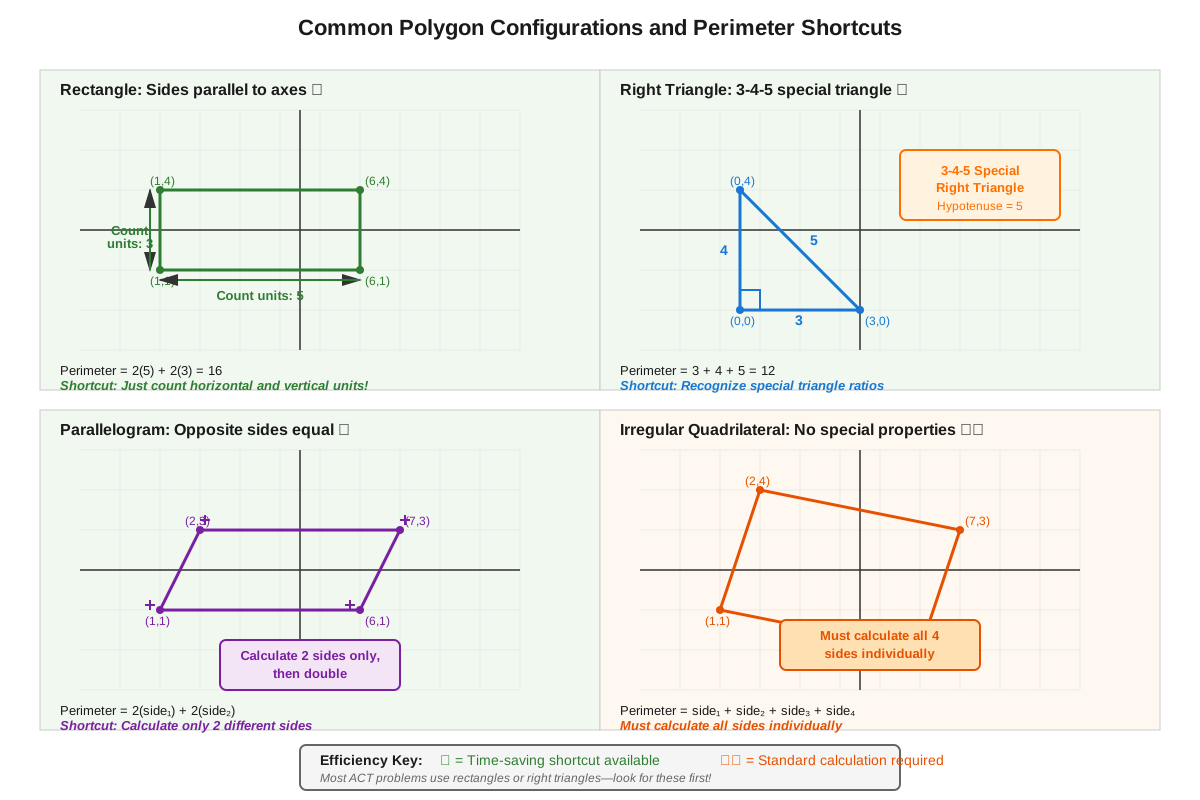
Rectangles and squares aligned with the coordinate axes offer the most straightforward calculations. For a rectangle with vertices at (x₁, y₁), (x₂, y₁), (x₂, y₂), and (x₁, y₂), the perimeter simplifies to:
P = 2|x₂ - x₁| + 2|y₂ - y₁|This represents twice the width plus twice the height, a formula students should recognize instantly.
Special Right Triangles in Coordinate Geometry
The ACT frequently constructs problems where sides form 45-45-90 or 30-60-90 triangles. When the horizontal and vertical distances between two points are equal, the connecting segment forms the hypotenuse of a 45-45-90 triangle, and the distance equals the leg length times √2. For example, from (2, 3) to (5, 6), both horizontal and vertical distances equal 3, so the actual distance is 3√2.
Counting Method for Simple Cases
For polygons with vertices at integer coordinates and sides parallel to the axes, counting grid squares provides a visual alternative. This method works best for rectangles and right triangles where students can literally count horizontal and vertical units. While not suitable for all problems, this approach offers a quick verification method and helps students who think visually.
Irregular Polygons and Complex Shapes
When dealing with irregular polygons (pentagons, hexagons, or other multi-sided figures), the process remains identical but requires more calculations. Students must systematically work around the perimeter, calculating each side length individually. Organization becomes critical—listing each side calculation separately prevents errors and makes verification possible.
| Polygon Type | Calculation Approach | Time Efficiency |
|---|---|---|
| Rectangle (axis-aligned) | Use 2(width + height) | Fastest |
| Right triangle (legs on axes) | Count or subtract coordinates | Very fast |
| General triangle | Distance formula for all 3 sides | Moderate |
| Irregular polygon | Distance formula for each side | Slower |
| Tilted rectangle | Distance formula for 2 adjacent sides, then double | Moderate |
Concept Relationships
The foundation of perimeter in the coordinate plane rests on the distance formula, which itself derives from the Pythagorean theorem. This hierarchical relationship means that understanding right triangle relationships directly enhances perimeter calculation ability. The distance formula → enables calculation of individual side lengths → which sum to produce the perimeter.
Coordinate plane fundamentals provide the framework within which all calculations occur. The ability to plot points and visualize shapes connects to polygon properties, allowing students to recognize when special cases apply. For instance, recognizing that four points form a rectangle immediately suggests using the simplified perimeter formula rather than calculating all four sides individually.
This topic bridges to area calculations in the coordinate plane, as many ACT questions ask for both perimeter and area of the same figure. The relationship extends to midpoint formula applications, since some problems require finding midpoints before calculating perimeter. Additionally, understanding slope helps identify parallel and perpendicular sides, which often indicate rectangles or other special quadrilaterals.
The progression flows: Basic coordinate plotting → Distance between two points → Multiple distance calculations → Perimeter of complete figures → Combined perimeter and area problems. Each level builds upon the previous, with perimeter serving as a mid-level skill that demonstrates coordinate geometry mastery.
High-Yield Facts
- ⭐ The distance formula d = √[(x₂ - x₁)² + (y₂ - y₁)²] calculates the length of any segment between two coordinate points
- ⭐ Perimeter equals the sum of all side lengths, regardless of polygon type or orientation
- ⭐ For horizontal segments, distance = |x₂ - x₁|; for vertical segments, distance = |y₂ - y₁|
- ⭐ Rectangle perimeter with axis-aligned sides = 2(width) + 2(height) = 2|Δx| + 2|Δy|
- ⭐ Always calculate distances for consecutive vertices in order around the polygon to avoid missing or duplicating sides
- When both Δx and Δy are equal, the segment forms a 45-45-90 triangle diagonal with length = leg × √2
- The perimeter of a square with side length s equals 4s, even when tilted on the coordinate plane
- Absolute value ensures positive distances regardless of which point is labeled first or second
- For right triangles with legs on the axes, the hypotenuse requires the distance formula while legs can be counted
- Irregular polygons require individual calculation of each side—there are no shortcuts for general polygons
- The order of subtraction in the distance formula doesn't matter: (x₂ - x₁)² = (x₁ - x₂)²
- Perimeter is always expressed in linear units (units, not square units like area)
Quick check — test yourself on Perimeter in the coordinate plane so far.
Try Flashcards →Common Misconceptions
Misconception: The distance between two points equals the sum of horizontal and vertical distances (|Δx| + |Δy|).
Correction: This calculates the "taxicab distance" or Manhattan distance, not the straight-line Euclidean distance. The actual distance requires the distance formula: √[(Δx)² + (Δy)²]. The sum |Δx| + |Δy| always exceeds the true distance except when points share a coordinate.
Misconception: Perimeter can be calculated by finding the distance between the leftmost and rightmost points, then doubling it.
Correction: This approach only works for specific symmetric shapes and ignores the actual path around the polygon. Perimeter requires calculating every side individually and summing them. The distance between extreme points provides no reliable shortcut.
Misconception: When calculating perimeter, it doesn't matter which vertices you connect.
Correction: Perimeter requires connecting consecutive vertices that actually form the polygon's sides. Connecting non-adjacent vertices creates diagonals, not perimeter segments. Students must trace the boundary of the shape systematically.
Misconception: For rectangles, you only need to calculate one side length since all sides are equal.
Correction: Rectangles have two pairs of equal sides (length and width), not four equal sides. Only squares have four equal sides. For rectangles, calculate one length and one width, then use P = 2l + 2w.
Misconception: The distance formula can be skipped if points are close together on the grid.
Correction: Distance depends on coordinate differences, not visual proximity on a particular graph scale. Points that appear close might have large coordinate differences. Always use the appropriate calculation method based on coordinate values, not visual appearance.
Misconception: Negative coordinates make the distance formula produce negative results.
Correction: The distance formula always produces positive results because it squares the differences before taking the square root. The squaring operation eliminates negative signs, ensuring distance is always positive (or zero for identical points).
Worked Examples
Example 1: Triangle Perimeter with Mixed Segment Types
Problem: Find the perimeter of triangle ABC with vertices A(1, 2), B(1, 7), and C(5, 2).
Solution:
Step 1: Identify the three sides that need calculation: AB, BC, and CA.
Step 2: Calculate AB (vertical segment, same x-coordinate):
- Both points have x = 1, so this is a vertical line
- Distance = |y₂ - y₁| = |7 - 2| = 5 units
Step 3: Calculate BC (diagonal segment):
- From B(1, 7) to C(5, 2)
- Δx = 5 - 1 = 4
- Δy = 2 - 7 = -5
- Distance = √[(4)² + (-5)²] = √[16 + 25] = √41 units
Step 4: Calculate CA (horizontal segment, same y-coordinate):
- Both points have y = 2, so this is a horizontal line
- Distance = |x₂ - x₁| = |5 - 1| = 4 units
Step 5: Sum all sides:
- Perimeter = AB + BC + CA = 5 + √41 + 4 = 9 + √41 units
Step 6: If the ACT requires a decimal approximation:
- √41 ≈ 6.4
- Perimeter ≈ 9 + 6.4 = 15.4 units
Connection to Learning Objectives: This problem demonstrates identifying when perimeter is tested (given vertices, asked for perimeter), applying the core strategy (distance formula for diagonal, counting for axis-aligned segments), and executing ACT-style calculations accurately.
Example 2: Rectangle Perimeter with Tilted Orientation
Problem: A rectangle has vertices at P(-2, 1), Q(1, 5), R(5, 2), and S(2, -2). Find its perimeter.
Solution:
Step 1: Recognize this is a rectangle (opposite sides equal) but not axis-aligned, so we need to calculate adjacent sides.
Step 2: Calculate PQ:
- From P(-2, 1) to Q(1, 5)
- Δx = 1 - (-2) = 3
- Δy = 5 - 1 = 4
- Distance = √[(3)² + (4)²] = √[9 + 16] = √25 = 5 units
Step 3: Calculate QR:
- From Q(1, 5) to R(5, 2)
- Δx = 5 - 1 = 4
- Δy = 2 - 5 = -3
- Distance = √[(4)² + (-3)²] = √[16 + 9] = √25 = 5 units
Step 4: Verify rectangle property:
- We found two adjacent sides both equal 5 units
- This indicates a square (special rectangle where all sides equal)
Step 5: Calculate perimeter:
- For a square with side length 5: P = 4s = 4(5) = 20 units
- Alternatively, verify by calculating RS and SP (both will equal 5)
Step 6: Verification check:
- Calculate RS: √[(2-5)² + (-2-2)²] = √[9 + 16] = 5 ✓
- Calculate SP: √[(-2-2)² + (1-(-2))²] = √[16 + 9] = 5 ✓
Connection to Learning Objectives: This example shows how recognizing special properties (square) can streamline calculations, demonstrates systematic application of the distance formula, and illustrates the importance of verifying answers when time permits.
Exam Strategy
Trigger Words and Phrases: Watch for "vertices at," "points," "coordinate plane," "grid," "perimeter," "distance around," "fencing required," or "boundary length." These phrases signal coordinate-based perimeter problems. Questions asking "what is the perimeter of polygon ABCD with vertices..." directly test this concept.
Approach Sequence:
- Sketch quickly (5-10 seconds): Plot the points roughly to visualize the shape
- Identify shape type: Rectangle, triangle, or irregular polygon
- Check for axis-aligned sides: These save significant calculation time
- Choose calculation method: Distance formula for diagonals, counting for axis-aligned segments
- Work systematically: Calculate sides in order around the perimeter
- Sum carefully: Add all distances, keeping track of exact values (like √2) versus decimals
Process of Elimination Tips:
- Eliminate answers that are impossibly small (less than the longest single side you can identify)
- Eliminate answers that exceed the sum of horizontal and vertical distances between extreme points
- If you calculate one side as an irrational number (containing √), the correct answer likely contains that same radical
- For rectangles, the perimeter must be an even multiple of something if all sides are integers
Time Allocation: Budget 60-90 seconds for straightforward problems (rectangles, simple triangles) and up to 2 minutes for irregular polygons or complex configurations. If a problem requires more than three distance formula calculations, ensure you're not missing a shortcut. Skip and return if you're spending more than 2.5 minutes on any single perimeter problem.
Calculator Usage: Use your calculator for squaring numbers, adding under the radical, and taking square roots. However, recognize when exact answers (like 5 + 2√3) are required versus decimal approximations. The ACT often provides answer choices that help you determine which form is expected.
Memory Techniques
Distance Formula Mnemonic: "Difference Squared Summed Rooted" (DSSR)
- Difference: Subtract coordinates (x₂ - x₁) and (y₂ - y₁)
- Squared: Square both differences
- Summed: Add the squared values
- Rooted: Take the square root
Perimeter Process Acronym: "VISCO" for systematic calculation
- Vertices: List all vertices in order
- Identify: Determine which points connect
- Segments: Calculate each segment length
- Combine: Add all lengths together
- Output: State the final perimeter with units
Visualization Strategy: Picture "walking around" the polygon from vertex to vertex. Each step you take represents one side length calculation. You haven't completed the perimeter until you return to your starting point.
Horizontal/Vertical Shortcut Memory: "Same Same Simple"
- Same x-coordinates → Simple subtraction of y-values
- Same y-coordinates → Simple subtraction of x-values
- Same means simple (no distance formula needed)
Special Triangle Recognition: When Δx = Δy, think "45-45-90 diagonal" and remember the distance equals leg × √2.
Summary
Perimeter in the coordinate plane combines coordinate geometry with measurement concepts, requiring students to calculate distances between coordinate points and sum them to find the total distance around a polygon. The distance formula d = √[(x₂ - x₁)² + (y₂ - y₁)²] serves as the primary tool, though horizontal and vertical segments allow shortcuts using simple coordinate subtraction. Success requires systematic identification of all sides, appropriate selection of calculation methods, and careful summation of distances. The ACT tests this concept regularly through problems involving triangles, rectangles, and occasionally irregular polygons, with vertices given as coordinate pairs. Recognition of special cases—particularly axis-aligned rectangles and segments forming special right triangles—significantly improves efficiency. Students must balance speed with accuracy, using visualization to verify that all sides have been included and that the calculated perimeter makes geometric sense for the given figure.
Key Takeaways
- The distance formula is essential for calculating any non-axis-aligned segment length between coordinate points
- Perimeter always equals the sum of all side lengths; calculate each side systematically to avoid errors
- Horizontal segments (same y-coordinate) and vertical segments (same x-coordinate) allow quick calculation without the distance formula
- Axis-aligned rectangles offer the fastest calculation: P = 2(width) + 2(height)
- Sketching the polygon helps identify shape type, special properties, and potential shortcuts
- Work around the perimeter in order (clockwise or counterclockwise) to ensure all sides are included exactly once
- The ACT typically presents 2-3 perimeter problems per test, making this a high-yield topic worth mastering
Related Topics
Area in the Coordinate Plane: After mastering perimeter, students naturally progress to calculating areas of polygons using coordinate geometry. This involves techniques like the shoelace formula, breaking shapes into triangles and rectangles, or using base-height calculations. Many ACT problems ask for both perimeter and area of the same figure.
Distance and Midpoint Applications: The distance formula extends beyond perimeter to problems involving circles (radius calculations), optimization (shortest distance), and geometric proofs. The midpoint formula often appears in conjunction with perimeter problems.
Slope and Parallel/Perpendicular Lines: Understanding slope relationships helps identify rectangles and other special quadrilaterals in the coordinate plane, which streamlines perimeter calculations by revealing which sides must be equal.
Transformations in the Coordinate Plane: Translations, reflections, and rotations preserve distance, meaning perimeter remains constant under these transformations. This concept appears in more advanced coordinate geometry problems.
Practice CTA
Now that you've mastered the core concepts of perimeter in the coordinate plane, it's time to solidify your understanding through active practice. Work through the practice questions to apply these strategies to ACT-style problems, and use the flashcards to reinforce key formulas and shortcuts. Remember, the distance between understanding a concept and mastering it is measured in practice problems solved. Each problem you work through builds the pattern recognition and calculation speed that will serve you on test day. You've got this—start practicing!
Sign up free to keep reading
Create a free AnvayaPrep account to finish this ACT guide on Perimeter in the coordinate plane — plus flashcards and practice questions.