Overview
Area in the coordinate plane is a fundamental topic in coordinate geometry that appears consistently on the ACT Math test. This concept requires students to calculate the area of various geometric shapes—including triangles, rectangles, trapezoids, and irregular polygons—when these shapes are positioned on a coordinate grid. Unlike traditional geometry problems where dimensions are explicitly provided, ACT area in the coordinate plane questions require students to first extract information from coordinate points, then apply appropriate area formulas.
Mastering this topic is essential for ACT success because it integrates multiple mathematical skills: understanding the coordinate plane, calculating distances between points, recognizing geometric shapes from their vertices, and applying area formulas accurately. The ACT frequently tests this concept by presenting vertices of polygons and asking students to determine the enclosed area, often combining this with other coordinate geometry concepts like slope, midpoint, or distance formula. Questions may involve shapes with sides parallel to the axes (simpler calculations) or shapes with diagonal sides (requiring more sophisticated approaches).
This topic serves as a bridge between pure coordinate geometry and applied geometric measurement. It builds upon foundational concepts like plotting points, understanding quadrants, and calculating distances, while also connecting to broader mathematical reasoning about spatial relationships. Students who master area calculations in the coordinate plane develop stronger visualization skills and problem-solving flexibility—abilities that prove valuable across multiple ACT Math domains, including geometry, algebra, and even some trigonometry questions.
Learning Objectives
- [ ] Identify when Area in the coordinate plane is being tested
- [ ] Explain the core rule or strategy behind Area in the coordinate plane
- [ ] Apply Area in the coordinate plane to ACT-style questions accurately
- [ ] Calculate areas of triangles using the coordinate formula method
- [ ] Determine areas of rectangles and parallelograms using coordinate geometry techniques
- [ ] Decompose irregular polygons into simpler shapes for area calculation
- [ ] Apply the Shoelace formula for finding areas of general polygons
Prerequisites
- Plotting points on the coordinate plane: Essential for visualizing the shapes whose areas need to be calculated
- Distance formula: Required to find side lengths when they're not parallel to axes
- Basic area formulas: Students must know standard formulas for triangles (½bh), rectangles (lw), and trapezoids (½h(b₁+b₂))
- Understanding of absolute value: Necessary when calculating horizontal and vertical distances between points
- Slope concepts: Helpful for determining if sides are perpendicular or parallel
Why This Topic Matters
In real-world applications, coordinate plane area calculations appear in fields ranging from architecture and urban planning to computer graphics and geographic information systems (GIS). Surveyors use coordinate-based area calculations to determine property boundaries, while software engineers employ similar concepts in computational geometry for video games and design applications. Understanding how to calculate areas from coordinate data is fundamental to any field involving spatial analysis or digital mapping.
On the ACT Math test, area in the coordinate plane questions appear with notable frequency—typically 1-3 questions per exam. These questions often fall in the medium-to-difficult range (questions 30-50 out of 60), making them crucial for students aiming for scores above 25. The ACT tests this concept in several distinct ways: direct area calculation given vertices, finding missing coordinates when area is specified, determining which shape has the greatest area among options, and combining area calculations with other coordinate geometry concepts.
Common question formats include: presenting four vertices and asking for the area of the resulting quadrilateral; giving three vertices of a triangle with one variable coordinate and specifying the area to solve for that coordinate; showing a shaded region on a coordinate grid and asking for its area; or describing a geometric transformation and asking how it affects area. The ACT particularly favors questions where shapes have sides parallel to the axes, as these can be solved quickly using counting or simple subtraction, rewarding students who recognize efficient solution paths.
Core Concepts
Understanding the Coordinate Plane Framework
The coordinate plane consists of two perpendicular number lines—the x-axis (horizontal) and y-axis (vertical)—that intersect at the origin (0,0). When calculating areas, the coordinate system provides a precise framework for determining distances and positions. Each point is represented as an ordered pair (x, y), where x indicates horizontal position and y indicates vertical position. The key advantage of working in the coordinate plane is that distances parallel to the axes can be calculated through simple subtraction: the horizontal distance between points (x₁, y) and (x₂, y) is |x₂ - x₁|, while the vertical distance between points (x, y₁) and (x, y₂) is |y₂ - y₁|.
Rectangles and Squares with Axis-Parallel Sides
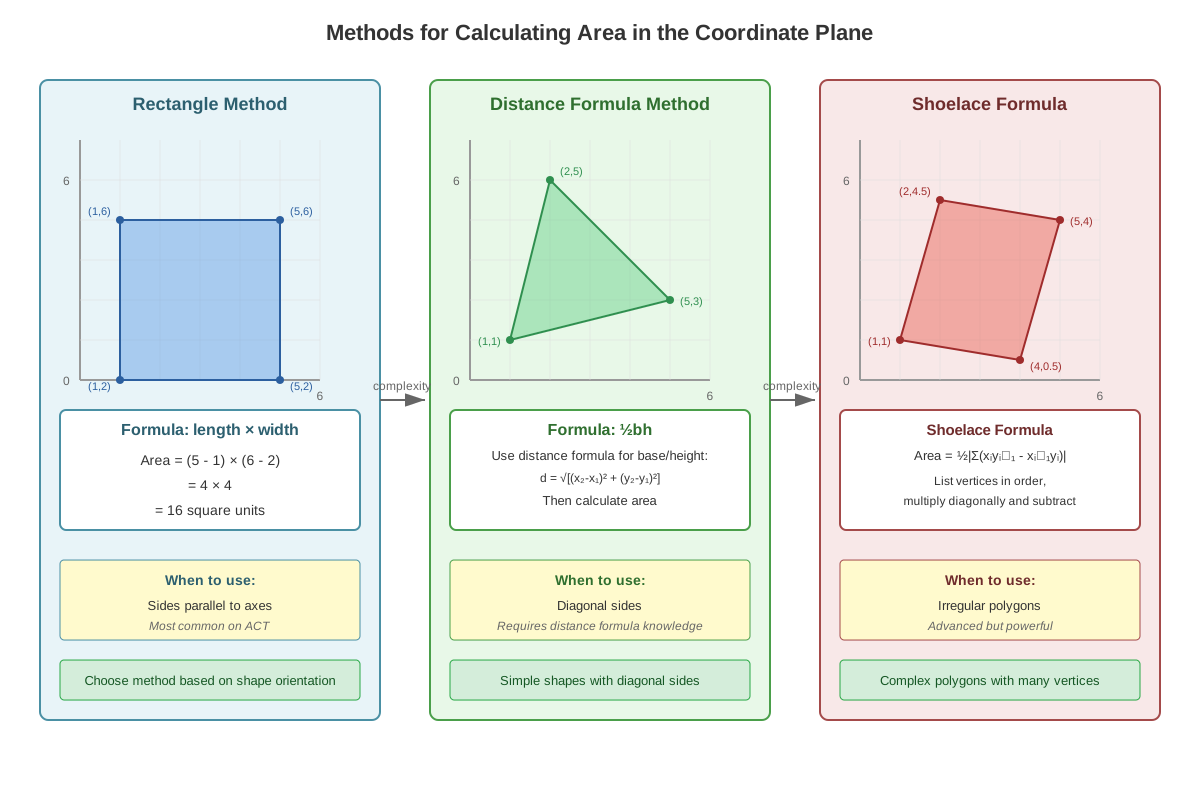
The simplest area calculations involve rectangles or squares whose sides are parallel to the coordinate axes. For a rectangle with vertices at (x₁, y₁), (x₂, y₁), (x₂, y₂), and (x₁, y₂), the area equals:
Area = |x₂ - x₁| × |y₂ - y₁|The length is the horizontal distance between vertical sides, and the width is the vertical distance between horizontal sides. The absolute value ensures positive measurements regardless of which coordinates are larger. For example, a rectangle with vertices at (2, 3), (7, 3), (7, 8), and (2, 8) has area = |7 - 2| × |8 - 3| = 5 × 5 = 25 square units.
Triangle Area Using the Coordinate Formula
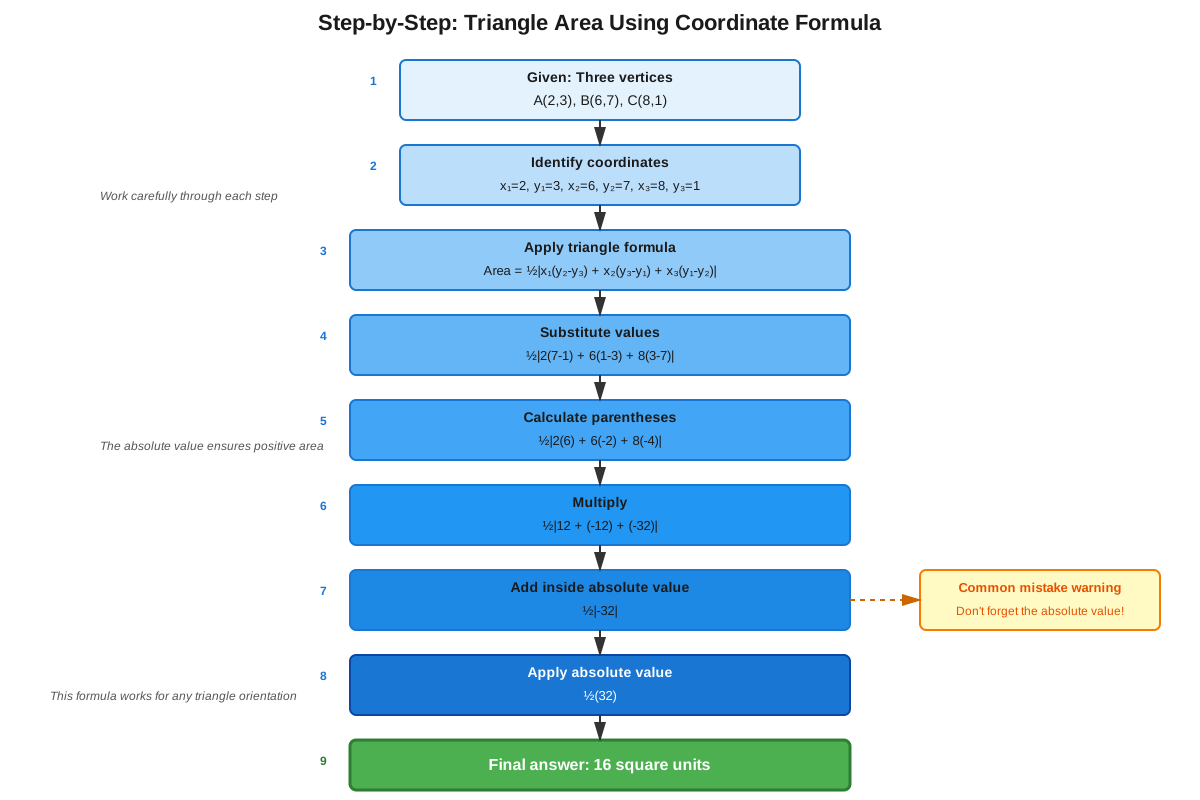
For triangles with vertices at (x₁, y₁), (x₂, y₂), and (x₃, y₃), the coordinate triangle area formula provides a direct calculation method:
Area = ½|x₁(y₂ - y₃) + x₂(y₃ - y₁) + x₃(y₁ - y₂)|This formula works for any triangle regardless of orientation. The absolute value ensures a positive result, and the ½ factor accounts for the triangular shape. This method is particularly efficient on the ACT because it eliminates the need to find base and height separately. For instance, a triangle with vertices at (1, 2), (5, 2), and (3, 6) has area = ½|1(2 - 6) + 5(6 - 2) + 3(2 - 2)| = ½|-4 + 20 + 0| = ½(16) = 8 square units.
Base-Height Method for Triangles
When a triangle has one side parallel to an axis, the base-height method often provides the quickest solution. Identify the side parallel to an axis as the base (calculate its length using coordinate subtraction), then find the perpendicular distance from the opposite vertex to the line containing that base—this is the height. The area is ½ × base × height. For a triangle with vertices at (1, 2), (6, 2), and (4, 7), the base from (1, 2) to (6, 2) has length 5, the height is the vertical distance from (4, 7) to the line y = 2, which is 5, so area = ½(5)(5) = 12.5 square units.
Counting Square Units for Simple Shapes
For shapes drawn on a coordinate grid with vertices at integer coordinates, counting square units can be the fastest method. Count complete unit squares inside the shape, then estimate partial squares along the boundaries. This method works best for small shapes or when precise calculation seems time-consuming. The ACT sometimes presents shaded regions on grids specifically to reward students who recognize that counting is more efficient than calculation.
Decomposition Strategy for Complex Polygons
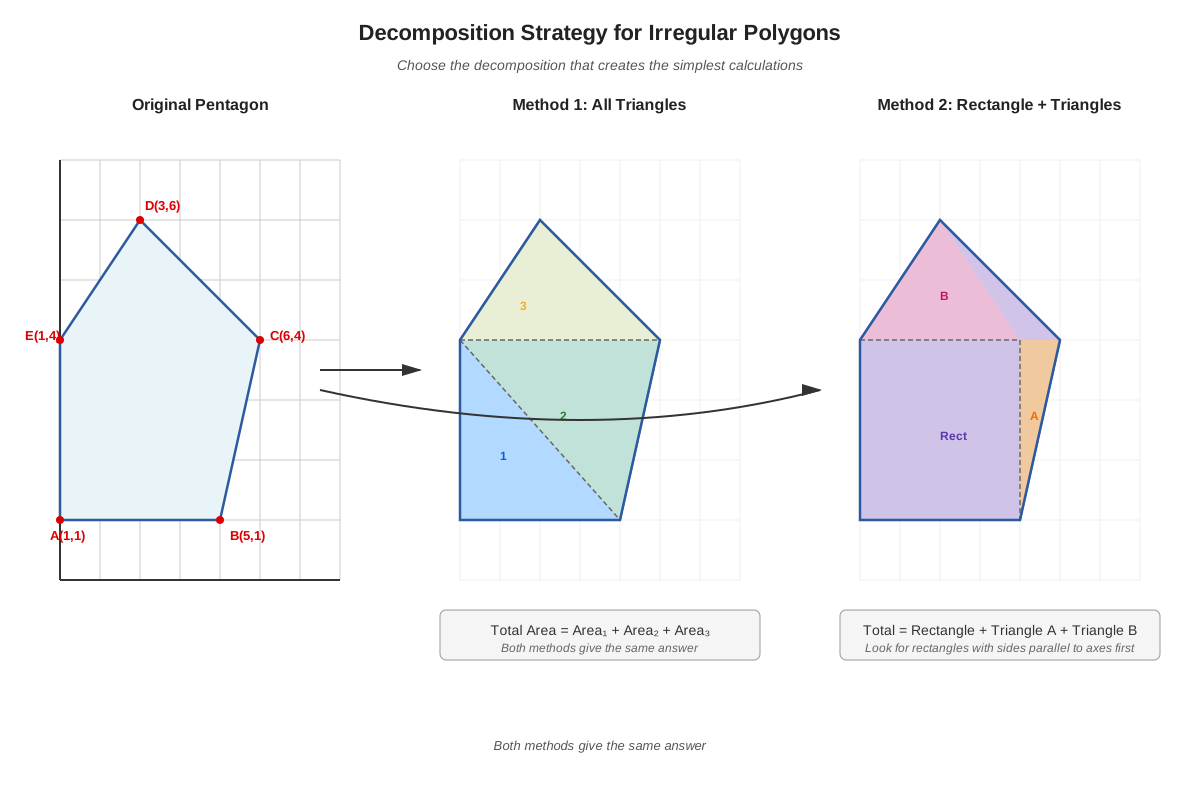
When dealing with quadrilaterals or polygons that aren't standard shapes, the decomposition strategy involves dividing the figure into triangles or rectangles whose areas can be calculated separately, then summing these areas. Draw diagonals or auxiliary lines to create simpler shapes. For example, any quadrilateral can be split into two triangles by drawing one diagonal, then the coordinate triangle formula can be applied to each triangle.
The Shoelace Formula for General Polygons
For polygons with more than three sides, the Shoelace formula (also called the surveyor's formula) provides a systematic approach. For a polygon with vertices (x₁, y₁), (x₂, y₂), ..., (xₙ, yₙ) listed in order (clockwise or counterclockwise):
Area = ½|x₁y₂ + x₂y₃ + ... + xₙy₁ - (y₁x₂ + y₂x₃ + ... + yₙx₁)|This formula generalizes the triangle formula and works for any simple polygon. While less commonly needed on the ACT, understanding this method demonstrates mathematical sophistication and provides a reliable backup for unusual polygon problems.
Subtraction Method for Irregular Regions
Sometimes the most efficient approach involves calculating the area of a larger, simpler shape that contains the target region, then subtracting the areas of unwanted portions. For instance, if asked to find the area of a triangle with vertices at (0, 0), (4, 3), and (2, 5), one could calculate the area of the rectangle from (0, 0) to (4, 5) (area = 20), then subtract the three right triangles in the corners that aren't part of the target triangle.
Comparison Table of Methods
| Method | Best Used When | Advantages | Limitations |
|---|---|---|---|
| Length × Width | Rectangle with axis-parallel sides | Fastest, simplest calculation | Only works for rectangles/squares |
| Coordinate Formula | Any triangle | Works regardless of orientation | Requires careful arithmetic |
| Base-Height | Triangle with one axis-parallel side | Intuitive, quick | Need to identify appropriate base |
| Counting | Small shapes on grid | Visual, reduces calculation errors | Imprecise for large or non-integer areas |
| Decomposition | Irregular polygons | Breaks complex into manageable parts | Requires strategic planning |
| Shoelace | Any polygon | Systematic, comprehensive | More calculation steps |
| Subtraction | Irregular regions | Leverages simpler shapes | Requires visualization |
Concept Relationships
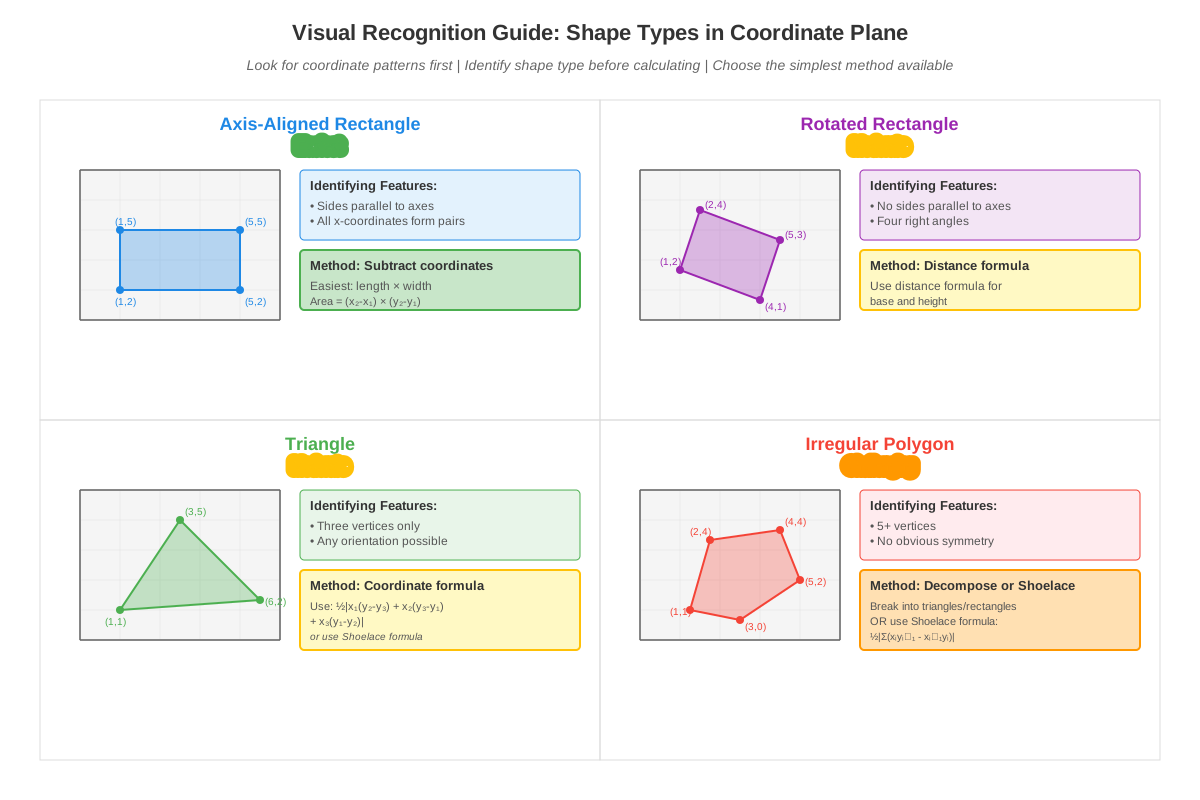
The concepts within area in the coordinate plane form a hierarchical structure. At the foundation lies coordinate plane understanding → which enables distance calculation between points → which supports identification of shape dimensions → which allows application of appropriate area formulas. The choice of method depends on shape recognition: axis-parallel rectangles → use direct length × width; triangles with axis-parallel sides → use base-height method; general triangles → use coordinate formula; complex polygons → use decomposition or Shoelace formula.
This topic connects directly to prerequisite knowledge: the distance formula provides side lengths when needed; absolute value ensures positive measurements; basic area formulas serve as the computational foundation. Looking forward, mastering area in the coordinate plane enables progression to more advanced topics like optimization problems (finding maximum/minimum areas), calculus applications (areas under curves), and vector geometry (cross products for area calculation).
The relationship between methods follows a complexity gradient: counting (most visual, least computational) → length × width (simple arithmetic) → base-height (requires perpendicular distance) → coordinate formula (algebraic manipulation) → decomposition (strategic planning) → Shoelace formula (systematic but calculation-intensive). Students should develop flexibility to move between methods based on problem characteristics.
Quick check — test yourself on Area in the coordinate plane so far.
Try Flashcards →High-Yield Facts
⭐ For rectangles with sides parallel to axes, area = (difference in x-coordinates) × (difference in y-coordinates)
⭐ The coordinate triangle area formula is: Area = ½|x₁(y₂ - y₃) + x₂(y₃ - y₁) + x₃(y₁ - y₂)|
⭐ When one side of a triangle is horizontal or vertical, the base-height method is usually fastest
⭐ Any quadrilateral can be divided into two triangles by drawing one diagonal
⭐ The area of a shape doesn't change under translation (sliding), but coordinates do change
- For shapes on a grid with integer vertices, counting square units can be faster than calculation
- The absolute value in area formulas ensures positive results regardless of coordinate order
- A triangle with one vertex at (x, y) and opposite side on an axis has height equal to |y| (if side is on x-axis) or |x| (if side is on y-axis)
- The Shoelace formula works for any simple polygon when vertices are listed consecutively
- Subtracting areas of unwanted regions from a bounding rectangle often simplifies complex problems
- When coordinates involve fractions or decimals, look for alternative methods like decomposition
- The area of a parallelogram in the coordinate plane equals base × height, where height is perpendicular distance between parallel sides
Common Misconceptions
Misconception: Area equals the sum of all coordinate values → Correction: Area is calculated using geometric formulas applied to distances between points, not by adding coordinate values. The coordinates provide position information that must be converted to lengths and widths.
Misconception: The coordinate triangle formula can be used without absolute value → Correction: The absolute value is essential because the expression inside can be negative depending on whether vertices are listed clockwise or counterclockwise. Without absolute value, you might get a negative area, which is meaningless.
Misconception: For a rectangle, you can multiply any two coordinates to get area → Correction: Area requires multiplying the length (horizontal distance) by the width (vertical distance), which are calculated as differences between coordinates, not the coordinates themselves. A rectangle from (2,3) to (5,7) has area (5-2)(7-3) = 12, not 5×7 = 35.
Misconception: The distance formula is always needed to find triangle area → Correction: The coordinate triangle formula calculates area directly from coordinates without requiring side lengths. The distance formula is only needed when using methods that require knowing specific side lengths (like Heron's formula).
Misconception: Shapes in different quadrants require different formulas → Correction: All area formulas work regardless of which quadrant(s) the shape occupies. The absolute value operations in the formulas handle negative coordinates automatically.
Misconception: Counting squares gives exact areas for all shapes → Correction: Counting provides exact areas only when all vertices fall on grid intersections and all boundaries align with grid lines. For shapes with diagonal sides, counting gives approximations unless you carefully account for partial squares.
Misconception: The order of vertices doesn't matter when using the coordinate formula → Correction: While the absolute value ensures a positive result, vertices must be used consistently in the formula. Randomly mixing up the order can lead to calculation errors. List vertices in consecutive order around the perimeter.
Worked Examples
Example 1: Rectangle with Axis-Parallel Sides
Problem: Find the area of the rectangle with vertices at A(2, 3), B(8, 3), C(8, 9), and D(2, 9).
Solution:
Step 1: Recognize that this is a rectangle with sides parallel to the axes (all x-coordinates are either 2 or 8, and all y-coordinates are either 3 or 9).
Step 2: Calculate the horizontal distance (length):
- The x-coordinates are 2 and 8
- Length = |8 - 2| = 6 units
Step 3: Calculate the vertical distance (width):
- The y-coordinates are 3 and 9
- Width = |9 - 3| = 6 units
Step 4: Apply the rectangle area formula:
- Area = length × width = 6 × 6 = 36 square units
Connection to Learning Objectives: This example demonstrates identifying when area in the coordinate plane is being tested (vertices given on coordinate plane) and applying the core strategy (using coordinate differences for axis-parallel rectangles).
Example 2: Triangle Using Coordinate Formula
Problem: A triangle has vertices at P(1, 2), Q(5, 8), and R(7, 3). Find its area.
Solution:
Step 1: Identify that this triangle doesn't have sides parallel to axes, so the coordinate formula is most efficient.
Step 2: Label the coordinates:
- (x₁, y₁) = (1, 2)
- (x₂, y₂) = (5, 8)
- (x₃, y₃) = (7, 3)
Step 3: Apply the coordinate triangle area formula:
Area = ½|x₁(y₂ - y₃) + x₂(y₃ - y₁) + x₃(y₁ - y₂)|
Step 4: Substitute values:
Area = ½|1(8 - 3) + 5(3 - 2) + 7(2 - 8)|
Step 5: Calculate each term:
- First term: 1(5) = 5
- Second term: 5(1) = 5
- Third term: 7(-6) = -42
Step 6: Complete the calculation:
Area = ½|5 + 5 + (-42)| = ½|-32| = ½(32) = 16 square units
Connection to Learning Objectives: This example shows applying the coordinate formula method to ACT-style questions accurately, demonstrating the core strategy for triangles without axis-parallel sides.
Example 3: Irregular Quadrilateral Using Decomposition
Problem: Find the area of quadrilateral ABCD with vertices at A(1, 1), B(6, 2), C(5, 6), and D(2, 5).
Solution:
Step 1: Recognize this is an irregular quadrilateral, so decomposition into triangles is appropriate.
Step 2: Draw diagonal AC to divide the quadrilateral into triangles ABC and ACD.
Step 3: Calculate area of triangle ABC using the coordinate formula:
- (x₁, y₁) = (1, 1), (x₂, y₂) = (6, 2), (x₃, y₃) = (5, 6)
- Area₁ = ½|1(2 - 6) + 6(6 - 1) + 5(1 - 2)|
- Area₁ = ½|1(-4) + 6(5) + 5(-1)|
- Area₁ = ½|-4 + 30 - 5| = ½|21| = 10.5 square units
Step 4: Calculate area of triangle ACD:
- (x₁, y₁) = (1, 1), (x₂, y₂) = (5, 6), (x₃, y₃) = (2, 5)
- Area₂ = ½|1(6 - 5) + 5(5 - 1) + 2(1 - 6)|
- Area₂ = ½|1(1) + 5(4) + 2(-5)|
- Area₂ = ½|1 + 20 - 10| = ½|11| = 5.5 square units
Step 5: Add the two triangle areas:
Total Area = 10.5 + 5.5 = 16 square units
Connection to Learning Objectives: This demonstrates decomposing irregular polygons into simpler shapes, a key strategy for complex ACT problems.
Exam Strategy
When approaching ACT questions on area in the coordinate plane, begin by quickly sketching the shape on scratch paper or in the test booklet margin. This visualization helps identify the shape type and suggests the most efficient solution method. Look for axis-parallel sides first—these indicate that simple subtraction will give dimensions, making calculation much faster.
Trigger words and phrases that signal area in the coordinate plane questions include: "vertices at," "points on the coordinate plane," "enclosed region," "shaded area," "square units," and "find the area of the polygon." When you see coordinates listed as ordered pairs in a geometry question, area calculation is likely involved.
For process of elimination, use these strategies:
- Quickly estimate area by approximating the shape as a rectangle or triangle and calculating rough bounds
- Eliminate answers that are impossibly large (greater than the bounding rectangle) or impossibly small (less than half the bounding rectangle for most shapes)
- Check if the answer should be a whole number (when all coordinates are integers and the shape has axis-parallel sides) or could be a fraction/decimal
- Verify units—ACT answers for area are always in square units
Time allocation: Spend 15-20 seconds sketching and identifying the shape type, 30-45 seconds on calculation, and 10-15 seconds checking your answer. If a problem seems to require more than 90 seconds, consider whether you've chosen the most efficient method. Rectangle problems should take 30-45 seconds total; triangle problems 45-60 seconds; complex polygons up to 90 seconds.
Strategic approach sequence:
- Identify the shape from the number and arrangement of vertices
- Check for axis-parallel sides (fastest calculation method)
- For triangles without axis-parallel sides, use the coordinate formula
- For quadrilaterals, consider decomposition into two triangles
- For irregular regions, consider the subtraction method
- Always double-check that you've used absolute value where needed
ACT Tip: If you're stuck between two methods, choose the one with fewer calculation steps. The ACT rewards efficiency, and simpler methods reduce arithmetic errors.
Memory Techniques
Mnemonic for Coordinate Triangle Formula: "X-Y Differences Halved" reminds you that the formula involves x-coordinates multiplied by y-differences, and the result is halved.
Visualization Strategy: Picture the coordinate plane as a city grid where each unit represents one city block. Area represents how many blocks a park or building occupies. This concrete visualization helps with counting methods and estimating reasonable answers.
Acronym for Method Selection - ARCH:
- Axis-parallel? Use length × width
- Rectangle or square? Direct calculation
- Complex shape? Decompose
- Height identifiable? Use base-height
Pattern Recognition: Remember that shapes with all integer coordinates and axis-parallel sides always have integer areas. If your calculation gives a fraction or decimal for such a shape, recheck your work.
Formula Memory Aid: For the coordinate triangle formula, remember the pattern "x₁ times (y₂ minus y₃)"—each x-coordinate multiplies the difference of the two y-coordinates that don't belong to it. This pattern continues cyclically through all three vertices.
Summary
Area in the coordinate plane is a high-yield ACT Math topic that integrates coordinate geometry with geometric measurement. Success requires recognizing shape types from given vertices, selecting the most efficient calculation method, and applying area formulas accurately. Rectangles with axis-parallel sides use simple coordinate subtraction for dimensions, then length × width for area. Triangles can be solved using the coordinate formula (which works for any triangle) or the base-height method (when one side is axis-parallel). Complex polygons require decomposition into simpler shapes or application of the Shoelace formula. The key to ACT success is developing flexibility to choose the fastest method based on the specific problem characteristics—axis-parallel sides suggest direct calculation, while general triangles call for the coordinate formula. Always sketch the shape for visualization, use absolute value to ensure positive results, and verify that your answer is reasonable by comparing it to a bounding rectangle. Mastering these strategies enables students to solve area problems efficiently and accurately, typically within 60-90 seconds per question.
Key Takeaways
- For rectangles with sides parallel to axes, area equals (horizontal distance) × (vertical distance), calculated using coordinate differences
- The coordinate triangle area formula works for any triangle: ½|x₁(y₂ - y₃) + x₂(y₃ - y₁) + x₃(y₁ - y₂)|
- Always sketch the shape to identify the most efficient solution method—visualization prevents errors and reveals shortcuts
- Decompose irregular polygons into triangles or rectangles whose areas can be calculated separately and summed
- Use absolute value in formulas to ensure positive area results regardless of coordinate order or quadrant location
- Counting square units is fastest for small shapes with integer coordinates on a visible grid
- Estimate area bounds using a bounding rectangle to eliminate unreasonable answer choices quickly
Related Topics
Distance Formula in the Coordinate Plane: Understanding how to calculate the distance between any two points enables finding side lengths of shapes, which is essential for area calculations when using methods like Heron's formula or when verifying that a shape is a specific type (like a square or rhombus).
Slope and Parallel/Perpendicular Lines: Recognizing when sides are parallel or perpendicular helps identify rectangles, squares, and right triangles, which have simpler area formulas. This topic builds directly on coordinate plane fundamentals.
Transformations in the Coordinate Plane: Understanding how translations, reflections, rotations, and dilations affect coordinates and areas deepens geometric reasoning. Mastering basic area calculation is prerequisite to analyzing how transformations change or preserve area.
Polygons and Their Properties: Advanced study of polygon classification, interior angles, and special quadrilaterals (parallelograms, trapezoids, rhombi) extends area calculation skills to more complex scenarios and provides additional problem-solving strategies.
Practice CTA
Now that you've mastered the core concepts and strategies for area in the coordinate plane, it's time to solidify your understanding through practice! Work through the practice questions to apply these techniques to ACT-style problems, and use the flashcards to reinforce key formulas and methods. Remember, the difference between understanding a concept and mastering it for test day is consistent, focused practice. Each problem you solve builds the pattern recognition and calculation speed that will help you confidently tackle any area question the ACT presents. You've got this!
Sign up free to keep reading
Create a free AnvayaPrep account to finish this ACT guide on Area in the coordinate plane — plus flashcards and practice questions.