Overview
Decimals are fundamental numerical representations that appear extensively throughout the ACT Math test, serving as the bridge between whole numbers and fractions. Understanding decimals is not merely about recognizing numbers with decimal points—it encompasses a comprehensive skill set including place value interpretation, arithmetic operations, conversions between different numerical forms, and the ability to estimate and compare decimal quantities quickly and accurately. The ACT frequently embeds decimal concepts within word problems, geometry calculations, data interpretation questions, and algebraic expressions, making decimal fluency essential for success across multiple question types.
Mastery of ACT decimals directly impacts performance on approximately 15-20% of Math section questions, either as the primary focus or as a computational component within more complex problems. Students who struggle with decimal operations often lose valuable time on calculations, make preventable errors in multi-step problems, and miss opportunities to use estimation strategies that could eliminate incorrect answer choices efficiently. The ACT specifically tests whether students can work with decimals in practical contexts—calculating percentages, interpreting measurements, analyzing statistical data, and solving real-world problems where decimal precision matters.
Within the broader Number and Quantity unit, decimals connect intimately with fractions, percentages, ratios, and scientific notation. They serve as the computational foundation for algebra, coordinate geometry, and trigonometry problems that follow. Strong decimal skills enable students to verify answers through estimation, recognize unreasonable results, and maintain accuracy when using calculators. The ACT rewards students who can seamlessly convert between fractions and decimals, recognize equivalent forms, and choose the most efficient computational approach for each unique problem situation.
Learning Objectives
- [ ] Identify when Decimals is being tested in ACT Math questions
- [ ] Explain the core rule or strategy behind Decimals operations and conversions
- [ ] Apply Decimals to ACT-style questions accurately and efficiently
- [ ] Convert fluently between decimals, fractions, and percentages without calculator dependence
- [ ] Perform multi-step decimal operations while maintaining proper place value alignment
- [ ] Estimate decimal calculations to verify reasonableness of answers and eliminate incorrect choices
- [ ] Recognize and correct common decimal errors that lead to wrong answer choices
Prerequisites
- Whole number operations (addition, subtraction, multiplication, division): Decimal operations follow identical algorithms with the added consideration of place value alignment
- Place value understanding (ones, tens, hundreds): Extends naturally to tenths, hundredths, thousandths positions to the right of the decimal point
- Basic fraction concepts: Decimals are alternative representations of fractions with denominators of 10, 100, 1000, etc.
- Order of operations (PEMDAS): Applies equally to expressions containing decimals
- Rounding principles: Essential for estimation strategies and interpreting decimal precision requirements
Why This Topic Matters
Decimals appear in everyday financial transactions, scientific measurements, statistical analysis, and technological applications. From calculating sales tax and tip percentages to interpreting batting averages and GPS coordinates, decimal literacy enables informed decision-making in personal and professional contexts. Engineers use decimals for precision measurements, financial analysts work with decimal representations of interest rates and stock prices, and healthcare professionals calculate medication dosages using decimal quantities.
On the ACT Math test, decimal questions appear in approximately 8-12 of the 60 questions, representing 13-20% of the exam. These questions span multiple content areas: Pre-Algebra (decimal operations and conversions), Elementary Algebra (solving equations with decimal coefficients), Intermediate Algebra (working with decimal exponents), Coordinate Geometry (plotting decimal coordinates), and Statistics (interpreting decimal data). The ACT specifically favors questions that combine decimal operations with other concepts—for example, calculating the area of a rectangle with decimal dimensions, finding the mean of a data set containing decimals, or solving a proportion that yields a decimal answer.
Common question formats include: word problems requiring decimal calculations (shopping scenarios, measurement conversions, rate problems), data interpretation from tables or graphs with decimal values, geometry problems with decimal measurements, percentage problems requiring decimal conversion, and scientific notation questions. The test writers deliberately include answer choices that represent common decimal errors (misplaced decimal points, incorrect rounding, conversion mistakes) to identify students who lack precision in their calculations.
Core Concepts
Place Value in Decimals
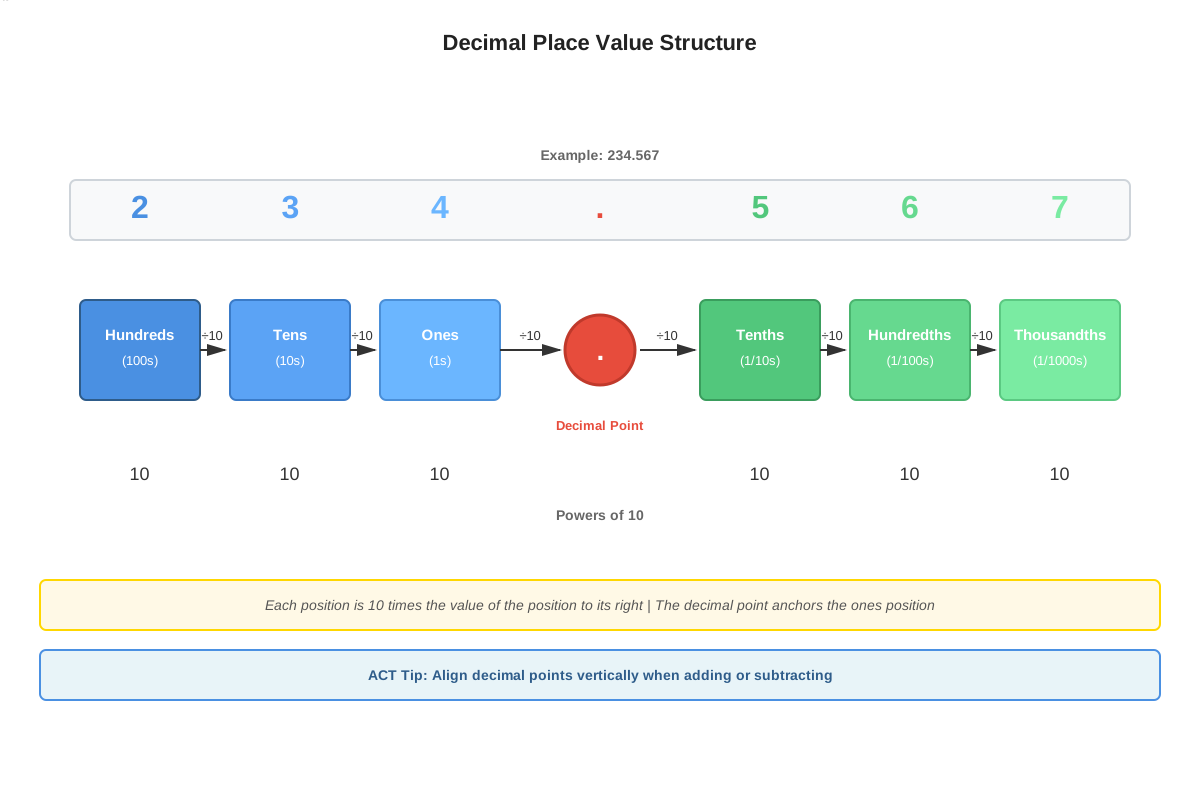
The decimal point serves as the reference marker separating whole number positions (to the left) from fractional positions (to the right). Each position represents a power of ten, with places to the right representing negative powers: tenths (10⁻¹), hundredths (10⁻²), thousandths (10⁻³), ten-thousandths (10⁻⁴), and so forth. Understanding place value is fundamental to all decimal operations.
Consider the number 3,456.789:
- 3 is in the thousands place (3 × 1000)
- 4 is in the hundreds place (4 × 100)
- 5 is in the tens place (5 × 10)
- 6 is in the ones place (6 × 1)
- 7 is in the tenths place (7 × 0.1)
- 8 is in the hundredths place (8 × 0.01)
- 9 is in the thousandths place (9 × 0.001)
The symmetry around the decimal point helps students remember that each move to the right divides by 10, while each move to the left multiplies by 10. This principle underlies multiplication and division by powers of ten—a frequent ACT testing point.
Comparing and Ordering Decimals
To compare decimals accurately, align the decimal points vertically and compare digits from left to right, starting with the leftmost position. Add zeros to the right as placeholders when decimals have different lengths—this does not change their value but facilitates comparison.
Comparison strategy:
- Compare whole number parts first
- If whole numbers are equal, compare tenths place
- If tenths are equal, compare hundredths place
- Continue rightward until finding a difference
Example: Order 0.5, 0.45, 0.505, 0.055 from least to greatest.
Rewrite with aligned place values:
- 0.500
- 0.450
- 0.505
- 0.055
Comparing: 0.055 < 0.450 < 0.500 < 0.505
Adding and Subtracting Decimals
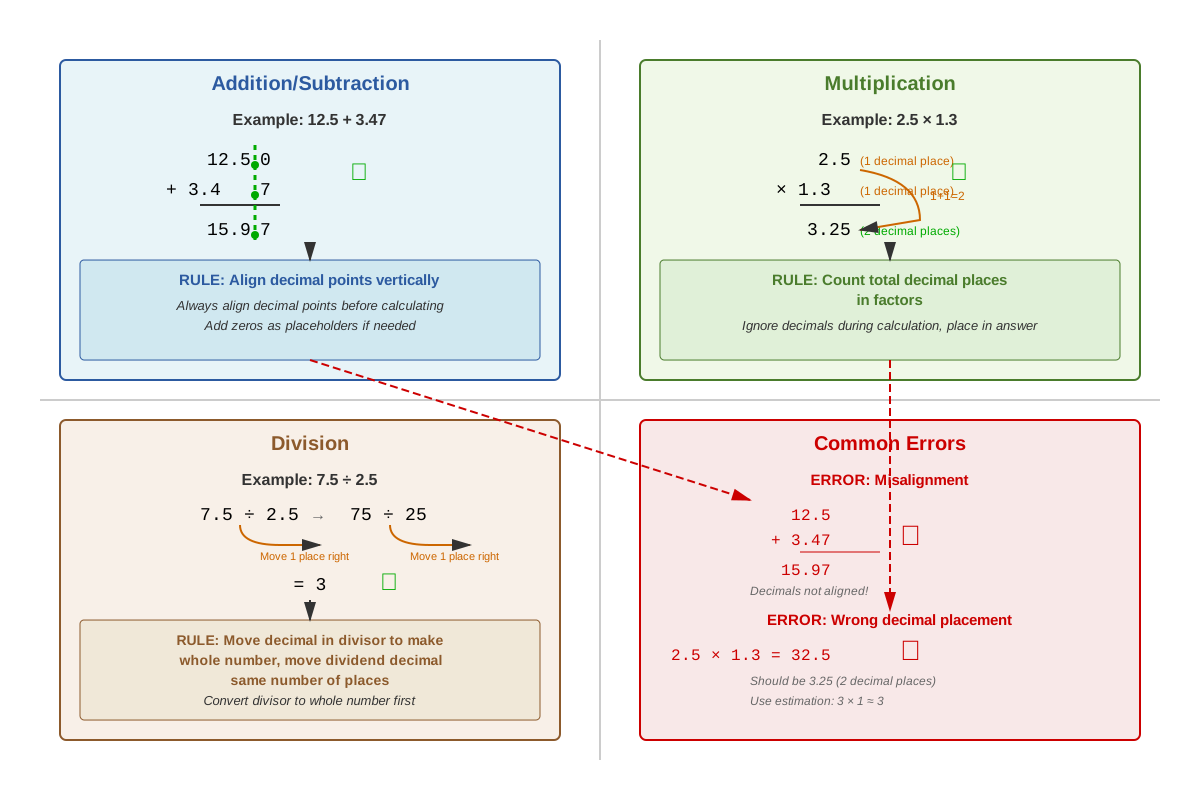
Decimal addition and subtraction require careful alignment of decimal points to ensure digits in the same place value positions combine correctly. The decimal point in the answer appears directly below the aligned decimal points in the problem.
Procedure:
- Write numbers vertically with decimal points aligned
- Add zeros as placeholders to make all numbers the same length
- Add or subtract as with whole numbers
- Place decimal point in answer directly below other decimal points
Example: 45.6 + 3.875 + 0.52
  45.600
+  3.875
+  0.520
---------
  49.995
Multiplying Decimals
When multiplying decimals, ignore the decimal points initially and multiply as whole numbers. Then count the total number of decimal places in all factors and place the decimal point in the product so it has that same total number of decimal places.
Procedure:
- Multiply the numbers as if they were whole numbers
- Count total decimal places in all factors
- Place decimal point in product from right to left, counting that many places
Example: 3.2 × 0.45
32 × 45 = 1440
3.2 has 1 decimal place
0.45 has 2 decimal places
Total: 3 decimal places
Answer: 1.440 or 1.44
Multiplying by powers of 10: Move the decimal point right one place for each factor of 10. Multiplying by 10 moves it right once, by 100 moves it right twice, by 1000 moves it right three times.
Dividing Decimals
Decimal division requires converting the divisor to a whole number by moving its decimal point to the right, then moving the dividend's decimal point the same number of places. The decimal point in the quotient aligns with the adjusted decimal point in the dividend.
Procedure:
- Move the decimal point in the divisor right until it becomes a whole number
- Move the decimal point in the dividend the same number of places right
- Place the decimal point in the quotient directly above the dividend's decimal point
- Divide as with whole numbers
Example: 4.56 ÷ 0.12
Move both decimal points 2 places right: 456 ÷ 12
456 ÷ 12 = 38
Answer: 38
Dividing by powers of 10: Move the decimal point left one place for each factor of 10. Dividing by 10 moves it left once, by 100 moves it left twice, by 1000 moves it left three times.
Converting Between Decimals and Fractions
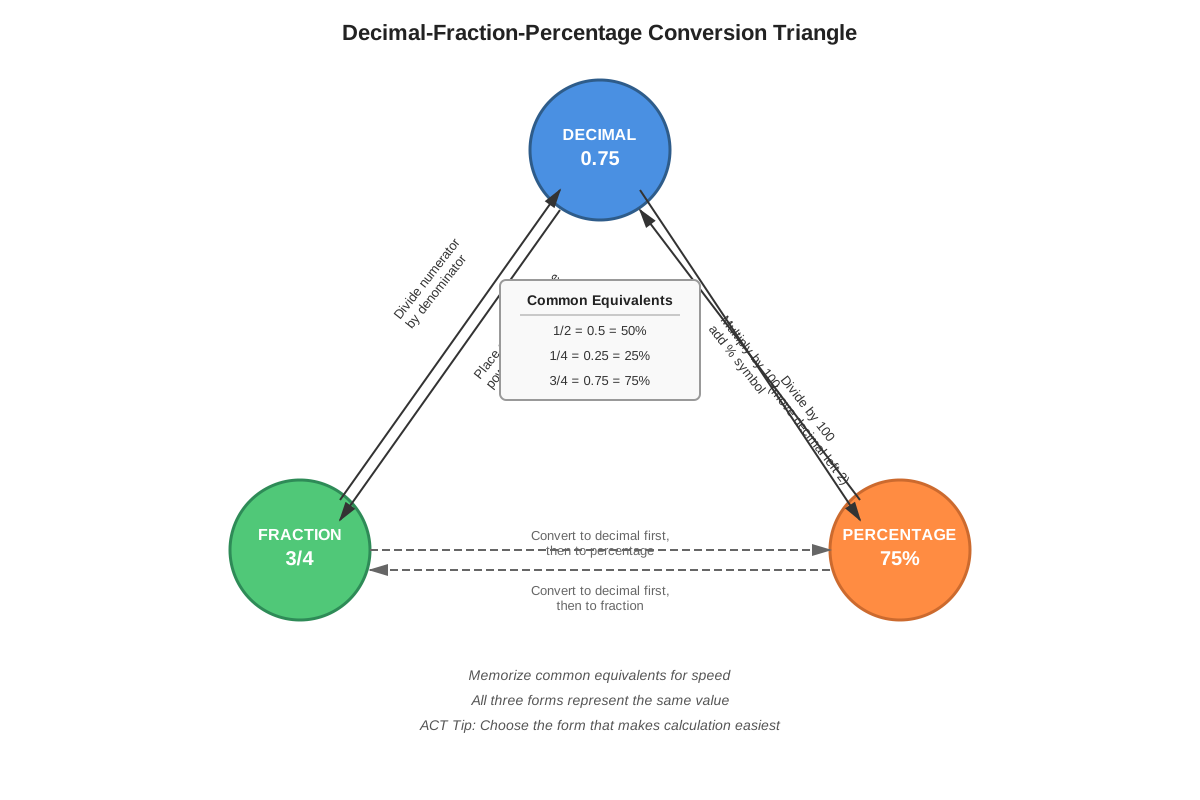
Every decimal represents a fraction with a denominator that is a power of 10. The number of decimal places determines the denominator: one decimal place means tenths (denominator 10), two places means hundredths (denominator 100), three places means thousandths (denominator 1000).
Decimal to fraction conversion:
- Write the digits after the decimal point as the numerator
- Use the place value of the rightmost digit to determine the denominator
- Simplify the fraction if possible
Example: 0.375 = 375/1000 = 3/8 (after simplifying by dividing both by 125)
Fraction to decimal conversion:
- Divide the numerator by the denominator
- Continue division until it terminates or shows a repeating pattern
Example: 5/8 = 5 ÷ 8 = 0.625
Terminating vs. Repeating Decimals
Terminating decimals end after a finite number of digits (0.25, 0.8, 0.125). These occur when the fraction's denominator (in simplest form) contains only factors of 2 and/or 5.
Repeating decimals continue infinitely with a repeating pattern (0.333..., 0.142857142857...). These occur when the denominator contains prime factors other than 2 or 5. Repeating decimals are indicated with a bar over the repeating digits: 0.3̄ or 0.1̄4̄2̄8̄5̄7̄.
Common repeating decimals to memorize:
- 1/3 = 0.3̄
- 2/3 = 0.6̄
- 1/6 = 0.16̄
- 1/9 = 0.1̄
- 1/11 = 0.0̄9̄
Rounding Decimals
Rounding decimals follows the standard rule: if the digit to the right of the rounding position is 5 or greater, round up; if it's 4 or less, round down (keep the digit the same).
Procedure:
- Identify the place value to which you're rounding
- Look at the digit immediately to the right
- If that digit is ≥ 5, increase the rounding position digit by 1
- If that digit is < 5, keep the rounding position digit the same
- Drop all digits to the right of the rounding position
Example: Round 3.14159 to the nearest hundredth
- Hundredths place: 4
- Next digit: 1 (less than 5)
- Answer: 3.14
Estimation with Decimals
Estimation enables quick answer verification and efficient elimination of unreasonable answer choices. Round decimals to convenient values before calculating, then compare the estimate to answer options.
Estimation strategies:
- Round to the nearest whole number for quick mental math
- Round to one significant digit for very rough estimates
- Use benchmark fractions (0.25, 0.5, 0.75) when appropriate
- Estimate before calculating to predict the answer's magnitude
Example: Estimate 19.8 × 4.2
- Round to 20 × 4 = 80
- Actual answer should be close to 80 (actual: 83.16)
Quick check — test yourself on Decimals so far.
Try Flashcards →Concept Relationships
Place value understanding forms the foundation for all decimal operations. Accurate place value recognition → enables proper alignment in addition/subtraction → ensures correct decimal point placement in answers. Similarly, place value mastery → facilitates decimal-fraction conversions → supports percentage calculations → enables ratio and proportion problem-solving.
Multiplication and division of decimals connect directly to powers of ten, which links to scientific notation (a related topic in Number and Quantity). Understanding that multiplying by 10 moves the decimal right while dividing by 10 moves it left → provides the conceptual basis for scientific notation manipulation → extends to exponential expressions with decimal bases.
The relationship between decimals and fractions creates a bidirectional pathway: decimals ↔ fractions ↔ percentages. Fluency in converting between these forms → enables strategic choice of the most efficient representation for each problem → reduces calculation time and error rates. For instance, recognizing that 0.125 = 1/8 allows mental calculation of 0.125 × 64 as 64/8 = 8, avoiding calculator dependence.
Rounding and estimation skills build upon place value knowledge and connect to significant figures in scientific contexts. Estimation → provides reasonableness checks → catches calculation errors → improves accuracy on multi-step problems. This relationship extends to data interpretation, where understanding decimal precision affects how statistical results are reported and interpreted.
High-Yield Facts
⭐ When multiplying decimals, the number of decimal places in the product equals the sum of decimal places in all factors
⭐ To multiply by 10, 100, or 1000, move the decimal point right 1, 2, or 3 places respectively
⭐ To divide by 10, 100, or 1000, move the decimal point left 1, 2, or 3 places respectively
⭐ When dividing decimals, move the decimal point in the divisor to make it a whole number, then move the dividend's decimal point the same number of places
⭐ Adding zeros to the right of a decimal (after the last non-zero digit) does not change its value: 0.5 = 0.50 = 0.500
- A terminating decimal has a denominator (in simplest form) with only factors of 2 and/or 5
- To convert a decimal to a fraction, use the place value of the rightmost digit as the denominator
- When comparing decimals, align decimal points and compare digit by digit from left to right
- The decimal 0.1̄ (repeating 1) equals 1/9, and 0.0̄1̄ equals 1/99
- Multiplying two decimals less than 1 produces a product smaller than either factor
- Common fraction-decimal equivalents: 1/4 = 0.25, 1/2 = 0.5, 3/4 = 0.75, 1/5 = 0.2, 1/8 = 0.125
- When rounding 0.5 exactly, the standard convention rounds up to the next whole number
- Decimal addition and subtraction require vertical alignment of decimal points
- The decimal point in a quotient appears directly above the decimal point in the dividend (after adjustment)
Common Misconceptions
Misconception: Longer decimals are always larger in value (e.g., 0.2 < 0.125 because 0.125 has more digits)
Correction: The value depends on place value, not the number of digits. Compare by aligning decimal points: 0.200 > 0.125 because 2 tenths > 1 tenth.
Misconception: When multiplying decimals, place the decimal point in the product by aligning it with the factors' decimal points
Correction: Count total decimal places in all factors, then place the decimal point in the product from the right, counting that many places leftward.
Misconception: Adding zeros to the left of a decimal changes its value (e.g., 0.5 ≠ 00.5)
Correction: Leading zeros before the decimal point don't change value, just as trailing zeros after the last significant digit don't change value. However, zeros between the decimal point and the first non-zero digit DO matter (0.05 ≠ 0.5).
Misconception: When dividing decimals, the quotient always has a decimal point
Correction: Division can yield whole number quotients. For example, 4.8 ÷ 0.6 = 8 (a whole number).
Misconception: Multiplying by a decimal always makes the product larger
Correction: Multiplying by a decimal less than 1 makes the product smaller. For example, 20 × 0.5 = 10, which is less than 20. Multiplying by a decimal greater than 1 makes the product larger.
Misconception: The decimal 0.5 equals 0.05 when written quickly
Correction: These differ by a factor of 10. The zero immediately after the decimal point in 0.05 indicates the tenths place is empty, placing the 5 in the hundredths position. Always count place values carefully.
Misconception: When converting fractions to decimals, the numerator always becomes the whole number part
Correction: Divide the numerator by the denominator. For proper fractions (numerator < denominator), the result is always less than 1, with no whole number part. For example, 3/4 = 0.75, not 3.4.
Worked Examples
Example 1: Multi-Step Decimal Operations with Real-World Context
Problem: Sarah bought 3 notebooks at $2.45 each and 2 pens at $1.89 each. She paid with a $20 bill. How much change did she receive?
Solution:
Step 1: Calculate the cost of notebooks
3 × $2.45
= 3 × 2.45
= 7.35
Cost of notebooks: $7.35
Step 2: Calculate the cost of pens
2 × $1.89
= 2 × 1.89
= 3.78
Cost of pens: $3.78
Step 3: Find total cost
  7.35
+ 3.78
------
 11.13
Total cost: $11.13
Step 4: Calculate change
  20.00
- 11.13
-------
   8.87
Change: $8.87
Connection to learning objectives: This problem tests the ability to identify decimal operations in context (multiplication and addition), apply proper decimal alignment in addition, and maintain accuracy through multiple steps—all essential ACT skills.
Example 2: Decimal-Fraction Conversion and Comparison
Problem: Which of the following is arranged in order from least to greatest?
A) 0.6, 5/8, 0.625, 2/3
B) 5/8, 0.6, 0.625, 2/3
C) 0.6, 5/8, 2/3, 0.625
D) 5/8, 0.6, 2/3, 0.625
E) 0.6, 0.625, 5/8, 2/3
Solution:
Step 1: Convert all values to decimals for easy comparison
- 0.6 = 0.600 (already decimal)
- 5/8 = 5 ÷ 8 = 0.625
- 0.625 (already decimal)
- 2/3 = 2 ÷ 3 = 0.666...
Step 2: Align and compare
0.600
0.625
0.625
0.666...
Step 3: Order from least to greatest
0.600 < 0.625 = 0.625 < 0.666...
Which translates to: 0.6 < 5/8 = 0.625 < 2/3
Step 4: Identify the matching answer choice
Looking at the options, we need: 0.6, then 5/8 and 0.625 (in either order since they're equal), then 2/3
Answer: A) 0.6, 5/8, 0.625, 2/3
Connection to learning objectives: This demonstrates the core strategy of converting between forms to facilitate comparison, a high-yield ACT skill. It also shows how recognizing equivalent values (5/8 = 0.625) can help verify answers.
Exam Strategy
Trigger words and phrases that signal decimal questions:
- "Calculate," "compute," or "find the value" with numbers containing decimal points
- Money amounts (always decimals: $4.99, $12.50)
- Measurements with precision (3.5 inches, 2.75 pounds, 98.6 degrees)
- "Round to the nearest tenth/hundredth"
- "Express as a decimal"
- Statistical measures (mean, median) of decimal data sets
- "What is the total cost/price/amount"
Approach strategy:
- Identify the operation required before calculating—don't rush into computation
- Estimate the answer first to establish a reasonable range
- Check decimal point placement carefully—this is the most common error source
- Use fraction equivalents when they simplify calculation (0.5 = 1/2, 0.25 = 1/4, 0.75 = 3/4)
- Verify with estimation after calculating—if your answer differs significantly from your estimate, recalculate
Process of elimination tips:
- Eliminate answers with incorrect magnitude (if estimating 20 × 0.5 ≈ 10, eliminate answers near 100 or 1)
- Watch for answers that represent common errors (misplaced decimal points, forgotten decimal points)
- If multiplying two decimals less than 1, eliminate any answer greater than either factor
- If dividing by a decimal less than 1, eliminate any answer smaller than the dividend
- Check units and context—negative money or negative measurements usually indicate errors
Time allocation:
- Simple decimal operations (one or two steps): 30-45 seconds
- Multi-step decimal problems: 60-90 seconds
- Decimal conversion and comparison: 45-60 seconds
- Use your calculator efficiently but verify decimal point placement manually
- If a problem takes longer than 90 seconds, mark it and return later
Calculator tips:
- Always re-enter decimal points carefully—the most common calculator error is mistyping decimals
- Use parentheses for complex expressions to ensure correct order of operations
- Verify that your calculator is in the correct mode (not scientific notation unless needed)
- For division, double-check you've entered divisor and dividend in the correct order
Memory Techniques
Mnemonic for decimal place values (right of decimal point):
"The Happy Turtle Travels Toward Home"
- Tenths
- Hundredths
- Thousandths
- Ten-thousandths
- Hundred-thousandths
Visualization for multiplication/division by powers of 10:
Picture the decimal point as a sliding marker on a number line. Multiplying by 10 "pushes" it right (making the number bigger), while dividing by 10 "pulls" it left (making the number smaller). Each power of 10 adds one position of movement.
Acronym for decimal division steps: "MDPD"
- Move the divisor's decimal point right (to make it whole)
- Move the dividend's decimal point right (same number of places)
- Place the decimal point in the quotient (above the dividend's adjusted position)
- Divide as usual
Memory aid for common fraction-decimal equivalents:
Think of a clock face:
- 1/4 hour = 15 minutes = 0.25 hour
- 1/2 hour = 30 minutes = 0.5 hour
- 3/4 hour = 45 minutes = 0.75 hour
Rhyme for rounding rule:
"Five or more, raise the score; four or less, let it rest"
Summary
Decimals represent fractional quantities using a base-ten positional system, with the decimal point separating whole number positions from fractional positions. Mastery requires understanding place value (tenths, hundredths, thousandths), performing accurate operations (addition, subtraction, multiplication, division), and converting fluently between decimals, fractions, and percentages. The ACT tests decimal concepts both directly and embedded within word problems, geometry calculations, and data interpretation questions. Critical skills include aligning decimal points for addition/subtraction, counting decimal places for multiplication, adjusting decimal positions for division, and using powers of ten to shift decimal points efficiently. Success depends on maintaining precision in calculations, estimating to verify reasonableness, recognizing common fraction-decimal equivalents, and identifying when conversion between forms simplifies problem-solving. Students must avoid common errors like misplacing decimal points, incorrectly comparing decimal values based on digit count rather than place value, and forgetting that multiplying by decimals less than one produces smaller products. Strategic use of estimation, careful calculator entry, and systematic checking of decimal point placement ensure accuracy on the 13-20% of ACT Math questions involving decimal operations.
Key Takeaways
- Place value determines decimal magnitude: Each position right of the decimal point represents a negative power of ten (tenths, hundredths, thousandths)
- Decimal point alignment is critical: For addition and subtraction, align decimal points vertically; for multiplication, count total decimal places in factors
- Powers of ten shift decimal points: Multiply by 10ⁿ moves the point right n places; divide by 10ⁿ moves it left n places
- Estimation prevents errors: Always estimate before calculating to establish a reasonable answer range and verify results
- Conversion flexibility saves time: Recognize when switching between decimals, fractions, and percentages simplifies calculations (0.5 = 1/2, 0.25 = 1/4)
- Common equivalents are high-yield: Memorize fraction-decimal pairs (1/8 = 0.125, 1/3 = 0.3̄, 2/3 = 0.6̄) for quick mental math
- Context clues signal decimal questions: Money amounts, precise measurements, and "round to" instructions indicate decimal operations
Related Topics
Fractions: Decimals and fractions are alternative representations of the same quantities. Mastering decimal-fraction conversion enables strategic choice of the most efficient form for each problem, particularly in ratio and proportion questions.
Percentages: Every percentage converts to a decimal by dividing by 100 (45% = 0.45). Percentage problems on the ACT frequently require decimal calculations for finding percent increase/decrease, tips, taxes, and discounts.
Scientific Notation: Extends decimal concepts to very large and very small numbers using powers of ten. Understanding decimal point movement with powers of ten directly supports scientific notation manipulation.
Ratios and Proportions: Often involve decimal quantities or yield decimal answers. Decimal fluency enables efficient cross-multiplication and division in proportion problems.
Statistics and Probability: Mean, median, and probability calculations frequently produce decimal results. Interpreting decimal data from tables and graphs is a common ACT question type.
Coordinate Geometry: Points on the coordinate plane often have decimal coordinates. Calculating distances, midpoints, and slopes requires accurate decimal operations.
Practice CTA
Now that you've mastered the core concepts of decimals, it's time to solidify your understanding through active practice. Complete the practice questions to test your ability to identify decimal problems, apply the strategies you've learned, and build the speed and accuracy needed for ACT success. Work through the flashcards to reinforce high-yield facts and common fraction-decimal equivalents. Remember: consistent practice with immediate feedback is the most effective way to transform knowledge into test-day performance. You've built a strong foundation—now prove your mastery!
Sign up free to keep reading
Create a free AnvayaPrep account to finish this ACT guide on Decimals — plus flashcards and practice questions.