Overview
Fractions represent one of the most fundamental and frequently tested concepts on the ACT Math section. A fraction expresses a part of a whole, written as one integer (the numerator) divided by another integer (the denominator). While fractions may seem elementary, the ACT tests them in sophisticated ways—embedding them within algebra problems, geometry calculations, word problems, and complex multi-step equations. Students who master fraction operations, conversions, and applications gain a significant advantage, as fraction-related questions appear in approximately 10-15% of all ACT Math problems.
Understanding fractions extends far beyond simple arithmetic. The ACT frequently combines fraction concepts with variables, ratios, proportions, percentages, and even trigonometric expressions. Questions may require students to add fractions with unlike denominators, simplify complex fractions (fractions within fractions), convert between fractions and decimals, or solve equations containing fractional coefficients. The ability to manipulate fractions fluently saves valuable time and prevents careless errors that can cost points on test day.
Mastery of fractions serves as a gateway to higher-level mathematical thinking. Rational expressions in algebra are essentially fractions with polynomials, probability calculations often involve fractional outcomes, and slope in coordinate geometry is expressed as a fraction. Students who struggle with basic fraction operations will find themselves at a disadvantage across multiple content areas of the ACT Math test. This guide provides comprehensive coverage of all fraction concepts necessary for ACT success, with particular emphasis on the strategic approaches that distinguish top scorers from average performers.
Learning Objectives
- [ ] Identify when Fractions is being tested in ACT Math questions
- [ ] Explain the core rule or strategy behind Fractions operations and simplification
- [ ] Apply Fractions to ACT-style questions accurately and efficiently
- [ ] Convert fluently between fractions, decimals, and percentages
- [ ] Simplify complex fractions and expressions containing multiple fractional terms
- [ ] Solve equations and inequalities involving fractions with confidence
- [ ] Recognize and avoid common fraction-related errors under time pressure
Prerequisites
- Basic multiplication and division: Essential for finding common denominators and simplifying fractions
- Prime factorization: Necessary for reducing fractions to lowest terms efficiently
- Order of operations (PEMDAS): Required when fractions appear in multi-step calculations
- Negative number rules: Critical when working with fractions that have negative signs
- Basic algebraic manipulation: Needed when fractions contain variables
Why This Topic Matters
Fractions appear throughout everyday life—from cooking measurements and financial calculations to time management and data interpretation. Understanding fractions enables students to work with proportions in recipes, calculate discounts and interest rates, interpret statistical data, and make informed decisions involving partial quantities. Professional fields including engineering, medicine, finance, and computer science all require fluency with fractional reasoning.
On the ACT Math section, fraction-related questions appear with remarkable consistency. Approximately 6-9 questions out of 60 directly test fraction concepts, while another 10-15 questions incorporate fractions as part of more complex problems. These questions span all difficulty levels, from straightforward arithmetic to challenging multi-step problems worth the same single point. The ACT tests fractions in multiple formats: pure computation problems, word problems requiring fraction setup, algebraic equations with fractional coefficients, and geometry problems involving fractional dimensions or ratios.
Common ACT question types include: comparing fraction sizes without a calculator, adding or subtracting fractions with different denominators, multiplying and dividing fractions (including mixed numbers), simplifying complex fractions, solving for variables in fractional equations, converting between fractions and other forms, and applying fractions to real-world scenarios. The test writers deliberately include answer choices that represent common errors—such as adding numerators and denominators separately—making it essential to understand the underlying principles rather than relying on memorized procedures.
Core Concepts
Understanding Fraction Structure
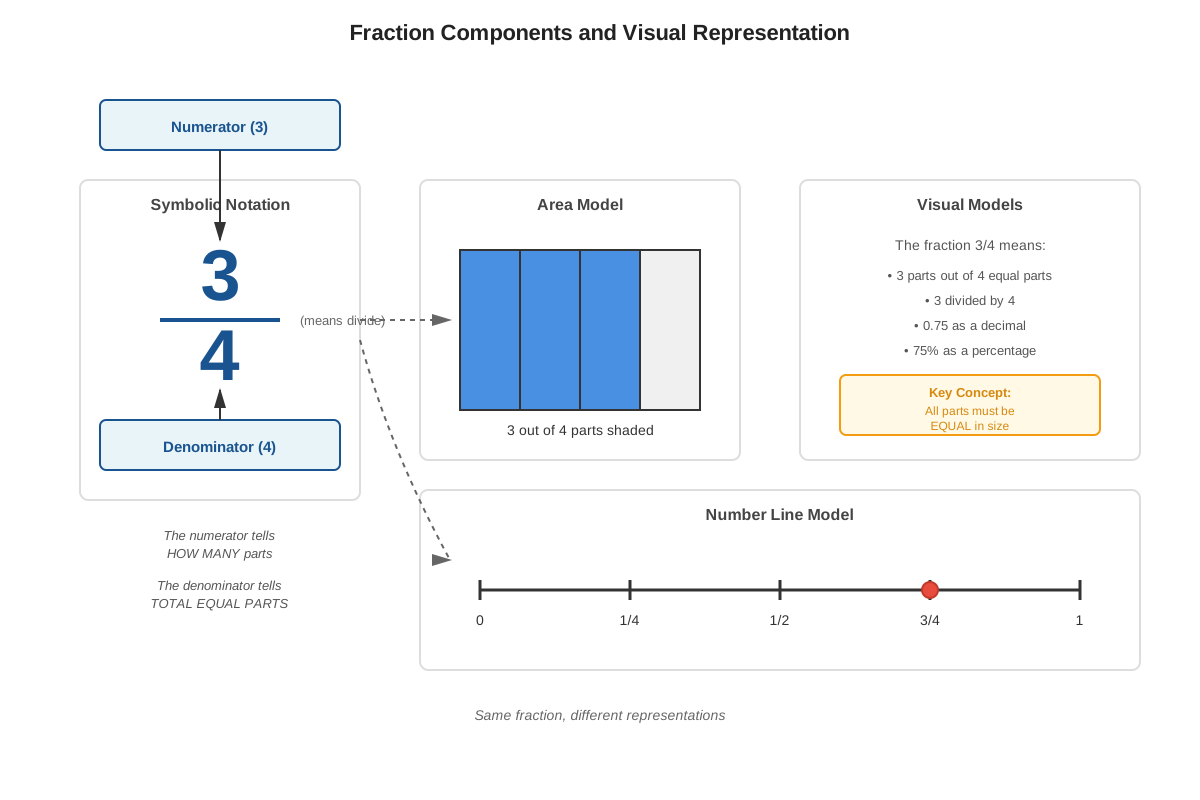
A fraction consists of two parts: the numerator (top number) represents how many parts are being considered, while the denominator (bottom number) represents the total number of equal parts in the whole. The fraction bar functions as a division symbol, so 3/4 means "3 divided by 4" or "3 out of 4 equal parts." The denominator can never be zero, as division by zero is undefined.
Proper fractions have numerators smaller than denominators (like 2/5), representing values less than one. Improper fractions have numerators equal to or greater than denominators (like 7/4), representing values equal to or greater than one. Mixed numbers combine a whole number with a proper fraction (like 1 3/4), offering an alternative representation of improper fractions.
Equivalent Fractions and Simplification
Fractions can be expressed in infinitely many equivalent forms by multiplying or dividing both numerator and denominator by the same non-zero number. This fundamental property—that multiplying or dividing by a form of 1 doesn't change the value—underlies most fraction operations. For example, 2/3 = 4/6 = 6/9 = 8/12, all representing the same quantity.
Simplifying or reducing a fraction means expressing it in lowest terms—where the numerator and denominator share no common factors except 1. To simplify, divide both parts by their greatest common factor (GCF). For instance, to simplify 24/36, find the GCF of 24 and 36 (which is 12), then divide: 24÷12 = 2 and 36÷12 = 3, yielding 2/3. The ACT expects final answers in simplified form unless otherwise specified.
Adding and Subtracting Fractions
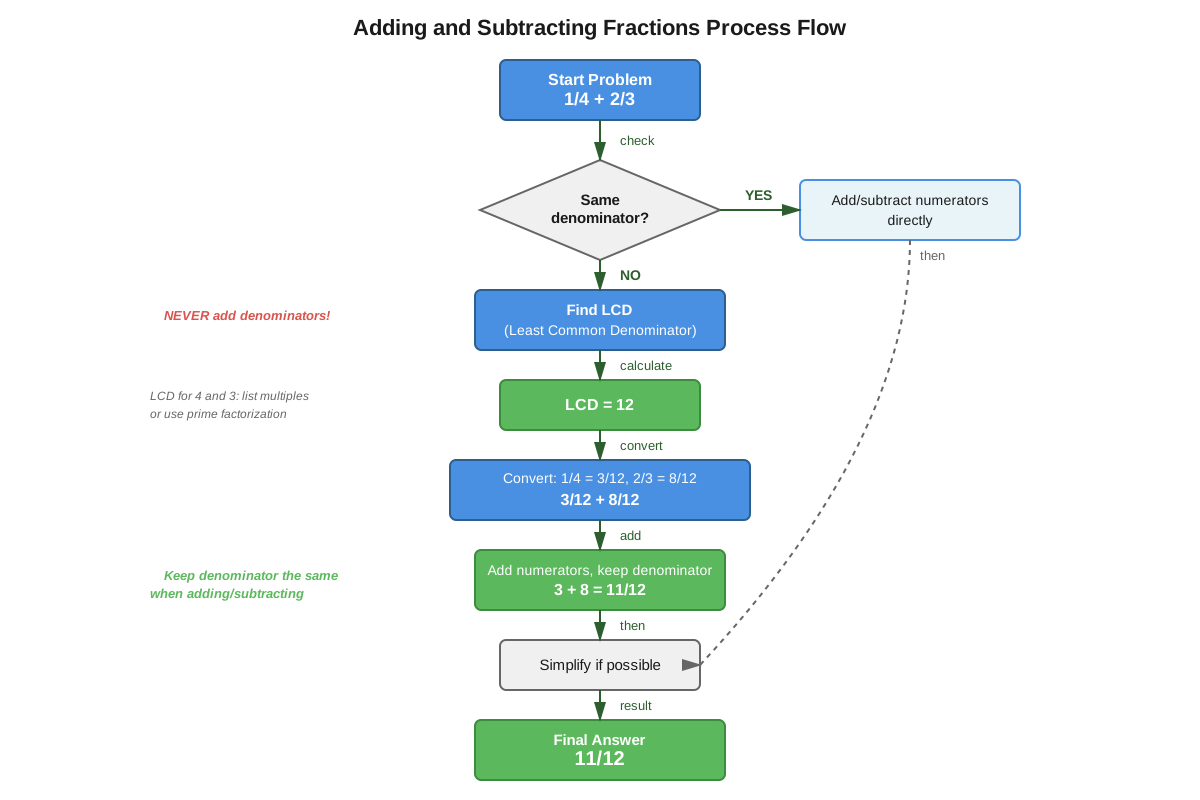
To add or subtract fractions, they must have a common denominator—the same number of equal parts. When denominators match, simply add or subtract the numerators while keeping the denominator unchanged: 2/7 + 3/7 = 5/7.
When denominators differ, find the least common denominator (LCD)—the smallest number divisible by all denominators involved. Convert each fraction to an equivalent fraction with the LCD, then add or subtract. For example, to calculate 1/4 + 2/3:
- Find LCD of 4 and 3: LCD = 12
- Convert: 1/4 = 3/12 and 2/3 = 8/12
- Add: 3/12 + 8/12 = 11/12
For subtraction, follow the same process: 5/6 - 1/4 requires LCD = 12, giving 10/12 - 3/12 = 7/12.
Multiplying Fractions
Multiplying fractions is straightforward: multiply numerators together and denominators together, then simplify. The formula is (a/b) × (c/d) = (a×c)/(b×d). For example, 2/3 × 4/5 = 8/15.
A powerful time-saving technique is cross-canceling or canceling before multiplying. If any numerator and any denominator share a common factor, divide both by that factor before multiplying. This produces the simplified answer immediately. For instance, in 4/9 × 3/8, notice that 4 and 8 share factor 4, while 3 and 9 share factor 3. Cancel to get 1/3 × 1/2 = 1/6.
When multiplying mixed numbers, first convert them to improper fractions. To convert a mixed number like 2 1/3 to an improper fraction: multiply the whole number by the denominator, add the numerator, and place over the original denominator: (2×3 + 1)/3 = 7/3.
Dividing Fractions
To divide fractions, multiply by the reciprocal of the divisor. The reciprocal of a fraction is obtained by flipping it—swapping numerator and denominator. The formula is (a/b) ÷ (c/d) = (a/b) × (d/c). For example, 2/5 ÷ 3/7 = 2/5 × 7/3 = 14/15.
This "invert and multiply" rule works because dividing by a number is equivalent to multiplying by its multiplicative inverse. Remember the phrase "keep, change, flip": keep the first fraction, change division to multiplication, flip the second fraction.
Complex Fractions
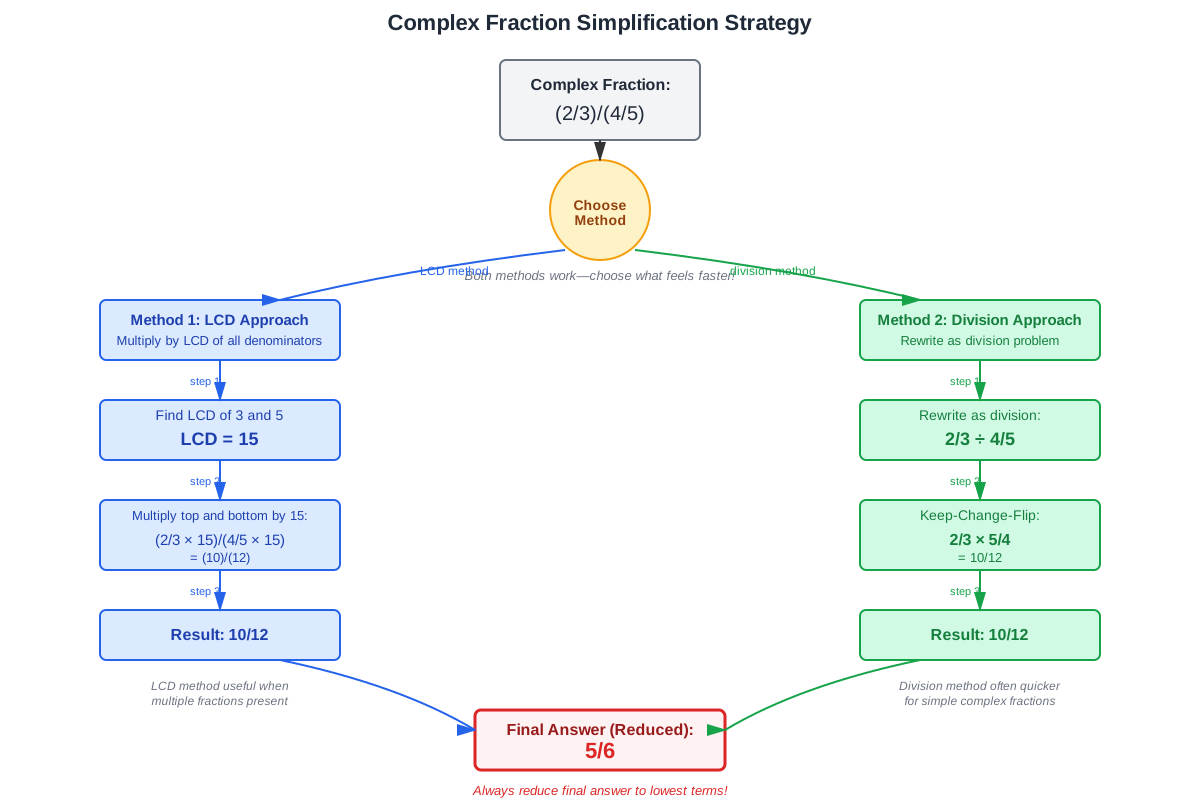
A complex fraction contains fractions in its numerator, denominator, or both. To simplify, treat the main fraction bar as a division symbol and follow division rules. For example, to simplify (2/3)/(4/5), rewrite as 2/3 ÷ 4/5 = 2/3 × 5/4 = 10/12 = 5/6.
Alternatively, multiply both numerator and denominator by the LCD of all fractions involved. For (1/2 + 1/3)/(1/4 - 1/6), the LCD of 2, 3, 4, and 6 is 12. Multiply top and bottom by 12: [12(1/2 + 1/3)]/[12(1/4 - 1/6)] = (6 + 4)/(3 - 2) = 10/1 = 10.
Comparing Fractions
The ACT frequently asks which fraction is largest or smallest. Several strategies work:
- Common denominator method: Convert all fractions to the same denominator, then compare numerators
- Cross-multiplication: For two fractions a/b and c/d, multiply a×d and b×c; the larger product indicates the larger fraction
- Decimal conversion: Convert to decimals (useful when a calculator is allowed)
- Benchmark comparison: Compare each fraction to common benchmarks like 1/2, 1, or 0
Fractions with Variables
When fractions contain variables, the same operations apply. To solve equations like x/4 = 3/5, cross-multiply: 5x = 12, so x = 12/5 or 2.4. When adding algebraic fractions like x/3 + x/4, find the LCD (12) and combine: 4x/12 + 3x/12 = 7x/12.
Converting Between Forms
The ACT requires fluency converting between fractions, decimals, and percentages:
- Fraction to decimal: Divide numerator by denominator (3/4 = 0.75)
- Decimal to fraction: Write over appropriate power of 10, then simplify (0.6 = 6/10 = 3/5)
- Fraction to percentage: Convert to decimal, multiply by 100 (1/4 = 0.25 = 25%)
- Percentage to fraction: Write over 100, simplify (40% = 40/100 = 2/5)
Memorize common conversions for speed: 1/2 = 0.5 = 50%, 1/4 = 0.25 = 25%, 3/4 = 0.75 = 75%, 1/3 ≈ 0.333 = 33.3%, 2/3 ≈ 0.667 = 66.7%, 1/5 = 0.2 = 20%.
Concept Relationships
Fraction operations build upon each other hierarchically. Equivalent fractions form the foundation, enabling all other operations. Simplification connects to equivalent fractions through the GCF concept. Addition and subtraction require equivalent fractions via common denominators, while multiplication stands independently but connects to simplification through cross-canceling. Division builds directly on multiplication through the reciprocal relationship.
Complex fractions synthesize multiple operations, requiring mastery of division, addition/subtraction, and simplification. Comparing fractions applies equivalent fraction concepts or cross-multiplication (which derives from multiplication principles). Algebraic fractions extend all basic operations into symbolic reasoning, connecting fractions to equation-solving and algebraic manipulation.
Fractions connect to prerequisite topics through prime factorization (for finding GCF and LCD), multiplication tables (for quick computation), and order of operations (for multi-step problems). They extend forward to ratios and proportions (which are essentially fraction equations), percentages (fractions with denominator 100), rational expressions (algebraic fractions), probability (favorable outcomes over total outcomes), and slope (rise over run).
The relationship map: Prime Factorization → GCF/LCD → Equivalent Fractions → Addition/Subtraction and Simplification → Complex Fractions; Multiplication → Division → Complex Fractions; All Operations → Algebraic Fractions → Equations and Proportions.
Quick check — test yourself on Fractions so far.
Try Flashcards →High-Yield Facts
⭐ To add or subtract fractions, they must have a common denominator; only numerators are added or subtracted
⭐ To multiply fractions, multiply numerators together and denominators together, then simplify
⭐ To divide fractions, multiply by the reciprocal of the divisor (keep, change, flip)
⭐ A fraction is in lowest terms when the GCF of numerator and denominator is 1
⭐ Cross-canceling before multiplying saves time and reduces errors
- The denominator of a fraction can never be zero (undefined)
- Multiplying or dividing both numerator and denominator by the same non-zero number creates an equivalent fraction
- To convert a mixed number to an improper fraction: (whole × denominator + numerator)/denominator
- To convert an improper fraction to a mixed number: divide numerator by denominator; quotient is whole number, remainder is new numerator
- When comparing fractions with the same numerator, the fraction with the smaller denominator is larger
- When comparing fractions with the same denominator, the fraction with the larger numerator is larger
- A negative sign in a fraction can be placed in the numerator, denominator, or in front of the entire fraction (all equivalent)
- The reciprocal of a/b is b/a; the product of a number and its reciprocal equals 1
- To simplify complex fractions, treat the main fraction bar as a division symbol
- Common benchmark fractions: 1/2 = 0.5, 1/4 = 0.25, 1/3 ≈ 0.33, 1/5 = 0.2, 1/8 = 0.125
Common Misconceptions
Misconception: When adding fractions, add both numerators and denominators (e.g., 1/2 + 1/3 = 2/5)
Correction: Only add numerators after finding a common denominator. The correct calculation is 1/2 + 1/3 = 3/6 + 2/6 = 5/6. The denominator represents the size of the pieces, which must be the same to combine them.
Misconception: When multiplying fractions, find a common denominator first
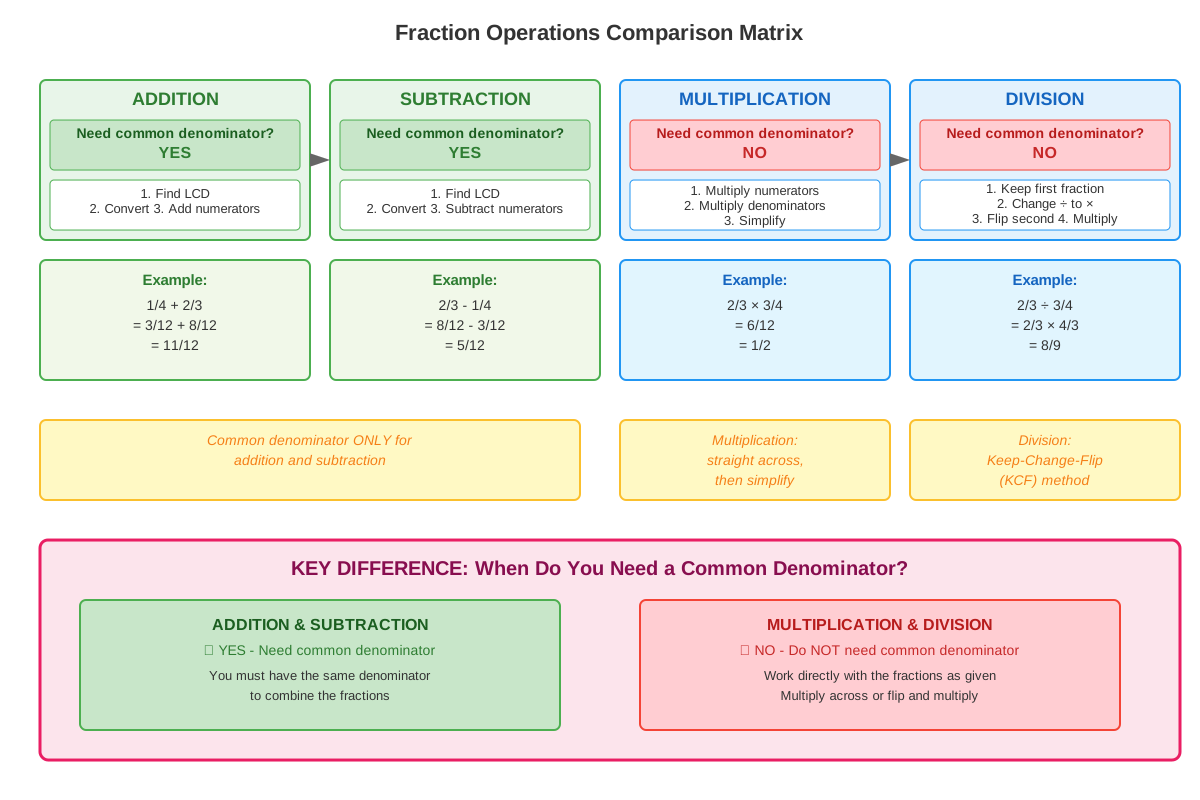
Correction: Multiplication does not require common denominators. Simply multiply straight across: numerator times numerator, denominator times denominator. Common denominators are only needed for addition and subtraction.
Misconception: A larger denominator means a larger fraction
Correction: When numerators are equal, a larger denominator actually means a smaller fraction because the whole is divided into more pieces. For example, 1/8 < 1/4 because eighths are smaller pieces than fourths.
Misconception: To divide fractions, flip both fractions
Correction: Only flip (find the reciprocal of) the second fraction—the divisor. The first fraction stays the same. For a/b ÷ c/d, the correct process is a/b × d/c, not b/a × d/c.
Misconception: Negative fractions can be simplified by making both numerator and denominator positive
Correction: A fraction has only one negative sign. If both numerator and denominator are negative, they cancel to make the fraction positive: -2/-3 = 2/3. But -2/3 and 2/-3 both equal -2/3 (negative).
Misconception: Mixed numbers can be added by adding whole numbers and fractions separately without considering improper results
Correction: When adding mixed numbers like 2 3/4 + 1 2/4, you get 3 5/4, which must be simplified to 4 1/4 by converting the improper fraction 5/4 to 1 1/4 and adding it to the whole number.
Misconception: Cross-multiplication can be used to add fractions
Correction: Cross-multiplication is used for comparing fractions or solving proportions (equations with fractions), not for adding them. To add fractions, find a common denominator.
Worked Examples
Example 1: Multi-Step Fraction Problem
Problem: Simplify the expression: (2/3 + 1/4) ÷ (5/6 - 1/2)
Solution:
Step 1: Simplify the numerator (2/3 + 1/4)
- Find LCD of 3 and 4: LCD = 12
- Convert: 2/3 = 8/12 and 1/4 = 3/12
- Add: 8/12 + 3/12 = 11/12
Step 2: Simplify the denominator (5/6 - 1/2)
- Find LCD of 6 and 2: LCD = 6
- Convert: 5/6 = 5/6 and 1/2 = 3/6
- Subtract: 5/6 - 3/6 = 2/6 = 1/3 (simplified)
Step 3: Divide the results
- (11/12) ÷ (1/3)
- Keep, change, flip: (11/12) × (3/1)
- Multiply: (11 × 3)/(12 × 1) = 33/12
Step 4: Simplify
- Find GCF of 33 and 12: GCF = 3
- Divide: 33 ÷ 3 = 11 and 12 ÷ 3 = 4
- Final answer: 11/4 or 2 3/4
Connection to Learning Objectives: This problem demonstrates the application of multiple fraction operations (addition, subtraction, division) in a complex expression, requiring identification of when each operation is needed and accurate execution of the core strategies.
Example 2: ACT-Style Word Problem
Problem: A recipe calls for 2/3 cup of flour, but Sarah wants to make only 3/4 of the recipe. How much flour should she use?
Solution:
Step 1: Identify the operation needed
- "3/4 of" means multiplication
- Calculate: (3/4) × (2/3)
Step 2: Set up the multiplication
- (3/4) × (2/3) = (3 × 2)/(4 × 3)
Step 3: Cross-cancel before multiplying
- Notice 3 appears in both numerator and denominator
- Cancel: (3 × 2)/(4 × 3) = (1 × 2)/(4 × 1)
Step 4: Multiply and simplify
- 2/4 = 1/2
Answer: Sarah should use 1/2 cup of flour.
Connection to Learning Objectives: This problem requires recognizing that a word problem involves fractions (identifying when fractions are tested), understanding that "of" signals multiplication (explaining the core strategy), and accurately performing the calculation with simplification (applying fractions to ACT-style questions).
Exam Strategy
When approaching ACT fractions questions, first identify what operation is required by reading carefully for key words: "sum" or "total" suggests addition, "difference" or "remaining" suggests subtraction, "of" or "product" suggests multiplication, and "per" or "quotient" suggests division. Many students rush and perform the wrong operation, falling into trap answers.
Trigger words and phrases to watch for include: "simplify," "reduce to lowest terms," "express as a single fraction," "what fraction of," "how much more/less," and "combined." When you see "simplify," the test expects the answer in reduced form. When you see "what fraction," you're likely setting up a part-to-whole relationship.
For process of elimination, immediately eliminate answers that:
- Are not in simplified form when the question asks for simplification
- Are larger than 1 when the problem clearly involves proper fractions
- Have denominators that don't make sense given the LCD of the problem
- Represent common errors (like adding numerators and denominators)
Time allocation strategy: Simple fraction arithmetic (one operation) should take 15-30 seconds. Multi-step fraction problems warrant 45-60 seconds. Complex word problems involving fractions may require 60-90 seconds. If a fraction problem is taking longer than 90 seconds, mark it and return later—you may be missing a shortcut or making an error.
Calculator usage: While the ACT allows calculators, they can be slower for fractions than mental math or paper calculations. Use calculators for converting fractions to decimals for comparison, or for checking your work. However, performing operations like finding common denominators or simplifying is often faster by hand.
Common shortcuts: Memorize decimal equivalents of common fractions (1/2, 1/3, 1/4, 1/5, 1/8) for quick conversions. When comparing fractions, use cross-multiplication rather than finding common denominators. When multiplying, always look for cross-canceling opportunities before multiplying large numbers.
Memory Techniques
For adding/subtracting fractions: "Same Denominator Only" (SDO) - you can only add or subtract fractions with the Same Denominator; Otherwise, find a common one first.
For dividing fractions: "Keep Change Flip" (KCF) - Keep the first fraction, Change division to multiplication, Flip the second fraction.
For converting mixed numbers to improper fractions: "Multiply Add Place" (MAP) - Multiply whole number by denominator, Add the numerator, Place over the original denominator.
For simplification: "Greatest Common Factor Divides Both" (GCF DB) - Find the Greatest Common Factor and Divide Both numerator and denominator by it.
Visualization strategy: Picture fractions as pizza slices. When adding 1/4 + 1/4, visualize two slices from a pizza cut into 4 pieces—you have 2 out of 4 slices, or 1/2 the pizza. This concrete image helps prevent errors like adding denominators.
For comparing fractions: Use the "Butterfly Method" - draw wings by cross-multiplying, then compare the products. The larger product indicates the larger fraction. For 2/3 vs 3/5: 2×5=10 and 3×3=9, so 2/3 > 3/5.
Common fraction equivalents (memorize these):
- Halves: 1/2 = 0.5 = 50%
- Thirds: 1/3 ≈ 0.33 = 33%, 2/3 ≈ 0.67 = 67%
- Fourths: 1/4 = 0.25 = 25%, 3/4 = 0.75 = 75%
- Fifths: 1/5 = 0.2 = 20%, 2/5 = 0.4 = 40%, 3/5 = 0.6 = 60%, 4/5 = 0.8 = 80%
Summary
Fractions represent parts of a whole and appear throughout the ACT Math section in various forms and difficulty levels. Mastery requires understanding fraction structure (numerator over denominator), creating equivalent fractions by multiplying or dividing both parts by the same number, and simplifying to lowest terms using the greatest common factor. Addition and subtraction demand common denominators—find the LCD, convert all fractions, then combine numerators only. Multiplication is straightforward—multiply across and simplify—with cross-canceling providing a powerful shortcut. Division uses the "keep, change, flip" rule: multiply by the reciprocal of the divisor. Complex fractions simplify by treating the main fraction bar as division. Converting between fractions, decimals, and percentages requires fluency with division and multiplication by powers of ten. Success on ACT fraction questions depends on recognizing which operation is needed, executing it accurately, and presenting answers in simplified form. Students who practice these operations until they become automatic will save valuable time and avoid the common errors that test writers deliberately target in wrong answer choices.
Key Takeaways
- Fractions require common denominators only for addition and subtraction, not for multiplication or division
- Simplify fractions by dividing both numerator and denominator by their greatest common factor
- To divide fractions, multiply by the reciprocal of the second fraction (keep, change, flip)
- Cross-canceling before multiplying fractions saves time and produces simplified answers immediately
- The ACT expects final answers in simplified form unless otherwise specified
- Memorizing decimal equivalents of common fractions (1/2, 1/3, 1/4, 1/5, 1/8) accelerates problem-solving
- Complex fractions simplify by treating the main fraction bar as a division operation
Related Topics
Ratios and Proportions: Fractions form the foundation of ratios (comparisons between quantities) and proportions (equations stating two ratios are equal). Mastering fraction operations enables solving proportion problems through cross-multiplication.
Percentages: Percentages are fractions with denominator 100. Understanding fraction-to-percentage conversion and operations with fractions directly translates to percentage calculations, a high-yield ACT topic.
Rational Expressions: In Algebra II, rational expressions extend fraction concepts to algebraic terms. The same rules for adding, subtracting, multiplying, and dividing fractions apply when numerators and denominators contain variables and polynomials.
Probability: Probability expresses the likelihood of events as fractions (favorable outcomes over total outcomes). Fraction operations are essential for calculating compound probabilities.
Slope and Rate: Slope in coordinate geometry is expressed as a fraction (rise over run), and rates (speed, unit prices) are fractional relationships. Fraction fluency enables quick slope calculations and rate conversions.
Practice CTA
Now that you've mastered the core concepts, strategies, and common pitfalls of fractions, it's time to put your knowledge into action! Complete the practice questions to reinforce these skills and build the speed and accuracy needed for test day. Use the flashcards to drill the high-yield facts and common conversions until they become automatic. Remember, fraction mastery isn't just about knowing the rules—it's about applying them confidently under timed conditions. Every practice problem you complete brings you one step closer to your target ACT Math score. You've got this!
Sign up free to keep reading
Create a free AnvayaPrep account to finish this ACT guide on Fractions — plus flashcards and practice questions.