Overview
Prime numbers form one of the foundational concepts in number theory and appear regularly on the ACT Math section. Understanding prime numbers is essential not only for direct questions about primes themselves, but also for solving problems involving factors, divisibility, greatest common factors (GCF), least common multiples (LCM), and even algebraic factorization. The ACT frequently tests whether students can identify prime numbers, understand their properties, and apply prime factorization to solve multi-step problems. Questions may appear straightforward—asking students to identify which number in a list is prime—or may embed prime number concepts within more complex word problems involving divisibility rules or optimization.
The significance of prime numbers extends beyond isolated identification questions. Many ACT problems require students to break down composite numbers into their prime factors to simplify fractions, find common denominators, or determine the number of factors a given number has. Additionally, understanding primes helps students recognize patterns in sequences, solve modular arithmetic problems, and work efficiently with rational expressions. The ability to quickly identify small primes (2, 3, 5, 7, 11, 13, etc.) and apply divisibility tests can save valuable time on test day.
Prime numbers connect to broader mathematical concepts tested on the ACT, including integer properties, rational number operations, and algebraic manipulation. Students who master prime numbers develop stronger number sense, which translates to improved performance across multiple question types. Since the ACT Math section emphasizes speed and accuracy, having automatic recall of prime number properties and efficient strategies for prime factorization provides a significant competitive advantage.
Learning Objectives
- [ ] Identify when Prime numbers is being tested in ACT questions
- [ ] Explain the core rule or strategy behind Prime numbers
- [ ] Apply Prime numbers to ACT-style questions accurately
- [ ] Determine whether a given integer is prime using divisibility tests
- [ ] Perform prime factorization of composite numbers efficiently
- [ ] Use prime factorization to find GCF and LCM of multiple numbers
- [ ] Calculate the total number of factors of a number using its prime factorization
Prerequisites
- Basic multiplication and division: Essential for testing divisibility and performing factorization
- Understanding of factors and multiples: Prime numbers are defined in terms of their factor properties
- Divisibility rules: Helps quickly eliminate non-prime candidates without lengthy division
- Integer properties: Primes are a special subset of positive integers with unique characteristics
Why This Topic Matters
Prime numbers represent the "building blocks" of all integers, much like atoms form the basis of matter. Every composite number can be expressed uniquely as a product of prime numbers, making primes fundamental to understanding number structure. In real-world applications, prime numbers are crucial in cryptography (securing online transactions), computer science (hash functions), and even biology (cicada life cycles). Understanding primes develops logical reasoning and pattern recognition skills that extend far beyond mathematics.
On the ACT Math section, prime number questions appear with moderate frequency—typically 1-3 questions per test. These questions may test prime identification directly (worth approximately 2% of the exam) or incorporate prime concepts into broader problems involving factors, multiples, or number properties (contributing to roughly 5-8% of total questions). The ACT favors testing primes in the range of 2 to 100, with occasional questions extending to 200. Students rarely need to identify primes larger than this range.
Common question formats include: identifying which number in a list is prime; finding the prime factorization of a given number; determining how many prime numbers exist within a specified range; using prime factorization to simplify expressions or find GCF/LCM; and solving word problems where prime number properties provide the key insight. The ACT also tests understanding of special cases, such as recognizing that 1 is not prime and that 2 is the only even prime number.
Core Concepts
Definition of Prime Numbers
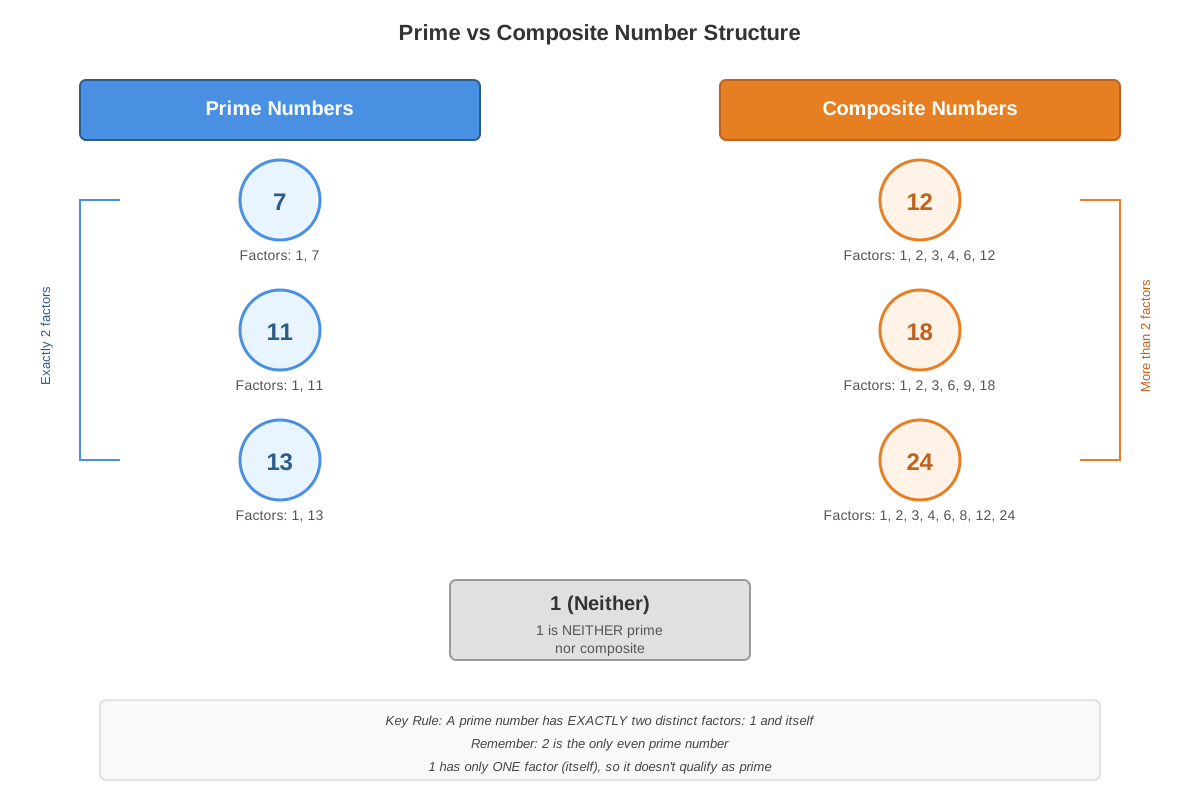
A prime number is a positive integer greater than 1 that has exactly two distinct positive divisors: 1 and itself. This means a prime number cannot be formed by multiplying two smaller positive integers. For example, 7 is prime because its only divisors are 1 and 7. In contrast, 6 is not prime (it is composite) because it has divisors 1, 2, 3, and 6.
The number 1 is explicitly excluded from the definition of prime numbers. While 1 has only one divisor (itself), mathematicians exclude it from the prime category to preserve the fundamental theorem of arithmetic, which states that every integer greater than 1 can be expressed uniquely as a product of primes. Including 1 as prime would destroy this uniqueness (since 6 = 2 × 3 = 1 × 2 × 3 = 1 × 1 × 2 × 3, etc.).
The First Twenty Prime Numbers
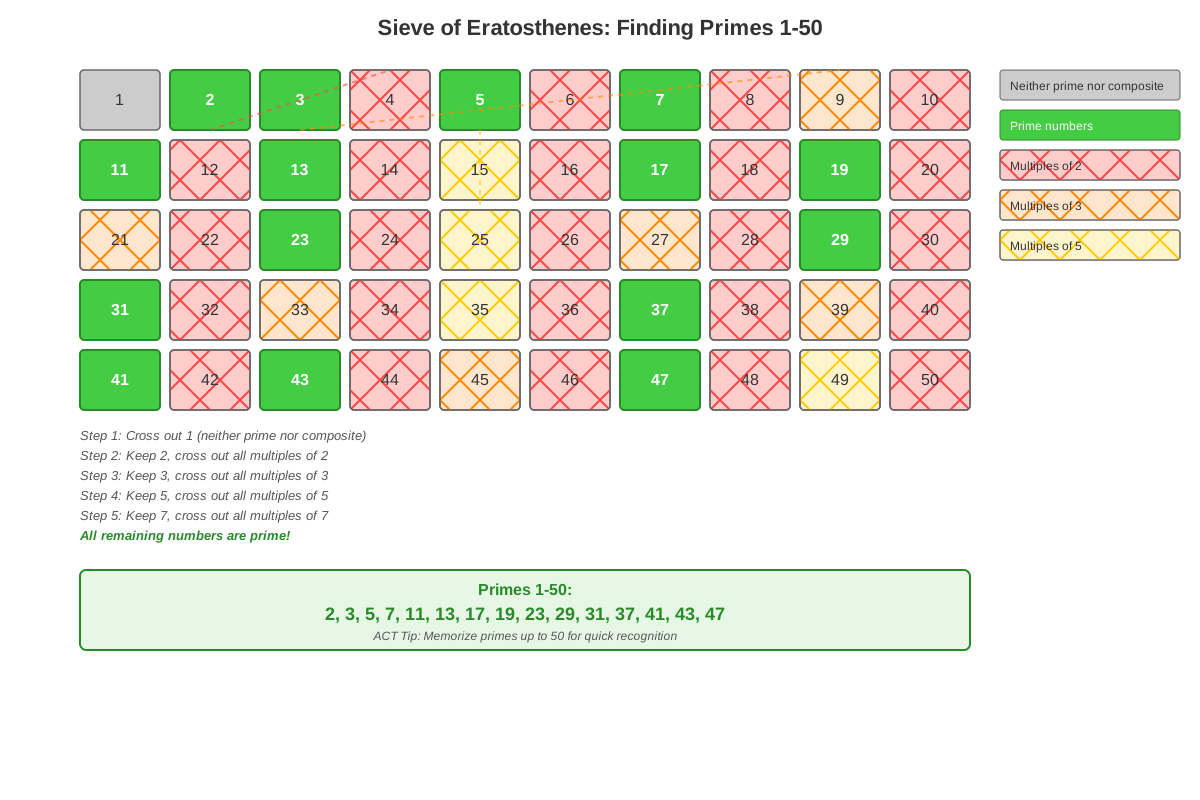
Memorizing the first several prime numbers provides a significant advantage on the ACT. The first twenty primes are:
2, 3, 5, 7, 11, 13, 17, 19, 23, 29, 31, 37, 41, 43, 47, 53, 59, 61, 67, 71
Note that 2 is the only even prime number. All other even numbers are divisible by 2 and therefore composite. This makes 2 unique among primes and frequently appears in ACT questions designed to test whether students recognize this special property.
Testing for Primality
To determine whether a number n is prime, test whether it is divisible by any prime number up to √n. If no prime up to √n divides n evenly, then n is prime. This method is efficient because if n = a × b where both a and b are greater than √n, then a × b would exceed n.
Example: Is 89 prime?
- √89 ≈ 9.4
- Test divisibility by primes up to 9: 2, 3, 5, 7
- 89 ÷ 2 = 44.5 (not divisible)
- 89 ÷ 3 = 29.67... (not divisible)
- 89 ÷ 5 = 17.8 (not divisible)
- 89 ÷ 7 = 12.71... (not divisible)
- Therefore, 89 is prime
Prime Factorization
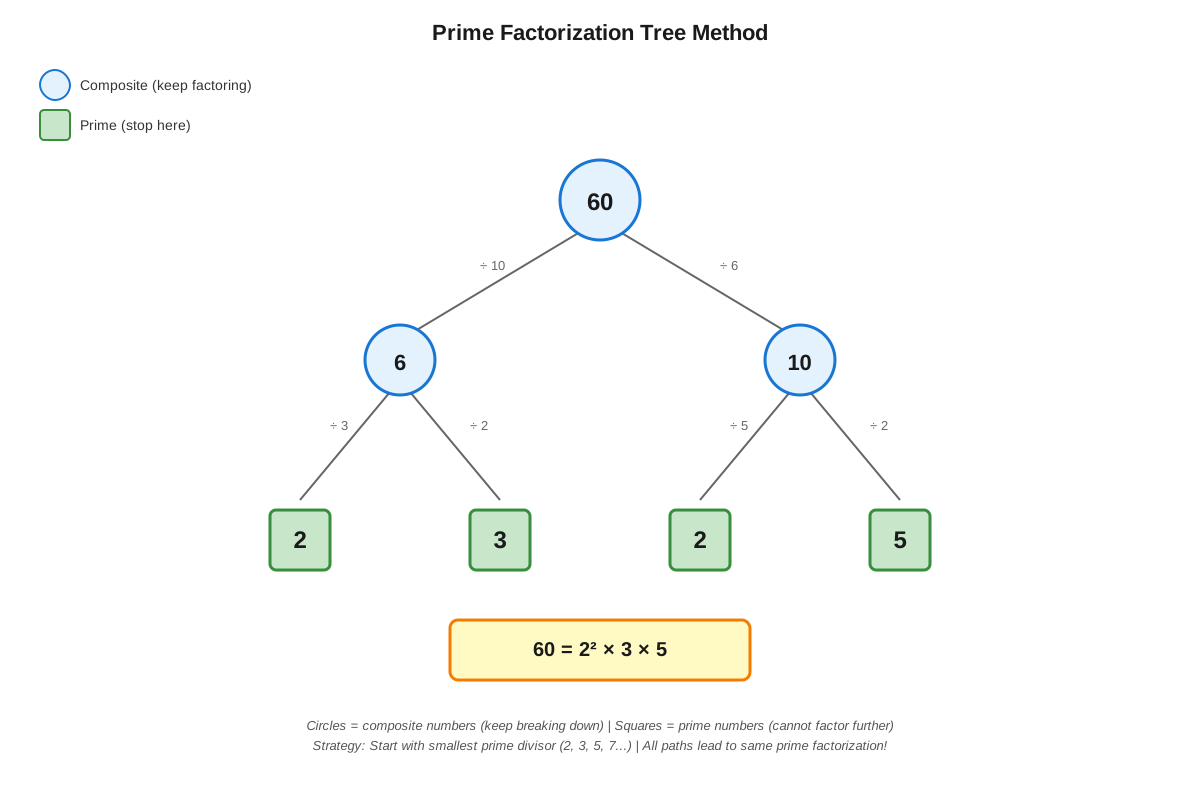
Prime factorization is the process of expressing a composite number as a product of prime numbers. Every composite number has a unique prime factorization (except for the order of factors). This process is fundamental to many ACT problems.
Method: Use a factor tree or repeated division
- Divide by the smallest prime that divides the number evenly
- Continue dividing the quotient by primes until reaching 1
- Express the result using exponents for repeated factors
Example: Find the prime factorization of 360
- 360 ÷ 2 = 180
- 180 ÷ 2 = 90
- 90 ÷ 2 = 45
- 45 ÷ 3 = 15
- 15 ÷ 3 = 5
- 5 ÷ 5 = 1
- Prime factorization: 360 = 2³ × 3² × 5
Applications of Prime Factorization
| Application | Method | Example |
|---|---|---|
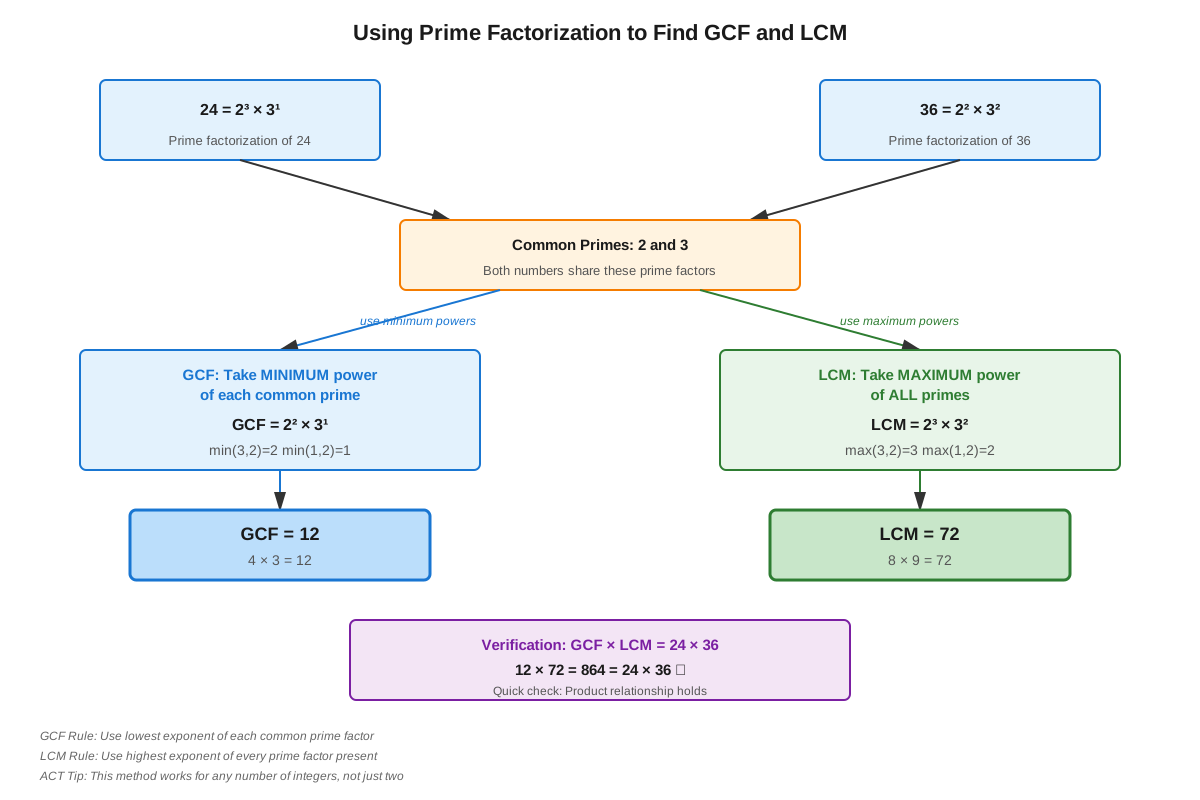
| Finding GCF | Multiply common prime factors with lowest exponents | GCF(24, 36): 24 = 2³ × 3, 36 = 2² × 3²; GCF = 2² × 3 = 12 |
| Finding LCM | Multiply all prime factors with highest exponents | LCM(24, 36): LCM = 2³ × 3² = 72 |
| Counting factors | Add 1 to each exponent and multiply | 360 = 2³ × 3² × 5¹; factors = (3+1)(2+1)(1+1) = 24 |
| Simplifying radicals | Extract perfect square factors | √360 = √(36 × 10) = 6√10 |
Special Properties and Patterns
Prime numbers exhibit several important patterns that appear on the ACT:
- Twin primes: Pairs of primes that differ by 2 (e.g., 11 and 13, 17 and 19, 29 and 31)
- Prime gaps: The spacing between consecutive primes increases as numbers get larger
- Distribution: Primes become less frequent in higher ranges but never stop occurring
- Goldbach's conjecture: Every even integer greater than 2 can be expressed as the sum of two primes (unproven but relevant for some ACT problems)
Composite Numbers
A composite number is a positive integer greater than 1 that is not prime—meaning it has more than two positive divisors. The first several composite numbers are: 4, 6, 8, 9, 10, 12, 14, 15, 16, 18, 20. Understanding the relationship between primes and composites helps students quickly categorize numbers during the test.
Concept Relationships
Prime numbers serve as the foundation for understanding integer structure. The relationship flows as follows: Definition of integers → Classification into primes and composites → Prime factorization of composites → Applications to GCF and LCM → Simplification of fractions and radicals.
Within the topic itself, recognizing prime numbers enables prime factorization, which in turn allows calculation of GCF and LCM. The ability to count factors depends directly on expressing a number in prime factorized form. Each concept builds upon the previous one, creating a hierarchical structure of understanding.
Prime numbers connect to prerequisite knowledge of divisibility rules, which provide shortcuts for testing primality. For instance, knowing that a number is divisible by 3 if its digit sum is divisible by 3 helps quickly eliminate candidates. The relationship extends forward to algebraic factorization, where recognizing prime polynomials parallels recognizing prime numbers.
The connection to other ACT topics includes: Factors and multiples (primes are numbers with exactly two factors), Rational numbers (simplifying fractions requires finding GCF through prime factorization), Exponents (prime factorization uses exponential notation), and Number theory problems (many word problems involve prime properties).
High-Yield Facts
⭐ 2 is the only even prime number; all other even numbers are divisible by 2 and therefore composite
⭐ 1 is neither prime nor composite; it is explicitly excluded from both categories
⭐ The first ten prime numbers are: 2, 3, 5, 7, 11, 13, 17, 19, 23, 29
⭐ To test if n is prime, check divisibility by all primes up to √n
⭐ Every composite number has a unique prime factorization (fundamental theorem of arithmetic)
- The smallest prime number is 2; there is no largest prime number (infinitely many primes exist)
- Prime numbers greater than 3 can be expressed as 6k ± 1 for some integer k
- The number of factors of n = p₁^a × p₂^b × p₃^c is (a+1)(b+1)(c+1)
- Two numbers are relatively prime (coprime) if their GCF is 1
- The prime factorization method is the most reliable way to find GCF and LCM
- Numbers ending in 0, 2, 4, 6, or 8 (except 2 itself) are never prime
- Numbers ending in 5 (except 5 itself) are never prime because they are divisible by 5
- The sum of two prime numbers greater than 2 is always even (since both are odd)
Quick check — test yourself on Prime numbers so far.
Try Flashcards →Common Misconceptions
Misconception: 1 is a prime number because it is only divisible by itself.
Correction: 1 is neither prime nor composite by definition. Prime numbers must have exactly two distinct divisors (1 and the number itself), but 1 has only one divisor.
Misconception: All odd numbers are prime.
Correction: While all primes except 2 are odd, not all odd numbers are prime. For example, 9, 15, 21, 25, 27, and 33 are all odd composite numbers.
Misconception: Large numbers are more likely to be prime than small numbers.
Correction: Prime numbers actually become less frequent as numbers increase. The density of primes decreases in higher ranges, though primes never stop occurring entirely.
Misconception: If a number is not divisible by 2 or 3, it must be prime.
Correction: Many composite numbers are not divisible by 2 or 3. For example, 25 = 5 × 5, 49 = 7 × 7, and 77 = 7 × 11 are all composite despite not being divisible by 2 or 3.
Misconception: The prime factorization of a number can be expressed in multiple different ways.
Correction: The fundamental theorem of arithmetic guarantees that every integer greater than 1 has exactly one unique prime factorization (ignoring the order of factors). For example, 12 can only be expressed as 2² × 3.
Misconception: Zero and negative numbers can be prime.
Correction: Prime numbers are defined only for positive integers greater than 1. Zero and negative numbers are excluded from the definition entirely.
Worked Examples
Example 1: Identifying Prime Numbers
Question: Which of the following numbers is prime: 51, 57, 61, 63, or 69?
Solution:
Test each number systematically using divisibility rules and prime division.
51: Check if divisible by small primes
- Not even, so not divisible by 2
- Sum of digits: 5 + 1 = 6, which is divisible by 3
- 51 ÷ 3 = 17 ✓
- Therefore, 51 = 3 × 17 (composite)
57:
- Not even
- Sum of digits: 5 + 7 = 12, divisible by 3
- 57 ÷ 3 = 19 ✓
- Therefore, 57 = 3 × 19 (composite)
61:
- Not even
- Sum of digits: 6 + 1 = 7, not divisible by 3
- Not ending in 5, so not divisible by 5
- √61 ≈ 7.8, so test primes up to 7
- 61 ÷ 7 = 8.71... (not divisible)
- No prime up to √61 divides 61 evenly
- Therefore, 61 is prime ✓
63:
- Sum of digits: 6 + 3 = 9, divisible by 3
- 63 ÷ 3 = 21 (composite)
69:
- Sum of digits: 6 + 9 = 15, divisible by 3
- 69 ÷ 3 = 23 (composite)
Answer: 61 is the only prime number in the list.
This example demonstrates Learning Objective 1 (identifying when primes are tested) and Objective 4 (determining whether a number is prime using divisibility tests).
Example 2: Using Prime Factorization to Find GCF and LCM
Question: Find the greatest common factor (GCF) and least common multiple (LCM) of 84 and 126.
Solution:
Step 1: Find the prime factorization of each number.
For 84:
- 84 ÷ 2 = 42
- 42 ÷ 2 = 21
- 21 ÷ 3 = 7
- 7 ÷ 7 = 1
- Prime factorization: 84 = 2² × 3 × 7
For 126:
- 126 ÷ 2 = 63
- 63 ÷ 3 = 21
- 21 ÷ 3 = 7
- 7 ÷ 7 = 1
- Prime factorization: 126 = 2 × 3² × 7
Step 2: Find the GCF by taking common prime factors with the lowest exponents.
Common primes: 2, 3, and 7
- For 2: minimum exponent is 1 (from 126)
- For 3: minimum exponent is 1 (from 84)
- For 7: minimum exponent is 1 (from both)
GCF = 2¹ × 3¹ × 7¹ = 2 × 3 × 7 = 42
Step 3: Find the LCM by taking all prime factors with the highest exponents.
All primes appearing: 2, 3, 7
- For 2: maximum exponent is 2 (from 84)
- For 3: maximum exponent is 2 (from 126)
- For 7: maximum exponent is 1 (from both)
LCM = 2² × 3² × 7¹ = 4 × 9 × 7 = 252
Verification: GCF × LCM should equal the product of the original numbers
- 42 × 252 = 10,584
- 84 × 126 = 10,584 ✓
This example demonstrates Learning Objectives 2 and 3 (explaining and applying prime number strategies), as well as Objectives 5 and 6 (performing prime factorization and using it to find GCF and LCM).
Exam Strategy
When approaching ACT prime numbers questions, first identify the question type. Direct identification questions ("Which of the following is prime?") require systematic testing using divisibility rules. Start by eliminating even numbers (except 2) and numbers ending in 5 (except 5). Then apply the divisibility rule for 3 (sum of digits) and test division by small primes up to the square root of the number.
Trigger words and phrases that signal prime number questions include:
- "prime number"
- "prime factorization"
- "expressed as a product of primes"
- "greatest common factor" or "GCF"
- "least common multiple" or "LCM"
- "how many factors does..."
- "relatively prime" or "coprime"
- "divisible by"
For process-of-elimination strategies, remember that on multiple-choice questions asking "which is prime," you can often eliminate 3-4 options quickly:
- Eliminate all even numbers except 2
- Eliminate numbers ending in 5 except 5
- Eliminate numbers whose digits sum to a multiple of 3
- Test remaining options systematically
Time allocation: Prime number questions typically require 30-60 seconds. If testing primality takes longer than 45 seconds, you may be testing too many divisors. Remember to only test primes up to the square root of the number. For prime factorization problems, budget 60-90 seconds, as these often involve multiple steps.
Exam Tip: Memorize primes up to 50 before test day. This eliminates the need to test these numbers and saves valuable time. The primes up to 50 are: 2, 3, 5, 7, 11, 13, 17, 19, 23, 29, 31, 37, 41, 43, 47.
When prime factorization appears in a problem, recognize that it's usually a tool for solving a larger question about GCF, LCM, or factor counting. Don't stop at finding the factorization—read carefully to determine what the question actually asks for.
Memory Techniques
Mnemonic for the first ten primes: "2 3-year-olds 5aw 7 11-foot 13-inch 17-pound 19-year-old 23-year-old 29-year-old"
While this sentence is somewhat awkward, creating a personal story or image involving these numbers helps cement them in memory. Alternatively, practice writing the first 20 primes repeatedly until recall becomes automatic.
Visualization for primality testing: Picture a number as a rectangle. Prime numbers can only form a 1 × n rectangle (one row with n items), while composite numbers can form multiple rectangle configurations. For example, 12 can form 1×12, 2×6, or 3×4 rectangles, but 11 can only form a 1×11 rectangle.
Acronym for divisibility quick checks: "ETFS"
- Even (divisible by 2)
- Three (sum of digits divisible by 3)
- Five (ends in 0 or 5)
- Seven (more complex rule, but test by division)
Factor tree visualization: When performing prime factorization, always draw a tree structure with the original number at the top, branching down to factors, and continuing until all branches end in primes. This visual organization prevents errors and ensures no factors are missed.
Memory palace technique: Associate each prime number with a location in a familiar place (your home, school route, etc.). For example, 2 = front door, 3 = living room, 5 = kitchen, 7 = bedroom, etc. Walking through this mental space helps recall the sequence.
Summary
Prime numbers are positive integers greater than 1 with exactly two divisors: 1 and themselves. They serve as the fundamental building blocks of all integers through the unique prime factorization of composite numbers. On the ACT, students must quickly identify prime numbers, perform prime factorization, and apply these concepts to find GCF and LCM. The number 2 is the only even prime, and 1 is neither prime nor composite. Testing primality requires checking divisibility by primes up to the square root of the number. Prime factorization enables solving complex problems involving factors, multiples, and simplification. Memorizing the first 20 primes and mastering divisibility rules provides significant time-saving advantages. Understanding that every composite number has exactly one unique prime factorization (fundamental theorem of arithmetic) underlies many ACT problem-solving strategies. Success with prime number questions requires both conceptual understanding and procedural fluency with factorization techniques.
Key Takeaways
- Prime numbers have exactly two divisors (1 and themselves); 1 is not prime, and 2 is the only even prime
- Test primality by checking divisibility by all primes up to √n; memorize primes up to 50 for efficiency
- Prime factorization expresses any composite number uniquely as a product of primes using exponential notation
- Find GCF by multiplying common prime factors with lowest exponents; find LCM using highest exponents
- Calculate the number of factors using the formula: multiply (exponent + 1) for each prime in the factorization
- Divisibility rules (especially for 2, 3, and 5) enable rapid elimination of non-prime candidates
- Prime number questions appear in 1-3 questions per ACT, often embedded in GCF/LCM or factor-counting problems
Related Topics
Factors and Multiples: Understanding how to find all factors of a number and work with multiples builds directly on prime factorization skills. Mastering primes enables efficient factor identification.
Greatest Common Factor (GCF) and Least Common Multiple (LCM): These topics rely heavily on prime factorization as the most efficient solution method, especially for larger numbers or multiple values.
Divisibility Rules: Learning comprehensive divisibility rules for 2 through 11 enhances the ability to test primality quickly and solve related number theory problems.
Rational Number Operations: Simplifying fractions to lowest terms requires finding the GCF of numerator and denominator, which depends on prime factorization skills.
Exponents and Radicals: Prime factorization helps simplify radical expressions and solve exponential equations by breaking numbers into prime components.
Practice CTA
Now that you understand the fundamental concepts of prime numbers and their applications on the ACT, it's time to solidify your mastery through practice. Attempt the practice questions to test your ability to identify primes, perform factorization, and apply these skills to multi-step problems. Use the flashcards to drill automatic recall of the first 20 primes and key properties. Remember: speed and accuracy with prime numbers will save you valuable time on test day and unlock solutions to more complex problems. Every practice question brings you closer to your target score—start practicing now!
Sign up free to keep reading
Create a free AnvayaPrep account to finish this ACT guide on Prime numbers — plus flashcards and practice questions.