Overview
Inequality notation is a fundamental mathematical language used to express relationships between quantities that are not equal. On the ACT Math test, inequality notation appears in approximately 10-15% of questions across multiple content areas, making it a high-yield topic that directly impacts your score. Rather than stating that two values are exactly equal, inequalities describe ranges, boundaries, and comparative relationships using symbols like <, >, ≤, and ≥.
Understanding ACT inequality notation goes far beyond simply recognizing symbols. You must be able to translate word problems into inequality statements, manipulate inequalities algebraically while respecting their unique rules, graph solutions on number lines, and interpret compound inequalities that describe multiple constraints simultaneously. The ACT frequently embeds inequality notation within algebra problems, coordinate geometry questions, and real-world application scenarios, testing whether you can move fluidly between verbal descriptions, symbolic notation, and graphical representations.
This topic serves as a bridge between basic arithmetic comparisons and advanced algebraic reasoning. Mastery of inequality notation enables you to solve optimization problems, understand domain and range restrictions in functions, work with absolute value equations, and tackle systems of inequalities—all of which appear regularly on the ACT. The skills you develop here form the foundation for more complex mathematical reasoning that extends through calculus and beyond.
Learning Objectives
- [ ] Identify when inequality notation is being tested in ACT questions
- [ ] Explain the core rule or strategy behind inequality notation
- [ ] Apply inequality notation to ACT-style questions accurately
- [ ] Translate verbal descriptions of relationships into correct inequality notation
- [ ] Solve and graph compound inequalities on a number line
- [ ] Recognize and avoid common errors when multiplying or dividing inequalities by negative numbers
- [ ] Interpret inequality solutions in context of real-world application problems
Prerequisites
- Basic arithmetic operations: Understanding addition, subtraction, multiplication, and division is essential because these operations are used to manipulate and solve inequalities.
- Number line concepts: Familiarity with plotting points and understanding left-to-right ordering on a number line enables visualization of inequality solutions.
- Algebraic equation solving: The ability to isolate variables and perform inverse operations transfers directly to solving inequalities, with important modifications.
- Order of operations: Correctly applying PEMDAS ensures accurate simplification when working with complex inequality expressions.
Why This Topic Matters
Inequality notation represents one of the most practical mathematical tools you'll encounter both on the ACT and in real-world applications. Engineers use inequalities to define safety tolerances, economists model budget constraints, and scientists express measurement uncertainties—all using the same notation you'll see on test day. The ability to think in terms of ranges rather than exact values reflects sophisticated mathematical reasoning that colleges value highly.
On the ACT Math test, inequality notation appears in 6-9 questions per exam, distributed across multiple question types. You'll encounter inequalities in pure algebra problems (solving for x), coordinate geometry questions (graphing solution regions), word problems (translating constraints), and even in some trigonometry contexts (defining domain restrictions). The topic appears most frequently in questions 20-45 of the 60-question Math section, placing it squarely in the medium-to-difficult range where strategic preparation yields the highest score improvements.
Common ACT question formats include: solving single-variable inequalities and identifying the correct solution set; translating verbal descriptions like "at least," "no more than," or "between" into symbolic form; graphing compound inequalities on number lines; determining which values satisfy a given inequality; and working with absolute value inequalities. The test writers particularly favor questions that combine inequality notation with other topics, such as finding the range of a function or determining feasible solutions in optimization scenarios.
Core Concepts
Basic Inequality Symbols and Their Meanings
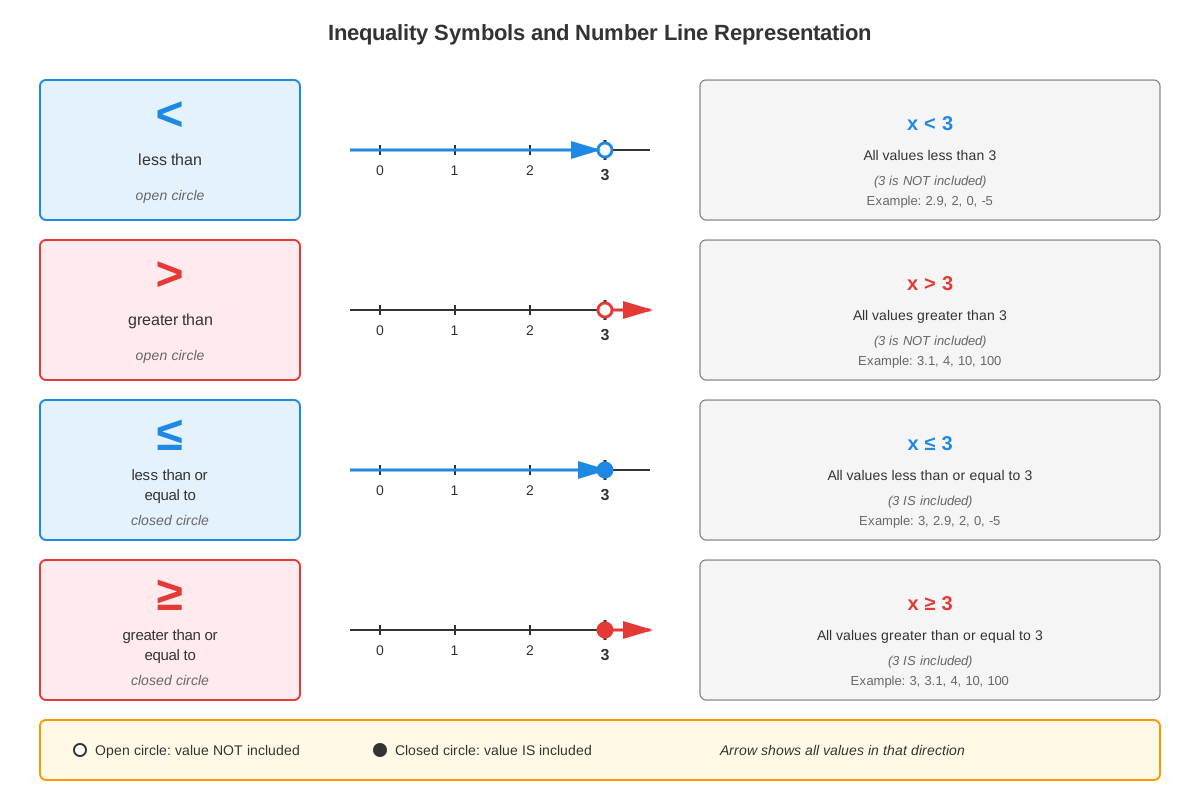
The foundation of inequality notation rests on five primary symbols that express comparative relationships. The symbol < means "less than" and indicates that the value on the left is smaller than the value on the right (e.g., 3 < 7). The symbol > means "greater than" and shows the left value exceeds the right value (e.g., 10 > 4). These are called strict inequalities because they exclude the boundary value itself.
The symbol ≤ means "less than or equal to" and includes the boundary value in the solution set (e.g., x ≤ 5 means x can be 5 or any number smaller than 5). Similarly, ≥ means "greater than or equal to" and also includes the boundary (e.g., x ≥ -2 includes -2 and all larger numbers). These are non-strict inequalities or inclusive inequalities. The fifth symbol, ≠, means "not equal to" and indicates any value except the specified number.
| Symbol | Meaning | Example | Verbal Translation |
|---|---|---|---|
| < | Less than | x < 4 | x is less than 4 |
| > | Greater than | x > -1 | x is greater than -1 |
| ≤ | Less than or equal to | x ≤ 7 | x is at most 7 |
| ≥ | Greater than or equal to | x ≥ 0 | x is at least 0 |
| ≠ | Not equal to | x ≠ 3 | x is not 3 |
Solving Single-Variable Inequalities
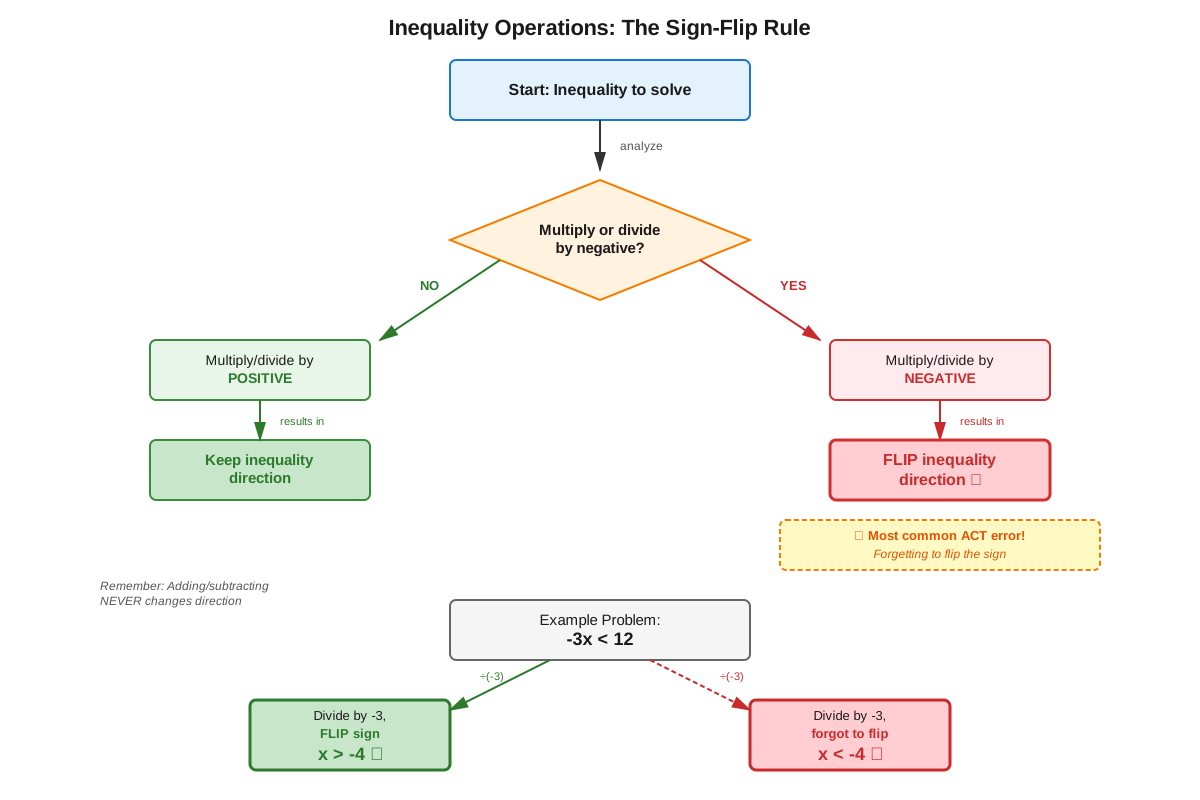
Solving inequalities follows similar procedures to solving equations, with one critical exception: when you multiply or divide both sides by a negative number, you must reverse the inequality symbol. This rule is the most frequently tested concept in ACT inequality problems and the source of many student errors.
The standard solving process involves:
- Simplify both sides of the inequality by combining like terms
- Use inverse operations to isolate the variable term
- Divide or multiply to solve for the variable
- Reverse the inequality symbol if you multiply or divide by a negative number
- Express the solution in proper notation
For example, solving -3x + 7 > 13:
- Subtract 7 from both sides: -3x > 6
- Divide both sides by -3 AND reverse the symbol: x < -2
- The solution is all numbers less than -2
Compound Inequalities
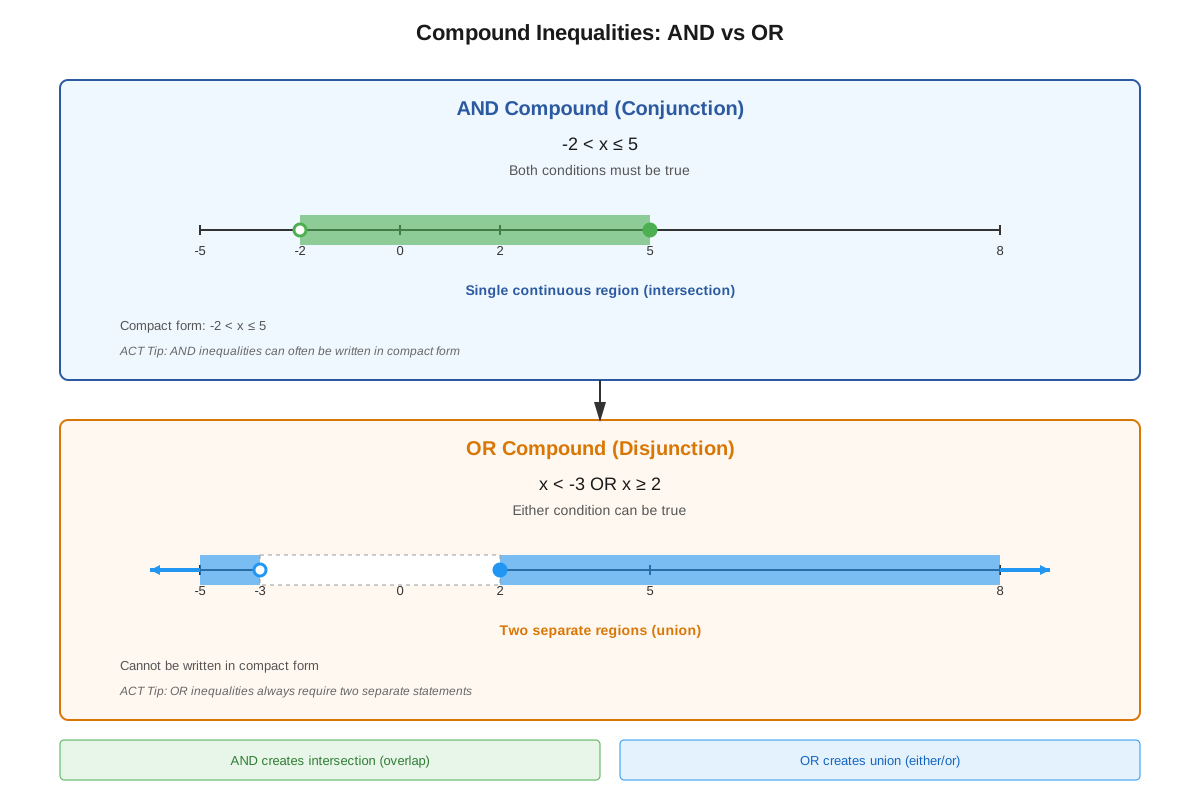
Compound inequalities express two constraints simultaneously and come in two forms: conjunction (AND) and disjunction (OR). A conjunction like 2 < x < 8 means x must satisfy both x > 2 AND x < 8, creating a single continuous interval. This is read as "x is between 2 and 8" and represents all numbers greater than 2 and less than 8.
A disjunction like x < -1 OR x > 5 describes two separate regions with a gap between them. The solution includes all numbers less than -1 together with all numbers greater than 5, but excludes everything from -1 to 5. On the ACT, you must recognize which type of compound inequality a problem describes and translate it correctly.
To solve compound inequalities written in the form a < bx + c < d:
- Treat this as two separate inequalities: a < bx + c AND bx + c < d
- Solve each inequality independently
- Combine the solutions using AND logic
- Alternatively, perform the same operation to all three parts simultaneously
Graphing Inequalities on Number Lines
Visual representation of inequality solutions on number lines helps verify answers and interpret results. Use an open circle (○) to indicate a boundary value that is NOT included (for < or >). Use a closed circle (●) to indicate a boundary value that IS included (for ≤ or ≥).
After marking the boundary point, shade the appropriate region:
- For x < a or x ≤ a, shade to the left of the boundary
- For x > a or x ≥ a, shade to the right of the boundary
- For compound inequalities with AND, shade only the overlapping region
- For compound inequalities with OR, shade both regions
Translating Verbal Descriptions
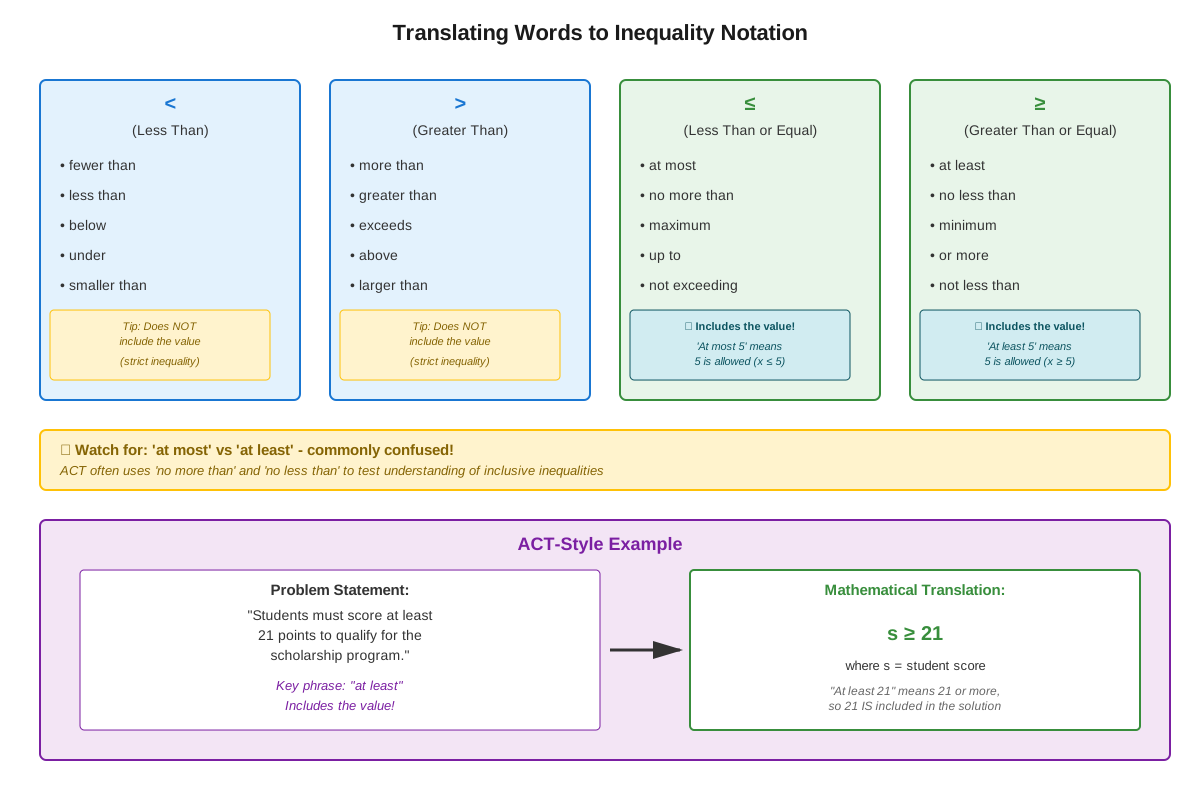
The ACT frequently tests your ability to convert word problems into inequality notation. Key phrases signal specific inequality symbols:
- "At least," "no less than," "minimum of" → use ≥
- "At most," "no more than," "maximum of" → use ≤
- "More than," "greater than," "exceeds" → use >
- "Less than," "fewer than," "below" → use <
- "Between a and b" → use a < x < b (or with ≤ if endpoints are included)
Context determines whether boundaries are inclusive. "You must be at least 16 to drive" means age ≥ 16 (16 is included). "The temperature stayed below freezing" means T < 32°F (32 is not included).
Properties of Inequalities
Understanding the properties of inequalities prevents errors and enables efficient problem-solving:
- Transitive Property: If a < b and b < c, then a < c
- Addition Property: If a < b, then a + c < b + c (adding the same value to both sides preserves the inequality)
- Subtraction Property: If a < b, then a - c < b - c
- Multiplication by Positive: If a < b and c > 0, then ac < bc
- Multiplication by Negative: If a < b and c < 0, then ac > bc (symbol reverses)
- Division by Positive: If a < b and c > 0, then a/c < b/c
- Division by Negative: If a < b and c < 0, then a/c > b/c (symbol reverses)
Concept Relationships
The concepts within inequality notation form a hierarchical structure where basic symbol recognition → enables translation of verbal descriptions → which allows formulation of mathematical inequalities → that can be solved using algebraic manipulation → and finally represented graphically on number lines. Each skill builds upon the previous one, creating a complete problem-solving framework.
Inequality notation connects directly to prerequisite topics: number line concepts provide the visual foundation for graphing solutions, while algebraic equation-solving techniques transfer to inequality manipulation with the critical modification of the reversal rule. The order of operations ensures correct simplification before applying inverse operations.
Looking forward, mastery of inequality notation enables progression to absolute value inequalities (which split into compound inequalities), systems of inequalities (used in linear programming), quadratic inequalities (requiring sign analysis), and function domain/range notation. The relationship map flows: Basic Inequalities → Compound Inequalities → Absolute Value Inequalities → Systems of Inequalities → Optimization Problems.
Quick check — test yourself on Inequality notation so far.
Try Flashcards →High-Yield Facts
⭐ When multiplying or dividing both sides of an inequality by a negative number, you must reverse the direction of the inequality symbol.
⭐ The phrase "at least" translates to ≥ (greater than or equal to), while "at most" translates to ≤ (less than or equal to).
⭐ A compound inequality like 2 < x < 8 means x > 2 AND x < 8 simultaneously, representing a single continuous interval.
⭐ On a number line, use an open circle (○) for < or > and a closed circle (●) for ≤ or ≥.
⭐ The inequality x < 5 OR x > 10 describes two separate regions with a gap between them, not a continuous interval.
- Adding or subtracting the same value from both sides of an inequality never requires reversing the symbol.
- The solution to x² > 9 is x < -3 OR x > 3, not -3 < x < 3 (a common error).
- "Between 5 and 10" typically means 5 < x < 10 unless the problem explicitly states "inclusive" or "between 5 and 10, inclusive," which would be 5 ≤ x ≤ 10.
- When solving compound inequalities written as a < bx + c < d, you can perform operations on all three parts simultaneously as long as you apply the same operation to each part.
- The inequality x ≠ 3 is not typically graphed as a shaded region but rather as a number line with an open circle at 3 and shading in both directions.
- Multiplying both sides of an inequality by zero creates the statement 0 < 0 or 0 > 0, which is meaningless; never multiply inequalities by zero.
- The solution set to an inequality can be expressed in multiple equivalent forms: inequality notation (x < 5), interval notation ((-∞, 5)), or set-builder notation ({x | x < 5}).
Common Misconceptions
Misconception: When solving -2x < 6, dividing both sides by -2 gives x < -3.
Correction: Dividing by a negative number requires reversing the inequality symbol, so -2x < 6 becomes x > -3. The solution is all numbers greater than -3, not less than -3.
Misconception: The compound inequality x < 3 OR x > 7 can be written as 3 > x > 7.
Correction: The notation 3 > x > 7 is mathematically invalid because it would mean 3 > 7, which is false. OR inequalities cannot be combined into a single statement; they must remain as two separate inequalities: x < 3 OR x > 7.
Misconception: "At least 5" means x > 5.
Correction: "At least 5" means 5 is included in the solution set, so the correct notation is x ≥ 5. The phrase indicates a minimum value that can be reached, not exceeded exclusively.
Misconception: When graphing x ≤ 4, use an open circle at 4.
Correction: The symbol ≤ includes the boundary value, so you must use a closed circle (●) at 4 to show that 4 is part of the solution set. Open circles are only for strict inequalities (< or >).
Misconception: Solving 5 < 2x + 1 < 11 requires solving two separate problems and then combining the answers.
Correction: While you can solve it as two separate inequalities (5 < 2x + 1 AND 2x + 1 < 11), it's more efficient to perform operations on all three parts simultaneously: subtract 1 from all parts to get 4 < 2x < 10, then divide all parts by 2 to get 2 < x < 5.
Misconception: The solution to |x| < 3 is x < 3.
Correction: Absolute value inequalities require considering both positive and negative cases. The solution to |x| < 3 is -3 < x < 3, representing all numbers whose distance from zero is less than 3.
Misconception: Adding 5 to both sides of x - 3 > 7 requires reversing the inequality symbol.
Correction: The reversal rule only applies when multiplying or dividing by negative numbers. Adding or subtracting any value (positive or negative) never requires reversing the symbol. The correct solution is x - 3 + 3 > 7 + 3, which simplifies to x > 10.
Worked Examples
Example 1: Solving and Graphing a Single-Variable Inequality
Problem: Solve the inequality -4x + 9 ≤ -7 and graph the solution on a number line.
Solution:
Step 1: Subtract 9 from both sides to isolate the term with x.
-4x + 9 - 9 ≤ -7 - 9
-4x ≤ -16
Step 2: Divide both sides by -4. Since we're dividing by a negative number, we must reverse the inequality symbol from ≤ to ≥.
-4x ÷ (-4) ≥ -16 ÷ (-4)
x ≥ 4
Step 3: Interpret the solution. The inequality x ≥ 4 means x can be 4 or any number greater than 4.
Step 4: Graph on a number line. Place a closed circle (●) at 4 (because the inequality includes 4) and shade to the right (because x is greater than or equal to 4).
Connection to Learning Objectives: This example demonstrates the core strategy of solving inequalities (applying inverse operations while respecting the reversal rule) and shows how to represent the solution graphically, addressing the objectives of explaining core rules and applying inequality notation accurately.
Example 2: Translating and Solving a Word Problem
Problem: A cell phone plan charges a $25 monthly fee plus $0.10 per text message. If Sarah wants to spend at most $40 per month, what is the maximum number of text messages she can send?
Solution:
Step 1: Translate the problem into inequality notation. Let t = number of text messages.
- Total cost = monthly fee + (cost per text × number of texts)
- Total cost = 25 + 0.10t
- "At most $40" means ≤ 40
The inequality is: 25 + 0.10t ≤ 40
Step 2: Solve for t.
Subtract 25 from both sides:
0.10t ≤ 15
Divide both sides by 0.10 (positive number, so no reversal):
t ≤ 150
Step 3: Interpret in context. Sarah can send at most 150 text messages per month to stay within her budget. Since you cannot send a fraction of a text message, the practical answer is any whole number from 0 to 150.
Connection to Learning Objectives: This example shows how to identify when inequality notation is being tested (recognizing "at most" as a trigger phrase), translate verbal descriptions into symbolic form, and apply the solving process to reach an accurate answer in a real-world context.
Exam Strategy
When approaching ACT questions involving inequality notation, begin by identifying trigger words and phrases that signal which inequality symbol to use. Words like "at least," "minimum," "no less than," and "or more" indicate ≥, while "at most," "maximum," "no more than," and "or fewer" indicate ≤. The phrases "more than" and "greater than" (without "or equal to") signal >, and "less than" or "fewer than" signal <. Underlining these phrases in the problem helps prevent translation errors.
Before solving, scan the inequality for negative coefficients on the variable term. If you'll need to divide or multiply by a negative number, write a reminder to reverse the symbol. This simple habit prevents the most common error on inequality questions. Many students find it helpful to circle the negative sign and draw an arrow indicating the symbol will flip.
For compound inequalities, determine whether the problem describes an AND situation (a single continuous interval) or an OR situation (two separate regions). AND problems typically use words like "between," "from...to," or present two constraints that must both be satisfied. OR problems use explicit "or" language or describe situations where either of two conditions works. Misidentifying the type leads to incorrect solutions.
When answer choices include graphs or number line representations, use the process of elimination by checking boundary points first. Determine whether the boundary should be included (closed circle) or excluded (open circle), then eliminate all choices that show the wrong circle type. Next, check the direction of shading by testing a single value from each region. This two-step elimination process is faster than solving algebraically and then matching to graphs.
Time allocation for inequality questions should average 45-60 seconds for straightforward solving problems and up to 90 seconds for word problems requiring translation and interpretation. If a problem requires more than 90 seconds, mark it for review and move on—inequality questions rarely justify spending more time because they're worth the same single point as easier questions.
Memory Techniques
Mnemonic for Reversal Rule: "Negative Flips" or "Divide by Negative, Direction New" reminds you that dividing (or multiplying) by a negative number requires reversing the inequality symbol.
Mnemonic for "At Least" vs. "At Most": Think of "at Least" as "Lower bound included, going up" (≥), and "at Most" as "Maximum included, going down" (≤). The visual of L pointing up and M pointing down can help.
Visualization for Compound Inequalities: Picture AND inequalities as a sandwich—the solution is squeezed between two boundaries with no gaps. Picture OR inequalities as two separate islands with ocean between them—the solution exists in two disconnected regions.
Circle Memory Device: Remember "Closed circle for Can equal" (≤ or ≥) and "Open circle for Only less/greater" (< or >). The matching first letters create a memorable association.
Acronym for Solving Steps: SIRD = Simplify, Isolate, Reverse (if needed), Determine solution. This provides a quick mental checklist for solving any inequality.
Summary
Inequality notation is a high-yield ACT Math topic that expresses comparative relationships using symbols <, >, ≤, ≥, and ≠. Mastery requires understanding that inequalities behave like equations when adding or subtracting, but demand symbol reversal when multiplying or dividing by negative numbers—the most critical rule tested on the ACT. Compound inequalities come in two forms: AND inequalities (like 2 < x < 8) describe continuous intervals where both conditions must be satisfied, while OR inequalities (like x < -1 OR x > 5) describe separate regions where either condition works. Translating verbal descriptions into correct notation depends on recognizing trigger phrases: "at least" means ≥, "at most" means ≤, "more than" means >, and "less than" means <. Graphing solutions on number lines requires using closed circles for inclusive boundaries (≤ or ≥) and open circles for exclusive boundaries (< or >). Success on ACT inequality questions combines accurate translation, careful algebraic manipulation with attention to the reversal rule, and correct interpretation of solutions in context.
Key Takeaways
- The reversal rule—flip the inequality symbol when multiplying or dividing by a negative number—is the most frequently tested concept and the most common source of errors.
- "At least" translates to ≥ (inclusive lower bound), while "at most" translates to ≤ (inclusive upper bound); these phrases appear in approximately 60% of ACT inequality word problems.
- Compound inequalities with AND (like a < x < b) represent continuous intervals, while OR inequalities represent two separate regions with a gap between them.
- Use closed circles (●) for ≤ or ≥ and open circles (○) for < or > when graphing on number lines.
- Adding or subtracting any value from both sides of an inequality never requires reversing the symbol—only multiplication or division by negatives triggers reversal.
- Inequality notation appears in 6-9 questions per ACT Math test, often embedded within algebra, coordinate geometry, and word problems rather than as isolated inequality-solving questions.
- Always interpret solutions in context for word problems: negative numbers of items or fractional people may be mathematically correct but contextually invalid.
Related Topics
Absolute Value Inequalities: Building on compound inequalities, absolute value inequalities like |x - 3| < 5 split into two separate inequalities and require understanding both AND and OR logic depending on whether the inequality uses < or >.
Systems of Inequalities: Extends single-variable inequalities to two variables, requiring graphing solution regions on coordinate planes and finding feasible regions—a topic that appears in 2-3 ACT questions per test.
Quadratic Inequalities: Combines inequality notation with quadratic expressions, requiring sign analysis and understanding of parabola behavior to determine solution intervals.
Function Domain and Range: Uses inequality notation to express the set of valid input values (domain) and output values (range) for functions, connecting algebra to function analysis.
Linear Programming: Applies systems of inequalities to optimization problems, representing real-world constraints and finding maximum or minimum values within feasible regions.
Practice CTA
Now that you've mastered the core concepts of inequality notation, it's time to cement your understanding through active practice. Attempt the practice questions to test your ability to translate, solve, and graph inequalities under timed conditions that simulate the actual ACT. Use the flashcards to drill the reversal rule and trigger phrases until they become automatic—speed and accuracy on these fundamentals directly translate to points on test day. Remember, inequality notation appears throughout the ACT Math section, so mastering this topic creates a foundation that improves performance across multiple question types. You've got this!
Sign up free to keep reading
Create a free AnvayaPrep account to finish this ACT guide on Inequality notation — plus flashcards and practice questions.