Overview
Rates represent one of the most frequently tested concepts on the ACT Math section, appearing in approximately 3-5 questions per exam. A rate describes how one quantity changes in relation to another quantity, typically expressed as a ratio with different units in the numerator and denominator. The most common rate students encounter is speed (distance per unit of time), but the ACT tests a diverse array of rate problems including work rates, unit conversions, flow rates, and cost per item.
Understanding rates is fundamental to success on the ACT because rate problems integrate multiple mathematical skills simultaneously. Students must demonstrate proficiency in proportional reasoning, algebraic manipulation, unit analysis, and problem-solving strategy. Rate questions often appear disguised within word problems that require careful translation from English to mathematical expressions. The ability to identify rate relationships, set up appropriate equations, and solve for unknown quantities distinguishes high-scoring students from those who struggle with the quantitative reasoning section.
Beyond their direct application, ACT rates problems serve as a bridge connecting arithmetic, algebra, and real-world applications. Mastery of rates enables students to tackle more complex topics including functions, linear relationships, and systems of equations. The conceptual framework developed through rate problems—identifying relationships between variables, maintaining dimensional consistency, and reasoning proportionally—transfers directly to physics, chemistry, economics, and other STEM disciplines that students will encounter in college coursework.
Learning Objectives
- [ ] Identify when Rates is being tested in ACT word problems and mathematical contexts
- [ ] Explain the core rule or strategy behind Rates, including the fundamental rate formula
- [ ] Apply Rates to ACT-style questions accurately, showing all work and unit conversions
- [ ] Convert between different rate units using dimensional analysis
- [ ] Solve combined rate problems involving multiple workers or processes
- [ ] Analyze inverse rate relationships and their applications
- [ ] Distinguish between average rates and instantaneous rates in context
Prerequisites
- Basic algebraic manipulation: Essential for isolating variables and solving rate equations for unknown quantities
- Fraction operations: Required for working with rates expressed as ratios and for combining multiple rates
- Unit conversion fundamentals: Necessary for translating between different measurement systems (miles to feet, hours to minutes)
- Proportional reasoning: Forms the conceptual foundation for understanding how rates scale with changes in quantity
- Word problem translation skills: Critical for converting verbal descriptions into mathematical expressions and equations
Why This Topic Matters
Rate problems appear throughout daily life in contexts ranging from calculating travel time for a road trip to determining the best value at a grocery store. Professionals in engineering, healthcare, finance, and logistics use rate calculations constantly—nurses calculate medication drip rates, financial analysts compute growth rates, and project managers estimate completion times based on work rates. Understanding rates develops quantitative literacy that extends far beyond the classroom.
On the ACT Math section, rate problems typically appear 3-5 times per exam, accounting for approximately 5-8% of all math questions. These problems span difficulty levels from straightforward speed-distance-time calculations to complex multi-step problems involving combined work rates or unit conversions across multiple dimensions. Rate questions most commonly appear in the Number and Quantity domain but also surface in Algebra and Functions contexts.
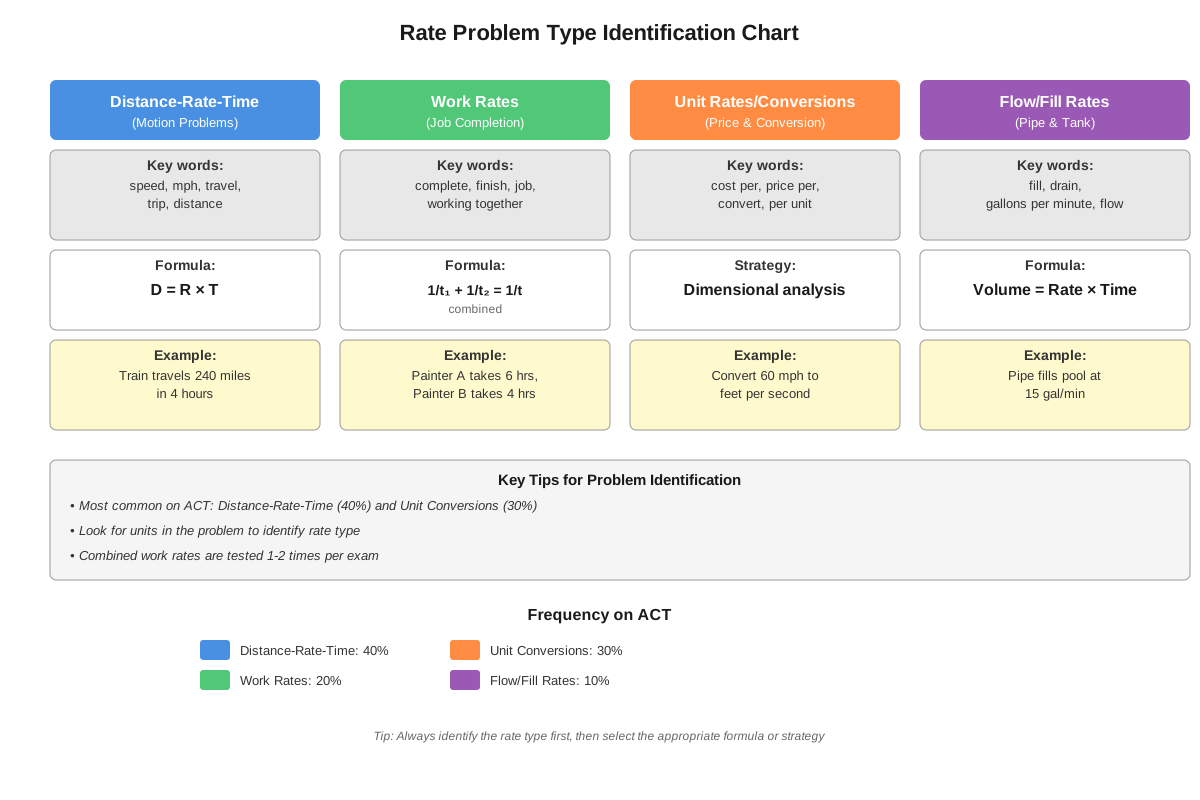
The ACT presents rate problems in several characteristic formats: classic distance-rate-time scenarios involving vehicles or runners, work rate problems where multiple people complete tasks together, unit price comparisons requiring rate conversions, and flow rate problems involving filling or draining containers. Questions may ask students to find an unknown rate, calculate time or distance given a rate, determine average rates over multiple segments, or solve for combined rates when multiple processes operate simultaneously. The ability to quickly recognize these patterns and apply the appropriate solution strategy directly impacts both accuracy and time management on test day.
Core Concepts
The Fundamental Rate Formula
A rate is defined as a ratio that compares two quantities with different units. The most fundamental rate relationship is expressed as:
Rate = Quantity₁ / Quantity₂This formula can be rearranged into three equivalent forms depending on which variable is unknown:
Quantity₁ = Rate × Quantity₂
Quantity₂ = Quantity₁ / Rate
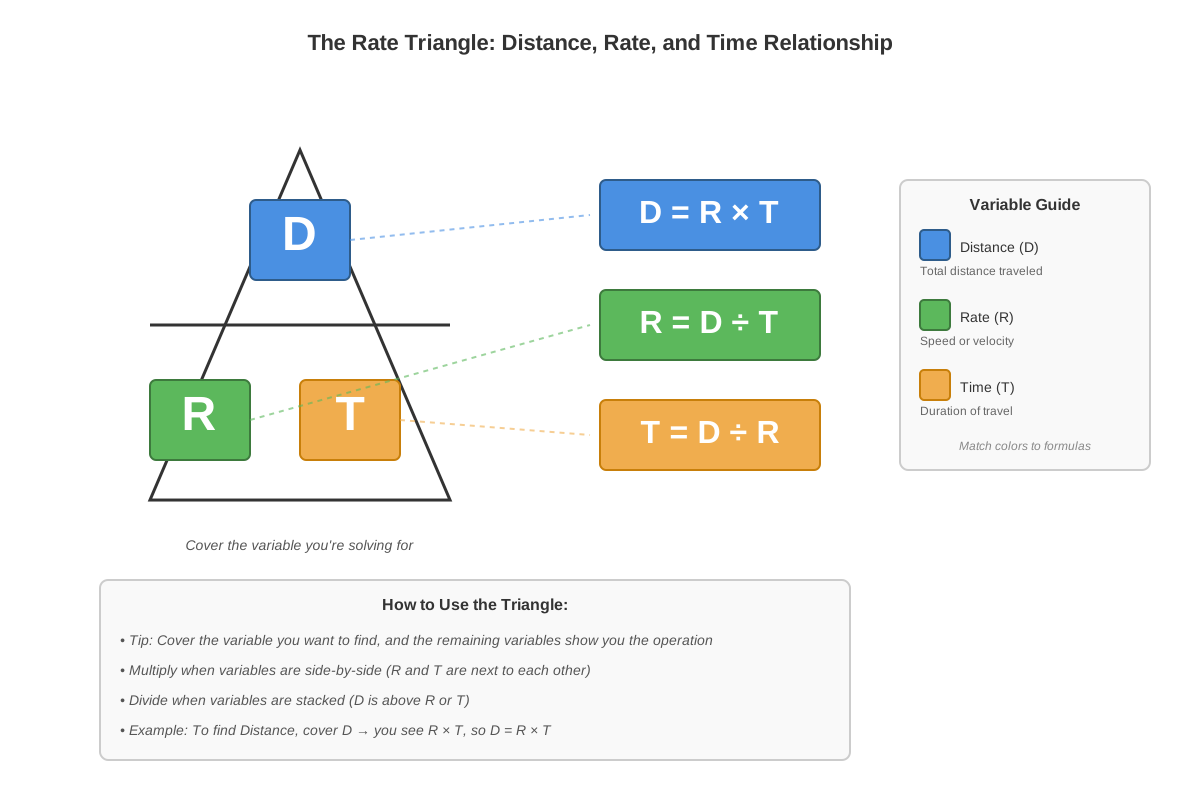
The most common application involves distance, rate (speed), and time, yielding the formula:
Distance = Rate × TimeThis relationship, often abbreviated as D = RT, serves as the foundation for most ACT rate problems. Understanding that this single equation can be manipulated to solve for any of its three variables is crucial for efficient problem-solving.
Units and Dimensional Analysis
Every rate carries specific units that must be tracked carefully throughout calculations. Common rate units include:
| Rate Type | Typical Units | Example |
|---|---|---|
| Speed | miles per hour (mph), feet per second (ft/s) | 60 mph |
| Work Rate | jobs per hour, pages per minute | 5 pages/min |
| Flow Rate | gallons per minute, liters per second | 3 gal/min |
| Unit Price | dollars per pound, cents per ounce | $2.50/lb |
| Growth Rate | percent per year, people per day | 3%/year |
Dimensional analysis is the systematic method of tracking and converting units. When multiplying or dividing rates, units behave like algebraic variables—identical units in numerator and denominator cancel. For example:
60 miles/hour × 3 hours = 180 milesThe "hours" units cancel, leaving only "miles" as expected for a distance calculation.
Unit Conversion in Rate Problems
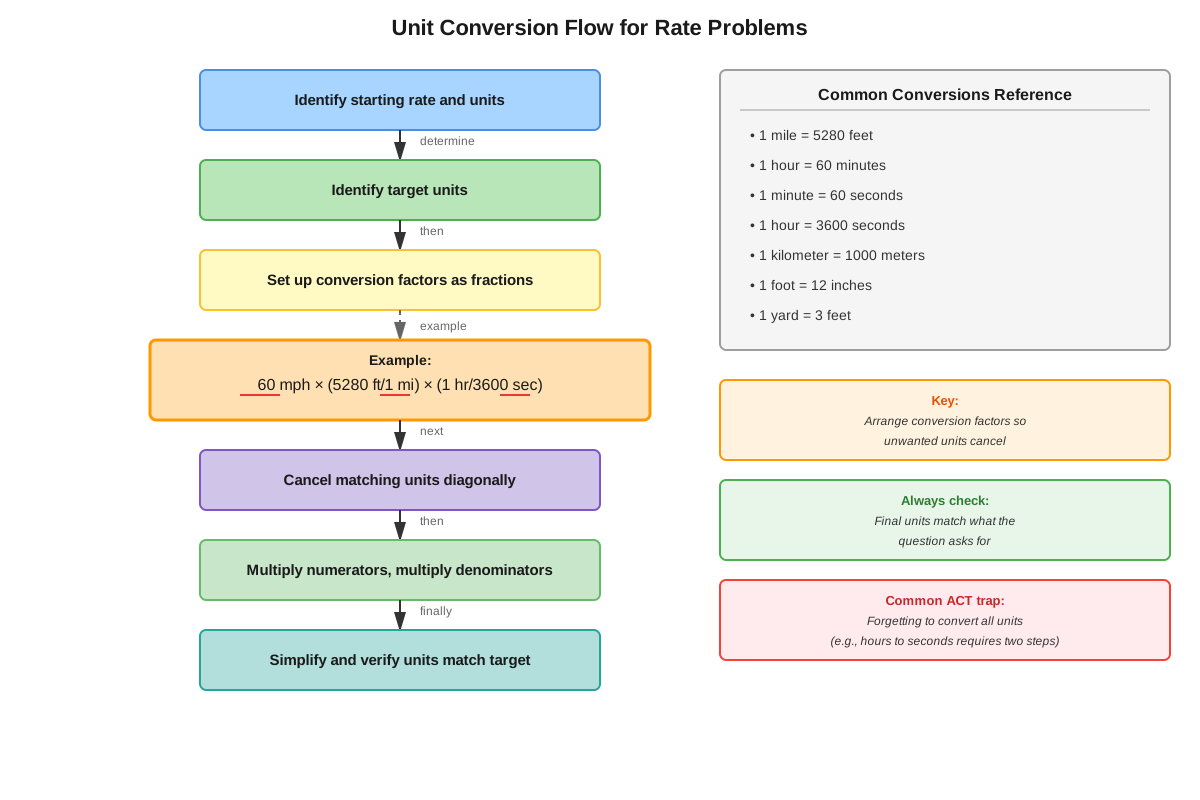
ACT questions frequently require converting rates from one unit system to another. The key strategy involves multiplying by conversion factors (fractions equal to 1) that cancel unwanted units:
60 miles/hour × (5280 feet/1 mile) × (1 hour/3600 seconds) = 88 feet/secondCommon conversions tested on the ACT include:
- 1 mile = 5,280 feet
- 1 hour = 60 minutes = 3,600 seconds
- 1 pound = 16 ounces
- 1 gallon = 4 quarts
Combined Rate Problems
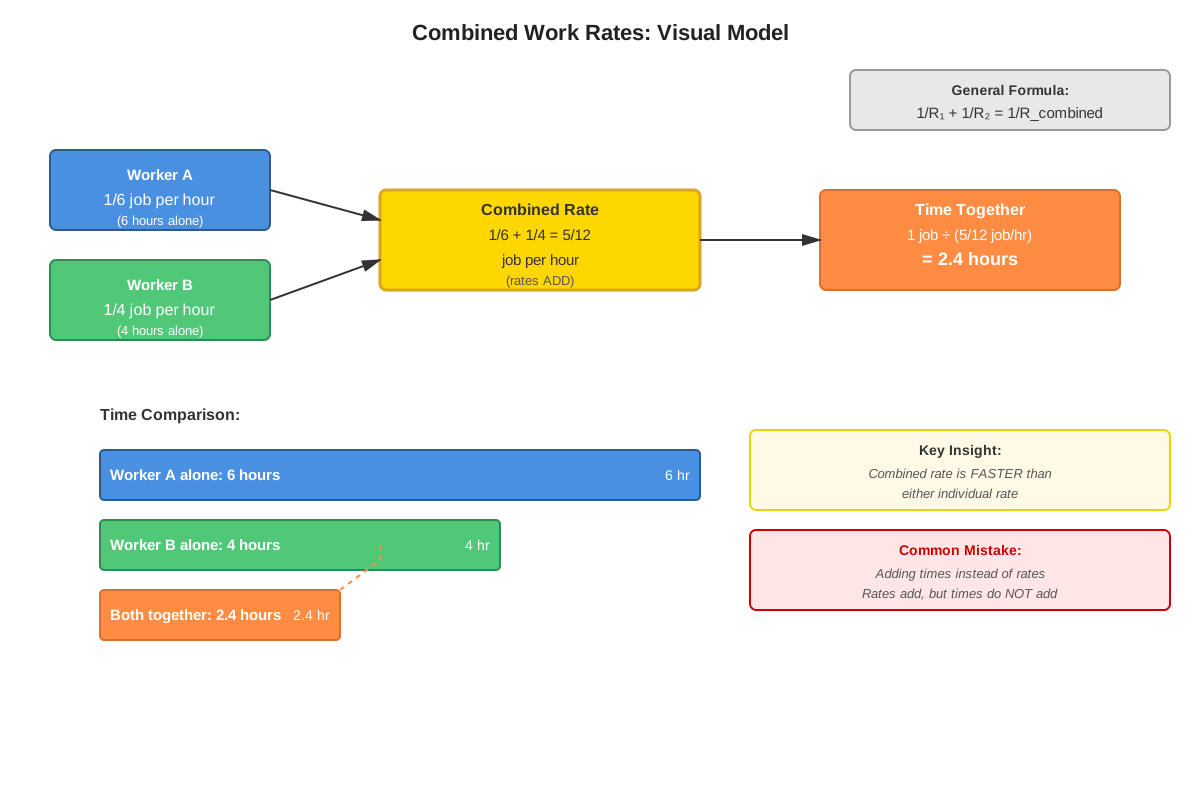
When multiple entities work together at different rates, their combined rate equals the sum of their individual rates (assuming they work independently):
Combined Rate = Rate₁ + Rate₂ + Rate₃ + ...For example, if Worker A completes 1/3 of a job per hour and Worker B completes 1/4 of a job per hour, together they complete:
1/3 + 1/4 = 7/12 of the job per hourThis principle applies to work problems, filling/draining problems, and any scenario where multiple processes operate simultaneously toward the same goal.
Inverse Rate Relationships
An important pattern emerges when comparing rate and time for a fixed quantity: they are inversely proportional. If the rate increases, the time required decreases proportionally:
Rate₁ × Time₁ = Rate₂ × Time₂This relationship proves particularly useful when comparing scenarios. For instance, if doubling your speed, you halve your travel time for the same distance.
Average Rate vs. Average Speed
A critical distinction that frequently appears on the ACT involves calculating average rates over multiple segments. The average rate is NOT simply the arithmetic mean of individual rates. Instead:
Average Rate = Total Distance / Total TimeFor example, if you drive 60 mph for 1 hour, then 40 mph for 1 hour, your average speed is:
(60 + 40) miles / (1 + 1) hours = 50 mphHowever, if you drive 60 mph for 60 miles, then 40 mph for 40 miles, the calculation differs:
Time₁ = 60 miles / 60 mph = 1 hour
Time₂ = 40 miles / 40 mph = 1 hour
Average Rate = 100 miles / 2 hours = 50 mph
The key insight: always calculate total distance and total time separately, then divide.
Relative Rate Problems
When two objects move toward or away from each other, their relative rate determines how quickly the distance between them changes:
- Approaching: Relative Rate = Rate₁ + Rate₂
- Moving apart: Relative Rate = Rate₁ + Rate₂
- Same direction: Relative Rate = |Rate₁ - Rate₂|
For example, two trains 300 miles apart traveling toward each other at 50 mph and 70 mph will meet in:
Time = 300 miles / (50 + 70) mph = 2.5 hoursConcept Relationships
The fundamental rate formula (Rate = Quantity₁/Quantity₂) serves as the central organizing principle from which all other rate concepts derive. This formula directly connects to dimensional analysis, as the units of the two quantities determine the rate's units. Understanding dimensional analysis enables unit conversion, which transforms rates between different measurement systems while preserving their mathematical relationships.
The fundamental formula also leads to combined rate problems through the principle of additivity—when multiple independent processes contribute to the same outcome, their rates sum. This concept connects back to fraction operations (a prerequisite) since rates are often expressed as fractions of a job or task completed per unit time.
Inverse rate relationships emerge directly from the fundamental formula: for fixed distance, if rate doubles, time must halve to maintain the equality D = RT. This inverse proportionality connects to the broader algebraic concept of inverse variation.
Average rate calculations represent a sophisticated application of the fundamental formula, requiring students to aggregate multiple distance-rate-time scenarios. This concept builds upon the prerequisite of proportional reasoning while introducing the critical insight that averages of rates require weighted calculations based on time or distance, not simple arithmetic means.
Relative rate problems combine the fundamental rate formula with vector-like reasoning about direction, connecting rate concepts to more advanced topics in physics and kinematics. The relationship map flows as:
Fundamental Rate Formula → Dimensional Analysis → Unit Conversion
↓
Combined Rates
↓
Inverse Relationships → Relative Rates
↓
Average Rate Calculations
Quick check — test yourself on Rates so far.
Try Flashcards →High-Yield Facts
⭐ The fundamental rate formula D = RT can be rearranged to solve for any variable: R = D/T or T = D/R
⭐ When converting units, multiply by conversion factors (fractions equal to 1) to cancel unwanted units
⭐ Combined rates for independent processes sum: Total Rate = Rate₁ + Rate₂
⭐ Average rate equals total distance divided by total time, NOT the average of individual rates
⭐ For objects approaching each other, relative rate equals the sum of individual rates
- Rate problems always involve a relationship between two different quantities with different units
- When rate increases and quantity stays constant, time decreases proportionally (inverse relationship)
- Work rate problems typically express rates as "fraction of job per unit time" (e.g., 1/4 job per hour)
- Unit price problems are rate problems comparing cost to quantity (dollars per pound, cents per ounce)
- Flow rate problems involving filling and draining use combined rates with opposite signs (filling is positive, draining is negative)
⭐ Converting mph to feet per second: multiply by 5280/3600 or approximately 1.47
- Round-trip average speed problems require calculating time for each leg separately before averaging
- When two objects move in the same direction, relative rate equals the difference of their speeds
- Percent rate problems (growth rates, interest rates) use the same fundamental formula structure
- ACT rate problems often hide the rate relationship within complex word problems requiring careful translation
Common Misconceptions
Misconception: Average speed is the arithmetic mean of two speeds → Correction: Average speed equals total distance divided by total time. If you travel 60 mph for one hour and 40 mph for one hour, your average speed is (60+40)/2 = 50 mph only because the times are equal. If the times differ, you must calculate total distance and total time separately.
Misconception: Units don't matter in rate calculations → Correction: Units are essential for setting up correct equations and ensuring dimensional consistency. Mixing miles and feet or hours and minutes without proper conversion leads to incorrect answers. Always track units through every calculation step.
Misconception: Combined work rates multiply rather than add → Correction: When workers operate independently on the same task, their rates add. If Worker A completes 1/3 job/hour and Worker B completes 1/4 job/hour, together they complete 1/3 + 1/4 = 7/12 job/hour, not 1/3 × 1/4 = 1/12 job/hour.
Misconception: Doubling speed doubles distance for the same time → Correction: This is actually correct! The misconception is thinking it doubles time instead. For fixed time, distance is directly proportional to rate. For fixed distance, time is inversely proportional to rate.
Misconception: In relative rate problems, always add the speeds → Correction: Add speeds only when objects move toward each other or away from each other. When moving in the same direction, subtract speeds to find relative rate. A car traveling 70 mph overtaking a car traveling 60 mph has a relative rate of 10 mph.
Misconception: Rate problems always involve speed and distance → Correction: The ACT tests many types of rates including work rates (jobs per hour), flow rates (gallons per minute), unit prices (dollars per pound), and growth rates (percent per year). The same mathematical principles apply regardless of the specific quantities involved.
Worked Examples
Example 1: Classic Distance-Rate-Time Problem
Problem: Sarah drives from City A to City B, a distance of 180 miles, at an average speed of 60 mph. After a 30-minute break, she drives back to City A at an average speed of 45 mph. What is her average speed for the entire round trip?
Solution:
Step 1: Calculate time for the first leg
Time₁ = Distance / Rate = 180 miles / 60 mph = 3 hoursStep 2: Calculate time for the return leg
Time₂ = Distance / Rate = 180 miles / 45 mph = 4 hoursStep 3: Convert break time to hours
Break = 30 minutes = 0.5 hoursStep 4: Calculate total distance and total time
Total Distance = 180 + 180 = 360 miles
Total Time = 3 + 0.5 + 4 = 7.5 hours
Step 5: Calculate average speed
Average Speed = Total Distance / Total Time = 360 miles / 7.5 hours = 48 mphKey Insight: Notice that the average speed (48 mph) is NOT the arithmetic mean of 60 and 45 mph (which would be 52.5 mph). The break time must be included in total time even though no distance is covered during the break. This problem directly addresses Learning Objective 3 (applying rates accurately) and demonstrates the common misconception about average rates.
Example 2: Combined Work Rate Problem
Problem: Printer A can print a batch of documents in 4 hours working alone. Printer B can print the same batch in 6 hours working alone. If both printers work together, how long will it take to print the batch?
Solution:
Step 1: Express each printer's rate as fraction of job per hour
Rate_A = 1 job / 4 hours = 1/4 job per hour
Rate_B = 1 job / 6 hours = 1/6 job per hour
Step 2: Calculate combined rate
Combined Rate = Rate_A + Rate_B = 1/4 + 1/6Step 3: Find common denominator and add
Combined Rate = 3/12 + 2/12 = 5/12 job per hourStep 4: Calculate time to complete 1 job at combined rate
Time = 1 job / (5/12 job per hour) = 1 × 12/5 = 12/5 = 2.4 hoursStep 5: Convert to hours and minutes (if needed)
2.4 hours = 2 hours + 0.4 hours = 2 hours + 24 minutesKey Insight: The combined time (2.4 hours) is less than either individual time but NOT half of the faster time. This problem illustrates Learning Objective 2 (explaining core strategies) by demonstrating the additive property of independent work rates. The reciprocal relationship between "time to complete job" and "rate of work" is fundamental to these problems.
Exam Strategy
When approaching ACT rate problems, begin by identifying the type of rate involved and the three quantities in the relationship. Look for trigger words that signal rate problems: "speed," "per," "each," "rate," "average," "together," "how long," "how far," and "how fast." The word "per" is particularly important as it always indicates a rate (miles per hour, dollars per pound, pages per minute).
Create a systematic approach for every rate problem:
- Identify the three variables (typically distance, rate, and time or their equivalents)
- Write down what you know and what you need to find
- Set up the fundamental equation (D = RT or equivalent)
- Check units and convert if necessary before calculating
- Solve algebraically for the unknown variable
- Verify your answer makes logical sense
For process of elimination, use logical reasoning about relationships:
- If rate increases and distance stays constant, time must decrease
- Average rates for round trips are always closer to the slower speed (because more time is spent at the slower speed)
- Combined rates are always faster than individual rates
- Answers with incorrect units can be eliminated immediately
Time allocation is critical: straightforward rate problems should take 30-45 seconds, while complex multi-step problems may require 90-120 seconds. If a problem requires more than 2 minutes, mark it and return later. The ACT rewards efficient problem-solving, so practice recognizing patterns quickly.
Watch for trap answers that represent common errors:
- The arithmetic mean of two speeds (instead of proper average rate)
- Results from adding rates when they should be subtracted (or vice versa)
- Answers with unconverted units
- Results from multiplying instead of dividing (or vice versa)
Exam Tip: When stuck on a complex rate problem, try working backwards from the answer choices. Plug each option into the scenario and check if it produces consistent results. This strategy is particularly effective for combined rate and average rate problems.
Memory Techniques
"DRT" Mnemonic: Remember the fundamental formula as "Dirt" → D = R × T. Visualize writing in dirt to recall that Distance equals Rate times Time.
"COWS" for Combined Rates: Combine Outputs When Simultaneous. When multiple entities work simultaneously on the same task, combine (add) their individual rates.
"TOAD" for Average Rate: Total Over All Divided. Average rate equals Total distance Over All time Divided (total distance divided by total time).
Unit Conversion Visualization: Picture a "unit ladder" where you climb up or down by multiplying by conversion factors. Each rung represents a different unit, and you multiply by fractions equal to 1 to climb between rungs.
"FAST" for Problem-Solving:
- Find what's given and what's unknown
- Arrange the formula (D = RT or equivalent)
- Substitute values with units
- Test that your answer makes sense
Relative Rate Hand Trick: Hold your hands together for "approaching" (add rates), move them apart for "separating" (add rates), and slide one past the other for "same direction" (subtract rates).
Summary
Rates represent relationships between two quantities with different units, most commonly expressed through the fundamental formula Distance = Rate × Time. Success on ACT rate problems requires mastery of several interconnected skills: identifying rate relationships in word problems, manipulating the fundamental formula to solve for unknown variables, tracking and converting units through dimensional analysis, calculating combined rates when multiple processes operate simultaneously, and computing average rates using total distance divided by total time rather than arithmetic means. The ACT tests rates in diverse contexts including speed problems, work rate scenarios, unit price comparisons, and flow rate calculations. Students must recognize that rates and time exhibit inverse relationships for fixed quantities, understand that relative rates depend on direction of motion, and avoid common misconceptions about averaging rates. Efficient problem-solving requires systematic identification of the three variables involved, careful unit tracking, algebraic manipulation, and logical verification of results. The ability to quickly recognize rate problem patterns and apply appropriate solution strategies distinguishes high-scoring students on this frequently-tested topic.
Key Takeaways
- The fundamental rate formula D = RT (and its rearrangements R = D/T and T = D/R) is the foundation for all rate problems
- Always track units carefully and use dimensional analysis to convert between unit systems by multiplying by conversion factors
- Combined rates for independent processes add together; if Worker A works at rate R₁ and Worker B at rate R₂, their combined rate is R₁ + R₂
- Average rate equals total distance divided by total time, NOT the arithmetic mean of individual rates
- Rate and time are inversely proportional for fixed distance; doubling rate halves time
- Relative rates depend on direction: add rates for approaching/separating objects, subtract for same-direction motion
- Recognize rate problem trigger words including "per," "speed," "average," "together," "how long," and "how fast"
Related Topics
Proportions and Ratios: Rates are special types of ratios with different units. Mastering rates provides the foundation for solving proportion problems and understanding direct and inverse variation, which appear frequently in ACT Algebra questions.
Linear Functions: Rate problems connect directly to linear functions where the rate represents the slope. Understanding rates enables students to interpret real-world linear relationships and solve problems involving constant rates of change.
Systems of Equations: Complex rate problems involving multiple unknowns often require setting up and solving systems of equations, particularly in scenarios with multiple travelers or workers.
Unit Analysis in Science: The dimensional analysis skills developed through rate problems transfer directly to chemistry (molarity, reaction rates), physics (velocity, acceleration), and other scientific applications that appear in ACT Science passages.
Percent Problems: Growth rates, interest rates, and percent change problems use the same mathematical structure as other rate problems, with percent representing a rate of change per 100 units.
Practice CTA
Now that you've mastered the core concepts, strategies, and common pitfalls of rate problems, it's time to solidify your understanding through active practice. Complete the practice questions to test your ability to identify rate relationships, set up equations correctly, and solve efficiently under timed conditions. Use the flashcards to reinforce key formulas, conversion factors, and problem-solving strategies until they become automatic. Remember: rate problems appear on every ACT Math section, and consistent practice with these high-yield question types will directly improve your score. The difference between knowing the concepts and applying them accurately under pressure comes from deliberate practice—start now!
Sign up free to keep reading
Create a free AnvayaPrep account to finish this ACT guide on Rates — plus flashcards and practice questions.