Overview
Roots and radicals represent one of the most frequently tested algebraic concepts on the ACT Math section, appearing in approximately 3-5 questions per exam. These mathematical expressions involve finding values that, when raised to a specific power, produce a given number. Understanding roots and radicals is essential not only for direct computation questions but also for solving equations, simplifying expressions, and working with exponential relationships that appear throughout the test.
The ACT consistently tests students' ability to manipulate radical expressions, convert between radical and exponential notation, simplify complex radical terms, and solve equations containing radicals. Questions may appear as straightforward simplification problems, embedded within algebraic equations, or disguised within word problems involving geometric formulas. Mastery of this topic directly impacts performance on questions involving the Pythagorean theorem, distance formula, quadratic equations, and rational exponents—making it a cornerstone concept that connects multiple mathematical domains.
Beyond isolated radical problems, ACT roots and radicals questions often integrate with other algebraic skills such as factoring, rationalizing denominators, and understanding function behavior. Students who develop fluency with radical operations gain significant advantages in time management and accuracy, as these skills enable quick recognition of equivalent forms and efficient problem-solving pathways. The ability to seamlessly convert between radical notation and exponential form, combined with strong simplification techniques, distinguishes high-scoring students from those who struggle with algebraic manipulation.
Learning Objectives
- [ ] Identify when Roots and radicals is being tested
- [ ] Explain the core rule or strategy behind Roots and radicals
- [ ] Apply Roots and radicals to ACT-style questions accurately
- [ ] Convert between radical notation and exponential form fluently
- [ ] Simplify radical expressions by identifying and extracting perfect powers
- [ ] Rationalize denominators containing radical expressions
- [ ] Solve equations containing radical expressions and verify solutions
Prerequisites
- Integer operations and prime factorization: Essential for breaking down radicands into factors and identifying perfect squares, cubes, or higher powers
- Exponent rules: Necessary for understanding the relationship between radicals and fractional exponents, and for manipulating expressions in exponential form
- Basic algebraic manipulation: Required for isolating variables, combining like terms, and performing operations on expressions containing radicals
- Order of operations: Critical for correctly evaluating expressions with multiple operations involving radicals
Why This Topic Matters
Roots and radicals extend far beyond abstract mathematical exercises, appearing in numerous real-world applications that students encounter in science, engineering, and everyday problem-solving. The square root function models relationships in physics (such as the period of a pendulum), finance (compound interest calculations), and geometry (diagonal measurements and spatial relationships). Understanding radicals enables students to work with the Pythagorean theorem in practical contexts like construction, navigation, and computer graphics.
On the ACT Math section, roots and radicals appear with remarkable consistency, typically accounting for 5-8% of all questions. These problems span multiple difficulty levels, from straightforward simplification of √50 to complex multi-step problems involving rationalization and radical equations. The ACT frequently embeds radical concepts within coordinate geometry questions (distance and midpoint formulas), right triangle problems, and algebraic equation solving. Questions may ask students to simplify expressions, solve for variables under radical signs, or identify equivalent forms of radical expressions.
The exam commonly presents roots and radicals in several distinct formats: direct simplification problems ("Simplify √72"), equations requiring isolation and squaring ("Solve √(x+3) = 5"), rationalization tasks ("Express 1/√2 with a rational denominator"), and application problems where students must recognize that a radical operation is needed. Additionally, the ACT often includes answer choices designed to trap students who make common errors in radical manipulation, making thorough understanding of the underlying principles essential for avoiding these distractors.
Core Concepts
Understanding Radical Notation and Terminology
A radical is a mathematical expression that indicates the root of a number. The general form is ⁿ√x, where n is the index (indicating which root to take), x is the radicand (the number under the radical sign), and the symbol √ is the radical sign. When no index is written, the index is understood to be 2, making √x a square root. The principal root refers to the positive root when multiple roots exist.
For any positive real number x and positive integer n, the expression ⁿ√x represents the number that, when raised to the nth power, equals x. For example, ³√8 = 2 because 2³ = 8. Understanding this fundamental definition helps students verify their answers and recognize when radical expressions are equivalent.
Relationship Between Radicals and Exponents
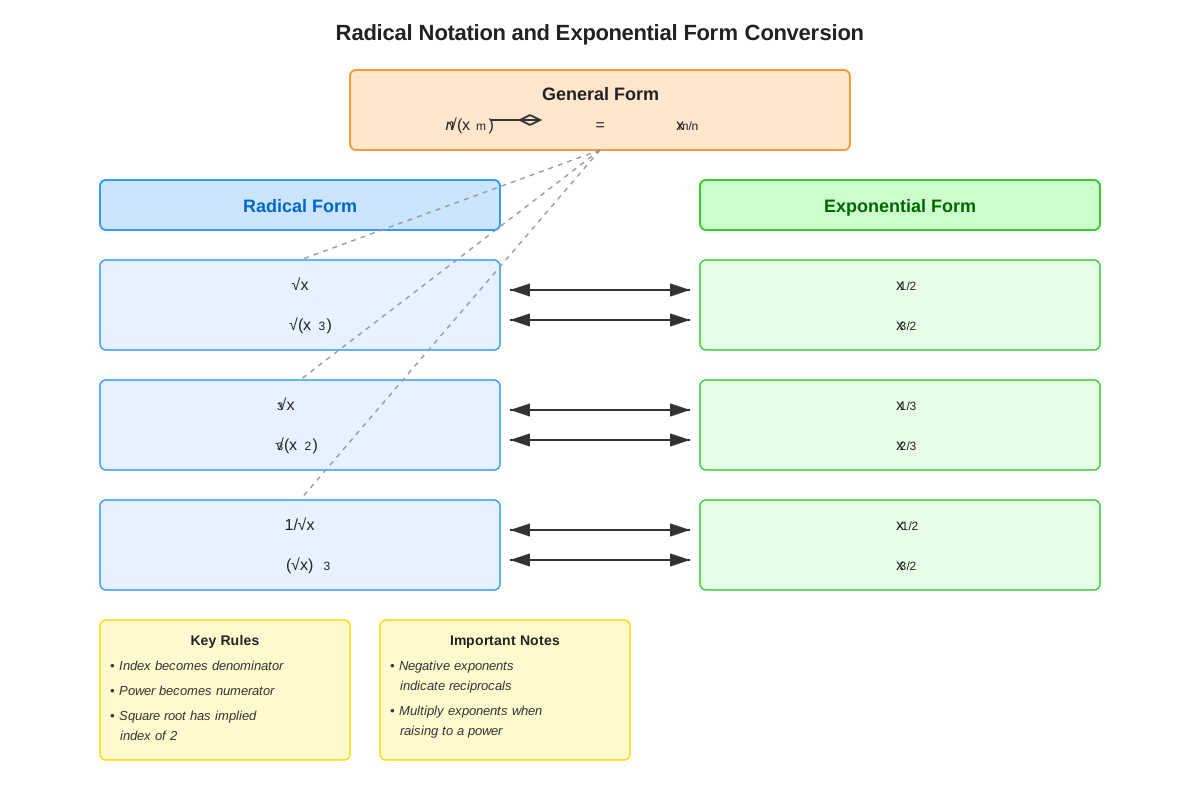
One of the most powerful concepts for ACT success is the equivalence between radical notation and exponential notation. Any radical can be expressed as an exponent with a fractional power:
ⁿ√x = x^(1/n)
ⁿ√(x^m) = x^(m/n)
This relationship allows students to apply familiar exponent rules to radical expressions. For instance, √x · √x = x^(1/2) · x^(1/2) = x^(1/2 + 1/2) = x¹ = x. Converting between forms often simplifies complex problems and reveals solution pathways that aren't immediately obvious in radical notation.
Simplifying Radical Expressions
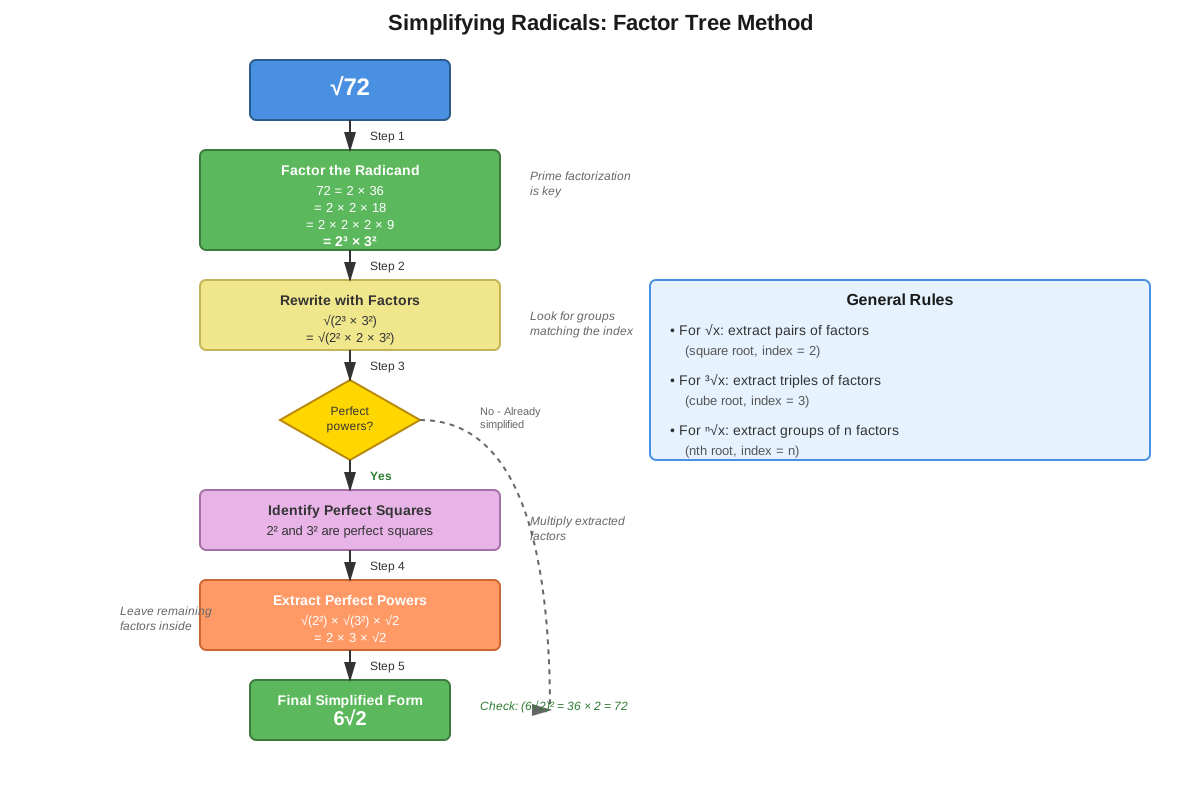
Simplification of radicals involves extracting perfect powers from the radicand to move factors outside the radical sign. The fundamental principle relies on the product property of radicals:
√(a · b) = √a · √bTo simplify a radical expression:
- Factor the radicand into prime factors or identify perfect squares (cubes, etc.)
- Group factors into perfect powers matching the index
- Extract these perfect powers from under the radical
- Multiply the extracted factors outside the radical
- Leave remaining factors under the radical in simplified form
For example, to simplify √72:
- Factor: 72 = 36 × 2 = 6² × 2
- Extract the perfect square: √(6² × 2) = 6√2
For cube roots and higher indices, look for perfect cubes, fourth powers, etc. The expression ³√(54) simplifies as follows:
- Factor: 54 = 27 × 2 = 3³ × 2
- Extract: ³√(3³ × 2) = 3³√2
Operations with Radicals
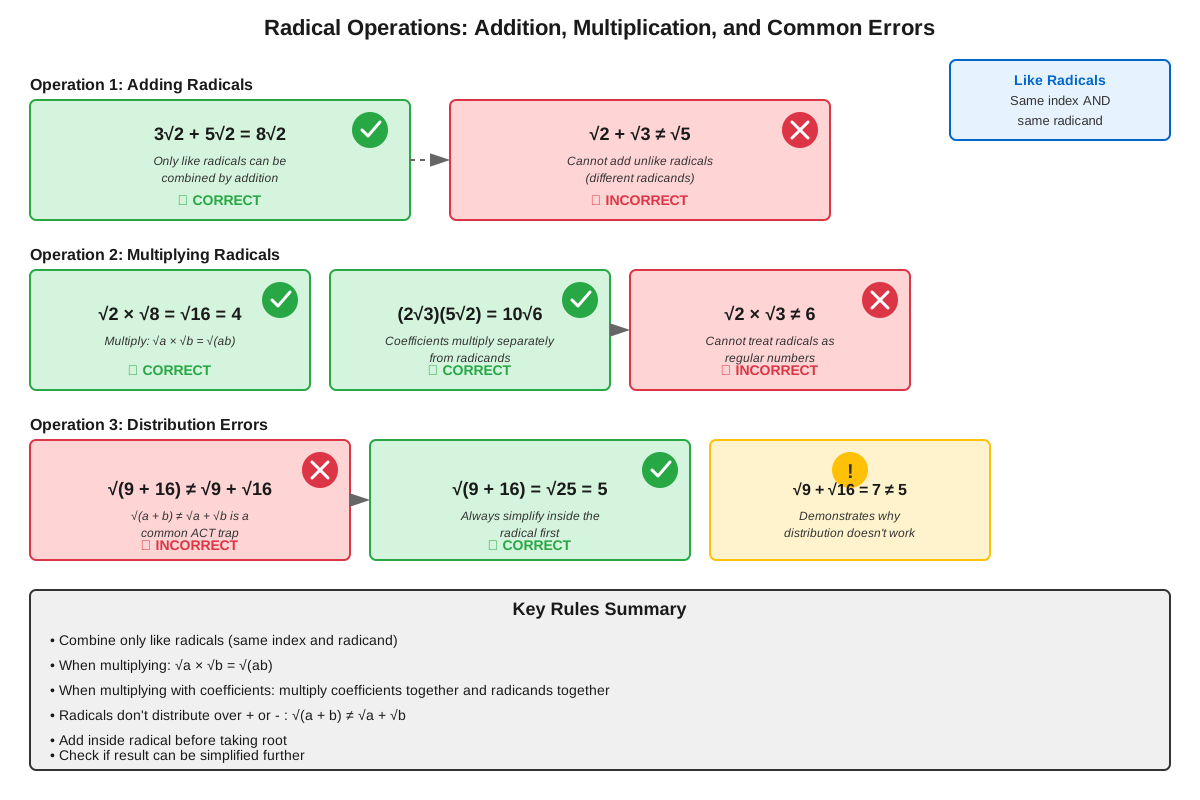
Addition and subtraction of radicals requires like terms—radicals with identical indices and radicands. Just as 3x + 5x = 8x, we have 3√2 + 5√2 = 8√2. However, √2 + √3 cannot be simplified further because the radicands differ. Students must first simplify all radicals to identify like terms that may not be initially obvious.
Multiplication of radicals with the same index uses the product property:
√a · √b = √(ab)For example: √3 · √12 = √36 = 6. When multiplying radicals with coefficients, multiply the coefficients separately: 2√3 · 5√2 = 10√6.
Division of radicals follows the quotient property:
√a / √b = √(a/b)This property is particularly useful when simplifying fractions under a single radical sign.
Rationalizing Denominators
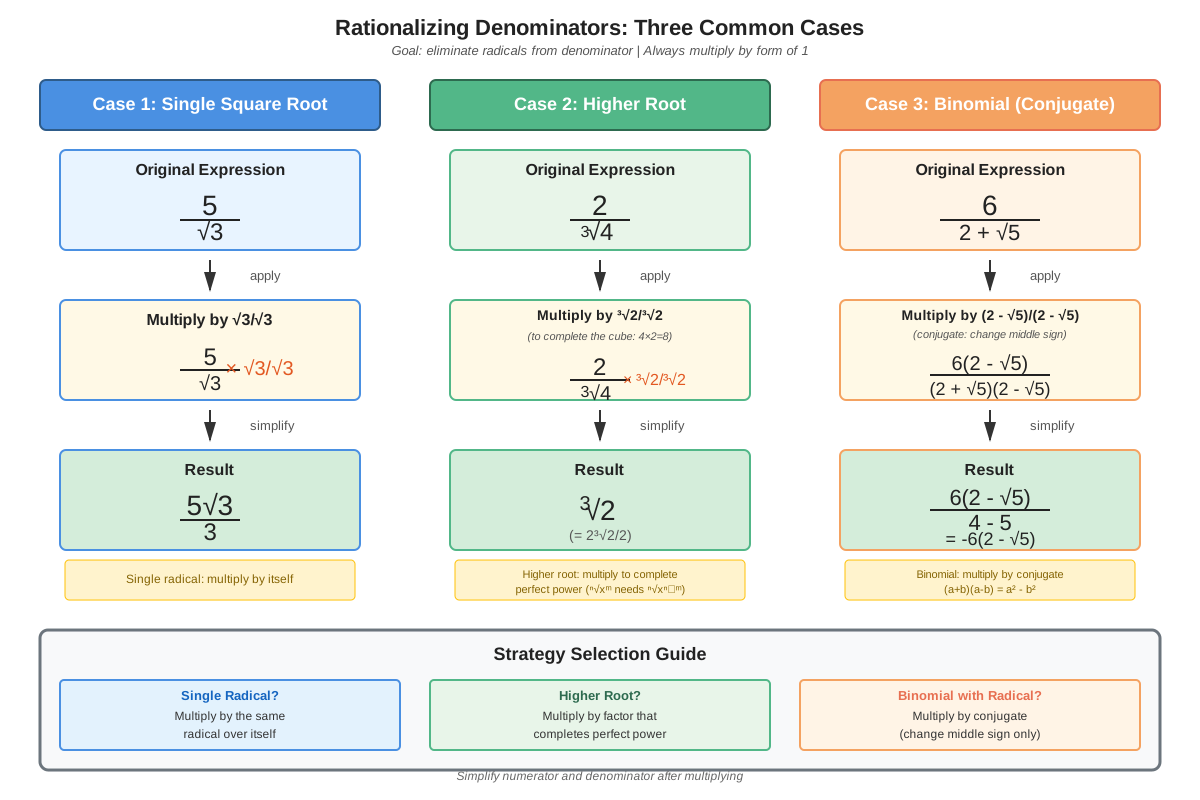
Rationalizing the denominator means eliminating radicals from the denominator of a fraction. The ACT strongly prefers rationalized forms in answer choices. For simple square roots in the denominator, multiply both numerator and denominator by the radical:
1/√2 = (1/√2) · (√2/√2) = √2/2For denominators containing sums or differences with radicals (binomial denominators), use the conjugate—the same terms with the opposite sign between them. The conjugate of (a + √b) is (a - √b). Multiplying by the conjugate eliminates the radical through the difference of squares pattern:
1/(2 + √3) = 1/(2 + √3) · (2 - √3)/(2 - √3) = (2 - √3)/(4 - 3) = 2 - √3Solving Radical Equations
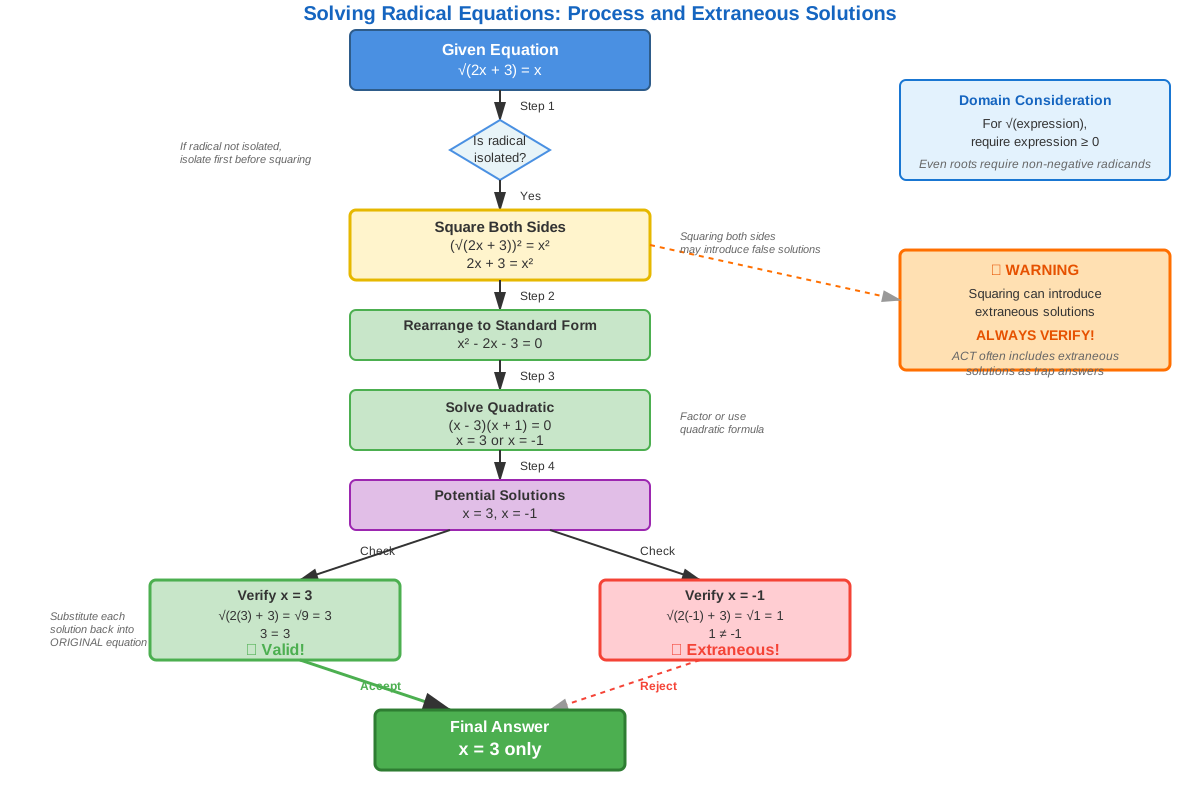
A radical equation contains a variable under a radical sign. The general strategy involves:
- Isolate the radical expression on one side of the equation
- Raise both sides to the power matching the radical's index
- Solve the resulting equation
- Check all solutions in the original equation (critical step!)
The checking step is essential because raising both sides to an even power can introduce extraneous solutions—values that satisfy the squared equation but not the original. For example, solving √x = -3 by squaring gives x = 9, but substituting back shows √9 = 3 ≠ -3, so there is no solution.
Higher-Order Roots
While square roots dominate ACT questions, cube roots and occasionally fourth roots appear. The same principles apply, but students must recognize perfect cubes (1, 8, 27, 64, 125, 216, etc.) and perfect fourth powers (1, 16, 81, 256, etc.). Cube roots of negative numbers are defined and negative: ³√(-8) = -2 because (-2)³ = -8.
| Root Type | Index | Perfect Powers to Memorize | Example |
|---|---|---|---|
| Square root | 2 | 1, 4, 9, 16, 25, 36, 49, 64, 81, 100, 121, 144, 169, 196, 225 | √144 = 12 |
| Cube root | 3 | 1, 8, 27, 64, 125, 216 | ³√64 = 4 |
| Fourth root | 4 | 1, 16, 81, 256 | ⁴√81 = 3 |
Concept Relationships
The concepts within roots and radicals form an interconnected system where each skill builds upon and reinforces others. Radical notation serves as the foundation → which connects to exponential form through the fractional exponent relationship → enabling application of exponent rules to radical operations. Understanding simplification requires recognizing perfect powers → which depends on prime factorization skills → leading to efficient extraction of factors from radicands.
Operations with radicals (addition, subtraction, multiplication, division) → require simplification as a prerequisite step → to identify like terms and combine expressions correctly. Rationalizing denominators → applies multiplication of radicals → combined with conjugate pairs for binomial denominators → ultimately producing simplified forms preferred on the ACT.
Solving radical equations → integrates isolation techniques from basic algebra → with inverse operations (raising to powers) → necessitating verification of solutions → to eliminate extraneous results introduced by squaring. This entire system connects back to prerequisite knowledge of exponent rules and algebraic manipulation, while extending forward to applications in geometry (Pythagorean theorem, distance formula), functions (radical functions and their graphs), and complex numbers (where √(-1) = i).
The relationship between radicals and exponents creates a bidirectional pathway: students can convert difficult radical problems into exponential form for easier manipulation, then convert back to radical form for final answers. This flexibility represents a key strategic advantage on timed exams.
Quick check — test yourself on Roots and radicals so far.
Try Flashcards →High-Yield Facts
⭐ The product property of radicals states that √(ab) = √a · √b, allowing factorization and simplification of radicands
⭐ Any radical ⁿ√x can be written as the exponential expression x^(1/n), enabling use of exponent rules
⭐ Only radicals with identical indices AND radicands can be added or subtracted as like terms
⭐ When solving radical equations, always check solutions in the original equation to identify extraneous solutions
⭐ To rationalize a denominator with a binomial containing a radical, multiply by the conjugate
- The principal square root of a positive number is always positive; √9 = 3, not ±3
- Perfect squares up to 225 should be memorized for rapid simplification
- The quotient property √(a/b) = √a / √b applies when both a and b are non-negative and b ≠ 0
- Cube roots of negative numbers are defined and negative: ³√(-27) = -3
- Simplifying before multiplying radicals often prevents working with unnecessarily large numbers
- The expression √x² = |x| for all real numbers, not simply x, due to the principal root definition
- Rationalizing denominators is not mathematically necessary but is the preferred form on standardized tests
- When a radical appears in both numerator and denominator, simplification may eliminate it entirely
Common Misconceptions
Misconception: √(a + b) = √a + √b → Correction: The radical of a sum does NOT equal the sum of radicals. √(9 + 16) = √25 = 5, but √9 + √16 = 3 + 4 = 7. The product and quotient properties work for radicals, but there is no sum or difference property.
Misconception: √x² = x for all values of x → Correction: √x² = |x|, the absolute value of x. When x is negative, √x² gives the positive value. For example, √(-3)² = √9 = 3, not -3. This distinction matters when solving equations.
Misconception: When solving √x = -5, squaring both sides gives x = 25 as a valid solution → Correction: After squaring and solving, you must check the solution in the original equation. Since √25 = 5 ≠ -5, there is no solution. The principal square root is always non-negative, so √x = -5 has no real solution.
Misconception: 2√3 + 3√2 can be combined to 5√5 → Correction: Only like radicals (same index and radicand) can be combined. Since √3 and √2 have different radicands, 2√3 + 3√2 cannot be simplified further. This is analogous to 2x + 3y, which cannot be combined.
Misconception: To rationalize 1/(2 + √3), multiply by √3/√3 → Correction: Multiplying by √3/√3 gives √3/(2√3 + 3), which still has a radical in the denominator. You must multiply by the conjugate (2 - √3)/(2 - √3) to eliminate the radical completely.
Misconception: ³√8 = ±2 → Correction: Unlike even roots, odd roots have only one real value. ³√8 = 2 only. The equation x³ = 8 has only one real solution: x = 2. The ± symbol applies only to even roots when solving equations like x² = 9.
Misconception: √50 is already simplified → Correction: √50 = √(25 × 2) = 5√2. A radical is simplified only when no perfect power factors remain under the radical sign and no radicals appear in denominators.
Worked Examples
Example 1: Simplifying and Combining Radical Expressions
Problem: Simplify 3√48 - 2√75 + √12
Solution:
Step 1: Simplify each radical by factoring out perfect squares.
For √48:
- 48 = 16 × 3 = 4² × 3
- √48 = √(16 × 3) = 4√3
For √75:
- 75 = 25 × 3 = 5² × 3
- √75 = √(25 × 3) = 5√3
For √12:
- 12 = 4 × 3 = 2² × 3
- √12 = √(4 × 3) = 2√3
Step 2: Substitute simplified forms into the original expression.
3√48 - 2√75 + √12 = 3(4√3) - 2(5√3) + 2√3
Step 3: Multiply coefficients.
= 12√3 - 10√3 + 2√3
Step 4: Combine like terms (all have √3 as the radical part).
= (12 - 10 + 2)√3 = 4√3
Answer: 4√3
Connection to Learning Objectives: This problem demonstrates the core strategy of simplifying radicals before combining them, and shows how to identify when roots and radicals are being tested through expressions requiring factorization and like-term combination.
Example 2: Solving a Radical Equation with Verification
Problem: Solve for x: √(2x + 5) = x - 1
Solution:
Step 1: The radical is already isolated on the left side.
Step 2: Square both sides to eliminate the radical.
(√(2x + 5))² = (x - 1)²
2x + 5 = x² - 2x + 1
Step 3: Rearrange to standard form.
0 = x² - 2x - 2x + 1 - 5
0 = x² - 4x - 4
Step 4: Solve the quadratic equation using the quadratic formula.
x = (4 ± √(16 + 16))/2 = (4 ± √32)/2 = (4 ± 4√2)/2 = 2 ± 2√2
This gives two potential solutions: x = 2 + 2√2 ≈ 4.83 and x = 2 - 2√2 ≈ -0.83
Step 5: Check both solutions in the original equation (critical step!).
For x = 2 + 2√2:
- Left side: √(2(2 + 2√2) + 5) = √(4 + 4√2 + 5) = √(9 + 4√2)
- Right side: (2 + 2√2) - 1 = 1 + 2√2
- We need to verify if √(9 + 4√2) = 1 + 2√2
- Squaring the right side: (1 + 2√2)² = 1 + 4√2 + 8 = 9 + 4√2 ✓
For x = 2 - 2√2:
- Left side: √(2(2 - 2√2) + 5) = √(4 - 4√2 + 5) = √(9 - 4√2) ≈ √1.34 ≈ 1.16
- Right side: (2 - 2√2) - 1 = 1 - 2√2 ≈ -1.83
- Since √(9 - 4√2) is positive but 1 - 2√2 is negative, this is extraneous ✗
Answer: x = 2 + 2√2 (approximately 4.83)
Connection to Learning Objectives: This example demonstrates applying roots and radicals to ACT-style equations, explains the core strategy of isolating and squaring, and shows why verification is essential to identify extraneous solutions.
Exam Strategy
When approaching ACT questions involving roots and radicals, begin by identifying the question type: simplification, equation solving, rationalization, or application. Look for trigger words such as "simplify," "rationalize," "solve," "radical form," or "express without radicals." Questions asking for "equivalent expressions" often test whether students can recognize different forms of the same radical expression.
Process-of-elimination strategies are particularly effective for radical questions. If asked to simplify √72, immediately eliminate any answer choice that doesn't have √2 as the radical part (since 72 = 36 × 2). When solving radical equations, eliminate answer choices that produce negative values under even-index radicals or that make the equation undefined. For rationalization problems, eliminate any answer choice that still contains a radical in the denominator.
Time allocation for radical questions should follow this guideline: straightforward simplification problems (30-45 seconds), rationalization problems (45-60 seconds), and radical equations (60-90 seconds). If a problem requires more than 90 seconds, mark it for review and move on—these questions often have elegant shortcuts that become apparent on a second look.
Exam Tip: When answer choices are in different forms (some with radicals, some with decimals), the question likely tests your ability to convert between forms. Use your calculator to verify, but understand the algebraic relationship.
Watch for common trap answers that result from typical errors: forgetting to simplify completely, incorrectly combining unlike radicals, failing to rationalize denominators, or including extraneous solutions. The ACT deliberately includes these incorrect results as answer choices. Additionally, be alert for questions that require recognizing perfect squares embedded in larger numbers—memorizing perfect squares through 225 provides a significant speed advantage.
For multi-step problems involving radicals, work systematically: simplify all radicals first, then perform operations, then simplify again if possible. This methodical approach prevents errors and often reveals cancellations that simplify calculations. When stuck, try converting radicals to exponential form—this alternative representation sometimes makes the solution path clearer.
Memory Techniques
Perfect Squares Mnemonic: Memorize perfect squares in groups of five using the pattern "1-4-9, 16-25, 36-49-64, 81-100, 121-144-169, 196-225." The rhythm helps recall, and grouping by fives creates manageable chunks.
PRIME for Simplification Steps:
- Prime factorization of the radicand
- Recognize perfect powers matching the index
- Isolate and extract those perfect powers
- Multiply extracted factors outside the radical
- Express remaining factors under the radical
Conjugate Visualization: Remember that conjugates are "twins with opposite attitudes"—same terms, opposite sign between them. Visualize (a + √b) and (a - √b) as mirror images that, when multiplied, eliminate the radical through (a² - b).
SOLVE for Radical Equations:
- Separate the radical (isolate it)
- Opposite operation (raise to the power)
- Linearize or simplify the resulting equation
- Verify all solutions in the original
- Eliminate extraneous solutions
Exponent-Radical Connection: Visualize the fraction bar in x^(1/n) as the radical sign rotated 90 degrees—the denominator n becomes the index, reinforcing that x^(1/2) = √x and x^(1/3) = ³√x.
Summary
Roots and radicals form an essential algebraic skill set for ACT Math success, requiring fluency in multiple interconnected operations. Students must master the fundamental relationship between radical notation and exponential form, recognizing that ⁿ√x = x^(1/n) enables application of exponent rules to radical expressions. Simplification relies on identifying and extracting perfect powers from radicands through prime factorization, while operations with radicals demand recognition of like terms and proper application of product and quotient properties. Rationalizing denominators—particularly using conjugates for binomial denominators—produces the preferred form for ACT answer choices. Solving radical equations requires systematic isolation, raising to appropriate powers, and critical verification to eliminate extraneous solutions introduced by squaring. Success on ACT roots and radicals questions depends on memorizing perfect squares through 225, understanding when radicals can and cannot be combined, and recognizing the various forms in which these concepts appear across geometry, algebra, and word problems.
Key Takeaways
- Radicals and fractional exponents are equivalent: ⁿ√x = x^(1/n), enabling flexible problem-solving approaches
- Simplify radicals by factoring radicands and extracting perfect powers; only like radicals (same index and radicand) can be combined
- The product property √(ab) = √a · √b works for multiplication, but there is no sum property: √(a+b) ≠ √a + √b
- Always verify solutions when solving radical equations, as squaring both sides can introduce extraneous solutions
- Rationalize denominators by multiplying by the radical for simple cases, or by the conjugate for binomial denominators
- Memorize perfect squares through 225 and perfect cubes through 216 for rapid simplification
- The principal root is always non-negative for even indices, making equations like √x = -5 have no real solution
Related Topics
Exponent Rules and Properties: Mastering roots and radicals provides the foundation for advanced work with exponential expressions, including negative and fractional exponents. The connection between x^(1/n) and ⁿ√x extends to more complex expressions like x^(m/n) = ⁿ√(x^m).
Quadratic Equations and the Quadratic Formula: The quadratic formula produces solutions involving square roots, requiring radical simplification skills. Understanding radicals enables students to express exact solutions rather than decimal approximations.
Distance and Midpoint Formulas: These coordinate geometry formulas inherently involve square roots, as the distance formula derives from the Pythagorean theorem. Proficiency with radicals enables efficient calculation and simplification of distances between points.
Pythagorean Theorem Applications: Right triangle problems consistently require square root operations to find side lengths. Radical simplification skills directly impact performance on geometry questions involving triangles, circles, and three-dimensional figures.
Rational Expressions and Complex Fractions: Rationalizing denominators extends to more sophisticated algebraic fractions, where radical expressions appear in numerators, denominators, or both, requiring systematic simplification techniques.
Practice CTA
Now that you've mastered the core concepts of roots and radicals, it's time to solidify your understanding through active practice. Challenge yourself with the practice questions designed specifically to mirror ACT question formats and difficulty levels. Use the flashcards to reinforce perfect squares, simplification patterns, and key properties until they become automatic. Remember: confidence with radicals comes from repeated application, and each problem you solve strengthens the neural pathways that will serve you on test day. You've built the foundation—now construct mastery through deliberate practice!
Sign up free to keep reading
Create a free AnvayaPrep account to finish this ACT guide on Roots and radicals — plus flashcards and practice questions.