Overview
Rounding is a fundamental mathematical skill that appears frequently throughout the ACT Math section, often embedded within more complex problems rather than tested in isolation. This topic involves approximating numbers to a specified place value—whether to the nearest whole number, tenth, hundredth, or other decimal place—to simplify calculations or express answers in a required format. While rounding may seem elementary, the ACT tests this concept in sophisticated ways: within multi-step word problems, scientific notation questions, estimation strategies, and data interpretation scenarios where precision matters.
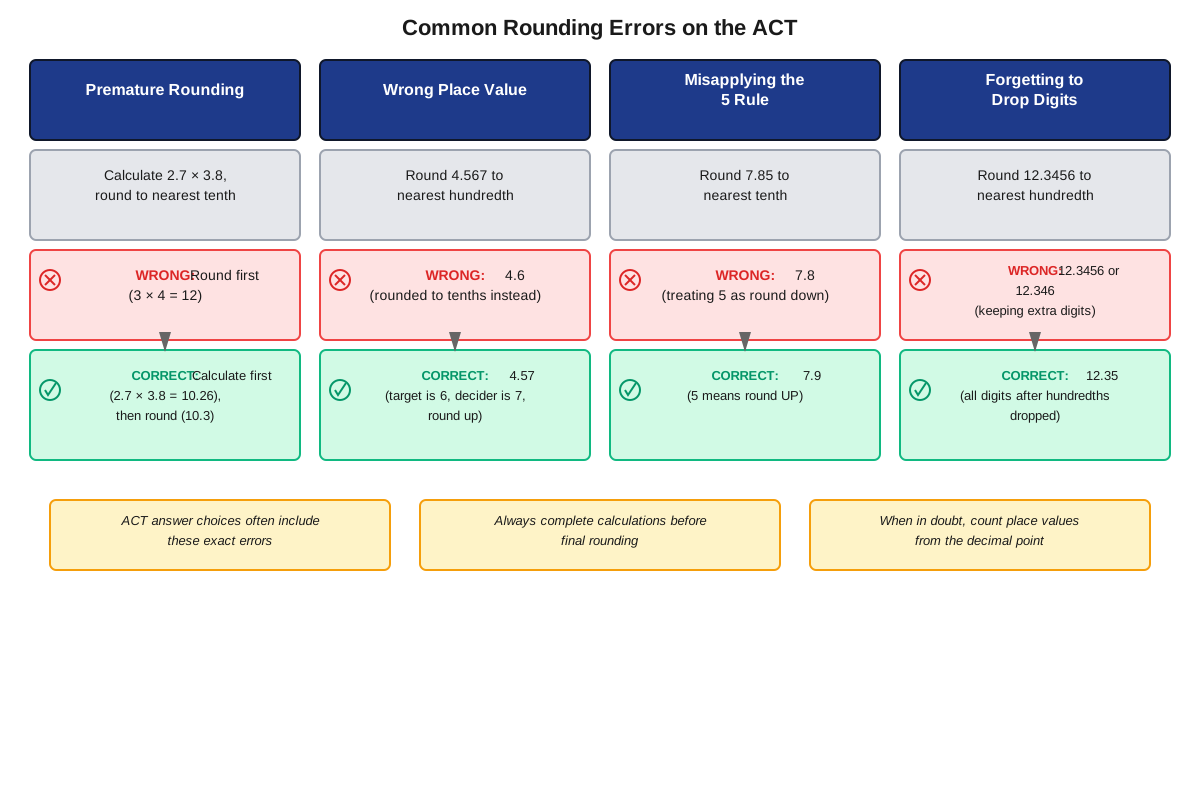
Understanding ACT rounding conventions is critical because the exam often requires students to round final answers to match answer choices, or to use strategic rounding during calculations to save time without sacrificing accuracy. Many students lose points not because they can't solve problems, but because they fail to round correctly at the final step or round prematurely during intermediate calculations, introducing errors that compound throughout the problem. The ACT typically expects standard rounding rules unless otherwise specified, and answer choices are deliberately designed to include common rounding errors as distractors.
This topic connects directly to nearly every area of ACT Math: from basic arithmetic and algebra to geometry, trigonometry, and statistics. Rounding intersects with significant figures in scientific contexts, decimal operations in real-world applications, and estimation techniques that help verify answer reasonableness. Mastering rounding enables students to work more efficiently, check their work quickly, and avoid careless mistakes that distinguish a good score from an excellent one.
Learning Objectives
- [ ] Identify when Rounding is being tested in ACT questions
- [ ] Explain the core rule or strategy behind Rounding
- [ ] Apply Rounding to ACT-style questions accurately
- [ ] Determine the appropriate place value for rounding based on context clues
- [ ] Distinguish between situations requiring rounding versus exact answers
- [ ] Execute strategic rounding to estimate answers and eliminate incorrect choices
- [ ] Recognize and avoid common rounding errors that appear in distractor answer choices
Prerequisites
- Place value understanding: Recognizing the value of digits in decimal positions (ones, tenths, hundredths, etc.) is essential for identifying which digit to examine when rounding
- Basic arithmetic operations: Addition, subtraction, multiplication, and division skills are necessary since rounding often occurs within larger calculations
- Decimal notation: Familiarity with reading and writing decimal numbers ensures accurate interpretation of rounding instructions
- Number comparison: The ability to determine whether a digit is greater than, less than, or equal to 5 drives the fundamental rounding decision
Why This Topic Matters
Rounding appears in approximately 10-15% of ACT Math questions, either as the primary skill being tested or as a necessary step within more complex problems. The ACT frequently incorporates rounding into word problems involving money, measurements, percentages, rates, and statistical calculations. Questions may explicitly state "round to the nearest tenth" or implicitly require rounding when answer choices are presented in rounded form.
In real-world applications, rounding is ubiquitous: calculating tips at restaurants, estimating project costs, reporting scientific measurements with appropriate precision, converting units in construction or cooking, and presenting financial data in business contexts. The skill of knowing when and how to round appropriately demonstrates mathematical maturity and practical numeracy.
On the ACT specifically, rounding appears in several question types: coordinate geometry problems requiring rounded slope calculations, trigonometry questions where calculator outputs need rounding, statistics problems involving mean or standard deviation, and word problems where answers represent real quantities (like money or people) that must be whole numbers. The exam also tests whether students understand that premature rounding can introduce significant errors, while strategic rounding can serve as a powerful estimation tool for eliminating obviously incorrect answer choices.
Core Concepts
The Fundamental Rounding Rule
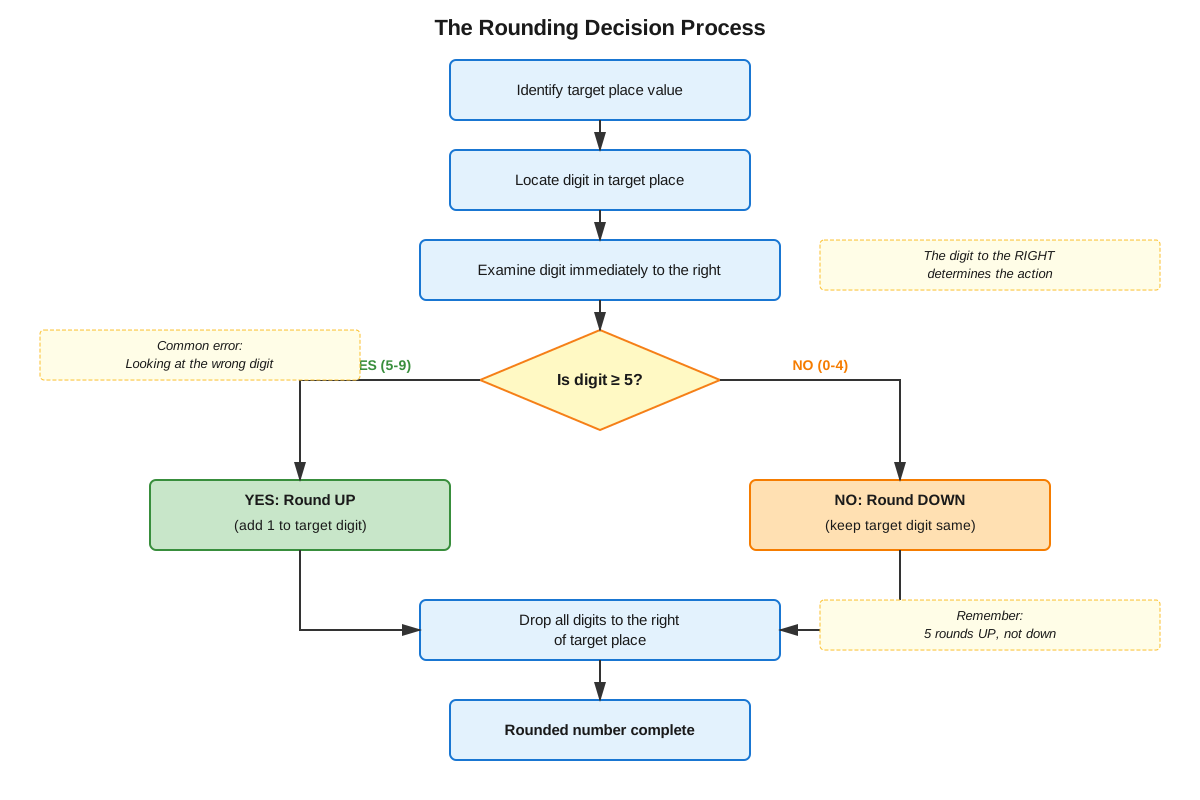
The standard rounding procedure follows a consistent algorithm regardless of the place value involved. To round a number to a specific place value:
- Identify the digit in the target place value (the rounding position)
- Examine the digit immediately to the right (the decision digit)
- If the decision digit is 5 or greater, increase the rounding position digit by 1
- If the decision digit is less than 5, keep the rounding position digit unchanged
- Replace all digits to the right of the rounding position with zeros (for whole numbers) or drop them (for decimals)
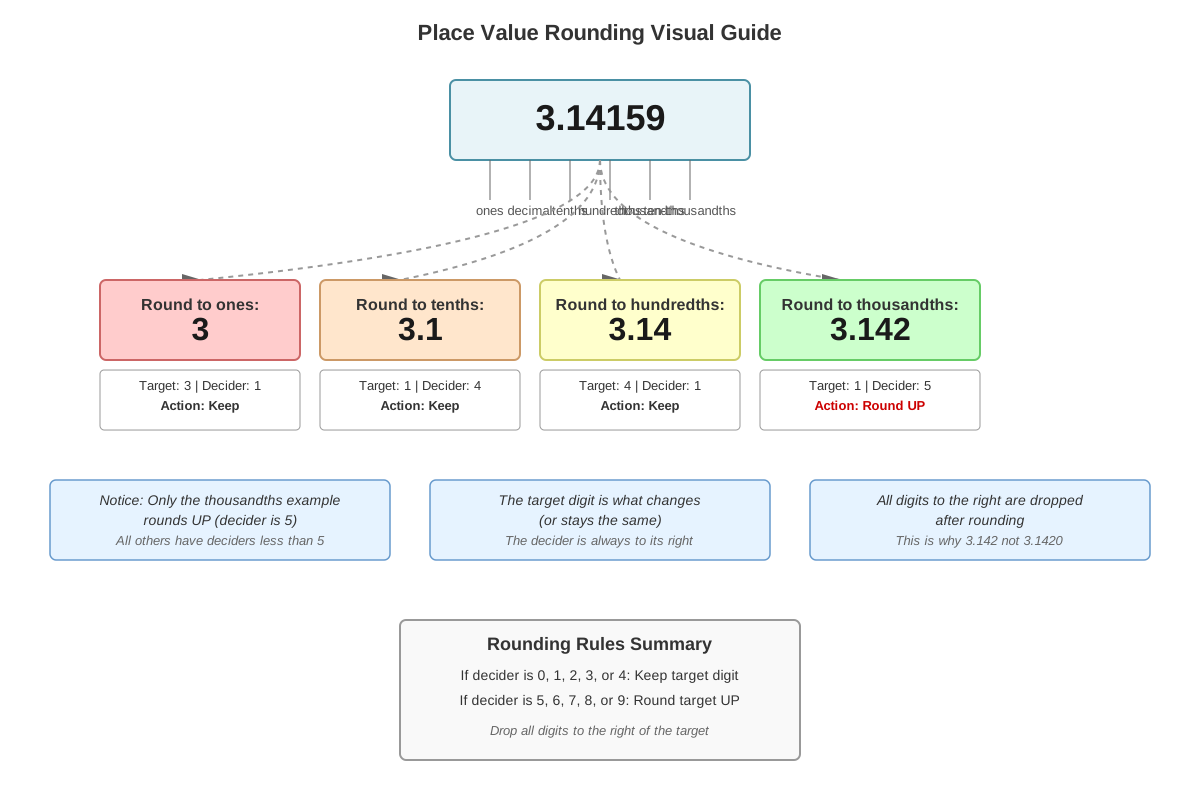
For example, rounding 47.836 to the nearest tenth: the rounding position is 8 (tenths place), the decision digit is 3 (hundredths place). Since 3 < 5, the 8 remains unchanged, yielding 47.8.
Place Value Targets
The ACT tests rounding to various place values, and recognizing the target is crucial:
| Place Value | Example Number | Rounded Result | Notes |
|---|---|---|---|
| Nearest whole number | 23.7 | 24 | Decision digit is 7 (≥5) |
| Nearest tenth | 45.832 | 45.8 | Decision digit is 3 (<5) |
| Nearest hundredth | 0.6749 | 0.67 | Decision digit is 4 (<5) |
| Nearest ten | 347 | 350 | Decision digit is 7 (≥5) |
| Nearest hundred | 1,482 | 1,500 | Decision digit is 8 (≥5) |
The Critical "5" Boundary
When the decision digit is exactly 5, standard mathematical convention rounds up (increases the rounding position digit by 1). This is the rule the ACT follows unless explicitly stated otherwise. For instance, 2.5 rounds to 3, and 7.85 rounds to 7.9 when rounding to the nearest tenth.
Some advanced contexts use "round half to even" (banker's rounding) to reduce bias, but the ACT uses traditional "round half up" rules. Students should not overthink this—when the decision digit is 5, always round up on the ACT.
Cascading Rounds
Occasionally, rounding up causes a cascade effect. When rounding 3.97 to the nearest tenth, the decision digit is 7, so the 9 should increase by 1. However, 9 + 1 = 10, which means the 9 becomes 0 and we carry 1 to the ones place: 3.97 → 4.0. This cascading is particularly important when rounding numbers like 99.95 to the nearest tenth (result: 100.0).
Rounding in Context: Money and Measurements
Real-world contexts often dictate rounding conventions. Money typically rounds to the nearest cent (hundredth of a dollar). When calculating costs, the ACT may present scenarios where rounding up is necessary even if the standard rule would round down—for example, if you need 3.2 gallons of paint, you must purchase 4 gallons since partial gallons aren't sold.
Similarly, problems involving people, vehicles, or other discrete objects require rounding to whole numbers, and context determines whether to round up or down. If a bus holds 45 people and 137 people need transportation, dividing gives 3.04 buses, but you need 4 buses (always round up in this context).
Strategic Estimation Through Rounding
Beyond producing final answers, rounding serves as a powerful estimation tool. When faced with complex calculations, rounding numbers to convenient values before computing can quickly eliminate unreasonable answer choices. For example, if calculating 47.8 × 31.2, rounding to 50 × 30 = 1,500 immediately shows that answer choices near 1,500 are plausible while those near 500 or 5,000 are not.
Precision and Significant Figures
While the ACT doesn't extensively test significant figures as a chemistry exam would, understanding that rounding affects precision is important. A measurement of 5.0 meters (rounded to the nearest tenth) is more precise than 5 meters (rounded to the nearest whole number). When the ACT provides measurements with specific decimal places, this often signals the expected precision of the answer.
Concept Relationships
The rounding concepts form a hierarchical structure: place value understanding serves as the foundation, enabling identification of the rounding position, which then allows application of the fundamental rounding rule. This rule branches into two pathways: producing final answers (where exact rounding is required) and strategic estimation (where approximate rounding accelerates problem-solving).
Rounding connects backward to prerequisite topics: decimal notation provides the framework for understanding place values, while number comparison enables the critical decision of whether the decision digit is ≥5 or <5. Forward connections extend to virtually all ACT Math topics: percentages often require rounding in word problems, statistics calculations (mean, median, standard deviation) frequently need rounding, trigonometry problems using calculators produce long decimals requiring rounding, and coordinate geometry slope calculations may need rounding to match answer choices.
The relationship map flows: Place Value Recognition → Rounding Position Identification → Decision Digit Evaluation → Rounding Rule Application → Context-Appropriate Final Answer. Parallel to this main pathway, Strategic Estimation branches off after Rounding Rule Application, feeding into Answer Choice Elimination and Solution Verification.
Quick check — test yourself on Rounding so far.
Try Flashcards →High-Yield Facts
- ⭐ When the decision digit is 5 or greater, round up; when less than 5, round down
- ⭐ Always identify the place value you're rounding TO before examining the digit to its right
- ⭐ Money problems on the ACT typically require rounding to the nearest cent (hundredth)
- ⭐ Real-world context problems may require rounding up even when the mathematical rule would round down (e.g., number of buses needed)
- ⭐ Premature rounding during multi-step calculations can introduce significant errors; round only at the final step unless estimating
- The ACT uses "round half up" convention: 2.5 rounds to 3, not 2
- When rounding causes a 9 to become 10, carry the 1 to the next place value (cascading)
- Answer choices often include common rounding errors as distractors
- Rounding to the nearest tenth means one decimal place; nearest hundredth means two decimal places
- Strategic rounding before calculation can eliminate 2-3 answer choices quickly
- Calculator displays often show 8-10 decimal places; the ACT expects appropriately rounded answers
- If a problem doesn't specify rounding instructions but answer choices are rounded, match their precision
Common Misconceptions
Misconception: Always round to the nearest whole number unless told otherwise.
Correction: The ACT specifies the required place value either explicitly in the question or implicitly through answer choice formatting. Always check what precision is expected.
Misconception: When the decision digit is 5, you can round either up or down.
Correction: Standard mathematical convention (used on the ACT) always rounds up when the decision digit is exactly 5. This eliminates ambiguity.
Misconception: Rounding 3.95 to the nearest tenth gives 3.9 because you just look at the 5.
Correction: The 5 causes the 9 to round up to 10, which cascades: 3.95 → 4.0. Always account for carrying when rounding up creates a 10.
Misconception: It's more accurate to round after each step in a multi-step calculation.
Correction: Rounding intermediate values compounds errors. Maintain full precision throughout calculations and round only the final answer, unless explicitly instructed otherwise or using strategic estimation.
Misconception: If a problem asks for "approximately" how many, exact rounding rules don't matter.
Correction: "Approximately" signals that estimation is appropriate, but the answer must still be reasonable. Use strategic rounding to calculate, but ensure your final answer is the closest option to the true value.
Misconception: Rounding 2.449 to the nearest tenth gives 2.5 because 4 rounds to 5.
Correction: Only the digit immediately to the right of the rounding position matters. For 2.449 rounded to the nearest tenth, the decision digit is 4 (the first 4), which is less than 5, so the result is 2.4.
Worked Examples
Example 1: Multi-Step Calculation with Final Rounding
Problem: A rectangular garden measures 12.7 feet by 8.3 feet. What is the area of the garden, rounded to the nearest square foot?
Solution:
Step 1: Identify what's being asked. We need area (length × width) rounded to the nearest whole number (nearest square foot).
Step 2: Calculate the exact area without rounding intermediate values:
Area = 12.7 × 8.3 = 105.41 square feet
Step 3: Identify the rounding position and decision digit:
- Rounding to the nearest whole number means the ones place (5) is the rounding position
- The decision digit is in the tenths place: 4
Step 4: Apply the rounding rule:
- Since 4 < 5, the 5 in the ones place stays unchanged
- Result: 105 square feet
Connection to Learning Objectives: This example demonstrates applying rounding to an ACT-style question accurately, determining the appropriate place value from context ("nearest square foot"), and avoiding premature rounding (we didn't round 12.7 or 8.3 before multiplying).
Example 2: Context-Driven Rounding Decision
Problem: A school is organizing a field trip. Each bus can hold 42 students, and 275 students are going on the trip. How many buses are needed?
Solution:
Step 1: Calculate the exact number of buses required:
275 ÷ 42 = 6.547619...
Step 2: Recognize the context constraint. You cannot have 6.547619 buses; buses are discrete whole units.
Step 3: Determine the appropriate rounding direction:
- Mathematical rounding would give 7 (since 5 ≥ 5)
- Context confirms this: 6 buses would only hold 252 students (6 × 42), leaving 23 students without transportation
- You must round UP to 7 buses to accommodate all students
Step 4: Verify the answer:
- 7 buses can hold 294 students (7 × 42), which is sufficient for 275 students
Connection to Learning Objectives: This example illustrates identifying when rounding is being tested (embedded in a word problem), explaining the strategy (context-driven rounding up), and recognizing that real-world constraints sometimes override standard mathematical rounding rules.
Exam Strategy
When approaching ACT questions involving rounding, follow this systematic process:
Step 1: Identify Rounding Requirements
Look for explicit instructions like "round to the nearest tenth" or "approximately how many." If not stated explicitly, examine answer choices—if they're all rounded to the same place value, that's your target precision.
Step 2: Maintain Precision During Calculation
Use your calculator's full precision throughout multi-step problems. Don't round intermediate values unless you're using strategic estimation to eliminate choices. Write down or store full calculator values between steps.
Step 3: Round Only at the End
Apply rounding rules to your final calculated answer, not to intermediate steps. This prevents error accumulation.
Step 4: Watch for Context Clues
Words like "approximately," "about," "nearest," and "estimate" signal rounding. Real-world contexts (money, people, objects) dictate appropriate rounding conventions.
Exam Tip: If answer choices differ by small amounts (like 23.4, 23.5, 23.6, 23.7), the question is testing precise rounding. If they differ significantly (like 20, 25, 30, 35), strategic estimation is appropriate.
Trigger Words and Phrases:
- "Round to the nearest..." (explicit rounding instruction)
- "Approximately" or "about" (estimation acceptable)
- "To the nearest cent" (round to hundredths)
- "How many [discrete objects]" (round to whole numbers)
- "What is the best estimate" (strategic rounding encouraged)
Process of Elimination:
Use strategic rounding to eliminate choices before calculating precisely. If multiplying 47.3 × 8.9, round to 50 × 9 = 450 to eliminate any choices near 200 or 800. Then calculate precisely only among remaining reasonable choices.
Time Allocation:
Don't spend more than 10-15 seconds on the rounding step itself. If you find yourself repeatedly rounding and re-rounding, you've likely misidentified the target place value—reread the question.
Memory Techniques
The "5 or More, Raise the Score" Rhyme: When the decision digit is 5 or more, increase (raise) the rounding position digit. This simple rhyme captures the fundamental rule.
The "Look Right, Decide, Act Left" Process:
- Look Right: Examine the digit to the right of your rounding position
- Decide: Determine if it's ≥5 or <5
- Act Left: Change (or don't change) the rounding position digit accordingly
The Place Value Ladder Visualization: Picture a ladder where each rung represents a place value (ones, tenths, hundredths, etc.). To round, you climb to your target rung, look down one rung to make your decision, then act on your target rung.
The "RICE" Acronym for Rounding Steps:
- Recognize the target place value
- Identify the decision digit
- Compare to 5
- Execute the rounding rule
The Money Mnemonic: "Two cents makes sense" reminds you that money rounds to two decimal places (cents = hundredths).
Summary
Rounding is a high-frequency ACT Math skill that appears both as a standalone concept and embedded within complex problems across all mathematical domains. The fundamental rule—examining the digit immediately right of the rounding position and rounding up if it's 5 or greater, down if less than 5—remains constant, but application varies by context. Students must distinguish between situations requiring precise final rounding versus strategic estimation, recognize when real-world constraints override mathematical conventions, and avoid premature rounding that compounds errors. Success requires identifying target place values from explicit instructions or answer choice formatting, maintaining calculator precision through multi-step calculations, and applying context-appropriate rounding only at the final step. Mastery of rounding not only secures direct points but also enables efficient problem-solving through estimation, answer verification, and rapid elimination of unreasonable choices—skills that improve performance across the entire ACT Math section.
Key Takeaways
- The fundamental rounding rule examines the digit immediately right of the rounding position: ≥5 rounds up, <5 rounds down
- Always identify the target place value before rounding, using explicit instructions or answer choice formatting as guides
- Maintain full calculator precision throughout multi-step problems; round only the final answer unless strategically estimating
- Real-world contexts (money, discrete objects, measurements) may require rounding conventions that differ from pure mathematical rules
- Strategic rounding before calculation serves as a powerful tool for eliminating incorrect answer choices and verifying solution reasonableness
- Watch for cascading rounds when rounding up causes a 9 to become 10, requiring a carry to the next place value
- ACT answer choices deliberately include common rounding errors as distractors; careful application of rounding rules distinguishes correct from incorrect options
Related Topics
Significant Figures and Scientific Notation: Understanding how rounding relates to precision in scientific contexts, particularly when expressing very large or very small numbers in scientific notation on ACT science-integrated math problems.
Estimation and Mental Math: Building on rounding skills to develop rapid estimation techniques that accelerate problem-solving and enable quick reasonableness checks without calculators.
Percent Calculations: Applying rounding appropriately when calculating percentages, percent change, and percent error—common ACT question types where final answers require specific precision.
Statistics and Data Analysis: Using rounding correctly when calculating mean, median, standard deviation, and other statistical measures that frequently appear in ACT data interpretation questions.
Measurement and Unit Conversion: Recognizing how rounding affects precision in measurement contexts and applying appropriate rounding when converting between units (feet to inches, hours to minutes, etc.).
Practice CTA
Now that you've mastered the core concepts, rules, and strategies for rounding on the ACT, it's time to cement your understanding through active practice. Work through the practice questions to apply these techniques to realistic ACT scenarios, and use the flashcards to reinforce the high-yield facts and common misconceptions. Remember: rounding mastery isn't just about getting rounding questions right—it's about working more efficiently and accurately across the entire Math section. Every practice problem is an opportunity to build the automaticity that leads to test-day confidence and top scores!
Sign up free to keep reading
Create a free AnvayaPrep account to finish this ACT guide on Rounding — plus flashcards and practice questions.